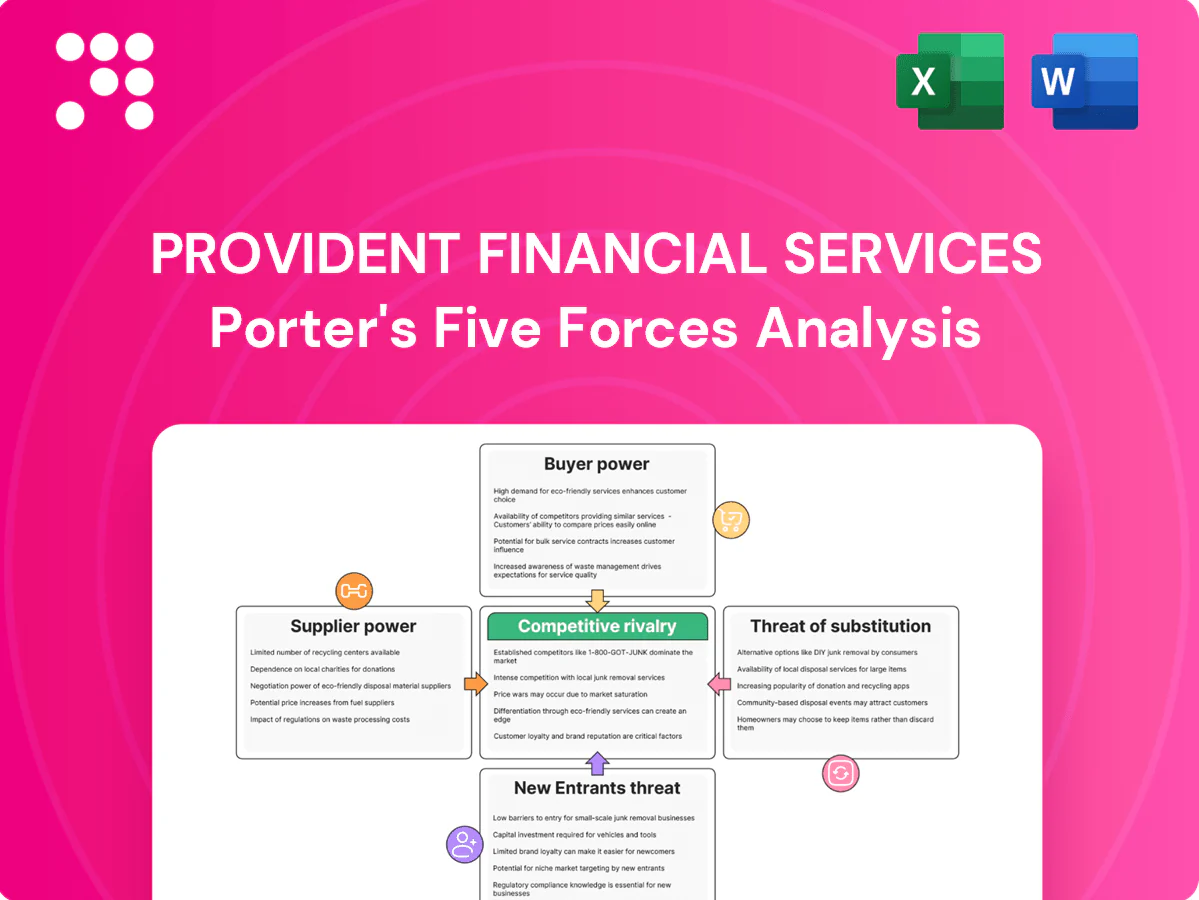
Provident Financial Services Porter's Five Forces Analysis

A Must-Have Tool for Decision-Makers
Provident Financial Services faces moderate buyer power, evolving regulatory pressures, and niche competitive threats that shape its strategic choices and profitability; this snapshot highlights key tensions and opportunities. The full Porter's Five Forces Analysis unlocks force-by-force ratings, visuals, and actionable implications. Purchase the complete report to inform investment or strategic decisions with consultant-grade insights.
Suppliers Bargaining Power

Concentrated tech/vendor ecosystem
Core banking vendors like FIS, Fiserv, Temenos and Jack Henry are few and sticky, raising switching costs; cloud providers remain concentrated (2024 market shares: AWS 31%, Azure 24%, GCP 12%) and Visa plus Mastercard account for roughly 80% of card network volume, limiting Provident’s leverage. Contract terms, integration complexity and migration risks constrain negotiation; multi-vendor strategies help but raise coordination costs and scale discounts favor larger banks.
Wholesale funding and capital markets
When deposit growth lags, Provident’s reliance on FHLB advances, brokered CDs and securitizations increases supplier power; FHLB advances are collateralized and can reprice quickly in a high-rate environment (Fed funds target 5.25–5.50% in 2024). Rate cycles and liquidity stress compress margins, while covenants and collateral haircuts constrain flexibility. Diversifying funding ladders and extending duration mitigate exposure.

Talent and compliance expertise
Specialized credit, risk, compliance and tech talent command 15–25% salary premiums in 2024, raising recruitment and retention costs and squeezing margins; industry turnover ran near 18% in 2024, and 60% of firms offer remote roles, widening talent competition globally. Robust culture and upskilling programs can cut attrition by 20–30% and thus blunt supplier bargaining power.

Data, analytics, and cybersecurity providers
Third-party data bureaus, fraud tools and cyber vendors are mission‑critical and regulated; vendor due diligence and ongoing monitoring raise switching friction for Provident. Rising cyber threats (global cybercrime projected at $10.5 trillion by 2025) increase supplier leverage through necessary add‑ons and cyber insurance. Bundled pricing and strict SLAs can partially rebalance contract terms.
Regulatory and payments infrastructure
Access to Fed payments rails (Fedwire, ACH and FedNow, launched July 2023) and attendant compliance frameworks is non-negotiable, creating quasi-supplier power; regulatory changes can mandate costly systems upgrades and limit product offerings. Noncompliance risks enforcement actions and operational constraints, while proactive governance and risk spend reduce surprise cost shocks.
- Fed rails: essential dependency
- July 2023: FedNow launched
- Reg changes → mandatory upgrades
- Proactive governance cuts shock risk
Concentrated cloud and cards, high Fed funds and talent premiums squeeze margins
Core banking and card networks are concentrated (Visa+Mastercard ~80%), cloud is concentrated (AWS 31%, Azure 24%, GCP 12% in 2024), raising switching costs; funding sensitivity (Fed funds 5.25–5.50% in 2024) and FHLB reliance increase supplier leverage. Talent premiums 15–25% and 18% industry turnover raise costs; cyber risk and Fed rails (FedNow July 2023) add mandatory dependencies.
| Supplier | Metric | 2024 |
|---|---|---|
| Cloud | Market share | AWS 31%, Azure 24%, GCP 12% |
| Card networks | Share | ~80% |
| Funding | Fed funds | 5.25–5.50% |
| Talent | Salary premium | 15–25% |
What is included in the product
 Detailed Word Document
Comprehensive Porter's Five Forces analysis for Provident Financial Services, highlighting competitive rivalry, buyer/supplier power, entry barriers, substitutes, and emerging threats to profitability.

 Customizable Excel Spreadsheet
A one-sheet Porter's Five Forces for Provident Financial Services that distills competitive pressure into a customizable spider chart for instant strategic clarity. Drag-and-drop your data, tweak scenario tabs (pre/post regulation) and paste straight into decks—no macros, no finance jargon, just boardroom-ready insight.
Customers Bargaining Power

High rate sensitivity of deposits
Consumers and businesses rapidly shift deposits via digital channels chasing yields; with the federal funds target at 5.25–5.50% in 2024, rate-sensitive depositors intensify price shopping and churn. Banks counter with promotional CDs and higher money-market tiers—raising marginal funding costs—while loyalty programs and bundled services partially blunt elasticity and reduce attrition.
Low switching costs in digital era
Low switching costs mean account opening, ACH access and card-updater tools let customers move quickly to competitors, and ACH volume—36.6 billion payments worth $78.6 trillion in 2023 (NACHA)—underscores digital rails that ease exits. Fintech aggregators and APIs accelerate product discovery and onboarding, boosting customer leverage on pricing and features. Friction-reducing retention tactics are therefore essential to defend margins and share.

Commercial clients negotiate hard
Commercial middle-market and CRE clients ran competitive lender RFPs in 2024, forcing holistic negotiation of relationship pricing, covenants and cross-sell bundles. Larger ticket sizes materially increase borrower bargaining power, while Provident can offset rate pressure via faster time-to-close and industry-specific execution.

Service quality and convenience demands
Customers now demand seamless omni-channel journeys and near-instant credit decisions; 2024 surveys report a majority of retail borrowers abandon slow pre-approvals, making outages an immediate switching trigger. Transparent fees and responsive support raise bargaining leverage, while ongoing UX investment reduces price-only competition and lowers attrition risk.
- Omni-channel expectation: majority in 2024 surveys
- Immediate switching on outages
- Transparent fees increase leverage
- Continuous UX cuts price-driven churn
Deposit concentration considerations
Large depositor relationships increase funding risk and give clients leverage, often forcing price concessions and bespoke terms to retain balances; uninsured balances above the FDIC limit of 250,000 remain particularly vulnerable. Monitoring uninsured concentrations and single-depositor concentration thresholds is critical to liquidity and repricing risk.
- FDIC insurance limit: 250,000
- Price concessions common to retain large balances
- Monitor uninsured and single-depositor concentrations
- Diversify depositor base to dilute client bargaining power
Depositors hunt yields as Fed at 5.25–5.50%; ACH and uninsured balances raise churn
Consumers shift deposits via digital channels chasing yields; with the fed funds target 5.25–5.50% in 2024, depositors intensify price shopping and churn. Low switching costs and 36.6 billion ACH payments in 2023 ($78.6T) amplify customer leverage and fintech-driven onboarding. Large uninsured balances above the FDIC limit 250,000 force price concessions.
| Metric | Value |
|---|---|
| Fed funds (2024) | 5.25–5.50% |
| ACH (2023) | 36.6B payments; $78.6T |
| FDIC limit | 250,000 |
Same Document Delivered
Provident Financial Services Porter's Five Forces Analysis
This Provident Financial Services Porter’s Five Forces analysis is the full, professionally prepared assessment of industry rivalry, buyer and supplier power, threat of substitutes, and barriers to entry. This preview is the exact document you’ll receive upon purchase—fully formatted and ready to download. No placeholders, no mockups—just the complete deliverable.

A Must-Have Tool for Decision-Makers
Provident Financial Services faces moderate buyer power, evolving regulatory pressures, and niche competitive threats that shape its strategic choices and profitability; this snapshot highlights key tensions and opportunities. The full Porter's Five Forces Analysis unlocks force-by-force ratings, visuals, and actionable implications. Purchase the complete report to inform investment or strategic decisions with consultant-grade insights.
Suppliers Bargaining Power
Concentrated tech/vendor ecosystem
Core banking vendors like FIS, Fiserv, Temenos and Jack Henry are few and sticky, raising switching costs; cloud providers remain concentrated (2024 market shares: AWS 31%, Azure 24%, GCP 12%) and Visa plus Mastercard account for roughly 80% of card network volume, limiting Provident’s leverage. Contract terms, integration complexity and migration risks constrain negotiation; multi-vendor strategies help but raise coordination costs and scale discounts favor larger banks.
Wholesale funding and capital markets
When deposit growth lags, Provident’s reliance on FHLB advances, brokered CDs and securitizations increases supplier power; FHLB advances are collateralized and can reprice quickly in a high-rate environment (Fed funds target 5.25–5.50% in 2024). Rate cycles and liquidity stress compress margins, while covenants and collateral haircuts constrain flexibility. Diversifying funding ladders and extending duration mitigate exposure.
Talent and compliance expertise
Specialized credit, risk, compliance and tech talent command 15–25% salary premiums in 2024, raising recruitment and retention costs and squeezing margins; industry turnover ran near 18% in 2024, and 60% of firms offer remote roles, widening talent competition globally. Robust culture and upskilling programs can cut attrition by 20–30% and thus blunt supplier bargaining power.
Data, analytics, and cybersecurity providers
Third-party data bureaus, fraud tools and cyber vendors are mission‑critical and regulated; vendor due diligence and ongoing monitoring raise switching friction for Provident. Rising cyber threats (global cybercrime projected at $10.5 trillion by 2025) increase supplier leverage through necessary add‑ons and cyber insurance. Bundled pricing and strict SLAs can partially rebalance contract terms.
Regulatory and payments infrastructure
Access to Fed payments rails (Fedwire, ACH and FedNow, launched July 2023) and attendant compliance frameworks is non-negotiable, creating quasi-supplier power; regulatory changes can mandate costly systems upgrades and limit product offerings. Noncompliance risks enforcement actions and operational constraints, while proactive governance and risk spend reduce surprise cost shocks.
- Fed rails: essential dependency
- July 2023: FedNow launched
- Reg changes → mandatory upgrades
- Proactive governance cuts shock risk
Concentrated cloud and cards, high Fed funds and talent premiums squeeze margins
Core banking and card networks are concentrated (Visa+Mastercard ~80%), cloud is concentrated (AWS 31%, Azure 24%, GCP 12% in 2024), raising switching costs; funding sensitivity (Fed funds 5.25–5.50% in 2024) and FHLB reliance increase supplier leverage. Talent premiums 15–25% and 18% industry turnover raise costs; cyber risk and Fed rails (FedNow July 2023) add mandatory dependencies.
| Supplier | Metric | 2024 |
|---|---|---|
| Cloud | Market share | AWS 31%, Azure 24%, GCP 12% |
| Card networks | Share | ~80% |
| Funding | Fed funds | 5.25–5.50% |
| Talent | Salary premium | 15–25% |
What is included in the product
Detailed Word Document
Comprehensive Porter's Five Forces analysis for Provident Financial Services, highlighting competitive rivalry, buyer/supplier power, entry barriers, substitutes, and emerging threats to profitability.
Customizable Excel Spreadsheet
A one-sheet Porter's Five Forces for Provident Financial Services that distills competitive pressure into a customizable spider chart for instant strategic clarity. Drag-and-drop your data, tweak scenario tabs (pre/post regulation) and paste straight into decks—no macros, no finance jargon, just boardroom-ready insight.
Customers Bargaining Power
High rate sensitivity of deposits
Consumers and businesses rapidly shift deposits via digital channels chasing yields; with the federal funds target at 5.25–5.50% in 2024, rate-sensitive depositors intensify price shopping and churn. Banks counter with promotional CDs and higher money-market tiers—raising marginal funding costs—while loyalty programs and bundled services partially blunt elasticity and reduce attrition.
Low switching costs in digital era
Low switching costs mean account opening, ACH access and card-updater tools let customers move quickly to competitors, and ACH volume—36.6 billion payments worth $78.6 trillion in 2023 (NACHA)—underscores digital rails that ease exits. Fintech aggregators and APIs accelerate product discovery and onboarding, boosting customer leverage on pricing and features. Friction-reducing retention tactics are therefore essential to defend margins and share.
Commercial clients negotiate hard
Commercial middle-market and CRE clients ran competitive lender RFPs in 2024, forcing holistic negotiation of relationship pricing, covenants and cross-sell bundles. Larger ticket sizes materially increase borrower bargaining power, while Provident can offset rate pressure via faster time-to-close and industry-specific execution.
Service quality and convenience demands
Customers now demand seamless omni-channel journeys and near-instant credit decisions; 2024 surveys report a majority of retail borrowers abandon slow pre-approvals, making outages an immediate switching trigger. Transparent fees and responsive support raise bargaining leverage, while ongoing UX investment reduces price-only competition and lowers attrition risk.
- Omni-channel expectation: majority in 2024 surveys
- Immediate switching on outages
- Transparent fees increase leverage
- Continuous UX cuts price-driven churn
Deposit concentration considerations
Large depositor relationships increase funding risk and give clients leverage, often forcing price concessions and bespoke terms to retain balances; uninsured balances above the FDIC limit of 250,000 remain particularly vulnerable. Monitoring uninsured concentrations and single-depositor concentration thresholds is critical to liquidity and repricing risk.
- FDIC insurance limit: 250,000
- Price concessions common to retain large balances
- Monitor uninsured and single-depositor concentrations
- Diversify depositor base to dilute client bargaining power
Depositors hunt yields as Fed at 5.25–5.50%; ACH and uninsured balances raise churn
Consumers shift deposits via digital channels chasing yields; with the fed funds target 5.25–5.50% in 2024, depositors intensify price shopping and churn. Low switching costs and 36.6 billion ACH payments in 2023 ($78.6T) amplify customer leverage and fintech-driven onboarding. Large uninsured balances above the FDIC limit 250,000 force price concessions.
| Metric | Value |
|---|---|
| Fed funds (2024) | 5.25–5.50% |
| ACH (2023) | 36.6B payments; $78.6T |
| FDIC limit | 250,000 |
Same Document Delivered
Provident Financial Services Porter's Five Forces Analysis
This Provident Financial Services Porter’s Five Forces analysis is the full, professionally prepared assessment of industry rivalry, buyer and supplier power, threat of substitutes, and barriers to entry. This preview is the exact document you’ll receive upon purchase—fully formatted and ready to download. No placeholders, no mockups—just the complete deliverable.
Original: $10.00
-65%$10.00
$3.50Description
A Must-Have Tool for Decision-Makers
Provident Financial Services faces moderate buyer power, evolving regulatory pressures, and niche competitive threats that shape its strategic choices and profitability; this snapshot highlights key tensions and opportunities. The full Porter's Five Forces Analysis unlocks force-by-force ratings, visuals, and actionable implications. Purchase the complete report to inform investment or strategic decisions with consultant-grade insights.
Suppliers Bargaining Power
Concentrated tech/vendor ecosystem
Core banking vendors like FIS, Fiserv, Temenos and Jack Henry are few and sticky, raising switching costs; cloud providers remain concentrated (2024 market shares: AWS 31%, Azure 24%, GCP 12%) and Visa plus Mastercard account for roughly 80% of card network volume, limiting Provident’s leverage. Contract terms, integration complexity and migration risks constrain negotiation; multi-vendor strategies help but raise coordination costs and scale discounts favor larger banks.
Wholesale funding and capital markets
When deposit growth lags, Provident’s reliance on FHLB advances, brokered CDs and securitizations increases supplier power; FHLB advances are collateralized and can reprice quickly in a high-rate environment (Fed funds target 5.25–5.50% in 2024). Rate cycles and liquidity stress compress margins, while covenants and collateral haircuts constrain flexibility. Diversifying funding ladders and extending duration mitigate exposure.
Talent and compliance expertise
Specialized credit, risk, compliance and tech talent command 15–25% salary premiums in 2024, raising recruitment and retention costs and squeezing margins; industry turnover ran near 18% in 2024, and 60% of firms offer remote roles, widening talent competition globally. Robust culture and upskilling programs can cut attrition by 20–30% and thus blunt supplier bargaining power.
Data, analytics, and cybersecurity providers
Third-party data bureaus, fraud tools and cyber vendors are mission‑critical and regulated; vendor due diligence and ongoing monitoring raise switching friction for Provident. Rising cyber threats (global cybercrime projected at $10.5 trillion by 2025) increase supplier leverage through necessary add‑ons and cyber insurance. Bundled pricing and strict SLAs can partially rebalance contract terms.
Regulatory and payments infrastructure
Access to Fed payments rails (Fedwire, ACH and FedNow, launched July 2023) and attendant compliance frameworks is non-negotiable, creating quasi-supplier power; regulatory changes can mandate costly systems upgrades and limit product offerings. Noncompliance risks enforcement actions and operational constraints, while proactive governance and risk spend reduce surprise cost shocks.
- Fed rails: essential dependency
- July 2023: FedNow launched
- Reg changes → mandatory upgrades
- Proactive governance cuts shock risk
Concentrated cloud and cards, high Fed funds and talent premiums squeeze margins
Core banking and card networks are concentrated (Visa+Mastercard ~80%), cloud is concentrated (AWS 31%, Azure 24%, GCP 12% in 2024), raising switching costs; funding sensitivity (Fed funds 5.25–5.50% in 2024) and FHLB reliance increase supplier leverage. Talent premiums 15–25% and 18% industry turnover raise costs; cyber risk and Fed rails (FedNow July 2023) add mandatory dependencies.
| Supplier | Metric | 2024 |
|---|---|---|
| Cloud | Market share | AWS 31%, Azure 24%, GCP 12% |
| Card networks | Share | ~80% |
| Funding | Fed funds | 5.25–5.50% |
| Talent | Salary premium | 15–25% |
What is included in the product
Detailed Word Document
Comprehensive Porter's Five Forces analysis for Provident Financial Services, highlighting competitive rivalry, buyer/supplier power, entry barriers, substitutes, and emerging threats to profitability.
Customizable Excel Spreadsheet
A one-sheet Porter's Five Forces for Provident Financial Services that distills competitive pressure into a customizable spider chart for instant strategic clarity. Drag-and-drop your data, tweak scenario tabs (pre/post regulation) and paste straight into decks—no macros, no finance jargon, just boardroom-ready insight.
Customers Bargaining Power
High rate sensitivity of deposits
Consumers and businesses rapidly shift deposits via digital channels chasing yields; with the federal funds target at 5.25–5.50% in 2024, rate-sensitive depositors intensify price shopping and churn. Banks counter with promotional CDs and higher money-market tiers—raising marginal funding costs—while loyalty programs and bundled services partially blunt elasticity and reduce attrition.
Low switching costs in digital era
Low switching costs mean account opening, ACH access and card-updater tools let customers move quickly to competitors, and ACH volume—36.6 billion payments worth $78.6 trillion in 2023 (NACHA)—underscores digital rails that ease exits. Fintech aggregators and APIs accelerate product discovery and onboarding, boosting customer leverage on pricing and features. Friction-reducing retention tactics are therefore essential to defend margins and share.
Commercial clients negotiate hard
Commercial middle-market and CRE clients ran competitive lender RFPs in 2024, forcing holistic negotiation of relationship pricing, covenants and cross-sell bundles. Larger ticket sizes materially increase borrower bargaining power, while Provident can offset rate pressure via faster time-to-close and industry-specific execution.
Service quality and convenience demands
Customers now demand seamless omni-channel journeys and near-instant credit decisions; 2024 surveys report a majority of retail borrowers abandon slow pre-approvals, making outages an immediate switching trigger. Transparent fees and responsive support raise bargaining leverage, while ongoing UX investment reduces price-only competition and lowers attrition risk.
- Omni-channel expectation: majority in 2024 surveys
- Immediate switching on outages
- Transparent fees increase leverage
- Continuous UX cuts price-driven churn
Deposit concentration considerations
Large depositor relationships increase funding risk and give clients leverage, often forcing price concessions and bespoke terms to retain balances; uninsured balances above the FDIC limit of 250,000 remain particularly vulnerable. Monitoring uninsured concentrations and single-depositor concentration thresholds is critical to liquidity and repricing risk.
- FDIC insurance limit: 250,000
- Price concessions common to retain large balances
- Monitor uninsured and single-depositor concentrations
- Diversify depositor base to dilute client bargaining power
Depositors hunt yields as Fed at 5.25–5.50%; ACH and uninsured balances raise churn
Consumers shift deposits via digital channels chasing yields; with the fed funds target 5.25–5.50% in 2024, depositors intensify price shopping and churn. Low switching costs and 36.6 billion ACH payments in 2023 ($78.6T) amplify customer leverage and fintech-driven onboarding. Large uninsured balances above the FDIC limit 250,000 force price concessions.
| Metric | Value |
|---|---|
| Fed funds (2024) | 5.25–5.50% |
| ACH (2023) | 36.6B payments; $78.6T |
| FDIC limit | 250,000 |
Same Document Delivered
Provident Financial Services Porter's Five Forces Analysis
This Provident Financial Services Porter’s Five Forces analysis is the full, professionally prepared assessment of industry rivalry, buyer and supplier power, threat of substitutes, and barriers to entry. This preview is the exact document you’ll receive upon purchase—fully formatted and ready to download. No placeholders, no mockups—just the complete deliverable.











