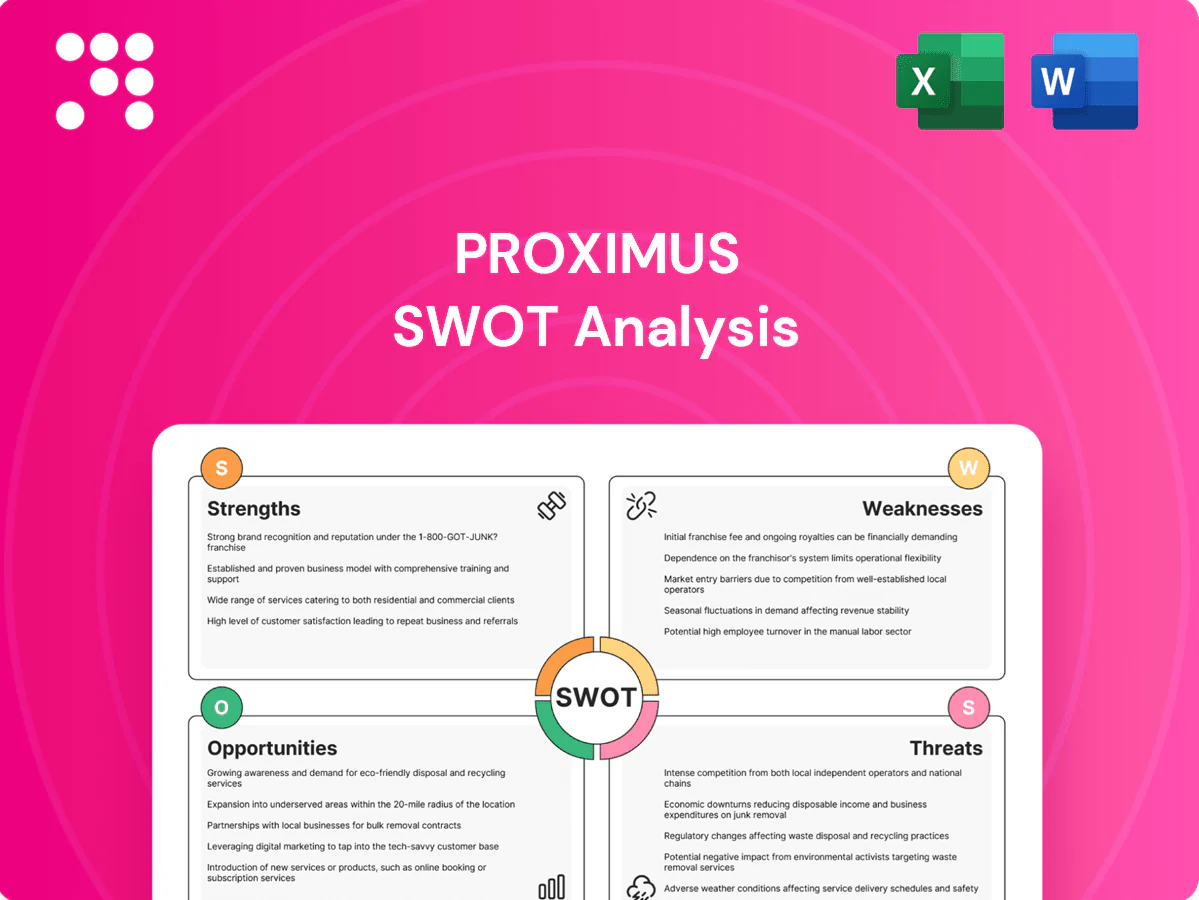
Proximus SWOT Analysis

Elevate Your Analysis with the Complete SWOT Report
Proximus shows resilient domestic market share and a strong fiber rollout but faces regulatory pressure and intense competition; opportunities in 5G and enterprise services could drive growth. Want the full story behind strengths, risks, and strategic moves? Purchase the complete SWOT analysis for an editable, investor-ready report with Word and Excel deliverables to plan and pitch with confidence.
Strengths

Incumbent market leadership
Proximus holds a leading share across Belgium in fixed, mobile and ICT, with more than 10.5 million customer relationships, providing scale and strong brand trust. Its established base drives resilient recurring revenues and helped deliver group revenue of about €4.8bn in 2024. Market leadership strengthens negotiating power with vendors and partners. It also enables an efficient go-to-market for new B2B solutions.
Converged fixed–mobile networks
Owning nationwide fixed and mobile infrastructure lets Proximus bundle services for higher service quality and cross-sell to businesses, leveraging a Belgian market of about 11.6 million people. Convergence lowers churn and boosts multi-product ARPA in corporate accounts. Full network control supports strict SLAs required by enterprise and public-sector clients. It also enables faster deployment of fiber and 5G features across the country.

Broad ICT and cloud portfolio
Proximus offers end-to-end connectivity, cloud, data center, security and managed services, positioning it as a one-stop ICT partner that increases wallet share and simplifies vendor management for clients. Higher-value ICT and cloud services typically deliver stronger gross margins than pure connectivity, improving overall profitability. The integrated portfolio creates clear cross-sell paths from legacy telecom customers into digital solutions, boosting lifetime value.

Public sector and critical workloads
Proximus strong footprint in Belgian government and public services secures long-term, sticky contracts and recurring revenue; the group reported consolidated revenue of EUR 5.9 billion in 2024. Hosting mission-critical workloads for public institutions raises switching costs and embeds services in national infrastructure. Proven capabilities in sovereignty, compliance and security differentiate Proximus versus smaller rivals and help win regulated-industry enterprise deals.
- Long-term government frameworks → stable revenue
- Mission-critical workloads → high switching costs
- Sovereignty & security credibility → wins regulated deals
International subsidiaries and partnerships
Selective international subsidiaries (Telindus, managed services across Benelux) and partnerships extend Proximus capability beyond Belgium, supporting cross-border enterprise contracts and knowledge transfer; group revenue reached about €5.7bn in 2024, enabling sustained investment. Hyperscaler, IoT and cybersecurity alliances (notably Microsoft and major security vendors) broaden solutions without duplicating assets, speeding innovation and diversifying revenue.
- International reach: Benelux managed services
- 2024 revenue: ~€5.7bn
- Partnerships: hyperscalers + cybersecurity vendors
- Benefits: deeper solutions, faster innovation, revenue diversification
Belgium telecom leader - nationwide fixed, mobile and ICT; 10.5M customers
Market leader in Belgian fixed, mobile and ICT with >10.5 million customer relationships, delivering resilient recurring revenue and strong vendor leverage. Nationwide infrastructure enables bundled services, higher ARPA and strict SLAs for enterprises and public sector. End-to-end ICT, cloud and security portfolio plus hyperscaler partnerships lift margins and cross-sell potential.
| Metric | Value |
|---|---|
| Customer relationships | 10.5M |
| Belgian population | 11.6M |
| 2024 consolidated revenue | €5.9bn |
What is included in the product
 Detailed Word Document
Provides a concise SWOT analysis of Proximus, outlining its core strengths and weaknesses and the market opportunities and threats shaping future growth and competitive position.

 Customizable Excel Spreadsheet
Provides a focused Proximus SWOT matrix that clarifies competitive strengths, regulatory risks and network investment priorities for rapid strategy alignment and concise stakeholder updates.
Weaknesses

High capex and legacy burden
Continual investment in fiber, 5G and data centers—capex at about €1.07bn in 2023 and guided near €1.1bn in 2024—continues to strain Proximus free cash flow. Persistent legacy copper and older IT stacks increase operating complexity and maintenance costs. Long migration timelines from legacy systems delay expected efficiency gains and slow rollout of new digital services, constraining revenue upside.
Limited geographic diversification
Proximus derives roughly 90% of revenues from Belgium, leaving it highly exposed to local competition and regulatory changes; FY2024 revenue was about EUR 4.9 billion. Economic or policy shifts in Belgium therefore have outsized impact on top-line and margins. Limited pan-European scale versus peers such as Deutsche Telekom and Orange constrains pricing power and procurement leverage.

Price-sensitive SMB segment
Belgian SMBs account for about 99% of enterprises (Eurostat) and display high price elasticity and multi-sourcing behavior. Aggressive rival promotions compress ARPU and margins for Proximus, especially outside premium managed services where differentiation is harder. Churn risk spikes at contract expiry as SMBs switch to lower‑cost suppliers.

Integration complexity in ICT
Combining acquired capabilities and partner solutions increases delivery complexity for Proximus, creating longer lead times and higher integration costs. Heterogeneous toolsets can degrade service quality and compress telecom margins. Skills shortages in cloud and cybersecurity — ISC2 estimates a 3.4 million global shortfall in 2024 — raise execution risk. Governance overhead further slows time-to-market.
- integration complexity: delivery delays
- heterogeneous tools: quality & margin pressure
- skills gap: 3.4M cybersecurity shortfall (ISC2 2024)
- governance: slower time-to-market
Unionized workforce and cost rigidity
Structured labor agreements constrain rapid cost adjustment, and transformation programs at Proximus face longer negotiation cycles that can delay planned efficiency initiatives.
These delays increase fixed cost intensity versus leaner competitors; Proximus employs about 11,000 staff (2024), making personnel costs a material portion of operating expenses.
Multi-year negotiation timelines have slowed rollout of savings measures and added uncertainty to near-term margin improvement.
- Longer negotiation cycles — slows program roll-out
- Higher fixed personnel cost — ~11,000 employees (2024)
- Competitive disadvantage vs lean operators
High capex and Belgian revenue concentration slow transformation — €1.1bn
High capex (~€1.07bn in 2023; guided ~€1.1bn in 2024) and legacy copper/IT lift operating costs and delay efficiency gains. ~90% revenue exposure to Belgium (FY2024 revenue ~€4.9bn) limits scale and raises regulatory risk. Skills gaps (ISC2 3.4M cybersecurity shortfall 2024) and ~11,000 employees (2024) increase fixed costs and slow transformation.
| Metric | Value |
|---|---|
| CapEx 2023 | €1.07bn |
| CapEx guide 2024 | ~€1.1bn |
| FY2024 Revenue | €4.9bn |
| Revenue Belgium | ~90% |
| Employees 2024 | ~11,000 |
| Cybersecurity gap | 3.4M (ISC2 2024) |
Preview Before You Purchase
Proximus SWOT Analysis
This is the actual Proximus SWOT analysis document you’ll receive upon purchase—no surprises, just professional quality. The preview below is taken directly from the full report and reflects the same structured, editable content. Buy now to unlock the complete, detailed version.

Elevate Your Analysis with the Complete SWOT Report
Proximus shows resilient domestic market share and a strong fiber rollout but faces regulatory pressure and intense competition; opportunities in 5G and enterprise services could drive growth. Want the full story behind strengths, risks, and strategic moves? Purchase the complete SWOT analysis for an editable, investor-ready report with Word and Excel deliverables to plan and pitch with confidence.
Strengths
Incumbent market leadership
Proximus holds a leading share across Belgium in fixed, mobile and ICT, with more than 10.5 million customer relationships, providing scale and strong brand trust. Its established base drives resilient recurring revenues and helped deliver group revenue of about €4.8bn in 2024. Market leadership strengthens negotiating power with vendors and partners. It also enables an efficient go-to-market for new B2B solutions.
Converged fixed–mobile networks
Owning nationwide fixed and mobile infrastructure lets Proximus bundle services for higher service quality and cross-sell to businesses, leveraging a Belgian market of about 11.6 million people. Convergence lowers churn and boosts multi-product ARPA in corporate accounts. Full network control supports strict SLAs required by enterprise and public-sector clients. It also enables faster deployment of fiber and 5G features across the country.
Broad ICT and cloud portfolio
Proximus offers end-to-end connectivity, cloud, data center, security and managed services, positioning it as a one-stop ICT partner that increases wallet share and simplifies vendor management for clients. Higher-value ICT and cloud services typically deliver stronger gross margins than pure connectivity, improving overall profitability. The integrated portfolio creates clear cross-sell paths from legacy telecom customers into digital solutions, boosting lifetime value.
Public sector and critical workloads
Proximus strong footprint in Belgian government and public services secures long-term, sticky contracts and recurring revenue; the group reported consolidated revenue of EUR 5.9 billion in 2024. Hosting mission-critical workloads for public institutions raises switching costs and embeds services in national infrastructure. Proven capabilities in sovereignty, compliance and security differentiate Proximus versus smaller rivals and help win regulated-industry enterprise deals.
- Long-term government frameworks → stable revenue
- Mission-critical workloads → high switching costs
- Sovereignty & security credibility → wins regulated deals
International subsidiaries and partnerships
Selective international subsidiaries (Telindus, managed services across Benelux) and partnerships extend Proximus capability beyond Belgium, supporting cross-border enterprise contracts and knowledge transfer; group revenue reached about €5.7bn in 2024, enabling sustained investment. Hyperscaler, IoT and cybersecurity alliances (notably Microsoft and major security vendors) broaden solutions without duplicating assets, speeding innovation and diversifying revenue.
- International reach: Benelux managed services
- 2024 revenue: ~€5.7bn
- Partnerships: hyperscalers + cybersecurity vendors
- Benefits: deeper solutions, faster innovation, revenue diversification
Belgium telecom leader - nationwide fixed, mobile and ICT; 10.5M customers
Market leader in Belgian fixed, mobile and ICT with >10.5 million customer relationships, delivering resilient recurring revenue and strong vendor leverage. Nationwide infrastructure enables bundled services, higher ARPA and strict SLAs for enterprises and public sector. End-to-end ICT, cloud and security portfolio plus hyperscaler partnerships lift margins and cross-sell potential.
| Metric | Value |
|---|---|
| Customer relationships | 10.5M |
| Belgian population | 11.6M |
| 2024 consolidated revenue | €5.9bn |
What is included in the product
Detailed Word Document
Provides a concise SWOT analysis of Proximus, outlining its core strengths and weaknesses and the market opportunities and threats shaping future growth and competitive position.
Customizable Excel Spreadsheet
Provides a focused Proximus SWOT matrix that clarifies competitive strengths, regulatory risks and network investment priorities for rapid strategy alignment and concise stakeholder updates.
Weaknesses
High capex and legacy burden
Continual investment in fiber, 5G and data centers—capex at about €1.07bn in 2023 and guided near €1.1bn in 2024—continues to strain Proximus free cash flow. Persistent legacy copper and older IT stacks increase operating complexity and maintenance costs. Long migration timelines from legacy systems delay expected efficiency gains and slow rollout of new digital services, constraining revenue upside.
Limited geographic diversification
Proximus derives roughly 90% of revenues from Belgium, leaving it highly exposed to local competition and regulatory changes; FY2024 revenue was about EUR 4.9 billion. Economic or policy shifts in Belgium therefore have outsized impact on top-line and margins. Limited pan-European scale versus peers such as Deutsche Telekom and Orange constrains pricing power and procurement leverage.
Price-sensitive SMB segment
Belgian SMBs account for about 99% of enterprises (Eurostat) and display high price elasticity and multi-sourcing behavior. Aggressive rival promotions compress ARPU and margins for Proximus, especially outside premium managed services where differentiation is harder. Churn risk spikes at contract expiry as SMBs switch to lower‑cost suppliers.
Integration complexity in ICT
Combining acquired capabilities and partner solutions increases delivery complexity for Proximus, creating longer lead times and higher integration costs. Heterogeneous toolsets can degrade service quality and compress telecom margins. Skills shortages in cloud and cybersecurity — ISC2 estimates a 3.4 million global shortfall in 2024 — raise execution risk. Governance overhead further slows time-to-market.
- integration complexity: delivery delays
- heterogeneous tools: quality & margin pressure
- skills gap: 3.4M cybersecurity shortfall (ISC2 2024)
- governance: slower time-to-market
Unionized workforce and cost rigidity
Structured labor agreements constrain rapid cost adjustment, and transformation programs at Proximus face longer negotiation cycles that can delay planned efficiency initiatives.
These delays increase fixed cost intensity versus leaner competitors; Proximus employs about 11,000 staff (2024), making personnel costs a material portion of operating expenses.
Multi-year negotiation timelines have slowed rollout of savings measures and added uncertainty to near-term margin improvement.
- Longer negotiation cycles — slows program roll-out
- Higher fixed personnel cost — ~11,000 employees (2024)
- Competitive disadvantage vs lean operators
High capex and Belgian revenue concentration slow transformation — €1.1bn
High capex (~€1.07bn in 2023; guided ~€1.1bn in 2024) and legacy copper/IT lift operating costs and delay efficiency gains. ~90% revenue exposure to Belgium (FY2024 revenue ~€4.9bn) limits scale and raises regulatory risk. Skills gaps (ISC2 3.4M cybersecurity shortfall 2024) and ~11,000 employees (2024) increase fixed costs and slow transformation.
| Metric | Value |
|---|---|
| CapEx 2023 | €1.07bn |
| CapEx guide 2024 | ~€1.1bn |
| FY2024 Revenue | €4.9bn |
| Revenue Belgium | ~90% |
| Employees 2024 | ~11,000 |
| Cybersecurity gap | 3.4M (ISC2 2024) |
Preview Before You Purchase
Proximus SWOT Analysis
This is the actual Proximus SWOT analysis document you’ll receive upon purchase—no surprises, just professional quality. The preview below is taken directly from the full report and reflects the same structured, editable content. Buy now to unlock the complete, detailed version.
Original: $10.00
-65%$10.00
$3.50Description
Elevate Your Analysis with the Complete SWOT Report
Proximus shows resilient domestic market share and a strong fiber rollout but faces regulatory pressure and intense competition; opportunities in 5G and enterprise services could drive growth. Want the full story behind strengths, risks, and strategic moves? Purchase the complete SWOT analysis for an editable, investor-ready report with Word and Excel deliverables to plan and pitch with confidence.
Strengths
Incumbent market leadership
Proximus holds a leading share across Belgium in fixed, mobile and ICT, with more than 10.5 million customer relationships, providing scale and strong brand trust. Its established base drives resilient recurring revenues and helped deliver group revenue of about €4.8bn in 2024. Market leadership strengthens negotiating power with vendors and partners. It also enables an efficient go-to-market for new B2B solutions.
Converged fixed–mobile networks
Owning nationwide fixed and mobile infrastructure lets Proximus bundle services for higher service quality and cross-sell to businesses, leveraging a Belgian market of about 11.6 million people. Convergence lowers churn and boosts multi-product ARPA in corporate accounts. Full network control supports strict SLAs required by enterprise and public-sector clients. It also enables faster deployment of fiber and 5G features across the country.
Broad ICT and cloud portfolio
Proximus offers end-to-end connectivity, cloud, data center, security and managed services, positioning it as a one-stop ICT partner that increases wallet share and simplifies vendor management for clients. Higher-value ICT and cloud services typically deliver stronger gross margins than pure connectivity, improving overall profitability. The integrated portfolio creates clear cross-sell paths from legacy telecom customers into digital solutions, boosting lifetime value.
Public sector and critical workloads
Proximus strong footprint in Belgian government and public services secures long-term, sticky contracts and recurring revenue; the group reported consolidated revenue of EUR 5.9 billion in 2024. Hosting mission-critical workloads for public institutions raises switching costs and embeds services in national infrastructure. Proven capabilities in sovereignty, compliance and security differentiate Proximus versus smaller rivals and help win regulated-industry enterprise deals.
- Long-term government frameworks → stable revenue
- Mission-critical workloads → high switching costs
- Sovereignty & security credibility → wins regulated deals
International subsidiaries and partnerships
Selective international subsidiaries (Telindus, managed services across Benelux) and partnerships extend Proximus capability beyond Belgium, supporting cross-border enterprise contracts and knowledge transfer; group revenue reached about €5.7bn in 2024, enabling sustained investment. Hyperscaler, IoT and cybersecurity alliances (notably Microsoft and major security vendors) broaden solutions without duplicating assets, speeding innovation and diversifying revenue.
- International reach: Benelux managed services
- 2024 revenue: ~€5.7bn
- Partnerships: hyperscalers + cybersecurity vendors
- Benefits: deeper solutions, faster innovation, revenue diversification
Belgium telecom leader - nationwide fixed, mobile and ICT; 10.5M customers
Market leader in Belgian fixed, mobile and ICT with >10.5 million customer relationships, delivering resilient recurring revenue and strong vendor leverage. Nationwide infrastructure enables bundled services, higher ARPA and strict SLAs for enterprises and public sector. End-to-end ICT, cloud and security portfolio plus hyperscaler partnerships lift margins and cross-sell potential.
| Metric | Value |
|---|---|
| Customer relationships | 10.5M |
| Belgian population | 11.6M |
| 2024 consolidated revenue | €5.9bn |
What is included in the product
Detailed Word Document
Provides a concise SWOT analysis of Proximus, outlining its core strengths and weaknesses and the market opportunities and threats shaping future growth and competitive position.
Customizable Excel Spreadsheet
Provides a focused Proximus SWOT matrix that clarifies competitive strengths, regulatory risks and network investment priorities for rapid strategy alignment and concise stakeholder updates.
Weaknesses
High capex and legacy burden
Continual investment in fiber, 5G and data centers—capex at about €1.07bn in 2023 and guided near €1.1bn in 2024—continues to strain Proximus free cash flow. Persistent legacy copper and older IT stacks increase operating complexity and maintenance costs. Long migration timelines from legacy systems delay expected efficiency gains and slow rollout of new digital services, constraining revenue upside.
Limited geographic diversification
Proximus derives roughly 90% of revenues from Belgium, leaving it highly exposed to local competition and regulatory changes; FY2024 revenue was about EUR 4.9 billion. Economic or policy shifts in Belgium therefore have outsized impact on top-line and margins. Limited pan-European scale versus peers such as Deutsche Telekom and Orange constrains pricing power and procurement leverage.
Price-sensitive SMB segment
Belgian SMBs account for about 99% of enterprises (Eurostat) and display high price elasticity and multi-sourcing behavior. Aggressive rival promotions compress ARPU and margins for Proximus, especially outside premium managed services where differentiation is harder. Churn risk spikes at contract expiry as SMBs switch to lower‑cost suppliers.
Integration complexity in ICT
Combining acquired capabilities and partner solutions increases delivery complexity for Proximus, creating longer lead times and higher integration costs. Heterogeneous toolsets can degrade service quality and compress telecom margins. Skills shortages in cloud and cybersecurity — ISC2 estimates a 3.4 million global shortfall in 2024 — raise execution risk. Governance overhead further slows time-to-market.
- integration complexity: delivery delays
- heterogeneous tools: quality & margin pressure
- skills gap: 3.4M cybersecurity shortfall (ISC2 2024)
- governance: slower time-to-market
Unionized workforce and cost rigidity
Structured labor agreements constrain rapid cost adjustment, and transformation programs at Proximus face longer negotiation cycles that can delay planned efficiency initiatives.
These delays increase fixed cost intensity versus leaner competitors; Proximus employs about 11,000 staff (2024), making personnel costs a material portion of operating expenses.
Multi-year negotiation timelines have slowed rollout of savings measures and added uncertainty to near-term margin improvement.
- Longer negotiation cycles — slows program roll-out
- Higher fixed personnel cost — ~11,000 employees (2024)
- Competitive disadvantage vs lean operators
High capex and Belgian revenue concentration slow transformation — €1.1bn
High capex (~€1.07bn in 2023; guided ~€1.1bn in 2024) and legacy copper/IT lift operating costs and delay efficiency gains. ~90% revenue exposure to Belgium (FY2024 revenue ~€4.9bn) limits scale and raises regulatory risk. Skills gaps (ISC2 3.4M cybersecurity shortfall 2024) and ~11,000 employees (2024) increase fixed costs and slow transformation.
| Metric | Value |
|---|---|
| CapEx 2023 | €1.07bn |
| CapEx guide 2024 | ~€1.1bn |
| FY2024 Revenue | €4.9bn |
| Revenue Belgium | ~90% |
| Employees 2024 | ~11,000 |
| Cybersecurity gap | 3.4M (ISC2 2024) |
Preview Before You Purchase
Proximus SWOT Analysis
This is the actual Proximus SWOT analysis document you’ll receive upon purchase—no surprises, just professional quality. The preview below is taken directly from the full report and reflects the same structured, editable content. Buy now to unlock the complete, detailed version.











