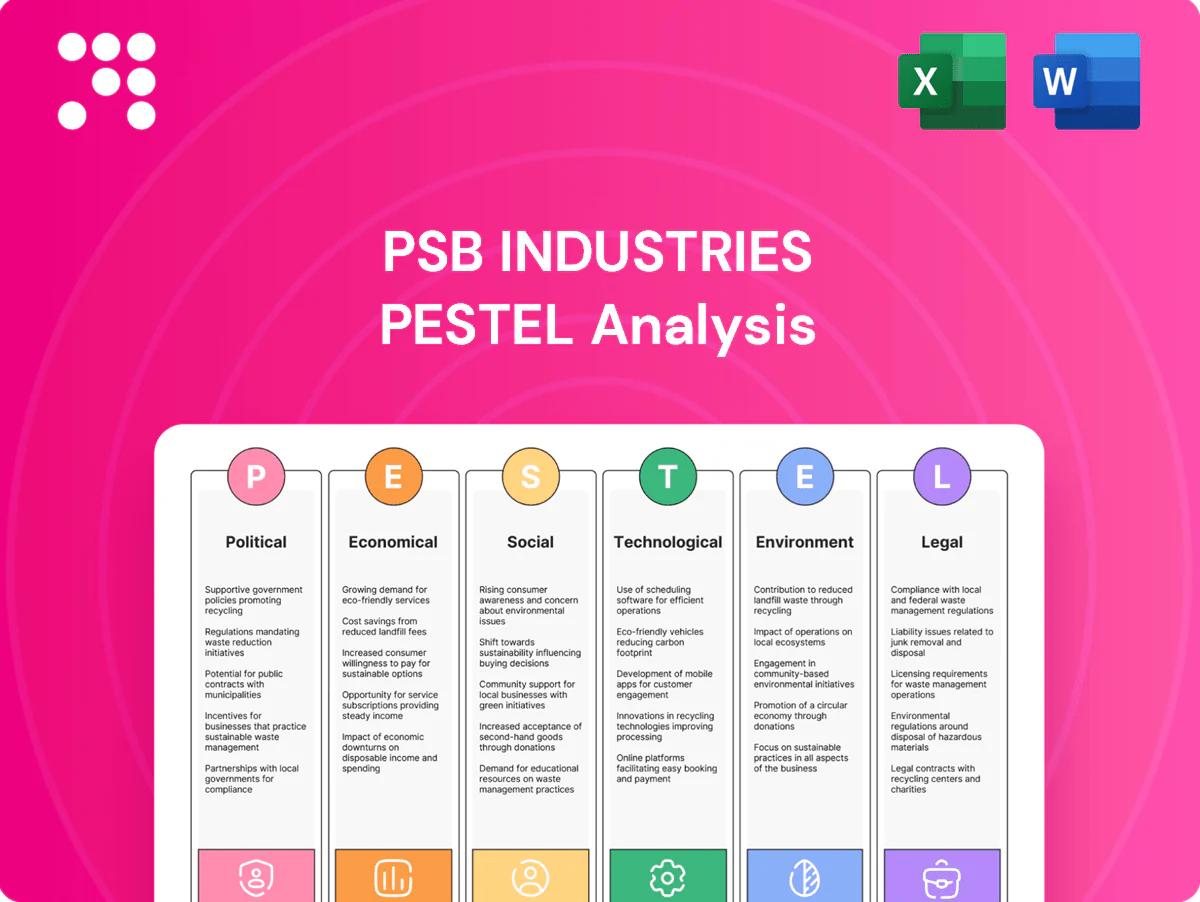
PSB Industries PESTLE Analysis

Plan Smarter. Present Sharper. Compete Stronger.
Discover how political shifts, economic trends, social dynamics, technological advances, legal changes, and environmental pressures converge to shape PSB Industries' prospects. Our concise PESTLE highlights key risks and opportunities to sharpen your strategy. Perfect for investors and strategists—purchase the full analysis for the complete, actionable breakdown.
Political factors

Trade policies and tariffs
Shifts in EU, US, and Asian trade policies affect resin, pigments, and machinery costs and lead times. US tariffs on Chinese goods remain as high as 25% since 2018, while container rates fell about 70% from 2021 peaks by 2023, altering landed costs and timing. Country-specific packaging approvals for beauty, food and healthcare can slow cross-border sales. Monitoring tariff changes, negotiating supplier terms and diversifying sourcing reduces single-country risk.
Regulatory activism in chemicals
Regulatory activism is rising as governments scrutinize chemicals under health and environmental agendas, with EU REACH covering roughly 22,000 registered substances and PFAS proposals targeting thousands more. Tighter rules on hazardous substances pressure formulation services and specialty ingredients, affecting margins in a global specialty chemicals market worth hundreds of billions. Early regulator engagement and substitution roadmaps help preserve market access; participation in alliances like Cefic or ACC shapes feasible standards.

Healthcare policy and public procurement
Healthcare packaging demand closely follows national reimbursement and hospital procurement rules, with public procurement representing roughly 12% of GDP globally (World Bank) and hospitals often sourcing via framework agreements that can cover 50–70% of consumables spend. Local content and security-of-supply rules introduced across 2023–24 have steered tenders to regional manufacturers. ISO 13485 certification and audit readiness are mandatory to win many tenders, and long-term agreements smooth volumes but demand strict compliance and traceability.

Subsidies for green manufacturing
EU and national programs such as NextGenerationEU (€806.9bn) and the EU Innovation Fund (~€38bn through 2030) prioritize decarbonization, recycling and advanced materials, enabling PSB Industries to access targeted grants. Grants and tax incentives often cover up to 50% of eligible energy-efficiency and circular-capex, lowering upfront investment burdens. Aligning project scopes with EU policy and taxonomy improves approval odds, while transparent impact reporting (GHG, circularity metrics) sustains eligibility and reputation.
- Programs: NextGenerationEU €806.9bn; Innovation Fund ~€38bn
- Capex relief: grants/tax credits up to 50%
- Approval tip: align with EU taxonomy and net-zero goals
- Reporting: mandatory GHG and circularity metrics to maintain funding
Geopolitical disruptions
Geopolitical disruptions since 2022–2024 have intermittently constrained energy and specialty feedstock flows and rerouted logistics, complicating timely deliveries to luxury and beauty clients and raising freight and insurance volatility. Volatility in shipping and war-risk premiums has tightened service-level guarantees; dual-sourcing and regionalized production proved effective in 2024 for resilience. Scenario planning preserved client service through Q4 2024 supply shocks.
- impact: disrupted energy/feedstock routes (2022–2024)
- risk: higher shipping/war-risk insurance volatility in 2024
- mitigation: dual-sourcing + regional production
- practice: scenario planning to maintain service levels
US-China tariffs, REACH rules and EU funds reshape costs, lead times and green investment
EU/US trade shifts and tariffs reshape landed costs and lead times, with US-China tariffs up to 25% and container rates down ~70% from 2021–23. Regulatory tightening (REACH ~22,000 substances; PFAS proposals) raises compliance costs. Public procurement/local content rules (public procurement ~12% GDP) favor regional suppliers. EU funds (NextGenerationEU €806.9bn; Innovation Fund €38bn) support decarbonization investments.
| Indicator | Value |
|---|---|
| US-China tariffs | up to 25% |
| Container rates change | -70% (2021–23) |
| REACH registered | ~22,000 substances |
| Public procurement | ~12% GDP |
| NextGenerationEU | €806.9bn |
| Innovation Fund | ~€38bn |
What is included in the product
 Detailed Word Document
Explores how external macro-environmental factors uniquely affect PSB Industries across Political, Economic, Social, Technological, Environmental, and Legal dimensions; each section uses current data and industry-specific examples to highlight risks and opportunities. Tailored for executives and investors, the analysis offers forward-looking insights for scenario planning and investor-ready presentation.

 Customizable Excel Spreadsheet
Condenses PSB Industries’ PESTLE into a clean, editable summary that highlights external risks and opportunities for quick alignment in meetings or decks, enabling teams to annotate context-specific notes and support strategic planning across regions and business lines.
Economic factors

Input cost volatility
Resin, solvents and energy are primary drivers of COGS for rigid and flexible packaging; PSB uses hedging, index-linked contracts and formula pricing to protect margins, while efficiency programs target yield improvement and scrap reduction to offset price spikes, and close supplier collaboration secures allocations during tight market conditions.
Currency fluctuations
EUR exposure against USD- and CNY-priced inputs materially affects PSB Industries profitability as EUR traded near 1.09 USD and 7.65 CNY in July 2025. Multi-currency revenues in beauty and healthcare provide natural hedging, reducing net FX risk across the portfolio. Use of financial hedges (forwards/options) helps stabilize cash flows for capex and M&A planning. Price lists should include FX adjustment clauses during volatile periods.

End-market cycles
Beauty and luxury are highly discretionary and cyclical—the global beauty market was about $530B in 2024 and e-commerce accounted for roughly 28% of sales, amplifying peak-season swings; healthcare and food remain defensive with global health spending near $10T annually and online grocery ~10–12% share. PSB’s diversified portfolio smooths downturns while capturing premiumization in upcycles. Demand planning must model retailer inventory volatility and e-commerce peaks. Flexible capacity allocation preserves utilization and margins.

Interest rates and financing
Higher interest rates (bank rates near 5% in 2024) raise borrowing costs for automation and sustainability projects, squeezing near-term project IRRs. Strong cash conversion from packaging production supports self-funded capex, reducing external debt needs. Phased investments and access to green financing can lower WACC, while tight working-capital discipline preserves ROCE.
- Interest rates ~5% (2024)
- Self-funded capex via high cash conversion
- Phased investments reduce financing risk
- Green finance lowers WACC; WC discipline protects ROCE
M&A and consolidation
M&A and consolidation in packaging and specialties drive scale and tech access, with bolt-on acquisitions into high-margin niches improving product mix and customer reach. Careful integration preserves service levels and regulatory compliance, while divestments of non-core lines free capital for innovation and R&D.
- Scale and tech consolidation
- Bolt-ons boost margins and access
- Integration safeguards service/regulatory
- Divestments free innovation capital
US-China tariffs, REACH rules and EU funds reshape costs, lead times and green investment
Resin, solvents and energy drive COGS; hedges, index contracts and supplier collaboration protect margins amid volatile commodity prices.
EUR at ~1.09 USD and 7.65 CNY (Jul 2025) plus multi-currency revenues provide partial natural FX hedging; financial hedges stabilize cash flows.
Beauty $530B (2024) cyclical vs healthcare/food defensive; interest ~5% (2024) raises capex cost but high cash conversion funds phased investments.
| Item | Value |
|---|---|
| Beauty market | $530B (2024) |
| EUR/USD | 1.09 (Jul 2025) |
| Rates | ~5% (2024) |
What You See Is What You Get
PSB Industries PESTLE Analysis
The preview shown here is the exact document you’ll receive after purchase—fully formatted and ready to use. This PSB Industries PESTLE Analysis is the final file, professionally structured and containing the full political, economic, social, technological, legal and environmental assessment. After payment you’ll instantly download this same ready-to-use report with no placeholders or surprises.

Plan Smarter. Present Sharper. Compete Stronger.
Discover how political shifts, economic trends, social dynamics, technological advances, legal changes, and environmental pressures converge to shape PSB Industries' prospects. Our concise PESTLE highlights key risks and opportunities to sharpen your strategy. Perfect for investors and strategists—purchase the full analysis for the complete, actionable breakdown.
Political factors
Trade policies and tariffs
Shifts in EU, US, and Asian trade policies affect resin, pigments, and machinery costs and lead times. US tariffs on Chinese goods remain as high as 25% since 2018, while container rates fell about 70% from 2021 peaks by 2023, altering landed costs and timing. Country-specific packaging approvals for beauty, food and healthcare can slow cross-border sales. Monitoring tariff changes, negotiating supplier terms and diversifying sourcing reduces single-country risk.
Regulatory activism in chemicals
Regulatory activism is rising as governments scrutinize chemicals under health and environmental agendas, with EU REACH covering roughly 22,000 registered substances and PFAS proposals targeting thousands more. Tighter rules on hazardous substances pressure formulation services and specialty ingredients, affecting margins in a global specialty chemicals market worth hundreds of billions. Early regulator engagement and substitution roadmaps help preserve market access; participation in alliances like Cefic or ACC shapes feasible standards.
Healthcare policy and public procurement
Healthcare packaging demand closely follows national reimbursement and hospital procurement rules, with public procurement representing roughly 12% of GDP globally (World Bank) and hospitals often sourcing via framework agreements that can cover 50–70% of consumables spend. Local content and security-of-supply rules introduced across 2023–24 have steered tenders to regional manufacturers. ISO 13485 certification and audit readiness are mandatory to win many tenders, and long-term agreements smooth volumes but demand strict compliance and traceability.
Subsidies for green manufacturing
EU and national programs such as NextGenerationEU (€806.9bn) and the EU Innovation Fund (~€38bn through 2030) prioritize decarbonization, recycling and advanced materials, enabling PSB Industries to access targeted grants. Grants and tax incentives often cover up to 50% of eligible energy-efficiency and circular-capex, lowering upfront investment burdens. Aligning project scopes with EU policy and taxonomy improves approval odds, while transparent impact reporting (GHG, circularity metrics) sustains eligibility and reputation.
- Programs: NextGenerationEU €806.9bn; Innovation Fund ~€38bn
- Capex relief: grants/tax credits up to 50%
- Approval tip: align with EU taxonomy and net-zero goals
- Reporting: mandatory GHG and circularity metrics to maintain funding
Geopolitical disruptions
Geopolitical disruptions since 2022–2024 have intermittently constrained energy and specialty feedstock flows and rerouted logistics, complicating timely deliveries to luxury and beauty clients and raising freight and insurance volatility. Volatility in shipping and war-risk premiums has tightened service-level guarantees; dual-sourcing and regionalized production proved effective in 2024 for resilience. Scenario planning preserved client service through Q4 2024 supply shocks.
- impact: disrupted energy/feedstock routes (2022–2024)
- risk: higher shipping/war-risk insurance volatility in 2024
- mitigation: dual-sourcing + regional production
- practice: scenario planning to maintain service levels
US-China tariffs, REACH rules and EU funds reshape costs, lead times and green investment
EU/US trade shifts and tariffs reshape landed costs and lead times, with US-China tariffs up to 25% and container rates down ~70% from 2021–23. Regulatory tightening (REACH ~22,000 substances; PFAS proposals) raises compliance costs. Public procurement/local content rules (public procurement ~12% GDP) favor regional suppliers. EU funds (NextGenerationEU €806.9bn; Innovation Fund €38bn) support decarbonization investments.
| Indicator | Value |
|---|---|
| US-China tariffs | up to 25% |
| Container rates change | -70% (2021–23) |
| REACH registered | ~22,000 substances |
| Public procurement | ~12% GDP |
| NextGenerationEU | €806.9bn |
| Innovation Fund | ~€38bn |
What is included in the product
Detailed Word Document
Explores how external macro-environmental factors uniquely affect PSB Industries across Political, Economic, Social, Technological, Environmental, and Legal dimensions; each section uses current data and industry-specific examples to highlight risks and opportunities. Tailored for executives and investors, the analysis offers forward-looking insights for scenario planning and investor-ready presentation.
Customizable Excel Spreadsheet
Condenses PSB Industries’ PESTLE into a clean, editable summary that highlights external risks and opportunities for quick alignment in meetings or decks, enabling teams to annotate context-specific notes and support strategic planning across regions and business lines.
Economic factors
Input cost volatility
Resin, solvents and energy are primary drivers of COGS for rigid and flexible packaging; PSB uses hedging, index-linked contracts and formula pricing to protect margins, while efficiency programs target yield improvement and scrap reduction to offset price spikes, and close supplier collaboration secures allocations during tight market conditions.
Currency fluctuations
EUR exposure against USD- and CNY-priced inputs materially affects PSB Industries profitability as EUR traded near 1.09 USD and 7.65 CNY in July 2025. Multi-currency revenues in beauty and healthcare provide natural hedging, reducing net FX risk across the portfolio. Use of financial hedges (forwards/options) helps stabilize cash flows for capex and M&A planning. Price lists should include FX adjustment clauses during volatile periods.
End-market cycles
Beauty and luxury are highly discretionary and cyclical—the global beauty market was about $530B in 2024 and e-commerce accounted for roughly 28% of sales, amplifying peak-season swings; healthcare and food remain defensive with global health spending near $10T annually and online grocery ~10–12% share. PSB’s diversified portfolio smooths downturns while capturing premiumization in upcycles. Demand planning must model retailer inventory volatility and e-commerce peaks. Flexible capacity allocation preserves utilization and margins.
Interest rates and financing
Higher interest rates (bank rates near 5% in 2024) raise borrowing costs for automation and sustainability projects, squeezing near-term project IRRs. Strong cash conversion from packaging production supports self-funded capex, reducing external debt needs. Phased investments and access to green financing can lower WACC, while tight working-capital discipline preserves ROCE.
- Interest rates ~5% (2024)
- Self-funded capex via high cash conversion
- Phased investments reduce financing risk
- Green finance lowers WACC; WC discipline protects ROCE
M&A and consolidation
M&A and consolidation in packaging and specialties drive scale and tech access, with bolt-on acquisitions into high-margin niches improving product mix and customer reach. Careful integration preserves service levels and regulatory compliance, while divestments of non-core lines free capital for innovation and R&D.
- Scale and tech consolidation
- Bolt-ons boost margins and access
- Integration safeguards service/regulatory
- Divestments free innovation capital
US-China tariffs, REACH rules and EU funds reshape costs, lead times and green investment
Resin, solvents and energy drive COGS; hedges, index contracts and supplier collaboration protect margins amid volatile commodity prices.
EUR at ~1.09 USD and 7.65 CNY (Jul 2025) plus multi-currency revenues provide partial natural FX hedging; financial hedges stabilize cash flows.
Beauty $530B (2024) cyclical vs healthcare/food defensive; interest ~5% (2024) raises capex cost but high cash conversion funds phased investments.
| Item | Value |
|---|---|
| Beauty market | $530B (2024) |
| EUR/USD | 1.09 (Jul 2025) |
| Rates | ~5% (2024) |
What You See Is What You Get
PSB Industries PESTLE Analysis
The preview shown here is the exact document you’ll receive after purchase—fully formatted and ready to use. This PSB Industries PESTLE Analysis is the final file, professionally structured and containing the full political, economic, social, technological, legal and environmental assessment. After payment you’ll instantly download this same ready-to-use report with no placeholders or surprises.
Description
Plan Smarter. Present Sharper. Compete Stronger.
Discover how political shifts, economic trends, social dynamics, technological advances, legal changes, and environmental pressures converge to shape PSB Industries' prospects. Our concise PESTLE highlights key risks and opportunities to sharpen your strategy. Perfect for investors and strategists—purchase the full analysis for the complete, actionable breakdown.
Political factors
Trade policies and tariffs
Shifts in EU, US, and Asian trade policies affect resin, pigments, and machinery costs and lead times. US tariffs on Chinese goods remain as high as 25% since 2018, while container rates fell about 70% from 2021 peaks by 2023, altering landed costs and timing. Country-specific packaging approvals for beauty, food and healthcare can slow cross-border sales. Monitoring tariff changes, negotiating supplier terms and diversifying sourcing reduces single-country risk.
Regulatory activism in chemicals
Regulatory activism is rising as governments scrutinize chemicals under health and environmental agendas, with EU REACH covering roughly 22,000 registered substances and PFAS proposals targeting thousands more. Tighter rules on hazardous substances pressure formulation services and specialty ingredients, affecting margins in a global specialty chemicals market worth hundreds of billions. Early regulator engagement and substitution roadmaps help preserve market access; participation in alliances like Cefic or ACC shapes feasible standards.
Healthcare policy and public procurement
Healthcare packaging demand closely follows national reimbursement and hospital procurement rules, with public procurement representing roughly 12% of GDP globally (World Bank) and hospitals often sourcing via framework agreements that can cover 50–70% of consumables spend. Local content and security-of-supply rules introduced across 2023–24 have steered tenders to regional manufacturers. ISO 13485 certification and audit readiness are mandatory to win many tenders, and long-term agreements smooth volumes but demand strict compliance and traceability.
Subsidies for green manufacturing
EU and national programs such as NextGenerationEU (€806.9bn) and the EU Innovation Fund (~€38bn through 2030) prioritize decarbonization, recycling and advanced materials, enabling PSB Industries to access targeted grants. Grants and tax incentives often cover up to 50% of eligible energy-efficiency and circular-capex, lowering upfront investment burdens. Aligning project scopes with EU policy and taxonomy improves approval odds, while transparent impact reporting (GHG, circularity metrics) sustains eligibility and reputation.
- Programs: NextGenerationEU €806.9bn; Innovation Fund ~€38bn
- Capex relief: grants/tax credits up to 50%
- Approval tip: align with EU taxonomy and net-zero goals
- Reporting: mandatory GHG and circularity metrics to maintain funding
Geopolitical disruptions
Geopolitical disruptions since 2022–2024 have intermittently constrained energy and specialty feedstock flows and rerouted logistics, complicating timely deliveries to luxury and beauty clients and raising freight and insurance volatility. Volatility in shipping and war-risk premiums has tightened service-level guarantees; dual-sourcing and regionalized production proved effective in 2024 for resilience. Scenario planning preserved client service through Q4 2024 supply shocks.
- impact: disrupted energy/feedstock routes (2022–2024)
- risk: higher shipping/war-risk insurance volatility in 2024
- mitigation: dual-sourcing + regional production
- practice: scenario planning to maintain service levels
US-China tariffs, REACH rules and EU funds reshape costs, lead times and green investment
EU/US trade shifts and tariffs reshape landed costs and lead times, with US-China tariffs up to 25% and container rates down ~70% from 2021–23. Regulatory tightening (REACH ~22,000 substances; PFAS proposals) raises compliance costs. Public procurement/local content rules (public procurement ~12% GDP) favor regional suppliers. EU funds (NextGenerationEU €806.9bn; Innovation Fund €38bn) support decarbonization investments.
| Indicator | Value |
|---|---|
| US-China tariffs | up to 25% |
| Container rates change | -70% (2021–23) |
| REACH registered | ~22,000 substances |
| Public procurement | ~12% GDP |
| NextGenerationEU | €806.9bn |
| Innovation Fund | ~€38bn |
What is included in the product
Detailed Word Document
Explores how external macro-environmental factors uniquely affect PSB Industries across Political, Economic, Social, Technological, Environmental, and Legal dimensions; each section uses current data and industry-specific examples to highlight risks and opportunities. Tailored for executives and investors, the analysis offers forward-looking insights for scenario planning and investor-ready presentation.
Customizable Excel Spreadsheet
Condenses PSB Industries’ PESTLE into a clean, editable summary that highlights external risks and opportunities for quick alignment in meetings or decks, enabling teams to annotate context-specific notes and support strategic planning across regions and business lines.
Economic factors
Input cost volatility
Resin, solvents and energy are primary drivers of COGS for rigid and flexible packaging; PSB uses hedging, index-linked contracts and formula pricing to protect margins, while efficiency programs target yield improvement and scrap reduction to offset price spikes, and close supplier collaboration secures allocations during tight market conditions.
Currency fluctuations
EUR exposure against USD- and CNY-priced inputs materially affects PSB Industries profitability as EUR traded near 1.09 USD and 7.65 CNY in July 2025. Multi-currency revenues in beauty and healthcare provide natural hedging, reducing net FX risk across the portfolio. Use of financial hedges (forwards/options) helps stabilize cash flows for capex and M&A planning. Price lists should include FX adjustment clauses during volatile periods.
End-market cycles
Beauty and luxury are highly discretionary and cyclical—the global beauty market was about $530B in 2024 and e-commerce accounted for roughly 28% of sales, amplifying peak-season swings; healthcare and food remain defensive with global health spending near $10T annually and online grocery ~10–12% share. PSB’s diversified portfolio smooths downturns while capturing premiumization in upcycles. Demand planning must model retailer inventory volatility and e-commerce peaks. Flexible capacity allocation preserves utilization and margins.
Interest rates and financing
Higher interest rates (bank rates near 5% in 2024) raise borrowing costs for automation and sustainability projects, squeezing near-term project IRRs. Strong cash conversion from packaging production supports self-funded capex, reducing external debt needs. Phased investments and access to green financing can lower WACC, while tight working-capital discipline preserves ROCE.
- Interest rates ~5% (2024)
- Self-funded capex via high cash conversion
- Phased investments reduce financing risk
- Green finance lowers WACC; WC discipline protects ROCE
M&A and consolidation
M&A and consolidation in packaging and specialties drive scale and tech access, with bolt-on acquisitions into high-margin niches improving product mix and customer reach. Careful integration preserves service levels and regulatory compliance, while divestments of non-core lines free capital for innovation and R&D.
- Scale and tech consolidation
- Bolt-ons boost margins and access
- Integration safeguards service/regulatory
- Divestments free innovation capital
US-China tariffs, REACH rules and EU funds reshape costs, lead times and green investment
Resin, solvents and energy drive COGS; hedges, index contracts and supplier collaboration protect margins amid volatile commodity prices.
EUR at ~1.09 USD and 7.65 CNY (Jul 2025) plus multi-currency revenues provide partial natural FX hedging; financial hedges stabilize cash flows.
Beauty $530B (2024) cyclical vs healthcare/food defensive; interest ~5% (2024) raises capex cost but high cash conversion funds phased investments.
| Item | Value |
|---|---|
| Beauty market | $530B (2024) |
| EUR/USD | 1.09 (Jul 2025) |
| Rates | ~5% (2024) |
What You See Is What You Get
PSB Industries PESTLE Analysis
The preview shown here is the exact document you’ll receive after purchase—fully formatted and ready to use. This PSB Industries PESTLE Analysis is the final file, professionally structured and containing the full political, economic, social, technological, legal and environmental assessment. After payment you’ll instantly download this same ready-to-use report with no placeholders or surprises.











