Pruksa Real Estate Porter's Five Forces Analysis

Go Beyond the Preview—Access the Full Strategic Report
Pruksa Real Estate faces moderate buyer power, intense rivalry, and rising threats from differentiated substitutes, while supplier leverage and entry barriers shape strategic choices; this snapshot teases key pressures and advantages. Unlock the full Porter's Five Forces Analysis for force-by-force ratings, visuals, and actionable strategy guidance.
Suppliers Bargaining Power

Diverse construction input sources
Pruksa sources cement, steel, MEP systems, finishes and fixtures from numerous local and regional suppliers, keeping switching costs moderate and supplier leverage low. Commodity availability across Thailand and ASEAN reduces individual supplier power, though short-term shocks can spike prices; multi-sourcing and hedging are used to stabilize procurement costs. Standardized project specs further limit dependence on any single vendor.
Landowners hold location leverage
Prime land in Bangkok and key provinces is scarce, giving site owners strong leverage over price and contract terms; off-market deals and long option periods frequently shift value capture to landholders. Pruksa’s scale and multi-year pipeline improve negotiating power, yet truly premium plots still command marked premiums. Peripheral and redevelopment sites lower land cost exposure but do not remove this supplier pressure.

Contractor and labor dynamics
Skilled labor availability and licensed contractors drive Pruksa project timelines and quality, with on-site labor typically representing 30–40% of construction cost; in 2024 cyclical upswings pushed subcontractor margins higher, tightening supplier power. Long-term partnerships and transparent workload forecasting allow Pruksa to secure capacity at improved rates. Adoption of prefab and industrialized methods reduces on-site labor exposure and shortens delivery lead times.

Regulated utilities and approvals
Connections for power, water and telecom plus inspections and EIA processes act as quasi-suppliers with procedural power, and queues, fees and compliance timelines can shift launch and handover schedules; Thailand has near‑universal electricity access (World Bank) so timing—rather than availability—drives impacts.
- Risk: queues/fees delay handovers
- Mitigation: early coordination & compliance expertise
- Strategy: project phasing spreads utility risk
Specialized finishes and brand standards
High-end segments require differentiated materials and branded fixtures that narrow supplier choices, raising switching costs and often producing lead-times of 8–16 weeks for premium packages. This concentrates supplier bargaining power on flagship Pruksa projects and increases inventory and scheduling risk. Framework agreements and approved-vendor lists restore negotiating leverage while value engineering preserves specs and protects margins.
Landowners keep pricing power; labor costs high and finishes face 8-16 week delays
Pruksa faces low supplier leverage for commodities due to multi-sourcing, but prime land owners retain strong pricing power; labor is 30–40% of build cost and subcontractor margins rose in 2024. Premium finishes have 8–16 week lead-times, raising inventory risk. Utilities are near-universal (electricity access ~99% World Bank), so timing—not availability—drives delays.
| Item | 2024 Metric |
|---|---|
| Labor share | 30–40% |
| Finish lead-time | 8–16 weeks |
| Electricity access (TH) | ~99% |
What is included in the product
 Detailed Word Document
Uncovers key drivers of competition, customer influence, supplier power, entry barriers and substitutes tailored to Pruksa Real Estate, identifying disruptive threats and strategic levers to protect market share.

 Customizable Excel Spreadsheet
One-sheet Porter's Five Forces for Pruksa Real Estate — a clean, customizable snapshot that instantly highlights competitive pressures and strategic pain points for boardrooms and quick decisions.
Customers Bargaining Power

Price-sensitive mass market
Thailand’s price-sensitive mass market—part of a population of about 71.5 million in 2024—gives buyers strong bargaining power, with promotions, free add-ons and mortgage subsidies routinely expected. Pruksa must optimize unit sizing and specs to meet affordability thresholds and cost-per-sqm targets. Transparent online pricing and portal comparisons further intensify pressure on margins.
Mortgage dependence and rate cycles
Most Pruksa buyers rely on bank mortgages, tying demand to interest-rate cycles and LTV rules; Bank of Thailand policy rate stood at 2.50% in 2024, keeping financing central to purchase decisions. Tight credit and stricter underwriting give buyers leverage to negotiate or postpone. Pruksa mitigates this via bank partnerships and installment/down-payment schemes to ease approvals, while a cycle of rate cuts would restore developer leverage through volume recovery.

Abundant alternatives across segments
In 2024 buyers face abundant alternatives—townhouses, condos and single-detached homes in adjacent price bands—enabling cross-shopping that intensifies negotiations over features and location. Ready-to-move versus off-plan choices add leverage on timing and discounting, pressuring margins. Reputation and after-sales service increasingly act as decisive tie-breakers in buyer decisions.

Information transparency and reviews
Online portals, social media, and customer forums make Pruksa pricing, defects, and service records highly visible, enabling well-informed buyers to demand better terms and extended warranties. Negative publicity on these channels frequently forces remedial concessions or upgrades to protect brand value. Robust CRM and proactive communication reduce escalation and dampen buyer bargaining power.
- Visibility: channels expose pricing and defects
- Leverage: informed buyers push terms/warranties
- Risk: negative publicity prompts concessions
- Mitigation: CRM and proactive outreach
Corporate and investor buyers
Corporate and investor buyers of Pruksa properties demand volume discounts on block purchases and routinely benchmark yields and exit liquidity, forcing developers to trade margin for speed of absorption. These sophisticated buyers can compress margins despite accelerating sales velocity, and in 2024 institutional bulk deals represented a notable double-digit share of some Thai developers' off-plan volumes. Tailored unit mixes and rental or buy-back guarantees are commonly used to close large transactions while protecting Pruksa's brand and long-term pricing power.
- Volume discounts pressure margins
- Sophisticated yield and exit liquidity scrutiny
- Bulk deals boost absorption but compress pricing
- Unit mix and rental guarantees mitigate brand and resale risk
Thailand housing: low BoT rate fuels buyer leverage; bulk deals squeeze developer margins
Thailand’s price-sensitive market (population 71.5 million in 2024) gives buyers strong bargaining power; promotions, add-ons and mortgage support are routinely expected. Bank of Thailand policy rate 2.50% in 2024 ties purchases to financing cycles, increasing buyer leverage under tight credit. Online portals and institutional bulk deals (double-digit share of some developers’ off-plan sales in 2024) further compress margins; CRM and bank partnerships mitigate.
| Metric | 2024 Value |
|---|---|
| Population | 71.5 million |
| BoT policy rate | 2.50% |
| Institutional bulk share | Double-digit (%) |
Preview the Actual Deliverable
Pruksa Real Estate Porter's Five Forces Analysis
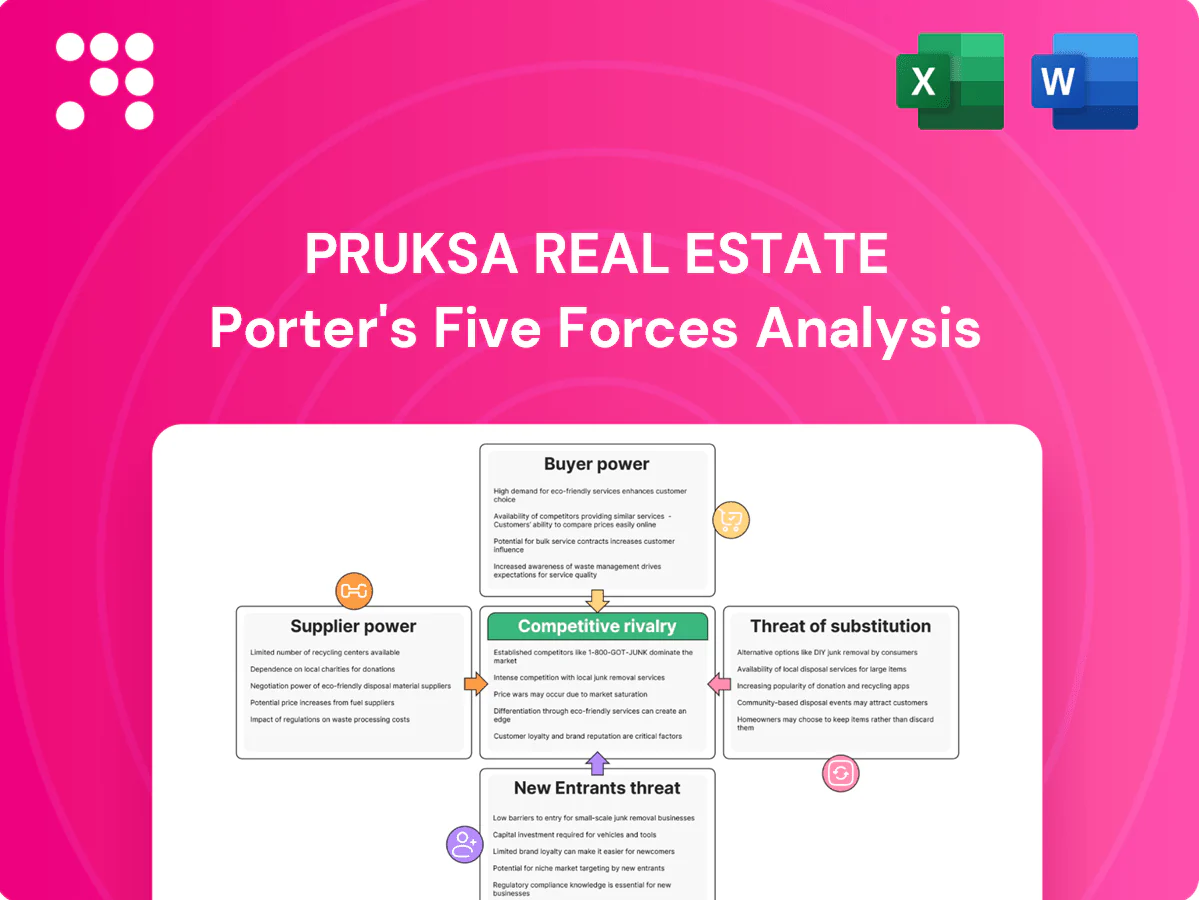
This preview shows the exact Porter's Five Forces analysis for Pruksa Real Estate you'll receive immediately after purchase—no placeholders. It covers threat of new entrants, bargaining power of suppliers and buyers, competitive rivalry and substitutes with data-driven interpretation. The file is fully formatted and ready for immediate download and use.

Go Beyond the Preview—Access the Full Strategic Report
Pruksa Real Estate faces moderate buyer power, intense rivalry, and rising threats from differentiated substitutes, while supplier leverage and entry barriers shape strategic choices; this snapshot teases key pressures and advantages. Unlock the full Porter's Five Forces Analysis for force-by-force ratings, visuals, and actionable strategy guidance.
Suppliers Bargaining Power
Diverse construction input sources
Pruksa sources cement, steel, MEP systems, finishes and fixtures from numerous local and regional suppliers, keeping switching costs moderate and supplier leverage low. Commodity availability across Thailand and ASEAN reduces individual supplier power, though short-term shocks can spike prices; multi-sourcing and hedging are used to stabilize procurement costs. Standardized project specs further limit dependence on any single vendor.
Landowners hold location leverage
Prime land in Bangkok and key provinces is scarce, giving site owners strong leverage over price and contract terms; off-market deals and long option periods frequently shift value capture to landholders. Pruksa’s scale and multi-year pipeline improve negotiating power, yet truly premium plots still command marked premiums. Peripheral and redevelopment sites lower land cost exposure but do not remove this supplier pressure.
Contractor and labor dynamics
Skilled labor availability and licensed contractors drive Pruksa project timelines and quality, with on-site labor typically representing 30–40% of construction cost; in 2024 cyclical upswings pushed subcontractor margins higher, tightening supplier power. Long-term partnerships and transparent workload forecasting allow Pruksa to secure capacity at improved rates. Adoption of prefab and industrialized methods reduces on-site labor exposure and shortens delivery lead times.
Regulated utilities and approvals
Connections for power, water and telecom plus inspections and EIA processes act as quasi-suppliers with procedural power, and queues, fees and compliance timelines can shift launch and handover schedules; Thailand has near‑universal electricity access (World Bank) so timing—rather than availability—drives impacts.
- Risk: queues/fees delay handovers
- Mitigation: early coordination & compliance expertise
- Strategy: project phasing spreads utility risk
Specialized finishes and brand standards
High-end segments require differentiated materials and branded fixtures that narrow supplier choices, raising switching costs and often producing lead-times of 8–16 weeks for premium packages. This concentrates supplier bargaining power on flagship Pruksa projects and increases inventory and scheduling risk. Framework agreements and approved-vendor lists restore negotiating leverage while value engineering preserves specs and protects margins.
Landowners keep pricing power; labor costs high and finishes face 8-16 week delays
Pruksa faces low supplier leverage for commodities due to multi-sourcing, but prime land owners retain strong pricing power; labor is 30–40% of build cost and subcontractor margins rose in 2024. Premium finishes have 8–16 week lead-times, raising inventory risk. Utilities are near-universal (electricity access ~99% World Bank), so timing—not availability—drives delays.
| Item | 2024 Metric |
|---|---|
| Labor share | 30–40% |
| Finish lead-time | 8–16 weeks |
| Electricity access (TH) | ~99% |
What is included in the product
Detailed Word Document
Uncovers key drivers of competition, customer influence, supplier power, entry barriers and substitutes tailored to Pruksa Real Estate, identifying disruptive threats and strategic levers to protect market share.
Customizable Excel Spreadsheet
One-sheet Porter's Five Forces for Pruksa Real Estate — a clean, customizable snapshot that instantly highlights competitive pressures and strategic pain points for boardrooms and quick decisions.
Customers Bargaining Power
Price-sensitive mass market
Thailand’s price-sensitive mass market—part of a population of about 71.5 million in 2024—gives buyers strong bargaining power, with promotions, free add-ons and mortgage subsidies routinely expected. Pruksa must optimize unit sizing and specs to meet affordability thresholds and cost-per-sqm targets. Transparent online pricing and portal comparisons further intensify pressure on margins.
Mortgage dependence and rate cycles
Most Pruksa buyers rely on bank mortgages, tying demand to interest-rate cycles and LTV rules; Bank of Thailand policy rate stood at 2.50% in 2024, keeping financing central to purchase decisions. Tight credit and stricter underwriting give buyers leverage to negotiate or postpone. Pruksa mitigates this via bank partnerships and installment/down-payment schemes to ease approvals, while a cycle of rate cuts would restore developer leverage through volume recovery.
Abundant alternatives across segments
In 2024 buyers face abundant alternatives—townhouses, condos and single-detached homes in adjacent price bands—enabling cross-shopping that intensifies negotiations over features and location. Ready-to-move versus off-plan choices add leverage on timing and discounting, pressuring margins. Reputation and after-sales service increasingly act as decisive tie-breakers in buyer decisions.
Information transparency and reviews
Online portals, social media, and customer forums make Pruksa pricing, defects, and service records highly visible, enabling well-informed buyers to demand better terms and extended warranties. Negative publicity on these channels frequently forces remedial concessions or upgrades to protect brand value. Robust CRM and proactive communication reduce escalation and dampen buyer bargaining power.
- Visibility: channels expose pricing and defects
- Leverage: informed buyers push terms/warranties
- Risk: negative publicity prompts concessions
- Mitigation: CRM and proactive outreach
Corporate and investor buyers
Corporate and investor buyers of Pruksa properties demand volume discounts on block purchases and routinely benchmark yields and exit liquidity, forcing developers to trade margin for speed of absorption. These sophisticated buyers can compress margins despite accelerating sales velocity, and in 2024 institutional bulk deals represented a notable double-digit share of some Thai developers' off-plan volumes. Tailored unit mixes and rental or buy-back guarantees are commonly used to close large transactions while protecting Pruksa's brand and long-term pricing power.
- Volume discounts pressure margins
- Sophisticated yield and exit liquidity scrutiny
- Bulk deals boost absorption but compress pricing
- Unit mix and rental guarantees mitigate brand and resale risk
Thailand housing: low BoT rate fuels buyer leverage; bulk deals squeeze developer margins
Thailand’s price-sensitive market (population 71.5 million in 2024) gives buyers strong bargaining power; promotions, add-ons and mortgage support are routinely expected. Bank of Thailand policy rate 2.50% in 2024 ties purchases to financing cycles, increasing buyer leverage under tight credit. Online portals and institutional bulk deals (double-digit share of some developers’ off-plan sales in 2024) further compress margins; CRM and bank partnerships mitigate.
| Metric | 2024 Value |
|---|---|
| Population | 71.5 million |
| BoT policy rate | 2.50% |
| Institutional bulk share | Double-digit (%) |
Preview the Actual Deliverable
Pruksa Real Estate Porter's Five Forces Analysis
This preview shows the exact Porter's Five Forces analysis for Pruksa Real Estate you'll receive immediately after purchase—no placeholders. It covers threat of new entrants, bargaining power of suppliers and buyers, competitive rivalry and substitutes with data-driven interpretation. The file is fully formatted and ready for immediate download and use.
Description
Go Beyond the Preview—Access the Full Strategic Report
Pruksa Real Estate faces moderate buyer power, intense rivalry, and rising threats from differentiated substitutes, while supplier leverage and entry barriers shape strategic choices; this snapshot teases key pressures and advantages. Unlock the full Porter's Five Forces Analysis for force-by-force ratings, visuals, and actionable strategy guidance.
Suppliers Bargaining Power
Diverse construction input sources
Pruksa sources cement, steel, MEP systems, finishes and fixtures from numerous local and regional suppliers, keeping switching costs moderate and supplier leverage low. Commodity availability across Thailand and ASEAN reduces individual supplier power, though short-term shocks can spike prices; multi-sourcing and hedging are used to stabilize procurement costs. Standardized project specs further limit dependence on any single vendor.
Landowners hold location leverage
Prime land in Bangkok and key provinces is scarce, giving site owners strong leverage over price and contract terms; off-market deals and long option periods frequently shift value capture to landholders. Pruksa’s scale and multi-year pipeline improve negotiating power, yet truly premium plots still command marked premiums. Peripheral and redevelopment sites lower land cost exposure but do not remove this supplier pressure.
Contractor and labor dynamics
Skilled labor availability and licensed contractors drive Pruksa project timelines and quality, with on-site labor typically representing 30–40% of construction cost; in 2024 cyclical upswings pushed subcontractor margins higher, tightening supplier power. Long-term partnerships and transparent workload forecasting allow Pruksa to secure capacity at improved rates. Adoption of prefab and industrialized methods reduces on-site labor exposure and shortens delivery lead times.
Regulated utilities and approvals
Connections for power, water and telecom plus inspections and EIA processes act as quasi-suppliers with procedural power, and queues, fees and compliance timelines can shift launch and handover schedules; Thailand has near‑universal electricity access (World Bank) so timing—rather than availability—drives impacts.
- Risk: queues/fees delay handovers
- Mitigation: early coordination & compliance expertise
- Strategy: project phasing spreads utility risk
Specialized finishes and brand standards
High-end segments require differentiated materials and branded fixtures that narrow supplier choices, raising switching costs and often producing lead-times of 8–16 weeks for premium packages. This concentrates supplier bargaining power on flagship Pruksa projects and increases inventory and scheduling risk. Framework agreements and approved-vendor lists restore negotiating leverage while value engineering preserves specs and protects margins.
Landowners keep pricing power; labor costs high and finishes face 8-16 week delays
Pruksa faces low supplier leverage for commodities due to multi-sourcing, but prime land owners retain strong pricing power; labor is 30–40% of build cost and subcontractor margins rose in 2024. Premium finishes have 8–16 week lead-times, raising inventory risk. Utilities are near-universal (electricity access ~99% World Bank), so timing—not availability—drives delays.
| Item | 2024 Metric |
|---|---|
| Labor share | 30–40% |
| Finish lead-time | 8–16 weeks |
| Electricity access (TH) | ~99% |
What is included in the product
Detailed Word Document
Uncovers key drivers of competition, customer influence, supplier power, entry barriers and substitutes tailored to Pruksa Real Estate, identifying disruptive threats and strategic levers to protect market share.
Customizable Excel Spreadsheet
One-sheet Porter's Five Forces for Pruksa Real Estate — a clean, customizable snapshot that instantly highlights competitive pressures and strategic pain points for boardrooms and quick decisions.
Customers Bargaining Power
Price-sensitive mass market
Thailand’s price-sensitive mass market—part of a population of about 71.5 million in 2024—gives buyers strong bargaining power, with promotions, free add-ons and mortgage subsidies routinely expected. Pruksa must optimize unit sizing and specs to meet affordability thresholds and cost-per-sqm targets. Transparent online pricing and portal comparisons further intensify pressure on margins.
Mortgage dependence and rate cycles
Most Pruksa buyers rely on bank mortgages, tying demand to interest-rate cycles and LTV rules; Bank of Thailand policy rate stood at 2.50% in 2024, keeping financing central to purchase decisions. Tight credit and stricter underwriting give buyers leverage to negotiate or postpone. Pruksa mitigates this via bank partnerships and installment/down-payment schemes to ease approvals, while a cycle of rate cuts would restore developer leverage through volume recovery.
Abundant alternatives across segments
In 2024 buyers face abundant alternatives—townhouses, condos and single-detached homes in adjacent price bands—enabling cross-shopping that intensifies negotiations over features and location. Ready-to-move versus off-plan choices add leverage on timing and discounting, pressuring margins. Reputation and after-sales service increasingly act as decisive tie-breakers in buyer decisions.
Information transparency and reviews
Online portals, social media, and customer forums make Pruksa pricing, defects, and service records highly visible, enabling well-informed buyers to demand better terms and extended warranties. Negative publicity on these channels frequently forces remedial concessions or upgrades to protect brand value. Robust CRM and proactive communication reduce escalation and dampen buyer bargaining power.
- Visibility: channels expose pricing and defects
- Leverage: informed buyers push terms/warranties
- Risk: negative publicity prompts concessions
- Mitigation: CRM and proactive outreach
Corporate and investor buyers
Corporate and investor buyers of Pruksa properties demand volume discounts on block purchases and routinely benchmark yields and exit liquidity, forcing developers to trade margin for speed of absorption. These sophisticated buyers can compress margins despite accelerating sales velocity, and in 2024 institutional bulk deals represented a notable double-digit share of some Thai developers' off-plan volumes. Tailored unit mixes and rental or buy-back guarantees are commonly used to close large transactions while protecting Pruksa's brand and long-term pricing power.
- Volume discounts pressure margins
- Sophisticated yield and exit liquidity scrutiny
- Bulk deals boost absorption but compress pricing
- Unit mix and rental guarantees mitigate brand and resale risk
Thailand housing: low BoT rate fuels buyer leverage; bulk deals squeeze developer margins
Thailand’s price-sensitive market (population 71.5 million in 2024) gives buyers strong bargaining power; promotions, add-ons and mortgage support are routinely expected. Bank of Thailand policy rate 2.50% in 2024 ties purchases to financing cycles, increasing buyer leverage under tight credit. Online portals and institutional bulk deals (double-digit share of some developers’ off-plan sales in 2024) further compress margins; CRM and bank partnerships mitigate.
| Metric | 2024 Value |
|---|---|
| Population | 71.5 million |
| BoT policy rate | 2.50% |
| Institutional bulk share | Double-digit (%) |
Preview the Actual Deliverable
Pruksa Real Estate Porter's Five Forces Analysis
This preview shows the exact Porter's Five Forces analysis for Pruksa Real Estate you'll receive immediately after purchase—no placeholders. It covers threat of new entrants, bargaining power of suppliers and buyers, competitive rivalry and substitutes with data-driven interpretation. The file is fully formatted and ready for immediate download and use.











