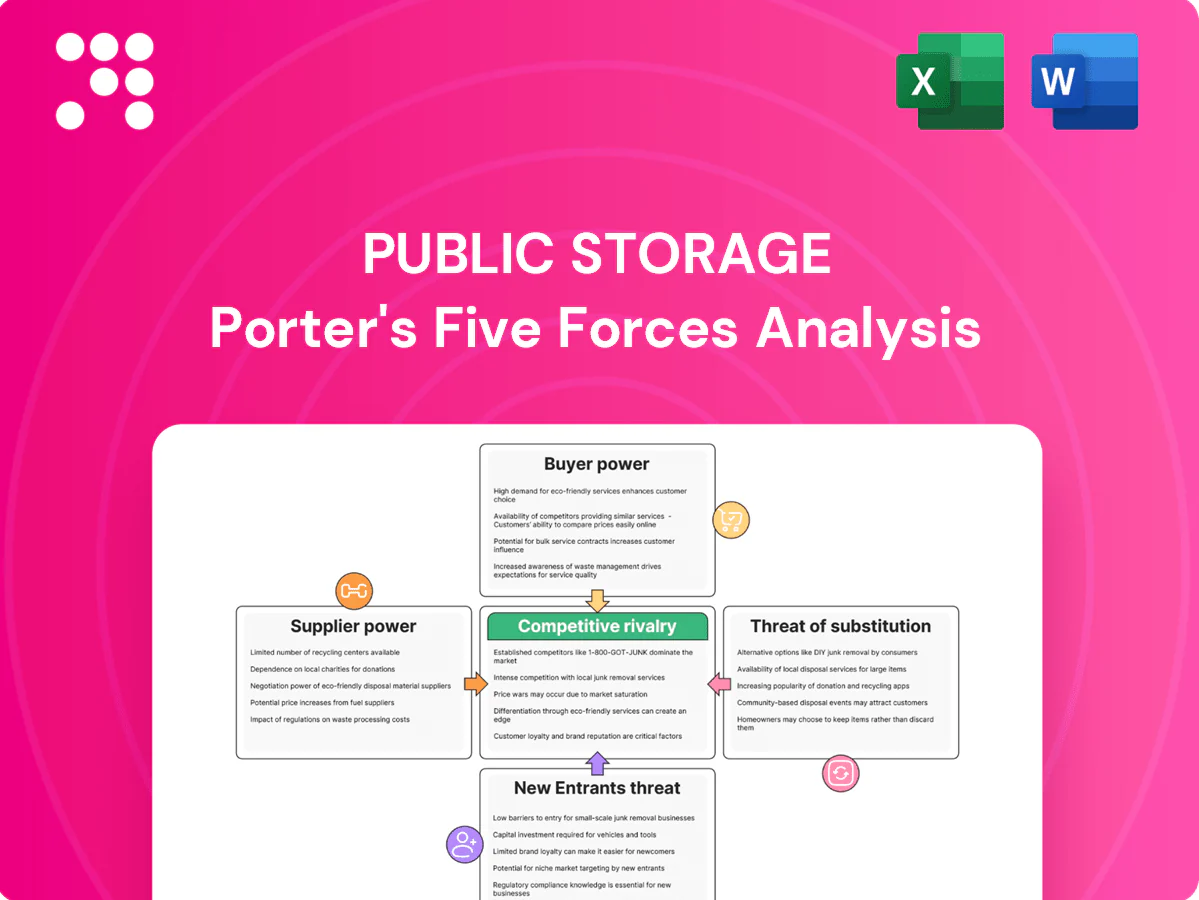
Public Storage Porter's Five Forces Analysis

A Must-Have Tool for Decision-Makers
Public Storage's Porter's Five Forces snapshot highlights intense rivalry, moderate buyer power, low supplier leverage, manageable threat of substitutes, and entry barriers tied to scale and real estate. This brief overview surfaces strategic pressures and competitive levers. Unlock the full Porter's Five Forces Analysis to explore force-by-force ratings, visuals, and actionable insights tailored to Public Storage.
Suppliers Bargaining Power

Fragmented construction vendors
General contractors, trades and maintenance providers are highly fragmented, giving Public Storage—which operates over 2,500 facilities—a low-switching-cost advantage as scale drives competitive bidding and standardized specs that reduce supplier leverage. Tight labor markets in 2024 pushed construction labor costs and timelines higher, but long-term vendor relationships help stabilize pricing and quality.
Building materials and equipment
Steel, concrete and roll-up door systems exhibited commodity-driven price volatility in 2024, modestly increasing supplier power, though Public Storage operates over 2,500 facilities (2024) allowing scale purchasing to partially offset spikes through bulk contracts.
Extended lead times for specialized roll-up doors and electronic security hardware in 2024 created measurable scheduling risk; strategic inventory planning and vendor diversification reduced disruption and shortened project delays.

Technology and access control
Gate systems, access-control software and IoT security vendors are relatively concentrated, creating moderate supplier power for Public Storage, which operates roughly 2,700 facilities and reported about $3.7B revenue in 2023. Integration and data-migration costs raise switching frictions and can exceed tens of thousands per site. Public Storage can dual-source, adopt open standards and require performance SLAs to limit lock-in and protect uptime.

Utilities and insurance inputs
Utilities are local monopolies with regulated tariffs, offering limited negotiating room; US average retail electricity was about 16¢/kWh in 2024 (EIA), so utilities are a persistent cost exposure. Energy-efficiency investments can curb exposure, often cutting bills 10–20% (DOE/IEA 2024 estimates). Property insurance markets hardened after recent catastrophes, with reinsurance rate uplifts of ~20–40% in high-risk areas (Aon 2024); a diversified portfolio and risk engineering dilute rate pressure.
- utilities: regulated local monopolies, limited bargaining
- energy-efficiency: potential 10–20% savings
- insurance: 2024 reinsurance uplifts ~20–40% in exposed zones
- mitigants: diversification + risk engineering reduce rate impact
Land sellers and municipalities
Entitlements, zoning, and community approvals give municipalities outsized influence over site feasibility; scarce infill parcels and NIMBY opposition often raise landowner price expectations. Public Storage, as the largest U.S. owner with over 2,600 locations, leverages reputation to smooth approvals and uses off-market sourcing and JV deals to reduce sellers’ bargaining power.
- Entitlements: municipal control
- Supply: infill scarcity elevates prices
- Reputation: 2,600+ locations aids approvals
- Mitigation: off-market sourcing, JVs
Low-to-moderate supplier power; 2024 reinsurance +20–40%
Suppliers exert low-to-moderate power: fragmented trades and bulk purchasing across ~2,700 facilities lowers leverage, but 2024 construction labor and material volatility raised costs. Concentrated access-control and roll-up-door vendors create switching frictions; utilities (≈$0.16/kWh 2024) and insurance (reinsurance +20–40% in 2024) remain persistent exposures.
| Metric | 2023/24 |
|---|---|
| Facilities | ≈2,700 |
| Revenue | $3.7B (2023) |
| Electricity | $0.16/kWh (2024) |
| Reinsurance uplift | 20–40% (2024) |
What is included in the product
 Detailed Word Document
Tailored Porter’s Five Forces analysis of Public Storage that uncovers key competitive drivers, buyer and supplier power, entry barriers, substitutes, and disruptive threats shaping its pricing and profitability.

 Customizable Excel Spreadsheet
A concise one-sheet Porter's Five Forces for Public Storage—customizable pressure levels and instant spider chart visualization to speed strategic decisions and slot directly into decks or dashboards.
Customers Bargaining Power

Low switching costs
Customers can compare rates online and often move to nearby facilities with minimal friction, pressuring Public Storage’s pricing discipline in saturated submarkets; Public Storage operates roughly 2,500 US facilities, amplifying local competition. Month-to-month leases heighten churn sensitivity as tenants can leave without penalty. Superior convenience and service (online booking, gate access, climate control) help retain customers despite low switching costs.
Price transparency and promotions
Online rates, discounts, and move-in specials increase buyer leverage as digital bookings rose industry-wide in 2024, pushing price sensitivity; Public Storage responded with targeted promotions while maintaining pricing discipline. Dynamic pricing tools balance occupancy and yield management, crucial as PSA’s market cap was about 46 billion USD in 2024, supporting tech investment. Public Storage’s brand enables premium pricing in constrained urban locations where occupancy often exceeds 95%. Clear fee structures reduce adverse selection and churn by simplifying comparisons for renters.

Highly local convenience
Highly local convenience drives customer bargaining power: as of 2024 Public Storage operates roughly 2,700 facilities in dense metropolitan clusters, so proximity often outweighs brand for many renters. Dense networks reduce leakage by keeping alternatives within a few miles of urban customers, where traffic and access constraints amplify the value of nearby sites. Investment in visibility and ingress/egress raises perceived convenience and retention.

Mixed customer segments
Residential customers are episodic and price-sensitive while small businesses provide steadier, less elastic demand; Public Storage's portfolio of roughly 2,650 facilities and millions of customers diversifies buyer mix, lowering aggregate bargaining power. Enterprise/commercial accounts can negotiate modest volume discounts, and ancillary services like insurance and locks reduce pure price focus.
Reputation and digital reviews
- Ratings influence selection
- Service/security = occupancy
- Fast remediation preserves pricing
- Online presence cuts CAC
~2,650 facilities, ~92% occupancy drive pricing resilience
Customers exert moderate bargaining power: low switching costs and month-to-month leases increase price sensitivity, yet proximity and convenience often trump price in urban markets. Public Storage’s scale (~2,650 US facilities) and 2024 occupancy ~92% support pricing resilience and targeted promotions. Digital booking growth and dynamic pricing tools limit sustained discounting pressure.
| Metric | 2024 |
|---|---|
| Facilities (US) | ~2,650 |
| Occupancy | ~92% |
| Market cap | ~$46B |
Full Version Awaits
Public Storage Porter's Five Forces Analysis
This preview shows the exact Public Storage Porter’s Five Forces Analysis you’ll receive—no placeholders or samples. It delivers a full assessment of industry rivalry, buyer and supplier power, threat of entry and substitutes, and strategic implications. The document is professionally formatted and ready for immediate download after purchase.

A Must-Have Tool for Decision-Makers
Public Storage's Porter's Five Forces snapshot highlights intense rivalry, moderate buyer power, low supplier leverage, manageable threat of substitutes, and entry barriers tied to scale and real estate. This brief overview surfaces strategic pressures and competitive levers. Unlock the full Porter's Five Forces Analysis to explore force-by-force ratings, visuals, and actionable insights tailored to Public Storage.
Suppliers Bargaining Power
Fragmented construction vendors
General contractors, trades and maintenance providers are highly fragmented, giving Public Storage—which operates over 2,500 facilities—a low-switching-cost advantage as scale drives competitive bidding and standardized specs that reduce supplier leverage. Tight labor markets in 2024 pushed construction labor costs and timelines higher, but long-term vendor relationships help stabilize pricing and quality.
Building materials and equipment
Steel, concrete and roll-up door systems exhibited commodity-driven price volatility in 2024, modestly increasing supplier power, though Public Storage operates over 2,500 facilities (2024) allowing scale purchasing to partially offset spikes through bulk contracts.
Extended lead times for specialized roll-up doors and electronic security hardware in 2024 created measurable scheduling risk; strategic inventory planning and vendor diversification reduced disruption and shortened project delays.
Technology and access control
Gate systems, access-control software and IoT security vendors are relatively concentrated, creating moderate supplier power for Public Storage, which operates roughly 2,700 facilities and reported about $3.7B revenue in 2023. Integration and data-migration costs raise switching frictions and can exceed tens of thousands per site. Public Storage can dual-source, adopt open standards and require performance SLAs to limit lock-in and protect uptime.
Utilities and insurance inputs
Utilities are local monopolies with regulated tariffs, offering limited negotiating room; US average retail electricity was about 16¢/kWh in 2024 (EIA), so utilities are a persistent cost exposure. Energy-efficiency investments can curb exposure, often cutting bills 10–20% (DOE/IEA 2024 estimates). Property insurance markets hardened after recent catastrophes, with reinsurance rate uplifts of ~20–40% in high-risk areas (Aon 2024); a diversified portfolio and risk engineering dilute rate pressure.
- utilities: regulated local monopolies, limited bargaining
- energy-efficiency: potential 10–20% savings
- insurance: 2024 reinsurance uplifts ~20–40% in exposed zones
- mitigants: diversification + risk engineering reduce rate impact
Land sellers and municipalities
Entitlements, zoning, and community approvals give municipalities outsized influence over site feasibility; scarce infill parcels and NIMBY opposition often raise landowner price expectations. Public Storage, as the largest U.S. owner with over 2,600 locations, leverages reputation to smooth approvals and uses off-market sourcing and JV deals to reduce sellers’ bargaining power.
- Entitlements: municipal control
- Supply: infill scarcity elevates prices
- Reputation: 2,600+ locations aids approvals
- Mitigation: off-market sourcing, JVs
Low-to-moderate supplier power; 2024 reinsurance +20–40%
Suppliers exert low-to-moderate power: fragmented trades and bulk purchasing across ~2,700 facilities lowers leverage, but 2024 construction labor and material volatility raised costs. Concentrated access-control and roll-up-door vendors create switching frictions; utilities (≈$0.16/kWh 2024) and insurance (reinsurance +20–40% in 2024) remain persistent exposures.
| Metric | 2023/24 |
|---|---|
| Facilities | ≈2,700 |
| Revenue | $3.7B (2023) |
| Electricity | $0.16/kWh (2024) |
| Reinsurance uplift | 20–40% (2024) |
What is included in the product
Detailed Word Document
Tailored Porter’s Five Forces analysis of Public Storage that uncovers key competitive drivers, buyer and supplier power, entry barriers, substitutes, and disruptive threats shaping its pricing and profitability.
Customizable Excel Spreadsheet
A concise one-sheet Porter's Five Forces for Public Storage—customizable pressure levels and instant spider chart visualization to speed strategic decisions and slot directly into decks or dashboards.
Customers Bargaining Power
Low switching costs
Customers can compare rates online and often move to nearby facilities with minimal friction, pressuring Public Storage’s pricing discipline in saturated submarkets; Public Storage operates roughly 2,500 US facilities, amplifying local competition. Month-to-month leases heighten churn sensitivity as tenants can leave without penalty. Superior convenience and service (online booking, gate access, climate control) help retain customers despite low switching costs.
Price transparency and promotions
Online rates, discounts, and move-in specials increase buyer leverage as digital bookings rose industry-wide in 2024, pushing price sensitivity; Public Storage responded with targeted promotions while maintaining pricing discipline. Dynamic pricing tools balance occupancy and yield management, crucial as PSA’s market cap was about 46 billion USD in 2024, supporting tech investment. Public Storage’s brand enables premium pricing in constrained urban locations where occupancy often exceeds 95%. Clear fee structures reduce adverse selection and churn by simplifying comparisons for renters.
Highly local convenience
Highly local convenience drives customer bargaining power: as of 2024 Public Storage operates roughly 2,700 facilities in dense metropolitan clusters, so proximity often outweighs brand for many renters. Dense networks reduce leakage by keeping alternatives within a few miles of urban customers, where traffic and access constraints amplify the value of nearby sites. Investment in visibility and ingress/egress raises perceived convenience and retention.
Mixed customer segments
Residential customers are episodic and price-sensitive while small businesses provide steadier, less elastic demand; Public Storage's portfolio of roughly 2,650 facilities and millions of customers diversifies buyer mix, lowering aggregate bargaining power. Enterprise/commercial accounts can negotiate modest volume discounts, and ancillary services like insurance and locks reduce pure price focus.
Reputation and digital reviews
- Ratings influence selection
- Service/security = occupancy
- Fast remediation preserves pricing
- Online presence cuts CAC
~2,650 facilities, ~92% occupancy drive pricing resilience
Customers exert moderate bargaining power: low switching costs and month-to-month leases increase price sensitivity, yet proximity and convenience often trump price in urban markets. Public Storage’s scale (~2,650 US facilities) and 2024 occupancy ~92% support pricing resilience and targeted promotions. Digital booking growth and dynamic pricing tools limit sustained discounting pressure.
| Metric | 2024 |
|---|---|
| Facilities (US) | ~2,650 |
| Occupancy | ~92% |
| Market cap | ~$46B |
Full Version Awaits
Public Storage Porter's Five Forces Analysis
This preview shows the exact Public Storage Porter’s Five Forces Analysis you’ll receive—no placeholders or samples. It delivers a full assessment of industry rivalry, buyer and supplier power, threat of entry and substitutes, and strategic implications. The document is professionally formatted and ready for immediate download after purchase.
Original: $10.00
-65%$10.00
$3.50Description
A Must-Have Tool for Decision-Makers
Public Storage's Porter's Five Forces snapshot highlights intense rivalry, moderate buyer power, low supplier leverage, manageable threat of substitutes, and entry barriers tied to scale and real estate. This brief overview surfaces strategic pressures and competitive levers. Unlock the full Porter's Five Forces Analysis to explore force-by-force ratings, visuals, and actionable insights tailored to Public Storage.
Suppliers Bargaining Power
Fragmented construction vendors
General contractors, trades and maintenance providers are highly fragmented, giving Public Storage—which operates over 2,500 facilities—a low-switching-cost advantage as scale drives competitive bidding and standardized specs that reduce supplier leverage. Tight labor markets in 2024 pushed construction labor costs and timelines higher, but long-term vendor relationships help stabilize pricing and quality.
Building materials and equipment
Steel, concrete and roll-up door systems exhibited commodity-driven price volatility in 2024, modestly increasing supplier power, though Public Storage operates over 2,500 facilities (2024) allowing scale purchasing to partially offset spikes through bulk contracts.
Extended lead times for specialized roll-up doors and electronic security hardware in 2024 created measurable scheduling risk; strategic inventory planning and vendor diversification reduced disruption and shortened project delays.
Technology and access control
Gate systems, access-control software and IoT security vendors are relatively concentrated, creating moderate supplier power for Public Storage, which operates roughly 2,700 facilities and reported about $3.7B revenue in 2023. Integration and data-migration costs raise switching frictions and can exceed tens of thousands per site. Public Storage can dual-source, adopt open standards and require performance SLAs to limit lock-in and protect uptime.
Utilities and insurance inputs
Utilities are local monopolies with regulated tariffs, offering limited negotiating room; US average retail electricity was about 16¢/kWh in 2024 (EIA), so utilities are a persistent cost exposure. Energy-efficiency investments can curb exposure, often cutting bills 10–20% (DOE/IEA 2024 estimates). Property insurance markets hardened after recent catastrophes, with reinsurance rate uplifts of ~20–40% in high-risk areas (Aon 2024); a diversified portfolio and risk engineering dilute rate pressure.
- utilities: regulated local monopolies, limited bargaining
- energy-efficiency: potential 10–20% savings
- insurance: 2024 reinsurance uplifts ~20–40% in exposed zones
- mitigants: diversification + risk engineering reduce rate impact
Land sellers and municipalities
Entitlements, zoning, and community approvals give municipalities outsized influence over site feasibility; scarce infill parcels and NIMBY opposition often raise landowner price expectations. Public Storage, as the largest U.S. owner with over 2,600 locations, leverages reputation to smooth approvals and uses off-market sourcing and JV deals to reduce sellers’ bargaining power.
- Entitlements: municipal control
- Supply: infill scarcity elevates prices
- Reputation: 2,600+ locations aids approvals
- Mitigation: off-market sourcing, JVs
Low-to-moderate supplier power; 2024 reinsurance +20–40%
Suppliers exert low-to-moderate power: fragmented trades and bulk purchasing across ~2,700 facilities lowers leverage, but 2024 construction labor and material volatility raised costs. Concentrated access-control and roll-up-door vendors create switching frictions; utilities (≈$0.16/kWh 2024) and insurance (reinsurance +20–40% in 2024) remain persistent exposures.
| Metric | 2023/24 |
|---|---|
| Facilities | ≈2,700 |
| Revenue | $3.7B (2023) |
| Electricity | $0.16/kWh (2024) |
| Reinsurance uplift | 20–40% (2024) |
What is included in the product
Detailed Word Document
Tailored Porter’s Five Forces analysis of Public Storage that uncovers key competitive drivers, buyer and supplier power, entry barriers, substitutes, and disruptive threats shaping its pricing and profitability.
Customizable Excel Spreadsheet
A concise one-sheet Porter's Five Forces for Public Storage—customizable pressure levels and instant spider chart visualization to speed strategic decisions and slot directly into decks or dashboards.
Customers Bargaining Power
Low switching costs
Customers can compare rates online and often move to nearby facilities with minimal friction, pressuring Public Storage’s pricing discipline in saturated submarkets; Public Storage operates roughly 2,500 US facilities, amplifying local competition. Month-to-month leases heighten churn sensitivity as tenants can leave without penalty. Superior convenience and service (online booking, gate access, climate control) help retain customers despite low switching costs.
Price transparency and promotions
Online rates, discounts, and move-in specials increase buyer leverage as digital bookings rose industry-wide in 2024, pushing price sensitivity; Public Storage responded with targeted promotions while maintaining pricing discipline. Dynamic pricing tools balance occupancy and yield management, crucial as PSA’s market cap was about 46 billion USD in 2024, supporting tech investment. Public Storage’s brand enables premium pricing in constrained urban locations where occupancy often exceeds 95%. Clear fee structures reduce adverse selection and churn by simplifying comparisons for renters.
Highly local convenience
Highly local convenience drives customer bargaining power: as of 2024 Public Storage operates roughly 2,700 facilities in dense metropolitan clusters, so proximity often outweighs brand for many renters. Dense networks reduce leakage by keeping alternatives within a few miles of urban customers, where traffic and access constraints amplify the value of nearby sites. Investment in visibility and ingress/egress raises perceived convenience and retention.
Mixed customer segments
Residential customers are episodic and price-sensitive while small businesses provide steadier, less elastic demand; Public Storage's portfolio of roughly 2,650 facilities and millions of customers diversifies buyer mix, lowering aggregate bargaining power. Enterprise/commercial accounts can negotiate modest volume discounts, and ancillary services like insurance and locks reduce pure price focus.
Reputation and digital reviews
- Ratings influence selection
- Service/security = occupancy
- Fast remediation preserves pricing
- Online presence cuts CAC
~2,650 facilities, ~92% occupancy drive pricing resilience
Customers exert moderate bargaining power: low switching costs and month-to-month leases increase price sensitivity, yet proximity and convenience often trump price in urban markets. Public Storage’s scale (~2,650 US facilities) and 2024 occupancy ~92% support pricing resilience and targeted promotions. Digital booking growth and dynamic pricing tools limit sustained discounting pressure.
| Metric | 2024 |
|---|---|
| Facilities (US) | ~2,650 |
| Occupancy | ~92% |
| Market cap | ~$46B |
Full Version Awaits
Public Storage Porter's Five Forces Analysis
This preview shows the exact Public Storage Porter’s Five Forces Analysis you’ll receive—no placeholders or samples. It delivers a full assessment of industry rivalry, buyer and supplier power, threat of entry and substitutes, and strategic implications. The document is professionally formatted and ready for immediate download after purchase.











