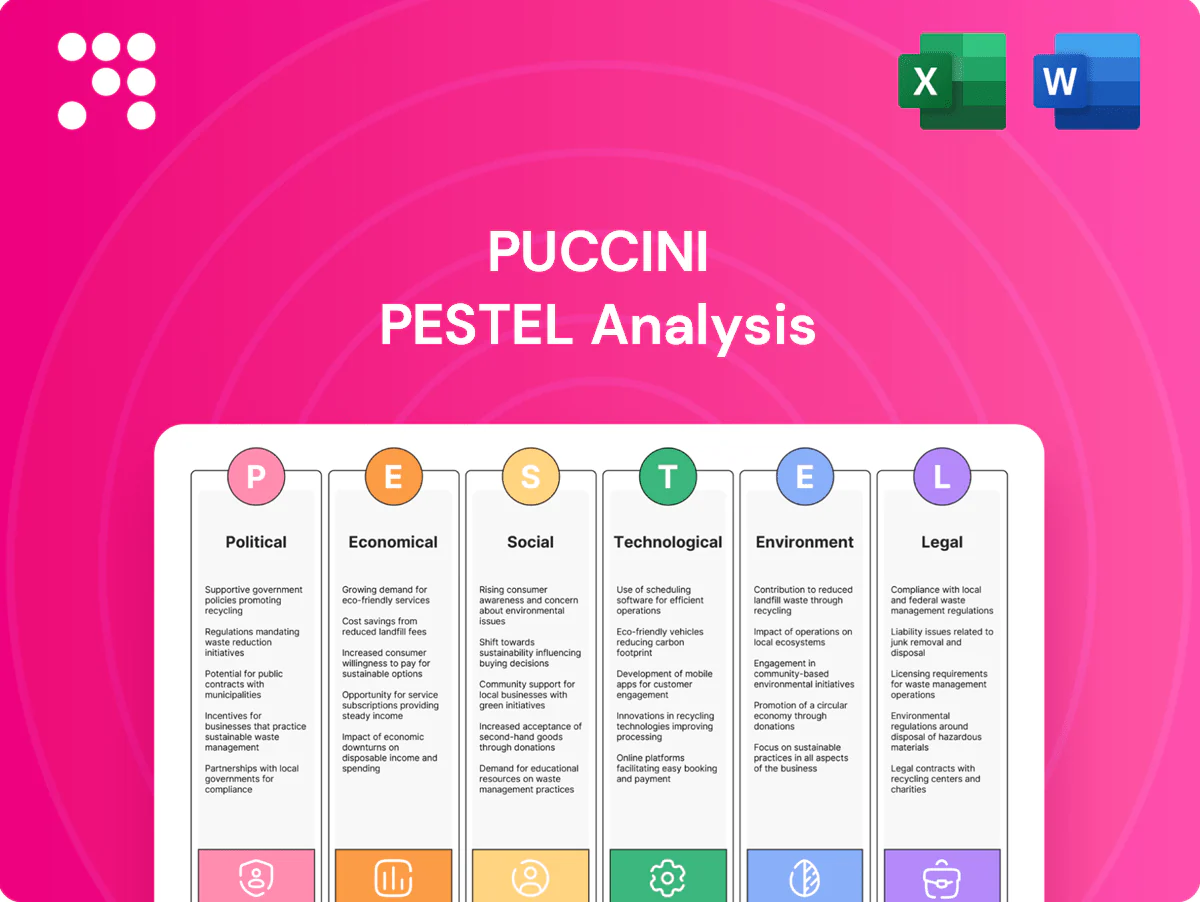
Puccini PESTLE Analysis

Your Competitive Advantage Starts with This Report
Our Puccini PESTLE Analysis pinpoints the political, economic, social, technological, legal, and environmental forces shaping the company’s outlook and competitive risks. Packed with actionable findings, it’s ideal for investors, strategists, and consultants seeking quick, reliable intelligence. Purchase the full report to access detailed drivers, forecasts, and ready-to-use slides that accelerate smarter decisions.
Political factors

EU trade policy and tariffs
As a German retailer Puccini is subject to the EU common external tariff regime on textiles and accessories, with extra-EU textile and clothing imports valued at about €121 billion in 2023, increasing exposure to tariff shifts. Changes in trade agreements or retaliatory tariffs can raise sourcing costs for silk and wool, where non-EU suppliers like China (≈35% of EU apparel imports) play a large role. Stable intra-EU trade enables smooth wholesale logistics, while non-EU imports face customs checks and rules of origin scrutiny that directly affect landed cost. Continuous monitoring of customs procedures and origin documentation is critical for cost control.
Geopolitical supply chain exposure
Political tensions in major hubs — China (≈30% of global textile production), Bangladesh (≈6%) and Turkey (≈5%) — can disrupt fabric and trim supplies; US Section 301 tariffs (up to 25%) and export controls on advanced fibers further constrain access. Diversified sourcing across regions and contingency plans with alternate mills and freight routes are essential to protect seasonal collections.

Government support for SMEs
German and EU SME programs—notably the EU Digital Europe Programme (€7.5bn 2021–27), COSME (€2.3bn) and Horizon Europe (€95.5bn)—offer financing, digitalisation grants and export support that can cut capex for e-commerce and logistics upgrades. Recent policy pivots increasingly target sustainability and innovation, redirecting funds accordingly. Maintaining eligibility requires strict compliance, documented KPIs and timely applications.

Public procurement and events climate
Political choices on public procurement and events directly shift formalwear demand: reduced state-backed ceremonies and civic events can soften tie and bow tie sales, while stimulus-driven event programs boost bookings; live-events revenue recovered to about 90% of 2019 levels by 2024, supporting higher formalwear turnover. City retail policies affect wholesale partners via zoning and high-street vacancy (UK 13.3% in 2023), making trade-body advocacy critical.
- Procurement shifts — lower public events reduce B2B formalwear orders
- Stimulus impact — 2024 live-events ~90% of 2019 revenue
- Retail zoning — UK high-street vacancy 13.3% (2023)
- Trade bodies — lobby for favorable retail environments
Regulatory stability in Germany/EU
Predictable policy frameworks in Germany/EU support Puccini’s long-term planning, while the EU Corporate Sustainability Reporting Directive (CSRD) — expanding reporting from ~11,000 to ~50,000 firms and effective for large companies from 2024 — increases disclosure requirements.
Sudden changes in labeling or sustainability rules (EU Strategy for Sustainable and Circular Textiles ongoing since 2022) raise administrative costs and compliance workload; alignment with EU standards eases cross-border wholesale within the single market.
Continuous monitoring of regulatory updates reduces risk of reporting gaps and potential penalties, improving operational resilience.
EU apparel sourcing risk: tariffs, geopolitics, and €121bn extra-EU imports
EU tariff regime and €121bn extra‑EU apparel imports (2023) raise sourcing cost risk; non‑EU suppliers (China ≈35% of EU apparel imports) amplify exposure. Political tensions in China/Bangladesh/Turkey threaten supply continuity; US tariffs/export controls add constraint. CSRD expansion to ~50,000 firms (effective 2024) and live‑events recovery (~90% of 2019 revenue by 2024) shift compliance and demand.
| Indicator | Value |
|---|---|
| Extra‑EU apparel imports (2023) | €121bn |
| China share of EU apparel imports | ≈35% |
| CSRD scope (from 2024) | ~50,000 firms |
| Live‑events recovery (2024) | ~90% of 2019 |
What is included in the product
 Detailed Word Document
Explores how external macro-environmental factors uniquely affect the Puccini across six dimensions—Political, Economic, Social, Technological, Environmental, and Legal—each section backed by current data and market trends. Designed for executives and advisors, the analysis is delivery-ready for plans, decks, and scenario planning to pinpoint risks and opportunities.

 Customizable Excel Spreadsheet
Provides a concise, visually segmented PESTLE summary of Puccini’s external landscape that’s easily shareable, editable for region- or business-specific notes, and ready to drop into presentations or planning sessions for quick team alignment.
Economic factors

Consumer spending cycles
Men’s accessories are highly discretionary and track income and confidence; the global apparel market was valued at about 1.7 trillion USD in 2023, amplifying sensitivity to downturns. Economic slowdowns compress formalwear demand while recoveries boost gifting and event-driven sales tied to the roughly 300 billion USD global wedding market (2023). Weddings, graduations and corporate events drive cycle upturns; adaptive inventory and targeted promotions reduce volatility.
Inflation and input costs
Rising input costs—silk and cotton up roughly 10–18% since 2023, logistics surcharges still ~50% above pre‑pandemic benchmarks and energy costs rising ~15% in 2024—compress Puccini’s margins. Passing costs risks premium positioning versus demand elasticity, with price increases limited by luxury price sensitivity. Long‑term supplier contracts and currency hedges covering a majority of COGS stabilize costs. Efficiency gains in warehousing and fulfillment preserve gross margin.

EUR exchange rate movements
EUR exchange rate swings materially affect Puccini: a strong euro (around EUR/USD 1.09 in mid‑2025) raises USD‑priced input costs and squeezes margins, while a weaker euro boosts EU export competitiveness. Hedging via forwards, options and FX swaps can smooth volatility—corporates reported using hedges for ~60% of FX exposure in 2024. Pricing strategies must plan for incomplete FX pass‑through to end customers.

Wholesale channel health
Department stores and menswear boutiques face structural pressures and rising operating costs that compress wholesale margins; partner solvency and slower inventory turnover directly reduce Puccini’s sell-in and cash flow. Diversifying accounts and implementing vendor-managed inventory can lower working capital—VMI has been shown to cut inventory by up to 20% (2024 studies). Online marketplaces drive incremental demand but incur typical fees of 8–15% that erode margins.
- Channel concentration risk
- Partner solvency impacts sell-in
- VMI reduces inventory ~20%
- Marketplace fees 8–15%
E-commerce growth and CAC
Puccini offset weaker brick-and-mortar with online sales growth—e-commerce channel revenue rose ~22% YoY through H1 2025 while fashion CAC climbed ~25% YoY, pressuring unit economics. Focusing SEO, email, and loyalty raised retention and LTV (loyalty programs +10–18% LTV), improving payback periods. Cross-selling pocket squares and cufflinks lifted AOV by ~8–12%, and tight returns handling (online apparel returns ~25%) preserves contribution margin.
- e-commerce +22% YoY (H1 2025)
- CAC +25% YoY
- LTV +10–18% via loyalty/email
- AOV +8–12% from cross-sell
- Returns ~25% — optimize to protect margin
EU apparel sourcing risk: tariffs, geopolitics, and €121bn extra-EU imports
Men’s accessories are highly discretionary; global apparel ~1.7T USD (2023) and wedding market ~300B USD (2023) drive sensitivity. Input costs up ~10–18% since 2023; logistics ~+50% vs pre‑pandemic and energy +15% (2024) compress margins. E‑commerce +22% H1 2025, CAC +25% YoY, loyalty lifts LTV 10–18%, returns ~25%.
| Metric | Value |
|---|---|
| Apparel market (2023) | 1.7T USD |
| Wedding market (2023) | 300B USD |
| Input cost rise | 10–18% |
| Logistics surcharge | +50% |
| E‑commerce H1 2025 | +22% YoY |
| CAC change | +25% YoY |
| Returns | ~25% |
Full Version Awaits
Puccini PESTLE Analysis
The preview shown here is the exact Puccini PESTLE Analysis document you’ll receive after purchase—fully formatted and ready to use. The layout, content, and structure visible are identical to the downloadable file. No placeholders or surprises; this is the final, professional report you’ll own immediately after checkout.

Your Competitive Advantage Starts with This Report
Our Puccini PESTLE Analysis pinpoints the political, economic, social, technological, legal, and environmental forces shaping the company’s outlook and competitive risks. Packed with actionable findings, it’s ideal for investors, strategists, and consultants seeking quick, reliable intelligence. Purchase the full report to access detailed drivers, forecasts, and ready-to-use slides that accelerate smarter decisions.
Political factors
EU trade policy and tariffs
As a German retailer Puccini is subject to the EU common external tariff regime on textiles and accessories, with extra-EU textile and clothing imports valued at about €121 billion in 2023, increasing exposure to tariff shifts. Changes in trade agreements or retaliatory tariffs can raise sourcing costs for silk and wool, where non-EU suppliers like China (≈35% of EU apparel imports) play a large role. Stable intra-EU trade enables smooth wholesale logistics, while non-EU imports face customs checks and rules of origin scrutiny that directly affect landed cost. Continuous monitoring of customs procedures and origin documentation is critical for cost control.
Geopolitical supply chain exposure
Political tensions in major hubs — China (≈30% of global textile production), Bangladesh (≈6%) and Turkey (≈5%) — can disrupt fabric and trim supplies; US Section 301 tariffs (up to 25%) and export controls on advanced fibers further constrain access. Diversified sourcing across regions and contingency plans with alternate mills and freight routes are essential to protect seasonal collections.
Government support for SMEs
German and EU SME programs—notably the EU Digital Europe Programme (€7.5bn 2021–27), COSME (€2.3bn) and Horizon Europe (€95.5bn)—offer financing, digitalisation grants and export support that can cut capex for e-commerce and logistics upgrades. Recent policy pivots increasingly target sustainability and innovation, redirecting funds accordingly. Maintaining eligibility requires strict compliance, documented KPIs and timely applications.
Public procurement and events climate
Political choices on public procurement and events directly shift formalwear demand: reduced state-backed ceremonies and civic events can soften tie and bow tie sales, while stimulus-driven event programs boost bookings; live-events revenue recovered to about 90% of 2019 levels by 2024, supporting higher formalwear turnover. City retail policies affect wholesale partners via zoning and high-street vacancy (UK 13.3% in 2023), making trade-body advocacy critical.
- Procurement shifts — lower public events reduce B2B formalwear orders
- Stimulus impact — 2024 live-events ~90% of 2019 revenue
- Retail zoning — UK high-street vacancy 13.3% (2023)
- Trade bodies — lobby for favorable retail environments
Regulatory stability in Germany/EU
Predictable policy frameworks in Germany/EU support Puccini’s long-term planning, while the EU Corporate Sustainability Reporting Directive (CSRD) — expanding reporting from ~11,000 to ~50,000 firms and effective for large companies from 2024 — increases disclosure requirements.
Sudden changes in labeling or sustainability rules (EU Strategy for Sustainable and Circular Textiles ongoing since 2022) raise administrative costs and compliance workload; alignment with EU standards eases cross-border wholesale within the single market.
Continuous monitoring of regulatory updates reduces risk of reporting gaps and potential penalties, improving operational resilience.
EU apparel sourcing risk: tariffs, geopolitics, and €121bn extra-EU imports
EU tariff regime and €121bn extra‑EU apparel imports (2023) raise sourcing cost risk; non‑EU suppliers (China ≈35% of EU apparel imports) amplify exposure. Political tensions in China/Bangladesh/Turkey threaten supply continuity; US tariffs/export controls add constraint. CSRD expansion to ~50,000 firms (effective 2024) and live‑events recovery (~90% of 2019 revenue by 2024) shift compliance and demand.
| Indicator | Value |
|---|---|
| Extra‑EU apparel imports (2023) | €121bn |
| China share of EU apparel imports | ≈35% |
| CSRD scope (from 2024) | ~50,000 firms |
| Live‑events recovery (2024) | ~90% of 2019 |
What is included in the product
Detailed Word Document
Explores how external macro-environmental factors uniquely affect the Puccini across six dimensions—Political, Economic, Social, Technological, Environmental, and Legal—each section backed by current data and market trends. Designed for executives and advisors, the analysis is delivery-ready for plans, decks, and scenario planning to pinpoint risks and opportunities.
Customizable Excel Spreadsheet
Provides a concise, visually segmented PESTLE summary of Puccini’s external landscape that’s easily shareable, editable for region- or business-specific notes, and ready to drop into presentations or planning sessions for quick team alignment.
Economic factors
Consumer spending cycles
Men’s accessories are highly discretionary and track income and confidence; the global apparel market was valued at about 1.7 trillion USD in 2023, amplifying sensitivity to downturns. Economic slowdowns compress formalwear demand while recoveries boost gifting and event-driven sales tied to the roughly 300 billion USD global wedding market (2023). Weddings, graduations and corporate events drive cycle upturns; adaptive inventory and targeted promotions reduce volatility.
Inflation and input costs
Rising input costs—silk and cotton up roughly 10–18% since 2023, logistics surcharges still ~50% above pre‑pandemic benchmarks and energy costs rising ~15% in 2024—compress Puccini’s margins. Passing costs risks premium positioning versus demand elasticity, with price increases limited by luxury price sensitivity. Long‑term supplier contracts and currency hedges covering a majority of COGS stabilize costs. Efficiency gains in warehousing and fulfillment preserve gross margin.
EUR exchange rate movements
EUR exchange rate swings materially affect Puccini: a strong euro (around EUR/USD 1.09 in mid‑2025) raises USD‑priced input costs and squeezes margins, while a weaker euro boosts EU export competitiveness. Hedging via forwards, options and FX swaps can smooth volatility—corporates reported using hedges for ~60% of FX exposure in 2024. Pricing strategies must plan for incomplete FX pass‑through to end customers.
Wholesale channel health
Department stores and menswear boutiques face structural pressures and rising operating costs that compress wholesale margins; partner solvency and slower inventory turnover directly reduce Puccini’s sell-in and cash flow. Diversifying accounts and implementing vendor-managed inventory can lower working capital—VMI has been shown to cut inventory by up to 20% (2024 studies). Online marketplaces drive incremental demand but incur typical fees of 8–15% that erode margins.
- Channel concentration risk
- Partner solvency impacts sell-in
- VMI reduces inventory ~20%
- Marketplace fees 8–15%
E-commerce growth and CAC
Puccini offset weaker brick-and-mortar with online sales growth—e-commerce channel revenue rose ~22% YoY through H1 2025 while fashion CAC climbed ~25% YoY, pressuring unit economics. Focusing SEO, email, and loyalty raised retention and LTV (loyalty programs +10–18% LTV), improving payback periods. Cross-selling pocket squares and cufflinks lifted AOV by ~8–12%, and tight returns handling (online apparel returns ~25%) preserves contribution margin.
- e-commerce +22% YoY (H1 2025)
- CAC +25% YoY
- LTV +10–18% via loyalty/email
- AOV +8–12% from cross-sell
- Returns ~25% — optimize to protect margin
EU apparel sourcing risk: tariffs, geopolitics, and €121bn extra-EU imports
Men’s accessories are highly discretionary; global apparel ~1.7T USD (2023) and wedding market ~300B USD (2023) drive sensitivity. Input costs up ~10–18% since 2023; logistics ~+50% vs pre‑pandemic and energy +15% (2024) compress margins. E‑commerce +22% H1 2025, CAC +25% YoY, loyalty lifts LTV 10–18%, returns ~25%.
| Metric | Value |
|---|---|
| Apparel market (2023) | 1.7T USD |
| Wedding market (2023) | 300B USD |
| Input cost rise | 10–18% |
| Logistics surcharge | +50% |
| E‑commerce H1 2025 | +22% YoY |
| CAC change | +25% YoY |
| Returns | ~25% |
Full Version Awaits
Puccini PESTLE Analysis
The preview shown here is the exact Puccini PESTLE Analysis document you’ll receive after purchase—fully formatted and ready to use. The layout, content, and structure visible are identical to the downloadable file. No placeholders or surprises; this is the final, professional report you’ll own immediately after checkout.
Description
Your Competitive Advantage Starts with This Report
Our Puccini PESTLE Analysis pinpoints the political, economic, social, technological, legal, and environmental forces shaping the company’s outlook and competitive risks. Packed with actionable findings, it’s ideal for investors, strategists, and consultants seeking quick, reliable intelligence. Purchase the full report to access detailed drivers, forecasts, and ready-to-use slides that accelerate smarter decisions.
Political factors
EU trade policy and tariffs
As a German retailer Puccini is subject to the EU common external tariff regime on textiles and accessories, with extra-EU textile and clothing imports valued at about €121 billion in 2023, increasing exposure to tariff shifts. Changes in trade agreements or retaliatory tariffs can raise sourcing costs for silk and wool, where non-EU suppliers like China (≈35% of EU apparel imports) play a large role. Stable intra-EU trade enables smooth wholesale logistics, while non-EU imports face customs checks and rules of origin scrutiny that directly affect landed cost. Continuous monitoring of customs procedures and origin documentation is critical for cost control.
Geopolitical supply chain exposure
Political tensions in major hubs — China (≈30% of global textile production), Bangladesh (≈6%) and Turkey (≈5%) — can disrupt fabric and trim supplies; US Section 301 tariffs (up to 25%) and export controls on advanced fibers further constrain access. Diversified sourcing across regions and contingency plans with alternate mills and freight routes are essential to protect seasonal collections.
Government support for SMEs
German and EU SME programs—notably the EU Digital Europe Programme (€7.5bn 2021–27), COSME (€2.3bn) and Horizon Europe (€95.5bn)—offer financing, digitalisation grants and export support that can cut capex for e-commerce and logistics upgrades. Recent policy pivots increasingly target sustainability and innovation, redirecting funds accordingly. Maintaining eligibility requires strict compliance, documented KPIs and timely applications.
Public procurement and events climate
Political choices on public procurement and events directly shift formalwear demand: reduced state-backed ceremonies and civic events can soften tie and bow tie sales, while stimulus-driven event programs boost bookings; live-events revenue recovered to about 90% of 2019 levels by 2024, supporting higher formalwear turnover. City retail policies affect wholesale partners via zoning and high-street vacancy (UK 13.3% in 2023), making trade-body advocacy critical.
- Procurement shifts — lower public events reduce B2B formalwear orders
- Stimulus impact — 2024 live-events ~90% of 2019 revenue
- Retail zoning — UK high-street vacancy 13.3% (2023)
- Trade bodies — lobby for favorable retail environments
Regulatory stability in Germany/EU
Predictable policy frameworks in Germany/EU support Puccini’s long-term planning, while the EU Corporate Sustainability Reporting Directive (CSRD) — expanding reporting from ~11,000 to ~50,000 firms and effective for large companies from 2024 — increases disclosure requirements.
Sudden changes in labeling or sustainability rules (EU Strategy for Sustainable and Circular Textiles ongoing since 2022) raise administrative costs and compliance workload; alignment with EU standards eases cross-border wholesale within the single market.
Continuous monitoring of regulatory updates reduces risk of reporting gaps and potential penalties, improving operational resilience.
EU apparel sourcing risk: tariffs, geopolitics, and €121bn extra-EU imports
EU tariff regime and €121bn extra‑EU apparel imports (2023) raise sourcing cost risk; non‑EU suppliers (China ≈35% of EU apparel imports) amplify exposure. Political tensions in China/Bangladesh/Turkey threaten supply continuity; US tariffs/export controls add constraint. CSRD expansion to ~50,000 firms (effective 2024) and live‑events recovery (~90% of 2019 revenue by 2024) shift compliance and demand.
| Indicator | Value |
|---|---|
| Extra‑EU apparel imports (2023) | €121bn |
| China share of EU apparel imports | ≈35% |
| CSRD scope (from 2024) | ~50,000 firms |
| Live‑events recovery (2024) | ~90% of 2019 |
What is included in the product
Detailed Word Document
Explores how external macro-environmental factors uniquely affect the Puccini across six dimensions—Political, Economic, Social, Technological, Environmental, and Legal—each section backed by current data and market trends. Designed for executives and advisors, the analysis is delivery-ready for plans, decks, and scenario planning to pinpoint risks and opportunities.
Customizable Excel Spreadsheet
Provides a concise, visually segmented PESTLE summary of Puccini’s external landscape that’s easily shareable, editable for region- or business-specific notes, and ready to drop into presentations or planning sessions for quick team alignment.
Economic factors
Consumer spending cycles
Men’s accessories are highly discretionary and track income and confidence; the global apparel market was valued at about 1.7 trillion USD in 2023, amplifying sensitivity to downturns. Economic slowdowns compress formalwear demand while recoveries boost gifting and event-driven sales tied to the roughly 300 billion USD global wedding market (2023). Weddings, graduations and corporate events drive cycle upturns; adaptive inventory and targeted promotions reduce volatility.
Inflation and input costs
Rising input costs—silk and cotton up roughly 10–18% since 2023, logistics surcharges still ~50% above pre‑pandemic benchmarks and energy costs rising ~15% in 2024—compress Puccini’s margins. Passing costs risks premium positioning versus demand elasticity, with price increases limited by luxury price sensitivity. Long‑term supplier contracts and currency hedges covering a majority of COGS stabilize costs. Efficiency gains in warehousing and fulfillment preserve gross margin.
EUR exchange rate movements
EUR exchange rate swings materially affect Puccini: a strong euro (around EUR/USD 1.09 in mid‑2025) raises USD‑priced input costs and squeezes margins, while a weaker euro boosts EU export competitiveness. Hedging via forwards, options and FX swaps can smooth volatility—corporates reported using hedges for ~60% of FX exposure in 2024. Pricing strategies must plan for incomplete FX pass‑through to end customers.
Wholesale channel health
Department stores and menswear boutiques face structural pressures and rising operating costs that compress wholesale margins; partner solvency and slower inventory turnover directly reduce Puccini’s sell-in and cash flow. Diversifying accounts and implementing vendor-managed inventory can lower working capital—VMI has been shown to cut inventory by up to 20% (2024 studies). Online marketplaces drive incremental demand but incur typical fees of 8–15% that erode margins.
- Channel concentration risk
- Partner solvency impacts sell-in
- VMI reduces inventory ~20%
- Marketplace fees 8–15%
E-commerce growth and CAC
Puccini offset weaker brick-and-mortar with online sales growth—e-commerce channel revenue rose ~22% YoY through H1 2025 while fashion CAC climbed ~25% YoY, pressuring unit economics. Focusing SEO, email, and loyalty raised retention and LTV (loyalty programs +10–18% LTV), improving payback periods. Cross-selling pocket squares and cufflinks lifted AOV by ~8–12%, and tight returns handling (online apparel returns ~25%) preserves contribution margin.
- e-commerce +22% YoY (H1 2025)
- CAC +25% YoY
- LTV +10–18% via loyalty/email
- AOV +8–12% from cross-sell
- Returns ~25% — optimize to protect margin
EU apparel sourcing risk: tariffs, geopolitics, and €121bn extra-EU imports
Men’s accessories are highly discretionary; global apparel ~1.7T USD (2023) and wedding market ~300B USD (2023) drive sensitivity. Input costs up ~10–18% since 2023; logistics ~+50% vs pre‑pandemic and energy +15% (2024) compress margins. E‑commerce +22% H1 2025, CAC +25% YoY, loyalty lifts LTV 10–18%, returns ~25%.
| Metric | Value |
|---|---|
| Apparel market (2023) | 1.7T USD |
| Wedding market (2023) | 300B USD |
| Input cost rise | 10–18% |
| Logistics surcharge | +50% |
| E‑commerce H1 2025 | +22% YoY |
| CAC change | +25% YoY |
| Returns | ~25% |
Full Version Awaits
Puccini PESTLE Analysis
The preview shown here is the exact Puccini PESTLE Analysis document you’ll receive after purchase—fully formatted and ready to use. The layout, content, and structure visible are identical to the downloadable file. No placeholders or surprises; this is the final, professional report you’ll own immediately after checkout.











