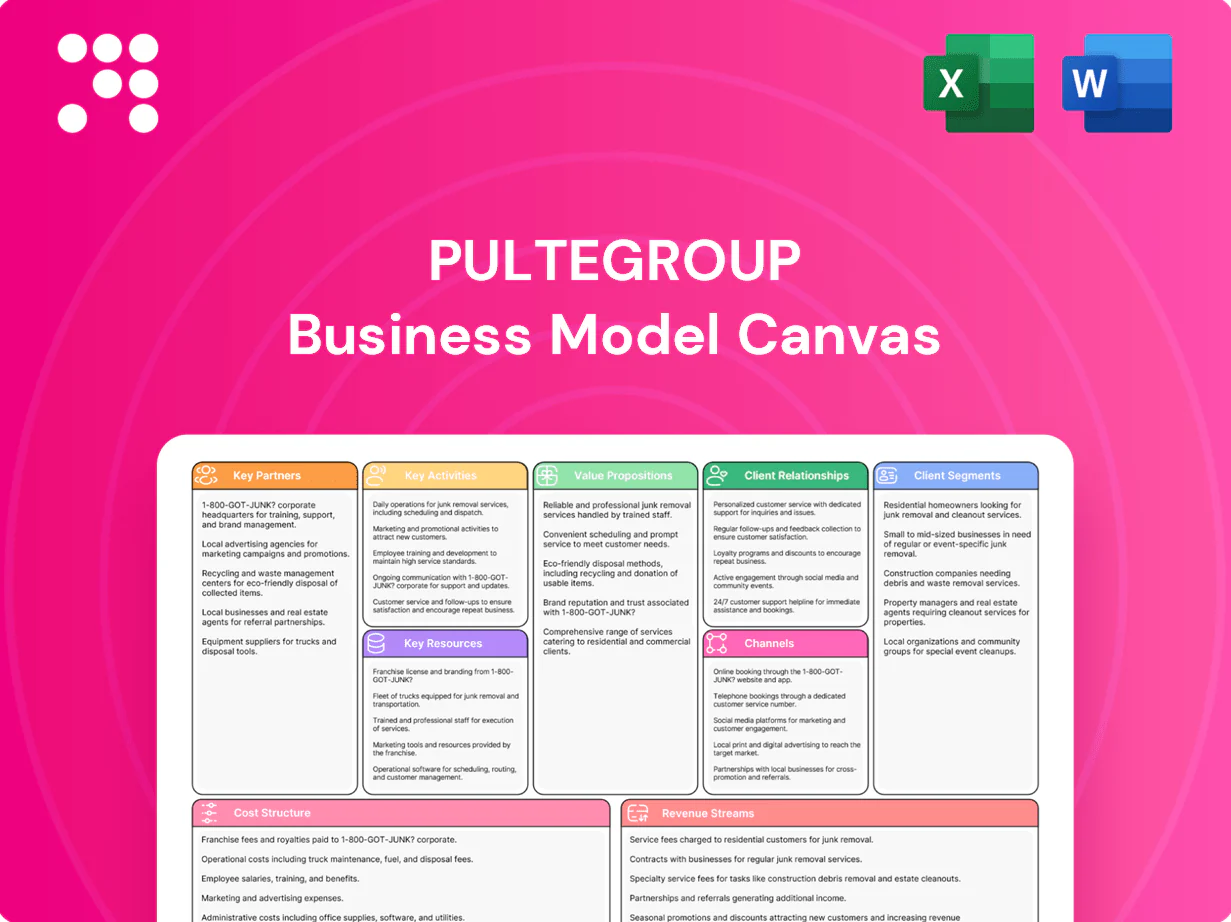
PulteGroup Business Model Canvas

Homebuilder Business Model Canvas: concise strategic blueprint and revenue insights
Explore PulteGroup's strategic blueprint with our concise Business Model Canvas summary—see how the homebuilder aligns value propositions, partnerships, and revenue streams to scale profitably. Dive deeper: the full, downloadable Canvas offers section-by-section insights, financial implications, and editable Word/Excel files for benchmarking and planning. Purchase now to access the complete strategic toolkit and accelerate your analysis.
Partnerships

National and regional landowners
Securing optioned and owned land underpins PulteGroup’s community pipeline and margin control, supporting its scale that produced roughly $17.9 billion in net revenues in 2024. Strong ties with national and regional landowners, land banks and developers provide flexibility across cycles and help manage lot absorption. Exclusive or priority deals accelerate approvals, lower bid competition and align entitlements, infrastructure phasing and release schedules.
Building material manufacturers and suppliers
Partnerships with lumber, concrete, roofing, window and appliance providers stabilized cost and availability, helping PulteGroup support roughly 44,000 home closings in 2024. National contracts delivered volume pricing and specification consistency, often trimming material spend by mid-single digits. Vendor-managed inventory and JIT deliveries compressed cycle time, while co-development of specs improved quality and warranty outcomes.

Trade contractors and labor networks
Reliable framers, MEP trades, drywallers, roofers and finish crews drive schedule certainty for PulteGroup, a top-five US homebuilder in 2024. Preferred trade programs enforce safety, QA/QC and cycle-time standards to protect margins and reduce rework. Multi-market partners enable rapid scaling and transfer of best practices across regions. Incentive structures tie trade pay to callbacks and customer-satisfaction metrics to align performance.

Financial institutions and insurers
Financial institutions and insurers—including warehouse lenders, mortgage investors and title underwriters—support Pulte Financial Services, expanding product breadth and rate competitiveness; in 2024 Pulte’s captive finance unit contributed materially to sales and mortgage servicing capabilities.
- Warehouse lenders: liquidity for originations
- Mortgage investors: broadened product/rates
- Hedging: pipeline and IR risk-sharing
- Insurers: lower construction/warranty risk
Municipalities and land-use authorities
Close coordination with municipalities and land-use authorities expedites entitlements, permits, and inspections, shortening approval timelines and reducing holding costs for PulteGroup developments.
Infrastructure agreements align public improvements with build schedules, ensuring timely utility and road work to support sales velocity and lot absorption.
Compliance partnerships and proactive community engagement reduce rework, legal friction, and support approvals for age-restricted and master-planned communities.
- Expedite entitlements
- Align public infrastructure
- Reduce compliance risk
- Support community approvals
Land, supplier and finance partnerships fueled $17.9B revenue and ~44,000 closings
Land partnerships secured PulteGroup’s pipeline, supporting $17.9B net revenue and ~44,000 home closings in 2024. Supplier and trade contracts trimmed material spend mid-single digits and compressed cycle times. Financial, municipal and insurer partners enabled Pulte Financial Services, liquidity, entitlements and risk transfer.
| Partnership | Role | 2024 Impact |
|---|---|---|
| Landowners/Developers | Pipeline & entitlements | Supported $17.9B revenue |
| Suppliers/Trades | Cost & schedule | ~44,000 closings; mid-single% savings |
| Finance/Insurers | Liquidity & risk | Enabled captive finance & hedging |
What is included in the product
 Detailed Word Document
A comprehensive Business Model Canvas for PulteGroup outlining customer segments, channels, value propositions, revenue streams, key activities, resources, partnerships, cost structure and governance, reflecting its homebuilding operations, land development strategy and mortgage services; ideal for investor presentations, strategic planning and competitive analysis with linked SWOT insights and actionable recommendations.

 Customizable Excel Spreadsheet
High-level PulteGroup business model with editable cells that condenses strategy into a digestible, one-page snapshot—ideal for quickly identifying core components, saving hours of formatting, and enabling team collaboration for boardrooms or fast deliverables.
Activities

Land acquisition and entitlement
Market scanning, underwriting, and option structures build a flexible lot pipeline that lets PulteGroup secure high-return parcels while limiting capital outlay. Focused entitlement management shortens approval cycles, cutting timeline risk and reducing holding costs. Active zoning, environmental review, and infrastructure coordination enable timely community launches, with phased lot releases used to align supply with housing demand cycles.
Design, engineering, and product development
Standardized plans tailored to local codes improve construction efficiency and reduced cycle times across PulteGroup’s top-5 homebuilder scale in 2024. Value engineering balances cost, speed, and buyer preferences to protect margins amid 2024 market pressure. Brand-specific elevations and floorplans target distinct segments across Pulte, Centex, and Del Webb portfolios. Continuous feedback loops from buyer data and sales centers refine features and options.

Construction and quality assurance
Lean scheduling and trade sequencing compress cycle times, helping PulteGroup sustain faster closings and contribute to a 2024 homebuilding gross margin near 27% reported by the company. Site supervision enforces safety and build standards, aligning with PulteGroup’s 2024 lower-than-industry warranty claims trend. QA checkpoints reduce callbacks and warranty costs, while data-driven variance control improved build efficiency and supported margin resilience in 2024.

Sales, marketing, and customer experience
In 2024 PulteGroup integrated online-to-onsite journeys to capture and convert leads, using model homes, design studios and virtual tools to personalize buyer choices and shorten sales cycles. CRM systems and NPS tracking elevated service levels across sales and construction, while structured post-close care drove repeat referrals and brand equity.
- Online-to-onsite conversion
- Model homes & virtual design
- CRM + NPS tracking
- Post-close referral programs
Mortgage, title, and closing services
In-house mortgage options streamline approvals and improve buyer capture while enabling rate-lock programs that optimize affordability amid 2024 30-year fixed mortgage rates near 7% (Freddie Mac).
Dedicated title and closing coordination removes friction and delays, and tight compliance and documentation workflows reduce post-close risk and warranty exposure.
- In-house financing: higher capture, faster approvals
- Rate lock & incentives: affordability management (30-yr ~7% in 2024)
- Title/closing coordination: fewer delays
- Compliance/documentation: lower post-close risk
Market-to-delivery cuts cycles; 27% margins amid 7% rates
Market-to-delivery activities—land acquisition, entitlement, standardized design, and lean construction—compress cycles and protect a 2024 homebuilding gross margin near 27%. Digital sales, in-house financing and tight title/closing workflows boost conversion amid 2024 30-yr rates ~7% (Freddie Mac). QA, warranty management and data loops lower post-close costs and support repeat referrals.
| Metric | 2024 |
|---|---|
| Homebuilding gross margin | ~27% |
| 30-yr fixed mortgage rate (Freddie Mac) | ~7% |
What You See Is What You Get
Business Model Canvas
The PulteGroup Business Model Canvas shown here is the actual deliverable, not a mockup, and reflects the full structure and content you’ll receive after purchase. When you complete your order you’ll download this same editable file, formatted and ready to use for analysis or presentation. No placeholders, no differences—what you preview is what you’ll own.

Homebuilder Business Model Canvas: concise strategic blueprint and revenue insights
Explore PulteGroup's strategic blueprint with our concise Business Model Canvas summary—see how the homebuilder aligns value propositions, partnerships, and revenue streams to scale profitably. Dive deeper: the full, downloadable Canvas offers section-by-section insights, financial implications, and editable Word/Excel files for benchmarking and planning. Purchase now to access the complete strategic toolkit and accelerate your analysis.
Partnerships
National and regional landowners
Securing optioned and owned land underpins PulteGroup’s community pipeline and margin control, supporting its scale that produced roughly $17.9 billion in net revenues in 2024. Strong ties with national and regional landowners, land banks and developers provide flexibility across cycles and help manage lot absorption. Exclusive or priority deals accelerate approvals, lower bid competition and align entitlements, infrastructure phasing and release schedules.
Building material manufacturers and suppliers
Partnerships with lumber, concrete, roofing, window and appliance providers stabilized cost and availability, helping PulteGroup support roughly 44,000 home closings in 2024. National contracts delivered volume pricing and specification consistency, often trimming material spend by mid-single digits. Vendor-managed inventory and JIT deliveries compressed cycle time, while co-development of specs improved quality and warranty outcomes.
Trade contractors and labor networks
Reliable framers, MEP trades, drywallers, roofers and finish crews drive schedule certainty for PulteGroup, a top-five US homebuilder in 2024. Preferred trade programs enforce safety, QA/QC and cycle-time standards to protect margins and reduce rework. Multi-market partners enable rapid scaling and transfer of best practices across regions. Incentive structures tie trade pay to callbacks and customer-satisfaction metrics to align performance.
Financial institutions and insurers
Financial institutions and insurers—including warehouse lenders, mortgage investors and title underwriters—support Pulte Financial Services, expanding product breadth and rate competitiveness; in 2024 Pulte’s captive finance unit contributed materially to sales and mortgage servicing capabilities.
- Warehouse lenders: liquidity for originations
- Mortgage investors: broadened product/rates
- Hedging: pipeline and IR risk-sharing
- Insurers: lower construction/warranty risk
Municipalities and land-use authorities
Close coordination with municipalities and land-use authorities expedites entitlements, permits, and inspections, shortening approval timelines and reducing holding costs for PulteGroup developments.
Infrastructure agreements align public improvements with build schedules, ensuring timely utility and road work to support sales velocity and lot absorption.
Compliance partnerships and proactive community engagement reduce rework, legal friction, and support approvals for age-restricted and master-planned communities.
- Expedite entitlements
- Align public infrastructure
- Reduce compliance risk
- Support community approvals
Land, supplier and finance partnerships fueled $17.9B revenue and ~44,000 closings
Land partnerships secured PulteGroup’s pipeline, supporting $17.9B net revenue and ~44,000 home closings in 2024. Supplier and trade contracts trimmed material spend mid-single digits and compressed cycle times. Financial, municipal and insurer partners enabled Pulte Financial Services, liquidity, entitlements and risk transfer.
| Partnership | Role | 2024 Impact |
|---|---|---|
| Landowners/Developers | Pipeline & entitlements | Supported $17.9B revenue |
| Suppliers/Trades | Cost & schedule | ~44,000 closings; mid-single% savings |
| Finance/Insurers | Liquidity & risk | Enabled captive finance & hedging |
What is included in the product
Detailed Word Document
A comprehensive Business Model Canvas for PulteGroup outlining customer segments, channels, value propositions, revenue streams, key activities, resources, partnerships, cost structure and governance, reflecting its homebuilding operations, land development strategy and mortgage services; ideal for investor presentations, strategic planning and competitive analysis with linked SWOT insights and actionable recommendations.
Customizable Excel Spreadsheet
High-level PulteGroup business model with editable cells that condenses strategy into a digestible, one-page snapshot—ideal for quickly identifying core components, saving hours of formatting, and enabling team collaboration for boardrooms or fast deliverables.
Activities
Land acquisition and entitlement
Market scanning, underwriting, and option structures build a flexible lot pipeline that lets PulteGroup secure high-return parcels while limiting capital outlay. Focused entitlement management shortens approval cycles, cutting timeline risk and reducing holding costs. Active zoning, environmental review, and infrastructure coordination enable timely community launches, with phased lot releases used to align supply with housing demand cycles.
Design, engineering, and product development
Standardized plans tailored to local codes improve construction efficiency and reduced cycle times across PulteGroup’s top-5 homebuilder scale in 2024. Value engineering balances cost, speed, and buyer preferences to protect margins amid 2024 market pressure. Brand-specific elevations and floorplans target distinct segments across Pulte, Centex, and Del Webb portfolios. Continuous feedback loops from buyer data and sales centers refine features and options.
Construction and quality assurance
Lean scheduling and trade sequencing compress cycle times, helping PulteGroup sustain faster closings and contribute to a 2024 homebuilding gross margin near 27% reported by the company. Site supervision enforces safety and build standards, aligning with PulteGroup’s 2024 lower-than-industry warranty claims trend. QA checkpoints reduce callbacks and warranty costs, while data-driven variance control improved build efficiency and supported margin resilience in 2024.
Sales, marketing, and customer experience
In 2024 PulteGroup integrated online-to-onsite journeys to capture and convert leads, using model homes, design studios and virtual tools to personalize buyer choices and shorten sales cycles. CRM systems and NPS tracking elevated service levels across sales and construction, while structured post-close care drove repeat referrals and brand equity.
- Online-to-onsite conversion
- Model homes & virtual design
- CRM + NPS tracking
- Post-close referral programs
Mortgage, title, and closing services
In-house mortgage options streamline approvals and improve buyer capture while enabling rate-lock programs that optimize affordability amid 2024 30-year fixed mortgage rates near 7% (Freddie Mac).
Dedicated title and closing coordination removes friction and delays, and tight compliance and documentation workflows reduce post-close risk and warranty exposure.
- In-house financing: higher capture, faster approvals
- Rate lock & incentives: affordability management (30-yr ~7% in 2024)
- Title/closing coordination: fewer delays
- Compliance/documentation: lower post-close risk
Market-to-delivery cuts cycles; 27% margins amid 7% rates
Market-to-delivery activities—land acquisition, entitlement, standardized design, and lean construction—compress cycles and protect a 2024 homebuilding gross margin near 27%. Digital sales, in-house financing and tight title/closing workflows boost conversion amid 2024 30-yr rates ~7% (Freddie Mac). QA, warranty management and data loops lower post-close costs and support repeat referrals.
| Metric | 2024 |
|---|---|
| Homebuilding gross margin | ~27% |
| 30-yr fixed mortgage rate (Freddie Mac) | ~7% |
What You See Is What You Get
Business Model Canvas
The PulteGroup Business Model Canvas shown here is the actual deliverable, not a mockup, and reflects the full structure and content you’ll receive after purchase. When you complete your order you’ll download this same editable file, formatted and ready to use for analysis or presentation. No placeholders, no differences—what you preview is what you’ll own.
Original: $10.00
-65%$10.00
$3.50Description
Homebuilder Business Model Canvas: concise strategic blueprint and revenue insights
Explore PulteGroup's strategic blueprint with our concise Business Model Canvas summary—see how the homebuilder aligns value propositions, partnerships, and revenue streams to scale profitably. Dive deeper: the full, downloadable Canvas offers section-by-section insights, financial implications, and editable Word/Excel files for benchmarking and planning. Purchase now to access the complete strategic toolkit and accelerate your analysis.
Partnerships
National and regional landowners
Securing optioned and owned land underpins PulteGroup’s community pipeline and margin control, supporting its scale that produced roughly $17.9 billion in net revenues in 2024. Strong ties with national and regional landowners, land banks and developers provide flexibility across cycles and help manage lot absorption. Exclusive or priority deals accelerate approvals, lower bid competition and align entitlements, infrastructure phasing and release schedules.
Building material manufacturers and suppliers
Partnerships with lumber, concrete, roofing, window and appliance providers stabilized cost and availability, helping PulteGroup support roughly 44,000 home closings in 2024. National contracts delivered volume pricing and specification consistency, often trimming material spend by mid-single digits. Vendor-managed inventory and JIT deliveries compressed cycle time, while co-development of specs improved quality and warranty outcomes.
Trade contractors and labor networks
Reliable framers, MEP trades, drywallers, roofers and finish crews drive schedule certainty for PulteGroup, a top-five US homebuilder in 2024. Preferred trade programs enforce safety, QA/QC and cycle-time standards to protect margins and reduce rework. Multi-market partners enable rapid scaling and transfer of best practices across regions. Incentive structures tie trade pay to callbacks and customer-satisfaction metrics to align performance.
Financial institutions and insurers
Financial institutions and insurers—including warehouse lenders, mortgage investors and title underwriters—support Pulte Financial Services, expanding product breadth and rate competitiveness; in 2024 Pulte’s captive finance unit contributed materially to sales and mortgage servicing capabilities.
- Warehouse lenders: liquidity for originations
- Mortgage investors: broadened product/rates
- Hedging: pipeline and IR risk-sharing
- Insurers: lower construction/warranty risk
Municipalities and land-use authorities
Close coordination with municipalities and land-use authorities expedites entitlements, permits, and inspections, shortening approval timelines and reducing holding costs for PulteGroup developments.
Infrastructure agreements align public improvements with build schedules, ensuring timely utility and road work to support sales velocity and lot absorption.
Compliance partnerships and proactive community engagement reduce rework, legal friction, and support approvals for age-restricted and master-planned communities.
- Expedite entitlements
- Align public infrastructure
- Reduce compliance risk
- Support community approvals
Land, supplier and finance partnerships fueled $17.9B revenue and ~44,000 closings
Land partnerships secured PulteGroup’s pipeline, supporting $17.9B net revenue and ~44,000 home closings in 2024. Supplier and trade contracts trimmed material spend mid-single digits and compressed cycle times. Financial, municipal and insurer partners enabled Pulte Financial Services, liquidity, entitlements and risk transfer.
| Partnership | Role | 2024 Impact |
|---|---|---|
| Landowners/Developers | Pipeline & entitlements | Supported $17.9B revenue |
| Suppliers/Trades | Cost & schedule | ~44,000 closings; mid-single% savings |
| Finance/Insurers | Liquidity & risk | Enabled captive finance & hedging |
What is included in the product
Detailed Word Document
A comprehensive Business Model Canvas for PulteGroup outlining customer segments, channels, value propositions, revenue streams, key activities, resources, partnerships, cost structure and governance, reflecting its homebuilding operations, land development strategy and mortgage services; ideal for investor presentations, strategic planning and competitive analysis with linked SWOT insights and actionable recommendations.
Customizable Excel Spreadsheet
High-level PulteGroup business model with editable cells that condenses strategy into a digestible, one-page snapshot—ideal for quickly identifying core components, saving hours of formatting, and enabling team collaboration for boardrooms or fast deliverables.
Activities
Land acquisition and entitlement
Market scanning, underwriting, and option structures build a flexible lot pipeline that lets PulteGroup secure high-return parcels while limiting capital outlay. Focused entitlement management shortens approval cycles, cutting timeline risk and reducing holding costs. Active zoning, environmental review, and infrastructure coordination enable timely community launches, with phased lot releases used to align supply with housing demand cycles.
Design, engineering, and product development
Standardized plans tailored to local codes improve construction efficiency and reduced cycle times across PulteGroup’s top-5 homebuilder scale in 2024. Value engineering balances cost, speed, and buyer preferences to protect margins amid 2024 market pressure. Brand-specific elevations and floorplans target distinct segments across Pulte, Centex, and Del Webb portfolios. Continuous feedback loops from buyer data and sales centers refine features and options.
Construction and quality assurance
Lean scheduling and trade sequencing compress cycle times, helping PulteGroup sustain faster closings and contribute to a 2024 homebuilding gross margin near 27% reported by the company. Site supervision enforces safety and build standards, aligning with PulteGroup’s 2024 lower-than-industry warranty claims trend. QA checkpoints reduce callbacks and warranty costs, while data-driven variance control improved build efficiency and supported margin resilience in 2024.
Sales, marketing, and customer experience
In 2024 PulteGroup integrated online-to-onsite journeys to capture and convert leads, using model homes, design studios and virtual tools to personalize buyer choices and shorten sales cycles. CRM systems and NPS tracking elevated service levels across sales and construction, while structured post-close care drove repeat referrals and brand equity.
- Online-to-onsite conversion
- Model homes & virtual design
- CRM + NPS tracking
- Post-close referral programs
Mortgage, title, and closing services
In-house mortgage options streamline approvals and improve buyer capture while enabling rate-lock programs that optimize affordability amid 2024 30-year fixed mortgage rates near 7% (Freddie Mac).
Dedicated title and closing coordination removes friction and delays, and tight compliance and documentation workflows reduce post-close risk and warranty exposure.
- In-house financing: higher capture, faster approvals
- Rate lock & incentives: affordability management (30-yr ~7% in 2024)
- Title/closing coordination: fewer delays
- Compliance/documentation: lower post-close risk
Market-to-delivery cuts cycles; 27% margins amid 7% rates
Market-to-delivery activities—land acquisition, entitlement, standardized design, and lean construction—compress cycles and protect a 2024 homebuilding gross margin near 27%. Digital sales, in-house financing and tight title/closing workflows boost conversion amid 2024 30-yr rates ~7% (Freddie Mac). QA, warranty management and data loops lower post-close costs and support repeat referrals.
| Metric | 2024 |
|---|---|
| Homebuilding gross margin | ~27% |
| 30-yr fixed mortgage rate (Freddie Mac) | ~7% |
What You See Is What You Get
Business Model Canvas
The PulteGroup Business Model Canvas shown here is the actual deliverable, not a mockup, and reflects the full structure and content you’ll receive after purchase. When you complete your order you’ll download this same editable file, formatted and ready to use for analysis or presentation. No placeholders, no differences—what you preview is what you’ll own.











