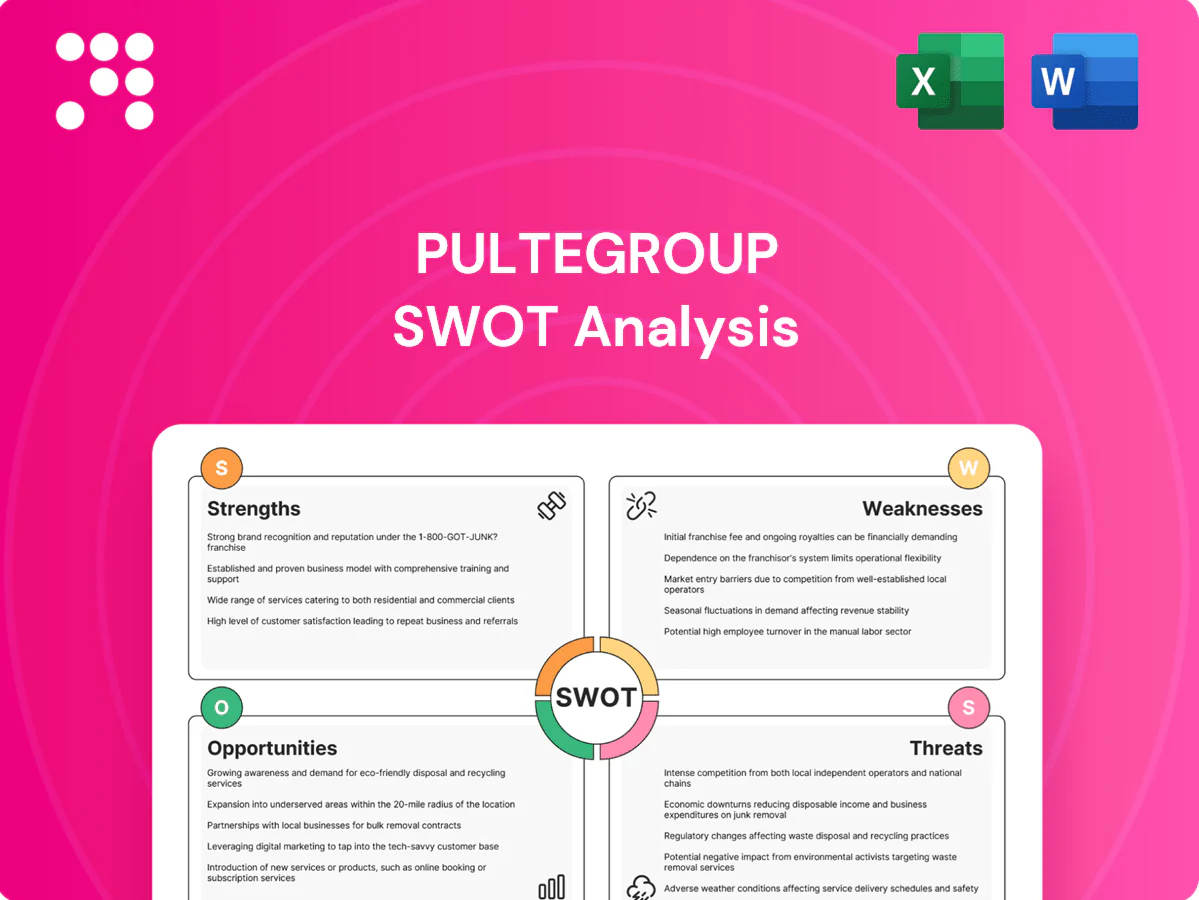
PulteGroup SWOT Analysis

Dive Deeper Into the Company’s Strategic Blueprint
PulteGroup combines scale, strong land backlog, and efficient buildops, but remains sensitive to interest-rate cycles and land-cost volatility. Opportunities include affordable housing demand and geographic expansion, while rising rates and supply constraints pose real risks. Want the full, editable SWOT with deep analysis and Excel tools? Purchase the complete report to plan and invest with confidence.
Strengths

Diversified brand portfolio
PulteGroup operates five distinct brands—Pulte Homes, Centex, Del Webb, DiVosta and John Wieland—allowing targeting of different buyer personas without diluting positioning. This segmentation boosts pricing power and lowers single-pool demand risk while enabling tailored product design and more efficient marketing. Cross-brand procurement and design synergies drive cost savings and margin enhancement across the portfolio.
Broad geographic footprint
PulteGroup (PHM) leverages a broad geographic footprint across roughly 30 U.S. markets, diluting regional economic and regulatory risk and supporting a multi-billion dollar backlog that improves revenue visibility. Its wide lot pipeline lets management shift volume into stronger metros as cycles move, while scale drives better pricing and terms with trades and suppliers, supporting consistent closings and operational agility.

Integrated financial services
Pulte Financial Services integrates mortgage and title to reduce buyer friction and accelerate cycle times, improving capture rates and closing predictability; in-house financing also adds ancillary fee income and higher margins while financing data refines underwriting and demand forecasting, strengthening both profitability and operational control.

Lifecycle segment coverage
Lifecycle segment coverage across first-time, move-up, luxury and active adult enables PulteGroup to retain customers as households evolve, smooth revenue volatility by spanning multiple price points, and capture margin uplift through optimized community absorption and mix.
- Retention via cross-segment funnel
- Diversified price exposure
- Shared design/construction platforms
- Community mix optimized for absorption & margins
Procurement scale and operational efficiency
Procurement scale and operational efficiency allow PulteGroup (NYSE: PHM) to leverage national purchasing to lower material costs and standardize plans, while repeatable building systems shorten cycle times and raise quality control; centralized design libraries cut rework and waste, supporting competitive pricing and protecting gross margins as reflected in the company’s 2024 disclosures.
- National purchasing: lower input costs
- Standard plans: faster approvals
- Repeatable systems: improved quality
- Design libraries: reduced waste
Diversified homebuilder: 5 brands, ~30 markets, multi‑billion backlog
PulteGroup (NYSE: PHM) combines five brands and ~30 U.S. markets to diversify demand and capture multiple price points, supporting a multi‑billion dollar backlog and scalable procurement synergies. Integrated Pulte Financial Services improves capture and closing predictability, while repeatable systems and national purchasing protect margins per 2024 disclosures.
| Metric | 2024 |
|---|---|
| Brands | 5 |
| Markets | ~30 |
| Backlog | multi‑billion (2024) |
What is included in the product
 Detailed Word Document
Provides a concise SWOT analysis of PulteGroup, highlighting internal strengths and weaknesses and external opportunities and threats shaping its competitive position in the U.S. homebuilding market.

 Customizable Excel Spreadsheet
Provides a concise SWOT matrix for fast, visual strategy alignment tailored to PulteGroup’s homebuilding strengths, market opportunities, regulatory risks, and competitive threats.
Weaknesses

High exposure to housing cycles
Revenue and margins remain tightly tied to macro housing demand; PulteGroup reported roughly $13 billion in 2024 net revenue, so declines in market activity quickly compress margins. Downturns weaken absorption, force higher incentives and raise cancellations (industry-wide spikes in 2022–24). Fixed overhead and community commitments limit rapid downsizing, complicating long-term capacity planning.
Capital-intensive land strategy
Securing and developing lots requires significant upfront capital and lengthy entitlement processes, creating concentration of investment in land and pre-construction costs. Land impairments can emerge quickly if demand softens or cost inflation rises, pressuring margins and earnings. Use of option agreements mitigates downside but increases option premiums and administrative complexity, while carrying land ties up liquidity compared with lighter-asset business models.

Interest-rate sensitivity
Even with in-house financing, buyer qualification remains tied to mortgage rates—30-year fixed was near 6.8% in mid-2025 per Freddie Mac—raising monthly payments and reducing affordability, forcing Pulte to offer larger incentives. Rate locks and buydowns compress gross margins and extend sales cycles. Demand elasticity can decline faster than Pulte can adjust pricing or construction costs, squeezing profitability.

Construction cycle-time and backlog risk
Long build cycles expose PulteGroup projects to cost inflation and cancellation risk, eroding margins and slowing revenue recognition; delays also damage customer satisfaction and referral potential while extending working capital needs. Backlog visibility can reverse quickly if market conditions weaken, increasing inventory and financing pressure.
- Risk: cost inflation and cancellations
- Customer: satisfaction/referral erosion
- Capital: higher working capital needs
- Backlog: rapid reversal risk
Product differentiation limits
Product differentiation is constrained as PulteGroup remains heavily single-family focused (2024 revenue ~$12.4B), exposing offerings to commoditization in many submarkets where location drives buyer choice and limits premium pricing. Competitors can replicate floorplans, finishes and financing incentives quickly, eroding margin upside. Sustaining differentiation requires continuous design and spec investment and higher per-home costs.
- Concentration: single-family heavy
- Replication risk: fast
- Location-driven pricing: lowers premiums
- Ongoing CAPEX: needed to differentiate
Housing slowdown squeezes margins; 2024 revenue ~$13B, 30-yr ~6.8%
Revenue and margins tightly track housing demand; 2024 net revenue about $13B, so market slowdowns quickly compress margins and raise cancellations. Heavy upfront land/pre‑construction capital and long entitlements concentrate investment and can trigger rapid land impairments. Mortgage rates (~6.8% 30‑yr mid‑2025) reduce affordability, force incentives and compress gross margins; long build cycles raise cost‑inflation and backlog reversal risk.
| Metric | Value |
|---|---|
| 2024 net revenue | $13B |
| 30‑yr fixed rate (mid‑2025) | ~6.8% |
| Industry cancellations | Spikes 2022–24 |
What You See Is What You Get
PulteGroup SWOT Analysis
This is the actual SWOT analysis document you’ll receive upon purchase—no surprises, just professional quality. The preview below is taken directly from the full SWOT report you'll get, with PulteGroup's strengths, weaknesses, opportunities and threats clearly laid out. Buy to unlock the complete, editable file.

Dive Deeper Into the Company’s Strategic Blueprint
PulteGroup combines scale, strong land backlog, and efficient buildops, but remains sensitive to interest-rate cycles and land-cost volatility. Opportunities include affordable housing demand and geographic expansion, while rising rates and supply constraints pose real risks. Want the full, editable SWOT with deep analysis and Excel tools? Purchase the complete report to plan and invest with confidence.
Strengths
Diversified brand portfolio
PulteGroup operates five distinct brands—Pulte Homes, Centex, Del Webb, DiVosta and John Wieland—allowing targeting of different buyer personas without diluting positioning. This segmentation boosts pricing power and lowers single-pool demand risk while enabling tailored product design and more efficient marketing. Cross-brand procurement and design synergies drive cost savings and margin enhancement across the portfolio.
Broad geographic footprint
PulteGroup (PHM) leverages a broad geographic footprint across roughly 30 U.S. markets, diluting regional economic and regulatory risk and supporting a multi-billion dollar backlog that improves revenue visibility. Its wide lot pipeline lets management shift volume into stronger metros as cycles move, while scale drives better pricing and terms with trades and suppliers, supporting consistent closings and operational agility.
Integrated financial services
Pulte Financial Services integrates mortgage and title to reduce buyer friction and accelerate cycle times, improving capture rates and closing predictability; in-house financing also adds ancillary fee income and higher margins while financing data refines underwriting and demand forecasting, strengthening both profitability and operational control.
Lifecycle segment coverage
Lifecycle segment coverage across first-time, move-up, luxury and active adult enables PulteGroup to retain customers as households evolve, smooth revenue volatility by spanning multiple price points, and capture margin uplift through optimized community absorption and mix.
- Retention via cross-segment funnel
- Diversified price exposure
- Shared design/construction platforms
- Community mix optimized for absorption & margins
Procurement scale and operational efficiency
Procurement scale and operational efficiency allow PulteGroup (NYSE: PHM) to leverage national purchasing to lower material costs and standardize plans, while repeatable building systems shorten cycle times and raise quality control; centralized design libraries cut rework and waste, supporting competitive pricing and protecting gross margins as reflected in the company’s 2024 disclosures.
- National purchasing: lower input costs
- Standard plans: faster approvals
- Repeatable systems: improved quality
- Design libraries: reduced waste
Diversified homebuilder: 5 brands, ~30 markets, multi‑billion backlog
PulteGroup (NYSE: PHM) combines five brands and ~30 U.S. markets to diversify demand and capture multiple price points, supporting a multi‑billion dollar backlog and scalable procurement synergies. Integrated Pulte Financial Services improves capture and closing predictability, while repeatable systems and national purchasing protect margins per 2024 disclosures.
| Metric | 2024 |
|---|---|
| Brands | 5 |
| Markets | ~30 |
| Backlog | multi‑billion (2024) |
What is included in the product
Detailed Word Document
Provides a concise SWOT analysis of PulteGroup, highlighting internal strengths and weaknesses and external opportunities and threats shaping its competitive position in the U.S. homebuilding market.
Customizable Excel Spreadsheet
Provides a concise SWOT matrix for fast, visual strategy alignment tailored to PulteGroup’s homebuilding strengths, market opportunities, regulatory risks, and competitive threats.
Weaknesses
High exposure to housing cycles
Revenue and margins remain tightly tied to macro housing demand; PulteGroup reported roughly $13 billion in 2024 net revenue, so declines in market activity quickly compress margins. Downturns weaken absorption, force higher incentives and raise cancellations (industry-wide spikes in 2022–24). Fixed overhead and community commitments limit rapid downsizing, complicating long-term capacity planning.
Capital-intensive land strategy
Securing and developing lots requires significant upfront capital and lengthy entitlement processes, creating concentration of investment in land and pre-construction costs. Land impairments can emerge quickly if demand softens or cost inflation rises, pressuring margins and earnings. Use of option agreements mitigates downside but increases option premiums and administrative complexity, while carrying land ties up liquidity compared with lighter-asset business models.
Interest-rate sensitivity
Even with in-house financing, buyer qualification remains tied to mortgage rates—30-year fixed was near 6.8% in mid-2025 per Freddie Mac—raising monthly payments and reducing affordability, forcing Pulte to offer larger incentives. Rate locks and buydowns compress gross margins and extend sales cycles. Demand elasticity can decline faster than Pulte can adjust pricing or construction costs, squeezing profitability.
Construction cycle-time and backlog risk
Long build cycles expose PulteGroup projects to cost inflation and cancellation risk, eroding margins and slowing revenue recognition; delays also damage customer satisfaction and referral potential while extending working capital needs. Backlog visibility can reverse quickly if market conditions weaken, increasing inventory and financing pressure.
- Risk: cost inflation and cancellations
- Customer: satisfaction/referral erosion
- Capital: higher working capital needs
- Backlog: rapid reversal risk
Product differentiation limits
Product differentiation is constrained as PulteGroup remains heavily single-family focused (2024 revenue ~$12.4B), exposing offerings to commoditization in many submarkets where location drives buyer choice and limits premium pricing. Competitors can replicate floorplans, finishes and financing incentives quickly, eroding margin upside. Sustaining differentiation requires continuous design and spec investment and higher per-home costs.
- Concentration: single-family heavy
- Replication risk: fast
- Location-driven pricing: lowers premiums
- Ongoing CAPEX: needed to differentiate
Housing slowdown squeezes margins; 2024 revenue ~$13B, 30-yr ~6.8%
Revenue and margins tightly track housing demand; 2024 net revenue about $13B, so market slowdowns quickly compress margins and raise cancellations. Heavy upfront land/pre‑construction capital and long entitlements concentrate investment and can trigger rapid land impairments. Mortgage rates (~6.8% 30‑yr mid‑2025) reduce affordability, force incentives and compress gross margins; long build cycles raise cost‑inflation and backlog reversal risk.
| Metric | Value |
|---|---|
| 2024 net revenue | $13B |
| 30‑yr fixed rate (mid‑2025) | ~6.8% |
| Industry cancellations | Spikes 2022–24 |
What You See Is What You Get
PulteGroup SWOT Analysis
This is the actual SWOT analysis document you’ll receive upon purchase—no surprises, just professional quality. The preview below is taken directly from the full SWOT report you'll get, with PulteGroup's strengths, weaknesses, opportunities and threats clearly laid out. Buy to unlock the complete, editable file.
Description
Dive Deeper Into the Company’s Strategic Blueprint
PulteGroup combines scale, strong land backlog, and efficient buildops, but remains sensitive to interest-rate cycles and land-cost volatility. Opportunities include affordable housing demand and geographic expansion, while rising rates and supply constraints pose real risks. Want the full, editable SWOT with deep analysis and Excel tools? Purchase the complete report to plan and invest with confidence.
Strengths
Diversified brand portfolio
PulteGroup operates five distinct brands—Pulte Homes, Centex, Del Webb, DiVosta and John Wieland—allowing targeting of different buyer personas without diluting positioning. This segmentation boosts pricing power and lowers single-pool demand risk while enabling tailored product design and more efficient marketing. Cross-brand procurement and design synergies drive cost savings and margin enhancement across the portfolio.
Broad geographic footprint
PulteGroup (PHM) leverages a broad geographic footprint across roughly 30 U.S. markets, diluting regional economic and regulatory risk and supporting a multi-billion dollar backlog that improves revenue visibility. Its wide lot pipeline lets management shift volume into stronger metros as cycles move, while scale drives better pricing and terms with trades and suppliers, supporting consistent closings and operational agility.
Integrated financial services
Pulte Financial Services integrates mortgage and title to reduce buyer friction and accelerate cycle times, improving capture rates and closing predictability; in-house financing also adds ancillary fee income and higher margins while financing data refines underwriting and demand forecasting, strengthening both profitability and operational control.
Lifecycle segment coverage
Lifecycle segment coverage across first-time, move-up, luxury and active adult enables PulteGroup to retain customers as households evolve, smooth revenue volatility by spanning multiple price points, and capture margin uplift through optimized community absorption and mix.
- Retention via cross-segment funnel
- Diversified price exposure
- Shared design/construction platforms
- Community mix optimized for absorption & margins
Procurement scale and operational efficiency
Procurement scale and operational efficiency allow PulteGroup (NYSE: PHM) to leverage national purchasing to lower material costs and standardize plans, while repeatable building systems shorten cycle times and raise quality control; centralized design libraries cut rework and waste, supporting competitive pricing and protecting gross margins as reflected in the company’s 2024 disclosures.
- National purchasing: lower input costs
- Standard plans: faster approvals
- Repeatable systems: improved quality
- Design libraries: reduced waste
Diversified homebuilder: 5 brands, ~30 markets, multi‑billion backlog
PulteGroup (NYSE: PHM) combines five brands and ~30 U.S. markets to diversify demand and capture multiple price points, supporting a multi‑billion dollar backlog and scalable procurement synergies. Integrated Pulte Financial Services improves capture and closing predictability, while repeatable systems and national purchasing protect margins per 2024 disclosures.
| Metric | 2024 |
|---|---|
| Brands | 5 |
| Markets | ~30 |
| Backlog | multi‑billion (2024) |
What is included in the product
Detailed Word Document
Provides a concise SWOT analysis of PulteGroup, highlighting internal strengths and weaknesses and external opportunities and threats shaping its competitive position in the U.S. homebuilding market.
Customizable Excel Spreadsheet
Provides a concise SWOT matrix for fast, visual strategy alignment tailored to PulteGroup’s homebuilding strengths, market opportunities, regulatory risks, and competitive threats.
Weaknesses
High exposure to housing cycles
Revenue and margins remain tightly tied to macro housing demand; PulteGroup reported roughly $13 billion in 2024 net revenue, so declines in market activity quickly compress margins. Downturns weaken absorption, force higher incentives and raise cancellations (industry-wide spikes in 2022–24). Fixed overhead and community commitments limit rapid downsizing, complicating long-term capacity planning.
Capital-intensive land strategy
Securing and developing lots requires significant upfront capital and lengthy entitlement processes, creating concentration of investment in land and pre-construction costs. Land impairments can emerge quickly if demand softens or cost inflation rises, pressuring margins and earnings. Use of option agreements mitigates downside but increases option premiums and administrative complexity, while carrying land ties up liquidity compared with lighter-asset business models.
Interest-rate sensitivity
Even with in-house financing, buyer qualification remains tied to mortgage rates—30-year fixed was near 6.8% in mid-2025 per Freddie Mac—raising monthly payments and reducing affordability, forcing Pulte to offer larger incentives. Rate locks and buydowns compress gross margins and extend sales cycles. Demand elasticity can decline faster than Pulte can adjust pricing or construction costs, squeezing profitability.
Construction cycle-time and backlog risk
Long build cycles expose PulteGroup projects to cost inflation and cancellation risk, eroding margins and slowing revenue recognition; delays also damage customer satisfaction and referral potential while extending working capital needs. Backlog visibility can reverse quickly if market conditions weaken, increasing inventory and financing pressure.
- Risk: cost inflation and cancellations
- Customer: satisfaction/referral erosion
- Capital: higher working capital needs
- Backlog: rapid reversal risk
Product differentiation limits
Product differentiation is constrained as PulteGroup remains heavily single-family focused (2024 revenue ~$12.4B), exposing offerings to commoditization in many submarkets where location drives buyer choice and limits premium pricing. Competitors can replicate floorplans, finishes and financing incentives quickly, eroding margin upside. Sustaining differentiation requires continuous design and spec investment and higher per-home costs.
- Concentration: single-family heavy
- Replication risk: fast
- Location-driven pricing: lowers premiums
- Ongoing CAPEX: needed to differentiate
Housing slowdown squeezes margins; 2024 revenue ~$13B, 30-yr ~6.8%
Revenue and margins tightly track housing demand; 2024 net revenue about $13B, so market slowdowns quickly compress margins and raise cancellations. Heavy upfront land/pre‑construction capital and long entitlements concentrate investment and can trigger rapid land impairments. Mortgage rates (~6.8% 30‑yr mid‑2025) reduce affordability, force incentives and compress gross margins; long build cycles raise cost‑inflation and backlog reversal risk.
| Metric | Value |
|---|---|
| 2024 net revenue | $13B |
| 30‑yr fixed rate (mid‑2025) | ~6.8% |
| Industry cancellations | Spikes 2022–24 |
What You See Is What You Get
PulteGroup SWOT Analysis
This is the actual SWOT analysis document you’ll receive upon purchase—no surprises, just professional quality. The preview below is taken directly from the full SWOT report you'll get, with PulteGroup's strengths, weaknesses, opportunities and threats clearly laid out. Buy to unlock the complete, editable file.











