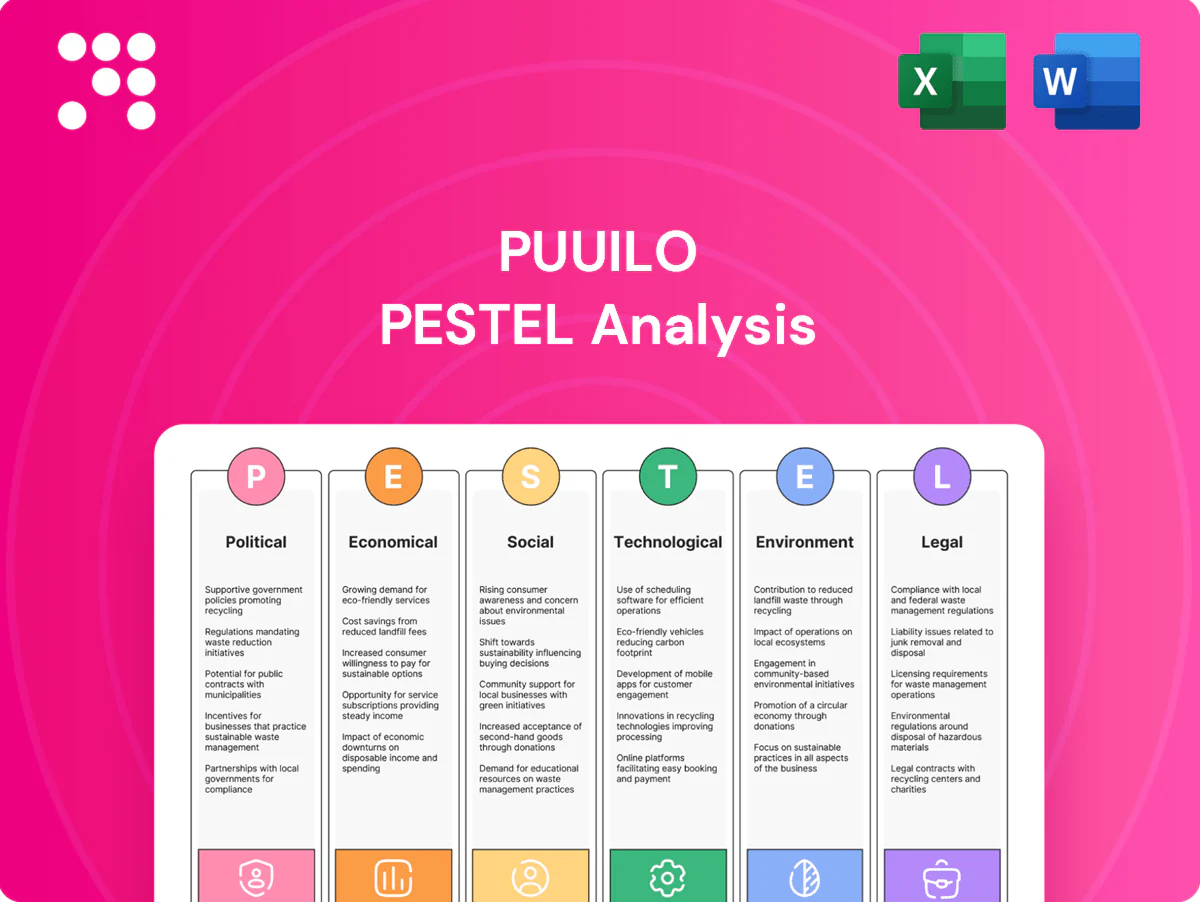
Puuilo PESTLE Analysis

Make Smarter Strategic Decisions with a Complete PESTEL View
Our PESTLE Analysis reveals how political shifts, economic cycles, social trends, and technology developments are shaping Puuilo's strategic outlook. It highlights regulatory risks and environmental opportunities that could affect margins and growth. Ideal for investors and strategists, the full report delivers actionable insights and ready-to-use charts. Purchase the complete PESTLE now to make informed, data-driven decisions.
Political factors

Finland retail policy stability
Finland’s stable political environment and EU membership support predictable retail operations across a population of about 5.6 million and a road network of roughly 78,000 km, aiding logistics to regional towns where discount formats perform well. Municipal permitting still varies across ~300 municipalities, so proactive engagement with local authorities speeds store openings and expansions.
EU single market and trade
As an EU member, Finland benefits from friction-reduced intra-EU sourcing for DIY, garden and household categories, supporting supply-chain efficiency; Eurostat reports 66% of EU goods trade was intra-EU in 2023. Customs formalities and anti-dumping duties on non-EU imports can raise landed costs for tools and consumer goods. EU-Asia trade tensions increase price volatility, so diversifying suppliers within the EU and EEA mitigates disruption risk.

Public procurement and stimulus
EU recovery funding via NextGenerationEU (€806.9bn) and the Renovation Wave (aiming to double annual energy renovation rates by 2030) support housing renovation, energy-efficiency and rural development, lifting DIY demand and categories tied to heat pumps, insulation and EV charging. Cuts or fiscal tightening would reduce stimulus and project volumes; monitoring policy cycles guides seasonal inventory bets.

Regional development and zoning
Local zoning decisions in Finland and other markets determine availability of large-format sites for Puuilo, often pushing operations toward retail parks and growth corridors where municipal incentives lower land and infrastructure costs.
Restrictions on signage, parking minimums and traffic access can materially reduce footfall potential; early engagement in planning secures favorable conditions and access agreements.
- zoning directs site supply toward retail parks
- municipal incentives cut upfront setup barriers
- signage/parking limits reduce customer catchment
- early planning engagement mitigates regulatory delays
Geopolitical proximity to Russia
- Sanctions/NATO impact: reduced Russia trade to ~1% (2023)
- Energy/price shock: Nordic power volatility 2022–24 increased logistics costs
- Supply-chain risk: ~80% seaborne trade via Baltic Sea needs contingency planning
Finland: stable politics, 5.6M; EU funds €806.9bn
Finland’s stable politics, EU membership and NATO accession (Apr 2023) support predictable retail operations across ~5.6M people, but ~300+ municipal permitting regimes affect store rollout timing. EU recovery funds (NextGenerationEU €806.9bn) and Renovation Wave boost DIY demand; sanctions cut Russia trade to ~1% (2023), shifting Baltic Sea-dependent supply chains (~80% seaborne trade) risk profile.
| Indicator | Value | Implication |
|---|---|---|
| Population | 5.6M (2024) | Domestic market size |
| Municipalities | ~310 | Local permitting variation |
| EU funds | €806.9bn | Renovation-driven demand |
| Russia trade | ~1% (2023) | Trade diversion |
| Baltic trade | ~80% | Maritime supply risk |
What is included in the product
 Detailed Word Document
Explores how macro-environmental factors uniquely affect Puuilo across Political, Economic, Social, Technological, Environmental and Legal dimensions, with data-backed trends and concrete sub-points tailored to the Finnish retail context; designed to help executives and investors identify risks, opportunities and scenario-driven strategies.

 Customizable Excel Spreadsheet
A clean, summarized PESTLE of Puuilo, visually segmented by category for quick interpretation and easy insertion into slides. Shareable and editable, it supports rapid team alignment and focused discussions on external risks and market positioning during planning sessions.
Economic factors

Consumer purchasing power
Inflation in Finland eased to around 2% in 2024 while ECB policy rates have averaged roughly 4–4.5% in 2024–25, directly squeezing discretionary spend on DIY and household items. Discount formats typically gain share in downcycles as households trade down; Puuilo’s value positioning benefits from this shift. Wage growth near 3% and unemployment around mid-single digits set basket sizes, so active price-elasticity management is key to protecting margin and volume.
Construction and renovation cycle
New housing starts—about 28,000 in Finland in 2024 per Statistics Finland—and renovation activity directly drive demand for tools, hardware and building supplies, boosting Puuilo sales. A weak housing market pressures big-ticket item turnover but increases DIY purchases among consumers. Professional trade customers, who contribute a significant share of revenue, help stabilize income across cycles. Seasonal weather spikes amplify garden and outdoor categories each spring/summer.

Currency and import costs
A euro trading near 1.08 vs USD in July 2025 changes sourcing economics for Puuilo, making euro weakness raise imported cost for non-euro suppliers and vice versa. Freight rates, with Drewry WCI averages near $1,500 per 40ft in 2024, and container availability directly raise landed cost and shelf prices. Active FX hedging and multi-sourcing strategies limit margin swings, while transparent EDLP pricing sustains customer trust amid cost volatility.

Labor availability and wage trends
Puuillo faces retail wage inflation and staffing shortages that pushed Finnish retail wages about 5% higher in 2024, raising hourly labour costs and pressuring margins. Regional stores encounter tighter hiring pools, slowing new-store openings. Productivity tools and optimized scheduling can offset pressure while a stable, growing employer brand supports retention.
- Wage inflation ~5% (2024)
- Staffing limits slow opening cadence
- Scheduling/productivity tools reduce margin impact
- Strong employer brand aids retention
Omnichannel cost-to-serve
In Puuilo's low‑margin discount model, click‑and‑collect and parcel delivery economics are critical: BOPIS can cut last‑mile costs by up to 40%, driving profitability where dense store coverage exists; efficient returns handling is essential given an average e‑commerce return rate near 18% to protect margins; data‑driven assortment localization trims inventory carrying costs, typically ~25% annually, improving cash conversion.
- Last‑mile saving: BOPIS ≈40%
- Returns rate: ≈18%
- Inventory carrying cost: ≈25% p.a.
- Dense stores = lower parcel cost & profitable BOPIS
Finland: stable politics, 5.6M; EU funds €806.9bn
Inflation ~2% (2024) and ECB rates ~4–4.5% (2024–25) squeeze discretionary DIY spend but favor discount formats like Puuilo; housing starts ~28,000 (2024) and steady renovation demand support sales; retail wage inflation ~5% (2024) and staffing limits pressure margins, making price elasticity, FX hedging and BOPIS critical.
| Metric | Value |
|---|---|
| Inflation (FI) | ~2% (2024) |
| ECB rate | 4–4.5% (2024–25) |
| Housing starts | 28,000 (2024) |
| Retail wage inflation | ~5% (2024) |
| EUR/USD | ~1.08 (Jul 2025) |
| BOPIS saving | ≈40% |
| Returns rate | ≈18% |
Same Document Delivered
Puuilo PESTLE Analysis
The Puuilo PESTLE Analysis preview shown here is the exact document you’ll receive after purchase—fully formatted and ready to use. The layout, content, and structure are identical to the downloadable file. No placeholders or teasers—this is the final, professional report you’ll own immediately after checkout.

Make Smarter Strategic Decisions with a Complete PESTEL View
Our PESTLE Analysis reveals how political shifts, economic cycles, social trends, and technology developments are shaping Puuilo's strategic outlook. It highlights regulatory risks and environmental opportunities that could affect margins and growth. Ideal for investors and strategists, the full report delivers actionable insights and ready-to-use charts. Purchase the complete PESTLE now to make informed, data-driven decisions.
Political factors
Finland retail policy stability
Finland’s stable political environment and EU membership support predictable retail operations across a population of about 5.6 million and a road network of roughly 78,000 km, aiding logistics to regional towns where discount formats perform well. Municipal permitting still varies across ~300 municipalities, so proactive engagement with local authorities speeds store openings and expansions.
EU single market and trade
As an EU member, Finland benefits from friction-reduced intra-EU sourcing for DIY, garden and household categories, supporting supply-chain efficiency; Eurostat reports 66% of EU goods trade was intra-EU in 2023. Customs formalities and anti-dumping duties on non-EU imports can raise landed costs for tools and consumer goods. EU-Asia trade tensions increase price volatility, so diversifying suppliers within the EU and EEA mitigates disruption risk.
Public procurement and stimulus
EU recovery funding via NextGenerationEU (€806.9bn) and the Renovation Wave (aiming to double annual energy renovation rates by 2030) support housing renovation, energy-efficiency and rural development, lifting DIY demand and categories tied to heat pumps, insulation and EV charging. Cuts or fiscal tightening would reduce stimulus and project volumes; monitoring policy cycles guides seasonal inventory bets.
Regional development and zoning
Local zoning decisions in Finland and other markets determine availability of large-format sites for Puuilo, often pushing operations toward retail parks and growth corridors where municipal incentives lower land and infrastructure costs.
Restrictions on signage, parking minimums and traffic access can materially reduce footfall potential; early engagement in planning secures favorable conditions and access agreements.
- zoning directs site supply toward retail parks
- municipal incentives cut upfront setup barriers
- signage/parking limits reduce customer catchment
- early planning engagement mitigates regulatory delays
Geopolitical proximity to Russia
- Sanctions/NATO impact: reduced Russia trade to ~1% (2023)
- Energy/price shock: Nordic power volatility 2022–24 increased logistics costs
- Supply-chain risk: ~80% seaborne trade via Baltic Sea needs contingency planning
Finland: stable politics, 5.6M; EU funds €806.9bn
Finland’s stable politics, EU membership and NATO accession (Apr 2023) support predictable retail operations across ~5.6M people, but ~300+ municipal permitting regimes affect store rollout timing. EU recovery funds (NextGenerationEU €806.9bn) and Renovation Wave boost DIY demand; sanctions cut Russia trade to ~1% (2023), shifting Baltic Sea-dependent supply chains (~80% seaborne trade) risk profile.
| Indicator | Value | Implication |
|---|---|---|
| Population | 5.6M (2024) | Domestic market size |
| Municipalities | ~310 | Local permitting variation |
| EU funds | €806.9bn | Renovation-driven demand |
| Russia trade | ~1% (2023) | Trade diversion |
| Baltic trade | ~80% | Maritime supply risk |
What is included in the product
Detailed Word Document
Explores how macro-environmental factors uniquely affect Puuilo across Political, Economic, Social, Technological, Environmental and Legal dimensions, with data-backed trends and concrete sub-points tailored to the Finnish retail context; designed to help executives and investors identify risks, opportunities and scenario-driven strategies.
Customizable Excel Spreadsheet
A clean, summarized PESTLE of Puuilo, visually segmented by category for quick interpretation and easy insertion into slides. Shareable and editable, it supports rapid team alignment and focused discussions on external risks and market positioning during planning sessions.
Economic factors
Consumer purchasing power
Inflation in Finland eased to around 2% in 2024 while ECB policy rates have averaged roughly 4–4.5% in 2024–25, directly squeezing discretionary spend on DIY and household items. Discount formats typically gain share in downcycles as households trade down; Puuilo’s value positioning benefits from this shift. Wage growth near 3% and unemployment around mid-single digits set basket sizes, so active price-elasticity management is key to protecting margin and volume.
Construction and renovation cycle
New housing starts—about 28,000 in Finland in 2024 per Statistics Finland—and renovation activity directly drive demand for tools, hardware and building supplies, boosting Puuilo sales. A weak housing market pressures big-ticket item turnover but increases DIY purchases among consumers. Professional trade customers, who contribute a significant share of revenue, help stabilize income across cycles. Seasonal weather spikes amplify garden and outdoor categories each spring/summer.
Currency and import costs
A euro trading near 1.08 vs USD in July 2025 changes sourcing economics for Puuilo, making euro weakness raise imported cost for non-euro suppliers and vice versa. Freight rates, with Drewry WCI averages near $1,500 per 40ft in 2024, and container availability directly raise landed cost and shelf prices. Active FX hedging and multi-sourcing strategies limit margin swings, while transparent EDLP pricing sustains customer trust amid cost volatility.
Labor availability and wage trends
Puuillo faces retail wage inflation and staffing shortages that pushed Finnish retail wages about 5% higher in 2024, raising hourly labour costs and pressuring margins. Regional stores encounter tighter hiring pools, slowing new-store openings. Productivity tools and optimized scheduling can offset pressure while a stable, growing employer brand supports retention.
- Wage inflation ~5% (2024)
- Staffing limits slow opening cadence
- Scheduling/productivity tools reduce margin impact
- Strong employer brand aids retention
Omnichannel cost-to-serve
In Puuilo's low‑margin discount model, click‑and‑collect and parcel delivery economics are critical: BOPIS can cut last‑mile costs by up to 40%, driving profitability where dense store coverage exists; efficient returns handling is essential given an average e‑commerce return rate near 18% to protect margins; data‑driven assortment localization trims inventory carrying costs, typically ~25% annually, improving cash conversion.
- Last‑mile saving: BOPIS ≈40%
- Returns rate: ≈18%
- Inventory carrying cost: ≈25% p.a.
- Dense stores = lower parcel cost & profitable BOPIS
Finland: stable politics, 5.6M; EU funds €806.9bn
Inflation ~2% (2024) and ECB rates ~4–4.5% (2024–25) squeeze discretionary DIY spend but favor discount formats like Puuilo; housing starts ~28,000 (2024) and steady renovation demand support sales; retail wage inflation ~5% (2024) and staffing limits pressure margins, making price elasticity, FX hedging and BOPIS critical.
| Metric | Value |
|---|---|
| Inflation (FI) | ~2% (2024) |
| ECB rate | 4–4.5% (2024–25) |
| Housing starts | 28,000 (2024) |
| Retail wage inflation | ~5% (2024) |
| EUR/USD | ~1.08 (Jul 2025) |
| BOPIS saving | ≈40% |
| Returns rate | ≈18% |
Same Document Delivered
Puuilo PESTLE Analysis
The Puuilo PESTLE Analysis preview shown here is the exact document you’ll receive after purchase—fully formatted and ready to use. The layout, content, and structure are identical to the downloadable file. No placeholders or teasers—this is the final, professional report you’ll own immediately after checkout.
Original: $10.00
-65%$10.00
$3.50Description
Make Smarter Strategic Decisions with a Complete PESTEL View
Our PESTLE Analysis reveals how political shifts, economic cycles, social trends, and technology developments are shaping Puuilo's strategic outlook. It highlights regulatory risks and environmental opportunities that could affect margins and growth. Ideal for investors and strategists, the full report delivers actionable insights and ready-to-use charts. Purchase the complete PESTLE now to make informed, data-driven decisions.
Political factors
Finland retail policy stability
Finland’s stable political environment and EU membership support predictable retail operations across a population of about 5.6 million and a road network of roughly 78,000 km, aiding logistics to regional towns where discount formats perform well. Municipal permitting still varies across ~300 municipalities, so proactive engagement with local authorities speeds store openings and expansions.
EU single market and trade
As an EU member, Finland benefits from friction-reduced intra-EU sourcing for DIY, garden and household categories, supporting supply-chain efficiency; Eurostat reports 66% of EU goods trade was intra-EU in 2023. Customs formalities and anti-dumping duties on non-EU imports can raise landed costs for tools and consumer goods. EU-Asia trade tensions increase price volatility, so diversifying suppliers within the EU and EEA mitigates disruption risk.
Public procurement and stimulus
EU recovery funding via NextGenerationEU (€806.9bn) and the Renovation Wave (aiming to double annual energy renovation rates by 2030) support housing renovation, energy-efficiency and rural development, lifting DIY demand and categories tied to heat pumps, insulation and EV charging. Cuts or fiscal tightening would reduce stimulus and project volumes; monitoring policy cycles guides seasonal inventory bets.
Regional development and zoning
Local zoning decisions in Finland and other markets determine availability of large-format sites for Puuilo, often pushing operations toward retail parks and growth corridors where municipal incentives lower land and infrastructure costs.
Restrictions on signage, parking minimums and traffic access can materially reduce footfall potential; early engagement in planning secures favorable conditions and access agreements.
- zoning directs site supply toward retail parks
- municipal incentives cut upfront setup barriers
- signage/parking limits reduce customer catchment
- early planning engagement mitigates regulatory delays
Geopolitical proximity to Russia
- Sanctions/NATO impact: reduced Russia trade to ~1% (2023)
- Energy/price shock: Nordic power volatility 2022–24 increased logistics costs
- Supply-chain risk: ~80% seaborne trade via Baltic Sea needs contingency planning
Finland: stable politics, 5.6M; EU funds €806.9bn
Finland’s stable politics, EU membership and NATO accession (Apr 2023) support predictable retail operations across ~5.6M people, but ~300+ municipal permitting regimes affect store rollout timing. EU recovery funds (NextGenerationEU €806.9bn) and Renovation Wave boost DIY demand; sanctions cut Russia trade to ~1% (2023), shifting Baltic Sea-dependent supply chains (~80% seaborne trade) risk profile.
| Indicator | Value | Implication |
|---|---|---|
| Population | 5.6M (2024) | Domestic market size |
| Municipalities | ~310 | Local permitting variation |
| EU funds | €806.9bn | Renovation-driven demand |
| Russia trade | ~1% (2023) | Trade diversion |
| Baltic trade | ~80% | Maritime supply risk |
What is included in the product
Detailed Word Document
Explores how macro-environmental factors uniquely affect Puuilo across Political, Economic, Social, Technological, Environmental and Legal dimensions, with data-backed trends and concrete sub-points tailored to the Finnish retail context; designed to help executives and investors identify risks, opportunities and scenario-driven strategies.
Customizable Excel Spreadsheet
A clean, summarized PESTLE of Puuilo, visually segmented by category for quick interpretation and easy insertion into slides. Shareable and editable, it supports rapid team alignment and focused discussions on external risks and market positioning during planning sessions.
Economic factors
Consumer purchasing power
Inflation in Finland eased to around 2% in 2024 while ECB policy rates have averaged roughly 4–4.5% in 2024–25, directly squeezing discretionary spend on DIY and household items. Discount formats typically gain share in downcycles as households trade down; Puuilo’s value positioning benefits from this shift. Wage growth near 3% and unemployment around mid-single digits set basket sizes, so active price-elasticity management is key to protecting margin and volume.
Construction and renovation cycle
New housing starts—about 28,000 in Finland in 2024 per Statistics Finland—and renovation activity directly drive demand for tools, hardware and building supplies, boosting Puuilo sales. A weak housing market pressures big-ticket item turnover but increases DIY purchases among consumers. Professional trade customers, who contribute a significant share of revenue, help stabilize income across cycles. Seasonal weather spikes amplify garden and outdoor categories each spring/summer.
Currency and import costs
A euro trading near 1.08 vs USD in July 2025 changes sourcing economics for Puuilo, making euro weakness raise imported cost for non-euro suppliers and vice versa. Freight rates, with Drewry WCI averages near $1,500 per 40ft in 2024, and container availability directly raise landed cost and shelf prices. Active FX hedging and multi-sourcing strategies limit margin swings, while transparent EDLP pricing sustains customer trust amid cost volatility.
Labor availability and wage trends
Puuillo faces retail wage inflation and staffing shortages that pushed Finnish retail wages about 5% higher in 2024, raising hourly labour costs and pressuring margins. Regional stores encounter tighter hiring pools, slowing new-store openings. Productivity tools and optimized scheduling can offset pressure while a stable, growing employer brand supports retention.
- Wage inflation ~5% (2024)
- Staffing limits slow opening cadence
- Scheduling/productivity tools reduce margin impact
- Strong employer brand aids retention
Omnichannel cost-to-serve
In Puuilo's low‑margin discount model, click‑and‑collect and parcel delivery economics are critical: BOPIS can cut last‑mile costs by up to 40%, driving profitability where dense store coverage exists; efficient returns handling is essential given an average e‑commerce return rate near 18% to protect margins; data‑driven assortment localization trims inventory carrying costs, typically ~25% annually, improving cash conversion.
- Last‑mile saving: BOPIS ≈40%
- Returns rate: ≈18%
- Inventory carrying cost: ≈25% p.a.
- Dense stores = lower parcel cost & profitable BOPIS
Finland: stable politics, 5.6M; EU funds €806.9bn
Inflation ~2% (2024) and ECB rates ~4–4.5% (2024–25) squeeze discretionary DIY spend but favor discount formats like Puuilo; housing starts ~28,000 (2024) and steady renovation demand support sales; retail wage inflation ~5% (2024) and staffing limits pressure margins, making price elasticity, FX hedging and BOPIS critical.
| Metric | Value |
|---|---|
| Inflation (FI) | ~2% (2024) |
| ECB rate | 4–4.5% (2024–25) |
| Housing starts | 28,000 (2024) |
| Retail wage inflation | ~5% (2024) |
| EUR/USD | ~1.08 (Jul 2025) |
| BOPIS saving | ≈40% |
| Returns rate | ≈18% |
Same Document Delivered
Puuilo PESTLE Analysis
The Puuilo PESTLE Analysis preview shown here is the exact document you’ll receive after purchase—fully formatted and ready to use. The layout, content, and structure are identical to the downloadable file. No placeholders or teasers—this is the final, professional report you’ll own immediately after checkout.











