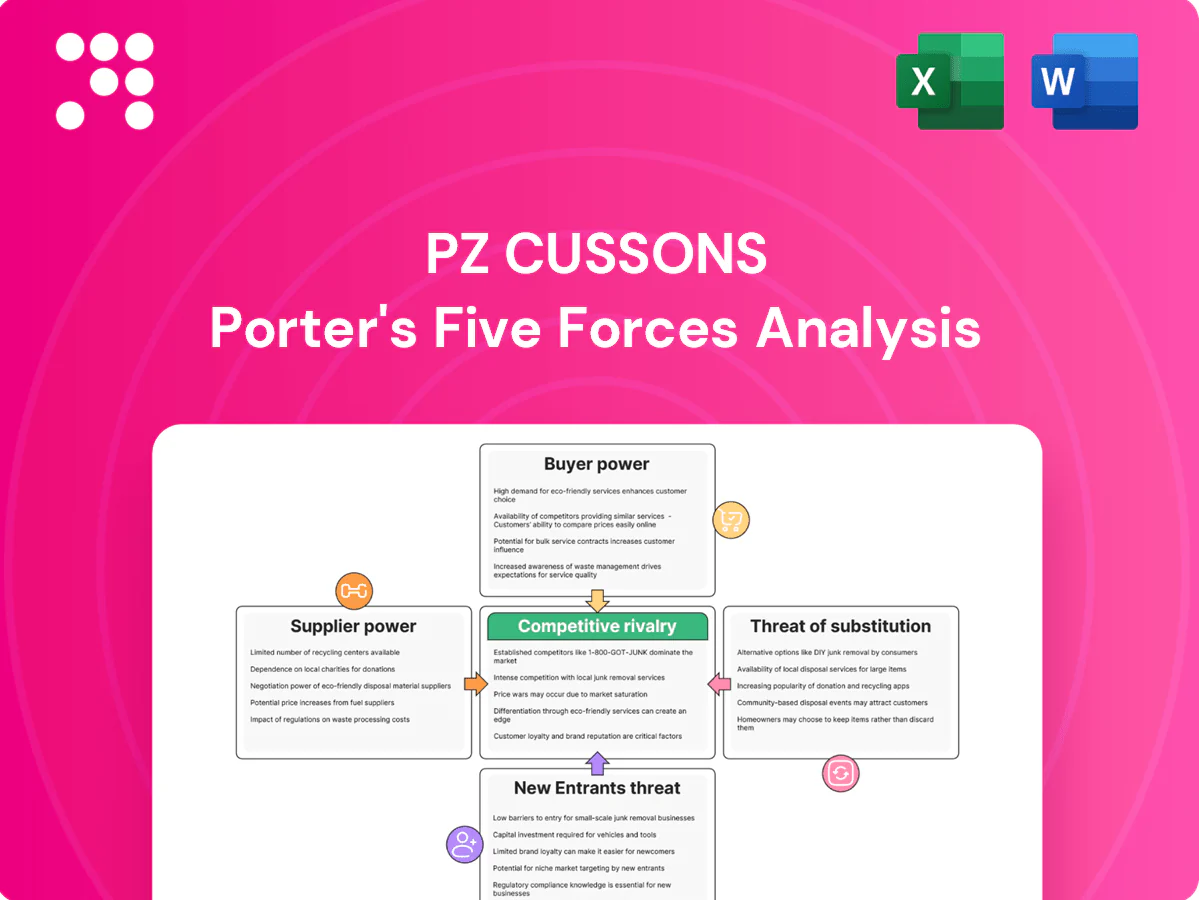
PZ Cussons Porter's Five Forces Analysis

Don't Miss the Bigger Picture
PZ Cussons faces moderate supplier power, fragmented buyer segments, and steady rivalry from regional FMCG players, while brand strength and distribution limit substitutes and new entrants. This snapshot highlights key competitive pressures shaping margins and strategic choices. The full Porter's Five Forces Analysis uncovers force-by-force ratings, visuals, and actionable implications for investors and strategists. Unlock the complete report to guide smarter decisions.
Suppliers Bargaining Power

Concentrated specialty inputs
Fragrance, specialty actives and enzymes for PZ Cussons are highly concentrated among global leaders (top 4 fragrance firms hold over 60% of the market), giving suppliers leverage. Switching risks product performance and typically requires 12–18 months for reformulation and requalification, boosting dependence on incumbents. Long qualification cycles and concentration have allowed suppliers to nudge pricing and contract terms in their favor.
Commodity volatility exposure
Palm oil derivatives, surfactants and packaging resins track global markets and in 2024 experienced repeated spikes that squeezed COGS, forcing PZ Cussons to consider price pass-through or pack‑size reductions to protect margins. Hedging programs reduce headline volatility but leave basis risk and residual exposure. In tight markets suppliers have tightened payment and lead‑time terms, raising supplier bargaining power.

Regional logistics constraints
Africa and Asia routes in 2024 faced notable port congestion and customs delays, with affected ports reporting average container wait times of about 5–7 days and periodic FX limits constraining imports. Suppliers controlling local warehousing and distribution therefore gain bargaining clout, capturing margin and service premiums. Longer lead times push up safety-stock requirements and working capital needs, sometimes increasing inventory carrying by double-digit percentages. Disruption risk heightens dependence on reliable partners for continuity.

Quality and compliance lock-in
Regulatory, microbiology and sustainability standards (RSPO had over 4,000 members in 2024) narrow vendor options for PZ Cussons, concentrating supply in certified suppliers. Approved-vendor lists and recurring audits raise switching costs and procurement lead times. Reformulations trigger stability testing and relabeling, embedding supplier power in critical categories.
- Vendor narrowing: compliance-driven
- Switching cost: audit + approval burdens
- Reformulation: stability testing & relabeling
Mitigation via scale and sourcing
PZ Cussons can mitigate supplier power by dual-sourcing, aggregating volumes and signing long-term contracts to secure input access and pricing; localizing inputs where feasible reduces freight and FX exposure. Collaborative R&D with suppliers allows trading margin for innovation-led growth, while specialty nodes (certain actives and fragrances) remain structurally powerful.
- Dual-source and long-term contracts
- Aggregate volumes to improve leverage
- Localize inputs to cut freight/FX risk
- Supplier collaboration for innovation vs margin
- Specialty suppliers retain structural power
Supplier power high: Top‑4 >60%, requal 12–18 months, waits 5–7 days
Supplier power is high: top‑4 fragrance firms hold over 60% of the market, specialty actives require 12–18 months to requalify, and 2024 saw repeated input-price spikes squeezing COGS. Logistics issues (container waits ~5–7 days) and RSPO membership >4,000 in 2024 narrow vendor options, raising switching costs and working‑capital needs. Dual‑sourcing, long‑term contracts and localisation partially mitigate but specialty suppliers remain structurally powerful.
| Metric | 2024 data |
|---|---|
| Fragrance concentration | Top‑4 >60% |
| Reformulation time | 12–18 months |
| Container wait | ~5–7 days |
| RSPO members | >4,000 |
What is included in the product
 Detailed Word Document
Tailored Porter's Five Forces analysis for PZ Cussons that uncovers key competitive drivers, supplier and buyer power, threats from substitutes and new entrants, and emerging disruptive forces affecting market share; actionable insights and strategic commentary ready for inclusion in reports or investor decks.

 Customizable Excel Spreadsheet
Clear one-sheet Porter's Five Forces for PZ Cussons that instantly visualizes competitive pressure with a customizable spider chart—ready for decks and decision-making, no macros or complex setup required.
Customers Bargaining Power

Retailer concentration
Supermarkets, pharmacies and discounters dominate shelf space: in the UK the Big 4 (Tesco, Sainsbury’s, Asda, Morrisons) held about 64% of grocery market in 2024 while Aldi and Lidl combined were ~19% (Kantar 2024), giving buyers strong leverage over listings and assortment. Listing fees, promo contributions and extended payment terms are common, with CPG trade spend typically running 10–15% of revenue. Private label growth at discounters and supermarkets intensifies retailer bargaining power, forcing PZ Cussons to fund visibility and promotional support to secure and maintain facings.
Price-sensitive consumers
In emerging markets soaps and detergents show high price elasticity, typically around -1.2 to -1.6 (2024 industry analyses), so shoppers often trade down or switch pack sizes when prices rise. Promotions and bundle packs drive roughly 20–30% of volume, shaping short-term demand. Strong brand equity attenuates but does not remove price sensitivity.

E-commerce and D2C transparency
Online channels increase price comparison and review-driven switching as global e-commerce reached about 23% of retail sales in 2024, raising transparency around PZ Cussons pricing and quality benchmarks.
Marketplaces compress margins via platform fees—Amazon referral fees average ~15%—plus promotional expectations that erode gross margins on fast-moving personal care lines.
D2C gives PZ Cussons first-party data and loyalty program leverage, which can boost customer lifetime value by up to ~30%, but overall digital-savvy shoppers still exert stronger bargaining power.

Health and hygiene expectations
Consumers in 2024 demand proven efficacy, gentle formulations and verifiable claims, so any quality lapse provokes rapid switching in low-inertia personal care categories; certifications and dermatological testing now materially influence purchase choice and brand trust. Meeting these standards raises production and compliance costs but preserves pricing power and limits churn.
- Efficacy and gentle formulation required
- Certifications/dermatological tests drive choice
- Quality lapses -> rapid switching
- Higher compliance costs protect pricing power
Brand loyalty in niches
Baby care and heritage soap brands like Cussons Baby and Imperial Leather deliver high stickiness and repeat rates, with PZ Cussons reporting 2024 group revenue of £635.3m, driven significantly by these niche staples; loyalty reduces buyer bargaining versus commoditized SKUs. Emotional branding and scent signatures reinforce retention, but sustained marketing and product investment are required to defend share.
- High repeat purchase: niche baby/heritage SKUs
- Loyalty lowers price sensitivity
- Emotional branding + scent = retention
- Ongoing investment needed to maintain 2024 shares
Retail leverage: Big 4 64%, Aldi+Lidl 19%, e-commerce 23%
Retail consolidation (Big 4 64%, Aldi+Lidl 19% in UK 2024) plus trade spend (10–15% of revenue) and promo-driven volumes (20–30%) give buyers strong leverage; e‑commerce (23% of retail) and Amazon fees (~15%) increase price transparency. Price elasticity ~-1.2 to -1.6 raises switching risk; D2C & brand loyalty (Cussons rev £635.3m; D2C CLV +30%) partially mitigate but do not eliminate buyer power.
| Metric | Value (2024) |
|---|---|
| Big 4 share (UK) | 64% |
| Aldi+Lidl | ~19% |
| Trade spend | 10–15% rev |
| Promo volume | 20–30% |
| E‑commerce | 23% |
| Amazon fees | ~15% |
| Price elasticity | -1.2 to -1.6 |
| PZ Cussons revenue | £635.3m |
| D2C CLV lift | +30% |
Preview Before You Purchase
PZ Cussons Porter's Five Forces Analysis
This preview shows the exact PZ Cussons Porter’s Five Forces analysis you'll receive—no placeholders or mockups. It presents a comprehensive evaluation of competitive rivalry, supplier and buyer power, and the threats of new entrants and substitutes. Upon purchase you get this fully formatted, ready-to-use file instantly.

Don't Miss the Bigger Picture
PZ Cussons faces moderate supplier power, fragmented buyer segments, and steady rivalry from regional FMCG players, while brand strength and distribution limit substitutes and new entrants. This snapshot highlights key competitive pressures shaping margins and strategic choices. The full Porter's Five Forces Analysis uncovers force-by-force ratings, visuals, and actionable implications for investors and strategists. Unlock the complete report to guide smarter decisions.
Suppliers Bargaining Power
Concentrated specialty inputs
Fragrance, specialty actives and enzymes for PZ Cussons are highly concentrated among global leaders (top 4 fragrance firms hold over 60% of the market), giving suppliers leverage. Switching risks product performance and typically requires 12–18 months for reformulation and requalification, boosting dependence on incumbents. Long qualification cycles and concentration have allowed suppliers to nudge pricing and contract terms in their favor.
Commodity volatility exposure
Palm oil derivatives, surfactants and packaging resins track global markets and in 2024 experienced repeated spikes that squeezed COGS, forcing PZ Cussons to consider price pass-through or pack‑size reductions to protect margins. Hedging programs reduce headline volatility but leave basis risk and residual exposure. In tight markets suppliers have tightened payment and lead‑time terms, raising supplier bargaining power.
Regional logistics constraints
Africa and Asia routes in 2024 faced notable port congestion and customs delays, with affected ports reporting average container wait times of about 5–7 days and periodic FX limits constraining imports. Suppliers controlling local warehousing and distribution therefore gain bargaining clout, capturing margin and service premiums. Longer lead times push up safety-stock requirements and working capital needs, sometimes increasing inventory carrying by double-digit percentages. Disruption risk heightens dependence on reliable partners for continuity.
Quality and compliance lock-in
Regulatory, microbiology and sustainability standards (RSPO had over 4,000 members in 2024) narrow vendor options for PZ Cussons, concentrating supply in certified suppliers. Approved-vendor lists and recurring audits raise switching costs and procurement lead times. Reformulations trigger stability testing and relabeling, embedding supplier power in critical categories.
- Vendor narrowing: compliance-driven
- Switching cost: audit + approval burdens
- Reformulation: stability testing & relabeling
Mitigation via scale and sourcing
PZ Cussons can mitigate supplier power by dual-sourcing, aggregating volumes and signing long-term contracts to secure input access and pricing; localizing inputs where feasible reduces freight and FX exposure. Collaborative R&D with suppliers allows trading margin for innovation-led growth, while specialty nodes (certain actives and fragrances) remain structurally powerful.
- Dual-source and long-term contracts
- Aggregate volumes to improve leverage
- Localize inputs to cut freight/FX risk
- Supplier collaboration for innovation vs margin
- Specialty suppliers retain structural power
Supplier power high: Top‑4 >60%, requal 12–18 months, waits 5–7 days
Supplier power is high: top‑4 fragrance firms hold over 60% of the market, specialty actives require 12–18 months to requalify, and 2024 saw repeated input-price spikes squeezing COGS. Logistics issues (container waits ~5–7 days) and RSPO membership >4,000 in 2024 narrow vendor options, raising switching costs and working‑capital needs. Dual‑sourcing, long‑term contracts and localisation partially mitigate but specialty suppliers remain structurally powerful.
| Metric | 2024 data |
|---|---|
| Fragrance concentration | Top‑4 >60% |
| Reformulation time | 12–18 months |
| Container wait | ~5–7 days |
| RSPO members | >4,000 |
What is included in the product
Detailed Word Document
Tailored Porter's Five Forces analysis for PZ Cussons that uncovers key competitive drivers, supplier and buyer power, threats from substitutes and new entrants, and emerging disruptive forces affecting market share; actionable insights and strategic commentary ready for inclusion in reports or investor decks.
Customizable Excel Spreadsheet
Clear one-sheet Porter's Five Forces for PZ Cussons that instantly visualizes competitive pressure with a customizable spider chart—ready for decks and decision-making, no macros or complex setup required.
Customers Bargaining Power
Retailer concentration
Supermarkets, pharmacies and discounters dominate shelf space: in the UK the Big 4 (Tesco, Sainsbury’s, Asda, Morrisons) held about 64% of grocery market in 2024 while Aldi and Lidl combined were ~19% (Kantar 2024), giving buyers strong leverage over listings and assortment. Listing fees, promo contributions and extended payment terms are common, with CPG trade spend typically running 10–15% of revenue. Private label growth at discounters and supermarkets intensifies retailer bargaining power, forcing PZ Cussons to fund visibility and promotional support to secure and maintain facings.
Price-sensitive consumers
In emerging markets soaps and detergents show high price elasticity, typically around -1.2 to -1.6 (2024 industry analyses), so shoppers often trade down or switch pack sizes when prices rise. Promotions and bundle packs drive roughly 20–30% of volume, shaping short-term demand. Strong brand equity attenuates but does not remove price sensitivity.
E-commerce and D2C transparency
Online channels increase price comparison and review-driven switching as global e-commerce reached about 23% of retail sales in 2024, raising transparency around PZ Cussons pricing and quality benchmarks.
Marketplaces compress margins via platform fees—Amazon referral fees average ~15%—plus promotional expectations that erode gross margins on fast-moving personal care lines.
D2C gives PZ Cussons first-party data and loyalty program leverage, which can boost customer lifetime value by up to ~30%, but overall digital-savvy shoppers still exert stronger bargaining power.
Health and hygiene expectations
Consumers in 2024 demand proven efficacy, gentle formulations and verifiable claims, so any quality lapse provokes rapid switching in low-inertia personal care categories; certifications and dermatological testing now materially influence purchase choice and brand trust. Meeting these standards raises production and compliance costs but preserves pricing power and limits churn.
- Efficacy and gentle formulation required
- Certifications/dermatological tests drive choice
- Quality lapses -> rapid switching
- Higher compliance costs protect pricing power
Brand loyalty in niches
Baby care and heritage soap brands like Cussons Baby and Imperial Leather deliver high stickiness and repeat rates, with PZ Cussons reporting 2024 group revenue of £635.3m, driven significantly by these niche staples; loyalty reduces buyer bargaining versus commoditized SKUs. Emotional branding and scent signatures reinforce retention, but sustained marketing and product investment are required to defend share.
- High repeat purchase: niche baby/heritage SKUs
- Loyalty lowers price sensitivity
- Emotional branding + scent = retention
- Ongoing investment needed to maintain 2024 shares
Retail leverage: Big 4 64%, Aldi+Lidl 19%, e-commerce 23%
Retail consolidation (Big 4 64%, Aldi+Lidl 19% in UK 2024) plus trade spend (10–15% of revenue) and promo-driven volumes (20–30%) give buyers strong leverage; e‑commerce (23% of retail) and Amazon fees (~15%) increase price transparency. Price elasticity ~-1.2 to -1.6 raises switching risk; D2C & brand loyalty (Cussons rev £635.3m; D2C CLV +30%) partially mitigate but do not eliminate buyer power.
| Metric | Value (2024) |
|---|---|
| Big 4 share (UK) | 64% |
| Aldi+Lidl | ~19% |
| Trade spend | 10–15% rev |
| Promo volume | 20–30% |
| E‑commerce | 23% |
| Amazon fees | ~15% |
| Price elasticity | -1.2 to -1.6 |
| PZ Cussons revenue | £635.3m |
| D2C CLV lift | +30% |
Preview Before You Purchase
PZ Cussons Porter's Five Forces Analysis
This preview shows the exact PZ Cussons Porter’s Five Forces analysis you'll receive—no placeholders or mockups. It presents a comprehensive evaluation of competitive rivalry, supplier and buyer power, and the threats of new entrants and substitutes. Upon purchase you get this fully formatted, ready-to-use file instantly.
Description
Don't Miss the Bigger Picture
PZ Cussons faces moderate supplier power, fragmented buyer segments, and steady rivalry from regional FMCG players, while brand strength and distribution limit substitutes and new entrants. This snapshot highlights key competitive pressures shaping margins and strategic choices. The full Porter's Five Forces Analysis uncovers force-by-force ratings, visuals, and actionable implications for investors and strategists. Unlock the complete report to guide smarter decisions.
Suppliers Bargaining Power
Concentrated specialty inputs
Fragrance, specialty actives and enzymes for PZ Cussons are highly concentrated among global leaders (top 4 fragrance firms hold over 60% of the market), giving suppliers leverage. Switching risks product performance and typically requires 12–18 months for reformulation and requalification, boosting dependence on incumbents. Long qualification cycles and concentration have allowed suppliers to nudge pricing and contract terms in their favor.
Commodity volatility exposure
Palm oil derivatives, surfactants and packaging resins track global markets and in 2024 experienced repeated spikes that squeezed COGS, forcing PZ Cussons to consider price pass-through or pack‑size reductions to protect margins. Hedging programs reduce headline volatility but leave basis risk and residual exposure. In tight markets suppliers have tightened payment and lead‑time terms, raising supplier bargaining power.
Regional logistics constraints
Africa and Asia routes in 2024 faced notable port congestion and customs delays, with affected ports reporting average container wait times of about 5–7 days and periodic FX limits constraining imports. Suppliers controlling local warehousing and distribution therefore gain bargaining clout, capturing margin and service premiums. Longer lead times push up safety-stock requirements and working capital needs, sometimes increasing inventory carrying by double-digit percentages. Disruption risk heightens dependence on reliable partners for continuity.
Quality and compliance lock-in
Regulatory, microbiology and sustainability standards (RSPO had over 4,000 members in 2024) narrow vendor options for PZ Cussons, concentrating supply in certified suppliers. Approved-vendor lists and recurring audits raise switching costs and procurement lead times. Reformulations trigger stability testing and relabeling, embedding supplier power in critical categories.
- Vendor narrowing: compliance-driven
- Switching cost: audit + approval burdens
- Reformulation: stability testing & relabeling
Mitigation via scale and sourcing
PZ Cussons can mitigate supplier power by dual-sourcing, aggregating volumes and signing long-term contracts to secure input access and pricing; localizing inputs where feasible reduces freight and FX exposure. Collaborative R&D with suppliers allows trading margin for innovation-led growth, while specialty nodes (certain actives and fragrances) remain structurally powerful.
- Dual-source and long-term contracts
- Aggregate volumes to improve leverage
- Localize inputs to cut freight/FX risk
- Supplier collaboration for innovation vs margin
- Specialty suppliers retain structural power
Supplier power high: Top‑4 >60%, requal 12–18 months, waits 5–7 days
Supplier power is high: top‑4 fragrance firms hold over 60% of the market, specialty actives require 12–18 months to requalify, and 2024 saw repeated input-price spikes squeezing COGS. Logistics issues (container waits ~5–7 days) and RSPO membership >4,000 in 2024 narrow vendor options, raising switching costs and working‑capital needs. Dual‑sourcing, long‑term contracts and localisation partially mitigate but specialty suppliers remain structurally powerful.
| Metric | 2024 data |
|---|---|
| Fragrance concentration | Top‑4 >60% |
| Reformulation time | 12–18 months |
| Container wait | ~5–7 days |
| RSPO members | >4,000 |
What is included in the product
Detailed Word Document
Tailored Porter's Five Forces analysis for PZ Cussons that uncovers key competitive drivers, supplier and buyer power, threats from substitutes and new entrants, and emerging disruptive forces affecting market share; actionable insights and strategic commentary ready for inclusion in reports or investor decks.
Customizable Excel Spreadsheet
Clear one-sheet Porter's Five Forces for PZ Cussons that instantly visualizes competitive pressure with a customizable spider chart—ready for decks and decision-making, no macros or complex setup required.
Customers Bargaining Power
Retailer concentration
Supermarkets, pharmacies and discounters dominate shelf space: in the UK the Big 4 (Tesco, Sainsbury’s, Asda, Morrisons) held about 64% of grocery market in 2024 while Aldi and Lidl combined were ~19% (Kantar 2024), giving buyers strong leverage over listings and assortment. Listing fees, promo contributions and extended payment terms are common, with CPG trade spend typically running 10–15% of revenue. Private label growth at discounters and supermarkets intensifies retailer bargaining power, forcing PZ Cussons to fund visibility and promotional support to secure and maintain facings.
Price-sensitive consumers
In emerging markets soaps and detergents show high price elasticity, typically around -1.2 to -1.6 (2024 industry analyses), so shoppers often trade down or switch pack sizes when prices rise. Promotions and bundle packs drive roughly 20–30% of volume, shaping short-term demand. Strong brand equity attenuates but does not remove price sensitivity.
E-commerce and D2C transparency
Online channels increase price comparison and review-driven switching as global e-commerce reached about 23% of retail sales in 2024, raising transparency around PZ Cussons pricing and quality benchmarks.
Marketplaces compress margins via platform fees—Amazon referral fees average ~15%—plus promotional expectations that erode gross margins on fast-moving personal care lines.
D2C gives PZ Cussons first-party data and loyalty program leverage, which can boost customer lifetime value by up to ~30%, but overall digital-savvy shoppers still exert stronger bargaining power.
Health and hygiene expectations
Consumers in 2024 demand proven efficacy, gentle formulations and verifiable claims, so any quality lapse provokes rapid switching in low-inertia personal care categories; certifications and dermatological testing now materially influence purchase choice and brand trust. Meeting these standards raises production and compliance costs but preserves pricing power and limits churn.
- Efficacy and gentle formulation required
- Certifications/dermatological tests drive choice
- Quality lapses -> rapid switching
- Higher compliance costs protect pricing power
Brand loyalty in niches
Baby care and heritage soap brands like Cussons Baby and Imperial Leather deliver high stickiness and repeat rates, with PZ Cussons reporting 2024 group revenue of £635.3m, driven significantly by these niche staples; loyalty reduces buyer bargaining versus commoditized SKUs. Emotional branding and scent signatures reinforce retention, but sustained marketing and product investment are required to defend share.
- High repeat purchase: niche baby/heritage SKUs
- Loyalty lowers price sensitivity
- Emotional branding + scent = retention
- Ongoing investment needed to maintain 2024 shares
Retail leverage: Big 4 64%, Aldi+Lidl 19%, e-commerce 23%
Retail consolidation (Big 4 64%, Aldi+Lidl 19% in UK 2024) plus trade spend (10–15% of revenue) and promo-driven volumes (20–30%) give buyers strong leverage; e‑commerce (23% of retail) and Amazon fees (~15%) increase price transparency. Price elasticity ~-1.2 to -1.6 raises switching risk; D2C & brand loyalty (Cussons rev £635.3m; D2C CLV +30%) partially mitigate but do not eliminate buyer power.
| Metric | Value (2024) |
|---|---|
| Big 4 share (UK) | 64% |
| Aldi+Lidl | ~19% |
| Trade spend | 10–15% rev |
| Promo volume | 20–30% |
| E‑commerce | 23% |
| Amazon fees | ~15% |
| Price elasticity | -1.2 to -1.6 |
| PZ Cussons revenue | £635.3m |
| D2C CLV lift | +30% |
Preview Before You Purchase
PZ Cussons Porter's Five Forces Analysis
This preview shows the exact PZ Cussons Porter’s Five Forces analysis you'll receive—no placeholders or mockups. It presents a comprehensive evaluation of competitive rivalry, supplier and buyer power, and the threats of new entrants and substitutes. Upon purchase you get this fully formatted, ready-to-use file instantly.











