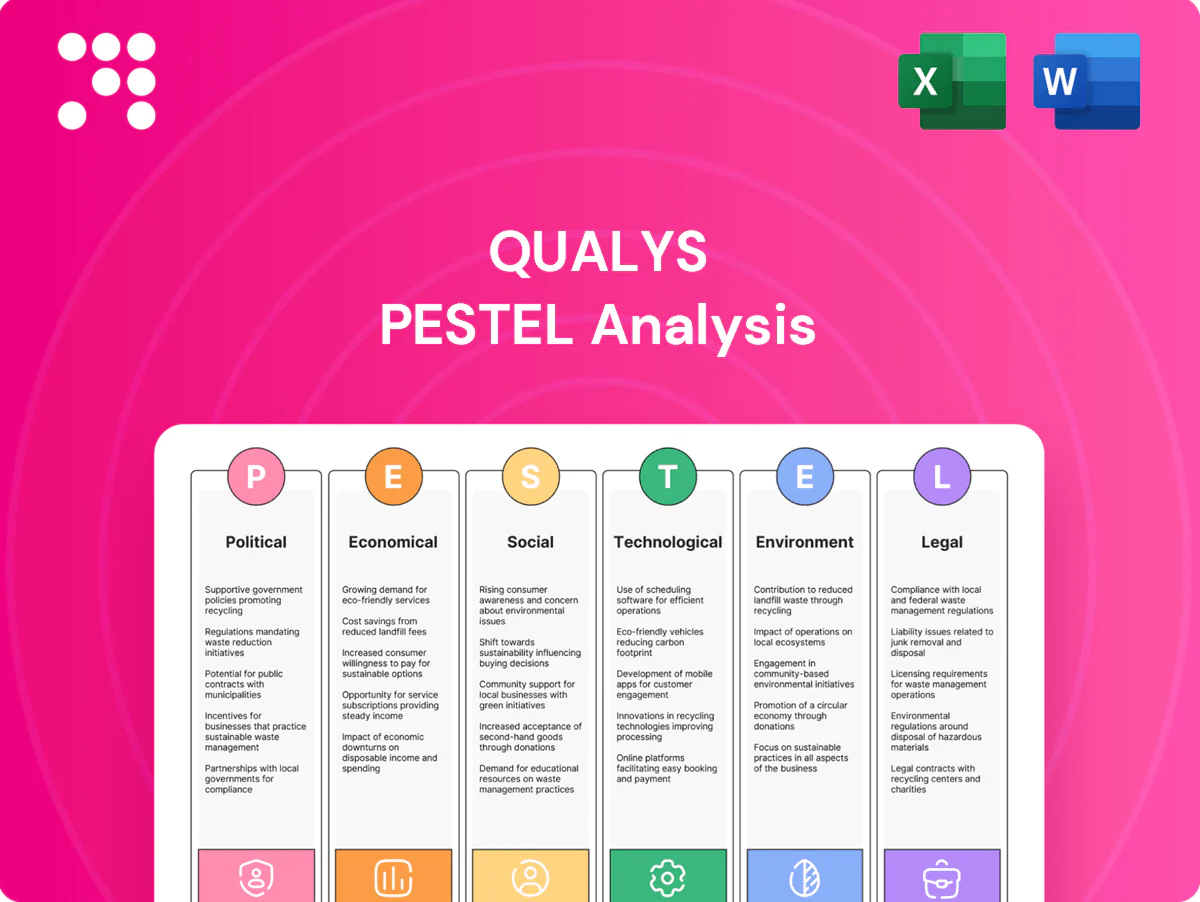
Qualys PESTLE Analysis

Your Shortcut to Market Insight Starts Here
Navigate the complex external forces shaping Qualys's future with our meticulously researched PESTLE analysis. Understand how political stability, economic shifts, and evolving social trends directly impact cybersecurity leaders. Arm yourself with actionable intelligence to refine your strategies and secure a competitive advantage. Download the full report now and gain the foresight you need.
Political factors

Government Cybersecurity Mandates
Governments globally are stepping up cybersecurity requirements, aiming to secure essential services and sensitive information. For instance, in 2024, the EU continued to refine its NIS2 Directive, pushing for broader compliance across sectors, which directly impacts how companies manage their digital defenses.
These mandates create a strong, ongoing demand for solutions like Qualys, as businesses must actively manage vulnerabilities and monitor threats to meet new legal obligations. Failure to comply can result in significant penalties, making robust security platforms a necessity, not a choice.
Data Privacy Regulations
The global data privacy landscape is rapidly evolving, with regulations like GDPR and CCPA setting stringent standards for data handling. These laws directly affect how Qualys's clients manage personal information, demanding robust security and transparent practices.
Qualys's compliance solutions are designed to help businesses navigate these complex legal frameworks, ensuring they meet the requirements of data privacy laws and avoid significant fines. For instance, the increasing focus on data protection means that companies are investing more in cybersecurity and compliance tools.

Geopolitical Cyber Warfare
Escalating global tensions are fueling a surge in state-sponsored cyber warfare, directly impacting both government bodies and essential private sector infrastructure. This escalating threat landscape necessitates significant organizational investment in robust cybersecurity measures and proactive threat detection systems.
For instance, a 2024 report indicated that the average cost of a data breach reached $4.45 million, a figure likely to climb due to sophisticated nation-state attacks. Organizations must therefore prioritize advanced security solutions to safeguard against these evolving cyber threats.
Qualys's integrated platform plays a vital role in this defense strategy. By continuously assessing vulnerabilities and providing real-time threat intelligence, Qualys empowers businesses to identify and remediate weaknesses before they can be exploited by advanced persistent threats.

Critical Infrastructure Protection
Governments worldwide are significantly increasing their focus on safeguarding critical infrastructure, such as energy grids, financial systems, and healthcare networks, against escalating cyber threats. This heightened attention is leading to the creation of more stringent regulations and comprehensive frameworks designed to bolster the resilience of these essential services.
Qualys is instrumental in this landscape by offering robust solutions that enable organizations within these vital sectors to effectively identify vulnerabilities, manage cybersecurity risks, and ensure adherence to evolving, sector-specific security mandates.
- Increased Government Spending: Global spending on cybersecurity for critical infrastructure is projected to reach over $100 billion annually by 2025, reflecting the growing urgency.
- Regulatory Focus: In 2024, the US Cybersecurity and Infrastructure Security Agency (CISA) issued updated guidelines for critical infrastructure cybersecurity, emphasizing continuous monitoring and risk management.
- Qualys's Role: Qualys's platform helps organizations meet compliance requirements for frameworks like the NIST Cybersecurity Framework, which is increasingly adopted by critical infrastructure operators.
- Sector-Specific Needs: For instance, the financial sector in the EU is subject to stringent regulations like DORA (Digital Operational Resilience Act), requiring robust security assessments that Qualys facilitates.
International Trade Policies
International trade policies significantly influence Qualys's global reach. For instance, the USMCA agreement, which replaced NAFTA in 2020, continues to shape trade dynamics in North America, impacting how Qualys delivers its cloud-based security and compliance solutions. New trade agreements or changes to existing ones, such as potential adjustments to tariffs on digital services or regulations on technology transfer, could alter Qualys's operational costs and market accessibility.
Data localization mandates, increasingly prevalent in regions like the European Union with GDPR and in countries like India, present a complex challenge. These policies can force companies like Qualys to invest in local data centers, increasing infrastructure costs and potentially fragmenting service delivery. By mid-2024, over 80 countries had some form of data localization laws, directly affecting how Qualys manages its global cloud footprint and customer data.
- Impact on Cloud Infrastructure: Data localization laws in over 80 countries by mid-2024 necessitate localized data storage, potentially increasing Qualys's operational expenses.
- Cross-Border Data Flow Regulations: Evolving regulations, like those stemming from the EU-US Data Privacy Framework, directly affect how Qualys transfers and processes customer data globally.
- Tariffs and Trade Barriers: Any new tariffs on technology services or software could impact Qualys's pricing strategies and competitive positioning in international markets.
Global Regulations Drive Cybersecurity Demand and Operational Shifts
Governments are intensifying efforts to protect critical infrastructure, leading to stricter cybersecurity mandates. For example, the US Cybersecurity and Infrastructure Security Agency (CISA) issued updated guidelines in 2024 for critical infrastructure, emphasizing continuous monitoring. This regulatory push, coupled with escalating global cyber warfare, drives significant demand for robust security solutions like Qualys.
The global regulatory environment for data privacy continues to evolve, with laws like GDPR and CCPA setting high standards for data handling. By mid-2024, over 80 countries had data localization laws, impacting how companies manage global cloud operations. These evolving international trade policies and data localization requirements directly influence Qualys's operational costs and market accessibility.
| Factor | 2024/2025 Data Point | Impact on Qualys |
|---|---|---|
| Cybersecurity Mandates | EU NIS2 Directive refinement (2024); CISA guidelines for critical infrastructure (2024) | Increased demand for compliance and vulnerability management solutions. |
| Data Privacy Regulations | Over 80 countries with data localization laws by mid-2024. | Necessitates investment in localized data centers, potentially increasing infrastructure costs. |
| Global Tensions | Average cost of data breach reached $4.45 million (2024 report). | Heightens the need for advanced threat detection and remediation capabilities. |
| International Trade | USMCA continuing to shape North American trade dynamics. | Affects operational costs and market accessibility for cloud-based services. |
What is included in the product
 Detailed Word Document
The Qualys PESTLE Analysis provides a comprehensive examination of the external macro-environmental factors impacting the company across Political, Economic, Social, Technological, Environmental, and Legal dimensions.
This insightful evaluation equips stakeholders with a strategic understanding of market dynamics, enabling informed decision-making and proactive strategy development.

 Customizable Excel Spreadsheet
Qualys' PESTLE analysis offers a clear, summarized version of complex external factors, making it easy to reference during meetings and presentations, thereby alleviating the pain point of information overload.
Economic factors

Global Cybersecurity Spending
Global cybersecurity spending is on a consistent upward trajectory, acting as a key economic enabler for companies like Qualys. This surge is fueled by the ever-increasing digitization of businesses and the escalating sophistication of cyber threats, compelling organizations to dedicate more resources to security solutions. For instance, Gartner projected worldwide spending on information security and risk management technology and services to reach $215 billion in 2024, an increase of 14.3% from 2023.
This sustained growth in the cybersecurity market creates a robust environment for Qualys's revenue expansion and deeper market penetration. As businesses grapple with evolving digital landscapes and more complex attack vectors, the demand for comprehensive cybersecurity platforms, such as those offered by Qualys, continues to climb. The Cybersecurity Ventures report from 2024 estimates that cybercrime damages will cost the world $10.5 trillion annually by 2025, underscoring the critical need for effective cybersecurity investments.
Economic Downturns and IT Budgets
Economic downturns, such as the anticipated slowdowns in late 2024 and early 2025, often trigger significant reductions in IT spending. This can directly affect companies like Qualys, as potential clients may delay or scale back investments in new cybersecurity solutions or opt out of renewing existing contracts. For instance, a survey by Gartner in late 2023 indicated that over 60% of IT leaders expected their budgets to be flat or decrease in 2024 due to economic uncertainty.
Despite budget tightening, cybersecurity remains a critical priority for most organizations, even during recessions. However, the pressure to control costs means customers will scrutinize every expenditure, seeking maximum value. This environment favors solutions that demonstrate clear ROI and operational efficiency, pushing vendors to justify their pricing more rigorously.
Qualys's cloud-based, subscription model offers a distinct advantage in such economic climates. By avoiding large upfront capital expenditures and providing predictable operational costs, it presents a more financially manageable approach to robust cybersecurity. This flexibility allows businesses to maintain essential security posture without the burden of significant initial investment, a key consideration when facing economic headwinds.

Inflationary Pressures
Inflationary pressures present a significant challenge for Qualys by increasing its operational expenses. For instance, rising wages in the tech sector, a key component of personnel costs, could climb by an estimated 4-5% in 2024-2025, impacting Qualys's ability to retain talent without adjusting compensation.
These escalating costs for infrastructure, cloud services, and essential software development resources can directly squeeze profit margins. If Qualys cannot absorb these increases, it may need to consider price adjustments, a delicate act given the competitive landscape of cybersecurity solutions.
Balancing these rising costs with competitive pricing is crucial for Qualys's sustained profitability. For example, while the cybersecurity market is projected for robust growth, a 10% increase in subscription prices, for instance, could alienate price-sensitive customers if competitors maintain their current pricing structures.

Cloud Adoption Cost-Benefit
The widespread adoption of cloud computing continues to drive significant economic shifts. For businesses, the scalability and reduced need for on-premise infrastructure offered by cloud solutions, like those from Qualys, translate into substantial cost savings. This trend is projected to see global cloud spending reach over $2.7 trillion by 2025, highlighting the economic imperative for cloud adoption.
However, the economics of cloud service provision and intense competition within the cloud security market directly impact Qualys's pricing strategies and service evolution. Companies are increasingly scrutinizing cloud expenditures, making the demonstration of a clear return on investment (ROI) paramount for customer acquisition and retention in this dynamic sector.
- Cloud Spending Growth: Global cloud infrastructure services spending is anticipated to grow by 20.4% in 2024, reaching $327.4 billion, and further accelerate to $370.7 billion in 2025.
- ROI Focus: A 2024 survey indicated that 85% of organizations consider ROI as a primary driver when evaluating cloud security solutions.
- Competitive Landscape: The cloud security market is highly competitive, with major players continuously adjusting pricing and feature sets to capture market share.
- Cost Optimization: Enterprises are actively seeking ways to optimize cloud costs, with 70% of organizations implementing cloud cost management strategies in 2024.
Currency Fluctuations
As a global player, Qualys faces the inherent risk of currency fluctuations, which can significantly affect its financial reporting, particularly for revenues and expenses stemming from international operations. For instance, a strengthening U.S. dollar can diminish the reported value of sales made in foreign currencies when those amounts are translated back into dollars.
Effective management of these currency risks is crucial for maintaining financial stability and predictable performance across Qualys's diverse global markets. This involves employing strategies to mitigate the impact of adverse currency movements.
- Impact on Revenue: A stronger USD in 2024 could reduce the reported USD value of Qualys's international sales, potentially impacting top-line growth figures.
- Expense Translation: Conversely, a weaker USD might increase the dollar cost of expenses incurred in foreign currencies, affecting profitability.
- Risk Mitigation: Companies like Qualys often utilize hedging instruments, such as forward contracts, to lock in exchange rates and reduce volatility.
- Economic Environment: Global economic conditions and central bank policies in 2024-2025 will continue to shape currency valuations, necessitating ongoing monitoring by Qualys.
Cybersecurity's Economic Crossroads: Growth, Challenges, and Cloud Resilience
The cybersecurity market's robust growth, projected to reach $215 billion in 2024, directly benefits Qualys by increasing demand for its solutions. This upward trend is driven by escalating digitization and sophisticated cyber threats, as evidenced by the estimated $10.5 trillion annual cost of cybercrime by 2025.
However, economic slowdowns anticipated in late 2024 and early 2025 may lead to reduced IT spending, potentially impacting Qualys's sales as clients defer or cut investments. Despite budget constraints, cybersecurity remains a priority, pushing companies like Qualys to demonstrate clear ROI and value for money.
Qualys's cloud-based, subscription model offers financial flexibility by avoiding large upfront costs and providing predictable expenses, a key advantage during economic uncertainty. This approach allows businesses to maintain essential security without significant initial outlays, making it attractive when facing economic headwinds.
Inflationary pressures, such as an estimated 4-5% rise in tech sector wages for 2024-2025, increase Qualys's operational costs, potentially affecting profit margins. The company must balance these rising expenses with competitive pricing, as a significant price hike could deter cost-sensitive customers in a competitive market.
The global cloud spending forecast exceeding $2.7 trillion by 2025 underscores the economic shift towards cloud solutions, benefiting providers like Qualys. However, intense competition and the need to demonstrate clear ROI are critical for customer acquisition and retention in this evolving market.
Full Version Awaits
Qualys PESTLE Analysis
The preview shown here is the exact Qualys PESTLE Analysis document you’ll receive after purchase—fully formatted and ready to use.
This is a real snapshot of the comprehensive PESTLE analysis for Qualys, delivered exactly as shown, no surprises.
The content and structure of this Qualys PESTLE analysis preview is the same document you’ll download after payment, providing immediate strategic insights.

Your Shortcut to Market Insight Starts Here
Navigate the complex external forces shaping Qualys's future with our meticulously researched PESTLE analysis. Understand how political stability, economic shifts, and evolving social trends directly impact cybersecurity leaders. Arm yourself with actionable intelligence to refine your strategies and secure a competitive advantage. Download the full report now and gain the foresight you need.
Political factors
Government Cybersecurity Mandates
Governments globally are stepping up cybersecurity requirements, aiming to secure essential services and sensitive information. For instance, in 2024, the EU continued to refine its NIS2 Directive, pushing for broader compliance across sectors, which directly impacts how companies manage their digital defenses.
These mandates create a strong, ongoing demand for solutions like Qualys, as businesses must actively manage vulnerabilities and monitor threats to meet new legal obligations. Failure to comply can result in significant penalties, making robust security platforms a necessity, not a choice.
Data Privacy Regulations
The global data privacy landscape is rapidly evolving, with regulations like GDPR and CCPA setting stringent standards for data handling. These laws directly affect how Qualys's clients manage personal information, demanding robust security and transparent practices.
Qualys's compliance solutions are designed to help businesses navigate these complex legal frameworks, ensuring they meet the requirements of data privacy laws and avoid significant fines. For instance, the increasing focus on data protection means that companies are investing more in cybersecurity and compliance tools.
Geopolitical Cyber Warfare
Escalating global tensions are fueling a surge in state-sponsored cyber warfare, directly impacting both government bodies and essential private sector infrastructure. This escalating threat landscape necessitates significant organizational investment in robust cybersecurity measures and proactive threat detection systems.
For instance, a 2024 report indicated that the average cost of a data breach reached $4.45 million, a figure likely to climb due to sophisticated nation-state attacks. Organizations must therefore prioritize advanced security solutions to safeguard against these evolving cyber threats.
Qualys's integrated platform plays a vital role in this defense strategy. By continuously assessing vulnerabilities and providing real-time threat intelligence, Qualys empowers businesses to identify and remediate weaknesses before they can be exploited by advanced persistent threats.
Critical Infrastructure Protection
Governments worldwide are significantly increasing their focus on safeguarding critical infrastructure, such as energy grids, financial systems, and healthcare networks, against escalating cyber threats. This heightened attention is leading to the creation of more stringent regulations and comprehensive frameworks designed to bolster the resilience of these essential services.
Qualys is instrumental in this landscape by offering robust solutions that enable organizations within these vital sectors to effectively identify vulnerabilities, manage cybersecurity risks, and ensure adherence to evolving, sector-specific security mandates.
- Increased Government Spending: Global spending on cybersecurity for critical infrastructure is projected to reach over $100 billion annually by 2025, reflecting the growing urgency.
- Regulatory Focus: In 2024, the US Cybersecurity and Infrastructure Security Agency (CISA) issued updated guidelines for critical infrastructure cybersecurity, emphasizing continuous monitoring and risk management.
- Qualys's Role: Qualys's platform helps organizations meet compliance requirements for frameworks like the NIST Cybersecurity Framework, which is increasingly adopted by critical infrastructure operators.
- Sector-Specific Needs: For instance, the financial sector in the EU is subject to stringent regulations like DORA (Digital Operational Resilience Act), requiring robust security assessments that Qualys facilitates.
International Trade Policies
International trade policies significantly influence Qualys's global reach. For instance, the USMCA agreement, which replaced NAFTA in 2020, continues to shape trade dynamics in North America, impacting how Qualys delivers its cloud-based security and compliance solutions. New trade agreements or changes to existing ones, such as potential adjustments to tariffs on digital services or regulations on technology transfer, could alter Qualys's operational costs and market accessibility.
Data localization mandates, increasingly prevalent in regions like the European Union with GDPR and in countries like India, present a complex challenge. These policies can force companies like Qualys to invest in local data centers, increasing infrastructure costs and potentially fragmenting service delivery. By mid-2024, over 80 countries had some form of data localization laws, directly affecting how Qualys manages its global cloud footprint and customer data.
- Impact on Cloud Infrastructure: Data localization laws in over 80 countries by mid-2024 necessitate localized data storage, potentially increasing Qualys's operational expenses.
- Cross-Border Data Flow Regulations: Evolving regulations, like those stemming from the EU-US Data Privacy Framework, directly affect how Qualys transfers and processes customer data globally.
- Tariffs and Trade Barriers: Any new tariffs on technology services or software could impact Qualys's pricing strategies and competitive positioning in international markets.
Global Regulations Drive Cybersecurity Demand and Operational Shifts
Governments are intensifying efforts to protect critical infrastructure, leading to stricter cybersecurity mandates. For example, the US Cybersecurity and Infrastructure Security Agency (CISA) issued updated guidelines in 2024 for critical infrastructure, emphasizing continuous monitoring. This regulatory push, coupled with escalating global cyber warfare, drives significant demand for robust security solutions like Qualys.
The global regulatory environment for data privacy continues to evolve, with laws like GDPR and CCPA setting high standards for data handling. By mid-2024, over 80 countries had data localization laws, impacting how companies manage global cloud operations. These evolving international trade policies and data localization requirements directly influence Qualys's operational costs and market accessibility.
| Factor | 2024/2025 Data Point | Impact on Qualys |
|---|---|---|
| Cybersecurity Mandates | EU NIS2 Directive refinement (2024); CISA guidelines for critical infrastructure (2024) | Increased demand for compliance and vulnerability management solutions. |
| Data Privacy Regulations | Over 80 countries with data localization laws by mid-2024. | Necessitates investment in localized data centers, potentially increasing infrastructure costs. |
| Global Tensions | Average cost of data breach reached $4.45 million (2024 report). | Heightens the need for advanced threat detection and remediation capabilities. |
| International Trade | USMCA continuing to shape North American trade dynamics. | Affects operational costs and market accessibility for cloud-based services. |
What is included in the product
Detailed Word Document
The Qualys PESTLE Analysis provides a comprehensive examination of the external macro-environmental factors impacting the company across Political, Economic, Social, Technological, Environmental, and Legal dimensions.
This insightful evaluation equips stakeholders with a strategic understanding of market dynamics, enabling informed decision-making and proactive strategy development.
Customizable Excel Spreadsheet
Qualys' PESTLE analysis offers a clear, summarized version of complex external factors, making it easy to reference during meetings and presentations, thereby alleviating the pain point of information overload.
Economic factors
Global Cybersecurity Spending
Global cybersecurity spending is on a consistent upward trajectory, acting as a key economic enabler for companies like Qualys. This surge is fueled by the ever-increasing digitization of businesses and the escalating sophistication of cyber threats, compelling organizations to dedicate more resources to security solutions. For instance, Gartner projected worldwide spending on information security and risk management technology and services to reach $215 billion in 2024, an increase of 14.3% from 2023.
This sustained growth in the cybersecurity market creates a robust environment for Qualys's revenue expansion and deeper market penetration. As businesses grapple with evolving digital landscapes and more complex attack vectors, the demand for comprehensive cybersecurity platforms, such as those offered by Qualys, continues to climb. The Cybersecurity Ventures report from 2024 estimates that cybercrime damages will cost the world $10.5 trillion annually by 2025, underscoring the critical need for effective cybersecurity investments.
Economic Downturns and IT Budgets
Economic downturns, such as the anticipated slowdowns in late 2024 and early 2025, often trigger significant reductions in IT spending. This can directly affect companies like Qualys, as potential clients may delay or scale back investments in new cybersecurity solutions or opt out of renewing existing contracts. For instance, a survey by Gartner in late 2023 indicated that over 60% of IT leaders expected their budgets to be flat or decrease in 2024 due to economic uncertainty.
Despite budget tightening, cybersecurity remains a critical priority for most organizations, even during recessions. However, the pressure to control costs means customers will scrutinize every expenditure, seeking maximum value. This environment favors solutions that demonstrate clear ROI and operational efficiency, pushing vendors to justify their pricing more rigorously.
Qualys's cloud-based, subscription model offers a distinct advantage in such economic climates. By avoiding large upfront capital expenditures and providing predictable operational costs, it presents a more financially manageable approach to robust cybersecurity. This flexibility allows businesses to maintain essential security posture without the burden of significant initial investment, a key consideration when facing economic headwinds.
Inflationary Pressures
Inflationary pressures present a significant challenge for Qualys by increasing its operational expenses. For instance, rising wages in the tech sector, a key component of personnel costs, could climb by an estimated 4-5% in 2024-2025, impacting Qualys's ability to retain talent without adjusting compensation.
These escalating costs for infrastructure, cloud services, and essential software development resources can directly squeeze profit margins. If Qualys cannot absorb these increases, it may need to consider price adjustments, a delicate act given the competitive landscape of cybersecurity solutions.
Balancing these rising costs with competitive pricing is crucial for Qualys's sustained profitability. For example, while the cybersecurity market is projected for robust growth, a 10% increase in subscription prices, for instance, could alienate price-sensitive customers if competitors maintain their current pricing structures.
Cloud Adoption Cost-Benefit
The widespread adoption of cloud computing continues to drive significant economic shifts. For businesses, the scalability and reduced need for on-premise infrastructure offered by cloud solutions, like those from Qualys, translate into substantial cost savings. This trend is projected to see global cloud spending reach over $2.7 trillion by 2025, highlighting the economic imperative for cloud adoption.
However, the economics of cloud service provision and intense competition within the cloud security market directly impact Qualys's pricing strategies and service evolution. Companies are increasingly scrutinizing cloud expenditures, making the demonstration of a clear return on investment (ROI) paramount for customer acquisition and retention in this dynamic sector.
- Cloud Spending Growth: Global cloud infrastructure services spending is anticipated to grow by 20.4% in 2024, reaching $327.4 billion, and further accelerate to $370.7 billion in 2025.
- ROI Focus: A 2024 survey indicated that 85% of organizations consider ROI as a primary driver when evaluating cloud security solutions.
- Competitive Landscape: The cloud security market is highly competitive, with major players continuously adjusting pricing and feature sets to capture market share.
- Cost Optimization: Enterprises are actively seeking ways to optimize cloud costs, with 70% of organizations implementing cloud cost management strategies in 2024.
Currency Fluctuations
As a global player, Qualys faces the inherent risk of currency fluctuations, which can significantly affect its financial reporting, particularly for revenues and expenses stemming from international operations. For instance, a strengthening U.S. dollar can diminish the reported value of sales made in foreign currencies when those amounts are translated back into dollars.
Effective management of these currency risks is crucial for maintaining financial stability and predictable performance across Qualys's diverse global markets. This involves employing strategies to mitigate the impact of adverse currency movements.
- Impact on Revenue: A stronger USD in 2024 could reduce the reported USD value of Qualys's international sales, potentially impacting top-line growth figures.
- Expense Translation: Conversely, a weaker USD might increase the dollar cost of expenses incurred in foreign currencies, affecting profitability.
- Risk Mitigation: Companies like Qualys often utilize hedging instruments, such as forward contracts, to lock in exchange rates and reduce volatility.
- Economic Environment: Global economic conditions and central bank policies in 2024-2025 will continue to shape currency valuations, necessitating ongoing monitoring by Qualys.
Cybersecurity's Economic Crossroads: Growth, Challenges, and Cloud Resilience
The cybersecurity market's robust growth, projected to reach $215 billion in 2024, directly benefits Qualys by increasing demand for its solutions. This upward trend is driven by escalating digitization and sophisticated cyber threats, as evidenced by the estimated $10.5 trillion annual cost of cybercrime by 2025.
However, economic slowdowns anticipated in late 2024 and early 2025 may lead to reduced IT spending, potentially impacting Qualys's sales as clients defer or cut investments. Despite budget constraints, cybersecurity remains a priority, pushing companies like Qualys to demonstrate clear ROI and value for money.
Qualys's cloud-based, subscription model offers financial flexibility by avoiding large upfront costs and providing predictable expenses, a key advantage during economic uncertainty. This approach allows businesses to maintain essential security without significant initial outlays, making it attractive when facing economic headwinds.
Inflationary pressures, such as an estimated 4-5% rise in tech sector wages for 2024-2025, increase Qualys's operational costs, potentially affecting profit margins. The company must balance these rising expenses with competitive pricing, as a significant price hike could deter cost-sensitive customers in a competitive market.
The global cloud spending forecast exceeding $2.7 trillion by 2025 underscores the economic shift towards cloud solutions, benefiting providers like Qualys. However, intense competition and the need to demonstrate clear ROI are critical for customer acquisition and retention in this evolving market.
Full Version Awaits
Qualys PESTLE Analysis
The preview shown here is the exact Qualys PESTLE Analysis document you’ll receive after purchase—fully formatted and ready to use.
This is a real snapshot of the comprehensive PESTLE analysis for Qualys, delivered exactly as shown, no surprises.
The content and structure of this Qualys PESTLE analysis preview is the same document you’ll download after payment, providing immediate strategic insights.
Description
Your Shortcut to Market Insight Starts Here
Navigate the complex external forces shaping Qualys's future with our meticulously researched PESTLE analysis. Understand how political stability, economic shifts, and evolving social trends directly impact cybersecurity leaders. Arm yourself with actionable intelligence to refine your strategies and secure a competitive advantage. Download the full report now and gain the foresight you need.
Political factors
Government Cybersecurity Mandates
Governments globally are stepping up cybersecurity requirements, aiming to secure essential services and sensitive information. For instance, in 2024, the EU continued to refine its NIS2 Directive, pushing for broader compliance across sectors, which directly impacts how companies manage their digital defenses.
These mandates create a strong, ongoing demand for solutions like Qualys, as businesses must actively manage vulnerabilities and monitor threats to meet new legal obligations. Failure to comply can result in significant penalties, making robust security platforms a necessity, not a choice.
Data Privacy Regulations
The global data privacy landscape is rapidly evolving, with regulations like GDPR and CCPA setting stringent standards for data handling. These laws directly affect how Qualys's clients manage personal information, demanding robust security and transparent practices.
Qualys's compliance solutions are designed to help businesses navigate these complex legal frameworks, ensuring they meet the requirements of data privacy laws and avoid significant fines. For instance, the increasing focus on data protection means that companies are investing more in cybersecurity and compliance tools.
Geopolitical Cyber Warfare
Escalating global tensions are fueling a surge in state-sponsored cyber warfare, directly impacting both government bodies and essential private sector infrastructure. This escalating threat landscape necessitates significant organizational investment in robust cybersecurity measures and proactive threat detection systems.
For instance, a 2024 report indicated that the average cost of a data breach reached $4.45 million, a figure likely to climb due to sophisticated nation-state attacks. Organizations must therefore prioritize advanced security solutions to safeguard against these evolving cyber threats.
Qualys's integrated platform plays a vital role in this defense strategy. By continuously assessing vulnerabilities and providing real-time threat intelligence, Qualys empowers businesses to identify and remediate weaknesses before they can be exploited by advanced persistent threats.
Critical Infrastructure Protection
Governments worldwide are significantly increasing their focus on safeguarding critical infrastructure, such as energy grids, financial systems, and healthcare networks, against escalating cyber threats. This heightened attention is leading to the creation of more stringent regulations and comprehensive frameworks designed to bolster the resilience of these essential services.
Qualys is instrumental in this landscape by offering robust solutions that enable organizations within these vital sectors to effectively identify vulnerabilities, manage cybersecurity risks, and ensure adherence to evolving, sector-specific security mandates.
- Increased Government Spending: Global spending on cybersecurity for critical infrastructure is projected to reach over $100 billion annually by 2025, reflecting the growing urgency.
- Regulatory Focus: In 2024, the US Cybersecurity and Infrastructure Security Agency (CISA) issued updated guidelines for critical infrastructure cybersecurity, emphasizing continuous monitoring and risk management.
- Qualys's Role: Qualys's platform helps organizations meet compliance requirements for frameworks like the NIST Cybersecurity Framework, which is increasingly adopted by critical infrastructure operators.
- Sector-Specific Needs: For instance, the financial sector in the EU is subject to stringent regulations like DORA (Digital Operational Resilience Act), requiring robust security assessments that Qualys facilitates.
International Trade Policies
International trade policies significantly influence Qualys's global reach. For instance, the USMCA agreement, which replaced NAFTA in 2020, continues to shape trade dynamics in North America, impacting how Qualys delivers its cloud-based security and compliance solutions. New trade agreements or changes to existing ones, such as potential adjustments to tariffs on digital services or regulations on technology transfer, could alter Qualys's operational costs and market accessibility.
Data localization mandates, increasingly prevalent in regions like the European Union with GDPR and in countries like India, present a complex challenge. These policies can force companies like Qualys to invest in local data centers, increasing infrastructure costs and potentially fragmenting service delivery. By mid-2024, over 80 countries had some form of data localization laws, directly affecting how Qualys manages its global cloud footprint and customer data.
- Impact on Cloud Infrastructure: Data localization laws in over 80 countries by mid-2024 necessitate localized data storage, potentially increasing Qualys's operational expenses.
- Cross-Border Data Flow Regulations: Evolving regulations, like those stemming from the EU-US Data Privacy Framework, directly affect how Qualys transfers and processes customer data globally.
- Tariffs and Trade Barriers: Any new tariffs on technology services or software could impact Qualys's pricing strategies and competitive positioning in international markets.
Global Regulations Drive Cybersecurity Demand and Operational Shifts
Governments are intensifying efforts to protect critical infrastructure, leading to stricter cybersecurity mandates. For example, the US Cybersecurity and Infrastructure Security Agency (CISA) issued updated guidelines in 2024 for critical infrastructure, emphasizing continuous monitoring. This regulatory push, coupled with escalating global cyber warfare, drives significant demand for robust security solutions like Qualys.
The global regulatory environment for data privacy continues to evolve, with laws like GDPR and CCPA setting high standards for data handling. By mid-2024, over 80 countries had data localization laws, impacting how companies manage global cloud operations. These evolving international trade policies and data localization requirements directly influence Qualys's operational costs and market accessibility.
| Factor | 2024/2025 Data Point | Impact on Qualys |
|---|---|---|
| Cybersecurity Mandates | EU NIS2 Directive refinement (2024); CISA guidelines for critical infrastructure (2024) | Increased demand for compliance and vulnerability management solutions. |
| Data Privacy Regulations | Over 80 countries with data localization laws by mid-2024. | Necessitates investment in localized data centers, potentially increasing infrastructure costs. |
| Global Tensions | Average cost of data breach reached $4.45 million (2024 report). | Heightens the need for advanced threat detection and remediation capabilities. |
| International Trade | USMCA continuing to shape North American trade dynamics. | Affects operational costs and market accessibility for cloud-based services. |
What is included in the product
Detailed Word Document
The Qualys PESTLE Analysis provides a comprehensive examination of the external macro-environmental factors impacting the company across Political, Economic, Social, Technological, Environmental, and Legal dimensions.
This insightful evaluation equips stakeholders with a strategic understanding of market dynamics, enabling informed decision-making and proactive strategy development.
Customizable Excel Spreadsheet
Qualys' PESTLE analysis offers a clear, summarized version of complex external factors, making it easy to reference during meetings and presentations, thereby alleviating the pain point of information overload.
Economic factors
Global Cybersecurity Spending
Global cybersecurity spending is on a consistent upward trajectory, acting as a key economic enabler for companies like Qualys. This surge is fueled by the ever-increasing digitization of businesses and the escalating sophistication of cyber threats, compelling organizations to dedicate more resources to security solutions. For instance, Gartner projected worldwide spending on information security and risk management technology and services to reach $215 billion in 2024, an increase of 14.3% from 2023.
This sustained growth in the cybersecurity market creates a robust environment for Qualys's revenue expansion and deeper market penetration. As businesses grapple with evolving digital landscapes and more complex attack vectors, the demand for comprehensive cybersecurity platforms, such as those offered by Qualys, continues to climb. The Cybersecurity Ventures report from 2024 estimates that cybercrime damages will cost the world $10.5 trillion annually by 2025, underscoring the critical need for effective cybersecurity investments.
Economic Downturns and IT Budgets
Economic downturns, such as the anticipated slowdowns in late 2024 and early 2025, often trigger significant reductions in IT spending. This can directly affect companies like Qualys, as potential clients may delay or scale back investments in new cybersecurity solutions or opt out of renewing existing contracts. For instance, a survey by Gartner in late 2023 indicated that over 60% of IT leaders expected their budgets to be flat or decrease in 2024 due to economic uncertainty.
Despite budget tightening, cybersecurity remains a critical priority for most organizations, even during recessions. However, the pressure to control costs means customers will scrutinize every expenditure, seeking maximum value. This environment favors solutions that demonstrate clear ROI and operational efficiency, pushing vendors to justify their pricing more rigorously.
Qualys's cloud-based, subscription model offers a distinct advantage in such economic climates. By avoiding large upfront capital expenditures and providing predictable operational costs, it presents a more financially manageable approach to robust cybersecurity. This flexibility allows businesses to maintain essential security posture without the burden of significant initial investment, a key consideration when facing economic headwinds.
Inflationary Pressures
Inflationary pressures present a significant challenge for Qualys by increasing its operational expenses. For instance, rising wages in the tech sector, a key component of personnel costs, could climb by an estimated 4-5% in 2024-2025, impacting Qualys's ability to retain talent without adjusting compensation.
These escalating costs for infrastructure, cloud services, and essential software development resources can directly squeeze profit margins. If Qualys cannot absorb these increases, it may need to consider price adjustments, a delicate act given the competitive landscape of cybersecurity solutions.
Balancing these rising costs with competitive pricing is crucial for Qualys's sustained profitability. For example, while the cybersecurity market is projected for robust growth, a 10% increase in subscription prices, for instance, could alienate price-sensitive customers if competitors maintain their current pricing structures.
Cloud Adoption Cost-Benefit
The widespread adoption of cloud computing continues to drive significant economic shifts. For businesses, the scalability and reduced need for on-premise infrastructure offered by cloud solutions, like those from Qualys, translate into substantial cost savings. This trend is projected to see global cloud spending reach over $2.7 trillion by 2025, highlighting the economic imperative for cloud adoption.
However, the economics of cloud service provision and intense competition within the cloud security market directly impact Qualys's pricing strategies and service evolution. Companies are increasingly scrutinizing cloud expenditures, making the demonstration of a clear return on investment (ROI) paramount for customer acquisition and retention in this dynamic sector.
- Cloud Spending Growth: Global cloud infrastructure services spending is anticipated to grow by 20.4% in 2024, reaching $327.4 billion, and further accelerate to $370.7 billion in 2025.
- ROI Focus: A 2024 survey indicated that 85% of organizations consider ROI as a primary driver when evaluating cloud security solutions.
- Competitive Landscape: The cloud security market is highly competitive, with major players continuously adjusting pricing and feature sets to capture market share.
- Cost Optimization: Enterprises are actively seeking ways to optimize cloud costs, with 70% of organizations implementing cloud cost management strategies in 2024.
Currency Fluctuations
As a global player, Qualys faces the inherent risk of currency fluctuations, which can significantly affect its financial reporting, particularly for revenues and expenses stemming from international operations. For instance, a strengthening U.S. dollar can diminish the reported value of sales made in foreign currencies when those amounts are translated back into dollars.
Effective management of these currency risks is crucial for maintaining financial stability and predictable performance across Qualys's diverse global markets. This involves employing strategies to mitigate the impact of adverse currency movements.
- Impact on Revenue: A stronger USD in 2024 could reduce the reported USD value of Qualys's international sales, potentially impacting top-line growth figures.
- Expense Translation: Conversely, a weaker USD might increase the dollar cost of expenses incurred in foreign currencies, affecting profitability.
- Risk Mitigation: Companies like Qualys often utilize hedging instruments, such as forward contracts, to lock in exchange rates and reduce volatility.
- Economic Environment: Global economic conditions and central bank policies in 2024-2025 will continue to shape currency valuations, necessitating ongoing monitoring by Qualys.
Cybersecurity's Economic Crossroads: Growth, Challenges, and Cloud Resilience
The cybersecurity market's robust growth, projected to reach $215 billion in 2024, directly benefits Qualys by increasing demand for its solutions. This upward trend is driven by escalating digitization and sophisticated cyber threats, as evidenced by the estimated $10.5 trillion annual cost of cybercrime by 2025.
However, economic slowdowns anticipated in late 2024 and early 2025 may lead to reduced IT spending, potentially impacting Qualys's sales as clients defer or cut investments. Despite budget constraints, cybersecurity remains a priority, pushing companies like Qualys to demonstrate clear ROI and value for money.
Qualys's cloud-based, subscription model offers financial flexibility by avoiding large upfront costs and providing predictable expenses, a key advantage during economic uncertainty. This approach allows businesses to maintain essential security without significant initial outlays, making it attractive when facing economic headwinds.
Inflationary pressures, such as an estimated 4-5% rise in tech sector wages for 2024-2025, increase Qualys's operational costs, potentially affecting profit margins. The company must balance these rising expenses with competitive pricing, as a significant price hike could deter cost-sensitive customers in a competitive market.
The global cloud spending forecast exceeding $2.7 trillion by 2025 underscores the economic shift towards cloud solutions, benefiting providers like Qualys. However, intense competition and the need to demonstrate clear ROI are critical for customer acquisition and retention in this evolving market.
Full Version Awaits
Qualys PESTLE Analysis
The preview shown here is the exact Qualys PESTLE Analysis document you’ll receive after purchase—fully formatted and ready to use.
This is a real snapshot of the comprehensive PESTLE analysis for Qualys, delivered exactly as shown, no surprises.
The content and structure of this Qualys PESTLE analysis preview is the same document you’ll download after payment, providing immediate strategic insights.











