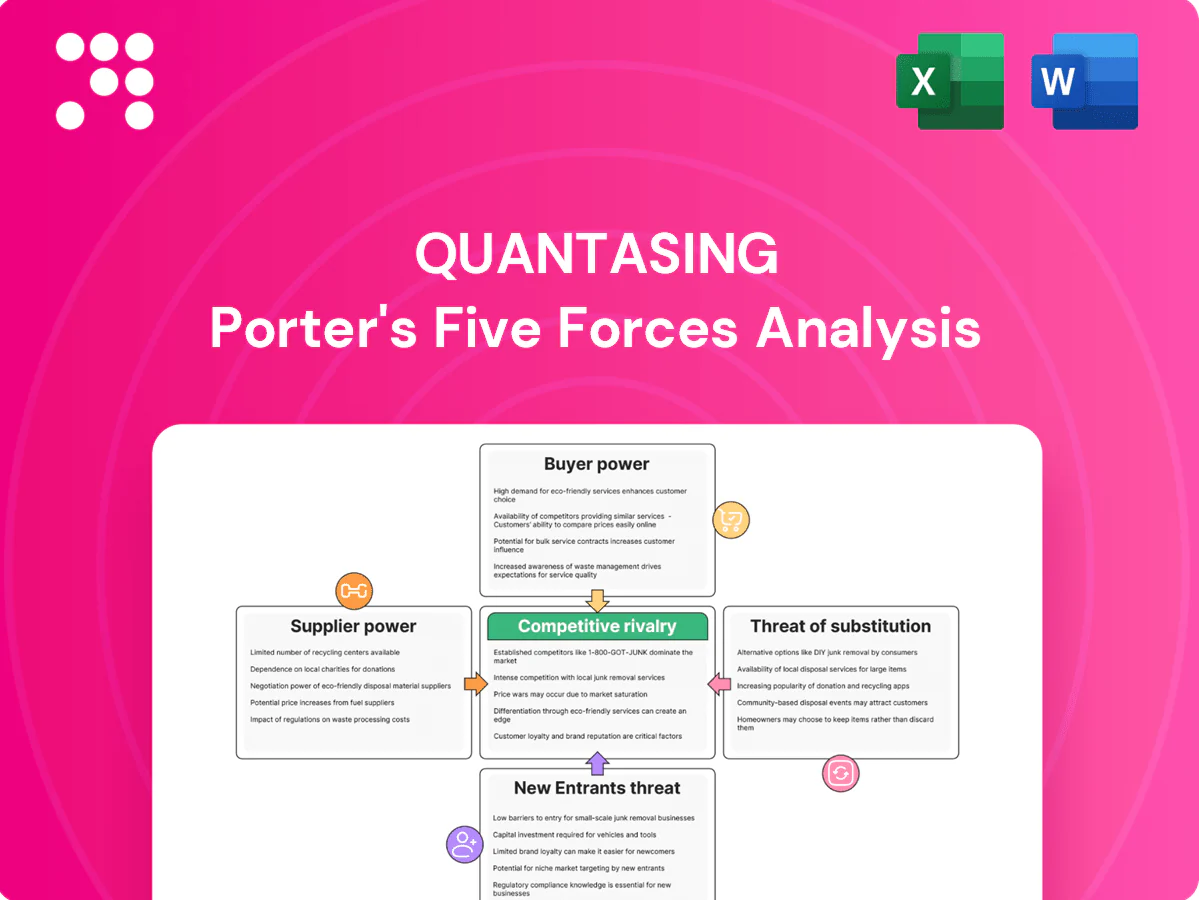
QuantaSing Porter's Five Forces Analysis

Go Beyond the Preview—Access the Full Strategic Report
QuantaSing operates in a dynamic educational technology landscape, facing distinct pressures from rivals and the ever-present threat of substitutes. Understanding these forces is crucial for navigating its market.
The complete report reveals the real forces shaping QuantaSing’s industry—from supplier influence to threat of new entrants. Gain actionable insights to drive smarter decision-making.
Suppliers Bargaining Power

Proprietary Content Creators
QuantaSing's internal content development significantly curbs the bargaining power of proprietary content creators for its core curriculum. However, for highly specialized or advanced courses, the company may still engage external experts, granting these niche suppliers a degree of influence. For instance, if a particular advanced AI course requires a globally recognized expert whose fees are substantial, QuantaSing's ability to secure that talent is dependent on meeting their terms, impacting profitability for that specific offering.
Technology Infrastructure Providers
Technology infrastructure providers, such as cloud computing services and internet providers, hold moderate bargaining power over QuantaSing. While the market offers numerous options, the costs and complexities associated with migrating critical online learning platforms can be substantial, benefiting established tech giants. QuantaSing's significant investments in its technological backbone are designed to mitigate these switching costs and foster more stable, long-term relationships with its key infrastructure partners.

Payment Gateway Services
QuantaSing, as an online financial services firm, relies heavily on payment gateway services to process customer transactions. This reliance places them in a position where suppliers of these services can exert some influence.
The market for payment gateway services is quite competitive, with numerous providers available. This generally weakens the bargaining power of any single supplier. For instance, in 2024, the global payment gateway market was estimated to be worth over $20 billion, indicating a broad range of options for businesses like QuantaSing.
However, certain factors can still bolster supplier power. Stringent regulatory compliance and the associated costs of integrating secure payment systems can create switching barriers. While transaction fees are a direct cost, the need for reliable and compliant processing means QuantaSing cannot simply choose the cheapest option, giving providers with robust infrastructure and regulatory adherence a degree of leverage.

Marketing and Advertising Platforms
QuantaSing relies on major social media and advertising networks in China to reach its extensive user base. These platforms, such as Tencent's WeChat and ByteDance's Douyin, represent key marketing and advertising suppliers.
The concentration of advertising spend on a few dominant platforms in China’s digital ecosystem grants these suppliers considerable leverage. For instance, in 2023, China's digital advertising market was valued at approximately $90 billion, with a significant portion flowing through these major players.
- Dominant Platforms: Tencent and ByteDance control a large share of China's digital ad market.
- High Concentration: Limited number of major platforms increases their supplier power.
- Cost Management: QuantaSing focuses on optimizing ad spend and operational efficiency to mitigate these costs.
- User Acquisition: Effective use of these platforms is crucial for QuantaSing's user acquisition and engagement strategies.
Human Capital and Expertise
The bargaining power of suppliers in QuantaSing's human capital segment is influenced by the demand for specialized skills. Skilled educators, curriculum designers, and technology professionals are crucial for QuantaSing's educational offerings and operational efficiency. The competitive EdTech landscape in China, which saw significant growth and investment prior to 2022, means that top talent can command higher salaries and better benefits, giving them moderate leverage.
QuantaSing's strategic expansion into areas like pop toys necessitates a broader range of expertise, potentially increasing the number of specialized roles where talent scarcity could amplify supplier (individual or agency) bargaining power. For instance, as of early 2024, the demand for AI-driven curriculum developers and user experience designers in the EdTech sector remained robust, reflecting this trend.
- Talent Demand: High demand for specialized EdTech professionals in China grants them moderate bargaining power.
- Expansion Impact: New business segments like pop toys require diverse talent, potentially increasing reliance on specialized suppliers.
- Market Dynamics: The competitive EdTech market in 2024 continued to favor skilled individuals seeking better compensation and roles.
Supplier Bargaining Power: A Critical Factor for EdTech Operations
QuantaSing faces moderate supplier bargaining power from technology infrastructure providers, as switching costs for critical online learning platforms can be substantial, benefiting established tech giants. While the payment gateway market is competitive, regulatory compliance and integration complexities give providers with robust systems leverage. The concentration of digital advertising spend on dominant Chinese platforms like Tencent and ByteDance grants these suppliers significant power, impacting QuantaSing's user acquisition costs.
The bargaining power of suppliers in QuantaSing's human capital segment is influenced by the demand for specialized skills in the competitive EdTech landscape. As of early 2024, the demand for AI-driven curriculum developers and UX designers remained robust, granting these professionals moderate leverage.
| Supplier Category | Key Players/Examples | Bargaining Power Level | Key Influencing Factors |
|---|---|---|---|
| Content Development | Proprietary creators, niche experts | Low to Moderate | Internal development, reliance on specialized external experts |
| Technology Infrastructure | Cloud computing (e.g., AWS, Azure), Internet providers | Moderate | Switching costs, market options, investment in infrastructure |
| Payment Gateways | Various payment processors | Moderate | Market competition, regulatory compliance, integration complexity |
| Advertising Networks | Tencent (WeChat), ByteDance (Douyin) | High | Market concentration, digital ad spend dominance |
| Human Capital | EdTech professionals, AI developers, UX designers | Moderate | Demand for specialized skills, competitive market dynamics |
What is included in the product
 Detailed Word Document
This analysis unpacks the competitive forces impacting QuantaSing, examining industry rivalry, buyer and supplier power, new entrant threats, and substitute products to illuminate strategic positioning and potential challenges.

 Customizable Excel Spreadsheet
QuantaSing's Porter's Five Forces Analysis offers a visual, interactive dashboard to quickly identify and address competitive threats, transforming complex market dynamics into actionable insights.
Customers Bargaining Power

Large and Diverse Customer Base
QuantaSing's vast user base, reaching 145 million registered users by March 2025, significantly dilutes the bargaining power of individual customers. This sheer volume means no single customer or small group can dictate terms or significantly impact QuantaSing's operations.
The company's diverse product portfolio addresses a wide array of needs within the adult learning market, from essential financial literacy to personal enrichment. This broad appeal across different demographics, including a dedicated focus on the senior population, further diversifies its customer base and reduces reliance on any specific segment.
This extensive market penetration provides a stable demand for QuantaSing's services. By catering to a broad spectrum of learners, the company mitigates the risk of a concentrated customer base, thereby strengthening its position against customer-driven power plays.
Price Sensitivity and Affordability
QuantaSing's focus on accessible and affordable online education suggests its customers are likely price-sensitive. In 2024, with numerous online learning platforms available, consumers can readily compare pricing and switch to competitors offering lower costs. This means QuantaSing must carefully balance its pricing strategy to ensure its courses remain attractive without sacrificing perceived value.

Low Switching Costs for Online Courses
The bargaining power of customers in the online course market is amplified by low switching costs, a significant factor for platforms like QuantaSing. For instance, a user can often transition between different online learning providers with minimal financial or technical hurdles, allowing them to easily compare offerings based on price, content quality, or user experience. This ease of movement means customers can quickly move to a competitor if they find a better deal or a more engaging learning environment.

Availability of Alternative Learning Options
The bargaining power of customers is significantly influenced by the availability of alternative learning options. Learners today have a vast array of choices, ranging from other online education providers and readily accessible free content on platforms like YouTube and Coursera, to traditional brick-and-mortar institutions and self-directed study using books and articles. This abundance of alternatives means customers can easily switch if they find a better value proposition.
This wide selection of educational resources empowers customers to be discerning, demanding high-quality, relevant, and engaging content. They can compare pricing, course structure, instructor credentials, and learning outcomes across multiple providers. For instance, a 2024 survey indicated that 65% of online learners compare at least three different platforms before enrolling in a course.
QuantaSing differentiates itself by focusing on practical, job-ready skills and offering a diverse curriculum tailored to specific demographic needs, such as upskilling for career advancement. This specialization, coupled with a commitment to delivering engaging and applicable knowledge, helps QuantaSing retain customers despite the competitive landscape. For example, QuantaSing reported a 92% satisfaction rate among its users in Q1 2024, partly attributed to its practical application focus.
- Abundant Alternatives: Learners can choose from numerous online platforms, free content, traditional courses, and self-study materials.
- Customer Empowerment: This broad choice allows customers to demand high quality, relevance, and engagement in educational offerings.
- QuantaSing's Differentiation: The company stands out through its emphasis on practical knowledge, a varied curriculum, and targeting specific learner demographics.
Value Proposition and Perceived Benefits
Customers assess QuantaSing's offerings by how well they boost skills, enhance life quality, and impart useful knowledge. The perceived value and concrete advantages from these courses directly shape customer loyalty and their price sensitivity.
For instance, QuantaSing's focus on practical, career-oriented training, such as their digital marketing and financial management courses, directly addresses market demand for upskilling. Their success in placing graduates in relevant roles, as evidenced by their reported placement rates, reinforces the tangible benefits for learners.
- Enhanced Capabilities: QuantaSing's curriculum is designed to equip individuals with in-demand skills, directly contributing to their career advancement and earning potential.
- Improved Quality of Life: By providing pathways to better employment or business opportunities, the courses aim to positively impact participants' overall well-being and financial security.
- Practical Knowledge and Skills: The emphasis is on actionable learning that can be immediately applied in professional settings, making the investment in education highly relevant.
- Customer Loyalty and Willingness to Pay: Strong demonstrated outcomes and positive testimonials from past students build trust and encourage repeat business, reducing the likelihood of customers seeking lower-cost alternatives.
Online Learning: Customer Power and Platform Strategy
QuantaSing's extensive user base of 145 million registered users as of March 2025 significantly diminishes the bargaining power of individual customers. The sheer volume of users means no single customer or small group can dictate terms or materially influence the company's operations. This broad market penetration ensures stable demand, reducing reliance on any specific customer segment and strengthening QuantaSing's position against customer-driven power plays.
Customers in the online learning market, including QuantaSing's users, are often price-sensitive and benefit from low switching costs. In 2024, with numerous platforms available, learners can easily compare prices and move to competitors. For instance, a 2024 survey showed 65% of online learners compare at least three platforms before enrolling. This necessitates QuantaSing balancing pricing to remain attractive while maintaining perceived value.
The availability of abundant alternatives, from other online providers and free content to traditional education, empowers customers. They can demand high quality and relevance, easily switching if a better value proposition arises. QuantaSing differentiates itself by focusing on practical, job-ready skills and a diverse curriculum, supported by a 92% user satisfaction rate in Q1 2024, which helps retain customers.
| Factor | Impact on QuantaSing | Supporting Data (2024/2025) |
|---|---|---|
| User Base Size | Lowers individual customer bargaining power | 145 million registered users (March 2025) |
| Availability of Alternatives | Increases customer bargaining power | Numerous online platforms, free content, traditional courses |
| Switching Costs | Low, increasing customer bargaining power | Minimal financial or technical hurdles to switch providers |
| Price Sensitivity | High, increasing customer bargaining power | 65% of online learners compare 3+ platforms (2024 survey) |
| QuantaSing's Differentiation | Mitigates customer bargaining power | Focus on practical skills, diverse curriculum, 92% user satisfaction (Q1 2024) |
Preview Before You Purchase
QuantaSing Porter's Five Forces Analysis
This preview showcases the complete QuantaSing Porter's Five Forces Analysis, offering a detailed examination of competitive forces within the online education sector. The document you see here is the exact, professionally formatted analysis you will receive immediately after purchase, ensuring no discrepancies or missing information. You're looking at the final, ready-to-use report, providing actionable insights into QuantaSing's strategic positioning and market dynamics.

Go Beyond the Preview—Access the Full Strategic Report
QuantaSing operates in a dynamic educational technology landscape, facing distinct pressures from rivals and the ever-present threat of substitutes. Understanding these forces is crucial for navigating its market.
The complete report reveals the real forces shaping QuantaSing’s industry—from supplier influence to threat of new entrants. Gain actionable insights to drive smarter decision-making.
Suppliers Bargaining Power
Proprietary Content Creators
QuantaSing's internal content development significantly curbs the bargaining power of proprietary content creators for its core curriculum. However, for highly specialized or advanced courses, the company may still engage external experts, granting these niche suppliers a degree of influence. For instance, if a particular advanced AI course requires a globally recognized expert whose fees are substantial, QuantaSing's ability to secure that talent is dependent on meeting their terms, impacting profitability for that specific offering.
Technology Infrastructure Providers
Technology infrastructure providers, such as cloud computing services and internet providers, hold moderate bargaining power over QuantaSing. While the market offers numerous options, the costs and complexities associated with migrating critical online learning platforms can be substantial, benefiting established tech giants. QuantaSing's significant investments in its technological backbone are designed to mitigate these switching costs and foster more stable, long-term relationships with its key infrastructure partners.
Payment Gateway Services
QuantaSing, as an online financial services firm, relies heavily on payment gateway services to process customer transactions. This reliance places them in a position where suppliers of these services can exert some influence.
The market for payment gateway services is quite competitive, with numerous providers available. This generally weakens the bargaining power of any single supplier. For instance, in 2024, the global payment gateway market was estimated to be worth over $20 billion, indicating a broad range of options for businesses like QuantaSing.
However, certain factors can still bolster supplier power. Stringent regulatory compliance and the associated costs of integrating secure payment systems can create switching barriers. While transaction fees are a direct cost, the need for reliable and compliant processing means QuantaSing cannot simply choose the cheapest option, giving providers with robust infrastructure and regulatory adherence a degree of leverage.
Marketing and Advertising Platforms
QuantaSing relies on major social media and advertising networks in China to reach its extensive user base. These platforms, such as Tencent's WeChat and ByteDance's Douyin, represent key marketing and advertising suppliers.
The concentration of advertising spend on a few dominant platforms in China’s digital ecosystem grants these suppliers considerable leverage. For instance, in 2023, China's digital advertising market was valued at approximately $90 billion, with a significant portion flowing through these major players.
- Dominant Platforms: Tencent and ByteDance control a large share of China's digital ad market.
- High Concentration: Limited number of major platforms increases their supplier power.
- Cost Management: QuantaSing focuses on optimizing ad spend and operational efficiency to mitigate these costs.
- User Acquisition: Effective use of these platforms is crucial for QuantaSing's user acquisition and engagement strategies.
Human Capital and Expertise
The bargaining power of suppliers in QuantaSing's human capital segment is influenced by the demand for specialized skills. Skilled educators, curriculum designers, and technology professionals are crucial for QuantaSing's educational offerings and operational efficiency. The competitive EdTech landscape in China, which saw significant growth and investment prior to 2022, means that top talent can command higher salaries and better benefits, giving them moderate leverage.
QuantaSing's strategic expansion into areas like pop toys necessitates a broader range of expertise, potentially increasing the number of specialized roles where talent scarcity could amplify supplier (individual or agency) bargaining power. For instance, as of early 2024, the demand for AI-driven curriculum developers and user experience designers in the EdTech sector remained robust, reflecting this trend.
- Talent Demand: High demand for specialized EdTech professionals in China grants them moderate bargaining power.
- Expansion Impact: New business segments like pop toys require diverse talent, potentially increasing reliance on specialized suppliers.
- Market Dynamics: The competitive EdTech market in 2024 continued to favor skilled individuals seeking better compensation and roles.
Supplier Bargaining Power: A Critical Factor for EdTech Operations
QuantaSing faces moderate supplier bargaining power from technology infrastructure providers, as switching costs for critical online learning platforms can be substantial, benefiting established tech giants. While the payment gateway market is competitive, regulatory compliance and integration complexities give providers with robust systems leverage. The concentration of digital advertising spend on dominant Chinese platforms like Tencent and ByteDance grants these suppliers significant power, impacting QuantaSing's user acquisition costs.
The bargaining power of suppliers in QuantaSing's human capital segment is influenced by the demand for specialized skills in the competitive EdTech landscape. As of early 2024, the demand for AI-driven curriculum developers and UX designers remained robust, granting these professionals moderate leverage.
| Supplier Category | Key Players/Examples | Bargaining Power Level | Key Influencing Factors |
|---|---|---|---|
| Content Development | Proprietary creators, niche experts | Low to Moderate | Internal development, reliance on specialized external experts |
| Technology Infrastructure | Cloud computing (e.g., AWS, Azure), Internet providers | Moderate | Switching costs, market options, investment in infrastructure |
| Payment Gateways | Various payment processors | Moderate | Market competition, regulatory compliance, integration complexity |
| Advertising Networks | Tencent (WeChat), ByteDance (Douyin) | High | Market concentration, digital ad spend dominance |
| Human Capital | EdTech professionals, AI developers, UX designers | Moderate | Demand for specialized skills, competitive market dynamics |
What is included in the product
Detailed Word Document
This analysis unpacks the competitive forces impacting QuantaSing, examining industry rivalry, buyer and supplier power, new entrant threats, and substitute products to illuminate strategic positioning and potential challenges.
Customizable Excel Spreadsheet
QuantaSing's Porter's Five Forces Analysis offers a visual, interactive dashboard to quickly identify and address competitive threats, transforming complex market dynamics into actionable insights.
Customers Bargaining Power
Large and Diverse Customer Base
QuantaSing's vast user base, reaching 145 million registered users by March 2025, significantly dilutes the bargaining power of individual customers. This sheer volume means no single customer or small group can dictate terms or significantly impact QuantaSing's operations.
The company's diverse product portfolio addresses a wide array of needs within the adult learning market, from essential financial literacy to personal enrichment. This broad appeal across different demographics, including a dedicated focus on the senior population, further diversifies its customer base and reduces reliance on any specific segment.
This extensive market penetration provides a stable demand for QuantaSing's services. By catering to a broad spectrum of learners, the company mitigates the risk of a concentrated customer base, thereby strengthening its position against customer-driven power plays.
Price Sensitivity and Affordability
QuantaSing's focus on accessible and affordable online education suggests its customers are likely price-sensitive. In 2024, with numerous online learning platforms available, consumers can readily compare pricing and switch to competitors offering lower costs. This means QuantaSing must carefully balance its pricing strategy to ensure its courses remain attractive without sacrificing perceived value.
Low Switching Costs for Online Courses
The bargaining power of customers in the online course market is amplified by low switching costs, a significant factor for platforms like QuantaSing. For instance, a user can often transition between different online learning providers with minimal financial or technical hurdles, allowing them to easily compare offerings based on price, content quality, or user experience. This ease of movement means customers can quickly move to a competitor if they find a better deal or a more engaging learning environment.
Availability of Alternative Learning Options
The bargaining power of customers is significantly influenced by the availability of alternative learning options. Learners today have a vast array of choices, ranging from other online education providers and readily accessible free content on platforms like YouTube and Coursera, to traditional brick-and-mortar institutions and self-directed study using books and articles. This abundance of alternatives means customers can easily switch if they find a better value proposition.
This wide selection of educational resources empowers customers to be discerning, demanding high-quality, relevant, and engaging content. They can compare pricing, course structure, instructor credentials, and learning outcomes across multiple providers. For instance, a 2024 survey indicated that 65% of online learners compare at least three different platforms before enrolling in a course.
QuantaSing differentiates itself by focusing on practical, job-ready skills and offering a diverse curriculum tailored to specific demographic needs, such as upskilling for career advancement. This specialization, coupled with a commitment to delivering engaging and applicable knowledge, helps QuantaSing retain customers despite the competitive landscape. For example, QuantaSing reported a 92% satisfaction rate among its users in Q1 2024, partly attributed to its practical application focus.
- Abundant Alternatives: Learners can choose from numerous online platforms, free content, traditional courses, and self-study materials.
- Customer Empowerment: This broad choice allows customers to demand high quality, relevance, and engagement in educational offerings.
- QuantaSing's Differentiation: The company stands out through its emphasis on practical knowledge, a varied curriculum, and targeting specific learner demographics.
Value Proposition and Perceived Benefits
Customers assess QuantaSing's offerings by how well they boost skills, enhance life quality, and impart useful knowledge. The perceived value and concrete advantages from these courses directly shape customer loyalty and their price sensitivity.
For instance, QuantaSing's focus on practical, career-oriented training, such as their digital marketing and financial management courses, directly addresses market demand for upskilling. Their success in placing graduates in relevant roles, as evidenced by their reported placement rates, reinforces the tangible benefits for learners.
- Enhanced Capabilities: QuantaSing's curriculum is designed to equip individuals with in-demand skills, directly contributing to their career advancement and earning potential.
- Improved Quality of Life: By providing pathways to better employment or business opportunities, the courses aim to positively impact participants' overall well-being and financial security.
- Practical Knowledge and Skills: The emphasis is on actionable learning that can be immediately applied in professional settings, making the investment in education highly relevant.
- Customer Loyalty and Willingness to Pay: Strong demonstrated outcomes and positive testimonials from past students build trust and encourage repeat business, reducing the likelihood of customers seeking lower-cost alternatives.
Online Learning: Customer Power and Platform Strategy
QuantaSing's extensive user base of 145 million registered users as of March 2025 significantly diminishes the bargaining power of individual customers. The sheer volume of users means no single customer or small group can dictate terms or materially influence the company's operations. This broad market penetration ensures stable demand, reducing reliance on any specific customer segment and strengthening QuantaSing's position against customer-driven power plays.
Customers in the online learning market, including QuantaSing's users, are often price-sensitive and benefit from low switching costs. In 2024, with numerous platforms available, learners can easily compare prices and move to competitors. For instance, a 2024 survey showed 65% of online learners compare at least three platforms before enrolling. This necessitates QuantaSing balancing pricing to remain attractive while maintaining perceived value.
The availability of abundant alternatives, from other online providers and free content to traditional education, empowers customers. They can demand high quality and relevance, easily switching if a better value proposition arises. QuantaSing differentiates itself by focusing on practical, job-ready skills and a diverse curriculum, supported by a 92% user satisfaction rate in Q1 2024, which helps retain customers.
| Factor | Impact on QuantaSing | Supporting Data (2024/2025) |
|---|---|---|
| User Base Size | Lowers individual customer bargaining power | 145 million registered users (March 2025) |
| Availability of Alternatives | Increases customer bargaining power | Numerous online platforms, free content, traditional courses |
| Switching Costs | Low, increasing customer bargaining power | Minimal financial or technical hurdles to switch providers |
| Price Sensitivity | High, increasing customer bargaining power | 65% of online learners compare 3+ platforms (2024 survey) |
| QuantaSing's Differentiation | Mitigates customer bargaining power | Focus on practical skills, diverse curriculum, 92% user satisfaction (Q1 2024) |
Preview Before You Purchase
QuantaSing Porter's Five Forces Analysis
This preview showcases the complete QuantaSing Porter's Five Forces Analysis, offering a detailed examination of competitive forces within the online education sector. The document you see here is the exact, professionally formatted analysis you will receive immediately after purchase, ensuring no discrepancies or missing information. You're looking at the final, ready-to-use report, providing actionable insights into QuantaSing's strategic positioning and market dynamics.
Description
Go Beyond the Preview—Access the Full Strategic Report
QuantaSing operates in a dynamic educational technology landscape, facing distinct pressures from rivals and the ever-present threat of substitutes. Understanding these forces is crucial for navigating its market.
The complete report reveals the real forces shaping QuantaSing’s industry—from supplier influence to threat of new entrants. Gain actionable insights to drive smarter decision-making.
Suppliers Bargaining Power
Proprietary Content Creators
QuantaSing's internal content development significantly curbs the bargaining power of proprietary content creators for its core curriculum. However, for highly specialized or advanced courses, the company may still engage external experts, granting these niche suppliers a degree of influence. For instance, if a particular advanced AI course requires a globally recognized expert whose fees are substantial, QuantaSing's ability to secure that talent is dependent on meeting their terms, impacting profitability for that specific offering.
Technology Infrastructure Providers
Technology infrastructure providers, such as cloud computing services and internet providers, hold moderate bargaining power over QuantaSing. While the market offers numerous options, the costs and complexities associated with migrating critical online learning platforms can be substantial, benefiting established tech giants. QuantaSing's significant investments in its technological backbone are designed to mitigate these switching costs and foster more stable, long-term relationships with its key infrastructure partners.
Payment Gateway Services
QuantaSing, as an online financial services firm, relies heavily on payment gateway services to process customer transactions. This reliance places them in a position where suppliers of these services can exert some influence.
The market for payment gateway services is quite competitive, with numerous providers available. This generally weakens the bargaining power of any single supplier. For instance, in 2024, the global payment gateway market was estimated to be worth over $20 billion, indicating a broad range of options for businesses like QuantaSing.
However, certain factors can still bolster supplier power. Stringent regulatory compliance and the associated costs of integrating secure payment systems can create switching barriers. While transaction fees are a direct cost, the need for reliable and compliant processing means QuantaSing cannot simply choose the cheapest option, giving providers with robust infrastructure and regulatory adherence a degree of leverage.
Marketing and Advertising Platforms
QuantaSing relies on major social media and advertising networks in China to reach its extensive user base. These platforms, such as Tencent's WeChat and ByteDance's Douyin, represent key marketing and advertising suppliers.
The concentration of advertising spend on a few dominant platforms in China’s digital ecosystem grants these suppliers considerable leverage. For instance, in 2023, China's digital advertising market was valued at approximately $90 billion, with a significant portion flowing through these major players.
- Dominant Platforms: Tencent and ByteDance control a large share of China's digital ad market.
- High Concentration: Limited number of major platforms increases their supplier power.
- Cost Management: QuantaSing focuses on optimizing ad spend and operational efficiency to mitigate these costs.
- User Acquisition: Effective use of these platforms is crucial for QuantaSing's user acquisition and engagement strategies.
Human Capital and Expertise
The bargaining power of suppliers in QuantaSing's human capital segment is influenced by the demand for specialized skills. Skilled educators, curriculum designers, and technology professionals are crucial for QuantaSing's educational offerings and operational efficiency. The competitive EdTech landscape in China, which saw significant growth and investment prior to 2022, means that top talent can command higher salaries and better benefits, giving them moderate leverage.
QuantaSing's strategic expansion into areas like pop toys necessitates a broader range of expertise, potentially increasing the number of specialized roles where talent scarcity could amplify supplier (individual or agency) bargaining power. For instance, as of early 2024, the demand for AI-driven curriculum developers and user experience designers in the EdTech sector remained robust, reflecting this trend.
- Talent Demand: High demand for specialized EdTech professionals in China grants them moderate bargaining power.
- Expansion Impact: New business segments like pop toys require diverse talent, potentially increasing reliance on specialized suppliers.
- Market Dynamics: The competitive EdTech market in 2024 continued to favor skilled individuals seeking better compensation and roles.
Supplier Bargaining Power: A Critical Factor for EdTech Operations
QuantaSing faces moderate supplier bargaining power from technology infrastructure providers, as switching costs for critical online learning platforms can be substantial, benefiting established tech giants. While the payment gateway market is competitive, regulatory compliance and integration complexities give providers with robust systems leverage. The concentration of digital advertising spend on dominant Chinese platforms like Tencent and ByteDance grants these suppliers significant power, impacting QuantaSing's user acquisition costs.
The bargaining power of suppliers in QuantaSing's human capital segment is influenced by the demand for specialized skills in the competitive EdTech landscape. As of early 2024, the demand for AI-driven curriculum developers and UX designers remained robust, granting these professionals moderate leverage.
| Supplier Category | Key Players/Examples | Bargaining Power Level | Key Influencing Factors |
|---|---|---|---|
| Content Development | Proprietary creators, niche experts | Low to Moderate | Internal development, reliance on specialized external experts |
| Technology Infrastructure | Cloud computing (e.g., AWS, Azure), Internet providers | Moderate | Switching costs, market options, investment in infrastructure |
| Payment Gateways | Various payment processors | Moderate | Market competition, regulatory compliance, integration complexity |
| Advertising Networks | Tencent (WeChat), ByteDance (Douyin) | High | Market concentration, digital ad spend dominance |
| Human Capital | EdTech professionals, AI developers, UX designers | Moderate | Demand for specialized skills, competitive market dynamics |
What is included in the product
Detailed Word Document
This analysis unpacks the competitive forces impacting QuantaSing, examining industry rivalry, buyer and supplier power, new entrant threats, and substitute products to illuminate strategic positioning and potential challenges.
Customizable Excel Spreadsheet
QuantaSing's Porter's Five Forces Analysis offers a visual, interactive dashboard to quickly identify and address competitive threats, transforming complex market dynamics into actionable insights.
Customers Bargaining Power
Large and Diverse Customer Base
QuantaSing's vast user base, reaching 145 million registered users by March 2025, significantly dilutes the bargaining power of individual customers. This sheer volume means no single customer or small group can dictate terms or significantly impact QuantaSing's operations.
The company's diverse product portfolio addresses a wide array of needs within the adult learning market, from essential financial literacy to personal enrichment. This broad appeal across different demographics, including a dedicated focus on the senior population, further diversifies its customer base and reduces reliance on any specific segment.
This extensive market penetration provides a stable demand for QuantaSing's services. By catering to a broad spectrum of learners, the company mitigates the risk of a concentrated customer base, thereby strengthening its position against customer-driven power plays.
Price Sensitivity and Affordability
QuantaSing's focus on accessible and affordable online education suggests its customers are likely price-sensitive. In 2024, with numerous online learning platforms available, consumers can readily compare pricing and switch to competitors offering lower costs. This means QuantaSing must carefully balance its pricing strategy to ensure its courses remain attractive without sacrificing perceived value.
Low Switching Costs for Online Courses
The bargaining power of customers in the online course market is amplified by low switching costs, a significant factor for platforms like QuantaSing. For instance, a user can often transition between different online learning providers with minimal financial or technical hurdles, allowing them to easily compare offerings based on price, content quality, or user experience. This ease of movement means customers can quickly move to a competitor if they find a better deal or a more engaging learning environment.
Availability of Alternative Learning Options
The bargaining power of customers is significantly influenced by the availability of alternative learning options. Learners today have a vast array of choices, ranging from other online education providers and readily accessible free content on platforms like YouTube and Coursera, to traditional brick-and-mortar institutions and self-directed study using books and articles. This abundance of alternatives means customers can easily switch if they find a better value proposition.
This wide selection of educational resources empowers customers to be discerning, demanding high-quality, relevant, and engaging content. They can compare pricing, course structure, instructor credentials, and learning outcomes across multiple providers. For instance, a 2024 survey indicated that 65% of online learners compare at least three different platforms before enrolling in a course.
QuantaSing differentiates itself by focusing on practical, job-ready skills and offering a diverse curriculum tailored to specific demographic needs, such as upskilling for career advancement. This specialization, coupled with a commitment to delivering engaging and applicable knowledge, helps QuantaSing retain customers despite the competitive landscape. For example, QuantaSing reported a 92% satisfaction rate among its users in Q1 2024, partly attributed to its practical application focus.
- Abundant Alternatives: Learners can choose from numerous online platforms, free content, traditional courses, and self-study materials.
- Customer Empowerment: This broad choice allows customers to demand high quality, relevance, and engagement in educational offerings.
- QuantaSing's Differentiation: The company stands out through its emphasis on practical knowledge, a varied curriculum, and targeting specific learner demographics.
Value Proposition and Perceived Benefits
Customers assess QuantaSing's offerings by how well they boost skills, enhance life quality, and impart useful knowledge. The perceived value and concrete advantages from these courses directly shape customer loyalty and their price sensitivity.
For instance, QuantaSing's focus on practical, career-oriented training, such as their digital marketing and financial management courses, directly addresses market demand for upskilling. Their success in placing graduates in relevant roles, as evidenced by their reported placement rates, reinforces the tangible benefits for learners.
- Enhanced Capabilities: QuantaSing's curriculum is designed to equip individuals with in-demand skills, directly contributing to their career advancement and earning potential.
- Improved Quality of Life: By providing pathways to better employment or business opportunities, the courses aim to positively impact participants' overall well-being and financial security.
- Practical Knowledge and Skills: The emphasis is on actionable learning that can be immediately applied in professional settings, making the investment in education highly relevant.
- Customer Loyalty and Willingness to Pay: Strong demonstrated outcomes and positive testimonials from past students build trust and encourage repeat business, reducing the likelihood of customers seeking lower-cost alternatives.
Online Learning: Customer Power and Platform Strategy
QuantaSing's extensive user base of 145 million registered users as of March 2025 significantly diminishes the bargaining power of individual customers. The sheer volume of users means no single customer or small group can dictate terms or materially influence the company's operations. This broad market penetration ensures stable demand, reducing reliance on any specific customer segment and strengthening QuantaSing's position against customer-driven power plays.
Customers in the online learning market, including QuantaSing's users, are often price-sensitive and benefit from low switching costs. In 2024, with numerous platforms available, learners can easily compare prices and move to competitors. For instance, a 2024 survey showed 65% of online learners compare at least three platforms before enrolling. This necessitates QuantaSing balancing pricing to remain attractive while maintaining perceived value.
The availability of abundant alternatives, from other online providers and free content to traditional education, empowers customers. They can demand high quality and relevance, easily switching if a better value proposition arises. QuantaSing differentiates itself by focusing on practical, job-ready skills and a diverse curriculum, supported by a 92% user satisfaction rate in Q1 2024, which helps retain customers.
| Factor | Impact on QuantaSing | Supporting Data (2024/2025) |
|---|---|---|
| User Base Size | Lowers individual customer bargaining power | 145 million registered users (March 2025) |
| Availability of Alternatives | Increases customer bargaining power | Numerous online platforms, free content, traditional courses |
| Switching Costs | Low, increasing customer bargaining power | Minimal financial or technical hurdles to switch providers |
| Price Sensitivity | High, increasing customer bargaining power | 65% of online learners compare 3+ platforms (2024 survey) |
| QuantaSing's Differentiation | Mitigates customer bargaining power | Focus on practical skills, diverse curriculum, 92% user satisfaction (Q1 2024) |
Preview Before You Purchase
QuantaSing Porter's Five Forces Analysis
This preview showcases the complete QuantaSing Porter's Five Forces Analysis, offering a detailed examination of competitive forces within the online education sector. The document you see here is the exact, professionally formatted analysis you will receive immediately after purchase, ensuring no discrepancies or missing information. You're looking at the final, ready-to-use report, providing actionable insights into QuantaSing's strategic positioning and market dynamics.











