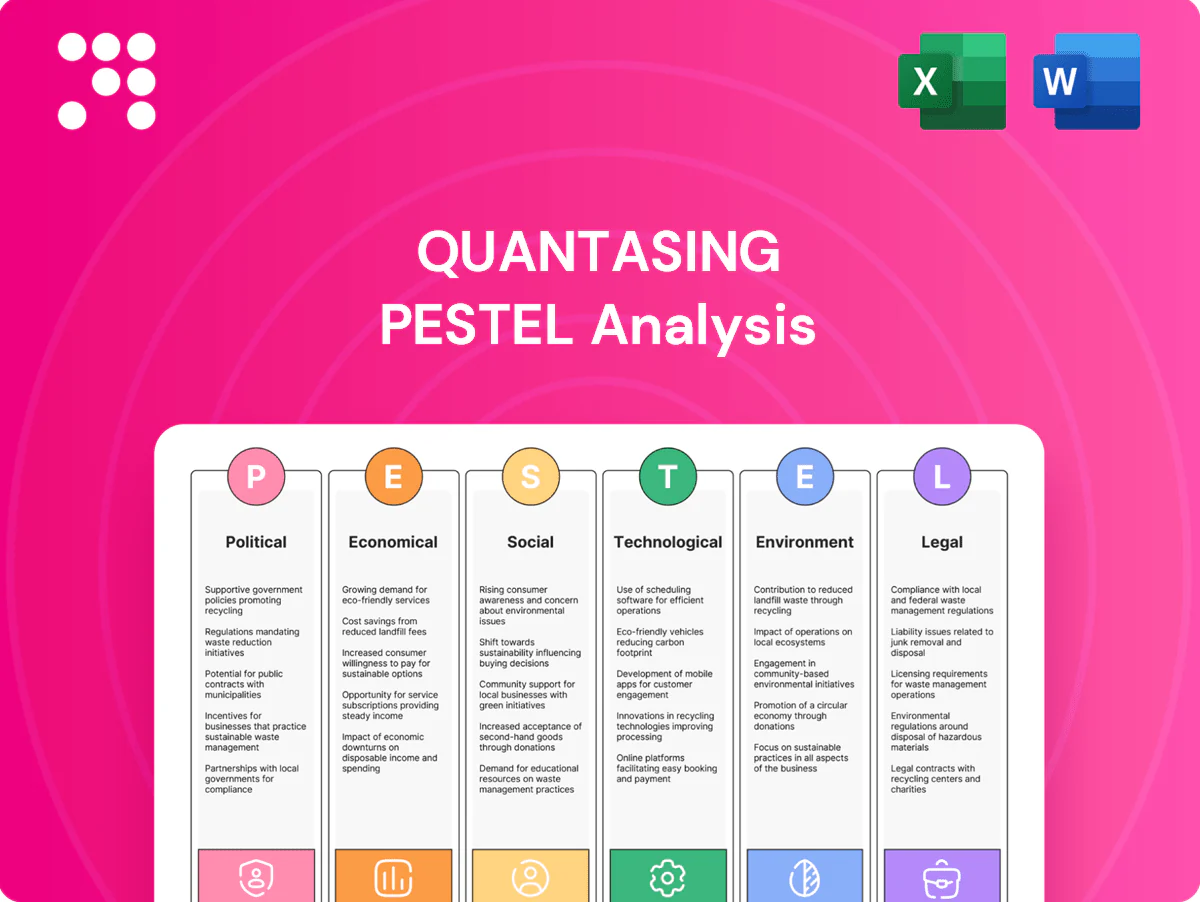
QuantaSing PESTLE Analysis

Your Competitive Advantage Starts with This Report
Unlock how political, economic, social, technological, legal and environmental shifts are shaping QuantaSing’s trajectory with our concise PESTLE Analysis—insights you can act on today. Buy the full version for the complete, editable breakdown and strategic recommendations you need.
Political factors

Education policy shifts in China
China’s regulators have repeatedly recalibrated online education rules since the 2021 double reduction, tightening K-12 curriculum scope and delivery while allowing monitored growth in adult education. Adult upskilling is less restricted but faces content-quality and social-value oversight aligned with the 14th Five-Year Plan’s vocational priorities. QuantaSing must map offerings to national upskilling goals and maintain proactive policy scanning and engagement to reduce compliance shocks.
Content oversight and ideological compliance
Authorities increasingly mandate digital content that supports positive values and social stability, highlighted by China’s 2021 double reduction and ongoing CAC oversight that reshaped the edtech landscape. Courses on financial literacy or social topics face heightened scrutiny for accuracy and tone, driving many firms to expand compliance teams—compliance budgets rose an estimated 20%+ in 2024. Robust editorial governance, formal review workflows and transparent complaint-handling procedures are essential to maintain regulator trust and reduce enforcement risk.

Alignment with “common prosperity” goals
Affordable, skills-focused learning complements China’s common prosperity push and the 2024 national growth target of about 5%, aiming to improve livelihoods by boosting workforce productivity. Demonstrable employability outcomes (placement rates, wage uplifts) can attract local government and community support. Partnerships with community centers and SOEs can unlock channels to millions of learners; misalignment risks reputational and administrative hurdles.

Government-led upskilling initiatives
Government-led upskilling initiatives create partnership opportunities with public vocational programs, enabling QuantaSing to co-deliver training and access public procurement; OECD data show OECD countries spend about 0.5% of GDP on active labor market policies (2022–24). Bidding for grants or certifications can boost credibility and revenue, while integration with regional workforce platforms expands reach; execution requires strict reporting and outcome metrics.
- Collaboration: public vocational programs
- Funding: grant/certification bids
- Scale: regional workforce platforms
- Compliance: strict reporting & outcome metrics
Geopolitics and data localization
China upskilling grows amid tight K-12 rules; compliance budgets +20%
Post-2021 rules keep K-12 tight while adult upskilling is permitted with strong content oversight; compliance budgets rose ~20% in 2024. Aligning courses to the 14th Five-Year Plan and demonstrable employability (placement, wage uplift) boosts local support. Data localization risks persist—PIPL (2021), GDPR (27 states), Russia localization (2015)—favor domestic cloud partners.
| Metric | Value |
|---|---|
| China 2024 growth target | ~5% |
| Compliance budget change (2024) | +20% |
| ALMP spend (OECD avg) | ~0.5% GDP |
What is included in the product
 Detailed Word Document
Provides a concise PESTLE evaluation of QuantaSing, examining Political, Economic, Social, Technological, Environmental and Legal drivers with data-backed trends and tailored subpoints; designed for executives and investors to identify risks, opportunities, and forward-looking scenarios ready for reports or decks.

 Customizable Excel Spreadsheet
Condensed, visually segmented QuantaSing PESTLE summaries relieve meeting and reporting pain points by providing clear, editable insights for quick sharing, slide-ready use, and fast alignment across teams or client reports.
Economic factors

Consumer confidence and GDP trends
Adult discretionary spending on education tracks macro sentiment: IMF projects global GDP growth of about 3.1% in 2025, and softer growth historically compresses conversion and ARPU for upskilling providers. Counter-cyclical demand can persist where courses demonstrably boost earnings, keeping enrollments steadier. Tiered pricing and modular bundles help absorb revenue volatility and protect lifetime value. Monitoring local consumer confidence indices guides regional offers and timing.
Unemployment and reskilling demand
Rising joblessness (ILO global unemployment ~5.3% in 2024) and WEF’s estimate that 44% of workers need reskilling by 2025 drive demand for vocational upskilling. Short, job-ready modules see higher uptake in downturns as learners seek quick reentry. Employer partnerships improve placement rates, and clear ROI messaging—linking course outcomes to salary uplift—boosts enrollment.

Price sensitivity and affordable models
China’s mass market remains highly value conscious, with a middle‑income cohort of roughly 400 million and over 1.05 billion internet users (CNNIC, 2023), driving demand for affordable tiers. Bundles, subscriptions and installment financing expand accessibility across income bands. Low acquisition cost via referrals and community channels helps sustain margins. Continuous A/B testing is routinely used to optimize willingness to pay.

Cost structure and RMB dynamics
Cloud hosting, traffic acquisition and instructor fees account for roughly 70–85% of QuantaSing’s operating costs in comparable edtech models; cloud spend alone can be 15–25% of revenue for large platforms. RMB depreciation (~5% vs USD in 2024) raises costs for imported tools and licensing, while scale and automation reduce per-course content cost by 30–60%; strict CAC payback <12 months and LTV/CAC >3 are essential.
- Cost mix: cloud/traffic/instructors ~70–85%
- RMB move: ≈5% weaker vs USD in 2024
- Scale savings: content unit cost −30–60%
- Unit economics: CAC payback <12m; LTV/CAC >3
Competitive intensity and capital access
Edtech for QuantaSing faces a crowded field from marketplaces to universities as the global market targets ~404B USD by 2025, pressuring share and pricing. With VC and public multiples compressed in 2024–25, profitability and cash discipline are critical for survival. Demonstrable learning outcomes and brand trust create defensibility while M&A and partnerships accelerate consolidation.
- Competitive density: many channels
- Profitability: tighter funding, cash focus
- Defensibility: outcomes & trust
- Consolidation: M&A/partnerships
China upskilling grows amid tight K-12 rules; compliance budgets +20%
Macro growth ~3.1% (IMF 2025) constrains discretionary upskilling ARPU; counter‑cyclical, job‑linked courses hold enrolments. Global unemployment ~5.3% (ILO 2024) and 44% reskilling need (WEF) boost demand for short, job‑ready modules and employer partnerships. Cost pressures: cloud/traffic/instructors ~70–85%, RMB ≈5% weaker vs USD (2024); CAC payback <12m, LTV/CAC >3.
| Metric | Value |
|---|---|
| Global GDP 2025 | ~3.1% |
| Unemployment 2024 | ~5.3% |
| EdTech market 2025 | ~$404B |
| RMB vs USD 2024 | ≈-5% |
| Cost mix | Cloud/traffic/instructors 70–85% |
Preview the Actual Deliverable
QuantaSing PESTLE Analysis
The preview shown here is the exact QuantaSing PESTLE Analysis you’ll receive after purchase—fully formatted and ready to use. This screenshot reflects the final content, layout, and structure with no placeholders or omissions. After checkout you’ll instantly download this same professional, ready-to-apply document.

Your Competitive Advantage Starts with This Report
Unlock how political, economic, social, technological, legal and environmental shifts are shaping QuantaSing’s trajectory with our concise PESTLE Analysis—insights you can act on today. Buy the full version for the complete, editable breakdown and strategic recommendations you need.
Political factors
Education policy shifts in China
China’s regulators have repeatedly recalibrated online education rules since the 2021 double reduction, tightening K-12 curriculum scope and delivery while allowing monitored growth in adult education. Adult upskilling is less restricted but faces content-quality and social-value oversight aligned with the 14th Five-Year Plan’s vocational priorities. QuantaSing must map offerings to national upskilling goals and maintain proactive policy scanning and engagement to reduce compliance shocks.
Content oversight and ideological compliance
Authorities increasingly mandate digital content that supports positive values and social stability, highlighted by China’s 2021 double reduction and ongoing CAC oversight that reshaped the edtech landscape. Courses on financial literacy or social topics face heightened scrutiny for accuracy and tone, driving many firms to expand compliance teams—compliance budgets rose an estimated 20%+ in 2024. Robust editorial governance, formal review workflows and transparent complaint-handling procedures are essential to maintain regulator trust and reduce enforcement risk.
Alignment with “common prosperity” goals
Affordable, skills-focused learning complements China’s common prosperity push and the 2024 national growth target of about 5%, aiming to improve livelihoods by boosting workforce productivity. Demonstrable employability outcomes (placement rates, wage uplifts) can attract local government and community support. Partnerships with community centers and SOEs can unlock channels to millions of learners; misalignment risks reputational and administrative hurdles.
Government-led upskilling initiatives
Government-led upskilling initiatives create partnership opportunities with public vocational programs, enabling QuantaSing to co-deliver training and access public procurement; OECD data show OECD countries spend about 0.5% of GDP on active labor market policies (2022–24). Bidding for grants or certifications can boost credibility and revenue, while integration with regional workforce platforms expands reach; execution requires strict reporting and outcome metrics.
- Collaboration: public vocational programs
- Funding: grant/certification bids
- Scale: regional workforce platforms
- Compliance: strict reporting & outcome metrics
Geopolitics and data localization
China upskilling grows amid tight K-12 rules; compliance budgets +20%
Post-2021 rules keep K-12 tight while adult upskilling is permitted with strong content oversight; compliance budgets rose ~20% in 2024. Aligning courses to the 14th Five-Year Plan and demonstrable employability (placement, wage uplift) boosts local support. Data localization risks persist—PIPL (2021), GDPR (27 states), Russia localization (2015)—favor domestic cloud partners.
| Metric | Value |
|---|---|
| China 2024 growth target | ~5% |
| Compliance budget change (2024) | +20% |
| ALMP spend (OECD avg) | ~0.5% GDP |
What is included in the product
Detailed Word Document
Provides a concise PESTLE evaluation of QuantaSing, examining Political, Economic, Social, Technological, Environmental and Legal drivers with data-backed trends and tailored subpoints; designed for executives and investors to identify risks, opportunities, and forward-looking scenarios ready for reports or decks.
Customizable Excel Spreadsheet
Condensed, visually segmented QuantaSing PESTLE summaries relieve meeting and reporting pain points by providing clear, editable insights for quick sharing, slide-ready use, and fast alignment across teams or client reports.
Economic factors
Consumer confidence and GDP trends
Adult discretionary spending on education tracks macro sentiment: IMF projects global GDP growth of about 3.1% in 2025, and softer growth historically compresses conversion and ARPU for upskilling providers. Counter-cyclical demand can persist where courses demonstrably boost earnings, keeping enrollments steadier. Tiered pricing and modular bundles help absorb revenue volatility and protect lifetime value. Monitoring local consumer confidence indices guides regional offers and timing.
Unemployment and reskilling demand
Rising joblessness (ILO global unemployment ~5.3% in 2024) and WEF’s estimate that 44% of workers need reskilling by 2025 drive demand for vocational upskilling. Short, job-ready modules see higher uptake in downturns as learners seek quick reentry. Employer partnerships improve placement rates, and clear ROI messaging—linking course outcomes to salary uplift—boosts enrollment.
Price sensitivity and affordable models
China’s mass market remains highly value conscious, with a middle‑income cohort of roughly 400 million and over 1.05 billion internet users (CNNIC, 2023), driving demand for affordable tiers. Bundles, subscriptions and installment financing expand accessibility across income bands. Low acquisition cost via referrals and community channels helps sustain margins. Continuous A/B testing is routinely used to optimize willingness to pay.
Cost structure and RMB dynamics
Cloud hosting, traffic acquisition and instructor fees account for roughly 70–85% of QuantaSing’s operating costs in comparable edtech models; cloud spend alone can be 15–25% of revenue for large platforms. RMB depreciation (~5% vs USD in 2024) raises costs for imported tools and licensing, while scale and automation reduce per-course content cost by 30–60%; strict CAC payback <12 months and LTV/CAC >3 are essential.
- Cost mix: cloud/traffic/instructors ~70–85%
- RMB move: ≈5% weaker vs USD in 2024
- Scale savings: content unit cost −30–60%
- Unit economics: CAC payback <12m; LTV/CAC >3
Competitive intensity and capital access
Edtech for QuantaSing faces a crowded field from marketplaces to universities as the global market targets ~404B USD by 2025, pressuring share and pricing. With VC and public multiples compressed in 2024–25, profitability and cash discipline are critical for survival. Demonstrable learning outcomes and brand trust create defensibility while M&A and partnerships accelerate consolidation.
- Competitive density: many channels
- Profitability: tighter funding, cash focus
- Defensibility: outcomes & trust
- Consolidation: M&A/partnerships
China upskilling grows amid tight K-12 rules; compliance budgets +20%
Macro growth ~3.1% (IMF 2025) constrains discretionary upskilling ARPU; counter‑cyclical, job‑linked courses hold enrolments. Global unemployment ~5.3% (ILO 2024) and 44% reskilling need (WEF) boost demand for short, job‑ready modules and employer partnerships. Cost pressures: cloud/traffic/instructors ~70–85%, RMB ≈5% weaker vs USD (2024); CAC payback <12m, LTV/CAC >3.
| Metric | Value |
|---|---|
| Global GDP 2025 | ~3.1% |
| Unemployment 2024 | ~5.3% |
| EdTech market 2025 | ~$404B |
| RMB vs USD 2024 | ≈-5% |
| Cost mix | Cloud/traffic/instructors 70–85% |
Preview the Actual Deliverable
QuantaSing PESTLE Analysis
The preview shown here is the exact QuantaSing PESTLE Analysis you’ll receive after purchase—fully formatted and ready to use. This screenshot reflects the final content, layout, and structure with no placeholders or omissions. After checkout you’ll instantly download this same professional, ready-to-apply document.
Description
Your Competitive Advantage Starts with This Report
Unlock how political, economic, social, technological, legal and environmental shifts are shaping QuantaSing’s trajectory with our concise PESTLE Analysis—insights you can act on today. Buy the full version for the complete, editable breakdown and strategic recommendations you need.
Political factors
Education policy shifts in China
China’s regulators have repeatedly recalibrated online education rules since the 2021 double reduction, tightening K-12 curriculum scope and delivery while allowing monitored growth in adult education. Adult upskilling is less restricted but faces content-quality and social-value oversight aligned with the 14th Five-Year Plan’s vocational priorities. QuantaSing must map offerings to national upskilling goals and maintain proactive policy scanning and engagement to reduce compliance shocks.
Content oversight and ideological compliance
Authorities increasingly mandate digital content that supports positive values and social stability, highlighted by China’s 2021 double reduction and ongoing CAC oversight that reshaped the edtech landscape. Courses on financial literacy or social topics face heightened scrutiny for accuracy and tone, driving many firms to expand compliance teams—compliance budgets rose an estimated 20%+ in 2024. Robust editorial governance, formal review workflows and transparent complaint-handling procedures are essential to maintain regulator trust and reduce enforcement risk.
Alignment with “common prosperity” goals
Affordable, skills-focused learning complements China’s common prosperity push and the 2024 national growth target of about 5%, aiming to improve livelihoods by boosting workforce productivity. Demonstrable employability outcomes (placement rates, wage uplifts) can attract local government and community support. Partnerships with community centers and SOEs can unlock channels to millions of learners; misalignment risks reputational and administrative hurdles.
Government-led upskilling initiatives
Government-led upskilling initiatives create partnership opportunities with public vocational programs, enabling QuantaSing to co-deliver training and access public procurement; OECD data show OECD countries spend about 0.5% of GDP on active labor market policies (2022–24). Bidding for grants or certifications can boost credibility and revenue, while integration with regional workforce platforms expands reach; execution requires strict reporting and outcome metrics.
- Collaboration: public vocational programs
- Funding: grant/certification bids
- Scale: regional workforce platforms
- Compliance: strict reporting & outcome metrics
Geopolitics and data localization
China upskilling grows amid tight K-12 rules; compliance budgets +20%
Post-2021 rules keep K-12 tight while adult upskilling is permitted with strong content oversight; compliance budgets rose ~20% in 2024. Aligning courses to the 14th Five-Year Plan and demonstrable employability (placement, wage uplift) boosts local support. Data localization risks persist—PIPL (2021), GDPR (27 states), Russia localization (2015)—favor domestic cloud partners.
| Metric | Value |
|---|---|
| China 2024 growth target | ~5% |
| Compliance budget change (2024) | +20% |
| ALMP spend (OECD avg) | ~0.5% GDP |
What is included in the product
Detailed Word Document
Provides a concise PESTLE evaluation of QuantaSing, examining Political, Economic, Social, Technological, Environmental and Legal drivers with data-backed trends and tailored subpoints; designed for executives and investors to identify risks, opportunities, and forward-looking scenarios ready for reports or decks.
Customizable Excel Spreadsheet
Condensed, visually segmented QuantaSing PESTLE summaries relieve meeting and reporting pain points by providing clear, editable insights for quick sharing, slide-ready use, and fast alignment across teams or client reports.
Economic factors
Consumer confidence and GDP trends
Adult discretionary spending on education tracks macro sentiment: IMF projects global GDP growth of about 3.1% in 2025, and softer growth historically compresses conversion and ARPU for upskilling providers. Counter-cyclical demand can persist where courses demonstrably boost earnings, keeping enrollments steadier. Tiered pricing and modular bundles help absorb revenue volatility and protect lifetime value. Monitoring local consumer confidence indices guides regional offers and timing.
Unemployment and reskilling demand
Rising joblessness (ILO global unemployment ~5.3% in 2024) and WEF’s estimate that 44% of workers need reskilling by 2025 drive demand for vocational upskilling. Short, job-ready modules see higher uptake in downturns as learners seek quick reentry. Employer partnerships improve placement rates, and clear ROI messaging—linking course outcomes to salary uplift—boosts enrollment.
Price sensitivity and affordable models
China’s mass market remains highly value conscious, with a middle‑income cohort of roughly 400 million and over 1.05 billion internet users (CNNIC, 2023), driving demand for affordable tiers. Bundles, subscriptions and installment financing expand accessibility across income bands. Low acquisition cost via referrals and community channels helps sustain margins. Continuous A/B testing is routinely used to optimize willingness to pay.
Cost structure and RMB dynamics
Cloud hosting, traffic acquisition and instructor fees account for roughly 70–85% of QuantaSing’s operating costs in comparable edtech models; cloud spend alone can be 15–25% of revenue for large platforms. RMB depreciation (~5% vs USD in 2024) raises costs for imported tools and licensing, while scale and automation reduce per-course content cost by 30–60%; strict CAC payback <12 months and LTV/CAC >3 are essential.
- Cost mix: cloud/traffic/instructors ~70–85%
- RMB move: ≈5% weaker vs USD in 2024
- Scale savings: content unit cost −30–60%
- Unit economics: CAC payback <12m; LTV/CAC >3
Competitive intensity and capital access
Edtech for QuantaSing faces a crowded field from marketplaces to universities as the global market targets ~404B USD by 2025, pressuring share and pricing. With VC and public multiples compressed in 2024–25, profitability and cash discipline are critical for survival. Demonstrable learning outcomes and brand trust create defensibility while M&A and partnerships accelerate consolidation.
- Competitive density: many channels
- Profitability: tighter funding, cash focus
- Defensibility: outcomes & trust
- Consolidation: M&A/partnerships
China upskilling grows amid tight K-12 rules; compliance budgets +20%
Macro growth ~3.1% (IMF 2025) constrains discretionary upskilling ARPU; counter‑cyclical, job‑linked courses hold enrolments. Global unemployment ~5.3% (ILO 2024) and 44% reskilling need (WEF) boost demand for short, job‑ready modules and employer partnerships. Cost pressures: cloud/traffic/instructors ~70–85%, RMB ≈5% weaker vs USD (2024); CAC payback <12m, LTV/CAC >3.
| Metric | Value |
|---|---|
| Global GDP 2025 | ~3.1% |
| Unemployment 2024 | ~5.3% |
| EdTech market 2025 | ~$404B |
| RMB vs USD 2024 | ≈-5% |
| Cost mix | Cloud/traffic/instructors 70–85% |
Preview the Actual Deliverable
QuantaSing PESTLE Analysis
The preview shown here is the exact QuantaSing PESTLE Analysis you’ll receive after purchase—fully formatted and ready to use. This screenshot reflects the final content, layout, and structure with no placeholders or omissions. After checkout you’ll instantly download this same professional, ready-to-apply document.











