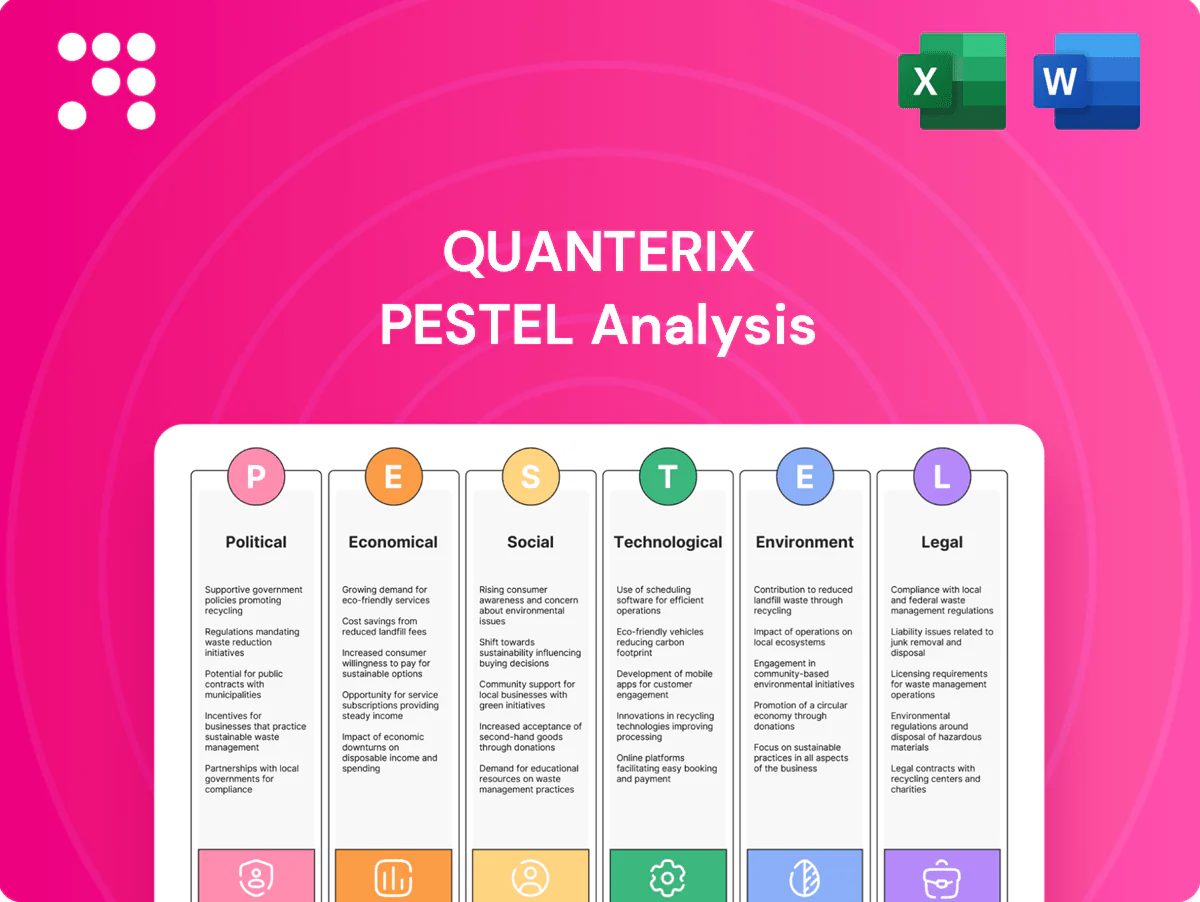
Quanterix PESTLE Analysis

Skip the Research. Get the Strategy.
Gain a strategic edge with our Quanterix PESTLE Analysis—concise, research-backed insights on political, economic, social, technological, legal and environmental forces shaping the company. Ideal for investors and strategists; buy the full report for a complete, actionable breakdown.
Political factors

Government R&D funding
NIH (~$50B/year), BARDA (multi‑billion emergency preparedness funds) and EU Horizon Europe (€95.5bn 2021–27) grants drive demand for ultra‑sensitive biomarker tools; funding priorities in neurology, oncology and infectious disease focus Quanterix assay development. Shifts in public‑health spending can accelerate or delay platform adoption, and election cycles plus budget negotiations add volatility to funding visibility.
Health policy and diagnostics agendas
National strategies prioritizing early detection and precision medicine boost demand for high-sensitivity assays, with the global precision medicine market ~70 billion USD in 2024 supporting investment in advanced diagnostics. Large-scale screening initiatives for neurodegeneration and cancer—Alzheimer’s affects ~6.7 million Americans (2023)—shape reimbursement and clinical pathways for tests. Strong policy support for real-world evidence, reinforced by FDA and CMS guidance through 2024, can expand longitudinal monitoring use, while policy retrenchment or restrictive coverage decisions can sharply slow clinical translation and revenue adoption.

Trade and supply chain geopolitics
Tighter US export controls on advanced bio-instrumentation since 2023 limit market access to China, while Section 301 tariffs—up to 25%—and customs frictions raise landed costs for Quanterix instruments and consumables. Geopolitical disruptions that hit plastics, enzymes and semiconductor components amplify lead-time risk; US CHIPS Act funding of roughly 52 billion USD and reshoring incentives increase pressure for multi-hub manufacturing footprints.

Pandemic preparedness priorities
Pandemic preparedness programs underpin sustained demand for ultra-sensitive infectious disease assays, anchoring market need for Quanterix’s Simoa platform but risking volume volatility if policymakers de-prioritize after crises.
- Preparedness sustainment — supports recurring assay demand
- Stockpiles & surveillance — create anchored procurement
- De-prioritization risk — can compress volumes/funding
- Policy cycles — require agile capacity planning
Public–private partnerships
Public–private partnerships linking regulators, academia and pharma amplify assay validation and standard-setting; joint initiatives in Alzheimer’s (55 million people with dementia worldwide in 2020, WHO) and oncology (19.3 million new cancer cases in 2020, IARC) can cement clinical utility. Political backing and >$45 billion annual NIH‑class funding for translational research speed evidence generation, while weak PPP frameworks delay harmonization and adoption.
- Regulatory consortia: amplify standards
- Alzheimer’s & oncology coalitions: cement utility
- Political funding (> $45B NIH scale): accelerates evidence
- Weak PPP frameworks: slow harmonization
Public funding, CHIPS, export controls and precision medicine fuel assay demand and volatility
Public funding (NIH ~$50B/year; Horizon Europe €95.5bn 2021–27) and precision medicine market (~$70bn 2024) drive assay demand, while election cycles and budget uncertainty add volatility. US export controls since 2023 and CHIPS $52bn reshape market access and supply chains. PPPs and Alzheimer’s/oncology initiatives (6.7M US with Alzheimer’s 2023) accelerate validation.
| Program | 2024 Value | Impact |
|---|---|---|
| NIH | $50B/yr | R&D funding |
| Horizon Europe | €95.5bn | EU grants |
| CHIPS Act | $52B | reshoring |
What is included in the product
 Detailed Word Document
Explores how external macro-environmental factors uniquely affect Quanterix across Political, Economic, Social, Technological, Environmental, and Legal dimensions, with data-driven trends and region/industry relevance. Designed for executives and investors, it delivers forward-looking insights, detailed sub-points, and ready-to-use formatting for strategy, funding, and scenario planning.

 Customizable Excel Spreadsheet
A concise, visually segmented Quanterix PESTLE summary that distills external risks and opportunities for quick reference in meetings or pitch decks, easily shared and annotated to align teams and support strategic planning.
Economic factors

Biopharma R&D spending
Global biopharma R&D spending topped $200 billion in 2024 (industry estimates), and pharma/biotech budgets remain the primary driver of instrument placements and consumables pull-through for Quanterix. Pipeline emphasis on neurodegenerative and oncology biomarkers aligns well with Simoa’s strengths and supports recurring reagent demand. A ~50% drop in biotech VC funding versus 2021 peaks has reduced pilot-project visibility and near-term orders. Mega-cap pharma with multi‑billion R&D budgets helps partially offset this cyclicality.
Reimbursement and health economics
Coverage for novel biomarker tests dictates clinical revenue potential; the global in vitro diagnostics market topped $100 billion in 2024, highlighting scale if payers adopt Simoa-class assays. Demonstrated cost-effectiveness in early detection—showing potential to reduce downstream treatment costs—can accelerate payer acceptance. Slow coding and payment policy lags, often many months to years, delay clinical uptake. Health system consolidation, with the majority of US hospitals system-affiliated, tightens value-based purchasing standards.

Capital markets and cost of capital
Rising capital costs — US fed funds at 5.25–5.50% and 10‑yr Treasury yields near 4.2–4.5% (mid‑2025) — increase hurdle rates for Quanterix instrument fleets and lab expansion, squeezing ROIs. Strong equity markets enable menu expansion and funding of clinical validation studies, while market volatility (VIX roughly 15–20) pressures pricing and operating leverage.

Currency and global sales mix
USD strength reduces translated international revenue and compresses margins; Quanterix’s growing EU and APAC sales partly offset US exposure, while hedging programs reduce but do not remove FX volatility. Sourcing in multiple currencies shifts cost sensitivity toward EUR and CNY, increasing operational FX complexity as regional demand diversifies.
- USD FX pressure: lowers translated revenues
- Hedging: partial mitigation, not elimination
- Multi-currency sourcing: raises cost-structure sensitivity
- EU/APAC growth: diversifies demand, reduces single-currency risk
Procurement dynamics
Procurement dynamics: group purchasing organizations (GPOs), which control roughly 70% of U.S. hospital purchases, push for lower per-test costs, compressing margins for high-sensitivity platforms. Long-term consumables contracts stabilize recurring revenue but intensify price competition; Quanterix’s demonstrated sensitivity and workflow efficiencies support a premium pricing stance. Extended institutional sales cycles demand rigorous, data-driven ROI cases to secure adoption.
- GPO leverage ~70% hospital purchasing
- Consumables = stable recurring cash, higher price pressure
- High sensitivity + workflow savings = premium positioning
- Extended sales cycles require robust ROI evidence
Public funding, CHIPS, export controls and precision medicine fuel assay demand and volatility
Biopharma R&D ~$200B (2024) and IVD >$100B (2024) underpin recurring reagent demand, but biotech VC funding is ~50% below 2021, reducing near-term pilot orders. Fed funds 5.25–5.50% and 10y ~4.2–4.5% (mid‑2025) raise capital costs; USD strength pressures margins while EU/APAC growth diversifies revenue.
| Metric | Value |
|---|---|
| Biopharma R&D (2024) | $200B |
| IVD Market (2024) | $100B+ |
| VC Funding vs 2021 | -50% |
| Fed funds / 10y (mid‑2025) | 5.25–5.50% / 4.2–4.5% |
| GPO hospital purchasing | ~70% |
Same Document Delivered
Quanterix PESTLE Analysis
The preview shown here is the exact Quanterix PESTLE Analysis document you’ll receive after purchase—fully formatted and ready to use. This screenshot reflects the real product with complete content, structure, and professional layout. No placeholders or teasers; after checkout you’ll be able to download this identical file instantly. Use it immediately for strategic planning or presentations.

Skip the Research. Get the Strategy.
Gain a strategic edge with our Quanterix PESTLE Analysis—concise, research-backed insights on political, economic, social, technological, legal and environmental forces shaping the company. Ideal for investors and strategists; buy the full report for a complete, actionable breakdown.
Political factors
Government R&D funding
NIH (~$50B/year), BARDA (multi‑billion emergency preparedness funds) and EU Horizon Europe (€95.5bn 2021–27) grants drive demand for ultra‑sensitive biomarker tools; funding priorities in neurology, oncology and infectious disease focus Quanterix assay development. Shifts in public‑health spending can accelerate or delay platform adoption, and election cycles plus budget negotiations add volatility to funding visibility.
Health policy and diagnostics agendas
National strategies prioritizing early detection and precision medicine boost demand for high-sensitivity assays, with the global precision medicine market ~70 billion USD in 2024 supporting investment in advanced diagnostics. Large-scale screening initiatives for neurodegeneration and cancer—Alzheimer’s affects ~6.7 million Americans (2023)—shape reimbursement and clinical pathways for tests. Strong policy support for real-world evidence, reinforced by FDA and CMS guidance through 2024, can expand longitudinal monitoring use, while policy retrenchment or restrictive coverage decisions can sharply slow clinical translation and revenue adoption.
Trade and supply chain geopolitics
Tighter US export controls on advanced bio-instrumentation since 2023 limit market access to China, while Section 301 tariffs—up to 25%—and customs frictions raise landed costs for Quanterix instruments and consumables. Geopolitical disruptions that hit plastics, enzymes and semiconductor components amplify lead-time risk; US CHIPS Act funding of roughly 52 billion USD and reshoring incentives increase pressure for multi-hub manufacturing footprints.
Pandemic preparedness priorities
Pandemic preparedness programs underpin sustained demand for ultra-sensitive infectious disease assays, anchoring market need for Quanterix’s Simoa platform but risking volume volatility if policymakers de-prioritize after crises.
- Preparedness sustainment — supports recurring assay demand
- Stockpiles & surveillance — create anchored procurement
- De-prioritization risk — can compress volumes/funding
- Policy cycles — require agile capacity planning
Public–private partnerships
Public–private partnerships linking regulators, academia and pharma amplify assay validation and standard-setting; joint initiatives in Alzheimer’s (55 million people with dementia worldwide in 2020, WHO) and oncology (19.3 million new cancer cases in 2020, IARC) can cement clinical utility. Political backing and >$45 billion annual NIH‑class funding for translational research speed evidence generation, while weak PPP frameworks delay harmonization and adoption.
- Regulatory consortia: amplify standards
- Alzheimer’s & oncology coalitions: cement utility
- Political funding (> $45B NIH scale): accelerates evidence
- Weak PPP frameworks: slow harmonization
Public funding, CHIPS, export controls and precision medicine fuel assay demand and volatility
Public funding (NIH ~$50B/year; Horizon Europe €95.5bn 2021–27) and precision medicine market (~$70bn 2024) drive assay demand, while election cycles and budget uncertainty add volatility. US export controls since 2023 and CHIPS $52bn reshape market access and supply chains. PPPs and Alzheimer’s/oncology initiatives (6.7M US with Alzheimer’s 2023) accelerate validation.
| Program | 2024 Value | Impact |
|---|---|---|
| NIH | $50B/yr | R&D funding |
| Horizon Europe | €95.5bn | EU grants |
| CHIPS Act | $52B | reshoring |
What is included in the product
Detailed Word Document
Explores how external macro-environmental factors uniquely affect Quanterix across Political, Economic, Social, Technological, Environmental, and Legal dimensions, with data-driven trends and region/industry relevance. Designed for executives and investors, it delivers forward-looking insights, detailed sub-points, and ready-to-use formatting for strategy, funding, and scenario planning.
Customizable Excel Spreadsheet
A concise, visually segmented Quanterix PESTLE summary that distills external risks and opportunities for quick reference in meetings or pitch decks, easily shared and annotated to align teams and support strategic planning.
Economic factors
Biopharma R&D spending
Global biopharma R&D spending topped $200 billion in 2024 (industry estimates), and pharma/biotech budgets remain the primary driver of instrument placements and consumables pull-through for Quanterix. Pipeline emphasis on neurodegenerative and oncology biomarkers aligns well with Simoa’s strengths and supports recurring reagent demand. A ~50% drop in biotech VC funding versus 2021 peaks has reduced pilot-project visibility and near-term orders. Mega-cap pharma with multi‑billion R&D budgets helps partially offset this cyclicality.
Reimbursement and health economics
Coverage for novel biomarker tests dictates clinical revenue potential; the global in vitro diagnostics market topped $100 billion in 2024, highlighting scale if payers adopt Simoa-class assays. Demonstrated cost-effectiveness in early detection—showing potential to reduce downstream treatment costs—can accelerate payer acceptance. Slow coding and payment policy lags, often many months to years, delay clinical uptake. Health system consolidation, with the majority of US hospitals system-affiliated, tightens value-based purchasing standards.
Capital markets and cost of capital
Rising capital costs — US fed funds at 5.25–5.50% and 10‑yr Treasury yields near 4.2–4.5% (mid‑2025) — increase hurdle rates for Quanterix instrument fleets and lab expansion, squeezing ROIs. Strong equity markets enable menu expansion and funding of clinical validation studies, while market volatility (VIX roughly 15–20) pressures pricing and operating leverage.
Currency and global sales mix
USD strength reduces translated international revenue and compresses margins; Quanterix’s growing EU and APAC sales partly offset US exposure, while hedging programs reduce but do not remove FX volatility. Sourcing in multiple currencies shifts cost sensitivity toward EUR and CNY, increasing operational FX complexity as regional demand diversifies.
- USD FX pressure: lowers translated revenues
- Hedging: partial mitigation, not elimination
- Multi-currency sourcing: raises cost-structure sensitivity
- EU/APAC growth: diversifies demand, reduces single-currency risk
Procurement dynamics
Procurement dynamics: group purchasing organizations (GPOs), which control roughly 70% of U.S. hospital purchases, push for lower per-test costs, compressing margins for high-sensitivity platforms. Long-term consumables contracts stabilize recurring revenue but intensify price competition; Quanterix’s demonstrated sensitivity and workflow efficiencies support a premium pricing stance. Extended institutional sales cycles demand rigorous, data-driven ROI cases to secure adoption.
- GPO leverage ~70% hospital purchasing
- Consumables = stable recurring cash, higher price pressure
- High sensitivity + workflow savings = premium positioning
- Extended sales cycles require robust ROI evidence
Public funding, CHIPS, export controls and precision medicine fuel assay demand and volatility
Biopharma R&D ~$200B (2024) and IVD >$100B (2024) underpin recurring reagent demand, but biotech VC funding is ~50% below 2021, reducing near-term pilot orders. Fed funds 5.25–5.50% and 10y ~4.2–4.5% (mid‑2025) raise capital costs; USD strength pressures margins while EU/APAC growth diversifies revenue.
| Metric | Value |
|---|---|
| Biopharma R&D (2024) | $200B |
| IVD Market (2024) | $100B+ |
| VC Funding vs 2021 | -50% |
| Fed funds / 10y (mid‑2025) | 5.25–5.50% / 4.2–4.5% |
| GPO hospital purchasing | ~70% |
Same Document Delivered
Quanterix PESTLE Analysis
The preview shown here is the exact Quanterix PESTLE Analysis document you’ll receive after purchase—fully formatted and ready to use. This screenshot reflects the real product with complete content, structure, and professional layout. No placeholders or teasers; after checkout you’ll be able to download this identical file instantly. Use it immediately for strategic planning or presentations.
Original: $10.00
-65%$10.00
$3.50Description
Skip the Research. Get the Strategy.
Gain a strategic edge with our Quanterix PESTLE Analysis—concise, research-backed insights on political, economic, social, technological, legal and environmental forces shaping the company. Ideal for investors and strategists; buy the full report for a complete, actionable breakdown.
Political factors
Government R&D funding
NIH (~$50B/year), BARDA (multi‑billion emergency preparedness funds) and EU Horizon Europe (€95.5bn 2021–27) grants drive demand for ultra‑sensitive biomarker tools; funding priorities in neurology, oncology and infectious disease focus Quanterix assay development. Shifts in public‑health spending can accelerate or delay platform adoption, and election cycles plus budget negotiations add volatility to funding visibility.
Health policy and diagnostics agendas
National strategies prioritizing early detection and precision medicine boost demand for high-sensitivity assays, with the global precision medicine market ~70 billion USD in 2024 supporting investment in advanced diagnostics. Large-scale screening initiatives for neurodegeneration and cancer—Alzheimer’s affects ~6.7 million Americans (2023)—shape reimbursement and clinical pathways for tests. Strong policy support for real-world evidence, reinforced by FDA and CMS guidance through 2024, can expand longitudinal monitoring use, while policy retrenchment or restrictive coverage decisions can sharply slow clinical translation and revenue adoption.
Trade and supply chain geopolitics
Tighter US export controls on advanced bio-instrumentation since 2023 limit market access to China, while Section 301 tariffs—up to 25%—and customs frictions raise landed costs for Quanterix instruments and consumables. Geopolitical disruptions that hit plastics, enzymes and semiconductor components amplify lead-time risk; US CHIPS Act funding of roughly 52 billion USD and reshoring incentives increase pressure for multi-hub manufacturing footprints.
Pandemic preparedness priorities
Pandemic preparedness programs underpin sustained demand for ultra-sensitive infectious disease assays, anchoring market need for Quanterix’s Simoa platform but risking volume volatility if policymakers de-prioritize after crises.
- Preparedness sustainment — supports recurring assay demand
- Stockpiles & surveillance — create anchored procurement
- De-prioritization risk — can compress volumes/funding
- Policy cycles — require agile capacity planning
Public–private partnerships
Public–private partnerships linking regulators, academia and pharma amplify assay validation and standard-setting; joint initiatives in Alzheimer’s (55 million people with dementia worldwide in 2020, WHO) and oncology (19.3 million new cancer cases in 2020, IARC) can cement clinical utility. Political backing and >$45 billion annual NIH‑class funding for translational research speed evidence generation, while weak PPP frameworks delay harmonization and adoption.
- Regulatory consortia: amplify standards
- Alzheimer’s & oncology coalitions: cement utility
- Political funding (> $45B NIH scale): accelerates evidence
- Weak PPP frameworks: slow harmonization
Public funding, CHIPS, export controls and precision medicine fuel assay demand and volatility
Public funding (NIH ~$50B/year; Horizon Europe €95.5bn 2021–27) and precision medicine market (~$70bn 2024) drive assay demand, while election cycles and budget uncertainty add volatility. US export controls since 2023 and CHIPS $52bn reshape market access and supply chains. PPPs and Alzheimer’s/oncology initiatives (6.7M US with Alzheimer’s 2023) accelerate validation.
| Program | 2024 Value | Impact |
|---|---|---|
| NIH | $50B/yr | R&D funding |
| Horizon Europe | €95.5bn | EU grants |
| CHIPS Act | $52B | reshoring |
What is included in the product
Detailed Word Document
Explores how external macro-environmental factors uniquely affect Quanterix across Political, Economic, Social, Technological, Environmental, and Legal dimensions, with data-driven trends and region/industry relevance. Designed for executives and investors, it delivers forward-looking insights, detailed sub-points, and ready-to-use formatting for strategy, funding, and scenario planning.
Customizable Excel Spreadsheet
A concise, visually segmented Quanterix PESTLE summary that distills external risks and opportunities for quick reference in meetings or pitch decks, easily shared and annotated to align teams and support strategic planning.
Economic factors
Biopharma R&D spending
Global biopharma R&D spending topped $200 billion in 2024 (industry estimates), and pharma/biotech budgets remain the primary driver of instrument placements and consumables pull-through for Quanterix. Pipeline emphasis on neurodegenerative and oncology biomarkers aligns well with Simoa’s strengths and supports recurring reagent demand. A ~50% drop in biotech VC funding versus 2021 peaks has reduced pilot-project visibility and near-term orders. Mega-cap pharma with multi‑billion R&D budgets helps partially offset this cyclicality.
Reimbursement and health economics
Coverage for novel biomarker tests dictates clinical revenue potential; the global in vitro diagnostics market topped $100 billion in 2024, highlighting scale if payers adopt Simoa-class assays. Demonstrated cost-effectiveness in early detection—showing potential to reduce downstream treatment costs—can accelerate payer acceptance. Slow coding and payment policy lags, often many months to years, delay clinical uptake. Health system consolidation, with the majority of US hospitals system-affiliated, tightens value-based purchasing standards.
Capital markets and cost of capital
Rising capital costs — US fed funds at 5.25–5.50% and 10‑yr Treasury yields near 4.2–4.5% (mid‑2025) — increase hurdle rates for Quanterix instrument fleets and lab expansion, squeezing ROIs. Strong equity markets enable menu expansion and funding of clinical validation studies, while market volatility (VIX roughly 15–20) pressures pricing and operating leverage.
Currency and global sales mix
USD strength reduces translated international revenue and compresses margins; Quanterix’s growing EU and APAC sales partly offset US exposure, while hedging programs reduce but do not remove FX volatility. Sourcing in multiple currencies shifts cost sensitivity toward EUR and CNY, increasing operational FX complexity as regional demand diversifies.
- USD FX pressure: lowers translated revenues
- Hedging: partial mitigation, not elimination
- Multi-currency sourcing: raises cost-structure sensitivity
- EU/APAC growth: diversifies demand, reduces single-currency risk
Procurement dynamics
Procurement dynamics: group purchasing organizations (GPOs), which control roughly 70% of U.S. hospital purchases, push for lower per-test costs, compressing margins for high-sensitivity platforms. Long-term consumables contracts stabilize recurring revenue but intensify price competition; Quanterix’s demonstrated sensitivity and workflow efficiencies support a premium pricing stance. Extended institutional sales cycles demand rigorous, data-driven ROI cases to secure adoption.
- GPO leverage ~70% hospital purchasing
- Consumables = stable recurring cash, higher price pressure
- High sensitivity + workflow savings = premium positioning
- Extended sales cycles require robust ROI evidence
Public funding, CHIPS, export controls and precision medicine fuel assay demand and volatility
Biopharma R&D ~$200B (2024) and IVD >$100B (2024) underpin recurring reagent demand, but biotech VC funding is ~50% below 2021, reducing near-term pilot orders. Fed funds 5.25–5.50% and 10y ~4.2–4.5% (mid‑2025) raise capital costs; USD strength pressures margins while EU/APAC growth diversifies revenue.
| Metric | Value |
|---|---|
| Biopharma R&D (2024) | $200B |
| IVD Market (2024) | $100B+ |
| VC Funding vs 2021 | -50% |
| Fed funds / 10y (mid‑2025) | 5.25–5.50% / 4.2–4.5% |
| GPO hospital purchasing | ~70% |
Same Document Delivered
Quanterix PESTLE Analysis
The preview shown here is the exact Quanterix PESTLE Analysis document you’ll receive after purchase—fully formatted and ready to use. This screenshot reflects the real product with complete content, structure, and professional layout. No placeholders or teasers; after checkout you’ll be able to download this identical file instantly. Use it immediately for strategic planning or presentations.











