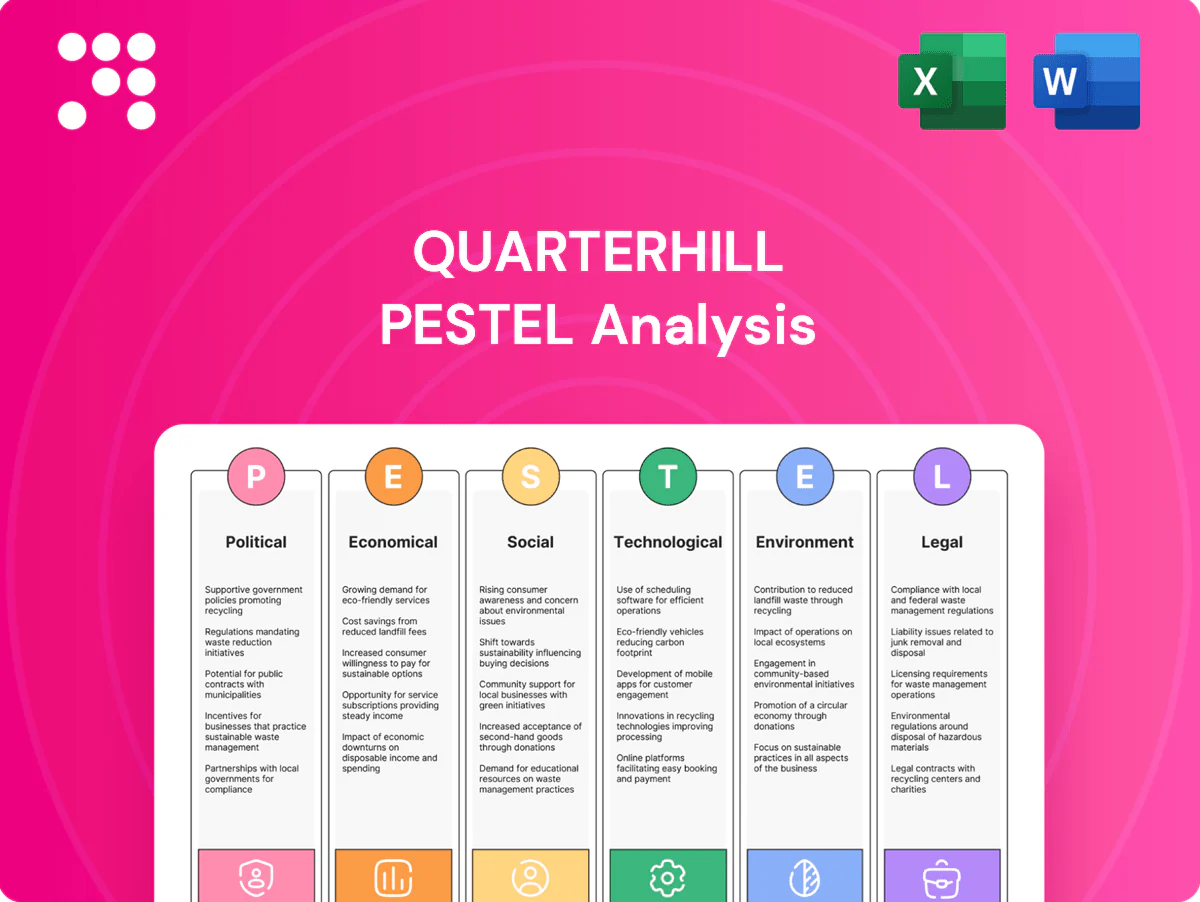
Quarterhill PESTLE Analysis

Your Shortcut to Market Insight Starts Here
Unlock strategic advantage with our focused PESTLE analysis of Quarterhill—three to five key external forces explained and tied to real business implications. Understand regulatory, economic, and technological risks shaping growth. Buy the full report for the complete, actionable breakdown and ready-to-use insights.
Political factors

Infrastructure and transport policy direction
Government priorities on smart mobility, Vision Zero (adopted by 40+ US cities) and congestion reduction — reinforced by the Bipartisan Infrastructure Law's $1.2 trillion framework — steer ITS funding and project pipelines. Post-election policy shifts can reallocate budgets between highways, transit and enforcement tech, altering opportunity mix. Quarterhill’s bid success depends on aligning proposals with current policy narratives, while proactive lobbying and continuous policy monitoring reduce abrupt revenue risk.
Public–private partnership and procurement models
Public–private partnership and design-build-operate contracts allocate risk, margin, and lifecycle obligations for ITS deployments, often tying performance guarantees to multi-year maintenance windows and penalties; procurement cycles typically exceed 12 months and bid bonds commonly range from 5–10% of contract value. Procurement rules favor vendors with proven delivery records and local content, increasing award odds for firms with regional partners. Quarterhill must navigate long sales cycles, bond requirements, and political stewardship; strong references and consortium roles materially boost win rates. Recent PPPs show consortium-led bids win a majority of large ITS contracts, underscoring the importance of partnerships.

Buy-local and industrial strategies
Buy America/Buy Canadian provisions—exemplified by the Build America, Buy America Act (2021) and comparable Canadian rules—influence sourcing, timelines, and cost structures. US federal contracting exceeded $700 billion in FY2023, advantaging domestically anchored suppliers while often raising BOM costs. Quarterhill may need localized assembly or US/Canadian partnerships and regular policy audits to reduce award risk and change-order disputes.

Geopolitical supply chain exposure
Tensions around semiconductors, sensors and networking gear—exacerbated by export controls since 2022—can delay ITS projects by extending lead times and constraining capacity; the global semiconductor market exceeds $500 billion annually, amplifying systemic risk. Sanctions and trade restrictions reshape approved vendor lists and increase procurement lead times. Diversified suppliers, buffer inventory and contract clauses that price-in geopolitical volatility protect delivery milestones.
- Risk: supply interruptions
- Mitigation: diversified suppliers
- Buffer: inventory to cover extended lead times
- Contract: price-in geopolitical volatility
Data sovereignty in mobility
National data‑residency rules (over 60 countries enforce localization as of 2024) force Quarterhill to design local processing and storage for traffic and ALPR, while cloud region limits can add 50–150 ms latency and affect redundancy and cost; sovereign hosting is often a procurement prerequisite for public sector deals and clear residency guarantees reduce political scrutiny.
- Design: local processing required
- Latency: +50–150 ms cross‑border
- Cost: sovereign hosting premium
- Procurement: mandatory for many public contracts
Policy shifts reshape ITS: $1.2T infrastructure, Buy America, export controls, data-residency
Policy drives Quarterhill’s ITS opportunities: Bipartisan Infrastructure Law ($1.2T), Buy America/Canada rules and FY2023 US federal contracting >$700B favor local suppliers but raise BOM costs. Export controls since 2022 and a $500B+ semiconductor market increase lead‑time risk. Data‑residency (60+ countries by 2024) adds hosting costs and latency.
| Policy | Metric | Impact |
|---|---|---|
| Infrastructure funding | $1.2T | More projects, competition |
What is included in the product
 Detailed Word Document
Explores how macro-environmental forces uniquely affect Quarterhill across Political, Economic, Social, Technological, Environmental, and Legal dimensions, with data-driven, region- and industry-specific insights and forward-looking scenarios to help executives, investors, and advisors identify risks, opportunities, and strategic responses.

 Customizable Excel Spreadsheet
A concise, visually segmented PESTLE summary for Quarterhill that’s easily editable and shareable—drop into slides, customize with notes, and use in meetings to align teams and surface external risks for strategic planning.
Economic factors

Interest rates and capital intensity
Higher policy rates at multi-decade highs near 5% (Bank of Canada/US Fed) raise discount rates for public ITS projects and slow awards, while rate easing unlocks backlogs. ITS deployments are capex-heavy, with individual projects often requiring millions to tens of millions in staged capital. Quarterhill’s M&A and financing costs track the rate cycle; hedging and milestone billing bolster cash-flow resilience.
Urban congestion and tolling economics
Tolling and congestion pricing create revenue models that justify ITS investments, with World Bank estimates putting urban congestion costs at up to 4% of city GDP, making recoverable toll revenue attractive to agencies. COVID saw traffic volumes fall 30–50%, depressing customer budgets, but by 2023 volumes recovered close to pre‑pandemic levels, accelerating upgrades; Quarterhill benefits from solutions tied to measurable ROI for agencies.

IP monetization cycles
Patent licensing revenues at Quarterhill are lumpy, driven by renewals, litigations and timing of deals, with macro stress often delaying cash settlements while increasing appetite for bundled, certainty-priced agreements.

FX exposure and cross-border sales
Quarterhill's CAD/USD/EUR swings directly affect consolidated results and hardware margins since many electronic and telecom components are priced in USD while revenues are invoiced across CAD, USD and EUR; management reports using natural hedges and forward contracts to limit quarterly earnings volatility. Long-duration contracts should include FX-adjustment clauses to protect margins on multiyear projects.
- FX impact: USD-priced inputs vs multi-currency sales
- Mitigants: natural hedges + forward contracts
- Recommendation: pricing clauses for FX drift
M&A market conditions
Valuation multiples and credit availability drive acquisition velocity in ITS and software; global M&A peaked at about 5.8 trillion USD in 2021 and dropped to ~2.4 trillion USD in 2023, forcing buyers to hunt bargains in soft markets and exercise discipline in hot windows. Integration capacity caps deal pace regardless of supply, while rigorous synergy targets and earn-outs tie payouts to performance.
- multiples impact timing
- credit availability = deal flow
- integration capacity limits pace
- synergies + earn-outs align outcomes
Policy shifts reshape ITS: $1.2T infrastructure, Buy America, export controls, data-residency
Higher policy rates near 5% in 2024–25 raise discount rates for public ITS projects, slowing awards; easing would unlock backlogs. Tolling/congestion pricing (urban congestion cost up to 4% of city GDP) support recoverable revenue and ROI-based upgrades. Patent licensing remains lumpy; FX (CAD/USD/EUR) swings and valuation multiples (global M&A 5.8T 2021 → 2.4T 2023) drive deal timing.
| Metric | Value |
|---|---|
| Policy rates (BoC/Fed) | ~5% (2024–25) |
| Urban congestion cost | up to 4% city GDP |
| Global M&A | 5.8T (2021) → 2.4T (2023) |
Preview the Actual Deliverable
Quarterhill PESTLE Analysis
The Quarterhill PESTLE Analysis preview shown here is the exact document you’ll receive after purchase—fully formatted and ready to use. This is a real snapshot of the final file with complete content and structure. No placeholders or teasers; you’ll download the same professionally styled report immediately after checkout.

Your Shortcut to Market Insight Starts Here
Unlock strategic advantage with our focused PESTLE analysis of Quarterhill—three to five key external forces explained and tied to real business implications. Understand regulatory, economic, and technological risks shaping growth. Buy the full report for the complete, actionable breakdown and ready-to-use insights.
Political factors
Infrastructure and transport policy direction
Government priorities on smart mobility, Vision Zero (adopted by 40+ US cities) and congestion reduction — reinforced by the Bipartisan Infrastructure Law's $1.2 trillion framework — steer ITS funding and project pipelines. Post-election policy shifts can reallocate budgets between highways, transit and enforcement tech, altering opportunity mix. Quarterhill’s bid success depends on aligning proposals with current policy narratives, while proactive lobbying and continuous policy monitoring reduce abrupt revenue risk.
Public–private partnership and procurement models
Public–private partnership and design-build-operate contracts allocate risk, margin, and lifecycle obligations for ITS deployments, often tying performance guarantees to multi-year maintenance windows and penalties; procurement cycles typically exceed 12 months and bid bonds commonly range from 5–10% of contract value. Procurement rules favor vendors with proven delivery records and local content, increasing award odds for firms with regional partners. Quarterhill must navigate long sales cycles, bond requirements, and political stewardship; strong references and consortium roles materially boost win rates. Recent PPPs show consortium-led bids win a majority of large ITS contracts, underscoring the importance of partnerships.
Buy-local and industrial strategies
Buy America/Buy Canadian provisions—exemplified by the Build America, Buy America Act (2021) and comparable Canadian rules—influence sourcing, timelines, and cost structures. US federal contracting exceeded $700 billion in FY2023, advantaging domestically anchored suppliers while often raising BOM costs. Quarterhill may need localized assembly or US/Canadian partnerships and regular policy audits to reduce award risk and change-order disputes.
Geopolitical supply chain exposure
Tensions around semiconductors, sensors and networking gear—exacerbated by export controls since 2022—can delay ITS projects by extending lead times and constraining capacity; the global semiconductor market exceeds $500 billion annually, amplifying systemic risk. Sanctions and trade restrictions reshape approved vendor lists and increase procurement lead times. Diversified suppliers, buffer inventory and contract clauses that price-in geopolitical volatility protect delivery milestones.
- Risk: supply interruptions
- Mitigation: diversified suppliers
- Buffer: inventory to cover extended lead times
- Contract: price-in geopolitical volatility
Data sovereignty in mobility
National data‑residency rules (over 60 countries enforce localization as of 2024) force Quarterhill to design local processing and storage for traffic and ALPR, while cloud region limits can add 50–150 ms latency and affect redundancy and cost; sovereign hosting is often a procurement prerequisite for public sector deals and clear residency guarantees reduce political scrutiny.
- Design: local processing required
- Latency: +50–150 ms cross‑border
- Cost: sovereign hosting premium
- Procurement: mandatory for many public contracts
Policy shifts reshape ITS: $1.2T infrastructure, Buy America, export controls, data-residency
Policy drives Quarterhill’s ITS opportunities: Bipartisan Infrastructure Law ($1.2T), Buy America/Canada rules and FY2023 US federal contracting >$700B favor local suppliers but raise BOM costs. Export controls since 2022 and a $500B+ semiconductor market increase lead‑time risk. Data‑residency (60+ countries by 2024) adds hosting costs and latency.
| Policy | Metric | Impact |
|---|---|---|
| Infrastructure funding | $1.2T | More projects, competition |
What is included in the product
Detailed Word Document
Explores how macro-environmental forces uniquely affect Quarterhill across Political, Economic, Social, Technological, Environmental, and Legal dimensions, with data-driven, region- and industry-specific insights and forward-looking scenarios to help executives, investors, and advisors identify risks, opportunities, and strategic responses.
Customizable Excel Spreadsheet
A concise, visually segmented PESTLE summary for Quarterhill that’s easily editable and shareable—drop into slides, customize with notes, and use in meetings to align teams and surface external risks for strategic planning.
Economic factors
Interest rates and capital intensity
Higher policy rates at multi-decade highs near 5% (Bank of Canada/US Fed) raise discount rates for public ITS projects and slow awards, while rate easing unlocks backlogs. ITS deployments are capex-heavy, with individual projects often requiring millions to tens of millions in staged capital. Quarterhill’s M&A and financing costs track the rate cycle; hedging and milestone billing bolster cash-flow resilience.
Urban congestion and tolling economics
Tolling and congestion pricing create revenue models that justify ITS investments, with World Bank estimates putting urban congestion costs at up to 4% of city GDP, making recoverable toll revenue attractive to agencies. COVID saw traffic volumes fall 30–50%, depressing customer budgets, but by 2023 volumes recovered close to pre‑pandemic levels, accelerating upgrades; Quarterhill benefits from solutions tied to measurable ROI for agencies.
IP monetization cycles
Patent licensing revenues at Quarterhill are lumpy, driven by renewals, litigations and timing of deals, with macro stress often delaying cash settlements while increasing appetite for bundled, certainty-priced agreements.
FX exposure and cross-border sales
Quarterhill's CAD/USD/EUR swings directly affect consolidated results and hardware margins since many electronic and telecom components are priced in USD while revenues are invoiced across CAD, USD and EUR; management reports using natural hedges and forward contracts to limit quarterly earnings volatility. Long-duration contracts should include FX-adjustment clauses to protect margins on multiyear projects.
- FX impact: USD-priced inputs vs multi-currency sales
- Mitigants: natural hedges + forward contracts
- Recommendation: pricing clauses for FX drift
M&A market conditions
Valuation multiples and credit availability drive acquisition velocity in ITS and software; global M&A peaked at about 5.8 trillion USD in 2021 and dropped to ~2.4 trillion USD in 2023, forcing buyers to hunt bargains in soft markets and exercise discipline in hot windows. Integration capacity caps deal pace regardless of supply, while rigorous synergy targets and earn-outs tie payouts to performance.
- multiples impact timing
- credit availability = deal flow
- integration capacity limits pace
- synergies + earn-outs align outcomes
Policy shifts reshape ITS: $1.2T infrastructure, Buy America, export controls, data-residency
Higher policy rates near 5% in 2024–25 raise discount rates for public ITS projects, slowing awards; easing would unlock backlogs. Tolling/congestion pricing (urban congestion cost up to 4% of city GDP) support recoverable revenue and ROI-based upgrades. Patent licensing remains lumpy; FX (CAD/USD/EUR) swings and valuation multiples (global M&A 5.8T 2021 → 2.4T 2023) drive deal timing.
| Metric | Value |
|---|---|
| Policy rates (BoC/Fed) | ~5% (2024–25) |
| Urban congestion cost | up to 4% city GDP |
| Global M&A | 5.8T (2021) → 2.4T (2023) |
Preview the Actual Deliverable
Quarterhill PESTLE Analysis
The Quarterhill PESTLE Analysis preview shown here is the exact document you’ll receive after purchase—fully formatted and ready to use. This is a real snapshot of the final file with complete content and structure. No placeholders or teasers; you’ll download the same professionally styled report immediately after checkout.
Original: $10.00
-65%$10.00
$3.50Description
Your Shortcut to Market Insight Starts Here
Unlock strategic advantage with our focused PESTLE analysis of Quarterhill—three to five key external forces explained and tied to real business implications. Understand regulatory, economic, and technological risks shaping growth. Buy the full report for the complete, actionable breakdown and ready-to-use insights.
Political factors
Infrastructure and transport policy direction
Government priorities on smart mobility, Vision Zero (adopted by 40+ US cities) and congestion reduction — reinforced by the Bipartisan Infrastructure Law's $1.2 trillion framework — steer ITS funding and project pipelines. Post-election policy shifts can reallocate budgets between highways, transit and enforcement tech, altering opportunity mix. Quarterhill’s bid success depends on aligning proposals with current policy narratives, while proactive lobbying and continuous policy monitoring reduce abrupt revenue risk.
Public–private partnership and procurement models
Public–private partnership and design-build-operate contracts allocate risk, margin, and lifecycle obligations for ITS deployments, often tying performance guarantees to multi-year maintenance windows and penalties; procurement cycles typically exceed 12 months and bid bonds commonly range from 5–10% of contract value. Procurement rules favor vendors with proven delivery records and local content, increasing award odds for firms with regional partners. Quarterhill must navigate long sales cycles, bond requirements, and political stewardship; strong references and consortium roles materially boost win rates. Recent PPPs show consortium-led bids win a majority of large ITS contracts, underscoring the importance of partnerships.
Buy-local and industrial strategies
Buy America/Buy Canadian provisions—exemplified by the Build America, Buy America Act (2021) and comparable Canadian rules—influence sourcing, timelines, and cost structures. US federal contracting exceeded $700 billion in FY2023, advantaging domestically anchored suppliers while often raising BOM costs. Quarterhill may need localized assembly or US/Canadian partnerships and regular policy audits to reduce award risk and change-order disputes.
Geopolitical supply chain exposure
Tensions around semiconductors, sensors and networking gear—exacerbated by export controls since 2022—can delay ITS projects by extending lead times and constraining capacity; the global semiconductor market exceeds $500 billion annually, amplifying systemic risk. Sanctions and trade restrictions reshape approved vendor lists and increase procurement lead times. Diversified suppliers, buffer inventory and contract clauses that price-in geopolitical volatility protect delivery milestones.
- Risk: supply interruptions
- Mitigation: diversified suppliers
- Buffer: inventory to cover extended lead times
- Contract: price-in geopolitical volatility
Data sovereignty in mobility
National data‑residency rules (over 60 countries enforce localization as of 2024) force Quarterhill to design local processing and storage for traffic and ALPR, while cloud region limits can add 50–150 ms latency and affect redundancy and cost; sovereign hosting is often a procurement prerequisite for public sector deals and clear residency guarantees reduce political scrutiny.
- Design: local processing required
- Latency: +50–150 ms cross‑border
- Cost: sovereign hosting premium
- Procurement: mandatory for many public contracts
Policy shifts reshape ITS: $1.2T infrastructure, Buy America, export controls, data-residency
Policy drives Quarterhill’s ITS opportunities: Bipartisan Infrastructure Law ($1.2T), Buy America/Canada rules and FY2023 US federal contracting >$700B favor local suppliers but raise BOM costs. Export controls since 2022 and a $500B+ semiconductor market increase lead‑time risk. Data‑residency (60+ countries by 2024) adds hosting costs and latency.
| Policy | Metric | Impact |
|---|---|---|
| Infrastructure funding | $1.2T | More projects, competition |
What is included in the product
Detailed Word Document
Explores how macro-environmental forces uniquely affect Quarterhill across Political, Economic, Social, Technological, Environmental, and Legal dimensions, with data-driven, region- and industry-specific insights and forward-looking scenarios to help executives, investors, and advisors identify risks, opportunities, and strategic responses.
Customizable Excel Spreadsheet
A concise, visually segmented PESTLE summary for Quarterhill that’s easily editable and shareable—drop into slides, customize with notes, and use in meetings to align teams and surface external risks for strategic planning.
Economic factors
Interest rates and capital intensity
Higher policy rates at multi-decade highs near 5% (Bank of Canada/US Fed) raise discount rates for public ITS projects and slow awards, while rate easing unlocks backlogs. ITS deployments are capex-heavy, with individual projects often requiring millions to tens of millions in staged capital. Quarterhill’s M&A and financing costs track the rate cycle; hedging and milestone billing bolster cash-flow resilience.
Urban congestion and tolling economics
Tolling and congestion pricing create revenue models that justify ITS investments, with World Bank estimates putting urban congestion costs at up to 4% of city GDP, making recoverable toll revenue attractive to agencies. COVID saw traffic volumes fall 30–50%, depressing customer budgets, but by 2023 volumes recovered close to pre‑pandemic levels, accelerating upgrades; Quarterhill benefits from solutions tied to measurable ROI for agencies.
IP monetization cycles
Patent licensing revenues at Quarterhill are lumpy, driven by renewals, litigations and timing of deals, with macro stress often delaying cash settlements while increasing appetite for bundled, certainty-priced agreements.
FX exposure and cross-border sales
Quarterhill's CAD/USD/EUR swings directly affect consolidated results and hardware margins since many electronic and telecom components are priced in USD while revenues are invoiced across CAD, USD and EUR; management reports using natural hedges and forward contracts to limit quarterly earnings volatility. Long-duration contracts should include FX-adjustment clauses to protect margins on multiyear projects.
- FX impact: USD-priced inputs vs multi-currency sales
- Mitigants: natural hedges + forward contracts
- Recommendation: pricing clauses for FX drift
M&A market conditions
Valuation multiples and credit availability drive acquisition velocity in ITS and software; global M&A peaked at about 5.8 trillion USD in 2021 and dropped to ~2.4 trillion USD in 2023, forcing buyers to hunt bargains in soft markets and exercise discipline in hot windows. Integration capacity caps deal pace regardless of supply, while rigorous synergy targets and earn-outs tie payouts to performance.
- multiples impact timing
- credit availability = deal flow
- integration capacity limits pace
- synergies + earn-outs align outcomes
Policy shifts reshape ITS: $1.2T infrastructure, Buy America, export controls, data-residency
Higher policy rates near 5% in 2024–25 raise discount rates for public ITS projects, slowing awards; easing would unlock backlogs. Tolling/congestion pricing (urban congestion cost up to 4% of city GDP) support recoverable revenue and ROI-based upgrades. Patent licensing remains lumpy; FX (CAD/USD/EUR) swings and valuation multiples (global M&A 5.8T 2021 → 2.4T 2023) drive deal timing.
| Metric | Value |
|---|---|
| Policy rates (BoC/Fed) | ~5% (2024–25) |
| Urban congestion cost | up to 4% city GDP |
| Global M&A | 5.8T (2021) → 2.4T (2023) |
Preview the Actual Deliverable
Quarterhill PESTLE Analysis
The Quarterhill PESTLE Analysis preview shown here is the exact document you’ll receive after purchase—fully formatted and ready to use. This is a real snapshot of the final file with complete content and structure. No placeholders or teasers; you’ll download the same professionally styled report immediately after checkout.











