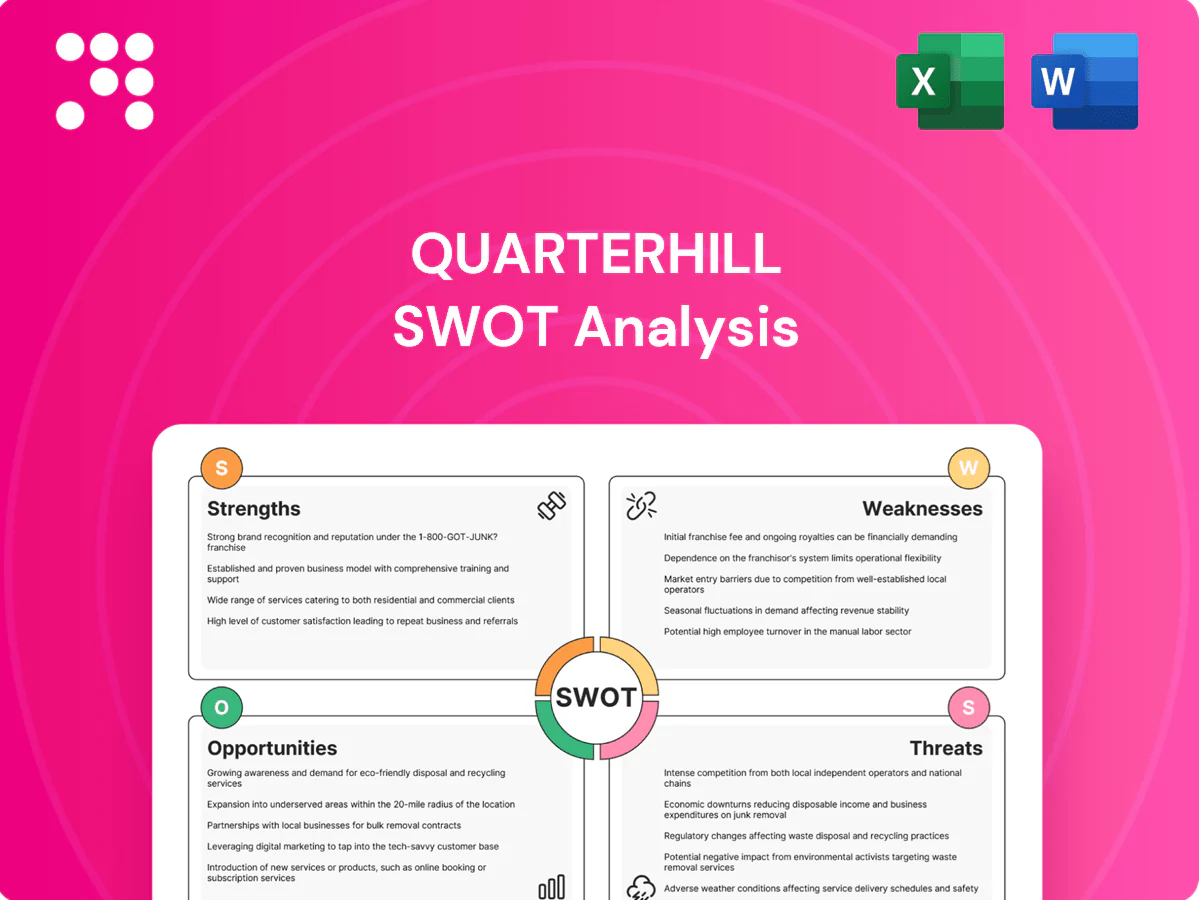
Quarterhill SWOT Analysis

Your Strategic Toolkit Starts Here
Quarterhill's SWOT distills the firm's tech licensing strengths, market risks, and growth levers into a clear, actionable view for investors and strategists. Purchase the full SWOT to access a research-backed, editable Word report plus Excel matrix. Use it to validate assumptions, build strategy, and present with confidence.
Strengths

Diversified ITS and IP portfolio
Operating in ITS and IP licensing spreads revenue sources and reduces single-market dependency; Quarterhill’s heritage includes an IP portfolio of roughly 2,000 patents, providing recurring licensing opportunities. The dual model helps balance cyclical swings between project-based ITS work and episodic IP monetizations. Cross-sector insights allow capital allocation to higher risk-adjusted returns, supporting resilience across economic cycles.
Proven acquisition and scaling playbook
Quarterhill, traded on the TSX as QTRH, employs a holding-company model that acquires, optimizes and scales niche leaders, using capital, governance and operational discipline to unlock synergies and margin lift. Repeatable M&A processes generate a steady pipeline of targets and predictable value-creation events. Deep integration expertise shortens payback and compounds returns across successive acquisitions.

Installed base and long-term ITS contracts
Quarterhill's installed ITS base and multi-year contracts (commonly 3–7 years) drive recurring maintenance, managed services and upgrade cycles, giving predictable revenue visibility. Long-term deployments create switching costs and customer stickiness, raising lifetime value. The installed base also serves as a platform for cross-selling analytics and new modules, enabling incremental ARPU expansion.

Data and analytics leverage in mobility
ITS solutions generate high-value traffic, safety and payments data that produce millions of probe points per city daily, and converting these streams into analytics and decision support measurably enhances agency/operator ROI by optimizing routing, safety interventions and fare capture. Data moats created from proprietary datasets strengthen differentiation and pricing power, and enable performance-based contracting tied to measurable KPIs.
- Data scale: millions of probe points/day
- Outcome: improved routing, safety, revenue capture
- Commercial: stronger pricing via proprietary moats
- Contracting: supports KPI-linked payments
Experienced IP monetization capabilities
Experienced IP monetization capabilities allow Quarterhill to unlock hidden value from its patent portfolio through licensing and settlements, converting dormant assets into recurring, high-margin cash flows; expertise in valuation, enforcement and negotiation supports these outcomes and helps diversify revenue beyond pure ITS project delivery.
- Licensing/settlements: monetizes dormant patents
- Valuation & enforcement: drives high-margin inflows
- Funds ITS growth: cash supports acquisitions
- Diversifies revenue: reduces reliance on project delivery
3–7yr contracts, ~2,000 patents + data moats fuel predictable cash
Quarterhill combines ITS recurring contracts (commonly 3–7 years) with an IP portfolio of roughly 2,000 patents, creating diversified, high-margin revenue streams. ITS installed base and millions of probe points/day produce proprietary data moats for analytics cross-sell and KPI-linked contracts. Repeatable holding-company M&A and IP monetization deliver predictable value creation and cash for growth.
| Metric | Value |
|---|---|
| Patent portfolio | ~2,000 |
| Contract length | 3–7 years |
| Data scale | millions probe points/day |
What is included in the product
 Detailed Word Document
Provides a concise SWOT analysis of Quarterhill, outlining internal strengths and weaknesses alongside external opportunities and threats to assess its competitive position and growth prospects.

 Customizable Excel Spreadsheet
Delivers a concise, visual SWOT matrix tailored to Quarterhill for rapid strategic alignment and stakeholder briefings; editable format enables quick updates as priorities shift, streamlining decision-making and cross‑team communication.
Weaknesses

Episodic and unpredictable IP revenues
IP licensing revenue is episodic and lumpy, with Quarterhill reporting CAD 14.3 million in FY2024 and quarterly IP receipts swinging by more than 40% year-over-year, creating forecasting challenges.
Court timelines, counterparties, and case outcomes — often spanning 18–30 months to resolution — drive variability and complicate capital planning.
This volatility can pressure quarterly results and has contributed to depressed valuation multiples relative to peers.
Integration and execution risk in M&A
Quarterhill's acquisitive growth model requires harmonizing systems, cultures and go-to-market approaches; Harvard Business Review notes roughly 70% of M&A fail to deliver expected synergies, so missteps can erode value and distract management. Earn-outs and deferred considerations add contractual complexity, while near-term integration costs can compress margins and cash flow for several quarters.

Capital intensity of ITS projects
ITS deployments require significant hardware, deployment and service capex and working capital—installations often incur upfront equipment and labor spending of tens to hundreds of thousands per site. Cash conversion on large public-sector contracts commonly stretches 120–180 days, while bid bonds and performance guarantees typically lock up 5–10% of contract value, straining the balance sheet and limiting Quarterhill's flexibility during downturns.

Public-sector customer concentration
Many ITS buyers are government entities with procurement cycles often spanning 6–24 months, creating timing risk for Quarterhill. Budget delays and policy shifts can stall awards and extend project start dates. Competitive tenders compress pricing, while collections and change orders can elongate cash conversion by several months.
- Public-sector concentration: customer mix risk
- Procurement cycles: 6–24 months
- Pricing pressure: competitive tenders
- Cash-cycle exposure: delayed collections/change orders
Legal and reputational exposure in IP enforcement
Quarterhill's licensing-focused strategy makes it vulnerable to litigation and adverse publicity; unfavorable rulings or fee awards can materially reduce licensing income and margins, while legal fees are highly variable and can escalate quickly, and reputational harm from aggressive enforcement can damage relationships and spill into other business lines.
- Licensing strategy attracts litigation risk
- Adverse rulings or fee awards hit profitability
- Legal costs can escalate unpredictably
- Reputation risk may affect other business units
Episodic IP (CAD 14.3M), 18–30m litigation, 120–180d cash drag, high M&A risk
Quarterhill's IP licensing is episodic (CAD 14.3M FY2024) and litigation timelines of 18–30 months create forecasting volatility. ITS deployments and public-sector procurement (6–24 months) strain cash conversion (120–180 days) and compress margins. Acquisitive growth faces integration risk (HBR: ~70% M&A fail), raising near-term costs and valuation pressure.
| Metric | Value | Impact |
|---|---|---|
| IP revenue FY2024 | CAD 14.3M | Revenue lumpy |
| Litigation timeline | 18–30 months | Forecast risk |
| Cash conversion | 120–180 days | Working capital strain |
What You See Is What You Get
Quarterhill SWOT Analysis
This is a real excerpt from the complete Quarterhill SWOT analysis you'll receive upon purchase—no surprises, just professional quality. The preview below is taken directly from the full report and is fully editable. Buy now to unlock the entire, detailed document immediately after checkout.

Your Strategic Toolkit Starts Here
Quarterhill's SWOT distills the firm's tech licensing strengths, market risks, and growth levers into a clear, actionable view for investors and strategists. Purchase the full SWOT to access a research-backed, editable Word report plus Excel matrix. Use it to validate assumptions, build strategy, and present with confidence.
Strengths
Diversified ITS and IP portfolio
Operating in ITS and IP licensing spreads revenue sources and reduces single-market dependency; Quarterhill’s heritage includes an IP portfolio of roughly 2,000 patents, providing recurring licensing opportunities. The dual model helps balance cyclical swings between project-based ITS work and episodic IP monetizations. Cross-sector insights allow capital allocation to higher risk-adjusted returns, supporting resilience across economic cycles.
Proven acquisition and scaling playbook
Quarterhill, traded on the TSX as QTRH, employs a holding-company model that acquires, optimizes and scales niche leaders, using capital, governance and operational discipline to unlock synergies and margin lift. Repeatable M&A processes generate a steady pipeline of targets and predictable value-creation events. Deep integration expertise shortens payback and compounds returns across successive acquisitions.
Installed base and long-term ITS contracts
Quarterhill's installed ITS base and multi-year contracts (commonly 3–7 years) drive recurring maintenance, managed services and upgrade cycles, giving predictable revenue visibility. Long-term deployments create switching costs and customer stickiness, raising lifetime value. The installed base also serves as a platform for cross-selling analytics and new modules, enabling incremental ARPU expansion.
Data and analytics leverage in mobility
ITS solutions generate high-value traffic, safety and payments data that produce millions of probe points per city daily, and converting these streams into analytics and decision support measurably enhances agency/operator ROI by optimizing routing, safety interventions and fare capture. Data moats created from proprietary datasets strengthen differentiation and pricing power, and enable performance-based contracting tied to measurable KPIs.
- Data scale: millions of probe points/day
- Outcome: improved routing, safety, revenue capture
- Commercial: stronger pricing via proprietary moats
- Contracting: supports KPI-linked payments
Experienced IP monetization capabilities
Experienced IP monetization capabilities allow Quarterhill to unlock hidden value from its patent portfolio through licensing and settlements, converting dormant assets into recurring, high-margin cash flows; expertise in valuation, enforcement and negotiation supports these outcomes and helps diversify revenue beyond pure ITS project delivery.
- Licensing/settlements: monetizes dormant patents
- Valuation & enforcement: drives high-margin inflows
- Funds ITS growth: cash supports acquisitions
- Diversifies revenue: reduces reliance on project delivery
3–7yr contracts, ~2,000 patents + data moats fuel predictable cash
Quarterhill combines ITS recurring contracts (commonly 3–7 years) with an IP portfolio of roughly 2,000 patents, creating diversified, high-margin revenue streams. ITS installed base and millions of probe points/day produce proprietary data moats for analytics cross-sell and KPI-linked contracts. Repeatable holding-company M&A and IP monetization deliver predictable value creation and cash for growth.
| Metric | Value |
|---|---|
| Patent portfolio | ~2,000 |
| Contract length | 3–7 years |
| Data scale | millions probe points/day |
What is included in the product
Detailed Word Document
Provides a concise SWOT analysis of Quarterhill, outlining internal strengths and weaknesses alongside external opportunities and threats to assess its competitive position and growth prospects.
Customizable Excel Spreadsheet
Delivers a concise, visual SWOT matrix tailored to Quarterhill for rapid strategic alignment and stakeholder briefings; editable format enables quick updates as priorities shift, streamlining decision-making and cross‑team communication.
Weaknesses
Episodic and unpredictable IP revenues
IP licensing revenue is episodic and lumpy, with Quarterhill reporting CAD 14.3 million in FY2024 and quarterly IP receipts swinging by more than 40% year-over-year, creating forecasting challenges.
Court timelines, counterparties, and case outcomes — often spanning 18–30 months to resolution — drive variability and complicate capital planning.
This volatility can pressure quarterly results and has contributed to depressed valuation multiples relative to peers.
Integration and execution risk in M&A
Quarterhill's acquisitive growth model requires harmonizing systems, cultures and go-to-market approaches; Harvard Business Review notes roughly 70% of M&A fail to deliver expected synergies, so missteps can erode value and distract management. Earn-outs and deferred considerations add contractual complexity, while near-term integration costs can compress margins and cash flow for several quarters.
Capital intensity of ITS projects
ITS deployments require significant hardware, deployment and service capex and working capital—installations often incur upfront equipment and labor spending of tens to hundreds of thousands per site. Cash conversion on large public-sector contracts commonly stretches 120–180 days, while bid bonds and performance guarantees typically lock up 5–10% of contract value, straining the balance sheet and limiting Quarterhill's flexibility during downturns.
Public-sector customer concentration
Many ITS buyers are government entities with procurement cycles often spanning 6–24 months, creating timing risk for Quarterhill. Budget delays and policy shifts can stall awards and extend project start dates. Competitive tenders compress pricing, while collections and change orders can elongate cash conversion by several months.
- Public-sector concentration: customer mix risk
- Procurement cycles: 6–24 months
- Pricing pressure: competitive tenders
- Cash-cycle exposure: delayed collections/change orders
Legal and reputational exposure in IP enforcement
Quarterhill's licensing-focused strategy makes it vulnerable to litigation and adverse publicity; unfavorable rulings or fee awards can materially reduce licensing income and margins, while legal fees are highly variable and can escalate quickly, and reputational harm from aggressive enforcement can damage relationships and spill into other business lines.
- Licensing strategy attracts litigation risk
- Adverse rulings or fee awards hit profitability
- Legal costs can escalate unpredictably
- Reputation risk may affect other business units
Episodic IP (CAD 14.3M), 18–30m litigation, 120–180d cash drag, high M&A risk
Quarterhill's IP licensing is episodic (CAD 14.3M FY2024) and litigation timelines of 18–30 months create forecasting volatility. ITS deployments and public-sector procurement (6–24 months) strain cash conversion (120–180 days) and compress margins. Acquisitive growth faces integration risk (HBR: ~70% M&A fail), raising near-term costs and valuation pressure.
| Metric | Value | Impact |
|---|---|---|
| IP revenue FY2024 | CAD 14.3M | Revenue lumpy |
| Litigation timeline | 18–30 months | Forecast risk |
| Cash conversion | 120–180 days | Working capital strain |
What You See Is What You Get
Quarterhill SWOT Analysis
This is a real excerpt from the complete Quarterhill SWOT analysis you'll receive upon purchase—no surprises, just professional quality. The preview below is taken directly from the full report and is fully editable. Buy now to unlock the entire, detailed document immediately after checkout.
Original: $10.00
-65%$10.00
$3.50Description
Your Strategic Toolkit Starts Here
Quarterhill's SWOT distills the firm's tech licensing strengths, market risks, and growth levers into a clear, actionable view for investors and strategists. Purchase the full SWOT to access a research-backed, editable Word report plus Excel matrix. Use it to validate assumptions, build strategy, and present with confidence.
Strengths
Diversified ITS and IP portfolio
Operating in ITS and IP licensing spreads revenue sources and reduces single-market dependency; Quarterhill’s heritage includes an IP portfolio of roughly 2,000 patents, providing recurring licensing opportunities. The dual model helps balance cyclical swings between project-based ITS work and episodic IP monetizations. Cross-sector insights allow capital allocation to higher risk-adjusted returns, supporting resilience across economic cycles.
Proven acquisition and scaling playbook
Quarterhill, traded on the TSX as QTRH, employs a holding-company model that acquires, optimizes and scales niche leaders, using capital, governance and operational discipline to unlock synergies and margin lift. Repeatable M&A processes generate a steady pipeline of targets and predictable value-creation events. Deep integration expertise shortens payback and compounds returns across successive acquisitions.
Installed base and long-term ITS contracts
Quarterhill's installed ITS base and multi-year contracts (commonly 3–7 years) drive recurring maintenance, managed services and upgrade cycles, giving predictable revenue visibility. Long-term deployments create switching costs and customer stickiness, raising lifetime value. The installed base also serves as a platform for cross-selling analytics and new modules, enabling incremental ARPU expansion.
Data and analytics leverage in mobility
ITS solutions generate high-value traffic, safety and payments data that produce millions of probe points per city daily, and converting these streams into analytics and decision support measurably enhances agency/operator ROI by optimizing routing, safety interventions and fare capture. Data moats created from proprietary datasets strengthen differentiation and pricing power, and enable performance-based contracting tied to measurable KPIs.
- Data scale: millions of probe points/day
- Outcome: improved routing, safety, revenue capture
- Commercial: stronger pricing via proprietary moats
- Contracting: supports KPI-linked payments
Experienced IP monetization capabilities
Experienced IP monetization capabilities allow Quarterhill to unlock hidden value from its patent portfolio through licensing and settlements, converting dormant assets into recurring, high-margin cash flows; expertise in valuation, enforcement and negotiation supports these outcomes and helps diversify revenue beyond pure ITS project delivery.
- Licensing/settlements: monetizes dormant patents
- Valuation & enforcement: drives high-margin inflows
- Funds ITS growth: cash supports acquisitions
- Diversifies revenue: reduces reliance on project delivery
3–7yr contracts, ~2,000 patents + data moats fuel predictable cash
Quarterhill combines ITS recurring contracts (commonly 3–7 years) with an IP portfolio of roughly 2,000 patents, creating diversified, high-margin revenue streams. ITS installed base and millions of probe points/day produce proprietary data moats for analytics cross-sell and KPI-linked contracts. Repeatable holding-company M&A and IP monetization deliver predictable value creation and cash for growth.
| Metric | Value |
|---|---|
| Patent portfolio | ~2,000 |
| Contract length | 3–7 years |
| Data scale | millions probe points/day |
What is included in the product
Detailed Word Document
Provides a concise SWOT analysis of Quarterhill, outlining internal strengths and weaknesses alongside external opportunities and threats to assess its competitive position and growth prospects.
Customizable Excel Spreadsheet
Delivers a concise, visual SWOT matrix tailored to Quarterhill for rapid strategic alignment and stakeholder briefings; editable format enables quick updates as priorities shift, streamlining decision-making and cross‑team communication.
Weaknesses
Episodic and unpredictable IP revenues
IP licensing revenue is episodic and lumpy, with Quarterhill reporting CAD 14.3 million in FY2024 and quarterly IP receipts swinging by more than 40% year-over-year, creating forecasting challenges.
Court timelines, counterparties, and case outcomes — often spanning 18–30 months to resolution — drive variability and complicate capital planning.
This volatility can pressure quarterly results and has contributed to depressed valuation multiples relative to peers.
Integration and execution risk in M&A
Quarterhill's acquisitive growth model requires harmonizing systems, cultures and go-to-market approaches; Harvard Business Review notes roughly 70% of M&A fail to deliver expected synergies, so missteps can erode value and distract management. Earn-outs and deferred considerations add contractual complexity, while near-term integration costs can compress margins and cash flow for several quarters.
Capital intensity of ITS projects
ITS deployments require significant hardware, deployment and service capex and working capital—installations often incur upfront equipment and labor spending of tens to hundreds of thousands per site. Cash conversion on large public-sector contracts commonly stretches 120–180 days, while bid bonds and performance guarantees typically lock up 5–10% of contract value, straining the balance sheet and limiting Quarterhill's flexibility during downturns.
Public-sector customer concentration
Many ITS buyers are government entities with procurement cycles often spanning 6–24 months, creating timing risk for Quarterhill. Budget delays and policy shifts can stall awards and extend project start dates. Competitive tenders compress pricing, while collections and change orders can elongate cash conversion by several months.
- Public-sector concentration: customer mix risk
- Procurement cycles: 6–24 months
- Pricing pressure: competitive tenders
- Cash-cycle exposure: delayed collections/change orders
Legal and reputational exposure in IP enforcement
Quarterhill's licensing-focused strategy makes it vulnerable to litigation and adverse publicity; unfavorable rulings or fee awards can materially reduce licensing income and margins, while legal fees are highly variable and can escalate quickly, and reputational harm from aggressive enforcement can damage relationships and spill into other business lines.
- Licensing strategy attracts litigation risk
- Adverse rulings or fee awards hit profitability
- Legal costs can escalate unpredictably
- Reputation risk may affect other business units
Episodic IP (CAD 14.3M), 18–30m litigation, 120–180d cash drag, high M&A risk
Quarterhill's IP licensing is episodic (CAD 14.3M FY2024) and litigation timelines of 18–30 months create forecasting volatility. ITS deployments and public-sector procurement (6–24 months) strain cash conversion (120–180 days) and compress margins. Acquisitive growth faces integration risk (HBR: ~70% M&A fail), raising near-term costs and valuation pressure.
| Metric | Value | Impact |
|---|---|---|
| IP revenue FY2024 | CAD 14.3M | Revenue lumpy |
| Litigation timeline | 18–30 months | Forecast risk |
| Cash conversion | 120–180 days | Working capital strain |
What You See Is What You Get
Quarterhill SWOT Analysis
This is a real excerpt from the complete Quarterhill SWOT analysis you'll receive upon purchase—no surprises, just professional quality. The preview below is taken directly from the full report and is fully editable. Buy now to unlock the entire, detailed document immediately after checkout.











