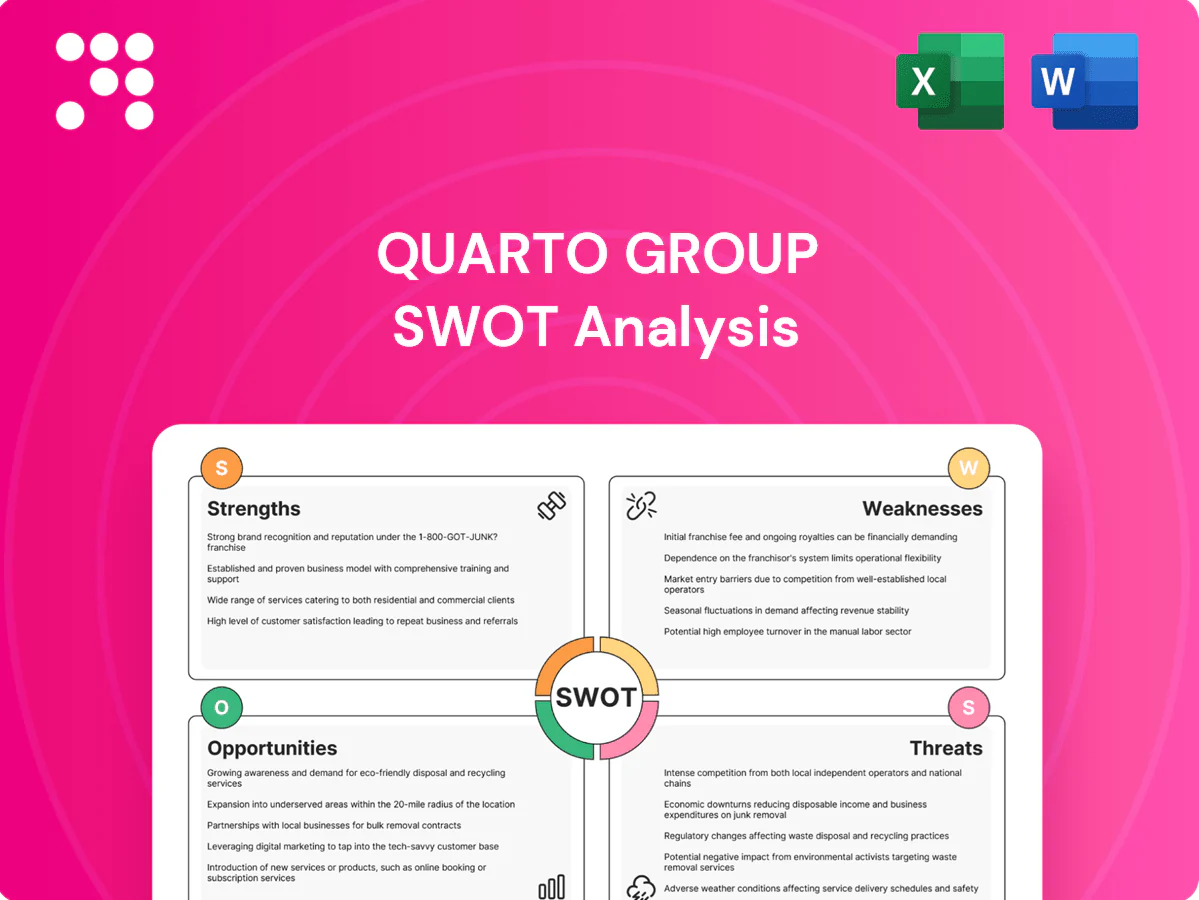
Quarto Group SWOT Analysis

Your Strategic Toolkit Starts Here
Quarto Group’s SWOT uncovers nimble content strengths, global distribution gains, and genre diversification, alongside margin pressures and digital transition risks; want the full strategic picture? Purchase the complete SWOT for a research-backed, editable Word + Excel package to plan, pitch, or invest with confidence.
Strengths

Diverse nonfiction portfolio
Quarto’s diverse nonfiction range—cooking, gardening, crafts, home and children’s—spans over 5,000 titles across 11 imprints, reducing reliance on any single niche and tapping varied demographics and seasonal demand cycles; this breadth enables cross-selling across imprints and categories and helps buffer group revenues against category-specific downturns.
Global distribution reach
Quarto Group leverages established retail, wholesale and online channels to penetrate over 40 markets, supporting annual sell-through across thousands of retail doors and major e-tailers. Its international presence boosts rights monetization and export sales, with scale enabling efficient print runs and lower per-unit costs. Multiple routes to market reduce channel concentration risk and improve inventory placement across regions.

Illustrated content expertise
Quarto's strong design, layout and visual storytelling across its over 1,000 illustrated titles differentiates products and supports premium pricing in gift and reference segments. High production values enable higher average unit prices and international sales, with visual formats translating easily across languages and markets. This expertise strengthens brand equity with retailers and consumers.

Backlist and evergreen titles
Quarto Group's robust backlist in how-to and lifestyle titles delivers recurring revenue as perennial interest in cooking, gardening and home projects sustains steady sales and repeat reprints.
Backlist economics boost margins through lower acquisition and development costs, while predictable reprint cycles enhance cash flow stability for the publishing calendar.
- Recurring revenue from backlist
- Evergreen demand: cooking, gardening
- Lower acquisition/development costs
- Predictable reprints and cash flow
Rights and co-edition model
Quarto Group's rights and co-edition model boosts revenue with minimal incremental cost, as shared production and print runs lower unit costs and inventory risk while enabling rapid localization into new markets. Licensing and foreign rights provide diversified income streams beyond physical sales, improving margin stability and cash flow predictability.
- Co-editions reduce per-unit cost
- Localization opens new markets efficiently
- Rights income diversifies revenue
- Lower inventory risk
5,000+ titles, 11 imprints and 40+ markets drive diversified, recurring illustrated-book revenue
Quarto’s 5,000+ title catalogue across 11 imprints and distribution into 40+ markets drives diversified, seasonal-resistant sales; 1,000+ illustrated titles and strong backlist underpin premium pricing, repeat reprints and recurring revenue. Rights and co-edition models further lower unit costs and expand localization with limited incremental spend.
| Metric | Value |
|---|---|
| Titles | 5,000+ |
| Imprints | 11 |
| Illustrated titles | 1,000+ |
| Markets | 40+ |
What is included in the product
 Detailed Word Document
Provides a concise SWOT analysis of Quarto Group, outlining internal strengths and weaknesses and external opportunities and threats to assess its competitive position, growth drivers, and strategic risks.

 Customizable Excel Spreadsheet
Provides a concise Quarto Group SWOT matrix for fast, visual alignment of publishing strategy and investor priorities.
Weaknesses

Print-heavy reliance
Illustrated titles require costly paper, printing and heavier shipping, with production cycles typically 6–12 months, reducing agility. Paper, printing and freight drove high-single to double-digit cost pressure across 2021–24, squeezing margins. Unit economics for illustrated books can be 20–40% higher than text-only volumes due to materials and weight. Digital substitution for richly illustrated formats remains limited, with digital share generally below 15% versus higher shares for text-heavy peers.
Retail seasonality
Gifting seasons concentrate Quarto Group sales into the holiday quarter, creating pronounced revenue volatility and pressuring margins. Unpredictable retail sell-in and elevated returns amplify forecasting risk. Inventory builds ahead of peaks tie up working capital and heighten missed-timing markdown and write-down exposure.

Narrow digital monetization
Quarto remains print-led, with digital sales reported as under 10% of group revenue in 2024, and illustrated content proving difficult to convert to e-book formats without heavy rework. Limited interactive/app-based offerings constrain addressable markets and product upsells, while direct-to-consumer subscriptions and CRM usage are underleveraged versus peers. This caps recurring, high-margin digital streams that typically boost publisher EBITDA and lifetime value metrics.

Author and illustrator dependency
Quarto’s frontlist performance is concentrated around hit creators, leaving revenue lumpy as hit titles can drive roughly 30% of trade publisher sales; losing a marquee author raises talent-retention and acquisition costs and can force costly advances. Schedule slippage from creator delays compresses quarterly pipelines and can push back revenue recognition, while shared IP arrangements dilute long-term value capture and licensing upside.
- Creator concentration: ~30% revenue risk
- Higher acquisition/retention costs
- Frontlist schedule slippage
- Shared IP dilutes long-term returns
Exposure to retailer concentration
Large chains and major online platforms wield disproportionate bargaining power; Amazon accounted for roughly 50–60% of US online book sales in 2023, concentrating channel risk. Cooperative marketing fees, slotting and generous returns (trade publishing sees double-digit return rates) and promotional terms erode Quarto Group margins. Algorithmic visibility on major platforms is volatile, and channel shifts force sustained marketing spend to defend sales.
- Retailer concentration: Amazon ~50–60% US online book sales (2023)
- Margin pressure: co-op/slotting and double-digit returns
- Discovery risk: algorithm volatility reduces predictability
- Cost burden: continuous marketing to support channel shifts
High production and freight lift unit costs 20–40%; sales seasonal, digital <10%
High production and freight costs raise illustrated unit economics ~20–40% versus text-only, squeezing margins and slowing turnaround. Sales are holiday-concentrated, creating revenue volatility and inventory/working-capital stress with elevated markdown risk. Digital revenue under 10% in 2024 limits recurring high-margin streams while channel concentration (Amazon 50–60% of US online sales, 2023) amplifies bargaining risk. Frontlist hits drive ~30% of sales, making revenue lumpy.
| Metric | Value |
|---|---|
| Illustrated unit premium | 20–40% |
| Digital revenue (2024) | <10% |
| Amazon share (US online, 2023) | 50–60% |
| Hit-title concentration | ~30% of sales |
| Return rates | Double-digit |
Same Document Delivered
Quarto Group SWOT Analysis
This preview is an actual excerpt from the Quarto Group SWOT Analysis you'll receive after purchase — no samples or placeholders. The full document is identical in structure and quality and becomes available immediately after checkout. It's professional, editable, and ready to use.

Your Strategic Toolkit Starts Here
Quarto Group’s SWOT uncovers nimble content strengths, global distribution gains, and genre diversification, alongside margin pressures and digital transition risks; want the full strategic picture? Purchase the complete SWOT for a research-backed, editable Word + Excel package to plan, pitch, or invest with confidence.
Strengths
Diverse nonfiction portfolio
Quarto’s diverse nonfiction range—cooking, gardening, crafts, home and children’s—spans over 5,000 titles across 11 imprints, reducing reliance on any single niche and tapping varied demographics and seasonal demand cycles; this breadth enables cross-selling across imprints and categories and helps buffer group revenues against category-specific downturns.
Global distribution reach
Quarto Group leverages established retail, wholesale and online channels to penetrate over 40 markets, supporting annual sell-through across thousands of retail doors and major e-tailers. Its international presence boosts rights monetization and export sales, with scale enabling efficient print runs and lower per-unit costs. Multiple routes to market reduce channel concentration risk and improve inventory placement across regions.
Illustrated content expertise
Quarto's strong design, layout and visual storytelling across its over 1,000 illustrated titles differentiates products and supports premium pricing in gift and reference segments. High production values enable higher average unit prices and international sales, with visual formats translating easily across languages and markets. This expertise strengthens brand equity with retailers and consumers.
Backlist and evergreen titles
Quarto Group's robust backlist in how-to and lifestyle titles delivers recurring revenue as perennial interest in cooking, gardening and home projects sustains steady sales and repeat reprints.
Backlist economics boost margins through lower acquisition and development costs, while predictable reprint cycles enhance cash flow stability for the publishing calendar.
- Recurring revenue from backlist
- Evergreen demand: cooking, gardening
- Lower acquisition/development costs
- Predictable reprints and cash flow
Rights and co-edition model
Quarto Group's rights and co-edition model boosts revenue with minimal incremental cost, as shared production and print runs lower unit costs and inventory risk while enabling rapid localization into new markets. Licensing and foreign rights provide diversified income streams beyond physical sales, improving margin stability and cash flow predictability.
- Co-editions reduce per-unit cost
- Localization opens new markets efficiently
- Rights income diversifies revenue
- Lower inventory risk
5,000+ titles, 11 imprints and 40+ markets drive diversified, recurring illustrated-book revenue
Quarto’s 5,000+ title catalogue across 11 imprints and distribution into 40+ markets drives diversified, seasonal-resistant sales; 1,000+ illustrated titles and strong backlist underpin premium pricing, repeat reprints and recurring revenue. Rights and co-edition models further lower unit costs and expand localization with limited incremental spend.
| Metric | Value |
|---|---|
| Titles | 5,000+ |
| Imprints | 11 |
| Illustrated titles | 1,000+ |
| Markets | 40+ |
What is included in the product
Detailed Word Document
Provides a concise SWOT analysis of Quarto Group, outlining internal strengths and weaknesses and external opportunities and threats to assess its competitive position, growth drivers, and strategic risks.
Customizable Excel Spreadsheet
Provides a concise Quarto Group SWOT matrix for fast, visual alignment of publishing strategy and investor priorities.
Weaknesses
Print-heavy reliance
Illustrated titles require costly paper, printing and heavier shipping, with production cycles typically 6–12 months, reducing agility. Paper, printing and freight drove high-single to double-digit cost pressure across 2021–24, squeezing margins. Unit economics for illustrated books can be 20–40% higher than text-only volumes due to materials and weight. Digital substitution for richly illustrated formats remains limited, with digital share generally below 15% versus higher shares for text-heavy peers.
Retail seasonality
Gifting seasons concentrate Quarto Group sales into the holiday quarter, creating pronounced revenue volatility and pressuring margins. Unpredictable retail sell-in and elevated returns amplify forecasting risk. Inventory builds ahead of peaks tie up working capital and heighten missed-timing markdown and write-down exposure.
Narrow digital monetization
Quarto remains print-led, with digital sales reported as under 10% of group revenue in 2024, and illustrated content proving difficult to convert to e-book formats without heavy rework. Limited interactive/app-based offerings constrain addressable markets and product upsells, while direct-to-consumer subscriptions and CRM usage are underleveraged versus peers. This caps recurring, high-margin digital streams that typically boost publisher EBITDA and lifetime value metrics.
Author and illustrator dependency
Quarto’s frontlist performance is concentrated around hit creators, leaving revenue lumpy as hit titles can drive roughly 30% of trade publisher sales; losing a marquee author raises talent-retention and acquisition costs and can force costly advances. Schedule slippage from creator delays compresses quarterly pipelines and can push back revenue recognition, while shared IP arrangements dilute long-term value capture and licensing upside.
- Creator concentration: ~30% revenue risk
- Higher acquisition/retention costs
- Frontlist schedule slippage
- Shared IP dilutes long-term returns
Exposure to retailer concentration
Large chains and major online platforms wield disproportionate bargaining power; Amazon accounted for roughly 50–60% of US online book sales in 2023, concentrating channel risk. Cooperative marketing fees, slotting and generous returns (trade publishing sees double-digit return rates) and promotional terms erode Quarto Group margins. Algorithmic visibility on major platforms is volatile, and channel shifts force sustained marketing spend to defend sales.
- Retailer concentration: Amazon ~50–60% US online book sales (2023)
- Margin pressure: co-op/slotting and double-digit returns
- Discovery risk: algorithm volatility reduces predictability
- Cost burden: continuous marketing to support channel shifts
High production and freight lift unit costs 20–40%; sales seasonal, digital <10%
High production and freight costs raise illustrated unit economics ~20–40% versus text-only, squeezing margins and slowing turnaround. Sales are holiday-concentrated, creating revenue volatility and inventory/working-capital stress with elevated markdown risk. Digital revenue under 10% in 2024 limits recurring high-margin streams while channel concentration (Amazon 50–60% of US online sales, 2023) amplifies bargaining risk. Frontlist hits drive ~30% of sales, making revenue lumpy.
| Metric | Value |
|---|---|
| Illustrated unit premium | 20–40% |
| Digital revenue (2024) | <10% |
| Amazon share (US online, 2023) | 50–60% |
| Hit-title concentration | ~30% of sales |
| Return rates | Double-digit |
Same Document Delivered
Quarto Group SWOT Analysis
This preview is an actual excerpt from the Quarto Group SWOT Analysis you'll receive after purchase — no samples or placeholders. The full document is identical in structure and quality and becomes available immediately after checkout. It's professional, editable, and ready to use.
Original: $10.00
-65%$10.00
$3.50Description
Your Strategic Toolkit Starts Here
Quarto Group’s SWOT uncovers nimble content strengths, global distribution gains, and genre diversification, alongside margin pressures and digital transition risks; want the full strategic picture? Purchase the complete SWOT for a research-backed, editable Word + Excel package to plan, pitch, or invest with confidence.
Strengths
Diverse nonfiction portfolio
Quarto’s diverse nonfiction range—cooking, gardening, crafts, home and children’s—spans over 5,000 titles across 11 imprints, reducing reliance on any single niche and tapping varied demographics and seasonal demand cycles; this breadth enables cross-selling across imprints and categories and helps buffer group revenues against category-specific downturns.
Global distribution reach
Quarto Group leverages established retail, wholesale and online channels to penetrate over 40 markets, supporting annual sell-through across thousands of retail doors and major e-tailers. Its international presence boosts rights monetization and export sales, with scale enabling efficient print runs and lower per-unit costs. Multiple routes to market reduce channel concentration risk and improve inventory placement across regions.
Illustrated content expertise
Quarto's strong design, layout and visual storytelling across its over 1,000 illustrated titles differentiates products and supports premium pricing in gift and reference segments. High production values enable higher average unit prices and international sales, with visual formats translating easily across languages and markets. This expertise strengthens brand equity with retailers and consumers.
Backlist and evergreen titles
Quarto Group's robust backlist in how-to and lifestyle titles delivers recurring revenue as perennial interest in cooking, gardening and home projects sustains steady sales and repeat reprints.
Backlist economics boost margins through lower acquisition and development costs, while predictable reprint cycles enhance cash flow stability for the publishing calendar.
- Recurring revenue from backlist
- Evergreen demand: cooking, gardening
- Lower acquisition/development costs
- Predictable reprints and cash flow
Rights and co-edition model
Quarto Group's rights and co-edition model boosts revenue with minimal incremental cost, as shared production and print runs lower unit costs and inventory risk while enabling rapid localization into new markets. Licensing and foreign rights provide diversified income streams beyond physical sales, improving margin stability and cash flow predictability.
- Co-editions reduce per-unit cost
- Localization opens new markets efficiently
- Rights income diversifies revenue
- Lower inventory risk
5,000+ titles, 11 imprints and 40+ markets drive diversified, recurring illustrated-book revenue
Quarto’s 5,000+ title catalogue across 11 imprints and distribution into 40+ markets drives diversified, seasonal-resistant sales; 1,000+ illustrated titles and strong backlist underpin premium pricing, repeat reprints and recurring revenue. Rights and co-edition models further lower unit costs and expand localization with limited incremental spend.
| Metric | Value |
|---|---|
| Titles | 5,000+ |
| Imprints | 11 |
| Illustrated titles | 1,000+ |
| Markets | 40+ |
What is included in the product
Detailed Word Document
Provides a concise SWOT analysis of Quarto Group, outlining internal strengths and weaknesses and external opportunities and threats to assess its competitive position, growth drivers, and strategic risks.
Customizable Excel Spreadsheet
Provides a concise Quarto Group SWOT matrix for fast, visual alignment of publishing strategy and investor priorities.
Weaknesses
Print-heavy reliance
Illustrated titles require costly paper, printing and heavier shipping, with production cycles typically 6–12 months, reducing agility. Paper, printing and freight drove high-single to double-digit cost pressure across 2021–24, squeezing margins. Unit economics for illustrated books can be 20–40% higher than text-only volumes due to materials and weight. Digital substitution for richly illustrated formats remains limited, with digital share generally below 15% versus higher shares for text-heavy peers.
Retail seasonality
Gifting seasons concentrate Quarto Group sales into the holiday quarter, creating pronounced revenue volatility and pressuring margins. Unpredictable retail sell-in and elevated returns amplify forecasting risk. Inventory builds ahead of peaks tie up working capital and heighten missed-timing markdown and write-down exposure.
Narrow digital monetization
Quarto remains print-led, with digital sales reported as under 10% of group revenue in 2024, and illustrated content proving difficult to convert to e-book formats without heavy rework. Limited interactive/app-based offerings constrain addressable markets and product upsells, while direct-to-consumer subscriptions and CRM usage are underleveraged versus peers. This caps recurring, high-margin digital streams that typically boost publisher EBITDA and lifetime value metrics.
Author and illustrator dependency
Quarto’s frontlist performance is concentrated around hit creators, leaving revenue lumpy as hit titles can drive roughly 30% of trade publisher sales; losing a marquee author raises talent-retention and acquisition costs and can force costly advances. Schedule slippage from creator delays compresses quarterly pipelines and can push back revenue recognition, while shared IP arrangements dilute long-term value capture and licensing upside.
- Creator concentration: ~30% revenue risk
- Higher acquisition/retention costs
- Frontlist schedule slippage
- Shared IP dilutes long-term returns
Exposure to retailer concentration
Large chains and major online platforms wield disproportionate bargaining power; Amazon accounted for roughly 50–60% of US online book sales in 2023, concentrating channel risk. Cooperative marketing fees, slotting and generous returns (trade publishing sees double-digit return rates) and promotional terms erode Quarto Group margins. Algorithmic visibility on major platforms is volatile, and channel shifts force sustained marketing spend to defend sales.
- Retailer concentration: Amazon ~50–60% US online book sales (2023)
- Margin pressure: co-op/slotting and double-digit returns
- Discovery risk: algorithm volatility reduces predictability
- Cost burden: continuous marketing to support channel shifts
High production and freight lift unit costs 20–40%; sales seasonal, digital <10%
High production and freight costs raise illustrated unit economics ~20–40% versus text-only, squeezing margins and slowing turnaround. Sales are holiday-concentrated, creating revenue volatility and inventory/working-capital stress with elevated markdown risk. Digital revenue under 10% in 2024 limits recurring high-margin streams while channel concentration (Amazon 50–60% of US online sales, 2023) amplifies bargaining risk. Frontlist hits drive ~30% of sales, making revenue lumpy.
| Metric | Value |
|---|---|
| Illustrated unit premium | 20–40% |
| Digital revenue (2024) | <10% |
| Amazon share (US online, 2023) | 50–60% |
| Hit-title concentration | ~30% of sales |
| Return rates | Double-digit |
Same Document Delivered
Quarto Group SWOT Analysis
This preview is an actual excerpt from the Quarto Group SWOT Analysis you'll receive after purchase — no samples or placeholders. The full document is identical in structure and quality and becomes available immediately after checkout. It's professional, editable, and ready to use.











