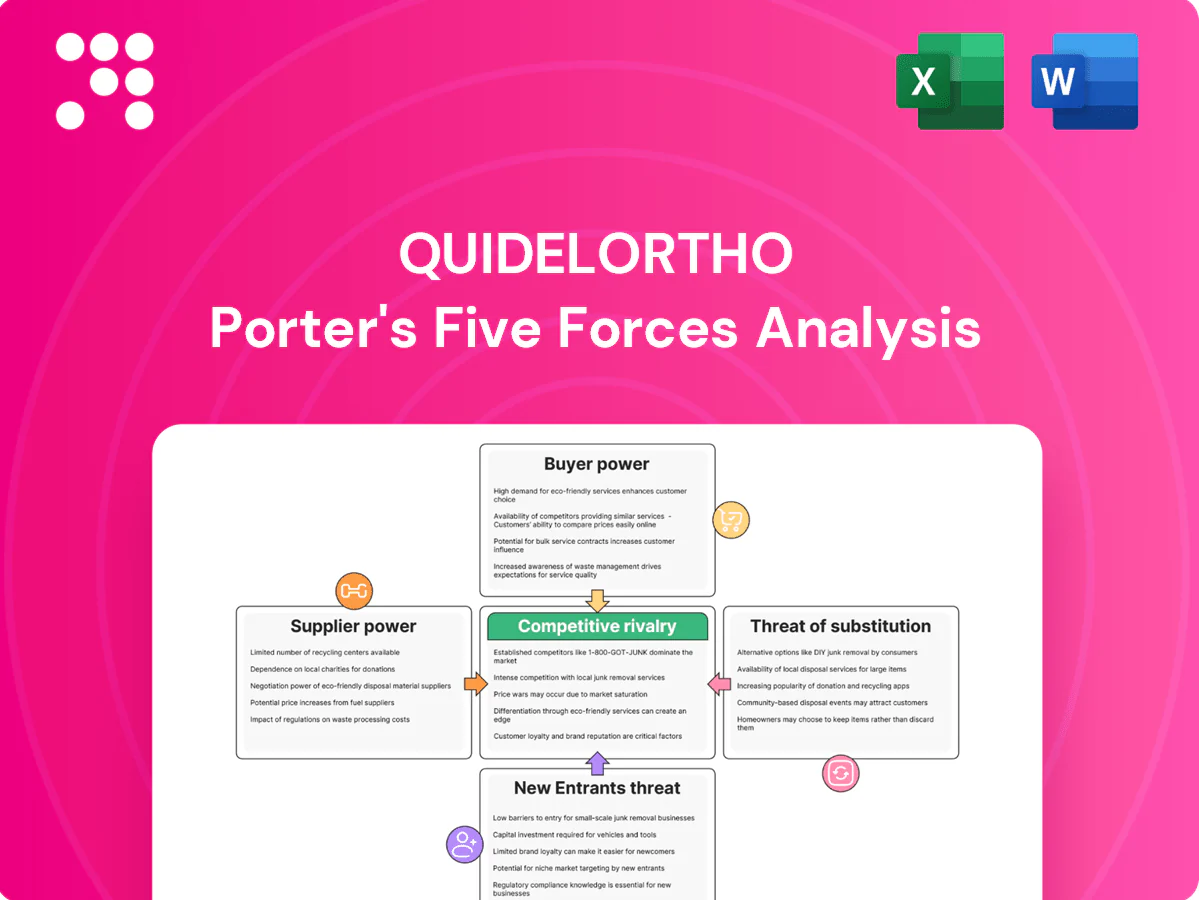
QuidelOrtho Porter's Five Forces Analysis

Don't Miss the Bigger Picture
QuidelOrtho faces intense rivalry, shifting buyer power from consolidated healthcare buyers, supplier reliance for reagents, moderate threat from new diagnostics entrants, and evolving substitute risks from alternative testing technologies. This snapshot only scratches the surface—unlock the full Porter's Five Forces Analysis for force-by-force ratings, visuals, and actionable strategic insights.
Suppliers Bargaining Power

Specialized reagents
Critical inputs like antibodies, enzymes and antigens are concentrated among a small number of qualified suppliers, raising switching costs and supplier leverage. Lot-to-lot consistency and validation burdens (often 6–12 month qualification cycles) increase dependence. Dual-sourcing is feasible but can raise procurement costs by 20–40% and delay commercialization.
Precision components
Precision optics, microfluidics, semiconductors and specialized plastics for QuidelOrtho instruments come from niche vendors, with the global microfluidics market estimated at about $7.1B in 2024, concentrating supplier power. Custom parts and tooling create dependency and multi-week lead-time risks that can delay shipments and SLAs. Supply disruptions have forced schedule slippages in medtech, so vendors often require volume commitments to secure priority.

Regulated supply chain
GMP/ISO-compliant materials (ISO 13485, FDA 21 CFR Part 820) are mandatory for QuidelOrtho, sharply limiting qualified vendors; regulatory documentation and supplier audits create high switching friction. Any substitution typically requires re-validation and potential 510(k) amendments, often adding weeks to months of delay, strengthening supplier bargaining power.

Logistics and cold chain
Temperature-sensitive reagents force QuidelOrtho to rely on reliable cold-chain partners; the global cold chain market was about USD 288 billion in 2024, highlighting dependence on external logistics. Rising fuel and freight rate volatility and constrained lane capacity compress margins, while regionalization to reduce disruption increases operating complexity and cost. Large distributors with scale extract stronger contract terms than manufacturers.
- Cold-chain market: USD 288B (2024)
- Fuel/freight volatility: margin pressure
- Regionalization: higher cost, more complexity
- Distributors' scale: greater negotiating power
Mitigation via scale
QuidelOrtho’s large purchasing footprint across point-of-care and lab franchises creates counter-leverage with suppliers, supported by long-term purchase agreements and safety-stock policies that smooth supply volatility. In-house reagent manufacturing insources critical steps and standardizing components across platforms reduces single-supplier dependency and switching costs.
- Purchasing scale → stronger negotiation
- Long-term contracts + safety stock → lower volatility
- In-house reagents → insourcing key steps
- Standardized components → reduced supplier dependency
Concentrated reagent and cold-chain supply drives high switching costs; scale mitigates risk
Critical reagent and component supply is concentrated, raising switching costs and supplier leverage. Microfluidics market ~$7.1B (2024) and cold-chain ~$288B (2024) signal concentrated, high-cost supply chains. QuidelOrtho offsets risk via scale, in-house reagent manufacturing, long-term contracts and safety stock, lowering effective supplier power.
| Metric | Value (2024) | Impact |
|---|---|---|
| Microfluidics market | $7.1B | Concentrated suppliers |
| Cold-chain | $288B | Logistics leverage |
| Dual-sourcing cost | +20–40% | Higher procurement cost |
| Qualification time | 6–12 months | Switching friction |
What is included in the product
 Detailed Word Document
Concise Porter’s Five Forces analysis tailored to QuidelOrtho, assessing competitive rivalry, supplier and buyer power, threat of substitutes and entrants, and highlighting disruptive technologies and regulatory risks affecting profitability.

 Customizable Excel Spreadsheet
A one-sheet Porter's Five Forces for QuidelOrtho that instantly isolates competitive pressures and actionable levers—simple to customize, copy into decks, and use by non-finance teams to cut analysis time and clarify strategic priorities.
Customers Bargaining Power

GPOs and IDNs
GPOs and IDNs aggregate demand—GPOs negotiate for roughly 80% of U.S. hospitals, giving them strong leverage over QuidelOrtho pricing. Multi-year contracts (typically 3–5 years) allow trading committed volume for meaningful discounts. Formularies and sole-source awards can shift market share by over 20 percentage points rapidly. Switching costs for diagnostics exist but are often outweighed by aggressive price pressure.
Reference labs scale
National reference labs like Quest Diagnostics and LabCorp together handle roughly 50% of US routine testing volumes, buying instruments and high reagent volumes and wielding strong leverage; they increasingly demand connectivity, uptime guarantees and tiered pricing, while industry consolidation amplifies customer bargaining power and performance-based contracts are becoming more common.

Clinical outcomes focus
Buyers now assess total cost-of-care, not just per-test price, as value-based contracts covered roughly 40–50% of US patients by 2024; demonstrated sensitivity/specificity (commonly >95%) and turnaround <30 minutes materially drive procurement and value-based negotiations. Health technology assessments (NICE, CMS) and reimbursement tiers guide adoption, so vendors must provide pharmacoeconomic evidence showing per-patient cost offsets and ROI.

Switching frictions
Installed base, LIS connectivity, training, and workflow integration make QuidelOrtho platforms highly sticky, as labs incur time and validation costs to switch; re-validation and parallel testing add operational burdens that raise effective switching costs. Competitive trade-in programs and reseller incentives can materially lower upfront friction, while consumable lock-in moderates buyer power after installation.
- Installed base: integration creates inertia
- LIS connectivity: high technical switching cost
- Re-validation & parallel testing: operational burden
- Trade-in programs: reduce upfront friction
- Consumable lock-in: sustains vendor leverage
Segment diversity
Buyers hold leverage: GPOs cover ~80%, labs handle ~50% of routine volumes
Buyers hold strong leverage: GPOs cover ~80% of US hospitals and national labs (Quest+LabCorp) handle ~50% of routine volumes, enabling aggressive price and contract terms. Value-based coverage reached ~40–50% of US patients by 2024, raising emphasis on sensitivity/specificity and total cost-of-care. POC market was ~45 billion USD in 2024, with price-sensitive POC/at-home channels vs accuracy-focused acute care.
| Metric | 2024 |
|---|---|
| GPO hospital coverage | ~80% |
| Quest+LabCorp share | ~50% |
| Value-based patient coverage | 40–50% |
| POC market size | $45B |
Preview Before You Purchase
QuidelOrtho Porter's Five Forces Analysis
This preview shows the exact QuidelOrtho Porter's Five Forces Analysis you'll receive immediately after purchase—fully formatted and ready to use. No placeholders, mockups, or sample pages are included. Once payment is complete you get instant access to this same final document.

Don't Miss the Bigger Picture
QuidelOrtho faces intense rivalry, shifting buyer power from consolidated healthcare buyers, supplier reliance for reagents, moderate threat from new diagnostics entrants, and evolving substitute risks from alternative testing technologies. This snapshot only scratches the surface—unlock the full Porter's Five Forces Analysis for force-by-force ratings, visuals, and actionable strategic insights.
Suppliers Bargaining Power
Specialized reagents
Critical inputs like antibodies, enzymes and antigens are concentrated among a small number of qualified suppliers, raising switching costs and supplier leverage. Lot-to-lot consistency and validation burdens (often 6–12 month qualification cycles) increase dependence. Dual-sourcing is feasible but can raise procurement costs by 20–40% and delay commercialization.
Precision components
Precision optics, microfluidics, semiconductors and specialized plastics for QuidelOrtho instruments come from niche vendors, with the global microfluidics market estimated at about $7.1B in 2024, concentrating supplier power. Custom parts and tooling create dependency and multi-week lead-time risks that can delay shipments and SLAs. Supply disruptions have forced schedule slippages in medtech, so vendors often require volume commitments to secure priority.
Regulated supply chain
GMP/ISO-compliant materials (ISO 13485, FDA 21 CFR Part 820) are mandatory for QuidelOrtho, sharply limiting qualified vendors; regulatory documentation and supplier audits create high switching friction. Any substitution typically requires re-validation and potential 510(k) amendments, often adding weeks to months of delay, strengthening supplier bargaining power.
Logistics and cold chain
Temperature-sensitive reagents force QuidelOrtho to rely on reliable cold-chain partners; the global cold chain market was about USD 288 billion in 2024, highlighting dependence on external logistics. Rising fuel and freight rate volatility and constrained lane capacity compress margins, while regionalization to reduce disruption increases operating complexity and cost. Large distributors with scale extract stronger contract terms than manufacturers.
- Cold-chain market: USD 288B (2024)
- Fuel/freight volatility: margin pressure
- Regionalization: higher cost, more complexity
- Distributors' scale: greater negotiating power
Mitigation via scale
QuidelOrtho’s large purchasing footprint across point-of-care and lab franchises creates counter-leverage with suppliers, supported by long-term purchase agreements and safety-stock policies that smooth supply volatility. In-house reagent manufacturing insources critical steps and standardizing components across platforms reduces single-supplier dependency and switching costs.
- Purchasing scale → stronger negotiation
- Long-term contracts + safety stock → lower volatility
- In-house reagents → insourcing key steps
- Standardized components → reduced supplier dependency
Concentrated reagent and cold-chain supply drives high switching costs; scale mitigates risk
Critical reagent and component supply is concentrated, raising switching costs and supplier leverage. Microfluidics market ~$7.1B (2024) and cold-chain ~$288B (2024) signal concentrated, high-cost supply chains. QuidelOrtho offsets risk via scale, in-house reagent manufacturing, long-term contracts and safety stock, lowering effective supplier power.
| Metric | Value (2024) | Impact |
|---|---|---|
| Microfluidics market | $7.1B | Concentrated suppliers |
| Cold-chain | $288B | Logistics leverage |
| Dual-sourcing cost | +20–40% | Higher procurement cost |
| Qualification time | 6–12 months | Switching friction |
What is included in the product
Detailed Word Document
Concise Porter’s Five Forces analysis tailored to QuidelOrtho, assessing competitive rivalry, supplier and buyer power, threat of substitutes and entrants, and highlighting disruptive technologies and regulatory risks affecting profitability.
Customizable Excel Spreadsheet
A one-sheet Porter's Five Forces for QuidelOrtho that instantly isolates competitive pressures and actionable levers—simple to customize, copy into decks, and use by non-finance teams to cut analysis time and clarify strategic priorities.
Customers Bargaining Power
GPOs and IDNs
GPOs and IDNs aggregate demand—GPOs negotiate for roughly 80% of U.S. hospitals, giving them strong leverage over QuidelOrtho pricing. Multi-year contracts (typically 3–5 years) allow trading committed volume for meaningful discounts. Formularies and sole-source awards can shift market share by over 20 percentage points rapidly. Switching costs for diagnostics exist but are often outweighed by aggressive price pressure.
Reference labs scale
National reference labs like Quest Diagnostics and LabCorp together handle roughly 50% of US routine testing volumes, buying instruments and high reagent volumes and wielding strong leverage; they increasingly demand connectivity, uptime guarantees and tiered pricing, while industry consolidation amplifies customer bargaining power and performance-based contracts are becoming more common.
Clinical outcomes focus
Buyers now assess total cost-of-care, not just per-test price, as value-based contracts covered roughly 40–50% of US patients by 2024; demonstrated sensitivity/specificity (commonly >95%) and turnaround <30 minutes materially drive procurement and value-based negotiations. Health technology assessments (NICE, CMS) and reimbursement tiers guide adoption, so vendors must provide pharmacoeconomic evidence showing per-patient cost offsets and ROI.
Switching frictions
Installed base, LIS connectivity, training, and workflow integration make QuidelOrtho platforms highly sticky, as labs incur time and validation costs to switch; re-validation and parallel testing add operational burdens that raise effective switching costs. Competitive trade-in programs and reseller incentives can materially lower upfront friction, while consumable lock-in moderates buyer power after installation.
- Installed base: integration creates inertia
- LIS connectivity: high technical switching cost
- Re-validation & parallel testing: operational burden
- Trade-in programs: reduce upfront friction
- Consumable lock-in: sustains vendor leverage
Segment diversity
Buyers hold leverage: GPOs cover ~80%, labs handle ~50% of routine volumes
Buyers hold strong leverage: GPOs cover ~80% of US hospitals and national labs (Quest+LabCorp) handle ~50% of routine volumes, enabling aggressive price and contract terms. Value-based coverage reached ~40–50% of US patients by 2024, raising emphasis on sensitivity/specificity and total cost-of-care. POC market was ~45 billion USD in 2024, with price-sensitive POC/at-home channels vs accuracy-focused acute care.
| Metric | 2024 |
|---|---|
| GPO hospital coverage | ~80% |
| Quest+LabCorp share | ~50% |
| Value-based patient coverage | 40–50% |
| POC market size | $45B |
Preview Before You Purchase
QuidelOrtho Porter's Five Forces Analysis
This preview shows the exact QuidelOrtho Porter's Five Forces Analysis you'll receive immediately after purchase—fully formatted and ready to use. No placeholders, mockups, or sample pages are included. Once payment is complete you get instant access to this same final document.
Description
Don't Miss the Bigger Picture
QuidelOrtho faces intense rivalry, shifting buyer power from consolidated healthcare buyers, supplier reliance for reagents, moderate threat from new diagnostics entrants, and evolving substitute risks from alternative testing technologies. This snapshot only scratches the surface—unlock the full Porter's Five Forces Analysis for force-by-force ratings, visuals, and actionable strategic insights.
Suppliers Bargaining Power
Specialized reagents
Critical inputs like antibodies, enzymes and antigens are concentrated among a small number of qualified suppliers, raising switching costs and supplier leverage. Lot-to-lot consistency and validation burdens (often 6–12 month qualification cycles) increase dependence. Dual-sourcing is feasible but can raise procurement costs by 20–40% and delay commercialization.
Precision components
Precision optics, microfluidics, semiconductors and specialized plastics for QuidelOrtho instruments come from niche vendors, with the global microfluidics market estimated at about $7.1B in 2024, concentrating supplier power. Custom parts and tooling create dependency and multi-week lead-time risks that can delay shipments and SLAs. Supply disruptions have forced schedule slippages in medtech, so vendors often require volume commitments to secure priority.
Regulated supply chain
GMP/ISO-compliant materials (ISO 13485, FDA 21 CFR Part 820) are mandatory for QuidelOrtho, sharply limiting qualified vendors; regulatory documentation and supplier audits create high switching friction. Any substitution typically requires re-validation and potential 510(k) amendments, often adding weeks to months of delay, strengthening supplier bargaining power.
Logistics and cold chain
Temperature-sensitive reagents force QuidelOrtho to rely on reliable cold-chain partners; the global cold chain market was about USD 288 billion in 2024, highlighting dependence on external logistics. Rising fuel and freight rate volatility and constrained lane capacity compress margins, while regionalization to reduce disruption increases operating complexity and cost. Large distributors with scale extract stronger contract terms than manufacturers.
- Cold-chain market: USD 288B (2024)
- Fuel/freight volatility: margin pressure
- Regionalization: higher cost, more complexity
- Distributors' scale: greater negotiating power
Mitigation via scale
QuidelOrtho’s large purchasing footprint across point-of-care and lab franchises creates counter-leverage with suppliers, supported by long-term purchase agreements and safety-stock policies that smooth supply volatility. In-house reagent manufacturing insources critical steps and standardizing components across platforms reduces single-supplier dependency and switching costs.
- Purchasing scale → stronger negotiation
- Long-term contracts + safety stock → lower volatility
- In-house reagents → insourcing key steps
- Standardized components → reduced supplier dependency
Concentrated reagent and cold-chain supply drives high switching costs; scale mitigates risk
Critical reagent and component supply is concentrated, raising switching costs and supplier leverage. Microfluidics market ~$7.1B (2024) and cold-chain ~$288B (2024) signal concentrated, high-cost supply chains. QuidelOrtho offsets risk via scale, in-house reagent manufacturing, long-term contracts and safety stock, lowering effective supplier power.
| Metric | Value (2024) | Impact |
|---|---|---|
| Microfluidics market | $7.1B | Concentrated suppliers |
| Cold-chain | $288B | Logistics leverage |
| Dual-sourcing cost | +20–40% | Higher procurement cost |
| Qualification time | 6–12 months | Switching friction |
What is included in the product
Detailed Word Document
Concise Porter’s Five Forces analysis tailored to QuidelOrtho, assessing competitive rivalry, supplier and buyer power, threat of substitutes and entrants, and highlighting disruptive technologies and regulatory risks affecting profitability.
Customizable Excel Spreadsheet
A one-sheet Porter's Five Forces for QuidelOrtho that instantly isolates competitive pressures and actionable levers—simple to customize, copy into decks, and use by non-finance teams to cut analysis time and clarify strategic priorities.
Customers Bargaining Power
GPOs and IDNs
GPOs and IDNs aggregate demand—GPOs negotiate for roughly 80% of U.S. hospitals, giving them strong leverage over QuidelOrtho pricing. Multi-year contracts (typically 3–5 years) allow trading committed volume for meaningful discounts. Formularies and sole-source awards can shift market share by over 20 percentage points rapidly. Switching costs for diagnostics exist but are often outweighed by aggressive price pressure.
Reference labs scale
National reference labs like Quest Diagnostics and LabCorp together handle roughly 50% of US routine testing volumes, buying instruments and high reagent volumes and wielding strong leverage; they increasingly demand connectivity, uptime guarantees and tiered pricing, while industry consolidation amplifies customer bargaining power and performance-based contracts are becoming more common.
Clinical outcomes focus
Buyers now assess total cost-of-care, not just per-test price, as value-based contracts covered roughly 40–50% of US patients by 2024; demonstrated sensitivity/specificity (commonly >95%) and turnaround <30 minutes materially drive procurement and value-based negotiations. Health technology assessments (NICE, CMS) and reimbursement tiers guide adoption, so vendors must provide pharmacoeconomic evidence showing per-patient cost offsets and ROI.
Switching frictions
Installed base, LIS connectivity, training, and workflow integration make QuidelOrtho platforms highly sticky, as labs incur time and validation costs to switch; re-validation and parallel testing add operational burdens that raise effective switching costs. Competitive trade-in programs and reseller incentives can materially lower upfront friction, while consumable lock-in moderates buyer power after installation.
- Installed base: integration creates inertia
- LIS connectivity: high technical switching cost
- Re-validation & parallel testing: operational burden
- Trade-in programs: reduce upfront friction
- Consumable lock-in: sustains vendor leverage
Segment diversity
Buyers hold leverage: GPOs cover ~80%, labs handle ~50% of routine volumes
Buyers hold strong leverage: GPOs cover ~80% of US hospitals and national labs (Quest+LabCorp) handle ~50% of routine volumes, enabling aggressive price and contract terms. Value-based coverage reached ~40–50% of US patients by 2024, raising emphasis on sensitivity/specificity and total cost-of-care. POC market was ~45 billion USD in 2024, with price-sensitive POC/at-home channels vs accuracy-focused acute care.
| Metric | 2024 |
|---|---|
| GPO hospital coverage | ~80% |
| Quest+LabCorp share | ~50% |
| Value-based patient coverage | 40–50% |
| POC market size | $45B |
Preview Before You Purchase
QuidelOrtho Porter's Five Forces Analysis
This preview shows the exact QuidelOrtho Porter's Five Forces Analysis you'll receive immediately after purchase—fully formatted and ready to use. No placeholders, mockups, or sample pages are included. Once payment is complete you get instant access to this same final document.











