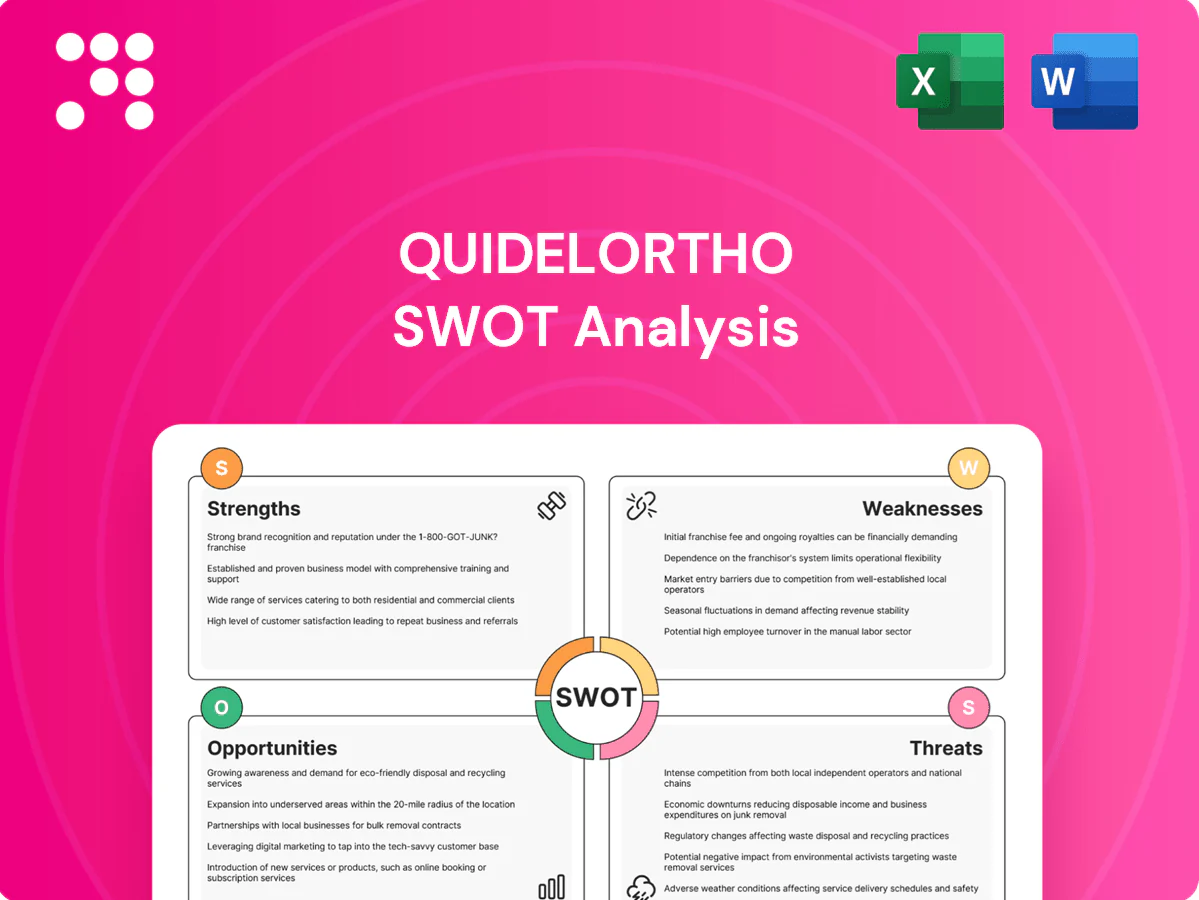
QuidelOrtho SWOT Analysis

Your Strategic Toolkit Starts Here
QuidelOrtho’s SWOT analysis highlights robust diagnostic product strengths, an expanding post-merger portfolio, and regulatory-tailored innovations, balanced against supply-chain pressures and competitive pricing in immunoassay markets.
Want the full story—with editable Word and Excel deliverables, financial context, and strategic recommendations? Purchase the complete SWOT analysis to plan, pitch, or invest with confidence.
Strengths

Broad portfolio across POC and lab
QuidelOrtho spans rapid POC, core‑lab immunoassay/chemistry and specialty tests, covering clinics to reference labs; 2024 revenue ~ $2.2B reflects diversified streams post‑2021 merger. This breadth raises customer stickiness and cross‑selling of instruments, assays and reagents, lowering single‑market dependence, while POC speed plus lab scale strengthens its value proposition.
Large installed base and recurring consumables
Legacy Ortho analyzers combined with Quidel rapid platforms create a sizable installed base that drives recurring reagent and assay pull-through; QuidelOrtho reported FY 2024 revenue of about $2.9 billion, with consumables forming a large portion of recurring sales. Consumables yield more predictable revenue and margin resilience versus one-time instrument sales. Long replacement cycles, validation costs and expanding field service and connectivity deepen customer lock-in over time.

Strong infectious disease franchise
QuidelOrtho leverages recognized brands—Sofia and QuickVue rapid antigen tests and VITROS immunodiagnostics—for respiratory and infectious disease testing, spanning rapid antigen and molecular assays. Seasonal flu and RSV cycles deliver recurring volumes beyond pandemic peaks, while a broad menu supports syndromic decision-making and care pathway standardization. Strong clinical performance and fast turnaround aid triage and antimicrobial stewardship.

Global reach and channel depth
QuidelOrtho’s distribution spans hospitals, clinics, physician offices and reference labs across major geographies, providing multichannel access that reduces reliance on any single healthcare system or region. Established contracts with group purchasing organizations and large health systems support consistent wins, while local regulatory experience accelerates market access and product lifecycle management. This depth enables rapid scaling of diagnostics and in-hospital solutions.
Integrated systems and workflow outcomes
Integrated instruments, reagents, QC, software and connectivity streamline lab and POC workflows, reducing manual steps and standardizing results across sites. Automation and middleware cut hands-on time and errors while improving turnaround times. Data connectivity enables remote monitoring, inventory management and analytics; outcome-oriented selling ties device performance to operational and clinical benefits.
- Integrated systems
- Automation reduces errors
- Remote monitoring & inventory
- Outcome-linked value
POC + lab diagnostics and consumables create cross-sell lock-in; $2.9B
QuidelOrtho combines rapid POC (Sofia, QuickVue) and VITROS lab immunodiagnostics with a large installed base and recurring consumables, driving customer stickiness and cross‑sell; FY2024 revenue about $2.9B supports scale, margin resilience and global multichannel distribution; integrated instruments, reagents, QC and connectivity reduce workflow steps and deepen lock‑in.
| Metric | Value |
|---|---|
| FY2024 revenue | $2.9B |
| Key brands | Sofia, QuickVue, VITROS |
| Channels | Hospitals, clinics, reference labs |
What is included in the product
 Detailed Word Document
Delivers a strategic overview of QuidelOrtho’s internal and external business factors, outlining strengths, weaknesses, opportunities, and threats to assess its competitive position and growth prospects in diagnostics and healthcare markets.

 Customizable Excel Spreadsheet
Provides a concise QuidelOrtho SWOT matrix that quickly highlights diagnostic-market strengths, regulatory and supply-chain vulnerabilities, and competitive threats so teams can prioritize mitigation and align strategic responses fast.
Weaknesses

Post-pandemic normalization exposure
Revenue tied to COVID-19 testing has fallen markedly since the WHO ended the Public Health Emergency on May 5, 2023, creating tough comps and leaving portions of manufacturing capacity underutilized. Demand volatility from episodic waves continues to distort forecasting and inventory, driving swings in working capital. Investors are questioning sustainable growth rates ex-COVID, pressuring management to accelerate non-COVID menu expansion to offset declines.
Portfolio complexity and integration
Combining POC and core lab portfolios raises R&D, manufacturing and service complexity, stretching resources across divergent platforms and regulatory paths. Integration of legacy systems and ERP/process harmonization can strain execution and increase operating costs. Overlapping SKUs and platforms create internal cannibalization risk, while added complexity can slow innovation velocity and compress margin capture.

Pricing pressure in commoditized segments
Rapid antigen and routine chemistry/immunoassay segments face intense price competition from large diagnostics peers and low-cost entrants, squeezing margins as seen in FY2024 when QuidelOrtho reported roughly $2.6 billion in revenue while facing margin pressure. GPO contracts and competitive tenders further compress pricing and can cut renewal margins significantly. Differentiation must rely on superior performance, workflow efficiencies, or lower total cost of ownership, otherwise renewals and customer retention become challenging.

Regulatory and quality burden
Diagnostics face stringent FDA and EU IVDR rules (IVDR in force since 26 May 2022), raising development cost and time-to-market; intensified postmarket surveillance and audits further elevate compliance overhead. Any quality issue or recall can materially harm reputation and disrupt supply, and QuidelOrtho’s broad portfolio increases the regulatory footprint to manage.
- IVDR in force since 26 May 2022
- Higher audit/postmarket demands
- Recalls = supply/reputation risk
- Large portfolio = amplified compliance burden
Supply chain and component dependencies
Assays and instruments depend on specialized reagents, plastics and electronics that face periodic shortages, creating lead-time risk and margin pressure. Reliance on single-source components makes QuidelOrtho vulnerable to supplier delays and sudden cost spikes, while cold-chain and sterilization needs add logistics complexity that can erode service levels and customer satisfaction.
- Single-source exposure
- Reagent and plastics shortages
- Cold-chain/sterility logistics
- Service-level erosion
FY2024 revenue $2.6B - tough comps, margin pressure, execution risk
Revenue tied to COVID has declined, with FY2024 revenue about $2.6 billion creating tough comps and underused capacity. Combining POC and core lab portfolios increases R&D/manufacturing/regulatory complexity and execution risk. Competitive pricing, margin pressure and single‑source supplier exposure elevate operational and financial vulnerability.
| Metric | FY2024 / Note |
|---|---|
| Revenue | $2.6B |
| IVDR | Effective 26-May-2022 |
| Key risks | Margin pressure; supplier single-source |
Preview Before You Purchase
QuidelOrtho SWOT Analysis
This is the actual QuidelOrtho SWOT analysis document you’ll receive upon purchase—no surprises, just professional quality. The preview below is taken directly from the full SWOT report you'll get; purchase unlocks the entire in-depth version. The complete, editable file becomes available immediately after checkout.

Your Strategic Toolkit Starts Here
QuidelOrtho’s SWOT analysis highlights robust diagnostic product strengths, an expanding post-merger portfolio, and regulatory-tailored innovations, balanced against supply-chain pressures and competitive pricing in immunoassay markets.
Want the full story—with editable Word and Excel deliverables, financial context, and strategic recommendations? Purchase the complete SWOT analysis to plan, pitch, or invest with confidence.
Strengths
Broad portfolio across POC and lab
QuidelOrtho spans rapid POC, core‑lab immunoassay/chemistry and specialty tests, covering clinics to reference labs; 2024 revenue ~ $2.2B reflects diversified streams post‑2021 merger. This breadth raises customer stickiness and cross‑selling of instruments, assays and reagents, lowering single‑market dependence, while POC speed plus lab scale strengthens its value proposition.
Large installed base and recurring consumables
Legacy Ortho analyzers combined with Quidel rapid platforms create a sizable installed base that drives recurring reagent and assay pull-through; QuidelOrtho reported FY 2024 revenue of about $2.9 billion, with consumables forming a large portion of recurring sales. Consumables yield more predictable revenue and margin resilience versus one-time instrument sales. Long replacement cycles, validation costs and expanding field service and connectivity deepen customer lock-in over time.
Strong infectious disease franchise
QuidelOrtho leverages recognized brands—Sofia and QuickVue rapid antigen tests and VITROS immunodiagnostics—for respiratory and infectious disease testing, spanning rapid antigen and molecular assays. Seasonal flu and RSV cycles deliver recurring volumes beyond pandemic peaks, while a broad menu supports syndromic decision-making and care pathway standardization. Strong clinical performance and fast turnaround aid triage and antimicrobial stewardship.
Global reach and channel depth
QuidelOrtho’s distribution spans hospitals, clinics, physician offices and reference labs across major geographies, providing multichannel access that reduces reliance on any single healthcare system or region. Established contracts with group purchasing organizations and large health systems support consistent wins, while local regulatory experience accelerates market access and product lifecycle management. This depth enables rapid scaling of diagnostics and in-hospital solutions.
Integrated systems and workflow outcomes
Integrated instruments, reagents, QC, software and connectivity streamline lab and POC workflows, reducing manual steps and standardizing results across sites. Automation and middleware cut hands-on time and errors while improving turnaround times. Data connectivity enables remote monitoring, inventory management and analytics; outcome-oriented selling ties device performance to operational and clinical benefits.
- Integrated systems
- Automation reduces errors
- Remote monitoring & inventory
- Outcome-linked value
POC + lab diagnostics and consumables create cross-sell lock-in; $2.9B
QuidelOrtho combines rapid POC (Sofia, QuickVue) and VITROS lab immunodiagnostics with a large installed base and recurring consumables, driving customer stickiness and cross‑sell; FY2024 revenue about $2.9B supports scale, margin resilience and global multichannel distribution; integrated instruments, reagents, QC and connectivity reduce workflow steps and deepen lock‑in.
| Metric | Value |
|---|---|
| FY2024 revenue | $2.9B |
| Key brands | Sofia, QuickVue, VITROS |
| Channels | Hospitals, clinics, reference labs |
What is included in the product
Detailed Word Document
Delivers a strategic overview of QuidelOrtho’s internal and external business factors, outlining strengths, weaknesses, opportunities, and threats to assess its competitive position and growth prospects in diagnostics and healthcare markets.
Customizable Excel Spreadsheet
Provides a concise QuidelOrtho SWOT matrix that quickly highlights diagnostic-market strengths, regulatory and supply-chain vulnerabilities, and competitive threats so teams can prioritize mitigation and align strategic responses fast.
Weaknesses
Post-pandemic normalization exposure
Revenue tied to COVID-19 testing has fallen markedly since the WHO ended the Public Health Emergency on May 5, 2023, creating tough comps and leaving portions of manufacturing capacity underutilized. Demand volatility from episodic waves continues to distort forecasting and inventory, driving swings in working capital. Investors are questioning sustainable growth rates ex-COVID, pressuring management to accelerate non-COVID menu expansion to offset declines.
Portfolio complexity and integration
Combining POC and core lab portfolios raises R&D, manufacturing and service complexity, stretching resources across divergent platforms and regulatory paths. Integration of legacy systems and ERP/process harmonization can strain execution and increase operating costs. Overlapping SKUs and platforms create internal cannibalization risk, while added complexity can slow innovation velocity and compress margin capture.
Pricing pressure in commoditized segments
Rapid antigen and routine chemistry/immunoassay segments face intense price competition from large diagnostics peers and low-cost entrants, squeezing margins as seen in FY2024 when QuidelOrtho reported roughly $2.6 billion in revenue while facing margin pressure. GPO contracts and competitive tenders further compress pricing and can cut renewal margins significantly. Differentiation must rely on superior performance, workflow efficiencies, or lower total cost of ownership, otherwise renewals and customer retention become challenging.
Regulatory and quality burden
Diagnostics face stringent FDA and EU IVDR rules (IVDR in force since 26 May 2022), raising development cost and time-to-market; intensified postmarket surveillance and audits further elevate compliance overhead. Any quality issue or recall can materially harm reputation and disrupt supply, and QuidelOrtho’s broad portfolio increases the regulatory footprint to manage.
- IVDR in force since 26 May 2022
- Higher audit/postmarket demands
- Recalls = supply/reputation risk
- Large portfolio = amplified compliance burden
Supply chain and component dependencies
Assays and instruments depend on specialized reagents, plastics and electronics that face periodic shortages, creating lead-time risk and margin pressure. Reliance on single-source components makes QuidelOrtho vulnerable to supplier delays and sudden cost spikes, while cold-chain and sterilization needs add logistics complexity that can erode service levels and customer satisfaction.
- Single-source exposure
- Reagent and plastics shortages
- Cold-chain/sterility logistics
- Service-level erosion
FY2024 revenue $2.6B - tough comps, margin pressure, execution risk
Revenue tied to COVID has declined, with FY2024 revenue about $2.6 billion creating tough comps and underused capacity. Combining POC and core lab portfolios increases R&D/manufacturing/regulatory complexity and execution risk. Competitive pricing, margin pressure and single‑source supplier exposure elevate operational and financial vulnerability.
| Metric | FY2024 / Note |
|---|---|
| Revenue | $2.6B |
| IVDR | Effective 26-May-2022 |
| Key risks | Margin pressure; supplier single-source |
Preview Before You Purchase
QuidelOrtho SWOT Analysis
This is the actual QuidelOrtho SWOT analysis document you’ll receive upon purchase—no surprises, just professional quality. The preview below is taken directly from the full SWOT report you'll get; purchase unlocks the entire in-depth version. The complete, editable file becomes available immediately after checkout.
Original: $10.00
-65%$10.00
$3.50Description
Your Strategic Toolkit Starts Here
QuidelOrtho’s SWOT analysis highlights robust diagnostic product strengths, an expanding post-merger portfolio, and regulatory-tailored innovations, balanced against supply-chain pressures and competitive pricing in immunoassay markets.
Want the full story—with editable Word and Excel deliverables, financial context, and strategic recommendations? Purchase the complete SWOT analysis to plan, pitch, or invest with confidence.
Strengths
Broad portfolio across POC and lab
QuidelOrtho spans rapid POC, core‑lab immunoassay/chemistry and specialty tests, covering clinics to reference labs; 2024 revenue ~ $2.2B reflects diversified streams post‑2021 merger. This breadth raises customer stickiness and cross‑selling of instruments, assays and reagents, lowering single‑market dependence, while POC speed plus lab scale strengthens its value proposition.
Large installed base and recurring consumables
Legacy Ortho analyzers combined with Quidel rapid platforms create a sizable installed base that drives recurring reagent and assay pull-through; QuidelOrtho reported FY 2024 revenue of about $2.9 billion, with consumables forming a large portion of recurring sales. Consumables yield more predictable revenue and margin resilience versus one-time instrument sales. Long replacement cycles, validation costs and expanding field service and connectivity deepen customer lock-in over time.
Strong infectious disease franchise
QuidelOrtho leverages recognized brands—Sofia and QuickVue rapid antigen tests and VITROS immunodiagnostics—for respiratory and infectious disease testing, spanning rapid antigen and molecular assays. Seasonal flu and RSV cycles deliver recurring volumes beyond pandemic peaks, while a broad menu supports syndromic decision-making and care pathway standardization. Strong clinical performance and fast turnaround aid triage and antimicrobial stewardship.
Global reach and channel depth
QuidelOrtho’s distribution spans hospitals, clinics, physician offices and reference labs across major geographies, providing multichannel access that reduces reliance on any single healthcare system or region. Established contracts with group purchasing organizations and large health systems support consistent wins, while local regulatory experience accelerates market access and product lifecycle management. This depth enables rapid scaling of diagnostics and in-hospital solutions.
Integrated systems and workflow outcomes
Integrated instruments, reagents, QC, software and connectivity streamline lab and POC workflows, reducing manual steps and standardizing results across sites. Automation and middleware cut hands-on time and errors while improving turnaround times. Data connectivity enables remote monitoring, inventory management and analytics; outcome-oriented selling ties device performance to operational and clinical benefits.
- Integrated systems
- Automation reduces errors
- Remote monitoring & inventory
- Outcome-linked value
POC + lab diagnostics and consumables create cross-sell lock-in; $2.9B
QuidelOrtho combines rapid POC (Sofia, QuickVue) and VITROS lab immunodiagnostics with a large installed base and recurring consumables, driving customer stickiness and cross‑sell; FY2024 revenue about $2.9B supports scale, margin resilience and global multichannel distribution; integrated instruments, reagents, QC and connectivity reduce workflow steps and deepen lock‑in.
| Metric | Value |
|---|---|
| FY2024 revenue | $2.9B |
| Key brands | Sofia, QuickVue, VITROS |
| Channels | Hospitals, clinics, reference labs |
What is included in the product
Detailed Word Document
Delivers a strategic overview of QuidelOrtho’s internal and external business factors, outlining strengths, weaknesses, opportunities, and threats to assess its competitive position and growth prospects in diagnostics and healthcare markets.
Customizable Excel Spreadsheet
Provides a concise QuidelOrtho SWOT matrix that quickly highlights diagnostic-market strengths, regulatory and supply-chain vulnerabilities, and competitive threats so teams can prioritize mitigation and align strategic responses fast.
Weaknesses
Post-pandemic normalization exposure
Revenue tied to COVID-19 testing has fallen markedly since the WHO ended the Public Health Emergency on May 5, 2023, creating tough comps and leaving portions of manufacturing capacity underutilized. Demand volatility from episodic waves continues to distort forecasting and inventory, driving swings in working capital. Investors are questioning sustainable growth rates ex-COVID, pressuring management to accelerate non-COVID menu expansion to offset declines.
Portfolio complexity and integration
Combining POC and core lab portfolios raises R&D, manufacturing and service complexity, stretching resources across divergent platforms and regulatory paths. Integration of legacy systems and ERP/process harmonization can strain execution and increase operating costs. Overlapping SKUs and platforms create internal cannibalization risk, while added complexity can slow innovation velocity and compress margin capture.
Pricing pressure in commoditized segments
Rapid antigen and routine chemistry/immunoassay segments face intense price competition from large diagnostics peers and low-cost entrants, squeezing margins as seen in FY2024 when QuidelOrtho reported roughly $2.6 billion in revenue while facing margin pressure. GPO contracts and competitive tenders further compress pricing and can cut renewal margins significantly. Differentiation must rely on superior performance, workflow efficiencies, or lower total cost of ownership, otherwise renewals and customer retention become challenging.
Regulatory and quality burden
Diagnostics face stringent FDA and EU IVDR rules (IVDR in force since 26 May 2022), raising development cost and time-to-market; intensified postmarket surveillance and audits further elevate compliance overhead. Any quality issue or recall can materially harm reputation and disrupt supply, and QuidelOrtho’s broad portfolio increases the regulatory footprint to manage.
- IVDR in force since 26 May 2022
- Higher audit/postmarket demands
- Recalls = supply/reputation risk
- Large portfolio = amplified compliance burden
Supply chain and component dependencies
Assays and instruments depend on specialized reagents, plastics and electronics that face periodic shortages, creating lead-time risk and margin pressure. Reliance on single-source components makes QuidelOrtho vulnerable to supplier delays and sudden cost spikes, while cold-chain and sterilization needs add logistics complexity that can erode service levels and customer satisfaction.
- Single-source exposure
- Reagent and plastics shortages
- Cold-chain/sterility logistics
- Service-level erosion
FY2024 revenue $2.6B - tough comps, margin pressure, execution risk
Revenue tied to COVID has declined, with FY2024 revenue about $2.6 billion creating tough comps and underused capacity. Combining POC and core lab portfolios increases R&D/manufacturing/regulatory complexity and execution risk. Competitive pricing, margin pressure and single‑source supplier exposure elevate operational and financial vulnerability.
| Metric | FY2024 / Note |
|---|---|
| Revenue | $2.6B |
| IVDR | Effective 26-May-2022 |
| Key risks | Margin pressure; supplier single-source |
Preview Before You Purchase
QuidelOrtho SWOT Analysis
This is the actual QuidelOrtho SWOT analysis document you’ll receive upon purchase—no surprises, just professional quality. The preview below is taken directly from the full SWOT report you'll get; purchase unlocks the entire in-depth version. The complete, editable file becomes available immediately after checkout.











