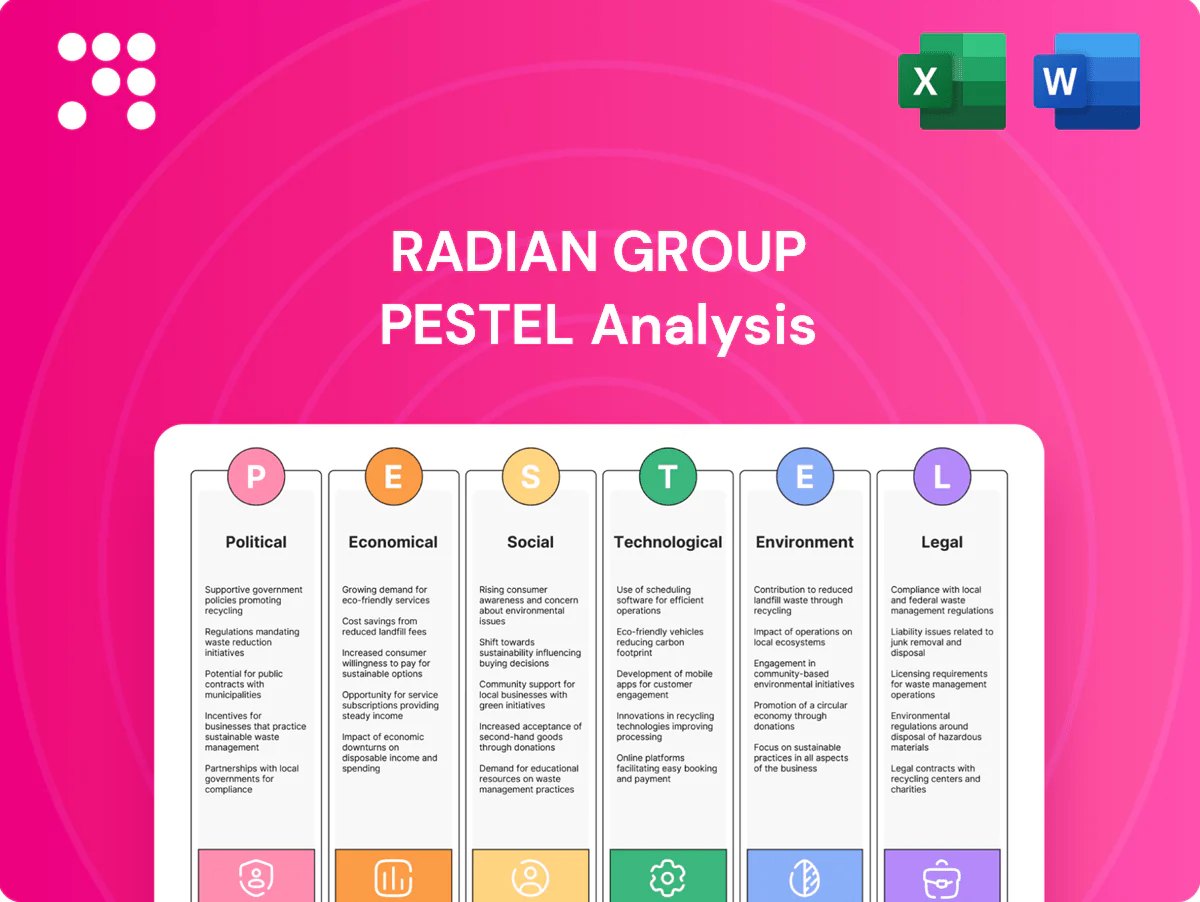
Radian Group PESTLE Analysis

Your Competitive Advantage Starts with This Report
Gain a competitive edge with our PESTLE Analysis of Radian Group—three concise sections reveal political, economic, and regulatory pressures shaping mortgage insurance and risk exposure. Use these actionable insights to anticipate threats and spot growth opportunities. Purchase the full report for the complete breakdown, editable charts, and instant download to power your strategy.
Political factors

Housing policy shifts
Changes in federal housing priorities directly affect mortgage availability and private mortgage insurance demand, altering lender risk appetite and capital allocation. Expansions of affordable housing programs can boost first-time buyer volumes—first-time buyers made about 33% of purchases in 2024 (NAR). Policy pullbacks or budget cuts tighten underwriting and can reduce originations. Radian must align products and pricing to evolving policy emphasis.
GSE reform trajectory
Adjustments to Fannie/Freddie capital rules and credit-risk transfer programs will shape mortgage insurance demand against a single-family guarantee book of about $7 trillion as of 2024; stronger GSE capital lowers MI use, looser rules boost it. PMIERs recalibrations alter insurer capital needs and pricing, affecting H1 2025 risk models. Any privatization or charter changes could materially reset market shares, and Radian’s margins remain directly tied to these regulatory rulebooks.

State-level insurance politics
State insurance commissioners in 51 jurisdictions shape rate approvals and reserving standards, with approval timelines ranging from weeks to 12 months; political turnover can abruptly shift oversight intensity and timing. Divergent state priorities across those jurisdictions raise compliance complexity, requiring Radian to maintain agile, localized filing strategies.

Election-driven volatility
National elections (US held Nov 5, 2024) shift housing incentives and regulator appointments, with macro swings feeding into consumer confidence and mortgage subsidy programs; the 30-year fixed mortgage averaged about 6.9% in 2024, dampening origination volumes and prompting lenders to pause new initiatives. Radian should scenario-plan for alternating agendas.
- election-date: Nov 5, 2024
- 30yr avg 2024: ~6.9%
- impact: regulator appointments alter oversight
- action: scenario-plan for policy switches
Infrastructure & local zoning
Infrastructure funding such as the Bipartisan Infrastructure Law ($1.2 trillion) can unlock housing supply in key markets, accelerating construction that drives mortgage insurance demand. Zoning reforms like California SB9 (allows lot splits to create up to two units) raise local build rates, so municipal politics indirectly set pipeline volume. Radian benefits from pro-housing policies that expand insured originations.
- BIL $1.2T boosts development capital
- SB9: lot splits up to 2 units increase build velocity
- Pro-housing cities raise MIable pipeline, benefiting Radian
Elections and regulators reshape housing policy; MI risk vs $7T GSE book
Elections (Nov 5, 2024) and regulator appointments shift housing policy and MI demand. First-time buyers ~33% (2024) and 30-yr avg ~6.9% (2024) influence originations. GSE rule changes and PMIERs affect MI against a ~$7T single-family guarantee book; infrastructure ($1.2T) and zoning reforms (e.g., SB9) alter supply.
| Item | Value |
|---|---|
| Election | Nov 5, 2024 |
| 1st-time buyers 2024 | ~33% |
| 30yr avg 2024 | ~6.9% |
| GSE guarantee book | ~$7T |
| BIL | $1.2T |
What is included in the product
 Detailed Word Document
Explores how macro-environmental factors uniquely affect Radian Group across Political, Economic, Social, Technological, Environmental and Legal dimensions, with data-backed trends, forward-looking insights and practical implications to help executives, investors and strategists identify risks, opportunities and scenario-driven actions.

 Customizable Excel Spreadsheet
A concise, visually segmented PESTLE summary for Radian Group that clarifies regulatory, economic, and technological risks at a glance, making it easy to drop into presentations or share across teams for faster decision alignment.
Economic factors

Interest rate cycles
Rising interest rate cycles—30-year fixed mortgage averages around 6.7% in 2024 per Freddie Mac—reduce affordability, cut purchase volumes and trigger steep declines in refinance activity (refi share fell below 20% per MBA in 2023–24). Higher rates elevate DTI pressures and credit strain, while lower rates expand eligibility and typically improve credit performance. Radian’s NIW and loss trends remain highly rate-sensitive, driving premium mix and reserve needs.
Employment and wages
Job growth—U.S. unemployment 3.7% (June 2025, BLS)—supports mortgage performance and reduces claims, while unemployment spikes historically drive higher delinquencies and defaults. Real average hourly earnings rose ~4.0% y/y (June 2025, BLS), aiding down payments and qualification. Radian’s insurance loss ratios historically move with labor-market stress, widening when unemployment rises.

Home price dynamics
Home price appreciation preserves borrower equity and lowers loss severity; FHFA reported U.S. house prices up about 3.0% year‑over‑year in 2024, helping reduce claim severity for insurers like Radian. Price declines push loan‑to‑value higher and raise claim costs, with regional dispersion—some MSAs underperforming national HPA—creating concentration risk. Radian must monitor HPA scenarios at the MSA level for portfolio stress testing.

Credit cycle and liquidity
Radian Group (NYSE: RDN) faces underwriting tightening as lender risk appetite and securitization flows fluctuate; with the 10-year Treasury around 4.3% and 30-year mortgage rates near 7.1% in July 2025, spread compression has raised CRT and reinsurance costs. Liquidity stress can curb originations sharply—purchase originations remain below 2019 peaks, amplifying volatility in premium inflows. Radian’s capital planning must be calibrated to cycle turns to preserve leverage and statutory capital ratios.
- Lender risk appetite: impacts underwriting tightness
- Securitization flows: drive MI demand and pricing
- Capital markets: 10y ~4.3%, 30y mortgage ~7.1% (Jul 2025)
- Liquidity shocks: can sharply cut originations
- Capital planning: align with cycle turns to protect ratios
Inflation and costs
Inflation erodes real incomes and housing affordability; US CPI was about 3.4% y/y in 2024, reducing buyer purchasing power. Rising input costs and reinsurance premiums lift Radian's operating expenses, while persistent inflation supports upward pressure on mortgage rates—30-year fixed averaged near 7% in 2024. Radian needs tight pricing discipline and cost control to protect underwriting margins.
- Inflation rate: ~3.4% y/y (2024)
- 30-year mortgage: ~7% avg (2024)
- Impacts: higher operating & reinsurance costs, margin pressure
- Response: pricing discipline, cost control
Elections and regulators reshape housing policy; MI risk vs $7T GSE book
Rising rates (30y ~7.1% Jul 2025, 10y ~4.3%) and CPI ~3.4% (2024) cut affordability, lower purchase/refi volumes and raise loss severity; unemployment 3.7% (Jun 2025) and HPA ~3.0% (2024 FHFA) support performance but regional downside risks persist; capital, pricing and reserve actions must track cycle shifts.
| Metric | Value |
|---|---|
| 30y mortgage | ~7.1% (Jul 2025) |
| 10y Treasury | ~4.3% (Jul 2025) |
| Unemployment | 3.7% (Jun 2025) |
| FHFA HPA | ~3.0% (2024) |
| CPI | ~3.4% (2024) |
Same Document Delivered
Radian Group PESTLE Analysis
This Radian Group PESTLE Analysis provides a concise evaluation of political, economic, social, technological, legal and environmental factors affecting the company. The preview shown here is the exact document you’ll receive after purchase—fully formatted and ready to use. No placeholders or teasers; the file is the final version available for immediate download.

Your Competitive Advantage Starts with This Report
Gain a competitive edge with our PESTLE Analysis of Radian Group—three concise sections reveal political, economic, and regulatory pressures shaping mortgage insurance and risk exposure. Use these actionable insights to anticipate threats and spot growth opportunities. Purchase the full report for the complete breakdown, editable charts, and instant download to power your strategy.
Political factors
Housing policy shifts
Changes in federal housing priorities directly affect mortgage availability and private mortgage insurance demand, altering lender risk appetite and capital allocation. Expansions of affordable housing programs can boost first-time buyer volumes—first-time buyers made about 33% of purchases in 2024 (NAR). Policy pullbacks or budget cuts tighten underwriting and can reduce originations. Radian must align products and pricing to evolving policy emphasis.
GSE reform trajectory
Adjustments to Fannie/Freddie capital rules and credit-risk transfer programs will shape mortgage insurance demand against a single-family guarantee book of about $7 trillion as of 2024; stronger GSE capital lowers MI use, looser rules boost it. PMIERs recalibrations alter insurer capital needs and pricing, affecting H1 2025 risk models. Any privatization or charter changes could materially reset market shares, and Radian’s margins remain directly tied to these regulatory rulebooks.
State-level insurance politics
State insurance commissioners in 51 jurisdictions shape rate approvals and reserving standards, with approval timelines ranging from weeks to 12 months; political turnover can abruptly shift oversight intensity and timing. Divergent state priorities across those jurisdictions raise compliance complexity, requiring Radian to maintain agile, localized filing strategies.
Election-driven volatility
National elections (US held Nov 5, 2024) shift housing incentives and regulator appointments, with macro swings feeding into consumer confidence and mortgage subsidy programs; the 30-year fixed mortgage averaged about 6.9% in 2024, dampening origination volumes and prompting lenders to pause new initiatives. Radian should scenario-plan for alternating agendas.
- election-date: Nov 5, 2024
- 30yr avg 2024: ~6.9%
- impact: regulator appointments alter oversight
- action: scenario-plan for policy switches
Infrastructure & local zoning
Infrastructure funding such as the Bipartisan Infrastructure Law ($1.2 trillion) can unlock housing supply in key markets, accelerating construction that drives mortgage insurance demand. Zoning reforms like California SB9 (allows lot splits to create up to two units) raise local build rates, so municipal politics indirectly set pipeline volume. Radian benefits from pro-housing policies that expand insured originations.
- BIL $1.2T boosts development capital
- SB9: lot splits up to 2 units increase build velocity
- Pro-housing cities raise MIable pipeline, benefiting Radian
Elections and regulators reshape housing policy; MI risk vs $7T GSE book
Elections (Nov 5, 2024) and regulator appointments shift housing policy and MI demand. First-time buyers ~33% (2024) and 30-yr avg ~6.9% (2024) influence originations. GSE rule changes and PMIERs affect MI against a ~$7T single-family guarantee book; infrastructure ($1.2T) and zoning reforms (e.g., SB9) alter supply.
| Item | Value |
|---|---|
| Election | Nov 5, 2024 |
| 1st-time buyers 2024 | ~33% |
| 30yr avg 2024 | ~6.9% |
| GSE guarantee book | ~$7T |
| BIL | $1.2T |
What is included in the product
Detailed Word Document
Explores how macro-environmental factors uniquely affect Radian Group across Political, Economic, Social, Technological, Environmental and Legal dimensions, with data-backed trends, forward-looking insights and practical implications to help executives, investors and strategists identify risks, opportunities and scenario-driven actions.
Customizable Excel Spreadsheet
A concise, visually segmented PESTLE summary for Radian Group that clarifies regulatory, economic, and technological risks at a glance, making it easy to drop into presentations or share across teams for faster decision alignment.
Economic factors
Interest rate cycles
Rising interest rate cycles—30-year fixed mortgage averages around 6.7% in 2024 per Freddie Mac—reduce affordability, cut purchase volumes and trigger steep declines in refinance activity (refi share fell below 20% per MBA in 2023–24). Higher rates elevate DTI pressures and credit strain, while lower rates expand eligibility and typically improve credit performance. Radian’s NIW and loss trends remain highly rate-sensitive, driving premium mix and reserve needs.
Employment and wages
Job growth—U.S. unemployment 3.7% (June 2025, BLS)—supports mortgage performance and reduces claims, while unemployment spikes historically drive higher delinquencies and defaults. Real average hourly earnings rose ~4.0% y/y (June 2025, BLS), aiding down payments and qualification. Radian’s insurance loss ratios historically move with labor-market stress, widening when unemployment rises.
Home price dynamics
Home price appreciation preserves borrower equity and lowers loss severity; FHFA reported U.S. house prices up about 3.0% year‑over‑year in 2024, helping reduce claim severity for insurers like Radian. Price declines push loan‑to‑value higher and raise claim costs, with regional dispersion—some MSAs underperforming national HPA—creating concentration risk. Radian must monitor HPA scenarios at the MSA level for portfolio stress testing.
Credit cycle and liquidity
Radian Group (NYSE: RDN) faces underwriting tightening as lender risk appetite and securitization flows fluctuate; with the 10-year Treasury around 4.3% and 30-year mortgage rates near 7.1% in July 2025, spread compression has raised CRT and reinsurance costs. Liquidity stress can curb originations sharply—purchase originations remain below 2019 peaks, amplifying volatility in premium inflows. Radian’s capital planning must be calibrated to cycle turns to preserve leverage and statutory capital ratios.
- Lender risk appetite: impacts underwriting tightness
- Securitization flows: drive MI demand and pricing
- Capital markets: 10y ~4.3%, 30y mortgage ~7.1% (Jul 2025)
- Liquidity shocks: can sharply cut originations
- Capital planning: align with cycle turns to protect ratios
Inflation and costs
Inflation erodes real incomes and housing affordability; US CPI was about 3.4% y/y in 2024, reducing buyer purchasing power. Rising input costs and reinsurance premiums lift Radian's operating expenses, while persistent inflation supports upward pressure on mortgage rates—30-year fixed averaged near 7% in 2024. Radian needs tight pricing discipline and cost control to protect underwriting margins.
- Inflation rate: ~3.4% y/y (2024)
- 30-year mortgage: ~7% avg (2024)
- Impacts: higher operating & reinsurance costs, margin pressure
- Response: pricing discipline, cost control
Elections and regulators reshape housing policy; MI risk vs $7T GSE book
Rising rates (30y ~7.1% Jul 2025, 10y ~4.3%) and CPI ~3.4% (2024) cut affordability, lower purchase/refi volumes and raise loss severity; unemployment 3.7% (Jun 2025) and HPA ~3.0% (2024 FHFA) support performance but regional downside risks persist; capital, pricing and reserve actions must track cycle shifts.
| Metric | Value |
|---|---|
| 30y mortgage | ~7.1% (Jul 2025) |
| 10y Treasury | ~4.3% (Jul 2025) |
| Unemployment | 3.7% (Jun 2025) |
| FHFA HPA | ~3.0% (2024) |
| CPI | ~3.4% (2024) |
Same Document Delivered
Radian Group PESTLE Analysis
This Radian Group PESTLE Analysis provides a concise evaluation of political, economic, social, technological, legal and environmental factors affecting the company. The preview shown here is the exact document you’ll receive after purchase—fully formatted and ready to use. No placeholders or teasers; the file is the final version available for immediate download.
Original: $10.00
-65%$10.00
$3.50Description
Your Competitive Advantage Starts with This Report
Gain a competitive edge with our PESTLE Analysis of Radian Group—three concise sections reveal political, economic, and regulatory pressures shaping mortgage insurance and risk exposure. Use these actionable insights to anticipate threats and spot growth opportunities. Purchase the full report for the complete breakdown, editable charts, and instant download to power your strategy.
Political factors
Housing policy shifts
Changes in federal housing priorities directly affect mortgage availability and private mortgage insurance demand, altering lender risk appetite and capital allocation. Expansions of affordable housing programs can boost first-time buyer volumes—first-time buyers made about 33% of purchases in 2024 (NAR). Policy pullbacks or budget cuts tighten underwriting and can reduce originations. Radian must align products and pricing to evolving policy emphasis.
GSE reform trajectory
Adjustments to Fannie/Freddie capital rules and credit-risk transfer programs will shape mortgage insurance demand against a single-family guarantee book of about $7 trillion as of 2024; stronger GSE capital lowers MI use, looser rules boost it. PMIERs recalibrations alter insurer capital needs and pricing, affecting H1 2025 risk models. Any privatization or charter changes could materially reset market shares, and Radian’s margins remain directly tied to these regulatory rulebooks.
State-level insurance politics
State insurance commissioners in 51 jurisdictions shape rate approvals and reserving standards, with approval timelines ranging from weeks to 12 months; political turnover can abruptly shift oversight intensity and timing. Divergent state priorities across those jurisdictions raise compliance complexity, requiring Radian to maintain agile, localized filing strategies.
Election-driven volatility
National elections (US held Nov 5, 2024) shift housing incentives and regulator appointments, with macro swings feeding into consumer confidence and mortgage subsidy programs; the 30-year fixed mortgage averaged about 6.9% in 2024, dampening origination volumes and prompting lenders to pause new initiatives. Radian should scenario-plan for alternating agendas.
- election-date: Nov 5, 2024
- 30yr avg 2024: ~6.9%
- impact: regulator appointments alter oversight
- action: scenario-plan for policy switches
Infrastructure & local zoning
Infrastructure funding such as the Bipartisan Infrastructure Law ($1.2 trillion) can unlock housing supply in key markets, accelerating construction that drives mortgage insurance demand. Zoning reforms like California SB9 (allows lot splits to create up to two units) raise local build rates, so municipal politics indirectly set pipeline volume. Radian benefits from pro-housing policies that expand insured originations.
- BIL $1.2T boosts development capital
- SB9: lot splits up to 2 units increase build velocity
- Pro-housing cities raise MIable pipeline, benefiting Radian
Elections and regulators reshape housing policy; MI risk vs $7T GSE book
Elections (Nov 5, 2024) and regulator appointments shift housing policy and MI demand. First-time buyers ~33% (2024) and 30-yr avg ~6.9% (2024) influence originations. GSE rule changes and PMIERs affect MI against a ~$7T single-family guarantee book; infrastructure ($1.2T) and zoning reforms (e.g., SB9) alter supply.
| Item | Value |
|---|---|
| Election | Nov 5, 2024 |
| 1st-time buyers 2024 | ~33% |
| 30yr avg 2024 | ~6.9% |
| GSE guarantee book | ~$7T |
| BIL | $1.2T |
What is included in the product
Detailed Word Document
Explores how macro-environmental factors uniquely affect Radian Group across Political, Economic, Social, Technological, Environmental and Legal dimensions, with data-backed trends, forward-looking insights and practical implications to help executives, investors and strategists identify risks, opportunities and scenario-driven actions.
Customizable Excel Spreadsheet
A concise, visually segmented PESTLE summary for Radian Group that clarifies regulatory, economic, and technological risks at a glance, making it easy to drop into presentations or share across teams for faster decision alignment.
Economic factors
Interest rate cycles
Rising interest rate cycles—30-year fixed mortgage averages around 6.7% in 2024 per Freddie Mac—reduce affordability, cut purchase volumes and trigger steep declines in refinance activity (refi share fell below 20% per MBA in 2023–24). Higher rates elevate DTI pressures and credit strain, while lower rates expand eligibility and typically improve credit performance. Radian’s NIW and loss trends remain highly rate-sensitive, driving premium mix and reserve needs.
Employment and wages
Job growth—U.S. unemployment 3.7% (June 2025, BLS)—supports mortgage performance and reduces claims, while unemployment spikes historically drive higher delinquencies and defaults. Real average hourly earnings rose ~4.0% y/y (June 2025, BLS), aiding down payments and qualification. Radian’s insurance loss ratios historically move with labor-market stress, widening when unemployment rises.
Home price dynamics
Home price appreciation preserves borrower equity and lowers loss severity; FHFA reported U.S. house prices up about 3.0% year‑over‑year in 2024, helping reduce claim severity for insurers like Radian. Price declines push loan‑to‑value higher and raise claim costs, with regional dispersion—some MSAs underperforming national HPA—creating concentration risk. Radian must monitor HPA scenarios at the MSA level for portfolio stress testing.
Credit cycle and liquidity
Radian Group (NYSE: RDN) faces underwriting tightening as lender risk appetite and securitization flows fluctuate; with the 10-year Treasury around 4.3% and 30-year mortgage rates near 7.1% in July 2025, spread compression has raised CRT and reinsurance costs. Liquidity stress can curb originations sharply—purchase originations remain below 2019 peaks, amplifying volatility in premium inflows. Radian’s capital planning must be calibrated to cycle turns to preserve leverage and statutory capital ratios.
- Lender risk appetite: impacts underwriting tightness
- Securitization flows: drive MI demand and pricing
- Capital markets: 10y ~4.3%, 30y mortgage ~7.1% (Jul 2025)
- Liquidity shocks: can sharply cut originations
- Capital planning: align with cycle turns to protect ratios
Inflation and costs
Inflation erodes real incomes and housing affordability; US CPI was about 3.4% y/y in 2024, reducing buyer purchasing power. Rising input costs and reinsurance premiums lift Radian's operating expenses, while persistent inflation supports upward pressure on mortgage rates—30-year fixed averaged near 7% in 2024. Radian needs tight pricing discipline and cost control to protect underwriting margins.
- Inflation rate: ~3.4% y/y (2024)
- 30-year mortgage: ~7% avg (2024)
- Impacts: higher operating & reinsurance costs, margin pressure
- Response: pricing discipline, cost control
Elections and regulators reshape housing policy; MI risk vs $7T GSE book
Rising rates (30y ~7.1% Jul 2025, 10y ~4.3%) and CPI ~3.4% (2024) cut affordability, lower purchase/refi volumes and raise loss severity; unemployment 3.7% (Jun 2025) and HPA ~3.0% (2024 FHFA) support performance but regional downside risks persist; capital, pricing and reserve actions must track cycle shifts.
| Metric | Value |
|---|---|
| 30y mortgage | ~7.1% (Jul 2025) |
| 10y Treasury | ~4.3% (Jul 2025) |
| Unemployment | 3.7% (Jun 2025) |
| FHFA HPA | ~3.0% (2024) |
| CPI | ~3.4% (2024) |
Same Document Delivered
Radian Group PESTLE Analysis
This Radian Group PESTLE Analysis provides a concise evaluation of political, economic, social, technological, legal and environmental factors affecting the company. The preview shown here is the exact document you’ll receive after purchase—fully formatted and ready to use. No placeholders or teasers; the file is the final version available for immediate download.











