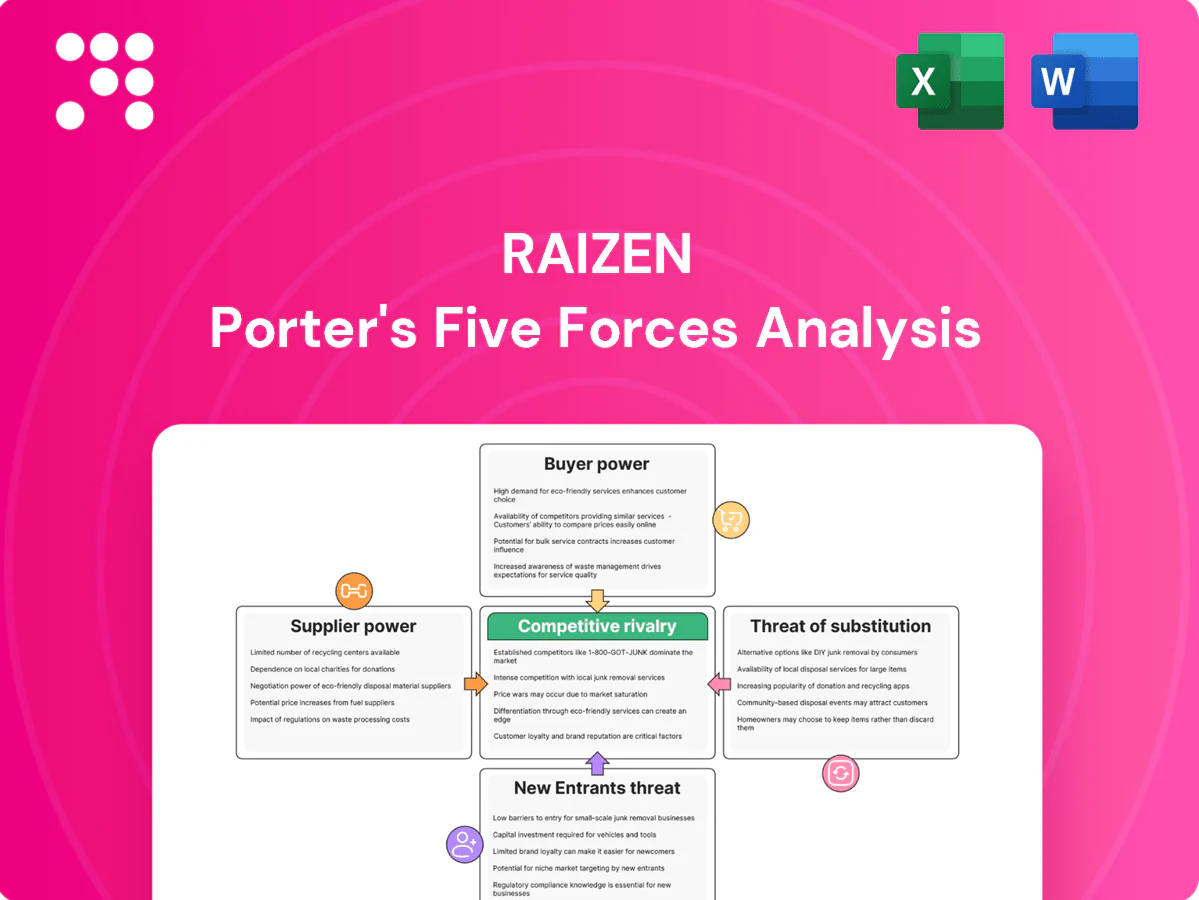
Raizen Porter's Five Forces Analysis

Elevate Your Analysis with the Complete Porter's Five Forces Analysis
Raizen faces powerful supplier influence, intense rivalry, evolving buyer expectations and growing substitute threats that shape its margins and strategy. This brief snapshot only scratches the surface. Unlock the full Porter's Five Forces Analysis to explore Raizen’s competitive dynamics, market pressures, and strategic advantages in detail. Get a consultant-grade, data-driven report ready for presentations and investment decisions.
Suppliers Bargaining Power

Concentrated cane supply clusters
Raízen relies on large sugarcane growers alongside its own plantations and roughly 30 industrial units, creating localized supplier concentration in core Brazilian harvest zones.
In those zones, major growers can negotiate price and logistics terms during peak season, while multi-year supply contracts and Raízen’s vertical integration (own planting, milling, trading) trim revenue volatility.
Severe weather shocks—droughts or excessive rainfall—periodically tighten cane availability, temporarily increasing growers’ bargaining leverage and pressuring margins.
Input and equipment OEM dependence
Specialized harvesters, boilers, enzymes and yeasts come from a concentrated supplier base—major enzyme suppliers such as Novozymes and DSM serve the bioindustry and the industrial enzyme market was about USD 6.2 billion in 2023—giving OEMs pricing power as switching costs and downtime risks are high for Raízen. Long-term service agreements and performance contracts partially mitigate this, while localization and dual-sourcing strategies can rebalance bargaining power.

Fuel sourcing and logistics partners
Distribution relies on pipeline operators, terminals and transport firms, and capacity constraints in peak harvest/seasonal windows can materially raise logistics fees and waiting times. Raízen’s scale—operating roughly 7,400 fuel stations in Brazil in 2024—helps secure slots and negotiate lower unit transport costs. Strategic infrastructure co-investments and terminal stakes further lock in favorable access and reduce supplier leverage.

Grid interconnection for bioenergy
Grid interconnection is critical for exporting biomass power, with dependable access shaping dispatch and revenue. Transmission operators and dispatch rules determine uptake and pricing, and curtailment risk, which IEA 2024 notes can reach about 10% in high‑renewable systems, can compress margins. Long‑term PPAs and regulatory advocacy reduce supplier‑like leverage of grid operators.
- Dependable access determines market entry
- Dispatch rules shape price capture
- Curtailment risk ~10% (IEA 2024)
- PPAs and policy lower grid leverage
Agricultural labor and services
Seasonal labor, agronomic services and contractors directly affect harvest efficiency and give suppliers bargaining leverage when tight labor markets push up costs and premiums for contractors.
Mechanization reduces dependency but raises capex and shifts bargaining toward equipment makers; training and safety programs improve retention and productivity, lowering supplier power over time.
- seasonal-labor: high
- agronomic-services: strategic
- mechanization-capex: increases
- training-safety: retention
Supplier power rises as enzyme market and seasonal labor squeeze margins
Supplier power is moderate-to-high: concentrated large sugarcane growers and specialized enzyme/OEM suppliers can press margins during seasonality and shocks.
Raízen’s vertical integration, multi-year contracts and 7,400 fuel stations (2024) limit logistics and buyer-side exposure.
Key metrics: enzyme market ~USD 6.2B (2023), grid curtailment ~10% (IEA 2024), seasonal labor tightness elevates contractor leverage.
| Supplier | Indicator | 2023/24 |
|---|---|---|
| Enzymes/OEM | Market size | USD 6.2B (2023) |
| Fuel network | Stations | 7,400 (2024) |
| Grid | Curtailment | ~10% (IEA 2024) |
What is included in the product
 Detailed Word Document
Tailored Porter's Five Forces analysis for Raízen, uncovering competitive intensity, supplier and buyer power, threat of substitutes and new entrants, plus disruptive risks and strategic implications.

 Customizable Excel Spreadsheet
Clear, one-sheet Raízen Five Forces summary that distills complex energy-market pressures for quick strategic decisions. Customize scores, swap data, and export-ready layout—no macros—perfect for decks or executive briefs.
Customers Bargaining Power

Price-sensitive fuel motorists
Price-sensitive motorists switch between gasoline and ethanol when ethanol prices fall to about 70% of gasoline, increasing buyer leverage; high price transparency via apps and 83% smartphone penetration in Brazil (2024) further boosts switching. Loyalty programs and the Shell brand reduce churn, while Raízen’s network of over 7,000 retail sites sustains volumes despite pricing pressure.
Industrial ethanol and sugar offtakers
Industrial ethanol and sugar offtakers exert strong bargaining power, negotiating volumes and indexation with Raizen through long-term and annual contracts; large B2B deals often determine pricing mechanics. Diversification across fuel, food and chemical sectors lowers concentration risk for Raizen. Sustainability certification (eg Bonsucro/ISCC) can secure price premiums commonly cited around 5–10%. Persistent spot exposure still leaves margins vulnerable to global commodity cycles.

Aviation and biofuel blenders
Airlines and obligated parties demand low-carbon fuels at scale—IATA targets 10% SAF by 2030 while global jet fuel demand is ~300 Mt/yr and SAF was <0.1% of supply in 2023—giving large buyers strong negotiating leverage. Their volume-based procurement and long-term SAF/biofuel offtake contracts reduce Raizen’s price risk and stabilize cash flows. Policy levers like EU ReFuelEU and US 45Z tax credits can swing bargaining power back toward suppliers.

Power distributors and corporate PPAs
Utilities and corporates press Raízen on PPA price, tenor and attributes, with Brazil’s grid remaining roughly 80% renewable in 2024, intensifying competition from wind and solar that compresses margins. Firming services and renewable certificates command premiums and differentiate offers while creditworthy buyers reduce offtake risk but negotiate discounts.
- Price/tenor pressure
- Wind/solar cap on margins
- Firming/certificates add value
- Creditworthy buyers push discounts
Dealer network and convenience partners
Franchised station dealers negotiate margins and support, and multi-brand options raise their bargaining leverage; as of 2024 Raízen’s retail network exceeds 7,000 franchised stations, concentrating dealer importance. Raízen leverages Shell branding, logistics and sales data to retain dealers, while in-store partnerships boost joint economics and ease price pressure.
- Dealers negotiate margins/support
- Multi-brand increases leverage
- Raízen provides branding, logistics, data
- In-store partners improve joint economics
Motorists switch at ~70% ethanol price; SAF 10% by 2030; grid ~80% renewables
Customers hold strong leverage: motorists switch to ethanol at ~70% price ratio aided by 83% smartphone penetration (2024) and Raízen’s >7,000 stations; industrial offtakers secure indexed long/annual contracts; airlines push SAF (IATA 10% by 2030; SAF <0.1% in 2023); utilities negotiate PPAs in an ~80% renewable grid (2024).
| Segment | Leverage | Key numbers |
|---|---|---|
| Retail | High switching | 70% price ratio; 83% smartphone; >7,000 sites |
| Industrial | Contract bargaining | Long/annual offtakes |
| Airlines | Volume power | IATA 10% by 2030; SAF <0.1% (2023) |
| Utilities | PPA terms | ~80% renewable grid (2024) |
Preview Before You Purchase
Raizen Porter's Five Forces Analysis
This preview shows the exact Raízen Porter’s Five Forces analysis you’ll receive—no placeholders or mockups. It’s the final, professionally formatted document, ready for immediate download and use once you complete your purchase. No surprises, no extra setup required.

Elevate Your Analysis with the Complete Porter's Five Forces Analysis
Raizen faces powerful supplier influence, intense rivalry, evolving buyer expectations and growing substitute threats that shape its margins and strategy. This brief snapshot only scratches the surface. Unlock the full Porter's Five Forces Analysis to explore Raizen’s competitive dynamics, market pressures, and strategic advantages in detail. Get a consultant-grade, data-driven report ready for presentations and investment decisions.
Suppliers Bargaining Power
Concentrated cane supply clusters
Raízen relies on large sugarcane growers alongside its own plantations and roughly 30 industrial units, creating localized supplier concentration in core Brazilian harvest zones.
In those zones, major growers can negotiate price and logistics terms during peak season, while multi-year supply contracts and Raízen’s vertical integration (own planting, milling, trading) trim revenue volatility.
Severe weather shocks—droughts or excessive rainfall—periodically tighten cane availability, temporarily increasing growers’ bargaining leverage and pressuring margins.
Input and equipment OEM dependence
Specialized harvesters, boilers, enzymes and yeasts come from a concentrated supplier base—major enzyme suppliers such as Novozymes and DSM serve the bioindustry and the industrial enzyme market was about USD 6.2 billion in 2023—giving OEMs pricing power as switching costs and downtime risks are high for Raízen. Long-term service agreements and performance contracts partially mitigate this, while localization and dual-sourcing strategies can rebalance bargaining power.
Fuel sourcing and logistics partners
Distribution relies on pipeline operators, terminals and transport firms, and capacity constraints in peak harvest/seasonal windows can materially raise logistics fees and waiting times. Raízen’s scale—operating roughly 7,400 fuel stations in Brazil in 2024—helps secure slots and negotiate lower unit transport costs. Strategic infrastructure co-investments and terminal stakes further lock in favorable access and reduce supplier leverage.
Grid interconnection for bioenergy
Grid interconnection is critical for exporting biomass power, with dependable access shaping dispatch and revenue. Transmission operators and dispatch rules determine uptake and pricing, and curtailment risk, which IEA 2024 notes can reach about 10% in high‑renewable systems, can compress margins. Long‑term PPAs and regulatory advocacy reduce supplier‑like leverage of grid operators.
- Dependable access determines market entry
- Dispatch rules shape price capture
- Curtailment risk ~10% (IEA 2024)
- PPAs and policy lower grid leverage
Agricultural labor and services
Seasonal labor, agronomic services and contractors directly affect harvest efficiency and give suppliers bargaining leverage when tight labor markets push up costs and premiums for contractors.
Mechanization reduces dependency but raises capex and shifts bargaining toward equipment makers; training and safety programs improve retention and productivity, lowering supplier power over time.
- seasonal-labor: high
- agronomic-services: strategic
- mechanization-capex: increases
- training-safety: retention
Supplier power rises as enzyme market and seasonal labor squeeze margins
Supplier power is moderate-to-high: concentrated large sugarcane growers and specialized enzyme/OEM suppliers can press margins during seasonality and shocks.
Raízen’s vertical integration, multi-year contracts and 7,400 fuel stations (2024) limit logistics and buyer-side exposure.
Key metrics: enzyme market ~USD 6.2B (2023), grid curtailment ~10% (IEA 2024), seasonal labor tightness elevates contractor leverage.
| Supplier | Indicator | 2023/24 |
|---|---|---|
| Enzymes/OEM | Market size | USD 6.2B (2023) |
| Fuel network | Stations | 7,400 (2024) |
| Grid | Curtailment | ~10% (IEA 2024) |
What is included in the product
Detailed Word Document
Tailored Porter's Five Forces analysis for Raízen, uncovering competitive intensity, supplier and buyer power, threat of substitutes and new entrants, plus disruptive risks and strategic implications.
Customizable Excel Spreadsheet
Clear, one-sheet Raízen Five Forces summary that distills complex energy-market pressures for quick strategic decisions. Customize scores, swap data, and export-ready layout—no macros—perfect for decks or executive briefs.
Customers Bargaining Power
Price-sensitive fuel motorists
Price-sensitive motorists switch between gasoline and ethanol when ethanol prices fall to about 70% of gasoline, increasing buyer leverage; high price transparency via apps and 83% smartphone penetration in Brazil (2024) further boosts switching. Loyalty programs and the Shell brand reduce churn, while Raízen’s network of over 7,000 retail sites sustains volumes despite pricing pressure.
Industrial ethanol and sugar offtakers
Industrial ethanol and sugar offtakers exert strong bargaining power, negotiating volumes and indexation with Raizen through long-term and annual contracts; large B2B deals often determine pricing mechanics. Diversification across fuel, food and chemical sectors lowers concentration risk for Raizen. Sustainability certification (eg Bonsucro/ISCC) can secure price premiums commonly cited around 5–10%. Persistent spot exposure still leaves margins vulnerable to global commodity cycles.
Aviation and biofuel blenders
Airlines and obligated parties demand low-carbon fuels at scale—IATA targets 10% SAF by 2030 while global jet fuel demand is ~300 Mt/yr and SAF was <0.1% of supply in 2023—giving large buyers strong negotiating leverage. Their volume-based procurement and long-term SAF/biofuel offtake contracts reduce Raizen’s price risk and stabilize cash flows. Policy levers like EU ReFuelEU and US 45Z tax credits can swing bargaining power back toward suppliers.
Power distributors and corporate PPAs
Utilities and corporates press Raízen on PPA price, tenor and attributes, with Brazil’s grid remaining roughly 80% renewable in 2024, intensifying competition from wind and solar that compresses margins. Firming services and renewable certificates command premiums and differentiate offers while creditworthy buyers reduce offtake risk but negotiate discounts.
- Price/tenor pressure
- Wind/solar cap on margins
- Firming/certificates add value
- Creditworthy buyers push discounts
Dealer network and convenience partners
Franchised station dealers negotiate margins and support, and multi-brand options raise their bargaining leverage; as of 2024 Raízen’s retail network exceeds 7,000 franchised stations, concentrating dealer importance. Raízen leverages Shell branding, logistics and sales data to retain dealers, while in-store partnerships boost joint economics and ease price pressure.
- Dealers negotiate margins/support
- Multi-brand increases leverage
- Raízen provides branding, logistics, data
- In-store partners improve joint economics
Motorists switch at ~70% ethanol price; SAF 10% by 2030; grid ~80% renewables
Customers hold strong leverage: motorists switch to ethanol at ~70% price ratio aided by 83% smartphone penetration (2024) and Raízen’s >7,000 stations; industrial offtakers secure indexed long/annual contracts; airlines push SAF (IATA 10% by 2030; SAF <0.1% in 2023); utilities negotiate PPAs in an ~80% renewable grid (2024).
| Segment | Leverage | Key numbers |
|---|---|---|
| Retail | High switching | 70% price ratio; 83% smartphone; >7,000 sites |
| Industrial | Contract bargaining | Long/annual offtakes |
| Airlines | Volume power | IATA 10% by 2030; SAF <0.1% (2023) |
| Utilities | PPA terms | ~80% renewable grid (2024) |
Preview Before You Purchase
Raizen Porter's Five Forces Analysis
This preview shows the exact Raízen Porter’s Five Forces analysis you’ll receive—no placeholders or mockups. It’s the final, professionally formatted document, ready for immediate download and use once you complete your purchase. No surprises, no extra setup required.
Original: $10.00
-65%$10.00
$3.50Description
Elevate Your Analysis with the Complete Porter's Five Forces Analysis
Raizen faces powerful supplier influence, intense rivalry, evolving buyer expectations and growing substitute threats that shape its margins and strategy. This brief snapshot only scratches the surface. Unlock the full Porter's Five Forces Analysis to explore Raizen’s competitive dynamics, market pressures, and strategic advantages in detail. Get a consultant-grade, data-driven report ready for presentations and investment decisions.
Suppliers Bargaining Power
Concentrated cane supply clusters
Raízen relies on large sugarcane growers alongside its own plantations and roughly 30 industrial units, creating localized supplier concentration in core Brazilian harvest zones.
In those zones, major growers can negotiate price and logistics terms during peak season, while multi-year supply contracts and Raízen’s vertical integration (own planting, milling, trading) trim revenue volatility.
Severe weather shocks—droughts or excessive rainfall—periodically tighten cane availability, temporarily increasing growers’ bargaining leverage and pressuring margins.
Input and equipment OEM dependence
Specialized harvesters, boilers, enzymes and yeasts come from a concentrated supplier base—major enzyme suppliers such as Novozymes and DSM serve the bioindustry and the industrial enzyme market was about USD 6.2 billion in 2023—giving OEMs pricing power as switching costs and downtime risks are high for Raízen. Long-term service agreements and performance contracts partially mitigate this, while localization and dual-sourcing strategies can rebalance bargaining power.
Fuel sourcing and logistics partners
Distribution relies on pipeline operators, terminals and transport firms, and capacity constraints in peak harvest/seasonal windows can materially raise logistics fees and waiting times. Raízen’s scale—operating roughly 7,400 fuel stations in Brazil in 2024—helps secure slots and negotiate lower unit transport costs. Strategic infrastructure co-investments and terminal stakes further lock in favorable access and reduce supplier leverage.
Grid interconnection for bioenergy
Grid interconnection is critical for exporting biomass power, with dependable access shaping dispatch and revenue. Transmission operators and dispatch rules determine uptake and pricing, and curtailment risk, which IEA 2024 notes can reach about 10% in high‑renewable systems, can compress margins. Long‑term PPAs and regulatory advocacy reduce supplier‑like leverage of grid operators.
- Dependable access determines market entry
- Dispatch rules shape price capture
- Curtailment risk ~10% (IEA 2024)
- PPAs and policy lower grid leverage
Agricultural labor and services
Seasonal labor, agronomic services and contractors directly affect harvest efficiency and give suppliers bargaining leverage when tight labor markets push up costs and premiums for contractors.
Mechanization reduces dependency but raises capex and shifts bargaining toward equipment makers; training and safety programs improve retention and productivity, lowering supplier power over time.
- seasonal-labor: high
- agronomic-services: strategic
- mechanization-capex: increases
- training-safety: retention
Supplier power rises as enzyme market and seasonal labor squeeze margins
Supplier power is moderate-to-high: concentrated large sugarcane growers and specialized enzyme/OEM suppliers can press margins during seasonality and shocks.
Raízen’s vertical integration, multi-year contracts and 7,400 fuel stations (2024) limit logistics and buyer-side exposure.
Key metrics: enzyme market ~USD 6.2B (2023), grid curtailment ~10% (IEA 2024), seasonal labor tightness elevates contractor leverage.
| Supplier | Indicator | 2023/24 |
|---|---|---|
| Enzymes/OEM | Market size | USD 6.2B (2023) |
| Fuel network | Stations | 7,400 (2024) |
| Grid | Curtailment | ~10% (IEA 2024) |
What is included in the product
Detailed Word Document
Tailored Porter's Five Forces analysis for Raízen, uncovering competitive intensity, supplier and buyer power, threat of substitutes and new entrants, plus disruptive risks and strategic implications.
Customizable Excel Spreadsheet
Clear, one-sheet Raízen Five Forces summary that distills complex energy-market pressures for quick strategic decisions. Customize scores, swap data, and export-ready layout—no macros—perfect for decks or executive briefs.
Customers Bargaining Power
Price-sensitive fuel motorists
Price-sensitive motorists switch between gasoline and ethanol when ethanol prices fall to about 70% of gasoline, increasing buyer leverage; high price transparency via apps and 83% smartphone penetration in Brazil (2024) further boosts switching. Loyalty programs and the Shell brand reduce churn, while Raízen’s network of over 7,000 retail sites sustains volumes despite pricing pressure.
Industrial ethanol and sugar offtakers
Industrial ethanol and sugar offtakers exert strong bargaining power, negotiating volumes and indexation with Raizen through long-term and annual contracts; large B2B deals often determine pricing mechanics. Diversification across fuel, food and chemical sectors lowers concentration risk for Raizen. Sustainability certification (eg Bonsucro/ISCC) can secure price premiums commonly cited around 5–10%. Persistent spot exposure still leaves margins vulnerable to global commodity cycles.
Aviation and biofuel blenders
Airlines and obligated parties demand low-carbon fuels at scale—IATA targets 10% SAF by 2030 while global jet fuel demand is ~300 Mt/yr and SAF was <0.1% of supply in 2023—giving large buyers strong negotiating leverage. Their volume-based procurement and long-term SAF/biofuel offtake contracts reduce Raizen’s price risk and stabilize cash flows. Policy levers like EU ReFuelEU and US 45Z tax credits can swing bargaining power back toward suppliers.
Power distributors and corporate PPAs
Utilities and corporates press Raízen on PPA price, tenor and attributes, with Brazil’s grid remaining roughly 80% renewable in 2024, intensifying competition from wind and solar that compresses margins. Firming services and renewable certificates command premiums and differentiate offers while creditworthy buyers reduce offtake risk but negotiate discounts.
- Price/tenor pressure
- Wind/solar cap on margins
- Firming/certificates add value
- Creditworthy buyers push discounts
Dealer network and convenience partners
Franchised station dealers negotiate margins and support, and multi-brand options raise their bargaining leverage; as of 2024 Raízen’s retail network exceeds 7,000 franchised stations, concentrating dealer importance. Raízen leverages Shell branding, logistics and sales data to retain dealers, while in-store partnerships boost joint economics and ease price pressure.
- Dealers negotiate margins/support
- Multi-brand increases leverage
- Raízen provides branding, logistics, data
- In-store partners improve joint economics
Motorists switch at ~70% ethanol price; SAF 10% by 2030; grid ~80% renewables
Customers hold strong leverage: motorists switch to ethanol at ~70% price ratio aided by 83% smartphone penetration (2024) and Raízen’s >7,000 stations; industrial offtakers secure indexed long/annual contracts; airlines push SAF (IATA 10% by 2030; SAF <0.1% in 2023); utilities negotiate PPAs in an ~80% renewable grid (2024).
| Segment | Leverage | Key numbers |
|---|---|---|
| Retail | High switching | 70% price ratio; 83% smartphone; >7,000 sites |
| Industrial | Contract bargaining | Long/annual offtakes |
| Airlines | Volume power | IATA 10% by 2030; SAF <0.1% (2023) |
| Utilities | PPA terms | ~80% renewable grid (2024) |
Preview Before You Purchase
Raizen Porter's Five Forces Analysis
This preview shows the exact Raízen Porter’s Five Forces analysis you’ll receive—no placeholders or mockups. It’s the final, professionally formatted document, ready for immediate download and use once you complete your purchase. No surprises, no extra setup required.











