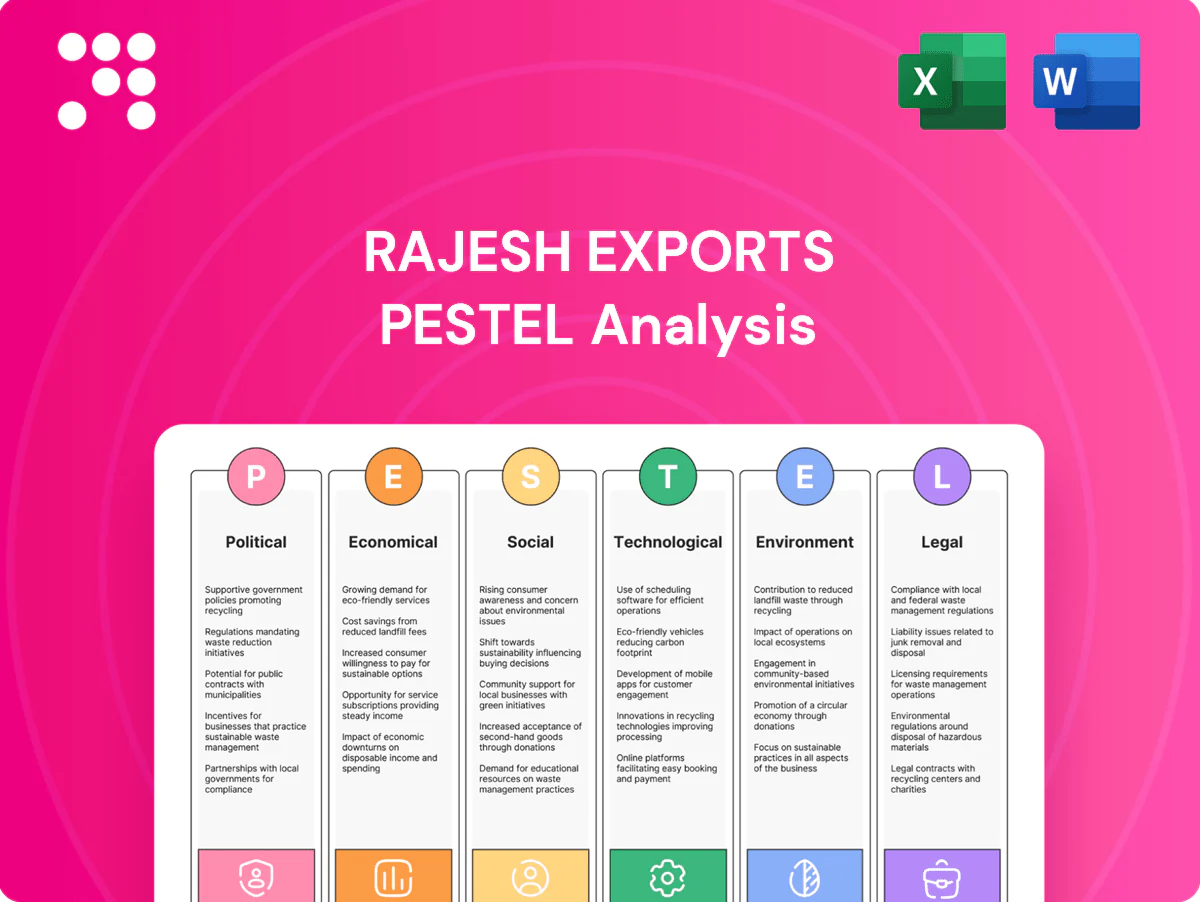
Rajesh Exports PESTLE Analysis

Make Smarter Strategic Decisions with a Complete PESTEL View
Gain strategic clarity with our PESTLE Analysis of Rajesh Exports—three to five concise insights on political, economic, social, technological, legal, and environmental forces shaping its future. Ideal for investors and strategists, this brief highlights risks and opportunities you can act on today. Purchase the full report for the complete, editable deep dive and immediate download.
Political factors

Import duties and tariffs on gold
Changes in customs duty on bullion directly alter Rajesh Exports landed costs and gross margins, with India adjusting tariffs frequently to manage current account pressures; gold imports were roughly USD 40 billion in 2023, amplifying sensitivity to duty shifts. Preferential duties under FTAs or tariff‑rate quotas could redirect sourcing and affect input mix. Rajesh Exports must hedge policy risk across jurisdictions using contractual clauses, diversified sourcing and financial hedges.
Geopolitical and sanctions exposure
Geopolitical sanctions can interrupt gold flows by targeting countries, refiners or banks, forcing Rajesh Exports to raise logistics costs and insurance premia amid tensions; the firm therefore emphasizes source diversification and strict counterparty screening, and rapid compliance actions to preserve market access and minimize supply-chain disruption.

Government stance on gold monetization
Government schemes such as the Gold Monetization Scheme (launched 2015) and Sovereign Gold Bonds (offering 2.5% interest p.a.) have redirected physical gold into financial instruments, reducing retail bullion demand. Policy-driven substitution from jewelry to financial gold can alter Rajesh Exports product mix and refining volumes. Active engagement with policymakers helps align company strategy with national formalization and import-reduction goals.

Trade agreements and export incentives
FTAs such as India-ASEAN and ongoing India-UK talks influence Rajesh Exports competitiveness in key markets, while export-promotion schemes like RoDTEP (active since 2019) directly affect margins and net realisation on jewellery and bullion sales. Changes to remission benefits require close monitoring as they can shift net receipts per kg of gold; Rajesh Exports’ 2015 acquisition of Valcambi strengthens its tariff and origin strategy. Proactive certification and rules-of-origin compliance secure preferential access and prevent duty erosion.
- FTA exposure: India-ASEAN, India-UK negotiations
- Export scheme: RoDTEP impacts net realisation
- Supply chain: country-of-origin planning
- Certification: ensures preferential market access
Political stability and regulatory predictability
Political stability in Rajesh Exports’ key markets lowers the risk of abrupt tax and compliance shocks; the 2015 Valcambi acquisition anchors its Swiss refining and multimarket footprint. Political cycles can still drive populist measures that affect gold demand and duties, while predictable regulation supports capex planning for refining and retail expansion.
- Valcambi acquisition 2015: Swiss refining base
- Stable governance reduces policy shock risk
- Populist cycles may alter gold duties/demand
- Predictable rules enable capex planning
- Multimarket presence diversifies country risk
Customs duty shifts on bullion lift landed costs; India imports USD 40B, SGBs 2.5% reshape demand
Customs duty shifts on bullion (India gold imports ~USD 40 billion in 2023) materially affect Rajesh Exports’ landed cost and margins; Valcambi (acquired 2015) supports origin strategy and tariff planning. Geopolitical sanctions, RoDTEP changes and schemes like Sovereign Gold Bonds (2.5% p.a.) reshape demand and trade costs, requiring diversified sourcing and strict compliance.
| Metric | Value |
|---|---|
| India gold imports (2023) | USD 40B |
| Valcambi acquisition | 2015 |
| Sovereign Gold Bonds rate | 2.5% p.a. |
What is included in the product
 Detailed Word Document
Provides a concise PESTLE review of Rajesh Exports, examining Political, Economic, Social, Technological, Environmental and Legal forces with data-backed trends and forward-looking scenarios to help executives and investors identify risks, opportunities and strategic responses specific to the company’s market and industry.

 Customizable Excel Spreadsheet
A concise, visually segmented PESTLE summary for Rajesh Exports that distills external risks and opportunities into an editable, presentation-ready format—ideal for quick alignment, client reports, and on-the-go strategy sessions.
Economic factors

Gold price volatility and spreads
Revenue scales with bullion: spot gold traded around USD 2,350/oz in July 2025, so topline moves with metal prices while margins depend on fabrication spreads, typically a few dollars per ounce in global markets. Volatility (12‑month realized ≈18%) drives inventory valuation swings and raises hedging costs, compressing EBITDA. Strong risk management and forward hedges are needed to avoid mark‑to‑market shocks, and customer pricing clauses (indexation/fixed spreads) can stabilize throughput.
Interest rates, USD strength, and INR FX
Higher RBI policy rates (repo at 6.5% in mid‑2025) raise holding and working‑capital costs, denting discretionary jewelry demand; a strong USD and INR near 83.3/USD lift local input costs as gold is USD‑priced. FX management and export natural hedges are critical for Rajesh Exports, and active market‑mix optimization (domestic vs export sales) helps offset currency swings.

Consumer income and wedding-season cycles
Jewellery demand closely tracks disposable income and cultural events; India's jewellery market was estimated at about USD 75 billion in 2024, with weddings and festivals driving peak buying. Festive and wedding seasons boost sales domestically and in diaspora markets, concentrating revenues into quarterly spikes. During slowdowns buyers shift to lighter grammage and lower ticket sizes, and agile assortment management preserves volumes and margins.

Liquidity and working capital intensity
Bullion trading and manufacturing at Rajesh Exports tie up large working capital, with typical jewellery-sector inventory turns of about 8–12x annually; credit availability and bullion lease rates directly affect throughput and margin. Efficient inventory turns, collateralized lending and digital treasury tools (real-time cash pooling, payment automation) materially reduce finance costs and improve cash discipline.
- Working capital intensity: high; inventory turns ~8–12x
- Key drivers: credit lines, bullion lease rates
- Mitigants: collateralized facilities, inventory optimization
- Digital tools: real-time treasury, payment automation
Global growth and wholesale demand
Wholesale orders for Rajesh Exports track global retail footfall and tourism, which recovered to about 88% of 2019 levels in 2023 (UNWTO); weaker travel or mall traffic directly reduces B2B demand. Recessions defer discretionary jewellery purchases and force higher discounting; IMF projected global growth of 3.2% for 2024, highlighting uneven demand recovery. Diversification across regions and channels smooths cycles, while value-engineered designs protect margins during downturns.
- Tourism recovery ~88% of 2019 (UNWTO)
- IMF global growth 2024: 3.2%
- Diversify regions/channels to reduce volatility
- Value-engineered designs defend margins
Customs duty shifts on bullion lift landed costs; India imports USD 40B, SGBs 2.5% reshape demand
Revenue and margins move with gold (spot ~USD 2,350/oz Jul 2025) and realized volatility (~18% 12m) which raises hedging and inventory costs. RBI repo ~6.5% mid‑2025 and INR ~83.3/USD increase working‑capital charges and pressure discretionary demand. Inventory turns ~8–12x; tourism recovery ~88% of 2019 supports wholesale; diversify channels to stabilize cash flow.
| Metric | Value |
|---|---|
| Gold spot | ~USD 2,350/oz (Jul 2025) |
| Volatility (12m) | ~18% |
| Repo rate | 6.5% (mid‑2025) |
| Inventory turns | 8–12x |
Preview the Actual Deliverable
Rajesh Exports PESTLE Analysis
The preview of the Rajesh Exports PESTLE Analysis shown here is the exact document you’ll receive after purchase—fully formatted and ready to use. The layout, content, and structure visible are identical to the downloadable file. No placeholders or teasers—this is the final, professionally structured report.

Make Smarter Strategic Decisions with a Complete PESTEL View
Gain strategic clarity with our PESTLE Analysis of Rajesh Exports—three to five concise insights on political, economic, social, technological, legal, and environmental forces shaping its future. Ideal for investors and strategists, this brief highlights risks and opportunities you can act on today. Purchase the full report for the complete, editable deep dive and immediate download.
Political factors
Import duties and tariffs on gold
Changes in customs duty on bullion directly alter Rajesh Exports landed costs and gross margins, with India adjusting tariffs frequently to manage current account pressures; gold imports were roughly USD 40 billion in 2023, amplifying sensitivity to duty shifts. Preferential duties under FTAs or tariff‑rate quotas could redirect sourcing and affect input mix. Rajesh Exports must hedge policy risk across jurisdictions using contractual clauses, diversified sourcing and financial hedges.
Geopolitical and sanctions exposure
Geopolitical sanctions can interrupt gold flows by targeting countries, refiners or banks, forcing Rajesh Exports to raise logistics costs and insurance premia amid tensions; the firm therefore emphasizes source diversification and strict counterparty screening, and rapid compliance actions to preserve market access and minimize supply-chain disruption.
Government stance on gold monetization
Government schemes such as the Gold Monetization Scheme (launched 2015) and Sovereign Gold Bonds (offering 2.5% interest p.a.) have redirected physical gold into financial instruments, reducing retail bullion demand. Policy-driven substitution from jewelry to financial gold can alter Rajesh Exports product mix and refining volumes. Active engagement with policymakers helps align company strategy with national formalization and import-reduction goals.
Trade agreements and export incentives
FTAs such as India-ASEAN and ongoing India-UK talks influence Rajesh Exports competitiveness in key markets, while export-promotion schemes like RoDTEP (active since 2019) directly affect margins and net realisation on jewellery and bullion sales. Changes to remission benefits require close monitoring as they can shift net receipts per kg of gold; Rajesh Exports’ 2015 acquisition of Valcambi strengthens its tariff and origin strategy. Proactive certification and rules-of-origin compliance secure preferential access and prevent duty erosion.
- FTA exposure: India-ASEAN, India-UK negotiations
- Export scheme: RoDTEP impacts net realisation
- Supply chain: country-of-origin planning
- Certification: ensures preferential market access
Political stability and regulatory predictability
Political stability in Rajesh Exports’ key markets lowers the risk of abrupt tax and compliance shocks; the 2015 Valcambi acquisition anchors its Swiss refining and multimarket footprint. Political cycles can still drive populist measures that affect gold demand and duties, while predictable regulation supports capex planning for refining and retail expansion.
- Valcambi acquisition 2015: Swiss refining base
- Stable governance reduces policy shock risk
- Populist cycles may alter gold duties/demand
- Predictable rules enable capex planning
- Multimarket presence diversifies country risk
Customs duty shifts on bullion lift landed costs; India imports USD 40B, SGBs 2.5% reshape demand
Customs duty shifts on bullion (India gold imports ~USD 40 billion in 2023) materially affect Rajesh Exports’ landed cost and margins; Valcambi (acquired 2015) supports origin strategy and tariff planning. Geopolitical sanctions, RoDTEP changes and schemes like Sovereign Gold Bonds (2.5% p.a.) reshape demand and trade costs, requiring diversified sourcing and strict compliance.
| Metric | Value |
|---|---|
| India gold imports (2023) | USD 40B |
| Valcambi acquisition | 2015 |
| Sovereign Gold Bonds rate | 2.5% p.a. |
What is included in the product
Detailed Word Document
Provides a concise PESTLE review of Rajesh Exports, examining Political, Economic, Social, Technological, Environmental and Legal forces with data-backed trends and forward-looking scenarios to help executives and investors identify risks, opportunities and strategic responses specific to the company’s market and industry.
Customizable Excel Spreadsheet
A concise, visually segmented PESTLE summary for Rajesh Exports that distills external risks and opportunities into an editable, presentation-ready format—ideal for quick alignment, client reports, and on-the-go strategy sessions.
Economic factors
Gold price volatility and spreads
Revenue scales with bullion: spot gold traded around USD 2,350/oz in July 2025, so topline moves with metal prices while margins depend on fabrication spreads, typically a few dollars per ounce in global markets. Volatility (12‑month realized ≈18%) drives inventory valuation swings and raises hedging costs, compressing EBITDA. Strong risk management and forward hedges are needed to avoid mark‑to‑market shocks, and customer pricing clauses (indexation/fixed spreads) can stabilize throughput.
Interest rates, USD strength, and INR FX
Higher RBI policy rates (repo at 6.5% in mid‑2025) raise holding and working‑capital costs, denting discretionary jewelry demand; a strong USD and INR near 83.3/USD lift local input costs as gold is USD‑priced. FX management and export natural hedges are critical for Rajesh Exports, and active market‑mix optimization (domestic vs export sales) helps offset currency swings.
Consumer income and wedding-season cycles
Jewellery demand closely tracks disposable income and cultural events; India's jewellery market was estimated at about USD 75 billion in 2024, with weddings and festivals driving peak buying. Festive and wedding seasons boost sales domestically and in diaspora markets, concentrating revenues into quarterly spikes. During slowdowns buyers shift to lighter grammage and lower ticket sizes, and agile assortment management preserves volumes and margins.
Liquidity and working capital intensity
Bullion trading and manufacturing at Rajesh Exports tie up large working capital, with typical jewellery-sector inventory turns of about 8–12x annually; credit availability and bullion lease rates directly affect throughput and margin. Efficient inventory turns, collateralized lending and digital treasury tools (real-time cash pooling, payment automation) materially reduce finance costs and improve cash discipline.
- Working capital intensity: high; inventory turns ~8–12x
- Key drivers: credit lines, bullion lease rates
- Mitigants: collateralized facilities, inventory optimization
- Digital tools: real-time treasury, payment automation
Global growth and wholesale demand
Wholesale orders for Rajesh Exports track global retail footfall and tourism, which recovered to about 88% of 2019 levels in 2023 (UNWTO); weaker travel or mall traffic directly reduces B2B demand. Recessions defer discretionary jewellery purchases and force higher discounting; IMF projected global growth of 3.2% for 2024, highlighting uneven demand recovery. Diversification across regions and channels smooths cycles, while value-engineered designs protect margins during downturns.
- Tourism recovery ~88% of 2019 (UNWTO)
- IMF global growth 2024: 3.2%
- Diversify regions/channels to reduce volatility
- Value-engineered designs defend margins
Customs duty shifts on bullion lift landed costs; India imports USD 40B, SGBs 2.5% reshape demand
Revenue and margins move with gold (spot ~USD 2,350/oz Jul 2025) and realized volatility (~18% 12m) which raises hedging and inventory costs. RBI repo ~6.5% mid‑2025 and INR ~83.3/USD increase working‑capital charges and pressure discretionary demand. Inventory turns ~8–12x; tourism recovery ~88% of 2019 supports wholesale; diversify channels to stabilize cash flow.
| Metric | Value |
|---|---|
| Gold spot | ~USD 2,350/oz (Jul 2025) |
| Volatility (12m) | ~18% |
| Repo rate | 6.5% (mid‑2025) |
| Inventory turns | 8–12x |
Preview the Actual Deliverable
Rajesh Exports PESTLE Analysis
The preview of the Rajesh Exports PESTLE Analysis shown here is the exact document you’ll receive after purchase—fully formatted and ready to use. The layout, content, and structure visible are identical to the downloadable file. No placeholders or teasers—this is the final, professionally structured report.
Description
Make Smarter Strategic Decisions with a Complete PESTEL View
Gain strategic clarity with our PESTLE Analysis of Rajesh Exports—three to five concise insights on political, economic, social, technological, legal, and environmental forces shaping its future. Ideal for investors and strategists, this brief highlights risks and opportunities you can act on today. Purchase the full report for the complete, editable deep dive and immediate download.
Political factors
Import duties and tariffs on gold
Changes in customs duty on bullion directly alter Rajesh Exports landed costs and gross margins, with India adjusting tariffs frequently to manage current account pressures; gold imports were roughly USD 40 billion in 2023, amplifying sensitivity to duty shifts. Preferential duties under FTAs or tariff‑rate quotas could redirect sourcing and affect input mix. Rajesh Exports must hedge policy risk across jurisdictions using contractual clauses, diversified sourcing and financial hedges.
Geopolitical and sanctions exposure
Geopolitical sanctions can interrupt gold flows by targeting countries, refiners or banks, forcing Rajesh Exports to raise logistics costs and insurance premia amid tensions; the firm therefore emphasizes source diversification and strict counterparty screening, and rapid compliance actions to preserve market access and minimize supply-chain disruption.
Government stance on gold monetization
Government schemes such as the Gold Monetization Scheme (launched 2015) and Sovereign Gold Bonds (offering 2.5% interest p.a.) have redirected physical gold into financial instruments, reducing retail bullion demand. Policy-driven substitution from jewelry to financial gold can alter Rajesh Exports product mix and refining volumes. Active engagement with policymakers helps align company strategy with national formalization and import-reduction goals.
Trade agreements and export incentives
FTAs such as India-ASEAN and ongoing India-UK talks influence Rajesh Exports competitiveness in key markets, while export-promotion schemes like RoDTEP (active since 2019) directly affect margins and net realisation on jewellery and bullion sales. Changes to remission benefits require close monitoring as they can shift net receipts per kg of gold; Rajesh Exports’ 2015 acquisition of Valcambi strengthens its tariff and origin strategy. Proactive certification and rules-of-origin compliance secure preferential access and prevent duty erosion.
- FTA exposure: India-ASEAN, India-UK negotiations
- Export scheme: RoDTEP impacts net realisation
- Supply chain: country-of-origin planning
- Certification: ensures preferential market access
Political stability and regulatory predictability
Political stability in Rajesh Exports’ key markets lowers the risk of abrupt tax and compliance shocks; the 2015 Valcambi acquisition anchors its Swiss refining and multimarket footprint. Political cycles can still drive populist measures that affect gold demand and duties, while predictable regulation supports capex planning for refining and retail expansion.
- Valcambi acquisition 2015: Swiss refining base
- Stable governance reduces policy shock risk
- Populist cycles may alter gold duties/demand
- Predictable rules enable capex planning
- Multimarket presence diversifies country risk
Customs duty shifts on bullion lift landed costs; India imports USD 40B, SGBs 2.5% reshape demand
Customs duty shifts on bullion (India gold imports ~USD 40 billion in 2023) materially affect Rajesh Exports’ landed cost and margins; Valcambi (acquired 2015) supports origin strategy and tariff planning. Geopolitical sanctions, RoDTEP changes and schemes like Sovereign Gold Bonds (2.5% p.a.) reshape demand and trade costs, requiring diversified sourcing and strict compliance.
| Metric | Value |
|---|---|
| India gold imports (2023) | USD 40B |
| Valcambi acquisition | 2015 |
| Sovereign Gold Bonds rate | 2.5% p.a. |
What is included in the product
Detailed Word Document
Provides a concise PESTLE review of Rajesh Exports, examining Political, Economic, Social, Technological, Environmental and Legal forces with data-backed trends and forward-looking scenarios to help executives and investors identify risks, opportunities and strategic responses specific to the company’s market and industry.
Customizable Excel Spreadsheet
A concise, visually segmented PESTLE summary for Rajesh Exports that distills external risks and opportunities into an editable, presentation-ready format—ideal for quick alignment, client reports, and on-the-go strategy sessions.
Economic factors
Gold price volatility and spreads
Revenue scales with bullion: spot gold traded around USD 2,350/oz in July 2025, so topline moves with metal prices while margins depend on fabrication spreads, typically a few dollars per ounce in global markets. Volatility (12‑month realized ≈18%) drives inventory valuation swings and raises hedging costs, compressing EBITDA. Strong risk management and forward hedges are needed to avoid mark‑to‑market shocks, and customer pricing clauses (indexation/fixed spreads) can stabilize throughput.
Interest rates, USD strength, and INR FX
Higher RBI policy rates (repo at 6.5% in mid‑2025) raise holding and working‑capital costs, denting discretionary jewelry demand; a strong USD and INR near 83.3/USD lift local input costs as gold is USD‑priced. FX management and export natural hedges are critical for Rajesh Exports, and active market‑mix optimization (domestic vs export sales) helps offset currency swings.
Consumer income and wedding-season cycles
Jewellery demand closely tracks disposable income and cultural events; India's jewellery market was estimated at about USD 75 billion in 2024, with weddings and festivals driving peak buying. Festive and wedding seasons boost sales domestically and in diaspora markets, concentrating revenues into quarterly spikes. During slowdowns buyers shift to lighter grammage and lower ticket sizes, and agile assortment management preserves volumes and margins.
Liquidity and working capital intensity
Bullion trading and manufacturing at Rajesh Exports tie up large working capital, with typical jewellery-sector inventory turns of about 8–12x annually; credit availability and bullion lease rates directly affect throughput and margin. Efficient inventory turns, collateralized lending and digital treasury tools (real-time cash pooling, payment automation) materially reduce finance costs and improve cash discipline.
- Working capital intensity: high; inventory turns ~8–12x
- Key drivers: credit lines, bullion lease rates
- Mitigants: collateralized facilities, inventory optimization
- Digital tools: real-time treasury, payment automation
Global growth and wholesale demand
Wholesale orders for Rajesh Exports track global retail footfall and tourism, which recovered to about 88% of 2019 levels in 2023 (UNWTO); weaker travel or mall traffic directly reduces B2B demand. Recessions defer discretionary jewellery purchases and force higher discounting; IMF projected global growth of 3.2% for 2024, highlighting uneven demand recovery. Diversification across regions and channels smooths cycles, while value-engineered designs protect margins during downturns.
- Tourism recovery ~88% of 2019 (UNWTO)
- IMF global growth 2024: 3.2%
- Diversify regions/channels to reduce volatility
- Value-engineered designs defend margins
Customs duty shifts on bullion lift landed costs; India imports USD 40B, SGBs 2.5% reshape demand
Revenue and margins move with gold (spot ~USD 2,350/oz Jul 2025) and realized volatility (~18% 12m) which raises hedging and inventory costs. RBI repo ~6.5% mid‑2025 and INR ~83.3/USD increase working‑capital charges and pressure discretionary demand. Inventory turns ~8–12x; tourism recovery ~88% of 2019 supports wholesale; diversify channels to stabilize cash flow.
| Metric | Value |
|---|---|
| Gold spot | ~USD 2,350/oz (Jul 2025) |
| Volatility (12m) | ~18% |
| Repo rate | 6.5% (mid‑2025) |
| Inventory turns | 8–12x |
Preview the Actual Deliverable
Rajesh Exports PESTLE Analysis
The preview of the Rajesh Exports PESTLE Analysis shown here is the exact document you’ll receive after purchase—fully formatted and ready to use. The layout, content, and structure visible are identical to the downloadable file. No placeholders or teasers—this is the final, professionally structured report.











