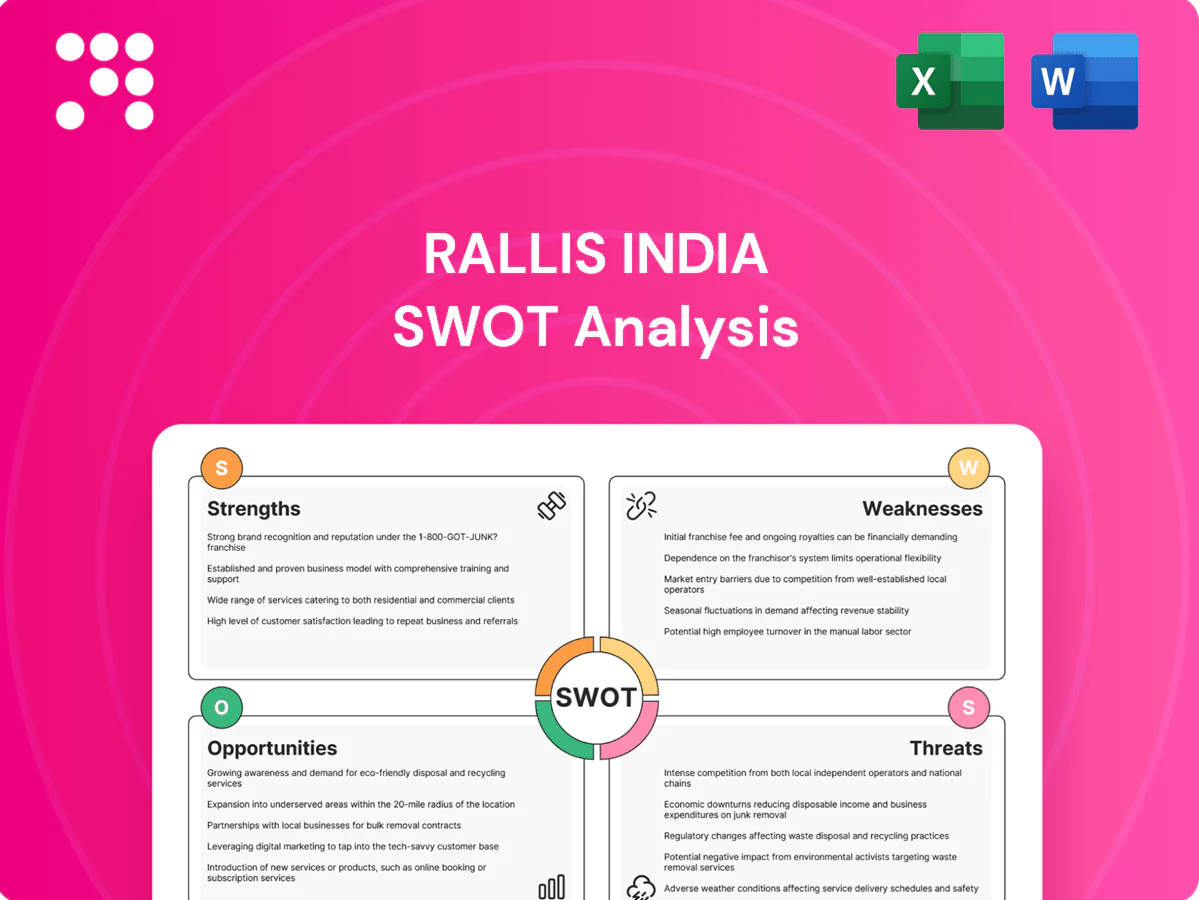
Rallis India SWOT Analysis

Your Strategic Toolkit Starts Here
Rallis India’s robust agrochemical portfolio, strong distribution network, and parent support position it well for growth, while regulatory shifts and input volatility pose clear risks; emerging precision ag and exports present compelling opportunities. Want the full story behind the company’s strengths, risks, and growth drivers? Purchase the complete SWOT analysis to gain a professionally written, editable report ideal for investors and strategists.
Strengths

Tata Group backing
Rallis benefits from the Tata Group's backing — a 157‑year‑old conglomerate with over 100 companies operating in 100+ countries, delivering strong brand trust and governance standards. This enhances credibility with farmers, channels and regulators and reduces counterparty risk. Group affiliation also improves access to capital and enables collaboration synergies for long‑term partnerships.
Diverse agrochemical portfolio
Rallis offers pesticides, herbicides, fungicides and plant growth nutrients across major crops, with a portfolio of 100+ formulations that smooths seasonal demand and pest cycles; this broad label basket stabilizes revenues, enables cross-selling into long-standing farmer relationships and helps defend shelf space with distributors and retail partners.

Seeds and inputs integration
Rallis India leverage in seeds complements its crop protection portfolio to create an end-to-end farm solutions play, enhancing bundling opportunities that increase wallet share and farmer stickiness. Integrated agronomic advisory lets the company align seed choice with protection protocols, improving field outcomes. This integration strengthens pricing power and enables data-driven selling through aggregated farm insights.

Pan-India distribution reach
Established pan-India dealer networks give Rallis last-mile access across key agri belts, sustaining product availability and farmer trust.
Network reach shortens new-product ramp times and lowers marketing and onboarding costs through entrenched channel partners.
Trusted local channels improve receivables management and enable localized agronomy support, boosting brand recall among farmers.
- Last-mile access via dealer network
- Faster product ramp-up, lower marketing spend
- Improved receivables through trusted partners
- Localized agronomy support and stronger brand recall
R&D and registrations capability
Rallis India, a Tata Chemicals subsidiary, leverages in-house formulation development and deep regulatory know-how to accelerate pipeline conversion and reduce external time-to-market. Strong registration capabilities with the Central Insecticides Board and Registration Committee create high barriers to entry in India’s tightly regulated crop protection market. Localization of formulations for Indian pests and climatic zones enhances perceived efficacy and drives repeat purchases.
- in-house R&D
- regulatory moat (CIBRC)
- localized formulations
- repeat-purchase advantage
Group-backed agri player: pan-India reach, 100+ formulations, CIBRC reg
Rallis benefits from Tata Group backing (157‑year legacy, 100+ companies), enhancing trust, governance and capital access. A 100+ formulation crop‑protection portfolio across major crops diversifies demand, enabling cross‑sell and stable revenues. Pan‑India dealer reach plus in‑house R&D and CIBRC registration shorten time‑to‑market and drive repeat purchases.
| Metric | Value |
|---|---|
| Group age | 157 years |
| Group companies | 100+ |
| Formulations | 100+ |
| Regulatory moat | CIBRC registration |
What is included in the product
 Detailed Word Document
Delivers a strategic overview of Rallis India’s internal and external business factors, outlining strengths, weaknesses, opportunities and threats to assess its competitive position, growth drivers and future risks.

 Customizable Excel Spreadsheet
Provides a concise Rallis India SWOT matrix for fast, visual strategy alignment, enabling quick identification of agribusiness strengths, market risks and regulatory threats to drive faster, actionable decisions.
Weaknesses

High farm-cycle dependence
Revenues are exposed to monsoon variability (India receives about 70% of annual rainfall in June–September) and shifting sowing patterns, creating demand volatility that strains inventory and working capital. Weather shocks can sharply compress volumes and margins in crop-protection and seeds segments. Forecasting remains challenging despite decades of historical data and seasonal models.
Raw material import exposure
Rallis relies heavily on imported technicals and intermediates, with over 60% of key agrochemical inputs sourced from China, exposing margins to FX moves and supplier constraints. Recent INR volatility and shipping bottlenecks have pressured gross margins and led to periodic cost spikes. Limited backward integration leaves the company vulnerable to geopolitical or logistics disruptions that can delay production and inflate input costs.

Product mix skew to generics
A large share of Rallis India’s portfolio is concentrated in off-patent molecules that face intense price competition, leading to commoditization that limits pricing power and compresses contribution margins. Differentiation depends more on formulation quality, channel service and execution than IP, forcing higher marketing and field-sales intensity to defend market share. This raises customer acquisition costs and margin volatility.

Working capital intensity
Extended credit to channel partners elevates receivables and seasonal stocking drives inventory peaks, as noted in Rallis India’s FY2023-24 filings; cash conversion cycles lengthen in weak seasons, increasing reliance on short-term borrowings and raising financing costs, which compresses ROCE.
- High receivables pressure
- Seasonal inventory peaks
- Longer cash conversion cycles
- Higher financing costs, lower ROCE
Regulatory and compliance drag
Multiple central and state registrations and evolving safety norms delay Rallis launches and extend time-to-market, increasing working capital needs. Compliance testing and documentation drive fixed overheads and CAPEX. Label changes and bans can erode portfolio value; India banned 18 pesticide actives in 2020. Navigating varying state-level rules adds administrative and distributional complexity.
- Reg approvals delay
- Compliance adds fixed costs
- Label changes/bans (18 actives banned, 2020)
- State-level regulatory complexity
Monsoon seasonality (~70% rainfall) and >60% China input reliance squeeze margins
Revenue and volumes remain highly tied to monsoon seasonality, with about 70% of India’s annual rainfall falling in June–September, creating demand and working-capital volatility. Over 60% of key agrochemical inputs are sourced from China, exposing margins to FX, shipping and supplier risks. Portfolio concentration in off-patent molecules and extended trade credit (noted in FY2023-24 filings) compress pricing power and lengthen cash conversion cycles.
| Metric | Fact |
|---|---|
| Monsoon dependence | ~70% rainfall in Jun–Sep |
| Input sourcing | >60% key inputs from China |
| Regulatory risk | 18 pesticide actives banned (2020) |
| Working capital | Extended trade credit noted in FY2023-24 filings |
Full Version Awaits
Rallis India SWOT Analysis
This is the actual Rallis India SWOT analysis document you’ll receive upon purchase—no surprises, just a professional, structured report covering strengths, weaknesses, opportunities and threats. The preview below is taken directly from the full report and reflects the editable file available after checkout. Buy to unlock the complete, in-depth version immediately.

Your Strategic Toolkit Starts Here
Rallis India’s robust agrochemical portfolio, strong distribution network, and parent support position it well for growth, while regulatory shifts and input volatility pose clear risks; emerging precision ag and exports present compelling opportunities. Want the full story behind the company’s strengths, risks, and growth drivers? Purchase the complete SWOT analysis to gain a professionally written, editable report ideal for investors and strategists.
Strengths
Tata Group backing
Rallis benefits from the Tata Group's backing — a 157‑year‑old conglomerate with over 100 companies operating in 100+ countries, delivering strong brand trust and governance standards. This enhances credibility with farmers, channels and regulators and reduces counterparty risk. Group affiliation also improves access to capital and enables collaboration synergies for long‑term partnerships.
Diverse agrochemical portfolio
Rallis offers pesticides, herbicides, fungicides and plant growth nutrients across major crops, with a portfolio of 100+ formulations that smooths seasonal demand and pest cycles; this broad label basket stabilizes revenues, enables cross-selling into long-standing farmer relationships and helps defend shelf space with distributors and retail partners.
Seeds and inputs integration
Rallis India leverage in seeds complements its crop protection portfolio to create an end-to-end farm solutions play, enhancing bundling opportunities that increase wallet share and farmer stickiness. Integrated agronomic advisory lets the company align seed choice with protection protocols, improving field outcomes. This integration strengthens pricing power and enables data-driven selling through aggregated farm insights.
Pan-India distribution reach
Established pan-India dealer networks give Rallis last-mile access across key agri belts, sustaining product availability and farmer trust.
Network reach shortens new-product ramp times and lowers marketing and onboarding costs through entrenched channel partners.
Trusted local channels improve receivables management and enable localized agronomy support, boosting brand recall among farmers.
- Last-mile access via dealer network
- Faster product ramp-up, lower marketing spend
- Improved receivables through trusted partners
- Localized agronomy support and stronger brand recall
R&D and registrations capability
Rallis India, a Tata Chemicals subsidiary, leverages in-house formulation development and deep regulatory know-how to accelerate pipeline conversion and reduce external time-to-market. Strong registration capabilities with the Central Insecticides Board and Registration Committee create high barriers to entry in India’s tightly regulated crop protection market. Localization of formulations for Indian pests and climatic zones enhances perceived efficacy and drives repeat purchases.
- in-house R&D
- regulatory moat (CIBRC)
- localized formulations
- repeat-purchase advantage
Group-backed agri player: pan-India reach, 100+ formulations, CIBRC reg
Rallis benefits from Tata Group backing (157‑year legacy, 100+ companies), enhancing trust, governance and capital access. A 100+ formulation crop‑protection portfolio across major crops diversifies demand, enabling cross‑sell and stable revenues. Pan‑India dealer reach plus in‑house R&D and CIBRC registration shorten time‑to‑market and drive repeat purchases.
| Metric | Value |
|---|---|
| Group age | 157 years |
| Group companies | 100+ |
| Formulations | 100+ |
| Regulatory moat | CIBRC registration |
What is included in the product
Detailed Word Document
Delivers a strategic overview of Rallis India’s internal and external business factors, outlining strengths, weaknesses, opportunities and threats to assess its competitive position, growth drivers and future risks.
Customizable Excel Spreadsheet
Provides a concise Rallis India SWOT matrix for fast, visual strategy alignment, enabling quick identification of agribusiness strengths, market risks and regulatory threats to drive faster, actionable decisions.
Weaknesses
High farm-cycle dependence
Revenues are exposed to monsoon variability (India receives about 70% of annual rainfall in June–September) and shifting sowing patterns, creating demand volatility that strains inventory and working capital. Weather shocks can sharply compress volumes and margins in crop-protection and seeds segments. Forecasting remains challenging despite decades of historical data and seasonal models.
Raw material import exposure
Rallis relies heavily on imported technicals and intermediates, with over 60% of key agrochemical inputs sourced from China, exposing margins to FX moves and supplier constraints. Recent INR volatility and shipping bottlenecks have pressured gross margins and led to periodic cost spikes. Limited backward integration leaves the company vulnerable to geopolitical or logistics disruptions that can delay production and inflate input costs.
Product mix skew to generics
A large share of Rallis India’s portfolio is concentrated in off-patent molecules that face intense price competition, leading to commoditization that limits pricing power and compresses contribution margins. Differentiation depends more on formulation quality, channel service and execution than IP, forcing higher marketing and field-sales intensity to defend market share. This raises customer acquisition costs and margin volatility.
Working capital intensity
Extended credit to channel partners elevates receivables and seasonal stocking drives inventory peaks, as noted in Rallis India’s FY2023-24 filings; cash conversion cycles lengthen in weak seasons, increasing reliance on short-term borrowings and raising financing costs, which compresses ROCE.
- High receivables pressure
- Seasonal inventory peaks
- Longer cash conversion cycles
- Higher financing costs, lower ROCE
Regulatory and compliance drag
Multiple central and state registrations and evolving safety norms delay Rallis launches and extend time-to-market, increasing working capital needs. Compliance testing and documentation drive fixed overheads and CAPEX. Label changes and bans can erode portfolio value; India banned 18 pesticide actives in 2020. Navigating varying state-level rules adds administrative and distributional complexity.
- Reg approvals delay
- Compliance adds fixed costs
- Label changes/bans (18 actives banned, 2020)
- State-level regulatory complexity
Monsoon seasonality (~70% rainfall) and >60% China input reliance squeeze margins
Revenue and volumes remain highly tied to monsoon seasonality, with about 70% of India’s annual rainfall falling in June–September, creating demand and working-capital volatility. Over 60% of key agrochemical inputs are sourced from China, exposing margins to FX, shipping and supplier risks. Portfolio concentration in off-patent molecules and extended trade credit (noted in FY2023-24 filings) compress pricing power and lengthen cash conversion cycles.
| Metric | Fact |
|---|---|
| Monsoon dependence | ~70% rainfall in Jun–Sep |
| Input sourcing | >60% key inputs from China |
| Regulatory risk | 18 pesticide actives banned (2020) |
| Working capital | Extended trade credit noted in FY2023-24 filings |
Full Version Awaits
Rallis India SWOT Analysis
This is the actual Rallis India SWOT analysis document you’ll receive upon purchase—no surprises, just a professional, structured report covering strengths, weaknesses, opportunities and threats. The preview below is taken directly from the full report and reflects the editable file available after checkout. Buy to unlock the complete, in-depth version immediately.
Original: $10.00
-65%$10.00
$3.50Description
Your Strategic Toolkit Starts Here
Rallis India’s robust agrochemical portfolio, strong distribution network, and parent support position it well for growth, while regulatory shifts and input volatility pose clear risks; emerging precision ag and exports present compelling opportunities. Want the full story behind the company’s strengths, risks, and growth drivers? Purchase the complete SWOT analysis to gain a professionally written, editable report ideal for investors and strategists.
Strengths
Tata Group backing
Rallis benefits from the Tata Group's backing — a 157‑year‑old conglomerate with over 100 companies operating in 100+ countries, delivering strong brand trust and governance standards. This enhances credibility with farmers, channels and regulators and reduces counterparty risk. Group affiliation also improves access to capital and enables collaboration synergies for long‑term partnerships.
Diverse agrochemical portfolio
Rallis offers pesticides, herbicides, fungicides and plant growth nutrients across major crops, with a portfolio of 100+ formulations that smooths seasonal demand and pest cycles; this broad label basket stabilizes revenues, enables cross-selling into long-standing farmer relationships and helps defend shelf space with distributors and retail partners.
Seeds and inputs integration
Rallis India leverage in seeds complements its crop protection portfolio to create an end-to-end farm solutions play, enhancing bundling opportunities that increase wallet share and farmer stickiness. Integrated agronomic advisory lets the company align seed choice with protection protocols, improving field outcomes. This integration strengthens pricing power and enables data-driven selling through aggregated farm insights.
Pan-India distribution reach
Established pan-India dealer networks give Rallis last-mile access across key agri belts, sustaining product availability and farmer trust.
Network reach shortens new-product ramp times and lowers marketing and onboarding costs through entrenched channel partners.
Trusted local channels improve receivables management and enable localized agronomy support, boosting brand recall among farmers.
- Last-mile access via dealer network
- Faster product ramp-up, lower marketing spend
- Improved receivables through trusted partners
- Localized agronomy support and stronger brand recall
R&D and registrations capability
Rallis India, a Tata Chemicals subsidiary, leverages in-house formulation development and deep regulatory know-how to accelerate pipeline conversion and reduce external time-to-market. Strong registration capabilities with the Central Insecticides Board and Registration Committee create high barriers to entry in India’s tightly regulated crop protection market. Localization of formulations for Indian pests and climatic zones enhances perceived efficacy and drives repeat purchases.
- in-house R&D
- regulatory moat (CIBRC)
- localized formulations
- repeat-purchase advantage
Group-backed agri player: pan-India reach, 100+ formulations, CIBRC reg
Rallis benefits from Tata Group backing (157‑year legacy, 100+ companies), enhancing trust, governance and capital access. A 100+ formulation crop‑protection portfolio across major crops diversifies demand, enabling cross‑sell and stable revenues. Pan‑India dealer reach plus in‑house R&D and CIBRC registration shorten time‑to‑market and drive repeat purchases.
| Metric | Value |
|---|---|
| Group age | 157 years |
| Group companies | 100+ |
| Formulations | 100+ |
| Regulatory moat | CIBRC registration |
What is included in the product
Detailed Word Document
Delivers a strategic overview of Rallis India’s internal and external business factors, outlining strengths, weaknesses, opportunities and threats to assess its competitive position, growth drivers and future risks.
Customizable Excel Spreadsheet
Provides a concise Rallis India SWOT matrix for fast, visual strategy alignment, enabling quick identification of agribusiness strengths, market risks and regulatory threats to drive faster, actionable decisions.
Weaknesses
High farm-cycle dependence
Revenues are exposed to monsoon variability (India receives about 70% of annual rainfall in June–September) and shifting sowing patterns, creating demand volatility that strains inventory and working capital. Weather shocks can sharply compress volumes and margins in crop-protection and seeds segments. Forecasting remains challenging despite decades of historical data and seasonal models.
Raw material import exposure
Rallis relies heavily on imported technicals and intermediates, with over 60% of key agrochemical inputs sourced from China, exposing margins to FX moves and supplier constraints. Recent INR volatility and shipping bottlenecks have pressured gross margins and led to periodic cost spikes. Limited backward integration leaves the company vulnerable to geopolitical or logistics disruptions that can delay production and inflate input costs.
Product mix skew to generics
A large share of Rallis India’s portfolio is concentrated in off-patent molecules that face intense price competition, leading to commoditization that limits pricing power and compresses contribution margins. Differentiation depends more on formulation quality, channel service and execution than IP, forcing higher marketing and field-sales intensity to defend market share. This raises customer acquisition costs and margin volatility.
Working capital intensity
Extended credit to channel partners elevates receivables and seasonal stocking drives inventory peaks, as noted in Rallis India’s FY2023-24 filings; cash conversion cycles lengthen in weak seasons, increasing reliance on short-term borrowings and raising financing costs, which compresses ROCE.
- High receivables pressure
- Seasonal inventory peaks
- Longer cash conversion cycles
- Higher financing costs, lower ROCE
Regulatory and compliance drag
Multiple central and state registrations and evolving safety norms delay Rallis launches and extend time-to-market, increasing working capital needs. Compliance testing and documentation drive fixed overheads and CAPEX. Label changes and bans can erode portfolio value; India banned 18 pesticide actives in 2020. Navigating varying state-level rules adds administrative and distributional complexity.
- Reg approvals delay
- Compliance adds fixed costs
- Label changes/bans (18 actives banned, 2020)
- State-level regulatory complexity
Monsoon seasonality (~70% rainfall) and >60% China input reliance squeeze margins
Revenue and volumes remain highly tied to monsoon seasonality, with about 70% of India’s annual rainfall falling in June–September, creating demand and working-capital volatility. Over 60% of key agrochemical inputs are sourced from China, exposing margins to FX, shipping and supplier risks. Portfolio concentration in off-patent molecules and extended trade credit (noted in FY2023-24 filings) compress pricing power and lengthen cash conversion cycles.
| Metric | Fact |
|---|---|
| Monsoon dependence | ~70% rainfall in Jun–Sep |
| Input sourcing | >60% key inputs from China |
| Regulatory risk | 18 pesticide actives banned (2020) |
| Working capital | Extended trade credit noted in FY2023-24 filings |
Full Version Awaits
Rallis India SWOT Analysis
This is the actual Rallis India SWOT analysis document you’ll receive upon purchase—no surprises, just a professional, structured report covering strengths, weaknesses, opportunities and threats. The preview below is taken directly from the full report and reflects the editable file available after checkout. Buy to unlock the complete, in-depth version immediately.











