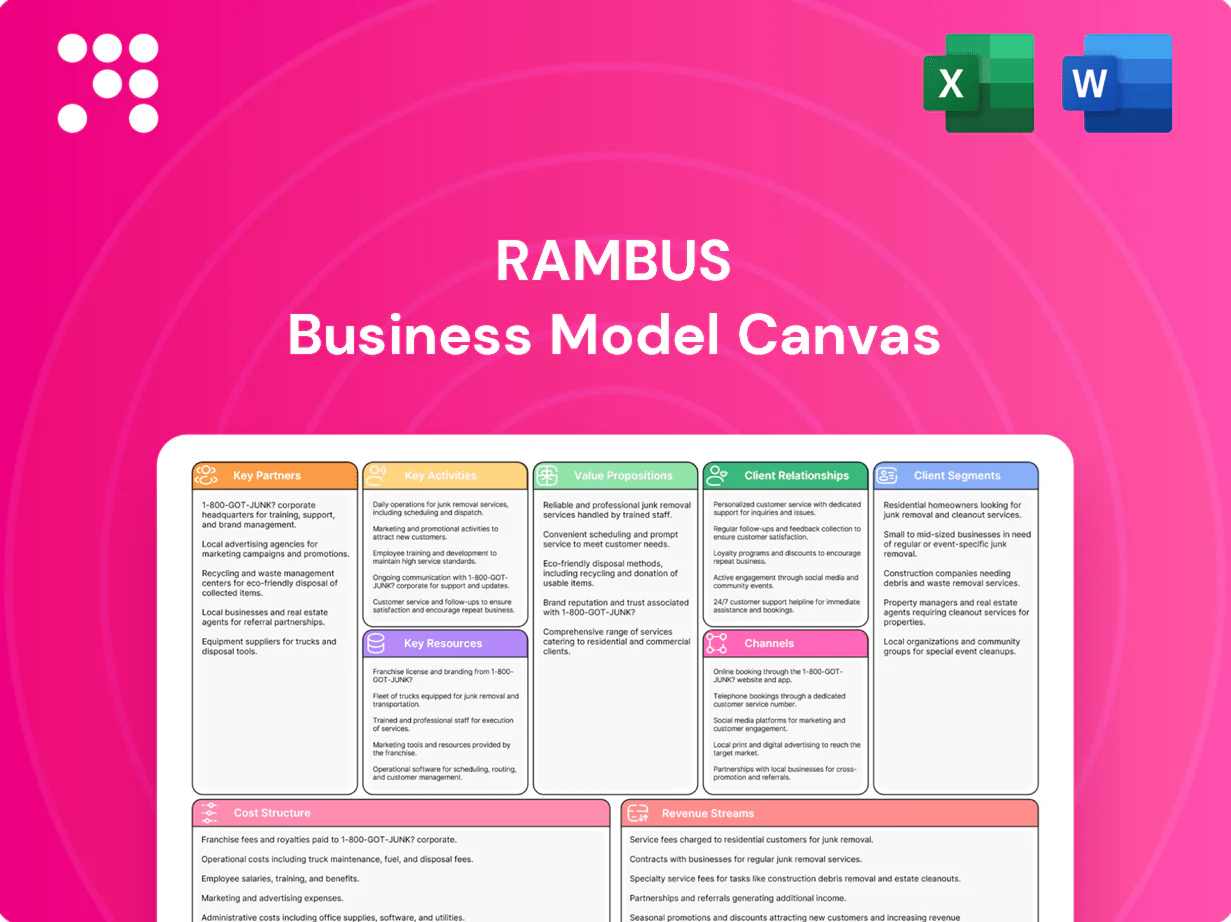
Rambus Business Model Canvas

Business Model Canvas for High-Performance IP and Security Market Strategies
Unlock the full strategic blueprint behind Rambus’s business model with our concise Business Model Canvas—three to five targeted insights show how value is created, monetized, and defended in high‑performance IP and security markets. Ideal for investors and strategists seeking actionable takeaways. Download the complete Word & Excel canvas to benchmark, adapt, and execute faster.
Partnerships

Foundry and OSAT alliances
Partnerships with leading fabs like TSMC and Samsung Foundry and OSATs such as ASE and Amkor ensure process compatibility, yield and supply continuity for Rambus memory-interface chips; in 2024 these alliances support rapid ramp and global scale for advanced nodes and 2.5D/3D packaging critical to high-speed, low-power performance, while joint PDK and DFM collaboration reduces risk and time-to-market.
EDA and design ecosystem partners
Collaborations with EDA vendors streamline IP integration, verification and timing closure, leveraging pre-validated tool flows and reference designs that cut customer effort and speed time-to-market. Model libraries and VIP improve interoperability across Cadence, Synopsys and Siemens toolchains, which together held about 70% of the EDA market in 2024. Joint support from Rambus and partners accelerates design-ins and tape-outs, aligning with Rambus 2024 revenue of about $576 million.

DRAM, controller, and CPU/GPU vendors
Close collaboration with DRAM and processor vendors ensures Rambus PHY/IP align to standards such as DDR5 (up to 6400 MT/s), LPDDR5X (up to 8533 MT/s), HBM3 (up to ~819 GB/s per stack) and evolving PCIe/CXL roadmaps. Rigorous interoperability testing elevates system-level performance and reliability. Early access programs shorten integration timelines and de-risk new standards. Joint co-marketing validates solutions for tier-1 OEMs.

Security ecosystem and certification bodies
Alliances with security IP vendors, certification labs, and standards groups harden Rambus solutions and shorten validation cycles. FIPS is required for US federal use and the Common Criteria Recognition Arrangement covered 31 countries in 2024, driving global adoption. Reference integrations with roots of trust and crypto cores accelerate deployment while joint threat research improves resilience.
- Standards: FIPS, Common Criteria (31 CCRA members in 2024)
- Integrations: roots of trust, crypto cores for faster time-to-market
- Research: joint threat analysis to harden products
OEMs, hyperscalers, and channel partners
OEMs supply co-development input and guaranteed volume demand, while hyperscalers set data center performance targets and TCO benchmarks—top five hyperscalers held roughly 70% of global cloud market in 2024, guiding Rambus priorities. Distributors and design houses expand regional reach across 100+ countries, and joint solution briefs can shorten procurement cycles by up to 30%.
- Co-development: strategic OEM accounts
- Hyperscaler metrics: top5 ≈70% cloud 2024
- Channel reach: 100+ countries
- Procurement: briefs cut cycles ~30%
TSMC/Samsung, EDA & hyperscaler alliances speed 2.5D/3D scale and design-ins
Partnerships with TSMC, Samsung Foundry and OSATs ensure advanced-node supply and 2.5D/3D scale; joint PDK/DFM cuts time-to-market. EDA alliances (Cadence/Synopsys/Siemens ≈70% share in 2024) and OEM/hyperscaler co-development (top5 hyperscalers ≈70% cloud share 2024) accelerate design-ins and demand. Security and standards (FIPS, Common Criteria 31 members 2024) speed validation and global adoption; Rambus 2024 revenue ≈$576M.
| Partner | 2024 Metric |
|---|---|
| Fabs/OSATs | TSMC/Samsung; 2.5D/3D ramp |
| EDA | ~70% market share |
| Hyperscalers | Top5 ≈70% cloud |
| Revenue | $576M |
What is included in the product
 Detailed Word Document
A comprehensive Business Model Canvas for Rambus detailing its nine core blocks—customer segments, value propositions, channels, customer relationships, revenue streams, key resources, activities, partnerships, and cost structure—focused on semiconductor IP, security cores, and licensing strategies; includes competitive advantages, SWOT-linked insights, and investor-ready narratives for strategic decision-making.

 Customizable Excel Spreadsheet
Condenses Rambus’s strategy into a clean, editable one-page snapshot that saves hours of formatting and helps teams quickly identify core components, compare models, and produce board-ready deliverables.
Activities

High-speed memory and interface R&D
Core R&D advances signal integrity, equalization and training algorithms to support industry PHYs like DDR5 at 6,400 MT/s and SerDes up to 112 Gbps per lane; PHY, controller and SerDes designs target higher bandwidth with lower latency and power. Silicon bring-up validates models and margins in lab and production; continuous innovation aligns with next‑gen standards such as PCIe 6.0 and DDR6.
IP development and licensing operations
IP development and licensing operations center on creating synthesizable cores, hard macros and full deliverables that underpin Rambus licensing, supporting billions of deployed devices annually as of 2024. Robust legal, compliance and contract management protect IP value and enforce royalties. Royalty tracking ensures accurate reporting and cash flow from licensed silicon. Customer enablement packages and reference integrations cut integration friction and time to first silicon.

Chip productization and supply management
Memory interface IC design moves from prototype to volume production with test, characterization, and reliability screening driving yields; Rambus reported FY2024 revenue of $292 million, underscoring scale. Forecasting and logistics align die supply to demand using rolling 12-month demand plans, while cost optimization (process node and packaging) targets improved gross margins.

Standards participation and interoperability
Rambus drives standards via active roles in JEDEC, PCI-SIG and the CXL Consortium, shaping specifications and roadmaps. Early compliance testing in Rambus labs builds credibility with OEMs and hyperscalers. Multi-vendor interoperability labs validate cross-platform compatibility; CXL membership surpassed 300 companies by 2023. Public contributions and published test results reinforce thought leadership.
- JEDEC/PCI-SIG/CXL participation
- Early compliance testing
- Multi-vendor interoperability labs
- Public contributions & test publications
Customer design-in and technical support
Field engineering provides floorplanning, timing, and SI/PI guidance to ensure Rambus IP fits customer layouts and meets signal and power budgets; reference boards and firmware accelerate evaluation and shorten time-to-first-silicon. Training and documentation support volume ramp, while sustaining engineering closes post-silicon bugs and issues rapidly to protect revenue streams.
- Field engineering: floorplanning, timing, SI/PI
- Reference boards & firmware: faster evaluation
- Training & docs: ramp enablement
- Sustaining eng: rapid post-silicon fixes
PHY/SerDes R&D (DDR5 6,400 MT/s, 112 Gbps); IP licensing drove $292M FY24
Rambus advances PHY/SerDes R&D (DDR5 6,400 MT/s, SerDes 112 Gbps) and silicon bring-up; IP licensing supports billions of devices and drove FY2024 revenue of $292M. Licensing/legal ops secure royalties and enable OEM integrations; field engineering, reference boards and sustaining support shorten time‑to‑silicon and ramps. Standards work (JEDEC/PCI‑SIG/CXL) with CXL >300 members by 2023 underpins interoperability.
| Activity | 2024 Metric |
|---|---|
| Revenue | $292M |
| Licensed devices | Billions deployed |
| R&D targets | DDR5 6,400 MT/s; SerDes 112 Gbps |
| CXL membership | >300 (2023) |
Full Version Awaits
Business Model Canvas
The document you're previewing is the actual Rambus Business Model Canvas, not a mockup or sample. When you purchase, you'll receive this exact file with all sections and formatting intact. The deliverable comes ready to edit and present in Word and Excel formats. No surprises—what you see is what you’ll get.

Business Model Canvas for High-Performance IP and Security Market Strategies
Unlock the full strategic blueprint behind Rambus’s business model with our concise Business Model Canvas—three to five targeted insights show how value is created, monetized, and defended in high‑performance IP and security markets. Ideal for investors and strategists seeking actionable takeaways. Download the complete Word & Excel canvas to benchmark, adapt, and execute faster.
Partnerships
Foundry and OSAT alliances
Partnerships with leading fabs like TSMC and Samsung Foundry and OSATs such as ASE and Amkor ensure process compatibility, yield and supply continuity for Rambus memory-interface chips; in 2024 these alliances support rapid ramp and global scale for advanced nodes and 2.5D/3D packaging critical to high-speed, low-power performance, while joint PDK and DFM collaboration reduces risk and time-to-market.
EDA and design ecosystem partners
Collaborations with EDA vendors streamline IP integration, verification and timing closure, leveraging pre-validated tool flows and reference designs that cut customer effort and speed time-to-market. Model libraries and VIP improve interoperability across Cadence, Synopsys and Siemens toolchains, which together held about 70% of the EDA market in 2024. Joint support from Rambus and partners accelerates design-ins and tape-outs, aligning with Rambus 2024 revenue of about $576 million.
DRAM, controller, and CPU/GPU vendors
Close collaboration with DRAM and processor vendors ensures Rambus PHY/IP align to standards such as DDR5 (up to 6400 MT/s), LPDDR5X (up to 8533 MT/s), HBM3 (up to ~819 GB/s per stack) and evolving PCIe/CXL roadmaps. Rigorous interoperability testing elevates system-level performance and reliability. Early access programs shorten integration timelines and de-risk new standards. Joint co-marketing validates solutions for tier-1 OEMs.
Security ecosystem and certification bodies
Alliances with security IP vendors, certification labs, and standards groups harden Rambus solutions and shorten validation cycles. FIPS is required for US federal use and the Common Criteria Recognition Arrangement covered 31 countries in 2024, driving global adoption. Reference integrations with roots of trust and crypto cores accelerate deployment while joint threat research improves resilience.
- Standards: FIPS, Common Criteria (31 CCRA members in 2024)
- Integrations: roots of trust, crypto cores for faster time-to-market
- Research: joint threat analysis to harden products
OEMs, hyperscalers, and channel partners
OEMs supply co-development input and guaranteed volume demand, while hyperscalers set data center performance targets and TCO benchmarks—top five hyperscalers held roughly 70% of global cloud market in 2024, guiding Rambus priorities. Distributors and design houses expand regional reach across 100+ countries, and joint solution briefs can shorten procurement cycles by up to 30%.
- Co-development: strategic OEM accounts
- Hyperscaler metrics: top5 ≈70% cloud 2024
- Channel reach: 100+ countries
- Procurement: briefs cut cycles ~30%
TSMC/Samsung, EDA & hyperscaler alliances speed 2.5D/3D scale and design-ins
Partnerships with TSMC, Samsung Foundry and OSATs ensure advanced-node supply and 2.5D/3D scale; joint PDK/DFM cuts time-to-market. EDA alliances (Cadence/Synopsys/Siemens ≈70% share in 2024) and OEM/hyperscaler co-development (top5 hyperscalers ≈70% cloud share 2024) accelerate design-ins and demand. Security and standards (FIPS, Common Criteria 31 members 2024) speed validation and global adoption; Rambus 2024 revenue ≈$576M.
| Partner | 2024 Metric |
|---|---|
| Fabs/OSATs | TSMC/Samsung; 2.5D/3D ramp |
| EDA | ~70% market share |
| Hyperscalers | Top5 ≈70% cloud |
| Revenue | $576M |
What is included in the product
Detailed Word Document
A comprehensive Business Model Canvas for Rambus detailing its nine core blocks—customer segments, value propositions, channels, customer relationships, revenue streams, key resources, activities, partnerships, and cost structure—focused on semiconductor IP, security cores, and licensing strategies; includes competitive advantages, SWOT-linked insights, and investor-ready narratives for strategic decision-making.
Customizable Excel Spreadsheet
Condenses Rambus’s strategy into a clean, editable one-page snapshot that saves hours of formatting and helps teams quickly identify core components, compare models, and produce board-ready deliverables.
Activities
High-speed memory and interface R&D
Core R&D advances signal integrity, equalization and training algorithms to support industry PHYs like DDR5 at 6,400 MT/s and SerDes up to 112 Gbps per lane; PHY, controller and SerDes designs target higher bandwidth with lower latency and power. Silicon bring-up validates models and margins in lab and production; continuous innovation aligns with next‑gen standards such as PCIe 6.0 and DDR6.
IP development and licensing operations
IP development and licensing operations center on creating synthesizable cores, hard macros and full deliverables that underpin Rambus licensing, supporting billions of deployed devices annually as of 2024. Robust legal, compliance and contract management protect IP value and enforce royalties. Royalty tracking ensures accurate reporting and cash flow from licensed silicon. Customer enablement packages and reference integrations cut integration friction and time to first silicon.
Chip productization and supply management
Memory interface IC design moves from prototype to volume production with test, characterization, and reliability screening driving yields; Rambus reported FY2024 revenue of $292 million, underscoring scale. Forecasting and logistics align die supply to demand using rolling 12-month demand plans, while cost optimization (process node and packaging) targets improved gross margins.
Standards participation and interoperability
Rambus drives standards via active roles in JEDEC, PCI-SIG and the CXL Consortium, shaping specifications and roadmaps. Early compliance testing in Rambus labs builds credibility with OEMs and hyperscalers. Multi-vendor interoperability labs validate cross-platform compatibility; CXL membership surpassed 300 companies by 2023. Public contributions and published test results reinforce thought leadership.
- JEDEC/PCI-SIG/CXL participation
- Early compliance testing
- Multi-vendor interoperability labs
- Public contributions & test publications
Customer design-in and technical support
Field engineering provides floorplanning, timing, and SI/PI guidance to ensure Rambus IP fits customer layouts and meets signal and power budgets; reference boards and firmware accelerate evaluation and shorten time-to-first-silicon. Training and documentation support volume ramp, while sustaining engineering closes post-silicon bugs and issues rapidly to protect revenue streams.
- Field engineering: floorplanning, timing, SI/PI
- Reference boards & firmware: faster evaluation
- Training & docs: ramp enablement
- Sustaining eng: rapid post-silicon fixes
PHY/SerDes R&D (DDR5 6,400 MT/s, 112 Gbps); IP licensing drove $292M FY24
Rambus advances PHY/SerDes R&D (DDR5 6,400 MT/s, SerDes 112 Gbps) and silicon bring-up; IP licensing supports billions of devices and drove FY2024 revenue of $292M. Licensing/legal ops secure royalties and enable OEM integrations; field engineering, reference boards and sustaining support shorten time‑to‑silicon and ramps. Standards work (JEDEC/PCI‑SIG/CXL) with CXL >300 members by 2023 underpins interoperability.
| Activity | 2024 Metric |
|---|---|
| Revenue | $292M |
| Licensed devices | Billions deployed |
| R&D targets | DDR5 6,400 MT/s; SerDes 112 Gbps |
| CXL membership | >300 (2023) |
Full Version Awaits
Business Model Canvas
The document you're previewing is the actual Rambus Business Model Canvas, not a mockup or sample. When you purchase, you'll receive this exact file with all sections and formatting intact. The deliverable comes ready to edit and present in Word and Excel formats. No surprises—what you see is what you’ll get.
Description
Business Model Canvas for High-Performance IP and Security Market Strategies
Unlock the full strategic blueprint behind Rambus’s business model with our concise Business Model Canvas—three to five targeted insights show how value is created, monetized, and defended in high‑performance IP and security markets. Ideal for investors and strategists seeking actionable takeaways. Download the complete Word & Excel canvas to benchmark, adapt, and execute faster.
Partnerships
Foundry and OSAT alliances
Partnerships with leading fabs like TSMC and Samsung Foundry and OSATs such as ASE and Amkor ensure process compatibility, yield and supply continuity for Rambus memory-interface chips; in 2024 these alliances support rapid ramp and global scale for advanced nodes and 2.5D/3D packaging critical to high-speed, low-power performance, while joint PDK and DFM collaboration reduces risk and time-to-market.
EDA and design ecosystem partners
Collaborations with EDA vendors streamline IP integration, verification and timing closure, leveraging pre-validated tool flows and reference designs that cut customer effort and speed time-to-market. Model libraries and VIP improve interoperability across Cadence, Synopsys and Siemens toolchains, which together held about 70% of the EDA market in 2024. Joint support from Rambus and partners accelerates design-ins and tape-outs, aligning with Rambus 2024 revenue of about $576 million.
DRAM, controller, and CPU/GPU vendors
Close collaboration with DRAM and processor vendors ensures Rambus PHY/IP align to standards such as DDR5 (up to 6400 MT/s), LPDDR5X (up to 8533 MT/s), HBM3 (up to ~819 GB/s per stack) and evolving PCIe/CXL roadmaps. Rigorous interoperability testing elevates system-level performance and reliability. Early access programs shorten integration timelines and de-risk new standards. Joint co-marketing validates solutions for tier-1 OEMs.
Security ecosystem and certification bodies
Alliances with security IP vendors, certification labs, and standards groups harden Rambus solutions and shorten validation cycles. FIPS is required for US federal use and the Common Criteria Recognition Arrangement covered 31 countries in 2024, driving global adoption. Reference integrations with roots of trust and crypto cores accelerate deployment while joint threat research improves resilience.
- Standards: FIPS, Common Criteria (31 CCRA members in 2024)
- Integrations: roots of trust, crypto cores for faster time-to-market
- Research: joint threat analysis to harden products
OEMs, hyperscalers, and channel partners
OEMs supply co-development input and guaranteed volume demand, while hyperscalers set data center performance targets and TCO benchmarks—top five hyperscalers held roughly 70% of global cloud market in 2024, guiding Rambus priorities. Distributors and design houses expand regional reach across 100+ countries, and joint solution briefs can shorten procurement cycles by up to 30%.
- Co-development: strategic OEM accounts
- Hyperscaler metrics: top5 ≈70% cloud 2024
- Channel reach: 100+ countries
- Procurement: briefs cut cycles ~30%
TSMC/Samsung, EDA & hyperscaler alliances speed 2.5D/3D scale and design-ins
Partnerships with TSMC, Samsung Foundry and OSATs ensure advanced-node supply and 2.5D/3D scale; joint PDK/DFM cuts time-to-market. EDA alliances (Cadence/Synopsys/Siemens ≈70% share in 2024) and OEM/hyperscaler co-development (top5 hyperscalers ≈70% cloud share 2024) accelerate design-ins and demand. Security and standards (FIPS, Common Criteria 31 members 2024) speed validation and global adoption; Rambus 2024 revenue ≈$576M.
| Partner | 2024 Metric |
|---|---|
| Fabs/OSATs | TSMC/Samsung; 2.5D/3D ramp |
| EDA | ~70% market share |
| Hyperscalers | Top5 ≈70% cloud |
| Revenue | $576M |
What is included in the product
Detailed Word Document
A comprehensive Business Model Canvas for Rambus detailing its nine core blocks—customer segments, value propositions, channels, customer relationships, revenue streams, key resources, activities, partnerships, and cost structure—focused on semiconductor IP, security cores, and licensing strategies; includes competitive advantages, SWOT-linked insights, and investor-ready narratives for strategic decision-making.
Customizable Excel Spreadsheet
Condenses Rambus’s strategy into a clean, editable one-page snapshot that saves hours of formatting and helps teams quickly identify core components, compare models, and produce board-ready deliverables.
Activities
High-speed memory and interface R&D
Core R&D advances signal integrity, equalization and training algorithms to support industry PHYs like DDR5 at 6,400 MT/s and SerDes up to 112 Gbps per lane; PHY, controller and SerDes designs target higher bandwidth with lower latency and power. Silicon bring-up validates models and margins in lab and production; continuous innovation aligns with next‑gen standards such as PCIe 6.0 and DDR6.
IP development and licensing operations
IP development and licensing operations center on creating synthesizable cores, hard macros and full deliverables that underpin Rambus licensing, supporting billions of deployed devices annually as of 2024. Robust legal, compliance and contract management protect IP value and enforce royalties. Royalty tracking ensures accurate reporting and cash flow from licensed silicon. Customer enablement packages and reference integrations cut integration friction and time to first silicon.
Chip productization and supply management
Memory interface IC design moves from prototype to volume production with test, characterization, and reliability screening driving yields; Rambus reported FY2024 revenue of $292 million, underscoring scale. Forecasting and logistics align die supply to demand using rolling 12-month demand plans, while cost optimization (process node and packaging) targets improved gross margins.
Standards participation and interoperability
Rambus drives standards via active roles in JEDEC, PCI-SIG and the CXL Consortium, shaping specifications and roadmaps. Early compliance testing in Rambus labs builds credibility with OEMs and hyperscalers. Multi-vendor interoperability labs validate cross-platform compatibility; CXL membership surpassed 300 companies by 2023. Public contributions and published test results reinforce thought leadership.
- JEDEC/PCI-SIG/CXL participation
- Early compliance testing
- Multi-vendor interoperability labs
- Public contributions & test publications
Customer design-in and technical support
Field engineering provides floorplanning, timing, and SI/PI guidance to ensure Rambus IP fits customer layouts and meets signal and power budgets; reference boards and firmware accelerate evaluation and shorten time-to-first-silicon. Training and documentation support volume ramp, while sustaining engineering closes post-silicon bugs and issues rapidly to protect revenue streams.
- Field engineering: floorplanning, timing, SI/PI
- Reference boards & firmware: faster evaluation
- Training & docs: ramp enablement
- Sustaining eng: rapid post-silicon fixes
PHY/SerDes R&D (DDR5 6,400 MT/s, 112 Gbps); IP licensing drove $292M FY24
Rambus advances PHY/SerDes R&D (DDR5 6,400 MT/s, SerDes 112 Gbps) and silicon bring-up; IP licensing supports billions of devices and drove FY2024 revenue of $292M. Licensing/legal ops secure royalties and enable OEM integrations; field engineering, reference boards and sustaining support shorten time‑to‑silicon and ramps. Standards work (JEDEC/PCI‑SIG/CXL) with CXL >300 members by 2023 underpins interoperability.
| Activity | 2024 Metric |
|---|---|
| Revenue | $292M |
| Licensed devices | Billions deployed |
| R&D targets | DDR5 6,400 MT/s; SerDes 112 Gbps |
| CXL membership | >300 (2023) |
Full Version Awaits
Business Model Canvas
The document you're previewing is the actual Rambus Business Model Canvas, not a mockup or sample. When you purchase, you'll receive this exact file with all sections and formatting intact. The deliverable comes ready to edit and present in Word and Excel formats. No surprises—what you see is what you’ll get.











