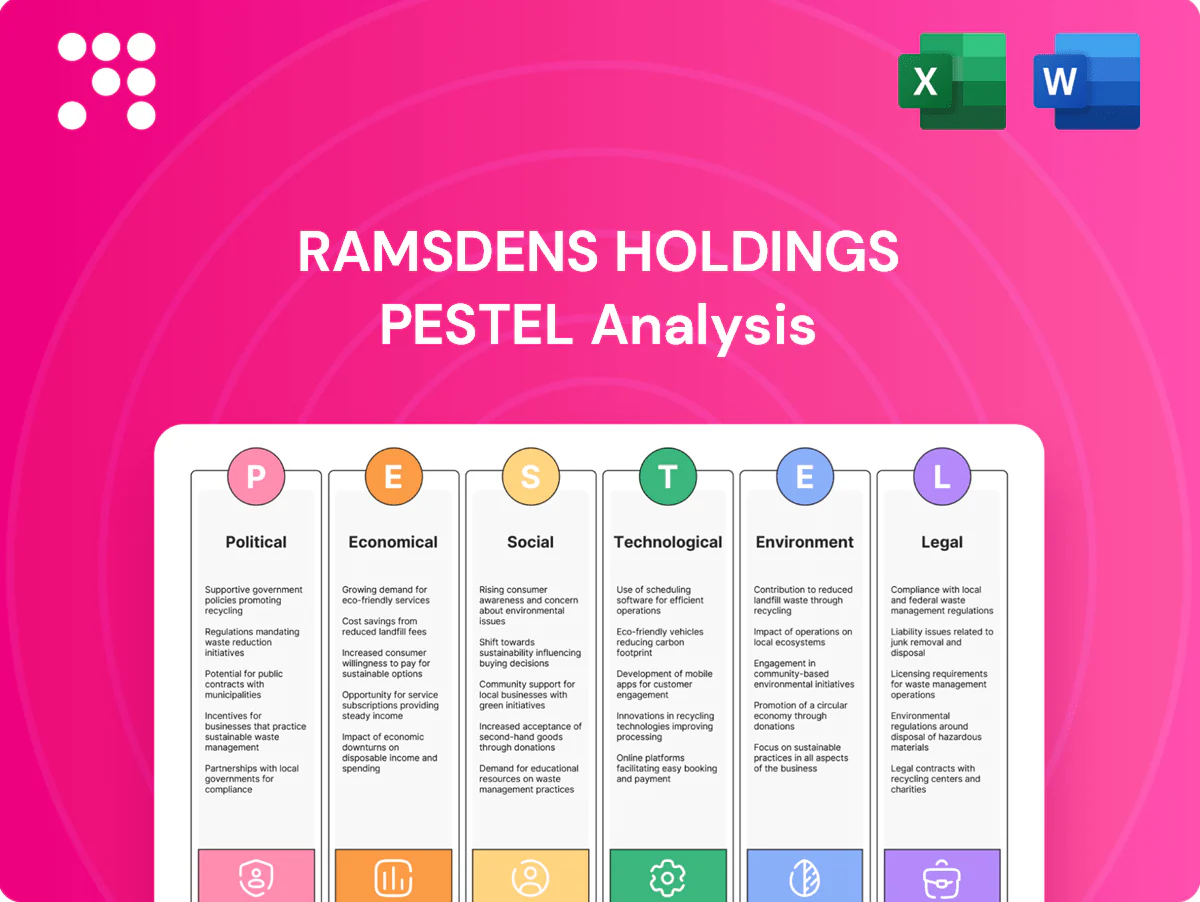
Ramsdens Holdings PESTLE Analysis

Plan Smarter. Present Sharper. Compete Stronger.
Gain a strategic advantage with our PESTLE analysis of Ramsdens Holdings. We reveal how political regulation, economic cycles, social trends and technological shifts shape the company’s performance. Buy the full report for detailed risks, opportunities and ready-to-use insights to guide investment or strategic decisions.
Political factors

UK policy stability
UK policy stability directly shapes consumer confidence and footfall for Ramsdens: GfK consumer confidence averaged about -25 in 2024 and Springboard reported high-street footfall c.6% below pre-pandemic levels. Shifts in fiscal policy, business rates relief and the April 2024 National Living Wage rise to £11.44 materially affect store economics and margins. Government support or tighter regulation alters expansion pacing, while post-local-election changes can change licensing and trading-hour rules regionally.
Sanctions and geopolitics
Sanctions on Russia and other jurisdictions have curtailed direct bullion imports and shifted flows to hubs like Turkey and the UAE, raising compliance costs and narrowing supply choices for retailers; global gold ETF holdings rose roughly 250 tonnes in 2024 while average gold price was about 2,100 USD/oz. Geopolitical tensions boosted safe-haven demand, lifting buy/sell volumes, and correspondent banking links and FX availability with high‑risk jurisdictions remain constrained, increasing settlement friction and working capital needs.

Brexit trade frictions
Customs procedures and changed VAT rules since the UK left the EU on 31 January 2020 (Trade and Cooperation Agreement, 24 Dec 2020) have added administrative overhead for jewellery and watches imported from the EU, increasing paperwork and compliance costs that pressure Ramsdens’ margins and pricing. UK-EU regulatory divergence complicates hallmarking recognition and product conformity, while sterling volatility around trade talks adds FX risk to purchasing and cash flow.

Consumer affordability agenda
Government focus on the cost-of-living (inflation peaked at 11.1% in the UK in 2022) and the FCA Consumer Duty (effective July 2023) drives interventions in credit markets, risking tighter rules for pawnbroking and short-term lending to protect vulnerable consumers.
- Regulatory pressure: tighter affordability checks
- Pricing scrutiny: fee transparency demanded
- Competition: Post Office/PayPoint alternatives expand
Local policing and crime policy
Local retail crime and second-hand trading rules force Ramsdens to raise store security and compliance; Money Laundering Regulations and NCA suspicious activity reporting (over 2 million SARs annually in 2023–24) increase transaction-recording workloads. Stronger enforcement deters fencing of stolen jewellery, while under-resourced policing exacerbates shrinkage and lifts insurance and security spend.
- Policy impact: higher security/compliance costs
- Data duties: NCA SARs regime, detailed record-keeping
- Enforcement: reduces fencing, improves market integrity
- Resourcing gaps: higher shrinkage and insurance premiums
UK retail pressure: NLW £11.44, GfK -25, footfall -6%, gold ~$2,100
UK policy stability, NLW £11.44 and GfK consumer confidence ~-25 in 2024 depress footfall (~-6% vs pre-COVID) and margins. Sanctions/geo-tension lifted gold to ~2,100 USD/oz and added compliance (gold ETF +250t in 2024). Post-Brexit customs/VAT and FCA Consumer Duty raise admin and credit constraints. SARs >2m (2023–24) and rising retail crime boost security costs.
| Metric | 2024/25 value |
|---|---|
| GfK confidence | -25 |
| High-street footfall | -6% vs pre-COVID |
| National Living Wage | £11.44 (Apr 2024) |
| Gold price | ~2,100 USD/oz |
| SARs | >2m (2023–24) |
What is included in the product
 Detailed Word Document
Explores how Political, Economic, Social, Technological, Environmental and Legal forces uniquely impact Ramsdens Holdings, with data-backed trends and specific examples for the UK pawnbroking, jewellery and retail financial services markets. Designed for executives and investors, it highlights risks, opportunities and forward-looking insights to support strategy, funding and scenario planning.

 Customizable Excel Spreadsheet
A concise, PESTLE-segmented summary of Ramsdens Holdings that highlights external risks, regulatory drivers and market opportunities for quick inclusion in presentations—editable for region or business line and ideal for aligning teams, streamlining strategic planning and consultant reports.
Economic factors

Interest rates and inflation
Higher Bank of England Bank Rate at 5.25% tightens consumer spending yet boosts demand for pawnbroking as a liquidity source; Ramsdens saw pawnbroking remain a core buffer in recent years. Elevated inflation and a gold price near £1,700/oz in 2024–25 increased scrap volumes as customers monetized assets, while rising costs squeezed margins. Rate cycles also shift FX demand through travel affordability, forcing disciplined pricing to protect margins.
Gold price volatility
Gold spot swings (roughly $1,900–$2,400/oz across 2023–mid‑2025) drive customer selling and inventory revaluation, with ~10% year-on-year moves forcing frequent markdowns; higher prices lift scrap buying revenue while compressing retail jewellery margins as input costs outpace finished-goods pricing. Hedging and dynamic pricing are essential to manage margin and inventory exposure, and volatility also shifts collateral values on pawn loans, raising LTV and default risk.

Tourism and travel FX
Outbound travel volume directly drives Ramsdens' FX turnover; international tourist arrivals recovered to roughly 85% of 2019 levels by 2023 (UNWTO), supporting higher note and card FX sales. Economic slowdowns or rising fuel costs compress holiday spending and reduce note demand, while 2024 aviation recovery boosts FX spreads and ancillary services. Shifts in popular destinations change currency mix, complicating stock management and working capital.

Household income pressure
Weak real wage growth — pay growth lagged inflation after the 11.1% UK CPI peak in Oct 2022, leaving real wages below pre‑pandemic levels through 2023–24 (ONS) — boosts demand for short‑term credit and pawnbroking, softens discretionary spend on watches and jewellery, supports pre‑owned sales, and raises credit risk, requiring tighter underwriting and collections.
- Higher pawnbroking demand
- Lower new luxury spend
- Stronger pre‑owned market
- Elevated credit/default risk
Labour and store costs
Tight UK labour markets (unemployment around 4.1% in 2024) have pushed average pay growth into mid-single digits, raising Ramsdens’ wage and recruitment costs across its c.170-store estate.
Higher energy and occupancy costs—energy prices still materially above pre-2020 levels—lift store breakevens, squeezing margins on low-ticket pawnbroking and retail transactions.
A multi-site footprint requires granular productivity tools and flexible rostering to control labour spend and performance; economic clustering data can optimise network density and reduce per-store overheads.
- labour: unemployment 4.1% (2024)
- stores: c.170 locations
- costs: energy above pre-2020 baseline
- strategy: productivity tools + cluster optimisation
UK retail pressure: NLW £11.44, GfK -25, footfall -6%, gold ~$2,100
Higher BoE rate 5.25% and weak real wages drive pawnbroking demand while squeezing retail jewellery margins; gold ~£1,700/oz (2024–25) and $1,900–$2,400/oz volatility increases scrap flows and inventory revaluations. FX recovery (tourists ~85% of 2019 by 2023) lifts FX sales but shifts currency mix; tight labour (4.1% unemployment in 2024) raises wage costs across c.170 stores.
| Metric | Value | Impact |
|---|---|---|
| BoE rate | 5.25% (2024) | ↑ pawnbroking |
| Gold | ~£1,700/oz (2024–25) | ↑ scrap, ↑ volatility |
| Unemployment | 4.1% (2024) | ↑ wages |
| Stores | c.170 | ↑ overheads |
What You See Is What You Get
Ramsdens Holdings PESTLE Analysis
The Ramsdens Holdings PESTLE Analysis provides a concise assessment of political, economic, social, technological, legal and environmental factors affecting the company. The preview shown here is the exact document you’ll receive after purchase—fully formatted and ready to use. No placeholders or teasers; this is the final, downloadable file.

Plan Smarter. Present Sharper. Compete Stronger.
Gain a strategic advantage with our PESTLE analysis of Ramsdens Holdings. We reveal how political regulation, economic cycles, social trends and technological shifts shape the company’s performance. Buy the full report for detailed risks, opportunities and ready-to-use insights to guide investment or strategic decisions.
Political factors
UK policy stability
UK policy stability directly shapes consumer confidence and footfall for Ramsdens: GfK consumer confidence averaged about -25 in 2024 and Springboard reported high-street footfall c.6% below pre-pandemic levels. Shifts in fiscal policy, business rates relief and the April 2024 National Living Wage rise to £11.44 materially affect store economics and margins. Government support or tighter regulation alters expansion pacing, while post-local-election changes can change licensing and trading-hour rules regionally.
Sanctions and geopolitics
Sanctions on Russia and other jurisdictions have curtailed direct bullion imports and shifted flows to hubs like Turkey and the UAE, raising compliance costs and narrowing supply choices for retailers; global gold ETF holdings rose roughly 250 tonnes in 2024 while average gold price was about 2,100 USD/oz. Geopolitical tensions boosted safe-haven demand, lifting buy/sell volumes, and correspondent banking links and FX availability with high‑risk jurisdictions remain constrained, increasing settlement friction and working capital needs.
Brexit trade frictions
Customs procedures and changed VAT rules since the UK left the EU on 31 January 2020 (Trade and Cooperation Agreement, 24 Dec 2020) have added administrative overhead for jewellery and watches imported from the EU, increasing paperwork and compliance costs that pressure Ramsdens’ margins and pricing. UK-EU regulatory divergence complicates hallmarking recognition and product conformity, while sterling volatility around trade talks adds FX risk to purchasing and cash flow.
Consumer affordability agenda
Government focus on the cost-of-living (inflation peaked at 11.1% in the UK in 2022) and the FCA Consumer Duty (effective July 2023) drives interventions in credit markets, risking tighter rules for pawnbroking and short-term lending to protect vulnerable consumers.
- Regulatory pressure: tighter affordability checks
- Pricing scrutiny: fee transparency demanded
- Competition: Post Office/PayPoint alternatives expand
Local policing and crime policy
Local retail crime and second-hand trading rules force Ramsdens to raise store security and compliance; Money Laundering Regulations and NCA suspicious activity reporting (over 2 million SARs annually in 2023–24) increase transaction-recording workloads. Stronger enforcement deters fencing of stolen jewellery, while under-resourced policing exacerbates shrinkage and lifts insurance and security spend.
- Policy impact: higher security/compliance costs
- Data duties: NCA SARs regime, detailed record-keeping
- Enforcement: reduces fencing, improves market integrity
- Resourcing gaps: higher shrinkage and insurance premiums
UK retail pressure: NLW £11.44, GfK -25, footfall -6%, gold ~$2,100
UK policy stability, NLW £11.44 and GfK consumer confidence ~-25 in 2024 depress footfall (~-6% vs pre-COVID) and margins. Sanctions/geo-tension lifted gold to ~2,100 USD/oz and added compliance (gold ETF +250t in 2024). Post-Brexit customs/VAT and FCA Consumer Duty raise admin and credit constraints. SARs >2m (2023–24) and rising retail crime boost security costs.
| Metric | 2024/25 value |
|---|---|
| GfK confidence | -25 |
| High-street footfall | -6% vs pre-COVID |
| National Living Wage | £11.44 (Apr 2024) |
| Gold price | ~2,100 USD/oz |
| SARs | >2m (2023–24) |
What is included in the product
Detailed Word Document
Explores how Political, Economic, Social, Technological, Environmental and Legal forces uniquely impact Ramsdens Holdings, with data-backed trends and specific examples for the UK pawnbroking, jewellery and retail financial services markets. Designed for executives and investors, it highlights risks, opportunities and forward-looking insights to support strategy, funding and scenario planning.
Customizable Excel Spreadsheet
A concise, PESTLE-segmented summary of Ramsdens Holdings that highlights external risks, regulatory drivers and market opportunities for quick inclusion in presentations—editable for region or business line and ideal for aligning teams, streamlining strategic planning and consultant reports.
Economic factors
Interest rates and inflation
Higher Bank of England Bank Rate at 5.25% tightens consumer spending yet boosts demand for pawnbroking as a liquidity source; Ramsdens saw pawnbroking remain a core buffer in recent years. Elevated inflation and a gold price near £1,700/oz in 2024–25 increased scrap volumes as customers monetized assets, while rising costs squeezed margins. Rate cycles also shift FX demand through travel affordability, forcing disciplined pricing to protect margins.
Gold price volatility
Gold spot swings (roughly $1,900–$2,400/oz across 2023–mid‑2025) drive customer selling and inventory revaluation, with ~10% year-on-year moves forcing frequent markdowns; higher prices lift scrap buying revenue while compressing retail jewellery margins as input costs outpace finished-goods pricing. Hedging and dynamic pricing are essential to manage margin and inventory exposure, and volatility also shifts collateral values on pawn loans, raising LTV and default risk.
Tourism and travel FX
Outbound travel volume directly drives Ramsdens' FX turnover; international tourist arrivals recovered to roughly 85% of 2019 levels by 2023 (UNWTO), supporting higher note and card FX sales. Economic slowdowns or rising fuel costs compress holiday spending and reduce note demand, while 2024 aviation recovery boosts FX spreads and ancillary services. Shifts in popular destinations change currency mix, complicating stock management and working capital.
Household income pressure
Weak real wage growth — pay growth lagged inflation after the 11.1% UK CPI peak in Oct 2022, leaving real wages below pre‑pandemic levels through 2023–24 (ONS) — boosts demand for short‑term credit and pawnbroking, softens discretionary spend on watches and jewellery, supports pre‑owned sales, and raises credit risk, requiring tighter underwriting and collections.
- Higher pawnbroking demand
- Lower new luxury spend
- Stronger pre‑owned market
- Elevated credit/default risk
Labour and store costs
Tight UK labour markets (unemployment around 4.1% in 2024) have pushed average pay growth into mid-single digits, raising Ramsdens’ wage and recruitment costs across its c.170-store estate.
Higher energy and occupancy costs—energy prices still materially above pre-2020 levels—lift store breakevens, squeezing margins on low-ticket pawnbroking and retail transactions.
A multi-site footprint requires granular productivity tools and flexible rostering to control labour spend and performance; economic clustering data can optimise network density and reduce per-store overheads.
- labour: unemployment 4.1% (2024)
- stores: c.170 locations
- costs: energy above pre-2020 baseline
- strategy: productivity tools + cluster optimisation
UK retail pressure: NLW £11.44, GfK -25, footfall -6%, gold ~$2,100
Higher BoE rate 5.25% and weak real wages drive pawnbroking demand while squeezing retail jewellery margins; gold ~£1,700/oz (2024–25) and $1,900–$2,400/oz volatility increases scrap flows and inventory revaluations. FX recovery (tourists ~85% of 2019 by 2023) lifts FX sales but shifts currency mix; tight labour (4.1% unemployment in 2024) raises wage costs across c.170 stores.
| Metric | Value | Impact |
|---|---|---|
| BoE rate | 5.25% (2024) | ↑ pawnbroking |
| Gold | ~£1,700/oz (2024–25) | ↑ scrap, ↑ volatility |
| Unemployment | 4.1% (2024) | ↑ wages |
| Stores | c.170 | ↑ overheads |
What You See Is What You Get
Ramsdens Holdings PESTLE Analysis
The Ramsdens Holdings PESTLE Analysis provides a concise assessment of political, economic, social, technological, legal and environmental factors affecting the company. The preview shown here is the exact document you’ll receive after purchase—fully formatted and ready to use. No placeholders or teasers; this is the final, downloadable file.
Original: $10.00
-65%$10.00
$3.50Description
Plan Smarter. Present Sharper. Compete Stronger.
Gain a strategic advantage with our PESTLE analysis of Ramsdens Holdings. We reveal how political regulation, economic cycles, social trends and technological shifts shape the company’s performance. Buy the full report for detailed risks, opportunities and ready-to-use insights to guide investment or strategic decisions.
Political factors
UK policy stability
UK policy stability directly shapes consumer confidence and footfall for Ramsdens: GfK consumer confidence averaged about -25 in 2024 and Springboard reported high-street footfall c.6% below pre-pandemic levels. Shifts in fiscal policy, business rates relief and the April 2024 National Living Wage rise to £11.44 materially affect store economics and margins. Government support or tighter regulation alters expansion pacing, while post-local-election changes can change licensing and trading-hour rules regionally.
Sanctions and geopolitics
Sanctions on Russia and other jurisdictions have curtailed direct bullion imports and shifted flows to hubs like Turkey and the UAE, raising compliance costs and narrowing supply choices for retailers; global gold ETF holdings rose roughly 250 tonnes in 2024 while average gold price was about 2,100 USD/oz. Geopolitical tensions boosted safe-haven demand, lifting buy/sell volumes, and correspondent banking links and FX availability with high‑risk jurisdictions remain constrained, increasing settlement friction and working capital needs.
Brexit trade frictions
Customs procedures and changed VAT rules since the UK left the EU on 31 January 2020 (Trade and Cooperation Agreement, 24 Dec 2020) have added administrative overhead for jewellery and watches imported from the EU, increasing paperwork and compliance costs that pressure Ramsdens’ margins and pricing. UK-EU regulatory divergence complicates hallmarking recognition and product conformity, while sterling volatility around trade talks adds FX risk to purchasing and cash flow.
Consumer affordability agenda
Government focus on the cost-of-living (inflation peaked at 11.1% in the UK in 2022) and the FCA Consumer Duty (effective July 2023) drives interventions in credit markets, risking tighter rules for pawnbroking and short-term lending to protect vulnerable consumers.
- Regulatory pressure: tighter affordability checks
- Pricing scrutiny: fee transparency demanded
- Competition: Post Office/PayPoint alternatives expand
Local policing and crime policy
Local retail crime and second-hand trading rules force Ramsdens to raise store security and compliance; Money Laundering Regulations and NCA suspicious activity reporting (over 2 million SARs annually in 2023–24) increase transaction-recording workloads. Stronger enforcement deters fencing of stolen jewellery, while under-resourced policing exacerbates shrinkage and lifts insurance and security spend.
- Policy impact: higher security/compliance costs
- Data duties: NCA SARs regime, detailed record-keeping
- Enforcement: reduces fencing, improves market integrity
- Resourcing gaps: higher shrinkage and insurance premiums
UK retail pressure: NLW £11.44, GfK -25, footfall -6%, gold ~$2,100
UK policy stability, NLW £11.44 and GfK consumer confidence ~-25 in 2024 depress footfall (~-6% vs pre-COVID) and margins. Sanctions/geo-tension lifted gold to ~2,100 USD/oz and added compliance (gold ETF +250t in 2024). Post-Brexit customs/VAT and FCA Consumer Duty raise admin and credit constraints. SARs >2m (2023–24) and rising retail crime boost security costs.
| Metric | 2024/25 value |
|---|---|
| GfK confidence | -25 |
| High-street footfall | -6% vs pre-COVID |
| National Living Wage | £11.44 (Apr 2024) |
| Gold price | ~2,100 USD/oz |
| SARs | >2m (2023–24) |
What is included in the product
Detailed Word Document
Explores how Political, Economic, Social, Technological, Environmental and Legal forces uniquely impact Ramsdens Holdings, with data-backed trends and specific examples for the UK pawnbroking, jewellery and retail financial services markets. Designed for executives and investors, it highlights risks, opportunities and forward-looking insights to support strategy, funding and scenario planning.
Customizable Excel Spreadsheet
A concise, PESTLE-segmented summary of Ramsdens Holdings that highlights external risks, regulatory drivers and market opportunities for quick inclusion in presentations—editable for region or business line and ideal for aligning teams, streamlining strategic planning and consultant reports.
Economic factors
Interest rates and inflation
Higher Bank of England Bank Rate at 5.25% tightens consumer spending yet boosts demand for pawnbroking as a liquidity source; Ramsdens saw pawnbroking remain a core buffer in recent years. Elevated inflation and a gold price near £1,700/oz in 2024–25 increased scrap volumes as customers monetized assets, while rising costs squeezed margins. Rate cycles also shift FX demand through travel affordability, forcing disciplined pricing to protect margins.
Gold price volatility
Gold spot swings (roughly $1,900–$2,400/oz across 2023–mid‑2025) drive customer selling and inventory revaluation, with ~10% year-on-year moves forcing frequent markdowns; higher prices lift scrap buying revenue while compressing retail jewellery margins as input costs outpace finished-goods pricing. Hedging and dynamic pricing are essential to manage margin and inventory exposure, and volatility also shifts collateral values on pawn loans, raising LTV and default risk.
Tourism and travel FX
Outbound travel volume directly drives Ramsdens' FX turnover; international tourist arrivals recovered to roughly 85% of 2019 levels by 2023 (UNWTO), supporting higher note and card FX sales. Economic slowdowns or rising fuel costs compress holiday spending and reduce note demand, while 2024 aviation recovery boosts FX spreads and ancillary services. Shifts in popular destinations change currency mix, complicating stock management and working capital.
Household income pressure
Weak real wage growth — pay growth lagged inflation after the 11.1% UK CPI peak in Oct 2022, leaving real wages below pre‑pandemic levels through 2023–24 (ONS) — boosts demand for short‑term credit and pawnbroking, softens discretionary spend on watches and jewellery, supports pre‑owned sales, and raises credit risk, requiring tighter underwriting and collections.
- Higher pawnbroking demand
- Lower new luxury spend
- Stronger pre‑owned market
- Elevated credit/default risk
Labour and store costs
Tight UK labour markets (unemployment around 4.1% in 2024) have pushed average pay growth into mid-single digits, raising Ramsdens’ wage and recruitment costs across its c.170-store estate.
Higher energy and occupancy costs—energy prices still materially above pre-2020 levels—lift store breakevens, squeezing margins on low-ticket pawnbroking and retail transactions.
A multi-site footprint requires granular productivity tools and flexible rostering to control labour spend and performance; economic clustering data can optimise network density and reduce per-store overheads.
- labour: unemployment 4.1% (2024)
- stores: c.170 locations
- costs: energy above pre-2020 baseline
- strategy: productivity tools + cluster optimisation
UK retail pressure: NLW £11.44, GfK -25, footfall -6%, gold ~$2,100
Higher BoE rate 5.25% and weak real wages drive pawnbroking demand while squeezing retail jewellery margins; gold ~£1,700/oz (2024–25) and $1,900–$2,400/oz volatility increases scrap flows and inventory revaluations. FX recovery (tourists ~85% of 2019 by 2023) lifts FX sales but shifts currency mix; tight labour (4.1% unemployment in 2024) raises wage costs across c.170 stores.
| Metric | Value | Impact |
|---|---|---|
| BoE rate | 5.25% (2024) | ↑ pawnbroking |
| Gold | ~£1,700/oz (2024–25) | ↑ scrap, ↑ volatility |
| Unemployment | 4.1% (2024) | ↑ wages |
| Stores | c.170 | ↑ overheads |
What You See Is What You Get
Ramsdens Holdings PESTLE Analysis
The Ramsdens Holdings PESTLE Analysis provides a concise assessment of political, economic, social, technological, legal and environmental factors affecting the company. The preview shown here is the exact document you’ll receive after purchase—fully formatted and ready to use. No placeholders or teasers; this is the final, downloadable file.











