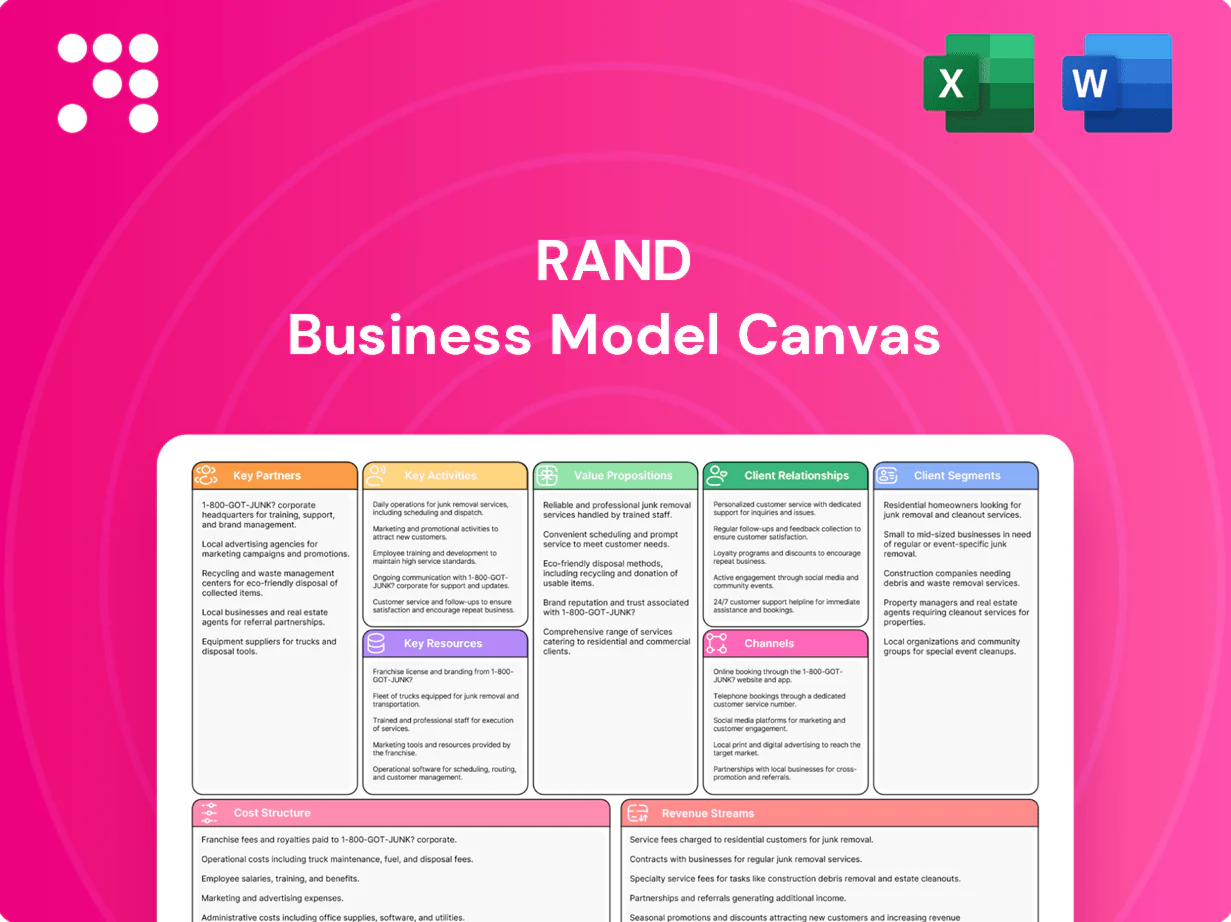
RAND Business Model Canvas

Unlock a strategic Business Model Canvas: value propositions, partners, revenue
Unlock RAND's strategic blueprint with our Business Model Canvas — clear, actionable insight into value propositions, key partners, and revenue streams. Ideal for entrepreneurs, analysts, and investors seeking practical takeaways. Download the full editable Word & Excel canvas to benchmark, adapt, and scale confidently.
Partnerships

Federal agencies and departments
Collaborations with over 100 federal agencies provide RAND access to priority policy questions and administrative datasets covering millions of records. These relationships enable mission-aligned, multi-year studies often structured as 3–5 year projects. Use of federal contracting frameworks such as GSA schedules and IDIQs streamlines initiation and oversight. Structured delivery channels increase the likelihood findings reach agency decision-makers and congressional staff.
Foundations and philanthropic funders
Philanthropic partners finance independent, public-interest research outside procurement cycles. Flexible, often unrestricted funding supports exploratory work and rapid-response analysis delivered in days to weeks. Co-designed initiatives target societal challenges with measurable outcomes, and multi-year grants (commonly 3–5 years) sustain program continuity and talent retention.

Universities and research institutes
Academic partnerships expand RAND’s methodological depth and subject-matter breadth, bringing specialized lab techniques and disciplinary frameworks into policy research. Joint projects, postdoctoral fellowships, and structured data-sharing agreements enhance rigor and innovation and supported multiple multi-institution studies in 2024. Access to external peer review strengthens credibility and transparency. Co-authorship accelerates dissemination across scholarly channels.

International organizations and NGOs
International organizations and NGOs surface cross-border policy issues and comparative insights across the 193 UN member states, facilitating field access, local context, and stakeholder networks. Joint evaluations and capacity-building improve implementation fidelity, while partnerships help scale evidence-based solutions across regions.
- Cross-border insights: 193-country policy scope
- Field access: local stakeholders and networks
- Implementation: joint evaluations & capacity-building
- Scale: regional evidence-based rollouts
Private sector and technology vendors
Industry partners supply data, tools and advanced analytics while collaborations enable secure platforms, cloud computing and model deployment; Gartner projects global public cloud end-user spending of $602.3B in 2024, underscoring scale. Ethical frameworks and conflict-of-interest safeguards govern data use. Co-development accelerates policy-relevant trials and pilots.
- Data provisioning
- Cloud deployment ($602.3B 2024)
- Ethics & COI safeguards
- Co-developed pilots
100+ federal partnerships, 3-5yr grants, global reach to 193 countries and $602.3B cloud spend
RAND’s 100+ federal partnerships deliver multi-year (3–5yr) contracts and access to millions of administrative records, enabling policy impact. Philanthropic grants (commonly 3–5yr) fund rapid-response and exploratory work. Academic, NGO and industry ties expand methods, field access across 193 countries, and cloud-enabled pilots (public cloud spend $602.3B in 2024).
| Partner | Metric |
|---|---|
| Federal | 100+ agencies; 3–5yr projects |
| Philanthropy | 3–5yr grants |
| Global | 193 countries |
| Industry | $602.3B public cloud (2024) |
What is included in the product
 Detailed Word Document
A comprehensive, pre-written business model tailored to the company’s strategy, organized into the 9 classic BMC blocks with full narrative, insights, and SWOT-linked analysis. Ideal for presentations, funding discussions, and validation using real company data, highlighting competitive advantages and actionable recommendations for entrepreneurs and analysts.

 Customizable Excel Spreadsheet
High-level RAND Business Model Canvas that condenses strategy into a single editable page, saving hours of structuring and enabling fast, shareable insights for teams, boardrooms, or comparative analysis.
Activities

Policy research and analysis
Design and execute rigorous studies addressing complex public problems, continuing RAND’s research tradition since 1948. Apply mixed methods and triangulate evidence to produce robust, replicable conclusions. Translate findings into actionable options and trade-off analyses for decisionmakers. Iterate with stakeholders to refine relevance and feasibility.
Data collection and modeling
Acquire, clean, and integrate administrative, survey, and open datasets—ranging from 10k to 100M records (including 2024 census microdata) with reproducible ETL pipelines. Build statistical, econometric, and simulation models (OLS, IV, Bayesian, Monte Carlo with 10,000 iterations) to test scenarios. Validate assumptions via sensitivity analyses (±20% shocks) and maintain secure workflows (AES-256, Docker, Git) for privacy and reproducibility.

Program evaluation and impact assessment
Assess effectiveness, efficiency, and equity of interventions using experimental and quasi-experimental designs (RCTs, diff-in-diff, RDD), building on a global evidence base of over 1,000 randomized evaluations by 2024. Deliver implementation diagnostics and prioritized improvement roadmaps with cost and timeline estimates. Report results in concise briefs, dashboards, and policy memos tailored for decision makers.

Publishing and dissemination
Produce reports, policy briefs, visualizations and interactive tools with full methodological appendices and transparency standards.
Openly share evidence-based insights to inform public discourse and tailor formats for policymakers, practitioners and the public (2024 emphasis on accessibility and reuse).
- Outputs: reports, briefs, tools
- Standards: transparency, methods
- Audiences: policymakers, practitioners, public
Stakeholder engagement and briefings
Conduct 100+ workshops, hearings, and closed-door briefings annually (2024 activity), eliciting needs, constraints, and operational realities early to shape feasible, evidence-informed options; build consensus among decision-makers and support adoption through targeted training and technical assistance to increase implementation rates.
- Engage 100+ stakeholders
- Elicit constraints early
- Consensus on evidence-based options
- Train and provide TA for adoption
Impact evaluations: 1,000+ RCTs, 100+ workshops, 10k-100M records
Design and run mixed-methods studies since 1948; 100+ annual workshops and 1,000+ randomized evaluations in the global evidence base by 2024.
Process 10k–100M records (including 2024 census microdata), build OLS/IV/Bayesian models and Monte Carlo (10,000 iterations), run ±20% sensitivity shocks, secure pipelines (AES-256, Docker, Git).
Deliver briefs, dashboards, tools and TA with costed roadmaps and implementation diagnostics to support adoption.
| Metric | 2024 |
|---|---|
| Workshops | 100+ |
| RCTs | 1,000+ |
| Records processed | 10k–100M |
| Monte Carlo | 10,000 iters |
| Security | AES-256, Docker, Git |
Preview Before You Purchase
Business Model Canvas
The document you're previewing is the actual RAND Business Model Canvas—not a mockup or sample. When you purchase, you'll receive this same complete, professionally formatted file exactly as shown. The full deliverable is ready to edit, present, and implement in Word and Excel formats. No surprises—what you see is what you'll get.

Unlock a strategic Business Model Canvas: value propositions, partners, revenue
Unlock RAND's strategic blueprint with our Business Model Canvas — clear, actionable insight into value propositions, key partners, and revenue streams. Ideal for entrepreneurs, analysts, and investors seeking practical takeaways. Download the full editable Word & Excel canvas to benchmark, adapt, and scale confidently.
Partnerships
Federal agencies and departments
Collaborations with over 100 federal agencies provide RAND access to priority policy questions and administrative datasets covering millions of records. These relationships enable mission-aligned, multi-year studies often structured as 3–5 year projects. Use of federal contracting frameworks such as GSA schedules and IDIQs streamlines initiation and oversight. Structured delivery channels increase the likelihood findings reach agency decision-makers and congressional staff.
Foundations and philanthropic funders
Philanthropic partners finance independent, public-interest research outside procurement cycles. Flexible, often unrestricted funding supports exploratory work and rapid-response analysis delivered in days to weeks. Co-designed initiatives target societal challenges with measurable outcomes, and multi-year grants (commonly 3–5 years) sustain program continuity and talent retention.
Universities and research institutes
Academic partnerships expand RAND’s methodological depth and subject-matter breadth, bringing specialized lab techniques and disciplinary frameworks into policy research. Joint projects, postdoctoral fellowships, and structured data-sharing agreements enhance rigor and innovation and supported multiple multi-institution studies in 2024. Access to external peer review strengthens credibility and transparency. Co-authorship accelerates dissemination across scholarly channels.
International organizations and NGOs
International organizations and NGOs surface cross-border policy issues and comparative insights across the 193 UN member states, facilitating field access, local context, and stakeholder networks. Joint evaluations and capacity-building improve implementation fidelity, while partnerships help scale evidence-based solutions across regions.
- Cross-border insights: 193-country policy scope
- Field access: local stakeholders and networks
- Implementation: joint evaluations & capacity-building
- Scale: regional evidence-based rollouts
Private sector and technology vendors
Industry partners supply data, tools and advanced analytics while collaborations enable secure platforms, cloud computing and model deployment; Gartner projects global public cloud end-user spending of $602.3B in 2024, underscoring scale. Ethical frameworks and conflict-of-interest safeguards govern data use. Co-development accelerates policy-relevant trials and pilots.
- Data provisioning
- Cloud deployment ($602.3B 2024)
- Ethics & COI safeguards
- Co-developed pilots
100+ federal partnerships, 3-5yr grants, global reach to 193 countries and $602.3B cloud spend
RAND’s 100+ federal partnerships deliver multi-year (3–5yr) contracts and access to millions of administrative records, enabling policy impact. Philanthropic grants (commonly 3–5yr) fund rapid-response and exploratory work. Academic, NGO and industry ties expand methods, field access across 193 countries, and cloud-enabled pilots (public cloud spend $602.3B in 2024).
| Partner | Metric |
|---|---|
| Federal | 100+ agencies; 3–5yr projects |
| Philanthropy | 3–5yr grants |
| Global | 193 countries |
| Industry | $602.3B public cloud (2024) |
What is included in the product
Detailed Word Document
A comprehensive, pre-written business model tailored to the company’s strategy, organized into the 9 classic BMC blocks with full narrative, insights, and SWOT-linked analysis. Ideal for presentations, funding discussions, and validation using real company data, highlighting competitive advantages and actionable recommendations for entrepreneurs and analysts.
Customizable Excel Spreadsheet
High-level RAND Business Model Canvas that condenses strategy into a single editable page, saving hours of structuring and enabling fast, shareable insights for teams, boardrooms, or comparative analysis.
Activities
Policy research and analysis
Design and execute rigorous studies addressing complex public problems, continuing RAND’s research tradition since 1948. Apply mixed methods and triangulate evidence to produce robust, replicable conclusions. Translate findings into actionable options and trade-off analyses for decisionmakers. Iterate with stakeholders to refine relevance and feasibility.
Data collection and modeling
Acquire, clean, and integrate administrative, survey, and open datasets—ranging from 10k to 100M records (including 2024 census microdata) with reproducible ETL pipelines. Build statistical, econometric, and simulation models (OLS, IV, Bayesian, Monte Carlo with 10,000 iterations) to test scenarios. Validate assumptions via sensitivity analyses (±20% shocks) and maintain secure workflows (AES-256, Docker, Git) for privacy and reproducibility.
Program evaluation and impact assessment
Assess effectiveness, efficiency, and equity of interventions using experimental and quasi-experimental designs (RCTs, diff-in-diff, RDD), building on a global evidence base of over 1,000 randomized evaluations by 2024. Deliver implementation diagnostics and prioritized improvement roadmaps with cost and timeline estimates. Report results in concise briefs, dashboards, and policy memos tailored for decision makers.
Publishing and dissemination
Produce reports, policy briefs, visualizations and interactive tools with full methodological appendices and transparency standards.
Openly share evidence-based insights to inform public discourse and tailor formats for policymakers, practitioners and the public (2024 emphasis on accessibility and reuse).
- Outputs: reports, briefs, tools
- Standards: transparency, methods
- Audiences: policymakers, practitioners, public
Stakeholder engagement and briefings
Conduct 100+ workshops, hearings, and closed-door briefings annually (2024 activity), eliciting needs, constraints, and operational realities early to shape feasible, evidence-informed options; build consensus among decision-makers and support adoption through targeted training and technical assistance to increase implementation rates.
- Engage 100+ stakeholders
- Elicit constraints early
- Consensus on evidence-based options
- Train and provide TA for adoption
Impact evaluations: 1,000+ RCTs, 100+ workshops, 10k-100M records
Design and run mixed-methods studies since 1948; 100+ annual workshops and 1,000+ randomized evaluations in the global evidence base by 2024.
Process 10k–100M records (including 2024 census microdata), build OLS/IV/Bayesian models and Monte Carlo (10,000 iterations), run ±20% sensitivity shocks, secure pipelines (AES-256, Docker, Git).
Deliver briefs, dashboards, tools and TA with costed roadmaps and implementation diagnostics to support adoption.
| Metric | 2024 |
|---|---|
| Workshops | 100+ |
| RCTs | 1,000+ |
| Records processed | 10k–100M |
| Monte Carlo | 10,000 iters |
| Security | AES-256, Docker, Git |
Preview Before You Purchase
Business Model Canvas
The document you're previewing is the actual RAND Business Model Canvas—not a mockup or sample. When you purchase, you'll receive this same complete, professionally formatted file exactly as shown. The full deliverable is ready to edit, present, and implement in Word and Excel formats. No surprises—what you see is what you'll get.
Description
Unlock a strategic Business Model Canvas: value propositions, partners, revenue
Unlock RAND's strategic blueprint with our Business Model Canvas — clear, actionable insight into value propositions, key partners, and revenue streams. Ideal for entrepreneurs, analysts, and investors seeking practical takeaways. Download the full editable Word & Excel canvas to benchmark, adapt, and scale confidently.
Partnerships
Federal agencies and departments
Collaborations with over 100 federal agencies provide RAND access to priority policy questions and administrative datasets covering millions of records. These relationships enable mission-aligned, multi-year studies often structured as 3–5 year projects. Use of federal contracting frameworks such as GSA schedules and IDIQs streamlines initiation and oversight. Structured delivery channels increase the likelihood findings reach agency decision-makers and congressional staff.
Foundations and philanthropic funders
Philanthropic partners finance independent, public-interest research outside procurement cycles. Flexible, often unrestricted funding supports exploratory work and rapid-response analysis delivered in days to weeks. Co-designed initiatives target societal challenges with measurable outcomes, and multi-year grants (commonly 3–5 years) sustain program continuity and talent retention.
Universities and research institutes
Academic partnerships expand RAND’s methodological depth and subject-matter breadth, bringing specialized lab techniques and disciplinary frameworks into policy research. Joint projects, postdoctoral fellowships, and structured data-sharing agreements enhance rigor and innovation and supported multiple multi-institution studies in 2024. Access to external peer review strengthens credibility and transparency. Co-authorship accelerates dissemination across scholarly channels.
International organizations and NGOs
International organizations and NGOs surface cross-border policy issues and comparative insights across the 193 UN member states, facilitating field access, local context, and stakeholder networks. Joint evaluations and capacity-building improve implementation fidelity, while partnerships help scale evidence-based solutions across regions.
- Cross-border insights: 193-country policy scope
- Field access: local stakeholders and networks
- Implementation: joint evaluations & capacity-building
- Scale: regional evidence-based rollouts
Private sector and technology vendors
Industry partners supply data, tools and advanced analytics while collaborations enable secure platforms, cloud computing and model deployment; Gartner projects global public cloud end-user spending of $602.3B in 2024, underscoring scale. Ethical frameworks and conflict-of-interest safeguards govern data use. Co-development accelerates policy-relevant trials and pilots.
- Data provisioning
- Cloud deployment ($602.3B 2024)
- Ethics & COI safeguards
- Co-developed pilots
100+ federal partnerships, 3-5yr grants, global reach to 193 countries and $602.3B cloud spend
RAND’s 100+ federal partnerships deliver multi-year (3–5yr) contracts and access to millions of administrative records, enabling policy impact. Philanthropic grants (commonly 3–5yr) fund rapid-response and exploratory work. Academic, NGO and industry ties expand methods, field access across 193 countries, and cloud-enabled pilots (public cloud spend $602.3B in 2024).
| Partner | Metric |
|---|---|
| Federal | 100+ agencies; 3–5yr projects |
| Philanthropy | 3–5yr grants |
| Global | 193 countries |
| Industry | $602.3B public cloud (2024) |
What is included in the product
Detailed Word Document
A comprehensive, pre-written business model tailored to the company’s strategy, organized into the 9 classic BMC blocks with full narrative, insights, and SWOT-linked analysis. Ideal for presentations, funding discussions, and validation using real company data, highlighting competitive advantages and actionable recommendations for entrepreneurs and analysts.
Customizable Excel Spreadsheet
High-level RAND Business Model Canvas that condenses strategy into a single editable page, saving hours of structuring and enabling fast, shareable insights for teams, boardrooms, or comparative analysis.
Activities
Policy research and analysis
Design and execute rigorous studies addressing complex public problems, continuing RAND’s research tradition since 1948. Apply mixed methods and triangulate evidence to produce robust, replicable conclusions. Translate findings into actionable options and trade-off analyses for decisionmakers. Iterate with stakeholders to refine relevance and feasibility.
Data collection and modeling
Acquire, clean, and integrate administrative, survey, and open datasets—ranging from 10k to 100M records (including 2024 census microdata) with reproducible ETL pipelines. Build statistical, econometric, and simulation models (OLS, IV, Bayesian, Monte Carlo with 10,000 iterations) to test scenarios. Validate assumptions via sensitivity analyses (±20% shocks) and maintain secure workflows (AES-256, Docker, Git) for privacy and reproducibility.
Program evaluation and impact assessment
Assess effectiveness, efficiency, and equity of interventions using experimental and quasi-experimental designs (RCTs, diff-in-diff, RDD), building on a global evidence base of over 1,000 randomized evaluations by 2024. Deliver implementation diagnostics and prioritized improvement roadmaps with cost and timeline estimates. Report results in concise briefs, dashboards, and policy memos tailored for decision makers.
Publishing and dissemination
Produce reports, policy briefs, visualizations and interactive tools with full methodological appendices and transparency standards.
Openly share evidence-based insights to inform public discourse and tailor formats for policymakers, practitioners and the public (2024 emphasis on accessibility and reuse).
- Outputs: reports, briefs, tools
- Standards: transparency, methods
- Audiences: policymakers, practitioners, public
Stakeholder engagement and briefings
Conduct 100+ workshops, hearings, and closed-door briefings annually (2024 activity), eliciting needs, constraints, and operational realities early to shape feasible, evidence-informed options; build consensus among decision-makers and support adoption through targeted training and technical assistance to increase implementation rates.
- Engage 100+ stakeholders
- Elicit constraints early
- Consensus on evidence-based options
- Train and provide TA for adoption
Impact evaluations: 1,000+ RCTs, 100+ workshops, 10k-100M records
Design and run mixed-methods studies since 1948; 100+ annual workshops and 1,000+ randomized evaluations in the global evidence base by 2024.
Process 10k–100M records (including 2024 census microdata), build OLS/IV/Bayesian models and Monte Carlo (10,000 iterations), run ±20% sensitivity shocks, secure pipelines (AES-256, Docker, Git).
Deliver briefs, dashboards, tools and TA with costed roadmaps and implementation diagnostics to support adoption.
| Metric | 2024 |
|---|---|
| Workshops | 100+ |
| RCTs | 1,000+ |
| Records processed | 10k–100M |
| Monte Carlo | 10,000 iters |
| Security | AES-256, Docker, Git |
Preview Before You Purchase
Business Model Canvas
The document you're previewing is the actual RAND Business Model Canvas—not a mockup or sample. When you purchase, you'll receive this same complete, professionally formatted file exactly as shown. The full deliverable is ready to edit, present, and implement in Word and Excel formats. No surprises—what you see is what you'll get.











