Rane Holdings Business Model Canvas

Unlock a concise Business Model Canvas: customer segments, value propositions, channels, revenue
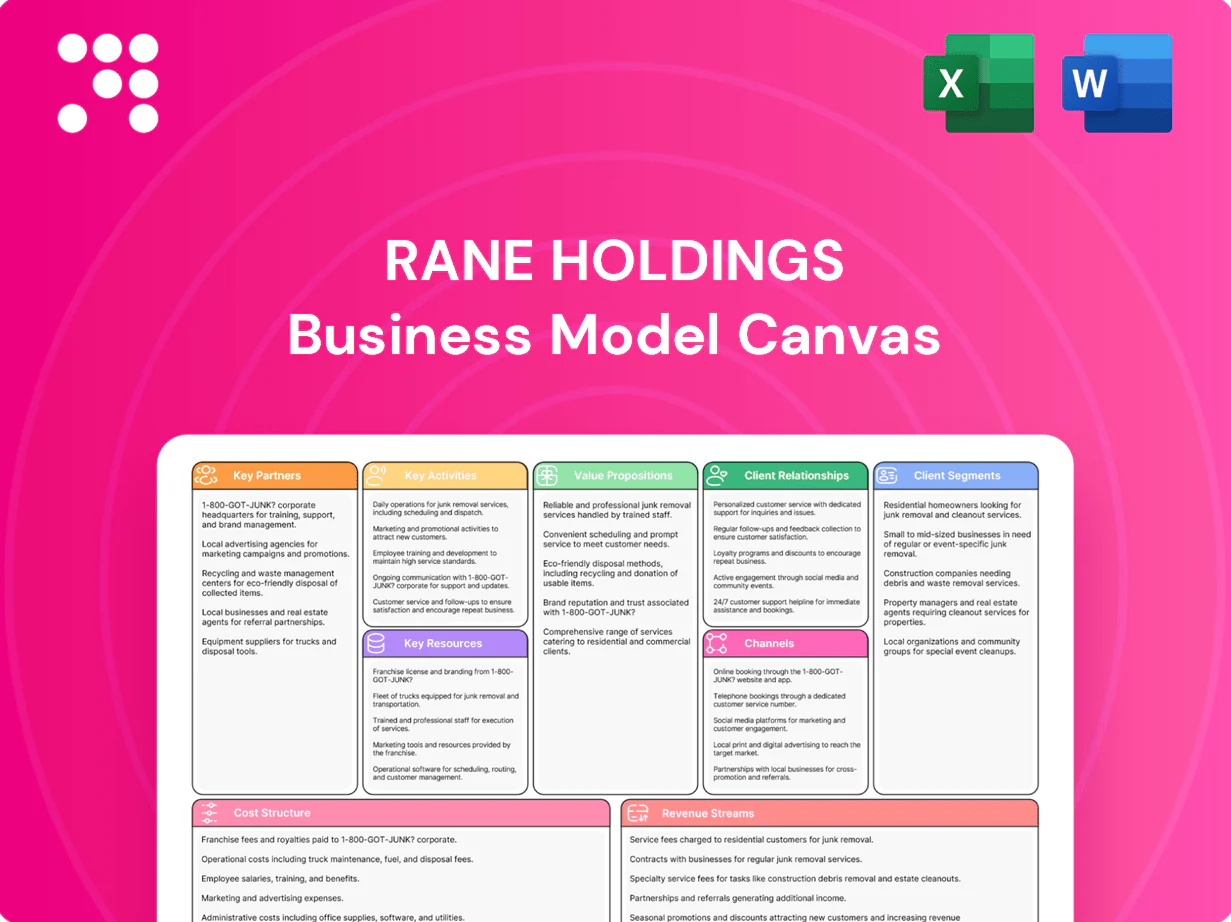
Unlock Rane Holdings’ strategic blueprint with our concise Business Model Canvas that maps customer segments, value propositions, channels, and revenue streams in one clear view. This ready-to-use file reveals growth levers, partnership dynamics, and cost drivers to inform decisions. Purchase the full Canvas to get editable Word and Excel versions, section-by-section analysis, and actionable insights for investors and strategists.
Partnerships

Strategic OEM alliances
Strategic OEM alliances anchor demand visibility and co-development, enabling Rane to align product roadmaps with OEM model launch cycles and capitalize on India’s light-vehicle production of about 5.1 million units in 2024. Preferred supplier status boosts volume commitments and pricing stability, while close ties accelerate qualification of new components, shortening time-to-market for next-gen modules.
Tier-1 and Tier-2 supplier network
As of 2024 Rane Holdings leverages a Tier-1 and Tier-2 supplier network across machining, forging, casting and tooling to secure capacity and component quality. Dual-sourcing across critical parts mitigates supply risk and cost spikes. Vendor development programs uplift process capability; long-term agreements lock in service levels and lead times.

Raw material and alloy providers
Steel, aluminum, friction compounds and specialty alloys are procured under strategic long‑term contracts to secure supply and favorable terms. Commodity hedging and indexed pricing mechanisms are used to dampen raw‑material volatility and protect margins. Collaborative R&D with materials partners drives lighter, higher‑wear materials and measurable performance gains. Consistent, qualified inputs underpin stable product quality and higher first‑pass yields.

Technology and R&D collaborators
Ties with universities, independent testing labs and technology licensors accelerate Rane Holdings' innovation pipeline; co‑engineering programs drive lightweighting, NVH reduction and advanced safety feature integration while protecting timelines. Access to shared testing rigs and simulation suites shortens validation cycles and IP sharing frameworks safeguard core know‑how.
- University & lab partnerships
- Co‑engineering for lightweighting, NVH, safety
- Shared testing/simulation access
- IP sharing & protection
Logistics and aftermarket distributors
3PL partners deliver to OEM plants and export hubs with a 98% on-time-in-full rate in 2024, cutting lead-time variability and export delays. Regional distributors expanded reach in replacement markets to cover ~65% of target geographies in 2024. Integrated tracking raised inventory turns from 4.0 to 6.0, while SLAs sustained a 95% fill rate and 24–48 hour warranty responsiveness.
- 3PL OTIF 98% (2024)
- Replacement reach ~65% (2024)
- Inventory turns 4.0→6.0 (2024)
- Fill rate 95% / warranty 24–48h (2024)
OEM alliances secure demand to 5.1m LVs; 3PL OTIF 98%
Strategic OEM alliances secure demand tied to India light‑vehicle output of ~5.1m units (2024), enabling preferred‑supplier volumes and faster qualification. Tier‑1/2 supplier network with dual‑sourcing and vendor development stabilizes capacity; commodity contracts and hedges protect margins. University/R&D ties speed lightweighting and NVH work; 3PL partner OTIF 98% supports export and aftermarket reach.
| Partner | 2024 KPI |
|---|---|
| OEMs | Aligned to 5.1m units |
| 3PL | OTIF 98% |
| Replacement network | Reach ~65% |
| Inventory | Turns 4→6 |
What is included in the product
 Detailed Word Document
A concise, pre-written Business Model Canvas for Rane Holdings that maps customer segments, channels, value propositions and revenue streams across the 9 classic BMC blocks. Includes competitive advantages, SWOT-linked insights and strategic implications—ready for presentations, investor discussions and operational planning.

 Customizable Excel Spreadsheet
High-level view of Rane Holdings' business model with editable cells that relieves the pain of fragmented strategy documents by consolidating revenue streams, cost drivers, and partners into one clear snapshot.
Activities

Precision manufacturing
High-volume machining, forging, die-casting and assembly produce Rane Holdings core components with robust process control to maintain tight tolerances, while automation and TPM lift throughput and overall equipment effectiveness; continuous yield-improvement programs systematically cut scrap and rework, improving unit economics and operational resilience.
Product engineering and validation
Design for manufacturability aligns components with OEM specs to meet Rane Holdings’ OEM customers across India and exports to over 30 countries, reducing rework at supplier lines.
Simulation, bench tests, and road trials validate durability and performance against OEM cycle-life targets and field conditions before approval.
APQP and PPAP frameworks de-risk launches through staged validations and control plans, while value engineering programs lower unit cost without sacrificing quality.

Supply chain and quality management
Supplier qualification and annual audits covering critical vendors maintain consistency and traceability while Rane reported consolidated revenue of INR 3,421 crore in FY2024. Lean inventory practices, JIT and Kanban synchronize with OEM lines, cutting inventory days toward ~30. Advanced quality tools (APQP, FMEA, SPC) target sub-100 ppm defects and full traceability. Compliance aligns with IATF 16949, ISO 9001 and applicable safety norms.

Business development and key account management
Business development pursues RFQs and platform bids to secure new programs; OEM platforms represented about 60% of supplier program value in 2024, reinforcing the focus on platform wins. Dedicated KAM teams manage forecasts, pricing and change control to protect margins and delivery. Early engineering engagement drives design-ins and long-term volumes, while quarterly performance reviews strengthen strategic customer relationships.
- Pursue RFQs/platforms — ~60% program value 2024
- KAM — forecasts, pricing, change control
- Early engagement — design-ins, sustained volumes
- Quarterly performance reviews — relationship reinforcement
Corporate governance and capital allocation
As a holding company, Rane Holdings focuses on portfolio oversight and strategy integration, aligning subsidiaries with group objectives; in 2024 the board prioritized high-ROCE investments and disciplined capital allocation. Capex decisions target businesses with strong return on capital and scalability, while rigorous risk management and compliance frameworks preserve group resilience. Ongoing M&A and JV evaluations in 2024 emphasize technology access and scale to support long-term competitiveness.
- Portfolio oversight — quarterly strategic reviews
- Capex — focus on high-ROCE projects
- Risk & compliance — enterprise-level controls
- M&A/JV — technology access and scale
High-volume machining, TPM automation, INR 3,421 cr, sub-100 ppm quality
High-volume machining, forging, die-casting and assembly with TPM/automation and yield programs drive scale and sub-100 ppm quality; APQP/PPAP de-risk launches. KAM and early engineering secure OEM platform wins (~60% program value) and JIT/Kanban keep inventory ≈30 days. Group oversight prioritizes high-ROCE capex; consolidated revenue INR 3,421 crore FY2024.
| Metric | 2024 |
|---|---|
| Revenue | INR 3,421 cr |
| OEM platform share | ~60% |
| Inventory days | ~30 |
| Defects | <100 ppm |
Delivered as Displayed
Business Model Canvas
The Rane Holdings Business Model Canvas you’re previewing is the actual deliverable, not a mockup. When you purchase, you’ll receive this exact file—complete, fully editable and formatted for presentation and analysis. No placeholders or missing sections: what you see here is what you’ll download and own.

Unlock a concise Business Model Canvas: customer segments, value propositions, channels, revenue
Unlock Rane Holdings’ strategic blueprint with our concise Business Model Canvas that maps customer segments, value propositions, channels, and revenue streams in one clear view. This ready-to-use file reveals growth levers, partnership dynamics, and cost drivers to inform decisions. Purchase the full Canvas to get editable Word and Excel versions, section-by-section analysis, and actionable insights for investors and strategists.
Partnerships
Strategic OEM alliances
Strategic OEM alliances anchor demand visibility and co-development, enabling Rane to align product roadmaps with OEM model launch cycles and capitalize on India’s light-vehicle production of about 5.1 million units in 2024. Preferred supplier status boosts volume commitments and pricing stability, while close ties accelerate qualification of new components, shortening time-to-market for next-gen modules.
Tier-1 and Tier-2 supplier network
As of 2024 Rane Holdings leverages a Tier-1 and Tier-2 supplier network across machining, forging, casting and tooling to secure capacity and component quality. Dual-sourcing across critical parts mitigates supply risk and cost spikes. Vendor development programs uplift process capability; long-term agreements lock in service levels and lead times.
Raw material and alloy providers
Steel, aluminum, friction compounds and specialty alloys are procured under strategic long‑term contracts to secure supply and favorable terms. Commodity hedging and indexed pricing mechanisms are used to dampen raw‑material volatility and protect margins. Collaborative R&D with materials partners drives lighter, higher‑wear materials and measurable performance gains. Consistent, qualified inputs underpin stable product quality and higher first‑pass yields.
Technology and R&D collaborators
Ties with universities, independent testing labs and technology licensors accelerate Rane Holdings' innovation pipeline; co‑engineering programs drive lightweighting, NVH reduction and advanced safety feature integration while protecting timelines. Access to shared testing rigs and simulation suites shortens validation cycles and IP sharing frameworks safeguard core know‑how.
- University & lab partnerships
- Co‑engineering for lightweighting, NVH, safety
- Shared testing/simulation access
- IP sharing & protection
Logistics and aftermarket distributors
3PL partners deliver to OEM plants and export hubs with a 98% on-time-in-full rate in 2024, cutting lead-time variability and export delays. Regional distributors expanded reach in replacement markets to cover ~65% of target geographies in 2024. Integrated tracking raised inventory turns from 4.0 to 6.0, while SLAs sustained a 95% fill rate and 24–48 hour warranty responsiveness.
- 3PL OTIF 98% (2024)
- Replacement reach ~65% (2024)
- Inventory turns 4.0→6.0 (2024)
- Fill rate 95% / warranty 24–48h (2024)
OEM alliances secure demand to 5.1m LVs; 3PL OTIF 98%
Strategic OEM alliances secure demand tied to India light‑vehicle output of ~5.1m units (2024), enabling preferred‑supplier volumes and faster qualification. Tier‑1/2 supplier network with dual‑sourcing and vendor development stabilizes capacity; commodity contracts and hedges protect margins. University/R&D ties speed lightweighting and NVH work; 3PL partner OTIF 98% supports export and aftermarket reach.
| Partner | 2024 KPI |
|---|---|
| OEMs | Aligned to 5.1m units |
| 3PL | OTIF 98% |
| Replacement network | Reach ~65% |
| Inventory | Turns 4→6 |
What is included in the product
Detailed Word Document
A concise, pre-written Business Model Canvas for Rane Holdings that maps customer segments, channels, value propositions and revenue streams across the 9 classic BMC blocks. Includes competitive advantages, SWOT-linked insights and strategic implications—ready for presentations, investor discussions and operational planning.
Customizable Excel Spreadsheet
High-level view of Rane Holdings' business model with editable cells that relieves the pain of fragmented strategy documents by consolidating revenue streams, cost drivers, and partners into one clear snapshot.
Activities
Precision manufacturing
High-volume machining, forging, die-casting and assembly produce Rane Holdings core components with robust process control to maintain tight tolerances, while automation and TPM lift throughput and overall equipment effectiveness; continuous yield-improvement programs systematically cut scrap and rework, improving unit economics and operational resilience.
Product engineering and validation
Design for manufacturability aligns components with OEM specs to meet Rane Holdings’ OEM customers across India and exports to over 30 countries, reducing rework at supplier lines.
Simulation, bench tests, and road trials validate durability and performance against OEM cycle-life targets and field conditions before approval.
APQP and PPAP frameworks de-risk launches through staged validations and control plans, while value engineering programs lower unit cost without sacrificing quality.
Supply chain and quality management
Supplier qualification and annual audits covering critical vendors maintain consistency and traceability while Rane reported consolidated revenue of INR 3,421 crore in FY2024. Lean inventory practices, JIT and Kanban synchronize with OEM lines, cutting inventory days toward ~30. Advanced quality tools (APQP, FMEA, SPC) target sub-100 ppm defects and full traceability. Compliance aligns with IATF 16949, ISO 9001 and applicable safety norms.
Business development and key account management
Business development pursues RFQs and platform bids to secure new programs; OEM platforms represented about 60% of supplier program value in 2024, reinforcing the focus on platform wins. Dedicated KAM teams manage forecasts, pricing and change control to protect margins and delivery. Early engineering engagement drives design-ins and long-term volumes, while quarterly performance reviews strengthen strategic customer relationships.
- Pursue RFQs/platforms — ~60% program value 2024
- KAM — forecasts, pricing, change control
- Early engagement — design-ins, sustained volumes
- Quarterly performance reviews — relationship reinforcement
Corporate governance and capital allocation
As a holding company, Rane Holdings focuses on portfolio oversight and strategy integration, aligning subsidiaries with group objectives; in 2024 the board prioritized high-ROCE investments and disciplined capital allocation. Capex decisions target businesses with strong return on capital and scalability, while rigorous risk management and compliance frameworks preserve group resilience. Ongoing M&A and JV evaluations in 2024 emphasize technology access and scale to support long-term competitiveness.
- Portfolio oversight — quarterly strategic reviews
- Capex — focus on high-ROCE projects
- Risk & compliance — enterprise-level controls
- M&A/JV — technology access and scale
High-volume machining, TPM automation, INR 3,421 cr, sub-100 ppm quality
High-volume machining, forging, die-casting and assembly with TPM/automation and yield programs drive scale and sub-100 ppm quality; APQP/PPAP de-risk launches. KAM and early engineering secure OEM platform wins (~60% program value) and JIT/Kanban keep inventory ≈30 days. Group oversight prioritizes high-ROCE capex; consolidated revenue INR 3,421 crore FY2024.
| Metric | 2024 |
|---|---|
| Revenue | INR 3,421 cr |
| OEM platform share | ~60% |
| Inventory days | ~30 |
| Defects | <100 ppm |
Delivered as Displayed
Business Model Canvas
The Rane Holdings Business Model Canvas you’re previewing is the actual deliverable, not a mockup. When you purchase, you’ll receive this exact file—complete, fully editable and formatted for presentation and analysis. No placeholders or missing sections: what you see here is what you’ll download and own.
Description
Unlock a concise Business Model Canvas: customer segments, value propositions, channels, revenue
Unlock Rane Holdings’ strategic blueprint with our concise Business Model Canvas that maps customer segments, value propositions, channels, and revenue streams in one clear view. This ready-to-use file reveals growth levers, partnership dynamics, and cost drivers to inform decisions. Purchase the full Canvas to get editable Word and Excel versions, section-by-section analysis, and actionable insights for investors and strategists.
Partnerships
Strategic OEM alliances
Strategic OEM alliances anchor demand visibility and co-development, enabling Rane to align product roadmaps with OEM model launch cycles and capitalize on India’s light-vehicle production of about 5.1 million units in 2024. Preferred supplier status boosts volume commitments and pricing stability, while close ties accelerate qualification of new components, shortening time-to-market for next-gen modules.
Tier-1 and Tier-2 supplier network
As of 2024 Rane Holdings leverages a Tier-1 and Tier-2 supplier network across machining, forging, casting and tooling to secure capacity and component quality. Dual-sourcing across critical parts mitigates supply risk and cost spikes. Vendor development programs uplift process capability; long-term agreements lock in service levels and lead times.
Raw material and alloy providers
Steel, aluminum, friction compounds and specialty alloys are procured under strategic long‑term contracts to secure supply and favorable terms. Commodity hedging and indexed pricing mechanisms are used to dampen raw‑material volatility and protect margins. Collaborative R&D with materials partners drives lighter, higher‑wear materials and measurable performance gains. Consistent, qualified inputs underpin stable product quality and higher first‑pass yields.
Technology and R&D collaborators
Ties with universities, independent testing labs and technology licensors accelerate Rane Holdings' innovation pipeline; co‑engineering programs drive lightweighting, NVH reduction and advanced safety feature integration while protecting timelines. Access to shared testing rigs and simulation suites shortens validation cycles and IP sharing frameworks safeguard core know‑how.
- University & lab partnerships
- Co‑engineering for lightweighting, NVH, safety
- Shared testing/simulation access
- IP sharing & protection
Logistics and aftermarket distributors
3PL partners deliver to OEM plants and export hubs with a 98% on-time-in-full rate in 2024, cutting lead-time variability and export delays. Regional distributors expanded reach in replacement markets to cover ~65% of target geographies in 2024. Integrated tracking raised inventory turns from 4.0 to 6.0, while SLAs sustained a 95% fill rate and 24–48 hour warranty responsiveness.
- 3PL OTIF 98% (2024)
- Replacement reach ~65% (2024)
- Inventory turns 4.0→6.0 (2024)
- Fill rate 95% / warranty 24–48h (2024)
OEM alliances secure demand to 5.1m LVs; 3PL OTIF 98%
Strategic OEM alliances secure demand tied to India light‑vehicle output of ~5.1m units (2024), enabling preferred‑supplier volumes and faster qualification. Tier‑1/2 supplier network with dual‑sourcing and vendor development stabilizes capacity; commodity contracts and hedges protect margins. University/R&D ties speed lightweighting and NVH work; 3PL partner OTIF 98% supports export and aftermarket reach.
| Partner | 2024 KPI |
|---|---|
| OEMs | Aligned to 5.1m units |
| 3PL | OTIF 98% |
| Replacement network | Reach ~65% |
| Inventory | Turns 4→6 |
What is included in the product
Detailed Word Document
A concise, pre-written Business Model Canvas for Rane Holdings that maps customer segments, channels, value propositions and revenue streams across the 9 classic BMC blocks. Includes competitive advantages, SWOT-linked insights and strategic implications—ready for presentations, investor discussions and operational planning.
Customizable Excel Spreadsheet
High-level view of Rane Holdings' business model with editable cells that relieves the pain of fragmented strategy documents by consolidating revenue streams, cost drivers, and partners into one clear snapshot.
Activities
Precision manufacturing
High-volume machining, forging, die-casting and assembly produce Rane Holdings core components with robust process control to maintain tight tolerances, while automation and TPM lift throughput and overall equipment effectiveness; continuous yield-improvement programs systematically cut scrap and rework, improving unit economics and operational resilience.
Product engineering and validation
Design for manufacturability aligns components with OEM specs to meet Rane Holdings’ OEM customers across India and exports to over 30 countries, reducing rework at supplier lines.
Simulation, bench tests, and road trials validate durability and performance against OEM cycle-life targets and field conditions before approval.
APQP and PPAP frameworks de-risk launches through staged validations and control plans, while value engineering programs lower unit cost without sacrificing quality.
Supply chain and quality management
Supplier qualification and annual audits covering critical vendors maintain consistency and traceability while Rane reported consolidated revenue of INR 3,421 crore in FY2024. Lean inventory practices, JIT and Kanban synchronize with OEM lines, cutting inventory days toward ~30. Advanced quality tools (APQP, FMEA, SPC) target sub-100 ppm defects and full traceability. Compliance aligns with IATF 16949, ISO 9001 and applicable safety norms.
Business development and key account management
Business development pursues RFQs and platform bids to secure new programs; OEM platforms represented about 60% of supplier program value in 2024, reinforcing the focus on platform wins. Dedicated KAM teams manage forecasts, pricing and change control to protect margins and delivery. Early engineering engagement drives design-ins and long-term volumes, while quarterly performance reviews strengthen strategic customer relationships.
- Pursue RFQs/platforms — ~60% program value 2024
- KAM — forecasts, pricing, change control
- Early engagement — design-ins, sustained volumes
- Quarterly performance reviews — relationship reinforcement
Corporate governance and capital allocation
As a holding company, Rane Holdings focuses on portfolio oversight and strategy integration, aligning subsidiaries with group objectives; in 2024 the board prioritized high-ROCE investments and disciplined capital allocation. Capex decisions target businesses with strong return on capital and scalability, while rigorous risk management and compliance frameworks preserve group resilience. Ongoing M&A and JV evaluations in 2024 emphasize technology access and scale to support long-term competitiveness.
- Portfolio oversight — quarterly strategic reviews
- Capex — focus on high-ROCE projects
- Risk & compliance — enterprise-level controls
- M&A/JV — technology access and scale
High-volume machining, TPM automation, INR 3,421 cr, sub-100 ppm quality
High-volume machining, forging, die-casting and assembly with TPM/automation and yield programs drive scale and sub-100 ppm quality; APQP/PPAP de-risk launches. KAM and early engineering secure OEM platform wins (~60% program value) and JIT/Kanban keep inventory ≈30 days. Group oversight prioritizes high-ROCE capex; consolidated revenue INR 3,421 crore FY2024.
| Metric | 2024 |
|---|---|
| Revenue | INR 3,421 cr |
| OEM platform share | ~60% |
| Inventory days | ~30 |
| Defects | <100 ppm |
Delivered as Displayed
Business Model Canvas
The Rane Holdings Business Model Canvas you’re previewing is the actual deliverable, not a mockup. When you purchase, you’ll receive this exact file—complete, fully editable and formatted for presentation and analysis. No placeholders or missing sections: what you see here is what you’ll download and own.











