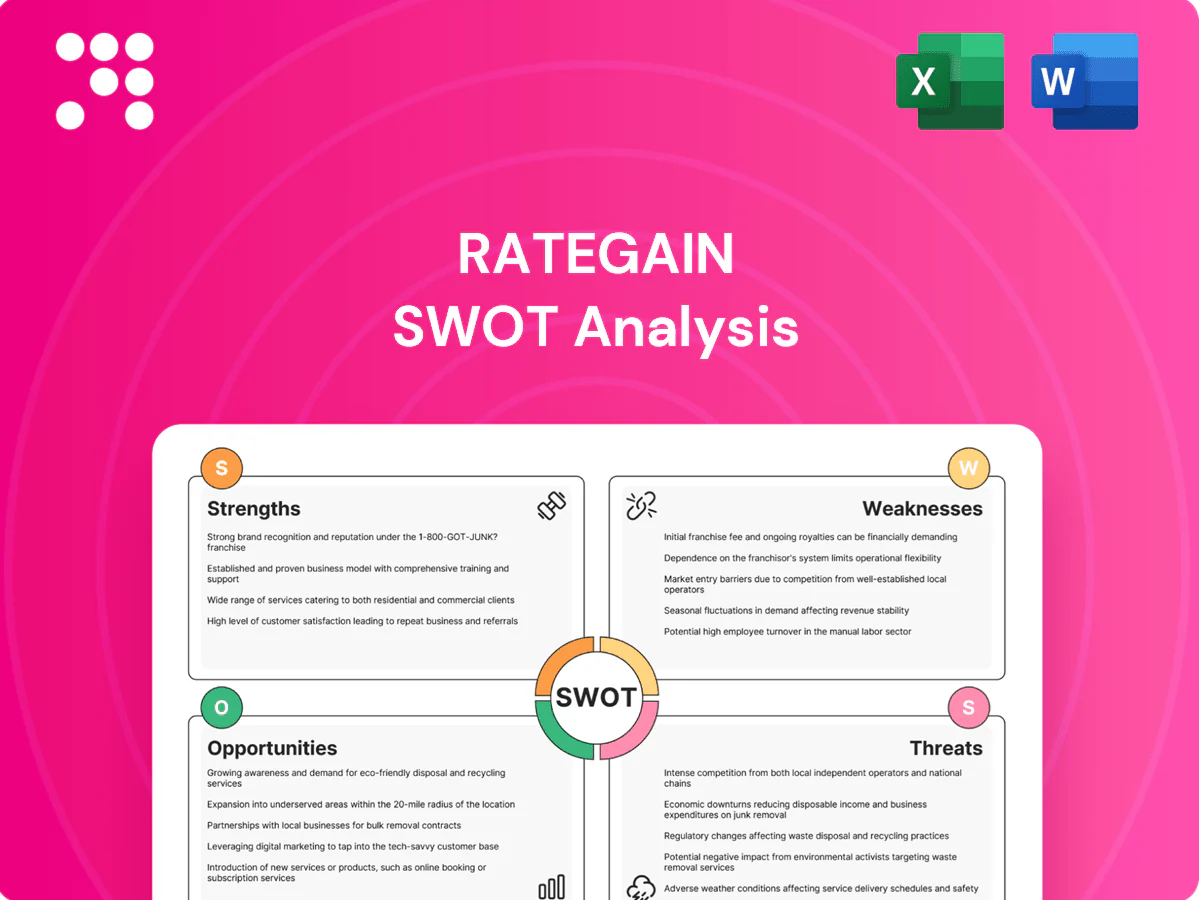
RateGain SWOT Analysis

Elevate Your Analysis with the Complete SWOT Report
RateGain's SWOT highlights robust tech-driven strengths, strategic channel partnerships, and scalable SaaS advantages, balanced against industry cyclicality and competitive pressure. Want the full story on growth levers, risks, and strategic moves? Purchase the complete SWOT analysis for a professionally formatted, editable Word and Excel package with research-backed insights to support investment, strategy, or pitch decks.
Strengths

AI-first, real-time analytics
RateGain’s AI-first platform ingests streaming data to deliver timely pricing and demand insights, serving 3,000+ customers across 80+ countries.
Real-time signals enable rapid response to market shifts across channels, shifting decisions from days to minutes and improving competitive positioning.
This capability enhances revenue optimization and reduces decision lag compared with batch-based or manual approaches, driving measurable yield uplift for hospitality and travel customers.
End-to-end travel SaaS suite
RateGain’s end-to-end travel SaaS—combining revenue management, distribution, rate intelligence and marketing—reduces vendor sprawl and integration friction for customers, enabling seamless cross-module data sharing that improves pricing accuracy and ROI, while driving higher stickiness and increased average contract values.

Deep travel and hospitality domain
RateGain's deep travel and hospitality specialization aligns products tightly with hotel, OTA, and airline workflows, enabling domain-trained models that capture seasonality, events, and channel nuances. This drives materially higher forecast precision and customer adoption, creating workflow lock-in and raising switching costs versus horizontal analytics tools. The vertical focus also streamlines integrations and accelerates time-to-value for clients.

Extensive integrations ecosystem
RateGain’s extensive integrations with PMS, CRS, channel managers and OTAs such as Booking.com, Expedia and Airbnb broaden distribution and metasearch coverage, enabling unified rate and inventory orchestration via wide API connectivity. Partners amplify distribution reach and enrich demand signals, creating network effects that continuously improve pricing accuracy and product performance.
- Connectivity: PMS, CRS, channel managers, OTAs, metasearch
- APIs: unified rate & inventory orchestration
- Partners: expanded distribution & richer data
- Outcome: network effects → better performance
Recurring, scalable SaaS model
Recurring subscription revenues give RateGain predictable growth and margin leverage, while multi-tenant architecture enables rapid feature rollout and lower incremental costs; the land-and-expand sales motion drives upsell and cross-sell, and usage-linked pricing aligns fees with customer outcomes.
- Predictable subscription mix
- Multi-tenant efficiency
- Land-and-expand upsell
- Usage-linked alignment
AI travel pricing: minute-level signals, 3,000+ customers, 80+ countries
RateGain’s AI-first platform ingests streaming data to serve 3,000+ customers across 80+ countries, enabling minute-level pricing and demand signals.
Real-time insights and vertical travel specialization drive higher forecast accuracy, yield uplift and workflow lock-in versus horizontal tools.
End-to-end SaaS, wide OTA/PMS integrations and subscription-based revenue support predictable growth, land-and-expand upsell and network effects.
| Metric | Value |
|---|---|
| Customers | 3,000+ |
| Countries | 80+ |
| Key integrations | Booking.com, Expedia, Airbnb, PMS/CRS |
What is included in the product
 Detailed Word Document
Delivers a strategic overview of RateGain’s internal and external business factors, outlining strengths, weaknesses, opportunities, and threats to assess its competitive position, growth drivers, and key risks.

 Customizable Excel Spreadsheet
Provides a concise SWOT matrix tailored to RateGain, enabling rapid identification of product and market pain points. Editable format and clear visuals accelerate stakeholder alignment and remedial planning.
Weaknesses

Exposure to travel cycles
Revenue is highly sensitive to travel-demand shocks and macro downturns, meaning prolonged slowdowns can compress bookings and renewals and push clients to defer IT spend. Seasonality in bookings complicates forecasting and capacity planning, increasing working-capital needs in peak months and idle capacity in off-peak periods. Diversification beyond travel remains limited, leaving RateGain exposed to sector-specific cyclicality.
Integration complexity and time-to-value
Legacy PMS/CRS diversity raises deployment effort and ongoing support, with integrations often requiring 3–6 months per property (HotelTechReport 2024), while data quality and mapping issues routinely delay go-live. Extended onboarding stretches customer payback beyond 12 months, constraining RateGain’s ability to scale into the mid-market.

Reliance on third-party data sources
APIs from OTAs, GDS and metasearch supply critical inputs for RateGain models, yet OTAs drive roughly 50% of online hotel bookings (Statista 2024), concentrating exposure. Policy or pricing shifts from these platforms can abruptly restrict access or raise feed costs, while data outages that breach typical 99.9% uptime SLAs erode model accuracy and customer trust. Heavy vendor dependency therefore adds measurable operational risk and cost volatility.

Competitive pressure from incumbents and startups
RateGain faces intense competitive pressure from Amadeus (≈€4.6bn revenue in 2023), Sabre (≈$2.1bn in 2023), Oracle Hospitality and nimble AI startups; feature-parity cycles compress pricing power and margin. Large incumbents bundle ends-to-end solutions to defend share, forcing RateGain to invest heavily to match bundles. Differentiation must outpace rapid innovation cycles to retain pricing and growth.
Complex enterprise sales motion
Multi-stakeholder buying in hotel chains pushes RateGain's sales cycles to 6–9 months, slowing revenue recognition. Procurement and compliance reviews add friction and approval layers, raising deal dropout risk. Customer-specific customizations inflate implementation effort and professional-services variability, stretching deployments and margins. These dynamics compress sales efficiency and pressure working capital via longer DSO and higher upfront costs.
- Multi-stakeholder buying: 6–9 month cycles
- Procurement/compliance: higher approval friction
- Customizations: longer deployments, variable margins
- Financial impact: stretched DSO and working capital strain
Travel SaaS: volatile demand, OTA 50%, payback 12m+
RateGain is exposed to travel cyclicality (OTA ~50% of online bookings, Statista 2024) and limited non-travel diversification, amplifying revenue swings. Long integrations (3–6 months) and >12-month payback slow mid-market scaling. Heavy vendor/API dependence and 99.9% SLA risk raise operational costs. Competitive pressure (Amadeus €4.6bn 2023; Sabre $2.1bn 2023) compresses pricing and margins.
| Metric | Value |
|---|---|
| OTA share | ~50% (Statista 2024) |
| Integration time | 3–6 months (HotelTechReport 2024) |
| Payback | >12 months |
| Competitive peers | Amadeus €4.6bn; Sabre $2.1bn (2023) |
Full Version Awaits
RateGain SWOT Analysis
This is the actual SWOT analysis document you’ll receive upon purchase—no surprises, just professional quality. The preview below is taken directly from the full SWOT report you'll get; purchase unlocks the entire in-depth, editable version. You’re viewing a live preview of the real file and will have immediate access to the complete document after checkout.

Elevate Your Analysis with the Complete SWOT Report
RateGain's SWOT highlights robust tech-driven strengths, strategic channel partnerships, and scalable SaaS advantages, balanced against industry cyclicality and competitive pressure. Want the full story on growth levers, risks, and strategic moves? Purchase the complete SWOT analysis for a professionally formatted, editable Word and Excel package with research-backed insights to support investment, strategy, or pitch decks.
Strengths
AI-first, real-time analytics
RateGain’s AI-first platform ingests streaming data to deliver timely pricing and demand insights, serving 3,000+ customers across 80+ countries.
Real-time signals enable rapid response to market shifts across channels, shifting decisions from days to minutes and improving competitive positioning.
This capability enhances revenue optimization and reduces decision lag compared with batch-based or manual approaches, driving measurable yield uplift for hospitality and travel customers.
End-to-end travel SaaS suite
RateGain’s end-to-end travel SaaS—combining revenue management, distribution, rate intelligence and marketing—reduces vendor sprawl and integration friction for customers, enabling seamless cross-module data sharing that improves pricing accuracy and ROI, while driving higher stickiness and increased average contract values.
Deep travel and hospitality domain
RateGain's deep travel and hospitality specialization aligns products tightly with hotel, OTA, and airline workflows, enabling domain-trained models that capture seasonality, events, and channel nuances. This drives materially higher forecast precision and customer adoption, creating workflow lock-in and raising switching costs versus horizontal analytics tools. The vertical focus also streamlines integrations and accelerates time-to-value for clients.
Extensive integrations ecosystem
RateGain’s extensive integrations with PMS, CRS, channel managers and OTAs such as Booking.com, Expedia and Airbnb broaden distribution and metasearch coverage, enabling unified rate and inventory orchestration via wide API connectivity. Partners amplify distribution reach and enrich demand signals, creating network effects that continuously improve pricing accuracy and product performance.
- Connectivity: PMS, CRS, channel managers, OTAs, metasearch
- APIs: unified rate & inventory orchestration
- Partners: expanded distribution & richer data
- Outcome: network effects → better performance
Recurring, scalable SaaS model
Recurring subscription revenues give RateGain predictable growth and margin leverage, while multi-tenant architecture enables rapid feature rollout and lower incremental costs; the land-and-expand sales motion drives upsell and cross-sell, and usage-linked pricing aligns fees with customer outcomes.
- Predictable subscription mix
- Multi-tenant efficiency
- Land-and-expand upsell
- Usage-linked alignment
AI travel pricing: minute-level signals, 3,000+ customers, 80+ countries
RateGain’s AI-first platform ingests streaming data to serve 3,000+ customers across 80+ countries, enabling minute-level pricing and demand signals.
Real-time insights and vertical travel specialization drive higher forecast accuracy, yield uplift and workflow lock-in versus horizontal tools.
End-to-end SaaS, wide OTA/PMS integrations and subscription-based revenue support predictable growth, land-and-expand upsell and network effects.
| Metric | Value |
|---|---|
| Customers | 3,000+ |
| Countries | 80+ |
| Key integrations | Booking.com, Expedia, Airbnb, PMS/CRS |
What is included in the product
Detailed Word Document
Delivers a strategic overview of RateGain’s internal and external business factors, outlining strengths, weaknesses, opportunities, and threats to assess its competitive position, growth drivers, and key risks.
Customizable Excel Spreadsheet
Provides a concise SWOT matrix tailored to RateGain, enabling rapid identification of product and market pain points. Editable format and clear visuals accelerate stakeholder alignment and remedial planning.
Weaknesses
Exposure to travel cycles
Revenue is highly sensitive to travel-demand shocks and macro downturns, meaning prolonged slowdowns can compress bookings and renewals and push clients to defer IT spend. Seasonality in bookings complicates forecasting and capacity planning, increasing working-capital needs in peak months and idle capacity in off-peak periods. Diversification beyond travel remains limited, leaving RateGain exposed to sector-specific cyclicality.
Integration complexity and time-to-value
Legacy PMS/CRS diversity raises deployment effort and ongoing support, with integrations often requiring 3–6 months per property (HotelTechReport 2024), while data quality and mapping issues routinely delay go-live. Extended onboarding stretches customer payback beyond 12 months, constraining RateGain’s ability to scale into the mid-market.
Reliance on third-party data sources
APIs from OTAs, GDS and metasearch supply critical inputs for RateGain models, yet OTAs drive roughly 50% of online hotel bookings (Statista 2024), concentrating exposure. Policy or pricing shifts from these platforms can abruptly restrict access or raise feed costs, while data outages that breach typical 99.9% uptime SLAs erode model accuracy and customer trust. Heavy vendor dependency therefore adds measurable operational risk and cost volatility.
Competitive pressure from incumbents and startups
RateGain faces intense competitive pressure from Amadeus (≈€4.6bn revenue in 2023), Sabre (≈$2.1bn in 2023), Oracle Hospitality and nimble AI startups; feature-parity cycles compress pricing power and margin. Large incumbents bundle ends-to-end solutions to defend share, forcing RateGain to invest heavily to match bundles. Differentiation must outpace rapid innovation cycles to retain pricing and growth.
Complex enterprise sales motion
Multi-stakeholder buying in hotel chains pushes RateGain's sales cycles to 6–9 months, slowing revenue recognition. Procurement and compliance reviews add friction and approval layers, raising deal dropout risk. Customer-specific customizations inflate implementation effort and professional-services variability, stretching deployments and margins. These dynamics compress sales efficiency and pressure working capital via longer DSO and higher upfront costs.
- Multi-stakeholder buying: 6–9 month cycles
- Procurement/compliance: higher approval friction
- Customizations: longer deployments, variable margins
- Financial impact: stretched DSO and working capital strain
Travel SaaS: volatile demand, OTA 50%, payback 12m+
RateGain is exposed to travel cyclicality (OTA ~50% of online bookings, Statista 2024) and limited non-travel diversification, amplifying revenue swings. Long integrations (3–6 months) and >12-month payback slow mid-market scaling. Heavy vendor/API dependence and 99.9% SLA risk raise operational costs. Competitive pressure (Amadeus €4.6bn 2023; Sabre $2.1bn 2023) compresses pricing and margins.
| Metric | Value |
|---|---|
| OTA share | ~50% (Statista 2024) |
| Integration time | 3–6 months (HotelTechReport 2024) |
| Payback | >12 months |
| Competitive peers | Amadeus €4.6bn; Sabre $2.1bn (2023) |
Full Version Awaits
RateGain SWOT Analysis
This is the actual SWOT analysis document you’ll receive upon purchase—no surprises, just professional quality. The preview below is taken directly from the full SWOT report you'll get; purchase unlocks the entire in-depth, editable version. You’re viewing a live preview of the real file and will have immediate access to the complete document after checkout.
Description
Elevate Your Analysis with the Complete SWOT Report
RateGain's SWOT highlights robust tech-driven strengths, strategic channel partnerships, and scalable SaaS advantages, balanced against industry cyclicality and competitive pressure. Want the full story on growth levers, risks, and strategic moves? Purchase the complete SWOT analysis for a professionally formatted, editable Word and Excel package with research-backed insights to support investment, strategy, or pitch decks.
Strengths
AI-first, real-time analytics
RateGain’s AI-first platform ingests streaming data to deliver timely pricing and demand insights, serving 3,000+ customers across 80+ countries.
Real-time signals enable rapid response to market shifts across channels, shifting decisions from days to minutes and improving competitive positioning.
This capability enhances revenue optimization and reduces decision lag compared with batch-based or manual approaches, driving measurable yield uplift for hospitality and travel customers.
End-to-end travel SaaS suite
RateGain’s end-to-end travel SaaS—combining revenue management, distribution, rate intelligence and marketing—reduces vendor sprawl and integration friction for customers, enabling seamless cross-module data sharing that improves pricing accuracy and ROI, while driving higher stickiness and increased average contract values.
Deep travel and hospitality domain
RateGain's deep travel and hospitality specialization aligns products tightly with hotel, OTA, and airline workflows, enabling domain-trained models that capture seasonality, events, and channel nuances. This drives materially higher forecast precision and customer adoption, creating workflow lock-in and raising switching costs versus horizontal analytics tools. The vertical focus also streamlines integrations and accelerates time-to-value for clients.
Extensive integrations ecosystem
RateGain’s extensive integrations with PMS, CRS, channel managers and OTAs such as Booking.com, Expedia and Airbnb broaden distribution and metasearch coverage, enabling unified rate and inventory orchestration via wide API connectivity. Partners amplify distribution reach and enrich demand signals, creating network effects that continuously improve pricing accuracy and product performance.
- Connectivity: PMS, CRS, channel managers, OTAs, metasearch
- APIs: unified rate & inventory orchestration
- Partners: expanded distribution & richer data
- Outcome: network effects → better performance
Recurring, scalable SaaS model
Recurring subscription revenues give RateGain predictable growth and margin leverage, while multi-tenant architecture enables rapid feature rollout and lower incremental costs; the land-and-expand sales motion drives upsell and cross-sell, and usage-linked pricing aligns fees with customer outcomes.
- Predictable subscription mix
- Multi-tenant efficiency
- Land-and-expand upsell
- Usage-linked alignment
AI travel pricing: minute-level signals, 3,000+ customers, 80+ countries
RateGain’s AI-first platform ingests streaming data to serve 3,000+ customers across 80+ countries, enabling minute-level pricing and demand signals.
Real-time insights and vertical travel specialization drive higher forecast accuracy, yield uplift and workflow lock-in versus horizontal tools.
End-to-end SaaS, wide OTA/PMS integrations and subscription-based revenue support predictable growth, land-and-expand upsell and network effects.
| Metric | Value |
|---|---|
| Customers | 3,000+ |
| Countries | 80+ |
| Key integrations | Booking.com, Expedia, Airbnb, PMS/CRS |
What is included in the product
Detailed Word Document
Delivers a strategic overview of RateGain’s internal and external business factors, outlining strengths, weaknesses, opportunities, and threats to assess its competitive position, growth drivers, and key risks.
Customizable Excel Spreadsheet
Provides a concise SWOT matrix tailored to RateGain, enabling rapid identification of product and market pain points. Editable format and clear visuals accelerate stakeholder alignment and remedial planning.
Weaknesses
Exposure to travel cycles
Revenue is highly sensitive to travel-demand shocks and macro downturns, meaning prolonged slowdowns can compress bookings and renewals and push clients to defer IT spend. Seasonality in bookings complicates forecasting and capacity planning, increasing working-capital needs in peak months and idle capacity in off-peak periods. Diversification beyond travel remains limited, leaving RateGain exposed to sector-specific cyclicality.
Integration complexity and time-to-value
Legacy PMS/CRS diversity raises deployment effort and ongoing support, with integrations often requiring 3–6 months per property (HotelTechReport 2024), while data quality and mapping issues routinely delay go-live. Extended onboarding stretches customer payback beyond 12 months, constraining RateGain’s ability to scale into the mid-market.
Reliance on third-party data sources
APIs from OTAs, GDS and metasearch supply critical inputs for RateGain models, yet OTAs drive roughly 50% of online hotel bookings (Statista 2024), concentrating exposure. Policy or pricing shifts from these platforms can abruptly restrict access or raise feed costs, while data outages that breach typical 99.9% uptime SLAs erode model accuracy and customer trust. Heavy vendor dependency therefore adds measurable operational risk and cost volatility.
Competitive pressure from incumbents and startups
RateGain faces intense competitive pressure from Amadeus (≈€4.6bn revenue in 2023), Sabre (≈$2.1bn in 2023), Oracle Hospitality and nimble AI startups; feature-parity cycles compress pricing power and margin. Large incumbents bundle ends-to-end solutions to defend share, forcing RateGain to invest heavily to match bundles. Differentiation must outpace rapid innovation cycles to retain pricing and growth.
Complex enterprise sales motion
Multi-stakeholder buying in hotel chains pushes RateGain's sales cycles to 6–9 months, slowing revenue recognition. Procurement and compliance reviews add friction and approval layers, raising deal dropout risk. Customer-specific customizations inflate implementation effort and professional-services variability, stretching deployments and margins. These dynamics compress sales efficiency and pressure working capital via longer DSO and higher upfront costs.
- Multi-stakeholder buying: 6–9 month cycles
- Procurement/compliance: higher approval friction
- Customizations: longer deployments, variable margins
- Financial impact: stretched DSO and working capital strain
Travel SaaS: volatile demand, OTA 50%, payback 12m+
RateGain is exposed to travel cyclicality (OTA ~50% of online bookings, Statista 2024) and limited non-travel diversification, amplifying revenue swings. Long integrations (3–6 months) and >12-month payback slow mid-market scaling. Heavy vendor/API dependence and 99.9% SLA risk raise operational costs. Competitive pressure (Amadeus €4.6bn 2023; Sabre $2.1bn 2023) compresses pricing and margins.
| Metric | Value |
|---|---|
| OTA share | ~50% (Statista 2024) |
| Integration time | 3–6 months (HotelTechReport 2024) |
| Payback | >12 months |
| Competitive peers | Amadeus €4.6bn; Sabre $2.1bn (2023) |
Full Version Awaits
RateGain SWOT Analysis
This is the actual SWOT analysis document you’ll receive upon purchase—no surprises, just professional quality. The preview below is taken directly from the full SWOT report you'll get; purchase unlocks the entire in-depth, editable version. You’re viewing a live preview of the real file and will have immediate access to the complete document after checkout.











