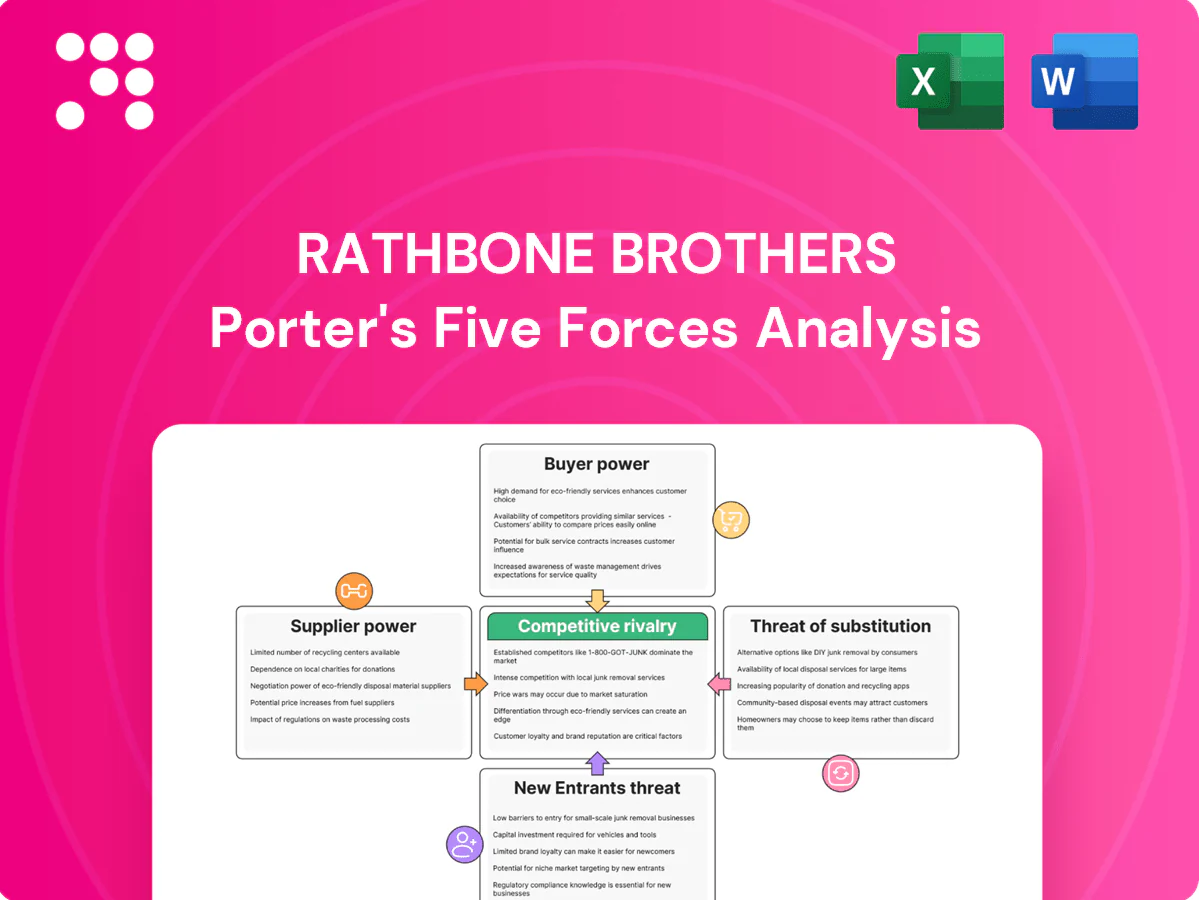
Rathbone Brothers Porter's Five Forces Analysis

Don't Miss the Bigger Picture
Rathbone Brothers faces nuanced competitive pressures—from concentrated client bargaining and fee compression to moderate threats from digital entrants and asset managers expanding services. This snapshot highlights key vulnerabilities and strategic levers. Unlock the full Porter's Five Forces Analysis to explore force-by-force ratings, visuals, and actionable insights tailored to Rathbone Brothers.
Suppliers Bargaining Power

Concentrated data and research vendors
As of 2024 core market data, analytics and index provision is concentrated among a few vendors (Bloomberg, Refinitiv, MSCI), giving them pricing leverage. Switching these platforms risks operational disruption, retraining and integration costs and is often blocked by multi‑year contracts. Dependence rises as platforms embed into workflows; Rathbone can mitigate by multi‑sourcing and negotiated enterprise deals to reduce single‑vendor risk.
Human capital as critical input
Portfolio managers, advisors and CIOs act as key suppliers to Rathbone Brothers, and in 2024 scarce seasoned advisers with client books command premium compensation and bespoke sign-on terms. Retention packages and culture have become material cost drivers for the firm. Team lift-outs are intensifying wage pressure across the UK wealth sector.

Custody, clearing, and banking partners
Custodians and clearing counterparties remain concentrated, with the top five global custodian banks holding over 60% of assets under custody in 2024, raising resilience and service demands; outages or fee rises can hit client experience and margins quickly. Diversification, strict SLAs and bilateral limits cut single‑point risk, while Rathbones’ scale improves fee leverage but does not eliminate counterparty dependence.

Third‑party fund providers and products
Third‑party fund providers shape Rathbones proposition: access to specialist and ESG vehicles expands breadth while popular managers can ration capacity or command premium fees; global ETF/active fund scale rose to c.15trn USD in 2024, increasing competition. Open‑architecture lowers concentration but raises due‑diligence and monitoring costs. Rathbones c.£70bn AUM (2024) and in‑house research plus model portfolios reduce supplier leverage.
- Access to specialist funds: expands proposition
- Capacity constraints: lead to rationing/higher fees
- Open‑architecture: lowers concentration, raises due diligence costs
- In‑house research & model portfolios: mitigate supplier power
Technology platforms and RegTech
Portfolio, CRM, cyber and compliance platforms are deeply embedded at Rathbone Brothers, costly to replace, and vendors often apply 3–7% annual uplifts tied to security and regulatory updates; API ecosystems lower marginal switching costs but integration and data-migration risk keep supplier leverage elevated.
- RegTech market ~USD 15bn (2024)
- Vendor uplifts 3–7% p.a.
- APIs ease margins; integration risk persists
- Co‑development roadmaps reduce pricing power
2024 supplier power rises: custodians >60% AUC; vendor uplifts 3–7% p.a.
Supplier power is elevated in 2024: market data (Bloomberg/Refinitiv/MSCI) and custodians (top5 >60% AUC) exert pricing leverage; seasoned advisers command premiums, driving retention costs. Rathbones c.£70bn AUM and in‑house research, multi‑sourcing and SLAs mitigate but do not remove supplier risk; vendor uplifts 3–7% p.a. raise operating costs.
| Metric | 2024 |
|---|---|
| Rathbones AUM | c.£70bn |
| Top‑5 custodians share | >60% |
| Global ETF/active funds | c.$15trn |
| RegTech market | $15bn |
| Vendor uplifts | 3–7% p.a. |
What is included in the product
 Detailed Word Document
Tailored Porter's Five Forces analysis for Rathbone Brothers that uncovers competitive drivers, buyer and supplier power, threat of substitutes and new entrants, and highlights emerging disruptors and strategic levers to protect profitability.

 Customizable Excel Spreadsheet
A concise, one-sheet Porter's Five Forces for Rathbone Brothers that instantly highlights competitive pressures, client bargaining trends and regulatory risks to speed strategic decision-making; easily customizable for evolving market data and ready to drop into pitch decks or boardroom slides.
Customers Bargaining Power

HNW/charity clients with mandate size
HNW and charity mandates at Rathbone, with AUMA reported at £62.6bn in 2024, give clients leverage to negotiate lower fees and demand bespoke reporting. Charities and trustees routinely run competitive RFPs, intensifying buyer power and fee compression. Mandates with explicit performance and impact targets increase monitoring and scrutiny. Deep, long-standing relationships can, however, reduce price sensitivity and preserve margins.
Low formal switching costs, relational stickiness
Operationally clients can move custody and mandates with low formal fees, but Rathbones' c. £70bn AUM in 2024 and bespoke tax-optimised portfolios create relational stickiness through trust and historic tax records. Informal frictions slow exits, yet poor performance or service lapses rapidly unlock mobility. Regular client reviews and transparent pricing keep fee pressure high and churn risk elevated.

Fee transparency and benchmarking
Industry focus on all‑in fees elevates client leverage: in 2024 active equity managers charged ~0.70% vs passive ~0.10%, pushing buyers to benchmark Rathbone against passive returns and peer managers. Tiered pricing and aggregation discounts are increasingly expected as passive AUM topped c. $11tn in 2024. Demonstrable alpha and financial planning value remain key to defend margins.

Multi‑banked, advice‑savvy clientele
Affluent clients are multi‑banked and advice‑savvy, spreading assets across providers and using consultants or peers to validate terms and performance, which intensifies competition at renewal; Rathbones must lean on differentiated planning and broad service breadth to avoid head‑to‑head price contests.
- Multi‑banking: enables cross‑quotes
- Third‑party validation: consultants/peers
- Renewal pressure: higher churn risk
- Differentiation: planning & service breadth reduces pure price battles
Digital service expectations
Clients now demand seamless portals, real-time reporting and prompt responsiveness; failures to match fintech standards trigger renegotiation or churn as digital expectations redefine service value. Service-level KPIs increasingly enter fee discussions, shifting bargaining leverage toward customers. Ongoing investment in UX and API-led integrations reduces buyer power by raising switching costs.
- digital portals
- reporting SLAs
- KPI-linked fees
- UX investment raises stickiness
Large clients push KPI-linked pricing; 0.60pp fee gap raises churn risk
Rathbone clients (AUMA £62.6bn in 2024) exert strong fee pressure via RFPs and multi‑banking, forcing bespoke reporting and KPI‑linked pricing. Passive vs active fee gap (passive ~0.10% vs active ~0.70% in 2024) raises benchmarking and churn risk. UX/API investment and tax‑optimised portfolios create relational stickiness that partially offsets bargaining power.
| Metric | 2024 | Implication |
|---|---|---|
| AUMA | £62.6bn | Scale but fee scrutiny |
| Passive AUM | ~$11tn | Benchmark pressure |
| Fee gap | 0.60pp | Compression risk |
Same Document Delivered
Rathbone Brothers Porter's Five Forces Analysis
This preview shows the exact Rathbone Brothers Porter's Five Forces Analysis you'll receive immediately after purchase—no placeholders or edits. The document is fully formatted, professionally written, and ready for download and use the moment you complete payment. What you see here is precisely the deliverable you will get.

Don't Miss the Bigger Picture
Rathbone Brothers faces nuanced competitive pressures—from concentrated client bargaining and fee compression to moderate threats from digital entrants and asset managers expanding services. This snapshot highlights key vulnerabilities and strategic levers. Unlock the full Porter's Five Forces Analysis to explore force-by-force ratings, visuals, and actionable insights tailored to Rathbone Brothers.
Suppliers Bargaining Power
Concentrated data and research vendors
As of 2024 core market data, analytics and index provision is concentrated among a few vendors (Bloomberg, Refinitiv, MSCI), giving them pricing leverage. Switching these platforms risks operational disruption, retraining and integration costs and is often blocked by multi‑year contracts. Dependence rises as platforms embed into workflows; Rathbone can mitigate by multi‑sourcing and negotiated enterprise deals to reduce single‑vendor risk.
Human capital as critical input
Portfolio managers, advisors and CIOs act as key suppliers to Rathbone Brothers, and in 2024 scarce seasoned advisers with client books command premium compensation and bespoke sign-on terms. Retention packages and culture have become material cost drivers for the firm. Team lift-outs are intensifying wage pressure across the UK wealth sector.
Custody, clearing, and banking partners
Custodians and clearing counterparties remain concentrated, with the top five global custodian banks holding over 60% of assets under custody in 2024, raising resilience and service demands; outages or fee rises can hit client experience and margins quickly. Diversification, strict SLAs and bilateral limits cut single‑point risk, while Rathbones’ scale improves fee leverage but does not eliminate counterparty dependence.
Third‑party fund providers and products
Third‑party fund providers shape Rathbones proposition: access to specialist and ESG vehicles expands breadth while popular managers can ration capacity or command premium fees; global ETF/active fund scale rose to c.15trn USD in 2024, increasing competition. Open‑architecture lowers concentration but raises due‑diligence and monitoring costs. Rathbones c.£70bn AUM (2024) and in‑house research plus model portfolios reduce supplier leverage.
- Access to specialist funds: expands proposition
- Capacity constraints: lead to rationing/higher fees
- Open‑architecture: lowers concentration, raises due diligence costs
- In‑house research & model portfolios: mitigate supplier power
Technology platforms and RegTech
Portfolio, CRM, cyber and compliance platforms are deeply embedded at Rathbone Brothers, costly to replace, and vendors often apply 3–7% annual uplifts tied to security and regulatory updates; API ecosystems lower marginal switching costs but integration and data-migration risk keep supplier leverage elevated.
- RegTech market ~USD 15bn (2024)
- Vendor uplifts 3–7% p.a.
- APIs ease margins; integration risk persists
- Co‑development roadmaps reduce pricing power
2024 supplier power rises: custodians >60% AUC; vendor uplifts 3–7% p.a.
Supplier power is elevated in 2024: market data (Bloomberg/Refinitiv/MSCI) and custodians (top5 >60% AUC) exert pricing leverage; seasoned advisers command premiums, driving retention costs. Rathbones c.£70bn AUM and in‑house research, multi‑sourcing and SLAs mitigate but do not remove supplier risk; vendor uplifts 3–7% p.a. raise operating costs.
| Metric | 2024 |
|---|---|
| Rathbones AUM | c.£70bn |
| Top‑5 custodians share | >60% |
| Global ETF/active funds | c.$15trn |
| RegTech market | $15bn |
| Vendor uplifts | 3–7% p.a. |
What is included in the product
Detailed Word Document
Tailored Porter's Five Forces analysis for Rathbone Brothers that uncovers competitive drivers, buyer and supplier power, threat of substitutes and new entrants, and highlights emerging disruptors and strategic levers to protect profitability.
Customizable Excel Spreadsheet
A concise, one-sheet Porter's Five Forces for Rathbone Brothers that instantly highlights competitive pressures, client bargaining trends and regulatory risks to speed strategic decision-making; easily customizable for evolving market data and ready to drop into pitch decks or boardroom slides.
Customers Bargaining Power
HNW/charity clients with mandate size
HNW and charity mandates at Rathbone, with AUMA reported at £62.6bn in 2024, give clients leverage to negotiate lower fees and demand bespoke reporting. Charities and trustees routinely run competitive RFPs, intensifying buyer power and fee compression. Mandates with explicit performance and impact targets increase monitoring and scrutiny. Deep, long-standing relationships can, however, reduce price sensitivity and preserve margins.
Low formal switching costs, relational stickiness
Operationally clients can move custody and mandates with low formal fees, but Rathbones' c. £70bn AUM in 2024 and bespoke tax-optimised portfolios create relational stickiness through trust and historic tax records. Informal frictions slow exits, yet poor performance or service lapses rapidly unlock mobility. Regular client reviews and transparent pricing keep fee pressure high and churn risk elevated.
Fee transparency and benchmarking
Industry focus on all‑in fees elevates client leverage: in 2024 active equity managers charged ~0.70% vs passive ~0.10%, pushing buyers to benchmark Rathbone against passive returns and peer managers. Tiered pricing and aggregation discounts are increasingly expected as passive AUM topped c. $11tn in 2024. Demonstrable alpha and financial planning value remain key to defend margins.
Multi‑banked, advice‑savvy clientele
Affluent clients are multi‑banked and advice‑savvy, spreading assets across providers and using consultants or peers to validate terms and performance, which intensifies competition at renewal; Rathbones must lean on differentiated planning and broad service breadth to avoid head‑to‑head price contests.
- Multi‑banking: enables cross‑quotes
- Third‑party validation: consultants/peers
- Renewal pressure: higher churn risk
- Differentiation: planning & service breadth reduces pure price battles
Digital service expectations
Clients now demand seamless portals, real-time reporting and prompt responsiveness; failures to match fintech standards trigger renegotiation or churn as digital expectations redefine service value. Service-level KPIs increasingly enter fee discussions, shifting bargaining leverage toward customers. Ongoing investment in UX and API-led integrations reduces buyer power by raising switching costs.
- digital portals
- reporting SLAs
- KPI-linked fees
- UX investment raises stickiness
Large clients push KPI-linked pricing; 0.60pp fee gap raises churn risk
Rathbone clients (AUMA £62.6bn in 2024) exert strong fee pressure via RFPs and multi‑banking, forcing bespoke reporting and KPI‑linked pricing. Passive vs active fee gap (passive ~0.10% vs active ~0.70% in 2024) raises benchmarking and churn risk. UX/API investment and tax‑optimised portfolios create relational stickiness that partially offsets bargaining power.
| Metric | 2024 | Implication |
|---|---|---|
| AUMA | £62.6bn | Scale but fee scrutiny |
| Passive AUM | ~$11tn | Benchmark pressure |
| Fee gap | 0.60pp | Compression risk |
Same Document Delivered
Rathbone Brothers Porter's Five Forces Analysis
This preview shows the exact Rathbone Brothers Porter's Five Forces Analysis you'll receive immediately after purchase—no placeholders or edits. The document is fully formatted, professionally written, and ready for download and use the moment you complete payment. What you see here is precisely the deliverable you will get.
Description
Don't Miss the Bigger Picture
Rathbone Brothers faces nuanced competitive pressures—from concentrated client bargaining and fee compression to moderate threats from digital entrants and asset managers expanding services. This snapshot highlights key vulnerabilities and strategic levers. Unlock the full Porter's Five Forces Analysis to explore force-by-force ratings, visuals, and actionable insights tailored to Rathbone Brothers.
Suppliers Bargaining Power
Concentrated data and research vendors
As of 2024 core market data, analytics and index provision is concentrated among a few vendors (Bloomberg, Refinitiv, MSCI), giving them pricing leverage. Switching these platforms risks operational disruption, retraining and integration costs and is often blocked by multi‑year contracts. Dependence rises as platforms embed into workflows; Rathbone can mitigate by multi‑sourcing and negotiated enterprise deals to reduce single‑vendor risk.
Human capital as critical input
Portfolio managers, advisors and CIOs act as key suppliers to Rathbone Brothers, and in 2024 scarce seasoned advisers with client books command premium compensation and bespoke sign-on terms. Retention packages and culture have become material cost drivers for the firm. Team lift-outs are intensifying wage pressure across the UK wealth sector.
Custody, clearing, and banking partners
Custodians and clearing counterparties remain concentrated, with the top five global custodian banks holding over 60% of assets under custody in 2024, raising resilience and service demands; outages or fee rises can hit client experience and margins quickly. Diversification, strict SLAs and bilateral limits cut single‑point risk, while Rathbones’ scale improves fee leverage but does not eliminate counterparty dependence.
Third‑party fund providers and products
Third‑party fund providers shape Rathbones proposition: access to specialist and ESG vehicles expands breadth while popular managers can ration capacity or command premium fees; global ETF/active fund scale rose to c.15trn USD in 2024, increasing competition. Open‑architecture lowers concentration but raises due‑diligence and monitoring costs. Rathbones c.£70bn AUM (2024) and in‑house research plus model portfolios reduce supplier leverage.
- Access to specialist funds: expands proposition
- Capacity constraints: lead to rationing/higher fees
- Open‑architecture: lowers concentration, raises due diligence costs
- In‑house research & model portfolios: mitigate supplier power
Technology platforms and RegTech
Portfolio, CRM, cyber and compliance platforms are deeply embedded at Rathbone Brothers, costly to replace, and vendors often apply 3–7% annual uplifts tied to security and regulatory updates; API ecosystems lower marginal switching costs but integration and data-migration risk keep supplier leverage elevated.
- RegTech market ~USD 15bn (2024)
- Vendor uplifts 3–7% p.a.
- APIs ease margins; integration risk persists
- Co‑development roadmaps reduce pricing power
2024 supplier power rises: custodians >60% AUC; vendor uplifts 3–7% p.a.
Supplier power is elevated in 2024: market data (Bloomberg/Refinitiv/MSCI) and custodians (top5 >60% AUC) exert pricing leverage; seasoned advisers command premiums, driving retention costs. Rathbones c.£70bn AUM and in‑house research, multi‑sourcing and SLAs mitigate but do not remove supplier risk; vendor uplifts 3–7% p.a. raise operating costs.
| Metric | 2024 |
|---|---|
| Rathbones AUM | c.£70bn |
| Top‑5 custodians share | >60% |
| Global ETF/active funds | c.$15trn |
| RegTech market | $15bn |
| Vendor uplifts | 3–7% p.a. |
What is included in the product
Detailed Word Document
Tailored Porter's Five Forces analysis for Rathbone Brothers that uncovers competitive drivers, buyer and supplier power, threat of substitutes and new entrants, and highlights emerging disruptors and strategic levers to protect profitability.
Customizable Excel Spreadsheet
A concise, one-sheet Porter's Five Forces for Rathbone Brothers that instantly highlights competitive pressures, client bargaining trends and regulatory risks to speed strategic decision-making; easily customizable for evolving market data and ready to drop into pitch decks or boardroom slides.
Customers Bargaining Power
HNW/charity clients with mandate size
HNW and charity mandates at Rathbone, with AUMA reported at £62.6bn in 2024, give clients leverage to negotiate lower fees and demand bespoke reporting. Charities and trustees routinely run competitive RFPs, intensifying buyer power and fee compression. Mandates with explicit performance and impact targets increase monitoring and scrutiny. Deep, long-standing relationships can, however, reduce price sensitivity and preserve margins.
Low formal switching costs, relational stickiness
Operationally clients can move custody and mandates with low formal fees, but Rathbones' c. £70bn AUM in 2024 and bespoke tax-optimised portfolios create relational stickiness through trust and historic tax records. Informal frictions slow exits, yet poor performance or service lapses rapidly unlock mobility. Regular client reviews and transparent pricing keep fee pressure high and churn risk elevated.
Fee transparency and benchmarking
Industry focus on all‑in fees elevates client leverage: in 2024 active equity managers charged ~0.70% vs passive ~0.10%, pushing buyers to benchmark Rathbone against passive returns and peer managers. Tiered pricing and aggregation discounts are increasingly expected as passive AUM topped c. $11tn in 2024. Demonstrable alpha and financial planning value remain key to defend margins.
Multi‑banked, advice‑savvy clientele
Affluent clients are multi‑banked and advice‑savvy, spreading assets across providers and using consultants or peers to validate terms and performance, which intensifies competition at renewal; Rathbones must lean on differentiated planning and broad service breadth to avoid head‑to‑head price contests.
- Multi‑banking: enables cross‑quotes
- Third‑party validation: consultants/peers
- Renewal pressure: higher churn risk
- Differentiation: planning & service breadth reduces pure price battles
Digital service expectations
Clients now demand seamless portals, real-time reporting and prompt responsiveness; failures to match fintech standards trigger renegotiation or churn as digital expectations redefine service value. Service-level KPIs increasingly enter fee discussions, shifting bargaining leverage toward customers. Ongoing investment in UX and API-led integrations reduces buyer power by raising switching costs.
- digital portals
- reporting SLAs
- KPI-linked fees
- UX investment raises stickiness
Large clients push KPI-linked pricing; 0.60pp fee gap raises churn risk
Rathbone clients (AUMA £62.6bn in 2024) exert strong fee pressure via RFPs and multi‑banking, forcing bespoke reporting and KPI‑linked pricing. Passive vs active fee gap (passive ~0.10% vs active ~0.70% in 2024) raises benchmarking and churn risk. UX/API investment and tax‑optimised portfolios create relational stickiness that partially offsets bargaining power.
| Metric | 2024 | Implication |
|---|---|---|
| AUMA | £62.6bn | Scale but fee scrutiny |
| Passive AUM | ~$11tn | Benchmark pressure |
| Fee gap | 0.60pp | Compression risk |
Same Document Delivered
Rathbone Brothers Porter's Five Forces Analysis
This preview shows the exact Rathbone Brothers Porter's Five Forces Analysis you'll receive immediately after purchase—no placeholders or edits. The document is fully formatted, professionally written, and ready for download and use the moment you complete payment. What you see here is precisely the deliverable you will get.











