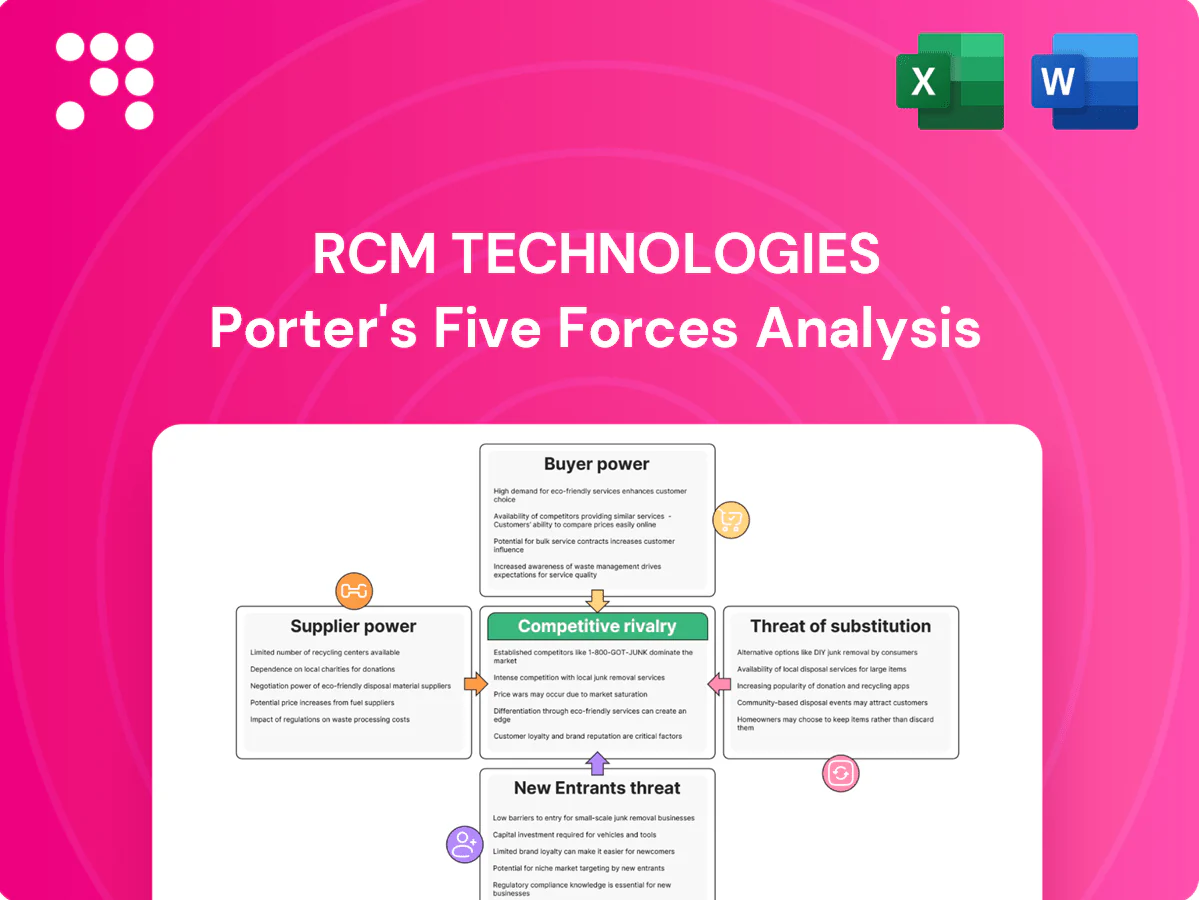
RCM Technologies Porter's Five Forces Analysis

Go Beyond the Preview—Access the Full Strategic Report
RCM Technologies faces intense supplier and buyer dynamics, niche rivalries, and evolving substitute threats that shape its competitive posture. Our snapshot highlights key pressures on margins and market access. This brief snapshot only scratches the surface. Unlock the full Porter's Five Forces Analysis to explore RCM Technologies’s competitive dynamics in detail.
Suppliers Bargaining Power

Specialized talent scarcity
RCM relies on scarce engineers, data scientists, and clinical IT specialists whose 2024 US median pay ranged broadly from about $110k for engineers to $120–150k+ for senior data and clinical IT roles, giving candidates and niche agencies leverage on pay, benefits, and contract terms. Tight 2024 labor markets and reported tech time-to-fill near 50–60 days raise project costs and delay delivery. This elevates supplier power, especially for urgent high-skill hires.
Platform and tool vendors
Dependence on hyperscalers and major software vendors (AWS 32%, Azure 23%, GCP 11% market shares in 2024) creates lock-in and pricing exposure for RCM Technologies. License changes or partner-tier shifts can compress project margins by reducing resale and implementation fees. Vendor certifications dictate deal eligibility and delivery options, and concentration among these platforms amplifies supplier bargaining power.

Regulatory credentials
Life sciences engagements require GxP, HIPAA, validated tools and accredited auditors, and HIPAA civil penalties can reach up to 1,500,000 USD per violation category per year, increasing reliance on compliant suppliers. Providers of validation, accredited tools and training command premium pricing and can exert cost pressure on RCM engagements. Limited substitutes for accredited solutions amplify supplier influence.

Subcontractors and IC networks
RCM relies on subcontractors and independent contractors to meet peak demand, and niche capabilities let these suppliers dictate rates and terms; quality and availability risks increase leverage on time-sensitive projects. With India IT demand up ~8% in 2024 per NASSCOM, supplier bargaining power rose where benches are thin. Diversified benches reduce but do not eliminate this risk.
- Peak cover: subcontractors/ICs
- Rate power: niche skills drive premiums
- Risk: quality/availability in time-sensitive work
- Mitigation: diversified benches—partial relief
Recruiting channels and data
Job boards, sourcing platforms and data providers (LinkedIn ~930M members in 2024; Indeed ~250–300M monthly users) control candidate access and market insights; their fee tiers and API limits materially affect cost-to-hire and time-to-fill. Algorithmic visibility and paid boosts skew outcomes toward paying employers, while reliance on a few channels raises supplier bargaining power and fee pass-through risk.
- Platform reach: LinkedIn 930M (2024)
- Indeed ~250–300M monthly users
- API/fee structures increase cost-to-hire and speed
- Algorithmic visibility favors buyers who pay
- Concentration heightens supplier leverage
Engineer shortages (110k-150k+) and hyperscaler lock-in squeeze sourcing
RCM faces high supplier power from scarce engineers/data scientists (2024 US med pay ~$110k–$150k+), hyperscaler lock-in (AWS 32%, Azure 23%, GCP 11% 2024), compliance vendors with HIPAA fines up to 1,500,000 USD per violation category, and concentrated sourcing platforms (LinkedIn 930M; Indeed 250–300M). Reliance on niche subcontractors raises rates and time-to-fill risk.
| Factor | 2024 datapoint |
|---|---|
| Engineer pay | $110k–$150k+ |
| Hyperscalers | AWS32%/Azure23%/GCP11% |
| Platforms | LinkedIn930M/Indeed250–300M |
What is included in the product
 Detailed Word Document
Tailored Porter’s Five Forces analysis for RCM Technologies, uncovering competition drivers, supplier and buyer power, threats from substitutes and new entrants, and strategic barriers protecting incumbency, with industry data and commentary on disruptive forces and pricing influence.

 Customizable Excel Spreadsheet
RCM Technologies Porter's Five Forces delivers a concise one-sheet summary and interactive spider chart to instantly reveal strategic pressure points, with easy customization for evolving market data and no complex code—perfect for pitch decks, boardrooms, or quick decision-making.
Customers Bargaining Power

Enterprise multi-sourcing
Enterprise multi-sourcing means clients keep panels of IT and engineering vendors, and Gartner 2024 notes multi-sourcing drives side-by-side comparisons that heighten price sensitivity and SLA scrutiny. Easy switching among approved suppliers increases buyer leverage. RCM must differentiate on measurable domain outcomes to resist rate compression and protect margins.
RFP and procurement rigor
In 2024 RFP-driven buying at RCM Technologies standardizes scope and price comparability, compressing supplier bid dispersion and enabling apples-to-apples evaluation. Procurement teams enforce discounts, rebates and contract penalties that lower margins and raise compliance rates. Extended payment terms and structured sourcing amplify buyer power across categories, tightening vendor cash flows and negotiating leverage.

Moderate switching costs
Staff augmentation can be swapped across vendors within weeks, whereas project-based engagements become embedded over months and carry higher yet reversible switching costs. Robust documentation and structured knowledge transfer lower friction over subsequent quarters, shortening handover times. Given low contractual lock-ins and repeat sourcing, buyers retain substantial leverage in pricing and terms.

Outcome-based contracting
- Clients demand milestones, KPIs, risk-sharing
- Shifts delivery risk to vendors, compresses margins
- Real-time performance enables renegotiation/reallocation
- Outcome metrics increase buyer bargaining power
Vendor consolidation
- 2024 trend: vendor consolidation concentrates spend
- Impact: increased price pressure, margin compression
- Tiering: limited access for smaller vendors
- Buyer leverage: dictates terms and tooling
Buyers' 2024 leverage: multi-sourcing, RFP standardization, outcome KPIs shift power
Buyers in 2024 wield strong leverage via multi-sourcing and RFP-standardization, heightening price sensitivity and SLA scrutiny. Easy switching (weeks) for staff augmentation and extended payment terms (60+ days) compress vendor margins. Outcome-based KPIs and real-time visibility enable scope reallocation and renegotiation, concentrating power with large consolidated buyers.
| Metric | 2024 Value |
|---|---|
| Switch time (staff aug) | Weeks |
| Project embed | Months |
| Payment terms | 60+ days |
Same Document Delivered
RCM Technologies Porter's Five Forces Analysis
This preview shows the exact Porter's Five Forces analysis for RCM Technologies you'll receive after purchase—no placeholders or mockups. The full document is fully formatted, professionally written and ready for immediate download and use. Purchase grants instant access to this identical file so you can apply the strategic insights right away.

Go Beyond the Preview—Access the Full Strategic Report
RCM Technologies faces intense supplier and buyer dynamics, niche rivalries, and evolving substitute threats that shape its competitive posture. Our snapshot highlights key pressures on margins and market access. This brief snapshot only scratches the surface. Unlock the full Porter's Five Forces Analysis to explore RCM Technologies’s competitive dynamics in detail.
Suppliers Bargaining Power
Specialized talent scarcity
RCM relies on scarce engineers, data scientists, and clinical IT specialists whose 2024 US median pay ranged broadly from about $110k for engineers to $120–150k+ for senior data and clinical IT roles, giving candidates and niche agencies leverage on pay, benefits, and contract terms. Tight 2024 labor markets and reported tech time-to-fill near 50–60 days raise project costs and delay delivery. This elevates supplier power, especially for urgent high-skill hires.
Platform and tool vendors
Dependence on hyperscalers and major software vendors (AWS 32%, Azure 23%, GCP 11% market shares in 2024) creates lock-in and pricing exposure for RCM Technologies. License changes or partner-tier shifts can compress project margins by reducing resale and implementation fees. Vendor certifications dictate deal eligibility and delivery options, and concentration among these platforms amplifies supplier bargaining power.
Regulatory credentials
Life sciences engagements require GxP, HIPAA, validated tools and accredited auditors, and HIPAA civil penalties can reach up to 1,500,000 USD per violation category per year, increasing reliance on compliant suppliers. Providers of validation, accredited tools and training command premium pricing and can exert cost pressure on RCM engagements. Limited substitutes for accredited solutions amplify supplier influence.
Subcontractors and IC networks
RCM relies on subcontractors and independent contractors to meet peak demand, and niche capabilities let these suppliers dictate rates and terms; quality and availability risks increase leverage on time-sensitive projects. With India IT demand up ~8% in 2024 per NASSCOM, supplier bargaining power rose where benches are thin. Diversified benches reduce but do not eliminate this risk.
- Peak cover: subcontractors/ICs
- Rate power: niche skills drive premiums
- Risk: quality/availability in time-sensitive work
- Mitigation: diversified benches—partial relief
Recruiting channels and data
Job boards, sourcing platforms and data providers (LinkedIn ~930M members in 2024; Indeed ~250–300M monthly users) control candidate access and market insights; their fee tiers and API limits materially affect cost-to-hire and time-to-fill. Algorithmic visibility and paid boosts skew outcomes toward paying employers, while reliance on a few channels raises supplier bargaining power and fee pass-through risk.
- Platform reach: LinkedIn 930M (2024)
- Indeed ~250–300M monthly users
- API/fee structures increase cost-to-hire and speed
- Algorithmic visibility favors buyers who pay
- Concentration heightens supplier leverage
Engineer shortages (110k-150k+) and hyperscaler lock-in squeeze sourcing
RCM faces high supplier power from scarce engineers/data scientists (2024 US med pay ~$110k–$150k+), hyperscaler lock-in (AWS 32%, Azure 23%, GCP 11% 2024), compliance vendors with HIPAA fines up to 1,500,000 USD per violation category, and concentrated sourcing platforms (LinkedIn 930M; Indeed 250–300M). Reliance on niche subcontractors raises rates and time-to-fill risk.
| Factor | 2024 datapoint |
|---|---|
| Engineer pay | $110k–$150k+ |
| Hyperscalers | AWS32%/Azure23%/GCP11% |
| Platforms | LinkedIn930M/Indeed250–300M |
What is included in the product
Detailed Word Document
Tailored Porter’s Five Forces analysis for RCM Technologies, uncovering competition drivers, supplier and buyer power, threats from substitutes and new entrants, and strategic barriers protecting incumbency, with industry data and commentary on disruptive forces and pricing influence.
Customizable Excel Spreadsheet
RCM Technologies Porter's Five Forces delivers a concise one-sheet summary and interactive spider chart to instantly reveal strategic pressure points, with easy customization for evolving market data and no complex code—perfect for pitch decks, boardrooms, or quick decision-making.
Customers Bargaining Power
Enterprise multi-sourcing
Enterprise multi-sourcing means clients keep panels of IT and engineering vendors, and Gartner 2024 notes multi-sourcing drives side-by-side comparisons that heighten price sensitivity and SLA scrutiny. Easy switching among approved suppliers increases buyer leverage. RCM must differentiate on measurable domain outcomes to resist rate compression and protect margins.
RFP and procurement rigor
In 2024 RFP-driven buying at RCM Technologies standardizes scope and price comparability, compressing supplier bid dispersion and enabling apples-to-apples evaluation. Procurement teams enforce discounts, rebates and contract penalties that lower margins and raise compliance rates. Extended payment terms and structured sourcing amplify buyer power across categories, tightening vendor cash flows and negotiating leverage.
Moderate switching costs
Staff augmentation can be swapped across vendors within weeks, whereas project-based engagements become embedded over months and carry higher yet reversible switching costs. Robust documentation and structured knowledge transfer lower friction over subsequent quarters, shortening handover times. Given low contractual lock-ins and repeat sourcing, buyers retain substantial leverage in pricing and terms.
Outcome-based contracting
- Clients demand milestones, KPIs, risk-sharing
- Shifts delivery risk to vendors, compresses margins
- Real-time performance enables renegotiation/reallocation
- Outcome metrics increase buyer bargaining power
Vendor consolidation
- 2024 trend: vendor consolidation concentrates spend
- Impact: increased price pressure, margin compression
- Tiering: limited access for smaller vendors
- Buyer leverage: dictates terms and tooling
Buyers' 2024 leverage: multi-sourcing, RFP standardization, outcome KPIs shift power
Buyers in 2024 wield strong leverage via multi-sourcing and RFP-standardization, heightening price sensitivity and SLA scrutiny. Easy switching (weeks) for staff augmentation and extended payment terms (60+ days) compress vendor margins. Outcome-based KPIs and real-time visibility enable scope reallocation and renegotiation, concentrating power with large consolidated buyers.
| Metric | 2024 Value |
|---|---|
| Switch time (staff aug) | Weeks |
| Project embed | Months |
| Payment terms | 60+ days |
Same Document Delivered
RCM Technologies Porter's Five Forces Analysis
This preview shows the exact Porter's Five Forces analysis for RCM Technologies you'll receive after purchase—no placeholders or mockups. The full document is fully formatted, professionally written and ready for immediate download and use. Purchase grants instant access to this identical file so you can apply the strategic insights right away.
Original: $10.00
-65%$10.00
$3.50Description
Go Beyond the Preview—Access the Full Strategic Report
RCM Technologies faces intense supplier and buyer dynamics, niche rivalries, and evolving substitute threats that shape its competitive posture. Our snapshot highlights key pressures on margins and market access. This brief snapshot only scratches the surface. Unlock the full Porter's Five Forces Analysis to explore RCM Technologies’s competitive dynamics in detail.
Suppliers Bargaining Power
Specialized talent scarcity
RCM relies on scarce engineers, data scientists, and clinical IT specialists whose 2024 US median pay ranged broadly from about $110k for engineers to $120–150k+ for senior data and clinical IT roles, giving candidates and niche agencies leverage on pay, benefits, and contract terms. Tight 2024 labor markets and reported tech time-to-fill near 50–60 days raise project costs and delay delivery. This elevates supplier power, especially for urgent high-skill hires.
Platform and tool vendors
Dependence on hyperscalers and major software vendors (AWS 32%, Azure 23%, GCP 11% market shares in 2024) creates lock-in and pricing exposure for RCM Technologies. License changes or partner-tier shifts can compress project margins by reducing resale and implementation fees. Vendor certifications dictate deal eligibility and delivery options, and concentration among these platforms amplifies supplier bargaining power.
Regulatory credentials
Life sciences engagements require GxP, HIPAA, validated tools and accredited auditors, and HIPAA civil penalties can reach up to 1,500,000 USD per violation category per year, increasing reliance on compliant suppliers. Providers of validation, accredited tools and training command premium pricing and can exert cost pressure on RCM engagements. Limited substitutes for accredited solutions amplify supplier influence.
Subcontractors and IC networks
RCM relies on subcontractors and independent contractors to meet peak demand, and niche capabilities let these suppliers dictate rates and terms; quality and availability risks increase leverage on time-sensitive projects. With India IT demand up ~8% in 2024 per NASSCOM, supplier bargaining power rose where benches are thin. Diversified benches reduce but do not eliminate this risk.
- Peak cover: subcontractors/ICs
- Rate power: niche skills drive premiums
- Risk: quality/availability in time-sensitive work
- Mitigation: diversified benches—partial relief
Recruiting channels and data
Job boards, sourcing platforms and data providers (LinkedIn ~930M members in 2024; Indeed ~250–300M monthly users) control candidate access and market insights; their fee tiers and API limits materially affect cost-to-hire and time-to-fill. Algorithmic visibility and paid boosts skew outcomes toward paying employers, while reliance on a few channels raises supplier bargaining power and fee pass-through risk.
- Platform reach: LinkedIn 930M (2024)
- Indeed ~250–300M monthly users
- API/fee structures increase cost-to-hire and speed
- Algorithmic visibility favors buyers who pay
- Concentration heightens supplier leverage
Engineer shortages (110k-150k+) and hyperscaler lock-in squeeze sourcing
RCM faces high supplier power from scarce engineers/data scientists (2024 US med pay ~$110k–$150k+), hyperscaler lock-in (AWS 32%, Azure 23%, GCP 11% 2024), compliance vendors with HIPAA fines up to 1,500,000 USD per violation category, and concentrated sourcing platforms (LinkedIn 930M; Indeed 250–300M). Reliance on niche subcontractors raises rates and time-to-fill risk.
| Factor | 2024 datapoint |
|---|---|
| Engineer pay | $110k–$150k+ |
| Hyperscalers | AWS32%/Azure23%/GCP11% |
| Platforms | LinkedIn930M/Indeed250–300M |
What is included in the product
Detailed Word Document
Tailored Porter’s Five Forces analysis for RCM Technologies, uncovering competition drivers, supplier and buyer power, threats from substitutes and new entrants, and strategic barriers protecting incumbency, with industry data and commentary on disruptive forces and pricing influence.
Customizable Excel Spreadsheet
RCM Technologies Porter's Five Forces delivers a concise one-sheet summary and interactive spider chart to instantly reveal strategic pressure points, with easy customization for evolving market data and no complex code—perfect for pitch decks, boardrooms, or quick decision-making.
Customers Bargaining Power
Enterprise multi-sourcing
Enterprise multi-sourcing means clients keep panels of IT and engineering vendors, and Gartner 2024 notes multi-sourcing drives side-by-side comparisons that heighten price sensitivity and SLA scrutiny. Easy switching among approved suppliers increases buyer leverage. RCM must differentiate on measurable domain outcomes to resist rate compression and protect margins.
RFP and procurement rigor
In 2024 RFP-driven buying at RCM Technologies standardizes scope and price comparability, compressing supplier bid dispersion and enabling apples-to-apples evaluation. Procurement teams enforce discounts, rebates and contract penalties that lower margins and raise compliance rates. Extended payment terms and structured sourcing amplify buyer power across categories, tightening vendor cash flows and negotiating leverage.
Moderate switching costs
Staff augmentation can be swapped across vendors within weeks, whereas project-based engagements become embedded over months and carry higher yet reversible switching costs. Robust documentation and structured knowledge transfer lower friction over subsequent quarters, shortening handover times. Given low contractual lock-ins and repeat sourcing, buyers retain substantial leverage in pricing and terms.
Outcome-based contracting
- Clients demand milestones, KPIs, risk-sharing
- Shifts delivery risk to vendors, compresses margins
- Real-time performance enables renegotiation/reallocation
- Outcome metrics increase buyer bargaining power
Vendor consolidation
- 2024 trend: vendor consolidation concentrates spend
- Impact: increased price pressure, margin compression
- Tiering: limited access for smaller vendors
- Buyer leverage: dictates terms and tooling
Buyers' 2024 leverage: multi-sourcing, RFP standardization, outcome KPIs shift power
Buyers in 2024 wield strong leverage via multi-sourcing and RFP-standardization, heightening price sensitivity and SLA scrutiny. Easy switching (weeks) for staff augmentation and extended payment terms (60+ days) compress vendor margins. Outcome-based KPIs and real-time visibility enable scope reallocation and renegotiation, concentrating power with large consolidated buyers.
| Metric | 2024 Value |
|---|---|
| Switch time (staff aug) | Weeks |
| Project embed | Months |
| Payment terms | 60+ days |
Same Document Delivered
RCM Technologies Porter's Five Forces Analysis
This preview shows the exact Porter's Five Forces analysis for RCM Technologies you'll receive after purchase—no placeholders or mockups. The full document is fully formatted, professionally written and ready for immediate download and use. Purchase grants instant access to this identical file so you can apply the strategic insights right away.











