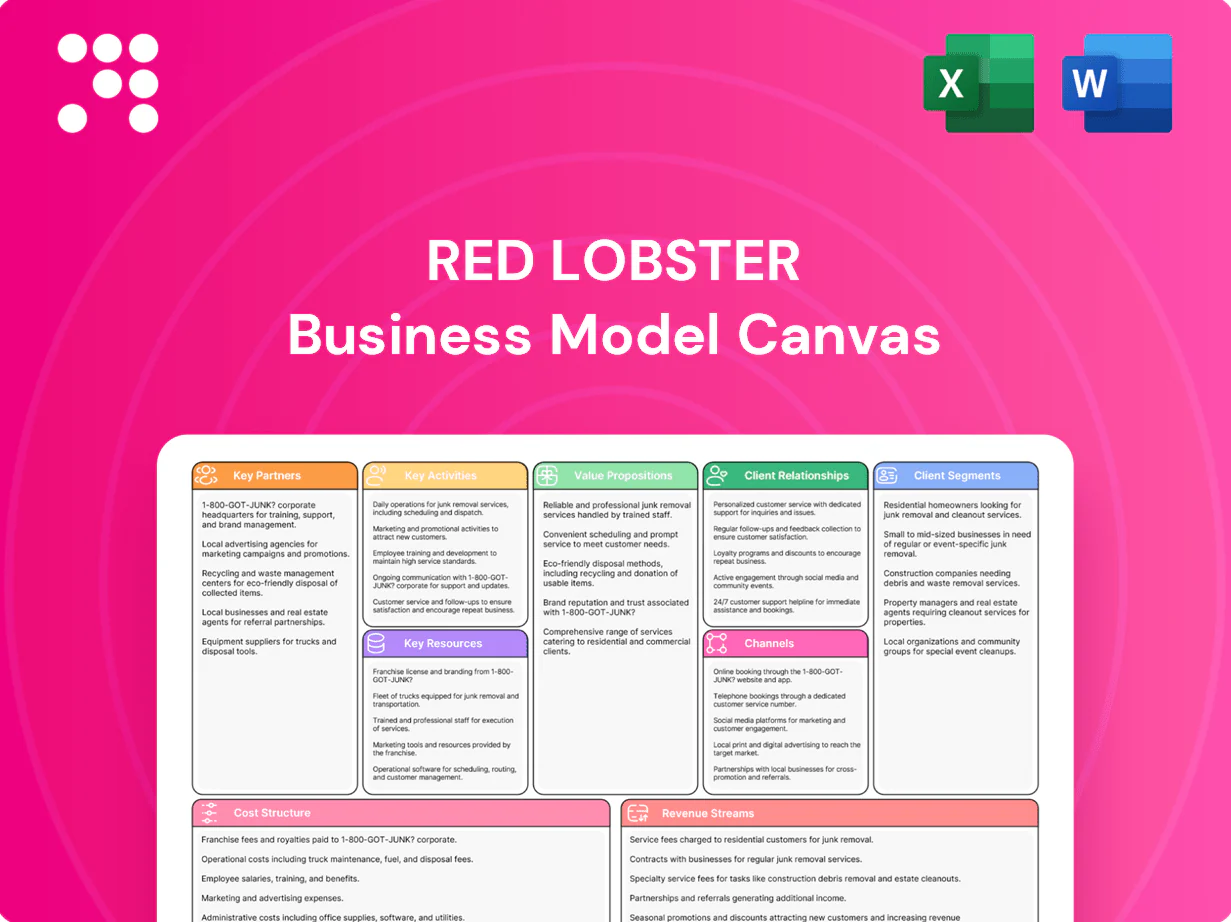
Red Lobster Business Model Canvas

Strategic Business Model Canvas for a seafood casual-dining chain — value, partners, revenue
Unlock the strategic blueprint behind Red Lobster with our concise Business Model Canvas, mapping value propositions, customer segments, and revenue streams. This clear, actionable snapshot reveals how partnerships, menu innovation, and operations drive margins and growth. Purchase the full editable Canvas in Word and Excel for detailed, ready-to-use insights and analysis.
Partnerships

Seafood suppliers and fisheries
Secure, diversified sourcing from certified fisheries ensures consistent supply of lobster, shrimp, crab and finfish, leveraging both wild-capture and aquaculture channels; since 2016 aquaculture has supplied over 50% of seafood for human consumption (FAO). Partner selection emphasizes sustainability certifications such as MSC and ASC and robust traceability systems. Long-term contracts help stabilize pricing and availability. Joint demand planning with suppliers reduces waste and stockouts.
Logistics and cold-chain providers
Refrigerated transport and warehousing preserve seafood quality and safety, critical given global food loss of about one-third of production (FAO). Partners enable just-in-time deliveries across regions to keep inventory low and freshness high at Red Lobster’s network. Real-time temperature monitoring cuts spoilage risk and regulatory recalls, with cold-chain digitization linked to waste reductions up to 30%. Network optimization lowers freight costs and can improve fill rates and utilization by double-digit percentages.

Franchisees and development partners
Franchise operators extend market reach with local execution, supporting Red Lobster’s roughly 700 restaurants across North America (2024). Shared standards and centralized food-safety protocols protect brand consistency and minimize recall risk. Co-investment models accelerate unit growth while lowering corporate capital outlay per new unit. Real-time performance dashboards track sales, margins and compliance to align incentives and drive franchise accountability.

Marketing, media, and delivery platforms
Agencies amplify national promotions like Endless Shrimp across TV, digital and social channels, increasing campaign reach and consistency.
Delivery aggregators expand off-premise demand—DoorDash held about 56% US market share in 2023—driving incremental revenue and convenience-led orders.
Co-op advertising with franchisees boosts local awareness and traffic, while data sharing with partners refines targeting and offer design to lift conversion rates.
Equipment, beverage, and technology vendors
OEM kitchen-equipment partners supply units and preventive maintenance that can cut downtime ~15% and extend equipment life, while beverage suppliers expand menu breadth and deliver manufacturer rebates typically in the 3-5% range of beverage spend (2024). POS, loyalty, and reservation tech partners drive operations and analytics, with loyalty programs lifting AOV ~8-12% in dining chains (2024). Joint pilots with vendors accelerate innovation and national rollouts, often reducing go-to-market time by ~30%.
- OEMs: uptime +15%
- Beverage rebates: 3-5% of spend
- POS/loyalty: AOV +8-12%
- Joint pilots: rollout time -30%
Partner Networks and Cold-Chain Drive Sustainable Growth, Faster Rollouts, Less Waste
Strategic suppliers, cold-chain logistics, franchisees, agencies, aggregators and tech/OEM partners secure supply, quality, distribution and demand; sustainability certifications and long-term contracts stabilize costs and availability. Joint planning, co-op advertising, delivery platforms and POS/loyalty partnerships drive sales, reduce waste and speed rollouts.
| Partner | Role | KPI |
|---|---|---|
| Suppliers | Supply & sustainability | Aquaculture >50% (2016 FAO) |
| Cold-chain | Quality | Waste -30% |
| Franchisees | Local ops | ~700 units (2024) |
| Aggregators | Off-premise | DoorDash ~56% (2023) |
| POS/Loyalty | Revenue uplift | AOV +8-12% (2024) |
| OEMs | Equipment | Uptime +15% |
What is included in the product
 Detailed Word Document
A comprehensive Business Model Canvas for Red Lobster detailing customer segments, value propositions, channels, revenue streams and cost structure, organized into 9 BMC blocks with strategic insights and SWOT-linked analysis for investors and managers.

 Customizable Excel Spreadsheet
High-level view of Red Lobster’s business model with editable cells—quickly identify operational pain points, cost drivers, and franchise/channel gaps to streamline menu strategy, reduce waste, and align customer value across locations.
Activities

Menu development and culinary innovation
R&D balances core seafood favorites with seasonal and value items, using taste, cost and kitchen-throughput testing to validate offerings. Supplier input informs feasibility and yield to control COGS and shrink. Continuous menu refresh sustains guest interest and frequency. This aligns with U.S. per-capita seafood consumption of 16.1 lb (NOAA 2022).
Restaurant operations and service execution
Daily prep, cooking and table service—focused on peak dinner windows (6–9 pm)—drive guest satisfaction through consistent execution. Line checks and HACCP protocols (hot holding >135°F, cold <41°F; 4-hour temperature checks) ensure safety. Labor scheduling aligns to traffic curves to control labor percent and maintain service levels. Ongoing training sustains standards in 2024.

Supply chain and inventory management
Forecasting aligns purchases with promotions and seasonality to reduce stockouts and waste, targeting a ~12% reduction in perishables loss in 2024. Cold-chain integrity holds seafood at ≤4°C through distribution to minimize spoilage. SKU rationalization has trimmed back-of-house items by about 20%, simplifying operations and lowering carrying costs. Vendor scorecards drive >95% on-time delivery and standardized quality metrics.

Marketing and promotions management
Red Lobster leverages campaigns like Endless Shrimp to boost traffic and drive repeat visits, with 2024 rollouts focused on limited-time offers and loyalty tie-ins. CRM segments guests by behavior and occasion to deliver targeted offers and increase redemption rates. Social and local media amplify awareness while granular ROI tracking refines media spend and creative allocation.
- Campaigns: Endless Shrimp—limited-time offers tied to loyalty
- CRM: segmentation by behavior and occasion
- Channels: social + local media for awareness
- Measurement: ROI tracking to optimize spend
Franchise support and quality assurance
Field audits enforce brand and food-safety standards through regular inspections across roughly 600 Red Lobster locations in the US and Canada (2024); standardized playbooks and continuous training sustain operational consistency; centralized procurement leverages scale for lower COGS and supplier terms; unit-level benchmarking surfaces best practices and operational gaps for targeted remediation.
- audits: quarterly inspections
- training: standardized playbooks
- procurement: centralized buying
- benchmarking: unit performance comparisons
R&D trims SKUs -20%, scales to ~600 stores, per-capita 16.1 lb
R&D balances core seafood and LTOs using cost and throughput testing; per-capita seafood 16.1 lb (NOAA 2022). Daypart-focused prep and HACCP controls (hot >135°F, cold <41°F; distribution ≤4°C) sustain safety and service across ~600 stores (2024). Forecasting, SKU rationalization (−20%), and vendor scorecards (>95% OTIF) cut waste (~12% target) and COGS.
| Metric | 2024 |
|---|---|
| Stores | ~600 |
| Per-capita seafood | 16.1 lb (NOAA 2022) |
| SKU reduction | 20% |
| Perishables loss target | −12% |
| OTIF | >95% |
Delivered as Displayed
Business Model Canvas
The document you're previewing is the actual Red Lobster Business Model Canvas—not a mockup. When you purchase, you’ll receive this exact file with all content included. The delivered document is ready-to-use and editable in Word and Excel.

Strategic Business Model Canvas for a seafood casual-dining chain — value, partners, revenue
Unlock the strategic blueprint behind Red Lobster with our concise Business Model Canvas, mapping value propositions, customer segments, and revenue streams. This clear, actionable snapshot reveals how partnerships, menu innovation, and operations drive margins and growth. Purchase the full editable Canvas in Word and Excel for detailed, ready-to-use insights and analysis.
Partnerships
Seafood suppliers and fisheries
Secure, diversified sourcing from certified fisheries ensures consistent supply of lobster, shrimp, crab and finfish, leveraging both wild-capture and aquaculture channels; since 2016 aquaculture has supplied over 50% of seafood for human consumption (FAO). Partner selection emphasizes sustainability certifications such as MSC and ASC and robust traceability systems. Long-term contracts help stabilize pricing and availability. Joint demand planning with suppliers reduces waste and stockouts.
Logistics and cold-chain providers
Refrigerated transport and warehousing preserve seafood quality and safety, critical given global food loss of about one-third of production (FAO). Partners enable just-in-time deliveries across regions to keep inventory low and freshness high at Red Lobster’s network. Real-time temperature monitoring cuts spoilage risk and regulatory recalls, with cold-chain digitization linked to waste reductions up to 30%. Network optimization lowers freight costs and can improve fill rates and utilization by double-digit percentages.
Franchisees and development partners
Franchise operators extend market reach with local execution, supporting Red Lobster’s roughly 700 restaurants across North America (2024). Shared standards and centralized food-safety protocols protect brand consistency and minimize recall risk. Co-investment models accelerate unit growth while lowering corporate capital outlay per new unit. Real-time performance dashboards track sales, margins and compliance to align incentives and drive franchise accountability.
Marketing, media, and delivery platforms
Agencies amplify national promotions like Endless Shrimp across TV, digital and social channels, increasing campaign reach and consistency.
Delivery aggregators expand off-premise demand—DoorDash held about 56% US market share in 2023—driving incremental revenue and convenience-led orders.
Co-op advertising with franchisees boosts local awareness and traffic, while data sharing with partners refines targeting and offer design to lift conversion rates.
Equipment, beverage, and technology vendors
OEM kitchen-equipment partners supply units and preventive maintenance that can cut downtime ~15% and extend equipment life, while beverage suppliers expand menu breadth and deliver manufacturer rebates typically in the 3-5% range of beverage spend (2024). POS, loyalty, and reservation tech partners drive operations and analytics, with loyalty programs lifting AOV ~8-12% in dining chains (2024). Joint pilots with vendors accelerate innovation and national rollouts, often reducing go-to-market time by ~30%.
- OEMs: uptime +15%
- Beverage rebates: 3-5% of spend
- POS/loyalty: AOV +8-12%
- Joint pilots: rollout time -30%
Partner Networks and Cold-Chain Drive Sustainable Growth, Faster Rollouts, Less Waste
Strategic suppliers, cold-chain logistics, franchisees, agencies, aggregators and tech/OEM partners secure supply, quality, distribution and demand; sustainability certifications and long-term contracts stabilize costs and availability. Joint planning, co-op advertising, delivery platforms and POS/loyalty partnerships drive sales, reduce waste and speed rollouts.
| Partner | Role | KPI |
|---|---|---|
| Suppliers | Supply & sustainability | Aquaculture >50% (2016 FAO) |
| Cold-chain | Quality | Waste -30% |
| Franchisees | Local ops | ~700 units (2024) |
| Aggregators | Off-premise | DoorDash ~56% (2023) |
| POS/Loyalty | Revenue uplift | AOV +8-12% (2024) |
| OEMs | Equipment | Uptime +15% |
What is included in the product
Detailed Word Document
A comprehensive Business Model Canvas for Red Lobster detailing customer segments, value propositions, channels, revenue streams and cost structure, organized into 9 BMC blocks with strategic insights and SWOT-linked analysis for investors and managers.
Customizable Excel Spreadsheet
High-level view of Red Lobster’s business model with editable cells—quickly identify operational pain points, cost drivers, and franchise/channel gaps to streamline menu strategy, reduce waste, and align customer value across locations.
Activities
Menu development and culinary innovation
R&D balances core seafood favorites with seasonal and value items, using taste, cost and kitchen-throughput testing to validate offerings. Supplier input informs feasibility and yield to control COGS and shrink. Continuous menu refresh sustains guest interest and frequency. This aligns with U.S. per-capita seafood consumption of 16.1 lb (NOAA 2022).
Restaurant operations and service execution
Daily prep, cooking and table service—focused on peak dinner windows (6–9 pm)—drive guest satisfaction through consistent execution. Line checks and HACCP protocols (hot holding >135°F, cold <41°F; 4-hour temperature checks) ensure safety. Labor scheduling aligns to traffic curves to control labor percent and maintain service levels. Ongoing training sustains standards in 2024.
Supply chain and inventory management
Forecasting aligns purchases with promotions and seasonality to reduce stockouts and waste, targeting a ~12% reduction in perishables loss in 2024. Cold-chain integrity holds seafood at ≤4°C through distribution to minimize spoilage. SKU rationalization has trimmed back-of-house items by about 20%, simplifying operations and lowering carrying costs. Vendor scorecards drive >95% on-time delivery and standardized quality metrics.
Marketing and promotions management
Red Lobster leverages campaigns like Endless Shrimp to boost traffic and drive repeat visits, with 2024 rollouts focused on limited-time offers and loyalty tie-ins. CRM segments guests by behavior and occasion to deliver targeted offers and increase redemption rates. Social and local media amplify awareness while granular ROI tracking refines media spend and creative allocation.
- Campaigns: Endless Shrimp—limited-time offers tied to loyalty
- CRM: segmentation by behavior and occasion
- Channels: social + local media for awareness
- Measurement: ROI tracking to optimize spend
Franchise support and quality assurance
Field audits enforce brand and food-safety standards through regular inspections across roughly 600 Red Lobster locations in the US and Canada (2024); standardized playbooks and continuous training sustain operational consistency; centralized procurement leverages scale for lower COGS and supplier terms; unit-level benchmarking surfaces best practices and operational gaps for targeted remediation.
- audits: quarterly inspections
- training: standardized playbooks
- procurement: centralized buying
- benchmarking: unit performance comparisons
R&D trims SKUs -20%, scales to ~600 stores, per-capita 16.1 lb
R&D balances core seafood and LTOs using cost and throughput testing; per-capita seafood 16.1 lb (NOAA 2022). Daypart-focused prep and HACCP controls (hot >135°F, cold <41°F; distribution ≤4°C) sustain safety and service across ~600 stores (2024). Forecasting, SKU rationalization (−20%), and vendor scorecards (>95% OTIF) cut waste (~12% target) and COGS.
| Metric | 2024 |
|---|---|
| Stores | ~600 |
| Per-capita seafood | 16.1 lb (NOAA 2022) |
| SKU reduction | 20% |
| Perishables loss target | −12% |
| OTIF | >95% |
Delivered as Displayed
Business Model Canvas
The document you're previewing is the actual Red Lobster Business Model Canvas—not a mockup. When you purchase, you’ll receive this exact file with all content included. The delivered document is ready-to-use and editable in Word and Excel.
Original: $10.00
-65%$10.00
$3.50Description
Strategic Business Model Canvas for a seafood casual-dining chain — value, partners, revenue
Unlock the strategic blueprint behind Red Lobster with our concise Business Model Canvas, mapping value propositions, customer segments, and revenue streams. This clear, actionable snapshot reveals how partnerships, menu innovation, and operations drive margins and growth. Purchase the full editable Canvas in Word and Excel for detailed, ready-to-use insights and analysis.
Partnerships
Seafood suppliers and fisheries
Secure, diversified sourcing from certified fisheries ensures consistent supply of lobster, shrimp, crab and finfish, leveraging both wild-capture and aquaculture channels; since 2016 aquaculture has supplied over 50% of seafood for human consumption (FAO). Partner selection emphasizes sustainability certifications such as MSC and ASC and robust traceability systems. Long-term contracts help stabilize pricing and availability. Joint demand planning with suppliers reduces waste and stockouts.
Logistics and cold-chain providers
Refrigerated transport and warehousing preserve seafood quality and safety, critical given global food loss of about one-third of production (FAO). Partners enable just-in-time deliveries across regions to keep inventory low and freshness high at Red Lobster’s network. Real-time temperature monitoring cuts spoilage risk and regulatory recalls, with cold-chain digitization linked to waste reductions up to 30%. Network optimization lowers freight costs and can improve fill rates and utilization by double-digit percentages.
Franchisees and development partners
Franchise operators extend market reach with local execution, supporting Red Lobster’s roughly 700 restaurants across North America (2024). Shared standards and centralized food-safety protocols protect brand consistency and minimize recall risk. Co-investment models accelerate unit growth while lowering corporate capital outlay per new unit. Real-time performance dashboards track sales, margins and compliance to align incentives and drive franchise accountability.
Marketing, media, and delivery platforms
Agencies amplify national promotions like Endless Shrimp across TV, digital and social channels, increasing campaign reach and consistency.
Delivery aggregators expand off-premise demand—DoorDash held about 56% US market share in 2023—driving incremental revenue and convenience-led orders.
Co-op advertising with franchisees boosts local awareness and traffic, while data sharing with partners refines targeting and offer design to lift conversion rates.
Equipment, beverage, and technology vendors
OEM kitchen-equipment partners supply units and preventive maintenance that can cut downtime ~15% and extend equipment life, while beverage suppliers expand menu breadth and deliver manufacturer rebates typically in the 3-5% range of beverage spend (2024). POS, loyalty, and reservation tech partners drive operations and analytics, with loyalty programs lifting AOV ~8-12% in dining chains (2024). Joint pilots with vendors accelerate innovation and national rollouts, often reducing go-to-market time by ~30%.
- OEMs: uptime +15%
- Beverage rebates: 3-5% of spend
- POS/loyalty: AOV +8-12%
- Joint pilots: rollout time -30%
Partner Networks and Cold-Chain Drive Sustainable Growth, Faster Rollouts, Less Waste
Strategic suppliers, cold-chain logistics, franchisees, agencies, aggregators and tech/OEM partners secure supply, quality, distribution and demand; sustainability certifications and long-term contracts stabilize costs and availability. Joint planning, co-op advertising, delivery platforms and POS/loyalty partnerships drive sales, reduce waste and speed rollouts.
| Partner | Role | KPI |
|---|---|---|
| Suppliers | Supply & sustainability | Aquaculture >50% (2016 FAO) |
| Cold-chain | Quality | Waste -30% |
| Franchisees | Local ops | ~700 units (2024) |
| Aggregators | Off-premise | DoorDash ~56% (2023) |
| POS/Loyalty | Revenue uplift | AOV +8-12% (2024) |
| OEMs | Equipment | Uptime +15% |
What is included in the product
Detailed Word Document
A comprehensive Business Model Canvas for Red Lobster detailing customer segments, value propositions, channels, revenue streams and cost structure, organized into 9 BMC blocks with strategic insights and SWOT-linked analysis for investors and managers.
Customizable Excel Spreadsheet
High-level view of Red Lobster’s business model with editable cells—quickly identify operational pain points, cost drivers, and franchise/channel gaps to streamline menu strategy, reduce waste, and align customer value across locations.
Activities
Menu development and culinary innovation
R&D balances core seafood favorites with seasonal and value items, using taste, cost and kitchen-throughput testing to validate offerings. Supplier input informs feasibility and yield to control COGS and shrink. Continuous menu refresh sustains guest interest and frequency. This aligns with U.S. per-capita seafood consumption of 16.1 lb (NOAA 2022).
Restaurant operations and service execution
Daily prep, cooking and table service—focused on peak dinner windows (6–9 pm)—drive guest satisfaction through consistent execution. Line checks and HACCP protocols (hot holding >135°F, cold <41°F; 4-hour temperature checks) ensure safety. Labor scheduling aligns to traffic curves to control labor percent and maintain service levels. Ongoing training sustains standards in 2024.
Supply chain and inventory management
Forecasting aligns purchases with promotions and seasonality to reduce stockouts and waste, targeting a ~12% reduction in perishables loss in 2024. Cold-chain integrity holds seafood at ≤4°C through distribution to minimize spoilage. SKU rationalization has trimmed back-of-house items by about 20%, simplifying operations and lowering carrying costs. Vendor scorecards drive >95% on-time delivery and standardized quality metrics.
Marketing and promotions management
Red Lobster leverages campaigns like Endless Shrimp to boost traffic and drive repeat visits, with 2024 rollouts focused on limited-time offers and loyalty tie-ins. CRM segments guests by behavior and occasion to deliver targeted offers and increase redemption rates. Social and local media amplify awareness while granular ROI tracking refines media spend and creative allocation.
- Campaigns: Endless Shrimp—limited-time offers tied to loyalty
- CRM: segmentation by behavior and occasion
- Channels: social + local media for awareness
- Measurement: ROI tracking to optimize spend
Franchise support and quality assurance
Field audits enforce brand and food-safety standards through regular inspections across roughly 600 Red Lobster locations in the US and Canada (2024); standardized playbooks and continuous training sustain operational consistency; centralized procurement leverages scale for lower COGS and supplier terms; unit-level benchmarking surfaces best practices and operational gaps for targeted remediation.
- audits: quarterly inspections
- training: standardized playbooks
- procurement: centralized buying
- benchmarking: unit performance comparisons
R&D trims SKUs -20%, scales to ~600 stores, per-capita 16.1 lb
R&D balances core seafood and LTOs using cost and throughput testing; per-capita seafood 16.1 lb (NOAA 2022). Daypart-focused prep and HACCP controls (hot >135°F, cold <41°F; distribution ≤4°C) sustain safety and service across ~600 stores (2024). Forecasting, SKU rationalization (−20%), and vendor scorecards (>95% OTIF) cut waste (~12% target) and COGS.
| Metric | 2024 |
|---|---|
| Stores | ~600 |
| Per-capita seafood | 16.1 lb (NOAA 2022) |
| SKU reduction | 20% |
| Perishables loss target | −12% |
| OTIF | >95% |
Delivered as Displayed
Business Model Canvas
The document you're previewing is the actual Red Lobster Business Model Canvas—not a mockup. When you purchase, you’ll receive this exact file with all content included. The delivered document is ready-to-use and editable in Word and Excel.











