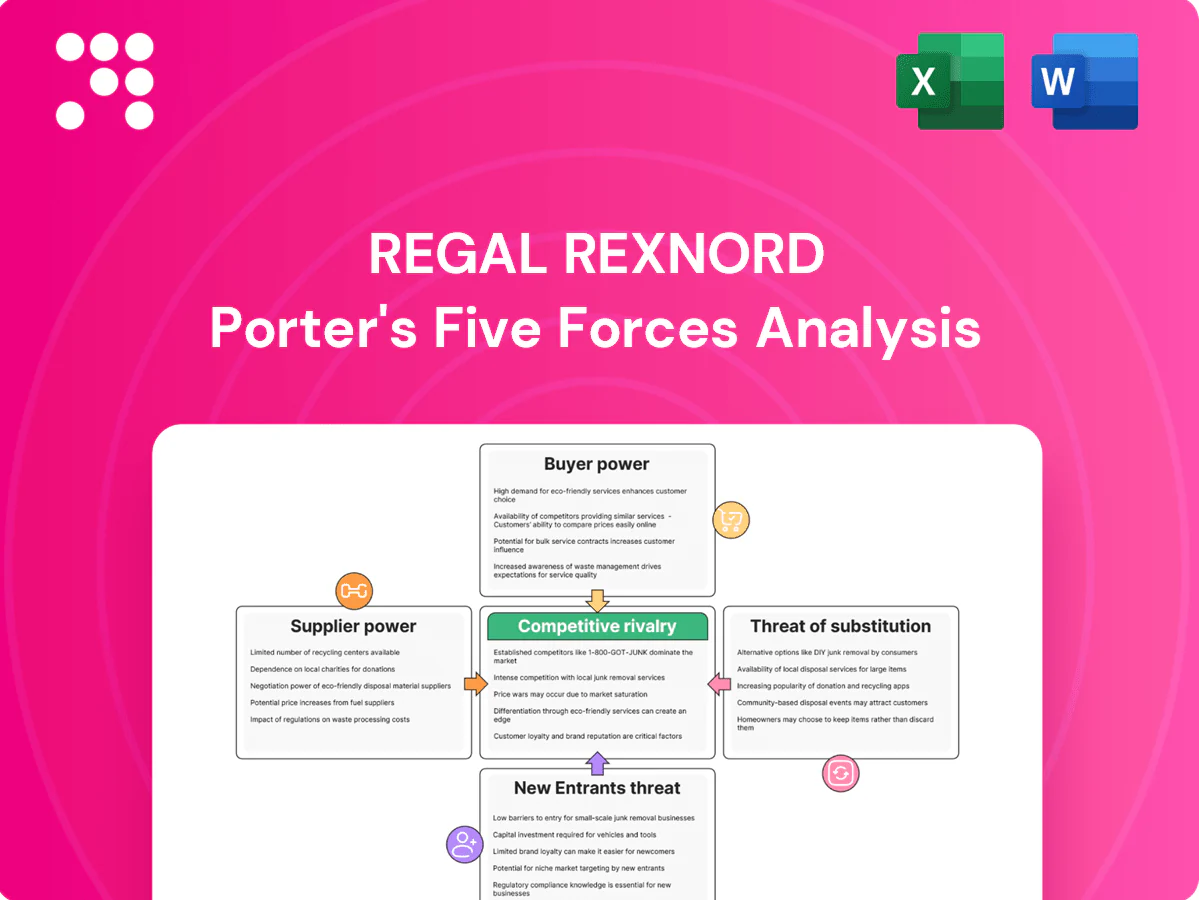
Regal Rexnord Porter's Five Forces Analysis

From Overview to Strategy Blueprint
Regal Rexnord faces moderate competitive rivalry, shifting supplier leverage, and evolving substitute threats as it navigates industrial markets and aftermarket demand. This brief highlights key pressure points and strategic levers but only scratches the surface. Unlock the full Porter's Five Forces Analysis to see force-by-force ratings, visuals, and actionable insights to inform investment or strategy decisions.
Suppliers Bargaining Power

Specialized materials dependence
Dependence on high-grade steel, rare-earth magnets and precision electronics narrows Regal Rexnord’s supplier base and raises bargaining power of vendors. China supplies over 70% of rare-earth material processing (2024), limiting alternatives and increasing lead-time risk. Even short disruptions quickly raise input costs and delay deliveries. Dual-sourcing reduces risk but cannot fully eliminate scarcity premiums.
Concentrated component vendors
Key inputs like bearings, castings and power electronics for Regal Rexnord come from a small set of qualified vendors, concentrating supply and elevating supplier bargaining power. Vendor concentration strengthens pricing leverage during tight capacity cycles and can lead to allocation priority for incumbents. Long qualification cycles often exceed 12 months, limiting rapid switching and entrenching supplier influence on terms and allocations.

Quality and certification lock-in
Industrial and aerospace applications demand certified, traceable inputs; as of 2024 AS9100 and NADCAP remain standard certification requirements for many OEMs. Requalification, batch traceability and third‑party audits substantially increase switching friction and timeline. Suppliers that meet stringent specs therefore obtain pricing and delivery leverage, while component failures carry acute warranty and reputational risk that reinforces dependence.

Logistics and energy cost pass-through
Suppliers can and do pass higher energy, freight and commodity costs onto OEMs, and in 2024 freight and surcharge recoveries remained a key channel for passthrough as spot sea freight rates normalized from 2022 peaks.
Volatility in metals and semiconductors continues to pressure margins when contracts lack hedges; surcharges implemented during tight markets often remain sticky even as spot prices ease.
Long-term supply agreements and indexed pass-through clauses mitigate but rarely eliminate exposure, leaving residual commodity and freight risk in operating margins.
- Suppliers pass energy, freight, commodity costs
- Metals/semiconductor volatility pressures unhedged margins
- Surcharges can be sticky post-spot easing
- Long-term contracts mitigate but do not remove exposure
Mitigation via scale and integration
Regal Rexnord’s scale (over $7 billion in 2024 revenue) enables volume commitments and collaborative planning with suppliers, lowering per-unit costs and improving lead-time predictability. In-house machining and assembly reduce exposure to external bottlenecks and support near-term flexibility. Vendor-managed inventory and targeted strategic buffers cut stockout risk, though suppliers of specialized components retain pricing and timing leverage.
- Scale: >$7B 2024 revenue
- Integration: in-house machining/assembly
- Inventory: VMI + strategic buffers
- Risk: specialized-component supplier leverage
Supplier leverage from rare-earth (>70%) and input surcharges squeeze margins despite >$7B scale
Regal Rexnord faces elevated supplier bargaining power due to reliance on high-grade steel, rare-earth magnets (China >70% processing 2024) and specialized electronics; qualification cycles >12 months limit switching. Suppliers pass energy, freight and commodity surcharges that often remain sticky, pressuring unhedged margins. Scale (>$7B revenue 2024), in-house machining and VMI mitigate but do not remove supplier leverage.
| Metric | 2024 |
|---|---|
| Rare-earth processing share | >70% |
| Revenue | >$7B |
| Qualification time | >12 months |
| Hedge exposure | Residual commodity/freight risk |
What is included in the product
 Detailed Word Document
Tailored Porter's Five Forces analysis for Regal Rexnord, uncovering rivalry, supplier and buyer power, entry barriers, and substitution threats that shape its pricing and profitability. Identifies disruptive trends and strategic levers to defend market share.

 Customizable Excel Spreadsheet
A clear, one-sheet Porter's Five Forces summary for Regal Rexnord—perfect for quick strategic decisions and investor briefings.
Customers Bargaining Power

Large OEM and distributor leverage
Major OEMs and global distributors negotiate price, lead times, and service with Regal Rexnord, leveraging volume concentration to secure rebates and priority — in fiscal 2024 Regal Rexnord reported $6.4 billion in net sales, with concentrated account wins amplifying bargaining power.
High buyer concentration lets large customers shift share among qualified suppliers, exerting downward pressure on margins and driving R&D and service commitments, especially acute in standardized product lines where product differentiation is limited.
Specification-driven switching costs
Custom-engineered motors and gearboxes are embedded into customer equipment, so redesign, retesting and downtime materially raise switching costs. Industry 2024 metrics show purchase price often ≈20% of total lifecycle cost while operations and downtime account for ≈80%, so lifecycle performance and reliability outweigh initial price. In high-spec applications this materially tempers buyer bargaining power.

Aftermarket and MRO resilience
Aftermarket and MRO resilience limits customer bargaining: recurring demand for replacement and service parts has lower price elasticity, with the global industrial MRO market estimated at about $600 billion in 2024, concentrating value on incumbents. Form-fit-function compatibility and warranty obligations favor OEMs, reducing switches even when price differs modestly. In critical maintenance windows, lead time and availability typically outweigh small savings, compressing buyer leverage.

Performance and compliance priorities
Energy efficiency, safety, and regulatory compliance drive buyer leverage at Regal Rexnord: electric motors represent about 45% of industrial electricity use, so purchasers pay roughly 8–12% premiums for IE3/IE4 motors that cut energy use 8–15% versus lower classes, and accept higher spend for low-noise designs and certification-backed safety.
- IE3/IE4 premium: 8–12%
- Energy savings: 8–15%
- Noise reduction: ~3–5 dB
- Payback horizon: documented ROI 1–3 years
Cyclical demand and project timing
Industrial cycles shift buyer aggressiveness on price and terms; during the 2024 slowdown Regal Rexnord saw order cadence compress, intensifying competitive bids and frame-contract concessions.
In tight 2024 markets buyers accepted longer lead times and surcharges; project deadlines often curtailed switching despite available alternatives.
- 2024 note: order volatility rose; buyers pushed harder on contract terms
- Project deadlines reduced effective switching
Aftermarket MRO and high switching costs blunt OEM price power; $6.4B
Large OEMs and global distributors exert strong price and service leverage against Regal Rexnord—company reported $6.4B net sales in fiscal 2024—yet concentrated aftermarket and MRO demand cushions margins. High switching costs and lifecycle cost focus (purchase ≈20%, operations/downtime ≈80%) reduce effective buyer power for critical applications. Energy-efficiency premiums (IE3/IE4 8–12%) and warranty/compatibility further constrain switches.
| Metric | Value | 2024 Note |
|---|---|---|
| Regal Rexnord net sales | $6.4B | Fiscal 2024 |
| Global industrial MRO | $600B | 2024 estimate |
| Lifecycle cost split | Purchase 20% / Ops 80% | Industry metric |
| IE3/IE4 premium | 8–12% | Energy-efficiency pricing |
Same Document Delivered
Regal Rexnord Porter's Five Forces Analysis
This Regal Rexnord Porter’s Five Forces Analysis preview is the exact, fully formatted document you’ll receive upon purchase—no placeholders or mockups. It provides a complete competitive assessment ready for immediate download and use. Purchase grants instant access to this same file.

From Overview to Strategy Blueprint
Regal Rexnord faces moderate competitive rivalry, shifting supplier leverage, and evolving substitute threats as it navigates industrial markets and aftermarket demand. This brief highlights key pressure points and strategic levers but only scratches the surface. Unlock the full Porter's Five Forces Analysis to see force-by-force ratings, visuals, and actionable insights to inform investment or strategy decisions.
Suppliers Bargaining Power
Specialized materials dependence
Dependence on high-grade steel, rare-earth magnets and precision electronics narrows Regal Rexnord’s supplier base and raises bargaining power of vendors. China supplies over 70% of rare-earth material processing (2024), limiting alternatives and increasing lead-time risk. Even short disruptions quickly raise input costs and delay deliveries. Dual-sourcing reduces risk but cannot fully eliminate scarcity premiums.
Concentrated component vendors
Key inputs like bearings, castings and power electronics for Regal Rexnord come from a small set of qualified vendors, concentrating supply and elevating supplier bargaining power. Vendor concentration strengthens pricing leverage during tight capacity cycles and can lead to allocation priority for incumbents. Long qualification cycles often exceed 12 months, limiting rapid switching and entrenching supplier influence on terms and allocations.
Quality and certification lock-in
Industrial and aerospace applications demand certified, traceable inputs; as of 2024 AS9100 and NADCAP remain standard certification requirements for many OEMs. Requalification, batch traceability and third‑party audits substantially increase switching friction and timeline. Suppliers that meet stringent specs therefore obtain pricing and delivery leverage, while component failures carry acute warranty and reputational risk that reinforces dependence.
Logistics and energy cost pass-through
Suppliers can and do pass higher energy, freight and commodity costs onto OEMs, and in 2024 freight and surcharge recoveries remained a key channel for passthrough as spot sea freight rates normalized from 2022 peaks.
Volatility in metals and semiconductors continues to pressure margins when contracts lack hedges; surcharges implemented during tight markets often remain sticky even as spot prices ease.
Long-term supply agreements and indexed pass-through clauses mitigate but rarely eliminate exposure, leaving residual commodity and freight risk in operating margins.
- Suppliers pass energy, freight, commodity costs
- Metals/semiconductor volatility pressures unhedged margins
- Surcharges can be sticky post-spot easing
- Long-term contracts mitigate but do not remove exposure
Mitigation via scale and integration
Regal Rexnord’s scale (over $7 billion in 2024 revenue) enables volume commitments and collaborative planning with suppliers, lowering per-unit costs and improving lead-time predictability. In-house machining and assembly reduce exposure to external bottlenecks and support near-term flexibility. Vendor-managed inventory and targeted strategic buffers cut stockout risk, though suppliers of specialized components retain pricing and timing leverage.
- Scale: >$7B 2024 revenue
- Integration: in-house machining/assembly
- Inventory: VMI + strategic buffers
- Risk: specialized-component supplier leverage
Supplier leverage from rare-earth (>70%) and input surcharges squeeze margins despite >$7B scale
Regal Rexnord faces elevated supplier bargaining power due to reliance on high-grade steel, rare-earth magnets (China >70% processing 2024) and specialized electronics; qualification cycles >12 months limit switching. Suppliers pass energy, freight and commodity surcharges that often remain sticky, pressuring unhedged margins. Scale (>$7B revenue 2024), in-house machining and VMI mitigate but do not remove supplier leverage.
| Metric | 2024 |
|---|---|
| Rare-earth processing share | >70% |
| Revenue | >$7B |
| Qualification time | >12 months |
| Hedge exposure | Residual commodity/freight risk |
What is included in the product
Detailed Word Document
Tailored Porter's Five Forces analysis for Regal Rexnord, uncovering rivalry, supplier and buyer power, entry barriers, and substitution threats that shape its pricing and profitability. Identifies disruptive trends and strategic levers to defend market share.
Customizable Excel Spreadsheet
A clear, one-sheet Porter's Five Forces summary for Regal Rexnord—perfect for quick strategic decisions and investor briefings.
Customers Bargaining Power
Large OEM and distributor leverage
Major OEMs and global distributors negotiate price, lead times, and service with Regal Rexnord, leveraging volume concentration to secure rebates and priority — in fiscal 2024 Regal Rexnord reported $6.4 billion in net sales, with concentrated account wins amplifying bargaining power.
High buyer concentration lets large customers shift share among qualified suppliers, exerting downward pressure on margins and driving R&D and service commitments, especially acute in standardized product lines where product differentiation is limited.
Specification-driven switching costs
Custom-engineered motors and gearboxes are embedded into customer equipment, so redesign, retesting and downtime materially raise switching costs. Industry 2024 metrics show purchase price often ≈20% of total lifecycle cost while operations and downtime account for ≈80%, so lifecycle performance and reliability outweigh initial price. In high-spec applications this materially tempers buyer bargaining power.
Aftermarket and MRO resilience
Aftermarket and MRO resilience limits customer bargaining: recurring demand for replacement and service parts has lower price elasticity, with the global industrial MRO market estimated at about $600 billion in 2024, concentrating value on incumbents. Form-fit-function compatibility and warranty obligations favor OEMs, reducing switches even when price differs modestly. In critical maintenance windows, lead time and availability typically outweigh small savings, compressing buyer leverage.
Performance and compliance priorities
Energy efficiency, safety, and regulatory compliance drive buyer leverage at Regal Rexnord: electric motors represent about 45% of industrial electricity use, so purchasers pay roughly 8–12% premiums for IE3/IE4 motors that cut energy use 8–15% versus lower classes, and accept higher spend for low-noise designs and certification-backed safety.
- IE3/IE4 premium: 8–12%
- Energy savings: 8–15%
- Noise reduction: ~3–5 dB
- Payback horizon: documented ROI 1–3 years
Cyclical demand and project timing
Industrial cycles shift buyer aggressiveness on price and terms; during the 2024 slowdown Regal Rexnord saw order cadence compress, intensifying competitive bids and frame-contract concessions.
In tight 2024 markets buyers accepted longer lead times and surcharges; project deadlines often curtailed switching despite available alternatives.
- 2024 note: order volatility rose; buyers pushed harder on contract terms
- Project deadlines reduced effective switching
Aftermarket MRO and high switching costs blunt OEM price power; $6.4B
Large OEMs and global distributors exert strong price and service leverage against Regal Rexnord—company reported $6.4B net sales in fiscal 2024—yet concentrated aftermarket and MRO demand cushions margins. High switching costs and lifecycle cost focus (purchase ≈20%, operations/downtime ≈80%) reduce effective buyer power for critical applications. Energy-efficiency premiums (IE3/IE4 8–12%) and warranty/compatibility further constrain switches.
| Metric | Value | 2024 Note |
|---|---|---|
| Regal Rexnord net sales | $6.4B | Fiscal 2024 |
| Global industrial MRO | $600B | 2024 estimate |
| Lifecycle cost split | Purchase 20% / Ops 80% | Industry metric |
| IE3/IE4 premium | 8–12% | Energy-efficiency pricing |
Same Document Delivered
Regal Rexnord Porter's Five Forces Analysis
This Regal Rexnord Porter’s Five Forces Analysis preview is the exact, fully formatted document you’ll receive upon purchase—no placeholders or mockups. It provides a complete competitive assessment ready for immediate download and use. Purchase grants instant access to this same file.
Description
From Overview to Strategy Blueprint
Regal Rexnord faces moderate competitive rivalry, shifting supplier leverage, and evolving substitute threats as it navigates industrial markets and aftermarket demand. This brief highlights key pressure points and strategic levers but only scratches the surface. Unlock the full Porter's Five Forces Analysis to see force-by-force ratings, visuals, and actionable insights to inform investment or strategy decisions.
Suppliers Bargaining Power
Specialized materials dependence
Dependence on high-grade steel, rare-earth magnets and precision electronics narrows Regal Rexnord’s supplier base and raises bargaining power of vendors. China supplies over 70% of rare-earth material processing (2024), limiting alternatives and increasing lead-time risk. Even short disruptions quickly raise input costs and delay deliveries. Dual-sourcing reduces risk but cannot fully eliminate scarcity premiums.
Concentrated component vendors
Key inputs like bearings, castings and power electronics for Regal Rexnord come from a small set of qualified vendors, concentrating supply and elevating supplier bargaining power. Vendor concentration strengthens pricing leverage during tight capacity cycles and can lead to allocation priority for incumbents. Long qualification cycles often exceed 12 months, limiting rapid switching and entrenching supplier influence on terms and allocations.
Quality and certification lock-in
Industrial and aerospace applications demand certified, traceable inputs; as of 2024 AS9100 and NADCAP remain standard certification requirements for many OEMs. Requalification, batch traceability and third‑party audits substantially increase switching friction and timeline. Suppliers that meet stringent specs therefore obtain pricing and delivery leverage, while component failures carry acute warranty and reputational risk that reinforces dependence.
Logistics and energy cost pass-through
Suppliers can and do pass higher energy, freight and commodity costs onto OEMs, and in 2024 freight and surcharge recoveries remained a key channel for passthrough as spot sea freight rates normalized from 2022 peaks.
Volatility in metals and semiconductors continues to pressure margins when contracts lack hedges; surcharges implemented during tight markets often remain sticky even as spot prices ease.
Long-term supply agreements and indexed pass-through clauses mitigate but rarely eliminate exposure, leaving residual commodity and freight risk in operating margins.
- Suppliers pass energy, freight, commodity costs
- Metals/semiconductor volatility pressures unhedged margins
- Surcharges can be sticky post-spot easing
- Long-term contracts mitigate but do not remove exposure
Mitigation via scale and integration
Regal Rexnord’s scale (over $7 billion in 2024 revenue) enables volume commitments and collaborative planning with suppliers, lowering per-unit costs and improving lead-time predictability. In-house machining and assembly reduce exposure to external bottlenecks and support near-term flexibility. Vendor-managed inventory and targeted strategic buffers cut stockout risk, though suppliers of specialized components retain pricing and timing leverage.
- Scale: >$7B 2024 revenue
- Integration: in-house machining/assembly
- Inventory: VMI + strategic buffers
- Risk: specialized-component supplier leverage
Supplier leverage from rare-earth (>70%) and input surcharges squeeze margins despite >$7B scale
Regal Rexnord faces elevated supplier bargaining power due to reliance on high-grade steel, rare-earth magnets (China >70% processing 2024) and specialized electronics; qualification cycles >12 months limit switching. Suppliers pass energy, freight and commodity surcharges that often remain sticky, pressuring unhedged margins. Scale (>$7B revenue 2024), in-house machining and VMI mitigate but do not remove supplier leverage.
| Metric | 2024 |
|---|---|
| Rare-earth processing share | >70% |
| Revenue | >$7B |
| Qualification time | >12 months |
| Hedge exposure | Residual commodity/freight risk |
What is included in the product
Detailed Word Document
Tailored Porter's Five Forces analysis for Regal Rexnord, uncovering rivalry, supplier and buyer power, entry barriers, and substitution threats that shape its pricing and profitability. Identifies disruptive trends and strategic levers to defend market share.
Customizable Excel Spreadsheet
A clear, one-sheet Porter's Five Forces summary for Regal Rexnord—perfect for quick strategic decisions and investor briefings.
Customers Bargaining Power
Large OEM and distributor leverage
Major OEMs and global distributors negotiate price, lead times, and service with Regal Rexnord, leveraging volume concentration to secure rebates and priority — in fiscal 2024 Regal Rexnord reported $6.4 billion in net sales, with concentrated account wins amplifying bargaining power.
High buyer concentration lets large customers shift share among qualified suppliers, exerting downward pressure on margins and driving R&D and service commitments, especially acute in standardized product lines where product differentiation is limited.
Specification-driven switching costs
Custom-engineered motors and gearboxes are embedded into customer equipment, so redesign, retesting and downtime materially raise switching costs. Industry 2024 metrics show purchase price often ≈20% of total lifecycle cost while operations and downtime account for ≈80%, so lifecycle performance and reliability outweigh initial price. In high-spec applications this materially tempers buyer bargaining power.
Aftermarket and MRO resilience
Aftermarket and MRO resilience limits customer bargaining: recurring demand for replacement and service parts has lower price elasticity, with the global industrial MRO market estimated at about $600 billion in 2024, concentrating value on incumbents. Form-fit-function compatibility and warranty obligations favor OEMs, reducing switches even when price differs modestly. In critical maintenance windows, lead time and availability typically outweigh small savings, compressing buyer leverage.
Performance and compliance priorities
Energy efficiency, safety, and regulatory compliance drive buyer leverage at Regal Rexnord: electric motors represent about 45% of industrial electricity use, so purchasers pay roughly 8–12% premiums for IE3/IE4 motors that cut energy use 8–15% versus lower classes, and accept higher spend for low-noise designs and certification-backed safety.
- IE3/IE4 premium: 8–12%
- Energy savings: 8–15%
- Noise reduction: ~3–5 dB
- Payback horizon: documented ROI 1–3 years
Cyclical demand and project timing
Industrial cycles shift buyer aggressiveness on price and terms; during the 2024 slowdown Regal Rexnord saw order cadence compress, intensifying competitive bids and frame-contract concessions.
In tight 2024 markets buyers accepted longer lead times and surcharges; project deadlines often curtailed switching despite available alternatives.
- 2024 note: order volatility rose; buyers pushed harder on contract terms
- Project deadlines reduced effective switching
Aftermarket MRO and high switching costs blunt OEM price power; $6.4B
Large OEMs and global distributors exert strong price and service leverage against Regal Rexnord—company reported $6.4B net sales in fiscal 2024—yet concentrated aftermarket and MRO demand cushions margins. High switching costs and lifecycle cost focus (purchase ≈20%, operations/downtime ≈80%) reduce effective buyer power for critical applications. Energy-efficiency premiums (IE3/IE4 8–12%) and warranty/compatibility further constrain switches.
| Metric | Value | 2024 Note |
|---|---|---|
| Regal Rexnord net sales | $6.4B | Fiscal 2024 |
| Global industrial MRO | $600B | 2024 estimate |
| Lifecycle cost split | Purchase 20% / Ops 80% | Industry metric |
| IE3/IE4 premium | 8–12% | Energy-efficiency pricing |
Same Document Delivered
Regal Rexnord Porter's Five Forces Analysis
This Regal Rexnord Porter’s Five Forces Analysis preview is the exact, fully formatted document you’ll receive upon purchase—no placeholders or mockups. It provides a complete competitive assessment ready for immediate download and use. Purchase grants instant access to this same file.











