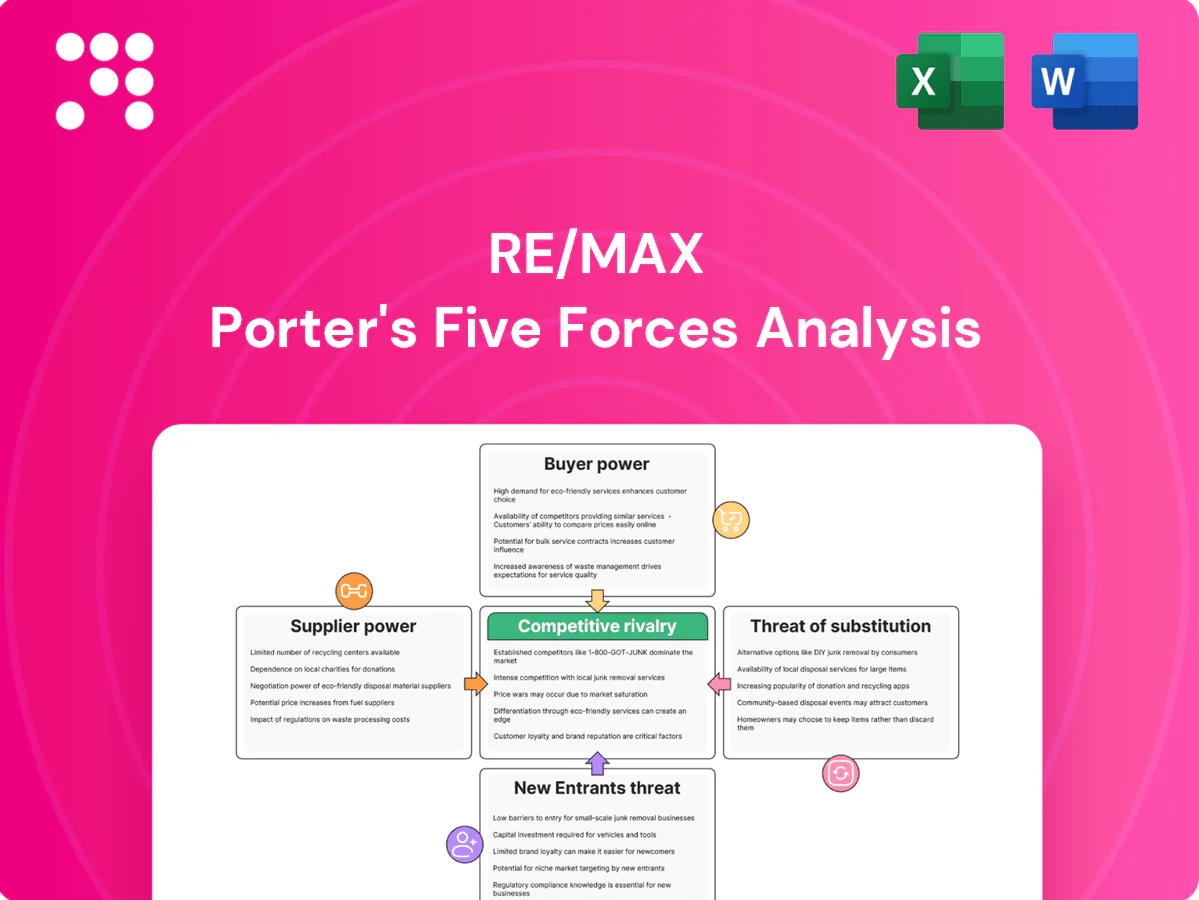
RE/MAX Porter's Five Forces Analysis

A Must-Have Tool for Decision-Makers
RE/MAX faces layered competitive pressures—from powerful buyers and franchisee dynamics to evolving substitute services—shaping margins and growth prospects. This brief snapshot highlights key tensions but only scratches the surface. Unlock the full Porter's Five Forces Analysis for a force-by-force breakdown, visuals, and actionable insights to inform investment or strategic decisions.
Suppliers Bargaining Power

Dependence on Agent Supply
RE/MAX depends on a large pool of agents—over 100,000 worldwide as of 2024—to drive transactions and royalty income. Top-performing agents can demand better commission splits and franchise support, increasing supplier leverage. The scarcity of elite producers concentrates power among a small cohort, and market downturns intensify competition to recruit and retain that talent.
Broker-Owner Franchises as Key Inputs
Independent broker-owners provide RE/MAX with local market presence, compliance oversight and agent recruiting capacity across roughly 8,000 offices and about 115,000 agents in 2024. Top-performing franchisees can leverage their volume to negotiate fee concessions, territory protections or enhanced tech support. Concentration of high-revenue offices amplifies supplier leverage, while underperforming offices exert minimal bargaining power.

MLS Associations and Data Access
Access to MLS data is essential for listings, comps and transaction workflows, with roughly 600 distinct MLSs in the US/Canada and over 90% of residential listings distributed via MLSs in 2024. Local associations set terms, fees and compliance rules franchisees must accept, with typical subscriber fees ranging roughly $20–150/month and per-listing or transaction charges adding costs. Limited substitutes for MLS data elevate supplier influence, and regional fragmentation increases integration complexity and operational expense for RE/MAX franchisees.

PropTech and Marketing Vendors
Ancillary Service Partners
Ancillary service partners—mortgage, title, insurance, and home-services—deliver referral volume and revenue to RE/MAX but strong local providers can negotiate preferred placement and revenue-share, raising supplier leverage. Compliance and regulatory limits on co-marketing and referral fees restrict integration, further increasing partner bargaining power. Diversifying partners reduces single-supplier risk and preserves margins.
- Mortgage referrals drive transaction velocity
- Title/insurance control closing pathways
- Compliance caps integration flexibility
- Diversification mitigates concentration risk
Broker network concentration elevates supplier power: 115,000 agents, ~600 MLSs, $50B PropTech
RE/MAX faces moderate-to-high supplier power: 115,000 agents and ~8,000 offices (2024) can demand better splits, while ~600 MLSs control essential data and subscribers pay ~$20–150/month. PropTech vendors sit in a $50B CRM market, with migration costs of tens–hundreds K per office, raising switching barriers.
| Supplier | Metric | 2024 |
|---|---|---|
| Agents/offices | Count | 115,000 agents; ~8,000 offices |
| MLS | Systems | ~600; $20–150/mo |
| PropTech | Market | $50B CRM; migration tens–hundreds K |
What is included in the product
 Detailed Word Document
Concise Porter's Five Forces analysis tailored to RE/MAX that uncovers competitive intensity, buyer/supplier bargaining power, entry barriers, and substitute threats, highlighting disruptive forces and strategic levers. Ideal for investor reports, strategy decks, and editable Word presentations.

 Customizable Excel Spreadsheet
A concise RE/MAX Porter's Five Forces one-sheet that instantly visualizes competitive pressure with a radar chart and customizable inputs—perfect for quick strategic decisions and slide-ready reporting.
Customers Bargaining Power

Franchisees as Primary Customers
Broker-owners buy territories, pay royalties and select brand affiliation; RE/MAX reported over 130,000 agents and roughly 8,200 offices worldwide in 2024, concentrating bargaining power in franchisees who directly fund the network.
Franchisees routinely compare competing franchise offers and independent models, and transparent economics and mid-single-digit royalty norms increase price sensitivity.
Multi-year franchise terms, commonly 5-10 years, reduce immediate switching but do not eliminate leverage as renewals and local market alternatives keep bargaining power high.
Agent Attraction and Retention Needs
Franchisees demand recruiting and retention tools to support RE/MAX’s network of over 100,000 agents worldwide; if tools underperform, franchisees can press for fee discounts or extra support. Competitive agent split structures, often ranging roughly 60–95% in favor of agents, heighten buyer (franchisee) bargaining. Strong brand and platform stickiness from 50+ years moderates but does not eliminate this pressure.

End Clients Influence Through Conversion
Home buyers and sellers influence RE/MAX through conversion rates and the 5–6% typical US commission level, with RE/MAX operating over 100,000 agents worldwide in 2024. Consumers shop agents, negotiate fees, or use discounted services, increasing fee competition. Rising price transparency in 2024 has tightened downstream margins, and franchisees consistently relay that pressure back to the franchisor.

Switching Costs and Contract Terms
Franchise transfers involve rebranding, tech migration, and retraining that create frictions—RE/MAX’s global network of ~8,000 offices and 100,000+ agents (2024) makes full transitions costly in time and fees, though virtual brokerages have reduced barriers for some offices. Renewal windows are frequent negotiation points where offices seek fee relief or incentives, and termination clauses plus performance covenants (sales thresholds, split adjustments) determine landlord leverage.
- Rebranding & tech migration: high fixed costs and downtime
- Virtual brokerages: lower marginal switching cost for 10–20% of listings
- Renewal windows: key leverage moments for fee concessions
- Termination/performance clauses: primary legal leverage tools
Global Footprint, Local Variability
Buyer power varies by country, regulation, and market cycle; in hot markets franchisees often accept higher fees for growth support, while in downturns they demand concessions and cost relief. RE/MAX, with about 140,000 agents across 110+ countries (2024), must tailor franchise offers to local elasticity and regulatory constraints.
- High-demand markets: higher fee tolerance
- Down cycles: push for fee relief and marketing subsidies
- Local tailoring: pricing, support, and compliance
Franchisees hold leverage: ~140,000 agents, ~8,200 offices; mid-single-digit royalties
Franchisees hold strong bargaining power: RE/MAX reported ~140,000 agents and ~8,200 offices in 2024, and franchise owners fund the network and compare alternatives. Mid-single-digit royalty norms and 5–6% typical US commissions increase price sensitivity, while 5–10 year terms and brand stickiness moderate but do not eliminate leverage.
| Metric | 2024 Value |
|---|---|
| Agents | ~140,000 |
| Offices | ~8,200 |
| Royalty | Mid-single-digit % |
| US commission | 5–6% |
| Franchise term | 5–10 yrs |
| Agent split | 60–95% |
What You See Is What You Get
RE/MAX Porter's Five Forces Analysis
This preview shows the exact RE/MAX Porter's Five Forces Analysis you'll receive immediately after purchase—no placeholders or mockups. The file is fully formatted, professionally written and ready to download and use. Instant access to this exact document begins as soon as payment is completed.

A Must-Have Tool for Decision-Makers
RE/MAX faces layered competitive pressures—from powerful buyers and franchisee dynamics to evolving substitute services—shaping margins and growth prospects. This brief snapshot highlights key tensions but only scratches the surface. Unlock the full Porter's Five Forces Analysis for a force-by-force breakdown, visuals, and actionable insights to inform investment or strategic decisions.
Suppliers Bargaining Power
Dependence on Agent Supply
RE/MAX depends on a large pool of agents—over 100,000 worldwide as of 2024—to drive transactions and royalty income. Top-performing agents can demand better commission splits and franchise support, increasing supplier leverage. The scarcity of elite producers concentrates power among a small cohort, and market downturns intensify competition to recruit and retain that talent.
Broker-Owner Franchises as Key Inputs
Independent broker-owners provide RE/MAX with local market presence, compliance oversight and agent recruiting capacity across roughly 8,000 offices and about 115,000 agents in 2024. Top-performing franchisees can leverage their volume to negotiate fee concessions, territory protections or enhanced tech support. Concentration of high-revenue offices amplifies supplier leverage, while underperforming offices exert minimal bargaining power.
MLS Associations and Data Access
Access to MLS data is essential for listings, comps and transaction workflows, with roughly 600 distinct MLSs in the US/Canada and over 90% of residential listings distributed via MLSs in 2024. Local associations set terms, fees and compliance rules franchisees must accept, with typical subscriber fees ranging roughly $20–150/month and per-listing or transaction charges adding costs. Limited substitutes for MLS data elevate supplier influence, and regional fragmentation increases integration complexity and operational expense for RE/MAX franchisees.
PropTech and Marketing Vendors
Ancillary Service Partners
Ancillary service partners—mortgage, title, insurance, and home-services—deliver referral volume and revenue to RE/MAX but strong local providers can negotiate preferred placement and revenue-share, raising supplier leverage. Compliance and regulatory limits on co-marketing and referral fees restrict integration, further increasing partner bargaining power. Diversifying partners reduces single-supplier risk and preserves margins.
- Mortgage referrals drive transaction velocity
- Title/insurance control closing pathways
- Compliance caps integration flexibility
- Diversification mitigates concentration risk
Broker network concentration elevates supplier power: 115,000 agents, ~600 MLSs, $50B PropTech
RE/MAX faces moderate-to-high supplier power: 115,000 agents and ~8,000 offices (2024) can demand better splits, while ~600 MLSs control essential data and subscribers pay ~$20–150/month. PropTech vendors sit in a $50B CRM market, with migration costs of tens–hundreds K per office, raising switching barriers.
| Supplier | Metric | 2024 |
|---|---|---|
| Agents/offices | Count | 115,000 agents; ~8,000 offices |
| MLS | Systems | ~600; $20–150/mo |
| PropTech | Market | $50B CRM; migration tens–hundreds K |
What is included in the product
Detailed Word Document
Concise Porter's Five Forces analysis tailored to RE/MAX that uncovers competitive intensity, buyer/supplier bargaining power, entry barriers, and substitute threats, highlighting disruptive forces and strategic levers. Ideal for investor reports, strategy decks, and editable Word presentations.
Customizable Excel Spreadsheet
A concise RE/MAX Porter's Five Forces one-sheet that instantly visualizes competitive pressure with a radar chart and customizable inputs—perfect for quick strategic decisions and slide-ready reporting.
Customers Bargaining Power
Franchisees as Primary Customers
Broker-owners buy territories, pay royalties and select brand affiliation; RE/MAX reported over 130,000 agents and roughly 8,200 offices worldwide in 2024, concentrating bargaining power in franchisees who directly fund the network.
Franchisees routinely compare competing franchise offers and independent models, and transparent economics and mid-single-digit royalty norms increase price sensitivity.
Multi-year franchise terms, commonly 5-10 years, reduce immediate switching but do not eliminate leverage as renewals and local market alternatives keep bargaining power high.
Agent Attraction and Retention Needs
Franchisees demand recruiting and retention tools to support RE/MAX’s network of over 100,000 agents worldwide; if tools underperform, franchisees can press for fee discounts or extra support. Competitive agent split structures, often ranging roughly 60–95% in favor of agents, heighten buyer (franchisee) bargaining. Strong brand and platform stickiness from 50+ years moderates but does not eliminate this pressure.
End Clients Influence Through Conversion
Home buyers and sellers influence RE/MAX through conversion rates and the 5–6% typical US commission level, with RE/MAX operating over 100,000 agents worldwide in 2024. Consumers shop agents, negotiate fees, or use discounted services, increasing fee competition. Rising price transparency in 2024 has tightened downstream margins, and franchisees consistently relay that pressure back to the franchisor.
Switching Costs and Contract Terms
Franchise transfers involve rebranding, tech migration, and retraining that create frictions—RE/MAX’s global network of ~8,000 offices and 100,000+ agents (2024) makes full transitions costly in time and fees, though virtual brokerages have reduced barriers for some offices. Renewal windows are frequent negotiation points where offices seek fee relief or incentives, and termination clauses plus performance covenants (sales thresholds, split adjustments) determine landlord leverage.
- Rebranding & tech migration: high fixed costs and downtime
- Virtual brokerages: lower marginal switching cost for 10–20% of listings
- Renewal windows: key leverage moments for fee concessions
- Termination/performance clauses: primary legal leverage tools
Global Footprint, Local Variability
Buyer power varies by country, regulation, and market cycle; in hot markets franchisees often accept higher fees for growth support, while in downturns they demand concessions and cost relief. RE/MAX, with about 140,000 agents across 110+ countries (2024), must tailor franchise offers to local elasticity and regulatory constraints.
- High-demand markets: higher fee tolerance
- Down cycles: push for fee relief and marketing subsidies
- Local tailoring: pricing, support, and compliance
Franchisees hold leverage: ~140,000 agents, ~8,200 offices; mid-single-digit royalties
Franchisees hold strong bargaining power: RE/MAX reported ~140,000 agents and ~8,200 offices in 2024, and franchise owners fund the network and compare alternatives. Mid-single-digit royalty norms and 5–6% typical US commissions increase price sensitivity, while 5–10 year terms and brand stickiness moderate but do not eliminate leverage.
| Metric | 2024 Value |
|---|---|
| Agents | ~140,000 |
| Offices | ~8,200 |
| Royalty | Mid-single-digit % |
| US commission | 5–6% |
| Franchise term | 5–10 yrs |
| Agent split | 60–95% |
What You See Is What You Get
RE/MAX Porter's Five Forces Analysis
This preview shows the exact RE/MAX Porter's Five Forces Analysis you'll receive immediately after purchase—no placeholders or mockups. The file is fully formatted, professionally written and ready to download and use. Instant access to this exact document begins as soon as payment is completed.
Original: $10.00
-65%$10.00
$3.50Description
A Must-Have Tool for Decision-Makers
RE/MAX faces layered competitive pressures—from powerful buyers and franchisee dynamics to evolving substitute services—shaping margins and growth prospects. This brief snapshot highlights key tensions but only scratches the surface. Unlock the full Porter's Five Forces Analysis for a force-by-force breakdown, visuals, and actionable insights to inform investment or strategic decisions.
Suppliers Bargaining Power
Dependence on Agent Supply
RE/MAX depends on a large pool of agents—over 100,000 worldwide as of 2024—to drive transactions and royalty income. Top-performing agents can demand better commission splits and franchise support, increasing supplier leverage. The scarcity of elite producers concentrates power among a small cohort, and market downturns intensify competition to recruit and retain that talent.
Broker-Owner Franchises as Key Inputs
Independent broker-owners provide RE/MAX with local market presence, compliance oversight and agent recruiting capacity across roughly 8,000 offices and about 115,000 agents in 2024. Top-performing franchisees can leverage their volume to negotiate fee concessions, territory protections or enhanced tech support. Concentration of high-revenue offices amplifies supplier leverage, while underperforming offices exert minimal bargaining power.
MLS Associations and Data Access
Access to MLS data is essential for listings, comps and transaction workflows, with roughly 600 distinct MLSs in the US/Canada and over 90% of residential listings distributed via MLSs in 2024. Local associations set terms, fees and compliance rules franchisees must accept, with typical subscriber fees ranging roughly $20–150/month and per-listing or transaction charges adding costs. Limited substitutes for MLS data elevate supplier influence, and regional fragmentation increases integration complexity and operational expense for RE/MAX franchisees.
PropTech and Marketing Vendors
Ancillary Service Partners
Ancillary service partners—mortgage, title, insurance, and home-services—deliver referral volume and revenue to RE/MAX but strong local providers can negotiate preferred placement and revenue-share, raising supplier leverage. Compliance and regulatory limits on co-marketing and referral fees restrict integration, further increasing partner bargaining power. Diversifying partners reduces single-supplier risk and preserves margins.
- Mortgage referrals drive transaction velocity
- Title/insurance control closing pathways
- Compliance caps integration flexibility
- Diversification mitigates concentration risk
Broker network concentration elevates supplier power: 115,000 agents, ~600 MLSs, $50B PropTech
RE/MAX faces moderate-to-high supplier power: 115,000 agents and ~8,000 offices (2024) can demand better splits, while ~600 MLSs control essential data and subscribers pay ~$20–150/month. PropTech vendors sit in a $50B CRM market, with migration costs of tens–hundreds K per office, raising switching barriers.
| Supplier | Metric | 2024 |
|---|---|---|
| Agents/offices | Count | 115,000 agents; ~8,000 offices |
| MLS | Systems | ~600; $20–150/mo |
| PropTech | Market | $50B CRM; migration tens–hundreds K |
What is included in the product
Detailed Word Document
Concise Porter's Five Forces analysis tailored to RE/MAX that uncovers competitive intensity, buyer/supplier bargaining power, entry barriers, and substitute threats, highlighting disruptive forces and strategic levers. Ideal for investor reports, strategy decks, and editable Word presentations.
Customizable Excel Spreadsheet
A concise RE/MAX Porter's Five Forces one-sheet that instantly visualizes competitive pressure with a radar chart and customizable inputs—perfect for quick strategic decisions and slide-ready reporting.
Customers Bargaining Power
Franchisees as Primary Customers
Broker-owners buy territories, pay royalties and select brand affiliation; RE/MAX reported over 130,000 agents and roughly 8,200 offices worldwide in 2024, concentrating bargaining power in franchisees who directly fund the network.
Franchisees routinely compare competing franchise offers and independent models, and transparent economics and mid-single-digit royalty norms increase price sensitivity.
Multi-year franchise terms, commonly 5-10 years, reduce immediate switching but do not eliminate leverage as renewals and local market alternatives keep bargaining power high.
Agent Attraction and Retention Needs
Franchisees demand recruiting and retention tools to support RE/MAX’s network of over 100,000 agents worldwide; if tools underperform, franchisees can press for fee discounts or extra support. Competitive agent split structures, often ranging roughly 60–95% in favor of agents, heighten buyer (franchisee) bargaining. Strong brand and platform stickiness from 50+ years moderates but does not eliminate this pressure.
End Clients Influence Through Conversion
Home buyers and sellers influence RE/MAX through conversion rates and the 5–6% typical US commission level, with RE/MAX operating over 100,000 agents worldwide in 2024. Consumers shop agents, negotiate fees, or use discounted services, increasing fee competition. Rising price transparency in 2024 has tightened downstream margins, and franchisees consistently relay that pressure back to the franchisor.
Switching Costs and Contract Terms
Franchise transfers involve rebranding, tech migration, and retraining that create frictions—RE/MAX’s global network of ~8,000 offices and 100,000+ agents (2024) makes full transitions costly in time and fees, though virtual brokerages have reduced barriers for some offices. Renewal windows are frequent negotiation points where offices seek fee relief or incentives, and termination clauses plus performance covenants (sales thresholds, split adjustments) determine landlord leverage.
- Rebranding & tech migration: high fixed costs and downtime
- Virtual brokerages: lower marginal switching cost for 10–20% of listings
- Renewal windows: key leverage moments for fee concessions
- Termination/performance clauses: primary legal leverage tools
Global Footprint, Local Variability
Buyer power varies by country, regulation, and market cycle; in hot markets franchisees often accept higher fees for growth support, while in downturns they demand concessions and cost relief. RE/MAX, with about 140,000 agents across 110+ countries (2024), must tailor franchise offers to local elasticity and regulatory constraints.
- High-demand markets: higher fee tolerance
- Down cycles: push for fee relief and marketing subsidies
- Local tailoring: pricing, support, and compliance
Franchisees hold leverage: ~140,000 agents, ~8,200 offices; mid-single-digit royalties
Franchisees hold strong bargaining power: RE/MAX reported ~140,000 agents and ~8,200 offices in 2024, and franchise owners fund the network and compare alternatives. Mid-single-digit royalty norms and 5–6% typical US commissions increase price sensitivity, while 5–10 year terms and brand stickiness moderate but do not eliminate leverage.
| Metric | 2024 Value |
|---|---|
| Agents | ~140,000 |
| Offices | ~8,200 |
| Royalty | Mid-single-digit % |
| US commission | 5–6% |
| Franchise term | 5–10 yrs |
| Agent split | 60–95% |
What You See Is What You Get
RE/MAX Porter's Five Forces Analysis
This preview shows the exact RE/MAX Porter's Five Forces Analysis you'll receive immediately after purchase—no placeholders or mockups. The file is fully formatted, professionally written and ready to download and use. Instant access to this exact document begins as soon as payment is completed.











