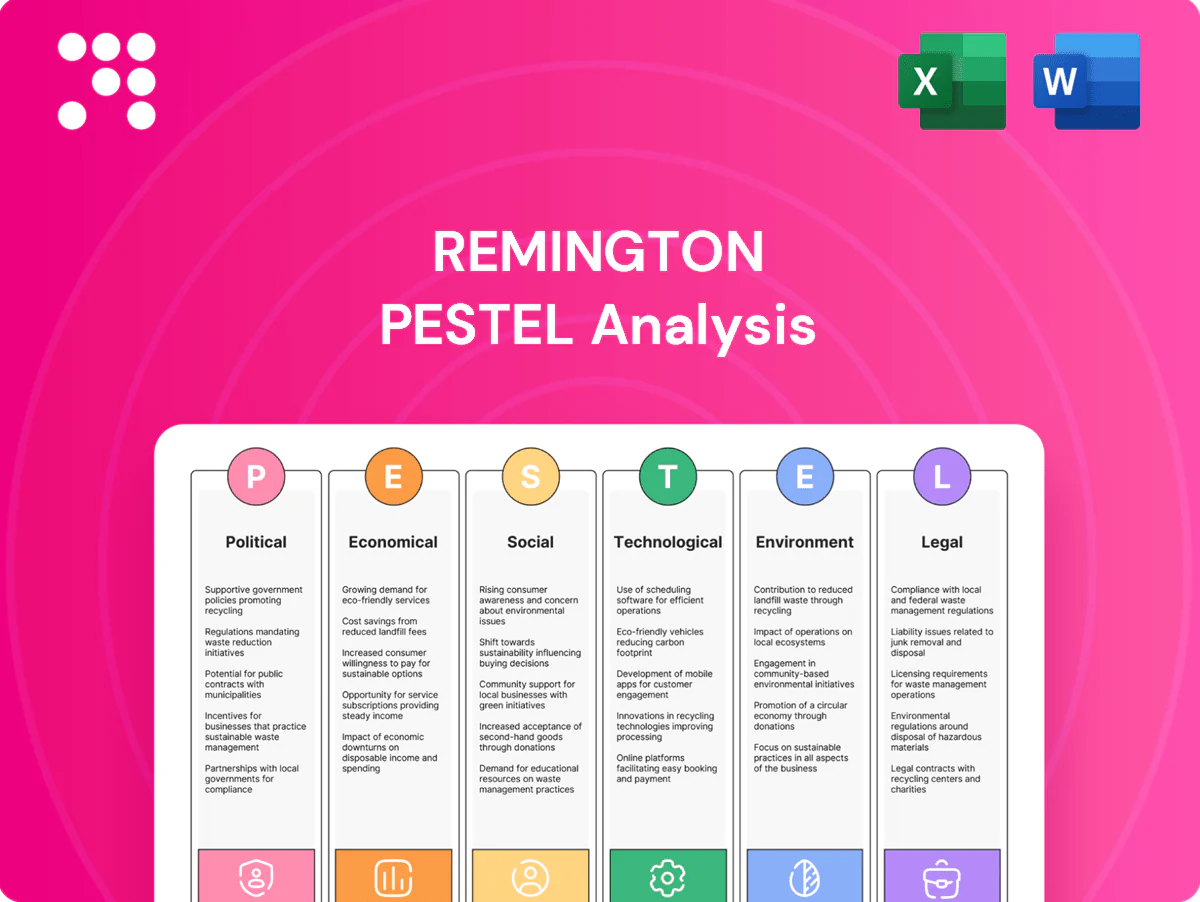
Remington PESTLE Analysis

Your Competitive Advantage Starts with This Report
Unlock how political shifts, economic cycles, and technological advances are reshaping Remington’s prospects with our concise PESTLE snapshot—perfect for investors and strategists who need clarity fast. This analysis highlights risks and growth levers you can act on immediately. Purchase the full PESTLE to access detailed, ready-to-use insights and downloadable templates.
Political factors

Gun policy volatility
Changes in federal and state firearms policies can rapidly reshape Remingtons market access and demand; background checks peaked at 39.7 million in 2020, illustrating volatility in purchaser activity. Election cycles, notably the Nov 5, 2024 vote, drive regulatory uncertainty and pre-election stockpiling. Remington must scenario-plan for tighter or looser rules, and policy stability in states like CA and NY influences production footprint and distribution.
Defense and law-enforcement procurement
Agency budgets drive Remington's institutional pipeline: the U.S. DoD budget was about $842 billion for FY2025, while state/local procurement for equipment supports multi-year buys. Shifts to modernization or standardization can create $50–500 million multi-year revenue streams or sudden gaps if programs end. Political emphasis on domestic sourcing and Buy American rules favors U.S. manufacturers, but competitive tenders demand strict compliance, sustained lobbying and relationship management.

Trade and export controls
ITAR/EAR constraints tightly govern Remingtons international sales and partnerships, restricting defense-related transfers and subjecting deals to US State and Commerce Dept approvals. Sanctions (eg, post-2022 Russia measures) and tariffs (US steel/Aluminum Section 232 duties remain at 25%/10%) can close markets or raise input costs. Licensing timelines of weeks to months strain delivery schedules and working capital, so diversifying export destinations mitigates concentrated country risk.

Subsidies and industrial policy
Manufacturing incentives, tax credits and workforce grants — including the CHIPS and Science Act which authorized about 52 billion USD for semiconductor manufacturing and the Inflation Reduction Act's roughly 369 billion USD in clean energy incentives — can materially lower Remington's operating costs and capex for advanced tooling.
State-level competition for advanced manufacturing sites, via bespoke incentive packages and rapid permitting, shifts Remington's location strategy toward states offering faster timelines and larger performance-based grants, while federal reshoring emphasis increases domestic supply security.
Program eligibility depends on strict compliance, reporting and prevailing-wage rules; failure to meet these can trigger clawbacks and reduce net benefit.
- Manufacturing incentives: CHIPS 52B; IRA ~369B
- Location strategy: state competition for sites
- Reshoring: boosts domestic supply security
- Eligibility: compliance, reporting, clawback risk
Public safety and crime trends
Policy responses to high-profile public safety incidents drive legislation and public sentiment, influencing Remington's regulatory landscape and market access. Municipal procurement for policing fluctuates with local crime metrics, affecting demand for small-arms and accessories. Political narratives around crime raise reputational risk and shape stakeholder engagement, while proactive safety advocacy positions Remington in policy dialogues and procurement conversations.
- Policy-driven demand shifts
- Procurement tied to crime metrics
- Reputational & stakeholder impact
- Advocacy shapes policy
Political shifts, 39.7M background checks, DoD $842B and 25% steel tariff reshape firearms market
Political shifts—federal/state gun laws and 2024 election volatility—reshape Remington's market; 2020 background checks hit 39.7M. DoD FY2025 ~$842B and Buy American favor US suppliers but procurement totals vary by $50–$500M per program. ITAR and Section 232 tariffs (steel 25%) constrain exports and input costs.
| Factor | Key data |
|---|---|
| Background checks | 39.7M (2020) |
| DoD budget | $842B (FY2025) |
| Steel tariff | 25% |
What is included in the product
 Detailed Word Document
Explores how Political, Economic, Social, Technological, Environmental and Legal forces uniquely affect Remington, with data-backed trends and industry-specific examples; designed for executives and investors to identify risks, opportunities and actionable, forward-looking strategies ready for business plans or pitch decks.

 Customizable Excel Spreadsheet
A concise, visually segmented Remington PESTLE summary that can be dropped into presentations and shared across teams, enabling quick reference, note customization for region or business line, and streamlined discussion of external risks and market positioning during planning sessions.
Economic factors

Consumer cyclical demand
Firearms demand is highly cyclical, linked to consumer confidence, disposable income, and perceived risk; FBI NICS checks peaked near 40 million in 2021 then eased to roughly 20 million by 2023, illustrating volatility. Election-driven surges (notably 2020–21) are often followed by troughs, stressing inventory and working capital. Remington's diversified exposure across hunting, sport shooting and defense helps stabilize revenue streams. Rigorous channel forecasting and flexible production capacity are critical to manage margin pressure.
Input costs and inflation
Rising input costs — LME copper ~9,500 USD/t, aluminum ~2,200 USD/t, U.S. HRC steel ~800 USD/t, lead ~2,000 USD/t, plus higher propellant and energy (Brent ~80 USD/bbl, Henry Hub ~3 USD/MMBtu) — compress Remington margins. Persistent inflation (U.S. CPI ~3.3% YoY, mid-2025) limits pricing power and shifts retailer inventory strategies. Long-term supplier contracts and hedging stabilize cost volatility; value engineering preserves affordability tiers.

Interest rates and financing
Higher interest rates (Fed funds 5.25–5.50% in mid‑2025) raise working capital and capex costs, delaying tooling and automation investments. Dealer financing and consumer credit availability constrain sell‑through as auto loan rates and credit tightness rise. Inventory carrying costs escalate in tight credit, making lean operations and cash‑conversion discipline critical.

Supply-chain resilience
Specialty components and powders face bottlenecks and export controls that can interrupt Remington’s production and international sales, so nearshoring and dual-sourcing are being adopted to cut lead-time risk and regulatory exposure. Improved digital visibility into tier-2/3 suppliers enhances continuity and traceability, while strategic safety stocks for critical SKUs protect revenue and customer fill rates.
- Nearshoring: reduces transit and regulatory risk
- Dual-sourcing: lowers single-vendor failure impact
- Digital tier-2/3 visibility: improves recovery speed
- Safety stocks: safeguard high-margin SKUs
Exchange rates and exports
Exchange-rate swings shift overseas price competitiveness: the US dollar rose about 4% in 2024 and hovered near 103 on the DXY in H1 2025, eroding export pricing power. FX volatility squeezed margins on multi-year international contracts. Localized costs act as natural hedges, and prudent hedging should align with order backlogs and long lead times.
- USD strength 2024 ~+4% vs basket
- FX volatility increases margin risk on contracts
- Localized production reduces net exposure
- Hedging tied to backlog and lead times
Political shifts, 39.7M background checks, DoD $842B and 25% steel tariff reshape firearms market
Firearms demand volatile: NICS ~40M in 2021 vs ~20M in 2023, election spikes then troughs; diversified hunting/sport/defense sales smooth revenue. Input cost pressure: copper ~9,500 USD/t, aluminum ~2,200 USD/t, HRC steel ~800 USD/t, Brent ~80 USD/bbl; U.S. CPI ~3.3% mid‑2025. Rates raise capital costs (Fed funds 5.25–5.50% mid‑2025); USD ~103 DXY (+4% in 2024) weakens exports.
| Metric | Peak | Recent/ mid‑2025 |
|---|---|---|
| NICS checks | ~40M (2021) | ~20M (2023) |
| Fed funds | 0–0.25% (2020) | 5.25–5.50% |
| CPI (US) | ~6–7% (2022) | ~3.3% |
| DXY | ~99 (2021) | ~103 (H1 2025) |
| Key metals | — | Cu 9,500; Al 2,200; HRC 800 USD/t |
Same Document Delivered
Remington PESTLE Analysis
The preview shown here is the exact document you’ll receive after purchase—fully formatted and ready to use. This Remington PESTLE Analysis delivers concise insights on political, economic, social, technological, legal and environmental factors affecting the company. It includes actionable implications for strategy and risk mitigation. No placeholders—download the final file immediately after purchase.

Your Competitive Advantage Starts with This Report
Unlock how political shifts, economic cycles, and technological advances are reshaping Remington’s prospects with our concise PESTLE snapshot—perfect for investors and strategists who need clarity fast. This analysis highlights risks and growth levers you can act on immediately. Purchase the full PESTLE to access detailed, ready-to-use insights and downloadable templates.
Political factors
Gun policy volatility
Changes in federal and state firearms policies can rapidly reshape Remingtons market access and demand; background checks peaked at 39.7 million in 2020, illustrating volatility in purchaser activity. Election cycles, notably the Nov 5, 2024 vote, drive regulatory uncertainty and pre-election stockpiling. Remington must scenario-plan for tighter or looser rules, and policy stability in states like CA and NY influences production footprint and distribution.
Defense and law-enforcement procurement
Agency budgets drive Remington's institutional pipeline: the U.S. DoD budget was about $842 billion for FY2025, while state/local procurement for equipment supports multi-year buys. Shifts to modernization or standardization can create $50–500 million multi-year revenue streams or sudden gaps if programs end. Political emphasis on domestic sourcing and Buy American rules favors U.S. manufacturers, but competitive tenders demand strict compliance, sustained lobbying and relationship management.
Trade and export controls
ITAR/EAR constraints tightly govern Remingtons international sales and partnerships, restricting defense-related transfers and subjecting deals to US State and Commerce Dept approvals. Sanctions (eg, post-2022 Russia measures) and tariffs (US steel/Aluminum Section 232 duties remain at 25%/10%) can close markets or raise input costs. Licensing timelines of weeks to months strain delivery schedules and working capital, so diversifying export destinations mitigates concentrated country risk.
Subsidies and industrial policy
Manufacturing incentives, tax credits and workforce grants — including the CHIPS and Science Act which authorized about 52 billion USD for semiconductor manufacturing and the Inflation Reduction Act's roughly 369 billion USD in clean energy incentives — can materially lower Remington's operating costs and capex for advanced tooling.
State-level competition for advanced manufacturing sites, via bespoke incentive packages and rapid permitting, shifts Remington's location strategy toward states offering faster timelines and larger performance-based grants, while federal reshoring emphasis increases domestic supply security.
Program eligibility depends on strict compliance, reporting and prevailing-wage rules; failure to meet these can trigger clawbacks and reduce net benefit.
- Manufacturing incentives: CHIPS 52B; IRA ~369B
- Location strategy: state competition for sites
- Reshoring: boosts domestic supply security
- Eligibility: compliance, reporting, clawback risk
Public safety and crime trends
Policy responses to high-profile public safety incidents drive legislation and public sentiment, influencing Remington's regulatory landscape and market access. Municipal procurement for policing fluctuates with local crime metrics, affecting demand for small-arms and accessories. Political narratives around crime raise reputational risk and shape stakeholder engagement, while proactive safety advocacy positions Remington in policy dialogues and procurement conversations.
- Policy-driven demand shifts
- Procurement tied to crime metrics
- Reputational & stakeholder impact
- Advocacy shapes policy
Political shifts, 39.7M background checks, DoD $842B and 25% steel tariff reshape firearms market
Political shifts—federal/state gun laws and 2024 election volatility—reshape Remington's market; 2020 background checks hit 39.7M. DoD FY2025 ~$842B and Buy American favor US suppliers but procurement totals vary by $50–$500M per program. ITAR and Section 232 tariffs (steel 25%) constrain exports and input costs.
| Factor | Key data |
|---|---|
| Background checks | 39.7M (2020) |
| DoD budget | $842B (FY2025) |
| Steel tariff | 25% |
What is included in the product
Detailed Word Document
Explores how Political, Economic, Social, Technological, Environmental and Legal forces uniquely affect Remington, with data-backed trends and industry-specific examples; designed for executives and investors to identify risks, opportunities and actionable, forward-looking strategies ready for business plans or pitch decks.
Customizable Excel Spreadsheet
A concise, visually segmented Remington PESTLE summary that can be dropped into presentations and shared across teams, enabling quick reference, note customization for region or business line, and streamlined discussion of external risks and market positioning during planning sessions.
Economic factors
Consumer cyclical demand
Firearms demand is highly cyclical, linked to consumer confidence, disposable income, and perceived risk; FBI NICS checks peaked near 40 million in 2021 then eased to roughly 20 million by 2023, illustrating volatility. Election-driven surges (notably 2020–21) are often followed by troughs, stressing inventory and working capital. Remington's diversified exposure across hunting, sport shooting and defense helps stabilize revenue streams. Rigorous channel forecasting and flexible production capacity are critical to manage margin pressure.
Input costs and inflation
Rising input costs — LME copper ~9,500 USD/t, aluminum ~2,200 USD/t, U.S. HRC steel ~800 USD/t, lead ~2,000 USD/t, plus higher propellant and energy (Brent ~80 USD/bbl, Henry Hub ~3 USD/MMBtu) — compress Remington margins. Persistent inflation (U.S. CPI ~3.3% YoY, mid-2025) limits pricing power and shifts retailer inventory strategies. Long-term supplier contracts and hedging stabilize cost volatility; value engineering preserves affordability tiers.
Interest rates and financing
Higher interest rates (Fed funds 5.25–5.50% in mid‑2025) raise working capital and capex costs, delaying tooling and automation investments. Dealer financing and consumer credit availability constrain sell‑through as auto loan rates and credit tightness rise. Inventory carrying costs escalate in tight credit, making lean operations and cash‑conversion discipline critical.
Supply-chain resilience
Specialty components and powders face bottlenecks and export controls that can interrupt Remington’s production and international sales, so nearshoring and dual-sourcing are being adopted to cut lead-time risk and regulatory exposure. Improved digital visibility into tier-2/3 suppliers enhances continuity and traceability, while strategic safety stocks for critical SKUs protect revenue and customer fill rates.
- Nearshoring: reduces transit and regulatory risk
- Dual-sourcing: lowers single-vendor failure impact
- Digital tier-2/3 visibility: improves recovery speed
- Safety stocks: safeguard high-margin SKUs
Exchange rates and exports
Exchange-rate swings shift overseas price competitiveness: the US dollar rose about 4% in 2024 and hovered near 103 on the DXY in H1 2025, eroding export pricing power. FX volatility squeezed margins on multi-year international contracts. Localized costs act as natural hedges, and prudent hedging should align with order backlogs and long lead times.
- USD strength 2024 ~+4% vs basket
- FX volatility increases margin risk on contracts
- Localized production reduces net exposure
- Hedging tied to backlog and lead times
Political shifts, 39.7M background checks, DoD $842B and 25% steel tariff reshape firearms market
Firearms demand volatile: NICS ~40M in 2021 vs ~20M in 2023, election spikes then troughs; diversified hunting/sport/defense sales smooth revenue. Input cost pressure: copper ~9,500 USD/t, aluminum ~2,200 USD/t, HRC steel ~800 USD/t, Brent ~80 USD/bbl; U.S. CPI ~3.3% mid‑2025. Rates raise capital costs (Fed funds 5.25–5.50% mid‑2025); USD ~103 DXY (+4% in 2024) weakens exports.
| Metric | Peak | Recent/ mid‑2025 |
|---|---|---|
| NICS checks | ~40M (2021) | ~20M (2023) |
| Fed funds | 0–0.25% (2020) | 5.25–5.50% |
| CPI (US) | ~6–7% (2022) | ~3.3% |
| DXY | ~99 (2021) | ~103 (H1 2025) |
| Key metals | — | Cu 9,500; Al 2,200; HRC 800 USD/t |
Same Document Delivered
Remington PESTLE Analysis
The preview shown here is the exact document you’ll receive after purchase—fully formatted and ready to use. This Remington PESTLE Analysis delivers concise insights on political, economic, social, technological, legal and environmental factors affecting the company. It includes actionable implications for strategy and risk mitigation. No placeholders—download the final file immediately after purchase.
Original: $10.00
-65%$10.00
$3.50Description
Your Competitive Advantage Starts with This Report
Unlock how political shifts, economic cycles, and technological advances are reshaping Remington’s prospects with our concise PESTLE snapshot—perfect for investors and strategists who need clarity fast. This analysis highlights risks and growth levers you can act on immediately. Purchase the full PESTLE to access detailed, ready-to-use insights and downloadable templates.
Political factors
Gun policy volatility
Changes in federal and state firearms policies can rapidly reshape Remingtons market access and demand; background checks peaked at 39.7 million in 2020, illustrating volatility in purchaser activity. Election cycles, notably the Nov 5, 2024 vote, drive regulatory uncertainty and pre-election stockpiling. Remington must scenario-plan for tighter or looser rules, and policy stability in states like CA and NY influences production footprint and distribution.
Defense and law-enforcement procurement
Agency budgets drive Remington's institutional pipeline: the U.S. DoD budget was about $842 billion for FY2025, while state/local procurement for equipment supports multi-year buys. Shifts to modernization or standardization can create $50–500 million multi-year revenue streams or sudden gaps if programs end. Political emphasis on domestic sourcing and Buy American rules favors U.S. manufacturers, but competitive tenders demand strict compliance, sustained lobbying and relationship management.
Trade and export controls
ITAR/EAR constraints tightly govern Remingtons international sales and partnerships, restricting defense-related transfers and subjecting deals to US State and Commerce Dept approvals. Sanctions (eg, post-2022 Russia measures) and tariffs (US steel/Aluminum Section 232 duties remain at 25%/10%) can close markets or raise input costs. Licensing timelines of weeks to months strain delivery schedules and working capital, so diversifying export destinations mitigates concentrated country risk.
Subsidies and industrial policy
Manufacturing incentives, tax credits and workforce grants — including the CHIPS and Science Act which authorized about 52 billion USD for semiconductor manufacturing and the Inflation Reduction Act's roughly 369 billion USD in clean energy incentives — can materially lower Remington's operating costs and capex for advanced tooling.
State-level competition for advanced manufacturing sites, via bespoke incentive packages and rapid permitting, shifts Remington's location strategy toward states offering faster timelines and larger performance-based grants, while federal reshoring emphasis increases domestic supply security.
Program eligibility depends on strict compliance, reporting and prevailing-wage rules; failure to meet these can trigger clawbacks and reduce net benefit.
- Manufacturing incentives: CHIPS 52B; IRA ~369B
- Location strategy: state competition for sites
- Reshoring: boosts domestic supply security
- Eligibility: compliance, reporting, clawback risk
Public safety and crime trends
Policy responses to high-profile public safety incidents drive legislation and public sentiment, influencing Remington's regulatory landscape and market access. Municipal procurement for policing fluctuates with local crime metrics, affecting demand for small-arms and accessories. Political narratives around crime raise reputational risk and shape stakeholder engagement, while proactive safety advocacy positions Remington in policy dialogues and procurement conversations.
- Policy-driven demand shifts
- Procurement tied to crime metrics
- Reputational & stakeholder impact
- Advocacy shapes policy
Political shifts, 39.7M background checks, DoD $842B and 25% steel tariff reshape firearms market
Political shifts—federal/state gun laws and 2024 election volatility—reshape Remington's market; 2020 background checks hit 39.7M. DoD FY2025 ~$842B and Buy American favor US suppliers but procurement totals vary by $50–$500M per program. ITAR and Section 232 tariffs (steel 25%) constrain exports and input costs.
| Factor | Key data |
|---|---|
| Background checks | 39.7M (2020) |
| DoD budget | $842B (FY2025) |
| Steel tariff | 25% |
What is included in the product
Detailed Word Document
Explores how Political, Economic, Social, Technological, Environmental and Legal forces uniquely affect Remington, with data-backed trends and industry-specific examples; designed for executives and investors to identify risks, opportunities and actionable, forward-looking strategies ready for business plans or pitch decks.
Customizable Excel Spreadsheet
A concise, visually segmented Remington PESTLE summary that can be dropped into presentations and shared across teams, enabling quick reference, note customization for region or business line, and streamlined discussion of external risks and market positioning during planning sessions.
Economic factors
Consumer cyclical demand
Firearms demand is highly cyclical, linked to consumer confidence, disposable income, and perceived risk; FBI NICS checks peaked near 40 million in 2021 then eased to roughly 20 million by 2023, illustrating volatility. Election-driven surges (notably 2020–21) are often followed by troughs, stressing inventory and working capital. Remington's diversified exposure across hunting, sport shooting and defense helps stabilize revenue streams. Rigorous channel forecasting and flexible production capacity are critical to manage margin pressure.
Input costs and inflation
Rising input costs — LME copper ~9,500 USD/t, aluminum ~2,200 USD/t, U.S. HRC steel ~800 USD/t, lead ~2,000 USD/t, plus higher propellant and energy (Brent ~80 USD/bbl, Henry Hub ~3 USD/MMBtu) — compress Remington margins. Persistent inflation (U.S. CPI ~3.3% YoY, mid-2025) limits pricing power and shifts retailer inventory strategies. Long-term supplier contracts and hedging stabilize cost volatility; value engineering preserves affordability tiers.
Interest rates and financing
Higher interest rates (Fed funds 5.25–5.50% in mid‑2025) raise working capital and capex costs, delaying tooling and automation investments. Dealer financing and consumer credit availability constrain sell‑through as auto loan rates and credit tightness rise. Inventory carrying costs escalate in tight credit, making lean operations and cash‑conversion discipline critical.
Supply-chain resilience
Specialty components and powders face bottlenecks and export controls that can interrupt Remington’s production and international sales, so nearshoring and dual-sourcing are being adopted to cut lead-time risk and regulatory exposure. Improved digital visibility into tier-2/3 suppliers enhances continuity and traceability, while strategic safety stocks for critical SKUs protect revenue and customer fill rates.
- Nearshoring: reduces transit and regulatory risk
- Dual-sourcing: lowers single-vendor failure impact
- Digital tier-2/3 visibility: improves recovery speed
- Safety stocks: safeguard high-margin SKUs
Exchange rates and exports
Exchange-rate swings shift overseas price competitiveness: the US dollar rose about 4% in 2024 and hovered near 103 on the DXY in H1 2025, eroding export pricing power. FX volatility squeezed margins on multi-year international contracts. Localized costs act as natural hedges, and prudent hedging should align with order backlogs and long lead times.
- USD strength 2024 ~+4% vs basket
- FX volatility increases margin risk on contracts
- Localized production reduces net exposure
- Hedging tied to backlog and lead times
Political shifts, 39.7M background checks, DoD $842B and 25% steel tariff reshape firearms market
Firearms demand volatile: NICS ~40M in 2021 vs ~20M in 2023, election spikes then troughs; diversified hunting/sport/defense sales smooth revenue. Input cost pressure: copper ~9,500 USD/t, aluminum ~2,200 USD/t, HRC steel ~800 USD/t, Brent ~80 USD/bbl; U.S. CPI ~3.3% mid‑2025. Rates raise capital costs (Fed funds 5.25–5.50% mid‑2025); USD ~103 DXY (+4% in 2024) weakens exports.
| Metric | Peak | Recent/ mid‑2025 |
|---|---|---|
| NICS checks | ~40M (2021) | ~20M (2023) |
| Fed funds | 0–0.25% (2020) | 5.25–5.50% |
| CPI (US) | ~6–7% (2022) | ~3.3% |
| DXY | ~99 (2021) | ~103 (H1 2025) |
| Key metals | — | Cu 9,500; Al 2,200; HRC 800 USD/t |
Same Document Delivered
Remington PESTLE Analysis
The preview shown here is the exact document you’ll receive after purchase—fully formatted and ready to use. This Remington PESTLE Analysis delivers concise insights on political, economic, social, technological, legal and environmental factors affecting the company. It includes actionable implications for strategy and risk mitigation. No placeholders—download the final file immediately after purchase.











