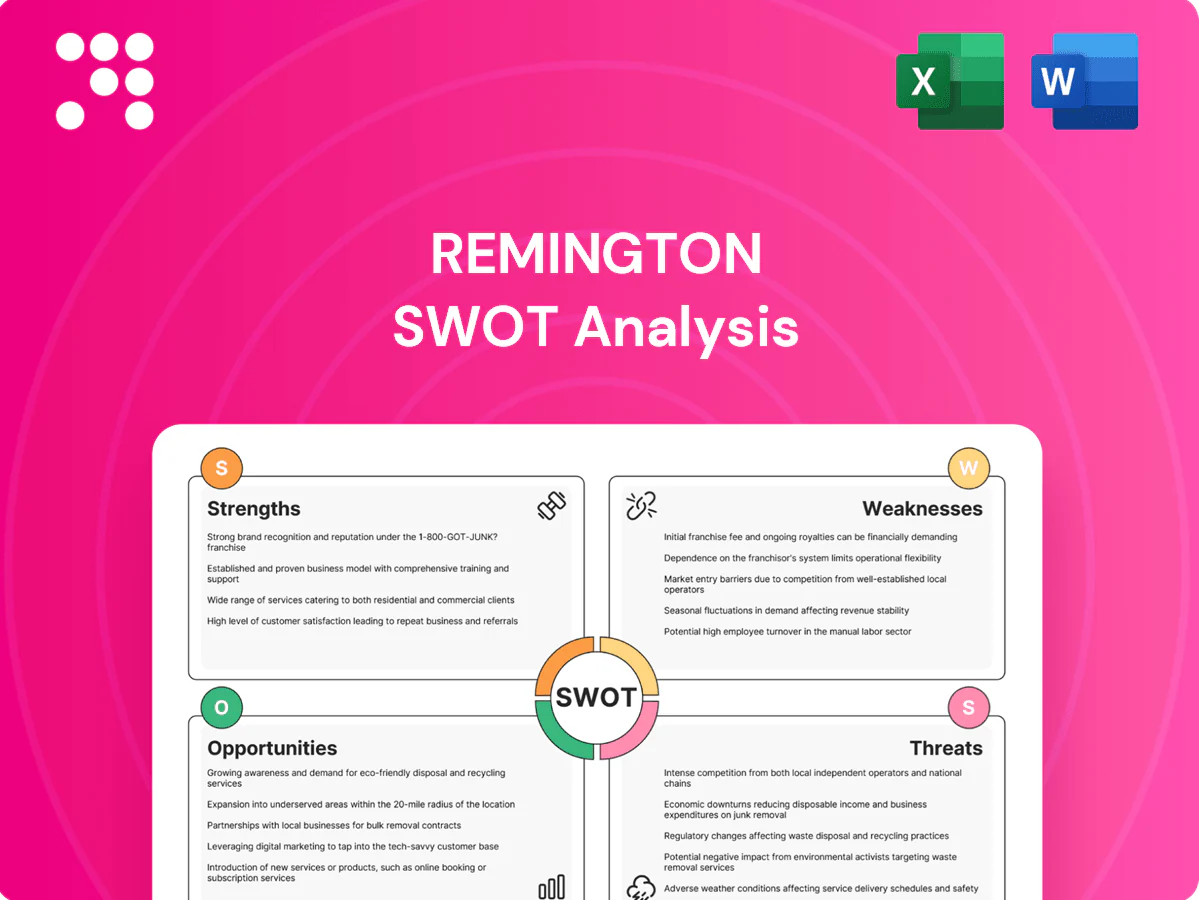
Remington SWOT Analysis

Dive Deeper Into the Company’s Strategic Blueprint
Explore Remington’s strategic standing with a concise SWOT snapshot—highlighting core strengths, competitive risks, and growth levers affecting value and market share. Want deeper, actionable insights and financial context? Purchase the full SWOT analysis for a professionally formatted, editable report and spreadsheet to guide investment, strategy, or due diligence.
Strengths

Iconic brand heritage
Remington’s 1816 founding gives it a 209-year heritage that builds deep trust with hunters, sport shooters and professionals. That longevity supports price resilience and multigenerational repeat purchases, aiding dealer negotiations and securing shelf space. The legacy also underpins premium product tiers and limited editions that command higher margins.
Broad product portfolio
Remington’s lineup spanning rifles, shotguns and ammunition supports hunting, sport shooting and self-defense across seasons. A broad SKU range helps smooth demand swings between segments and allows inventory balancing. Cross-selling ammo with firearms raises customer lifetime value through repeat purchases and accessory sales. Portfolio breadth enables rapid shifts into trending calibers and platforms.

Diverse end-market exposure
Revenue spans hunting, sport shooting, law enforcement and military, exposing Remington to diverse end markets. With roughly 11.5 million US hunters (USFWS 2022), ~18,000 local/state law enforcement agencies and ~1.3 million active-duty US military (DoD 2024), dependence on any single customer group is reduced. This mix helps buffer policy or macro swings in one channel and feeds product development through varied user feedback loops.

Established dealer and distributor relationships
Entrenched dealer and wholesaler networks give Remington broad market reach, enabling preferred placement and sell-through programs that reduce customer acquisition costs and improve inventory turnover. Aftermarket parts and service partners increase ecosystem stickiness and lifetime value, while these channels accelerate product launches and regional penetration.
- Entrenched retail/wholesale reach
- Lower acquisition via preferred placement
- Aftermarket service stickiness
- Faster launches and regional scale
Manufacturing know-how and IP
Decades of engineering since Remington’s founding in 1816 underpin consistent quality across product lines; hallmark designs like the Model 700 (introduced 1962) show enduring IP value. Proprietary tooling and in-house ballistics/testing shorten iteration cycles for new calibers and help lower unit costs at scale while supporting reliability claims.
- Founded 1816—>200+ years IP
- Model 700 legacy (1962)
- In-house testing accelerates R&D
209-year heritage powers trusted firearms line across hunters & agencies
Remington’s 209-year heritage (founded 1816) drives brand trust, premium pricing and repeat purchases. Broad portfolio—rifles, shotguns, ammunition—smooths demand across ~11.5M US hunters (USFWS 2022) and law enforcement/military channels (~18,000 agencies; ~1.3M active-duty, DoD 2024). In-house R&D and Model 700 legacy (1962) reduce time-to-market and support reliability claims.
| Metric | Value |
|---|---|
| Founded | 1816 |
| US Hunters | 11.5M (2022) |
| Law Enforcement Agencies | ~18,000 |
| Active-duty Military | ~1.3M (2024) |
What is included in the product
 Detailed Word Document
Provides a concise SWOT analysis of Remington, highlighting its core strengths, operational weaknesses, market opportunities, and external threats shaping competitive position and strategic choices.

 Customizable Excel Spreadsheet
Delivers a concise SWOT matrix tailored to Remington for fast, visual strategy alignment and risk spotting, with an editable format that enables quick updates to reflect market shifts and simplifies stakeholder presentations.
Weaknesses

Exposure to regulatory volatility
Permitting, shifting state and federal rules regularly add cost and delay launches, increasing time-to-market and tying up working capital. Complex ammunition and firearm classifications reduce SKU flexibility and force longer production runs. Compliance burdens disproportionately hit smaller batches and niche SKUs, compressing margins and making revenue planning less accurate.
Cyclical and event-driven demand
Firearms and ammo demand is highly cyclical and event-driven, with FBI NICS background checks peaking in 2020 and falling thereafter, showing sharp political- and sentiment-driven swings. Demand spikes often overextend production capacity and lead to subsequent inventory overhangs that depress margins. The volatility complicates forecasting and ties up working capital, and pricing discipline weakens during down cycles as retailers and OEMs cut prices to clear stock.

Concentration in U.S. market
Remington's heavy U.S. concentration heightens exposure to U.S.-specific legislation and macro trends; U.S. nominal GDP was about 24% of world GDP in 2024 (IMF), so domestic shocks reverberate broadly.

Product liability and litigation risk
Product liability and litigation risk raise insurance and settlement costs for Remington; notably the company agreed to a reported 73 million dollar settlement with Sandy Hook families in 2022, illustrating how legal exposure converts to cash outflows and insurers’ scrutiny. Even isolated incidents produce reputational spillovers; defensive engineering and heavier documentation raise overhead and legal distractions can slow product development cadence.
- legal settlement: 73 million (2022)
- higher insurance & compliance overhead
- reputational spillover slows sales/innovation
Legacy cost structure
Established plants and legacy processes constrain Remington’s operational flexibility versus newer rivals, making rapid product shifts and scaled cost-out measures harder to execute. High fixed overhead elevates break-even volumes during demand dips, while required modernization capex competes directly with R&D and marketing budgets. Procurement inertia further slows supplier renegotiation and volume-driven cost reductions.
- Legacy plants limit agility
- High fixed costs raise break-even
- Modernization vs R&D/marketing trade-off
- Procurement inertia hinders quick cost-downs
Permitting delays, cyclical demand and US litigation squeeze margins and extend time-to-market
Permitting, shifting rules and complex classifications raise costs, extend time-to-market and compress margins.
Demand is cyclical and politicized, driving capacity swings, inventory overhangs and forecasting volatility.
Heavy U.S. exposure (US ≈24% of world nominal GDP in 2024) and litigation (reported $73m Sandy Hook settlement 2022) increase regulatory, legal and financial risk.
| Weakness | Metric | Impact |
|---|---|---|
| Regulatory | Permitting delays | Higher capex/working capital |
| Cyclic demand | Sales volatility | Inventory & margin pressure |
| Litigation | $73m settlement (2022) | Insurance & cash outflow |
What You See Is What You Get
Remington SWOT Analysis
This is the actual SWOT analysis document you’ll receive upon purchase—no surprises, just professional quality. The preview below is taken directly from the full SWOT report you'll get; purchase unlocks the entire in-depth, editable version. You’re viewing a live preview of the real file—buy now to access the complete, detailed report.

Dive Deeper Into the Company’s Strategic Blueprint
Explore Remington’s strategic standing with a concise SWOT snapshot—highlighting core strengths, competitive risks, and growth levers affecting value and market share. Want deeper, actionable insights and financial context? Purchase the full SWOT analysis for a professionally formatted, editable report and spreadsheet to guide investment, strategy, or due diligence.
Strengths
Iconic brand heritage
Remington’s 1816 founding gives it a 209-year heritage that builds deep trust with hunters, sport shooters and professionals. That longevity supports price resilience and multigenerational repeat purchases, aiding dealer negotiations and securing shelf space. The legacy also underpins premium product tiers and limited editions that command higher margins.
Broad product portfolio
Remington’s lineup spanning rifles, shotguns and ammunition supports hunting, sport shooting and self-defense across seasons. A broad SKU range helps smooth demand swings between segments and allows inventory balancing. Cross-selling ammo with firearms raises customer lifetime value through repeat purchases and accessory sales. Portfolio breadth enables rapid shifts into trending calibers and platforms.
Diverse end-market exposure
Revenue spans hunting, sport shooting, law enforcement and military, exposing Remington to diverse end markets. With roughly 11.5 million US hunters (USFWS 2022), ~18,000 local/state law enforcement agencies and ~1.3 million active-duty US military (DoD 2024), dependence on any single customer group is reduced. This mix helps buffer policy or macro swings in one channel and feeds product development through varied user feedback loops.
Established dealer and distributor relationships
Entrenched dealer and wholesaler networks give Remington broad market reach, enabling preferred placement and sell-through programs that reduce customer acquisition costs and improve inventory turnover. Aftermarket parts and service partners increase ecosystem stickiness and lifetime value, while these channels accelerate product launches and regional penetration.
- Entrenched retail/wholesale reach
- Lower acquisition via preferred placement
- Aftermarket service stickiness
- Faster launches and regional scale
Manufacturing know-how and IP
Decades of engineering since Remington’s founding in 1816 underpin consistent quality across product lines; hallmark designs like the Model 700 (introduced 1962) show enduring IP value. Proprietary tooling and in-house ballistics/testing shorten iteration cycles for new calibers and help lower unit costs at scale while supporting reliability claims.
- Founded 1816—>200+ years IP
- Model 700 legacy (1962)
- In-house testing accelerates R&D
209-year heritage powers trusted firearms line across hunters & agencies
Remington’s 209-year heritage (founded 1816) drives brand trust, premium pricing and repeat purchases. Broad portfolio—rifles, shotguns, ammunition—smooths demand across ~11.5M US hunters (USFWS 2022) and law enforcement/military channels (~18,000 agencies; ~1.3M active-duty, DoD 2024). In-house R&D and Model 700 legacy (1962) reduce time-to-market and support reliability claims.
| Metric | Value |
|---|---|
| Founded | 1816 |
| US Hunters | 11.5M (2022) |
| Law Enforcement Agencies | ~18,000 |
| Active-duty Military | ~1.3M (2024) |
What is included in the product
Detailed Word Document
Provides a concise SWOT analysis of Remington, highlighting its core strengths, operational weaknesses, market opportunities, and external threats shaping competitive position and strategic choices.
Customizable Excel Spreadsheet
Delivers a concise SWOT matrix tailored to Remington for fast, visual strategy alignment and risk spotting, with an editable format that enables quick updates to reflect market shifts and simplifies stakeholder presentations.
Weaknesses
Exposure to regulatory volatility
Permitting, shifting state and federal rules regularly add cost and delay launches, increasing time-to-market and tying up working capital. Complex ammunition and firearm classifications reduce SKU flexibility and force longer production runs. Compliance burdens disproportionately hit smaller batches and niche SKUs, compressing margins and making revenue planning less accurate.
Cyclical and event-driven demand
Firearms and ammo demand is highly cyclical and event-driven, with FBI NICS background checks peaking in 2020 and falling thereafter, showing sharp political- and sentiment-driven swings. Demand spikes often overextend production capacity and lead to subsequent inventory overhangs that depress margins. The volatility complicates forecasting and ties up working capital, and pricing discipline weakens during down cycles as retailers and OEMs cut prices to clear stock.
Concentration in U.S. market
Remington's heavy U.S. concentration heightens exposure to U.S.-specific legislation and macro trends; U.S. nominal GDP was about 24% of world GDP in 2024 (IMF), so domestic shocks reverberate broadly.
Product liability and litigation risk
Product liability and litigation risk raise insurance and settlement costs for Remington; notably the company agreed to a reported 73 million dollar settlement with Sandy Hook families in 2022, illustrating how legal exposure converts to cash outflows and insurers’ scrutiny. Even isolated incidents produce reputational spillovers; defensive engineering and heavier documentation raise overhead and legal distractions can slow product development cadence.
- legal settlement: 73 million (2022)
- higher insurance & compliance overhead
- reputational spillover slows sales/innovation
Legacy cost structure
Established plants and legacy processes constrain Remington’s operational flexibility versus newer rivals, making rapid product shifts and scaled cost-out measures harder to execute. High fixed overhead elevates break-even volumes during demand dips, while required modernization capex competes directly with R&D and marketing budgets. Procurement inertia further slows supplier renegotiation and volume-driven cost reductions.
- Legacy plants limit agility
- High fixed costs raise break-even
- Modernization vs R&D/marketing trade-off
- Procurement inertia hinders quick cost-downs
Permitting delays, cyclical demand and US litigation squeeze margins and extend time-to-market
Permitting, shifting rules and complex classifications raise costs, extend time-to-market and compress margins.
Demand is cyclical and politicized, driving capacity swings, inventory overhangs and forecasting volatility.
Heavy U.S. exposure (US ≈24% of world nominal GDP in 2024) and litigation (reported $73m Sandy Hook settlement 2022) increase regulatory, legal and financial risk.
| Weakness | Metric | Impact |
|---|---|---|
| Regulatory | Permitting delays | Higher capex/working capital |
| Cyclic demand | Sales volatility | Inventory & margin pressure |
| Litigation | $73m settlement (2022) | Insurance & cash outflow |
What You See Is What You Get
Remington SWOT Analysis
This is the actual SWOT analysis document you’ll receive upon purchase—no surprises, just professional quality. The preview below is taken directly from the full SWOT report you'll get; purchase unlocks the entire in-depth, editable version. You’re viewing a live preview of the real file—buy now to access the complete, detailed report.
Original: $10.00
-65%$10.00
$3.50Description
Dive Deeper Into the Company’s Strategic Blueprint
Explore Remington’s strategic standing with a concise SWOT snapshot—highlighting core strengths, competitive risks, and growth levers affecting value and market share. Want deeper, actionable insights and financial context? Purchase the full SWOT analysis for a professionally formatted, editable report and spreadsheet to guide investment, strategy, or due diligence.
Strengths
Iconic brand heritage
Remington’s 1816 founding gives it a 209-year heritage that builds deep trust with hunters, sport shooters and professionals. That longevity supports price resilience and multigenerational repeat purchases, aiding dealer negotiations and securing shelf space. The legacy also underpins premium product tiers and limited editions that command higher margins.
Broad product portfolio
Remington’s lineup spanning rifles, shotguns and ammunition supports hunting, sport shooting and self-defense across seasons. A broad SKU range helps smooth demand swings between segments and allows inventory balancing. Cross-selling ammo with firearms raises customer lifetime value through repeat purchases and accessory sales. Portfolio breadth enables rapid shifts into trending calibers and platforms.
Diverse end-market exposure
Revenue spans hunting, sport shooting, law enforcement and military, exposing Remington to diverse end markets. With roughly 11.5 million US hunters (USFWS 2022), ~18,000 local/state law enforcement agencies and ~1.3 million active-duty US military (DoD 2024), dependence on any single customer group is reduced. This mix helps buffer policy or macro swings in one channel and feeds product development through varied user feedback loops.
Established dealer and distributor relationships
Entrenched dealer and wholesaler networks give Remington broad market reach, enabling preferred placement and sell-through programs that reduce customer acquisition costs and improve inventory turnover. Aftermarket parts and service partners increase ecosystem stickiness and lifetime value, while these channels accelerate product launches and regional penetration.
- Entrenched retail/wholesale reach
- Lower acquisition via preferred placement
- Aftermarket service stickiness
- Faster launches and regional scale
Manufacturing know-how and IP
Decades of engineering since Remington’s founding in 1816 underpin consistent quality across product lines; hallmark designs like the Model 700 (introduced 1962) show enduring IP value. Proprietary tooling and in-house ballistics/testing shorten iteration cycles for new calibers and help lower unit costs at scale while supporting reliability claims.
- Founded 1816—>200+ years IP
- Model 700 legacy (1962)
- In-house testing accelerates R&D
209-year heritage powers trusted firearms line across hunters & agencies
Remington’s 209-year heritage (founded 1816) drives brand trust, premium pricing and repeat purchases. Broad portfolio—rifles, shotguns, ammunition—smooths demand across ~11.5M US hunters (USFWS 2022) and law enforcement/military channels (~18,000 agencies; ~1.3M active-duty, DoD 2024). In-house R&D and Model 700 legacy (1962) reduce time-to-market and support reliability claims.
| Metric | Value |
|---|---|
| Founded | 1816 |
| US Hunters | 11.5M (2022) |
| Law Enforcement Agencies | ~18,000 |
| Active-duty Military | ~1.3M (2024) |
What is included in the product
Detailed Word Document
Provides a concise SWOT analysis of Remington, highlighting its core strengths, operational weaknesses, market opportunities, and external threats shaping competitive position and strategic choices.
Customizable Excel Spreadsheet
Delivers a concise SWOT matrix tailored to Remington for fast, visual strategy alignment and risk spotting, with an editable format that enables quick updates to reflect market shifts and simplifies stakeholder presentations.
Weaknesses
Exposure to regulatory volatility
Permitting, shifting state and federal rules regularly add cost and delay launches, increasing time-to-market and tying up working capital. Complex ammunition and firearm classifications reduce SKU flexibility and force longer production runs. Compliance burdens disproportionately hit smaller batches and niche SKUs, compressing margins and making revenue planning less accurate.
Cyclical and event-driven demand
Firearms and ammo demand is highly cyclical and event-driven, with FBI NICS background checks peaking in 2020 and falling thereafter, showing sharp political- and sentiment-driven swings. Demand spikes often overextend production capacity and lead to subsequent inventory overhangs that depress margins. The volatility complicates forecasting and ties up working capital, and pricing discipline weakens during down cycles as retailers and OEMs cut prices to clear stock.
Concentration in U.S. market
Remington's heavy U.S. concentration heightens exposure to U.S.-specific legislation and macro trends; U.S. nominal GDP was about 24% of world GDP in 2024 (IMF), so domestic shocks reverberate broadly.
Product liability and litigation risk
Product liability and litigation risk raise insurance and settlement costs for Remington; notably the company agreed to a reported 73 million dollar settlement with Sandy Hook families in 2022, illustrating how legal exposure converts to cash outflows and insurers’ scrutiny. Even isolated incidents produce reputational spillovers; defensive engineering and heavier documentation raise overhead and legal distractions can slow product development cadence.
- legal settlement: 73 million (2022)
- higher insurance & compliance overhead
- reputational spillover slows sales/innovation
Legacy cost structure
Established plants and legacy processes constrain Remington’s operational flexibility versus newer rivals, making rapid product shifts and scaled cost-out measures harder to execute. High fixed overhead elevates break-even volumes during demand dips, while required modernization capex competes directly with R&D and marketing budgets. Procurement inertia further slows supplier renegotiation and volume-driven cost reductions.
- Legacy plants limit agility
- High fixed costs raise break-even
- Modernization vs R&D/marketing trade-off
- Procurement inertia hinders quick cost-downs
Permitting delays, cyclical demand and US litigation squeeze margins and extend time-to-market
Permitting, shifting rules and complex classifications raise costs, extend time-to-market and compress margins.
Demand is cyclical and politicized, driving capacity swings, inventory overhangs and forecasting volatility.
Heavy U.S. exposure (US ≈24% of world nominal GDP in 2024) and litigation (reported $73m Sandy Hook settlement 2022) increase regulatory, legal and financial risk.
| Weakness | Metric | Impact |
|---|---|---|
| Regulatory | Permitting delays | Higher capex/working capital |
| Cyclic demand | Sales volatility | Inventory & margin pressure |
| Litigation | $73m settlement (2022) | Insurance & cash outflow |
What You See Is What You Get
Remington SWOT Analysis
This is the actual SWOT analysis document you’ll receive upon purchase—no surprises, just professional quality. The preview below is taken directly from the full SWOT report you'll get; purchase unlocks the entire in-depth, editable version. You’re viewing a live preview of the real file—buy now to access the complete, detailed report.











