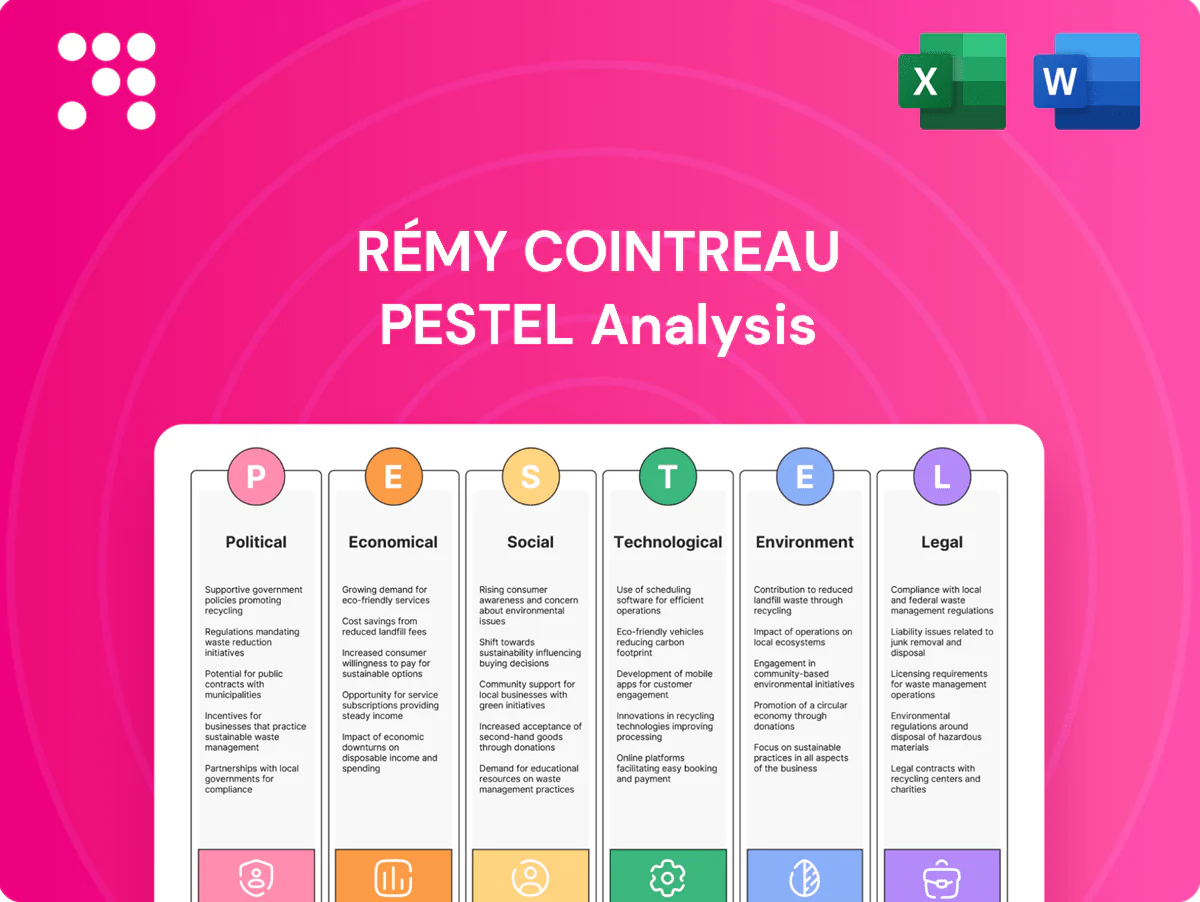
Rémy Cointreau PESTLE Analysis

Skip the Research. Get the Strategy.
Our PESTLE Analysis for Rémy Cointreau reveals how political shifts, economic cycles, social trends, technological advances, legal changes, and environmental pressures are shaping its premium spirits strategy. Packed with actionable insights and risk forecasts, it’s ideal for investors and strategists. Purchase the full report to access the complete, editable analysis and stay ahead of market moves.
Political factors

Tariffs and trade policy
Spirits trade faces shifting tariffs between the EU, US, China and other markets, altering price points and margin mix. Prior disputes—notably US 25% retaliatory duties linked to the Airbus case—show how quickly duties can hit Cognac exports. Rémy Cointreau hedges scenarios, adjusts routing and inventory and engages trade bodies while diversifying market exposure to mitigate shocks.
Geopolitical volatility
Geopolitical volatility hits Rémy Cointreau acutely: exposure to China, the US and travel retail makes sales sensitive to diplomatic tensions and sanctions, with China accounting for a significant share of Asian demand and group sales of about €1.13bn in FY 2023/24. Policy moves can restrict marketing, alter distributor agreements and slow customs clearance, raising inventory and cash-cycle risks. The firm requires contingency plans for sudden channel disruptions and scenario planning to reallocate inventory and protect prestige SKUs and Cognac eaux-de-vie.

Excise taxation and sin taxes
Governments increasingly raise alcohol excise and sin taxes to fund budgets and curb consumption; in 2023–24 several markets drove duty uplifts exceeding inflation, compressing affordability even for premium SKUs and trimming volumes. Higher duties force Rémy Cointreau to optimize pricing architecture and pack sizes by market to protect mix. Active monitoring of fiscal calendars and targeted lobbying can pre-empt shocks to margins and demand.

EU agricultural and regional policies
Cognac production depends on EU and French agricultural support and strict AOC vineyard rules across roughly 77,000 ha in the Cognac zone; CAP 2021–27 allocates €386.6bn, influencing subsidies and rural development funds that affect Rémy Cointreau’s input costs. Shifts in subsidy design, labor mobility rules and water-use regulation can materially change cost structures and long ageing inventory economics, so engagement with appellation bodies preserves continuity and market access.
- CAP budget €386.6bn
- Cognac area ~77,000 ha
- Regulatory visibility vital for long-cycle stocks
Market access and distribution regimes
Import licensing, state-level controls and quotas shape Rémy Cointreau’s route-to-market: the US three-tier framework spans 50 states with varied self-distribution exceptions, while excise and licensing remain at state level in India’s 28 states and across the EU’s 27 member countries, forcing country-by-country portfolio and trade-term adaptation. Political reforms can expand or restrict direct-to-consumer access; government duty-free stances also steer travel-retail strategy.
- Import licensing: varying permits by country
- US three-tier: 50 states, state-specific rules
- State excise: India 28 states, EU 27 members
- Duty-free/travel retail: affects channel mix
Tariff, excise shocks; 25% US duties hit cognac exports — €1.13bn risk
Tariff shifts between the EU, US and China alter price/margin mix and past US 25% retaliatory duties show export vulnerability; Rémy Cointreau hedges routing, inventory and market exposure. Geopolitical tensions and sanctions risk travel-retail and China-linked sales; FY 2023/24 group sales ~€1.13bn heighten sensitivity. Rising excise/duties in 2023–24 exceeded inflation, pressuring premium volumes and pricing.
| Metric | Value |
|---|---|
| Group sales FY23/24 | €1.13bn |
| CAP budget | €386.6bn |
| Cognac area | ~77,000 ha |
| Past US duties | 25% |
What is included in the product
 Detailed Word Document
Explores how Political, Economic, Social, Technological, Environmental and Legal forces uniquely shape Rémy Cointreau’s strategy and performance, with data‑backed trends and region‑specific examples. Designed for executives and advisors, it offers forward‑looking insights to identify risks, opportunities and scenario actions.

 Customizable Excel Spreadsheet
A concise, visually segmented PESTLE summary for Rémy Cointreau that's easily dropped into presentations, editable with regional or business-line notes, and shareable across teams to streamline discussions on external risks and market positioning.
Economic factors

Premiumization vs. macro slowdowns
Luxury spirits benefit from premiumization, yet cyclical slowdowns curb gifting and big-ticket buys; Cognac demand tracks China (2024 GDP ~5.2%), US (~2.6%) and EMEA/Euro area (~0.5%) growth. Rémy Cointreau needs elastic price ladders and limited editions to defend pricing power; strict inventory discipline preserves margins through downturns.
FX volatility and euro strength
Rémy Cointreau’s geographically diversified revenues are paid largely in USD, CNY and emerging‑market currencies while costs remain euro‑centric, leaving margins exposed as the euro strengthened to about 1.07 USD in mid‑2025; FX swings can compress reported growth and shift pricing thresholds. Hedging programs and localized pricing have historically smoothed volatility, and portfolio/channel mix shifts (e.g., priority on US travel retail or China on‑trade) can offset adverse moves.

Input costs: grapes, glass, energy
Inflation in agricultural inputs, glass and energy has lifted COGS for distillation and bottling; EU agricultural input prices surged during 2022–23 and glass container prices increased roughly 15% in that period, while European gas TTF spiked to about €340/MWh in 2022 before averaging near €60–80/MWh in 2024, pressuring margins for Rémy Cointreau.
Energy price volatility also stresses distillery operations and logistics through higher fuel and refrigeration costs and intermittent supply constraints, raising short‑term operating risk and transport spend.
Multi‑year supplier contracts and lightweight packaging design have been used to hedge input-price swings and cut per‑unit glass use, mitigating immediate cost pass‑through.
Targeted efficiency capex and shifting to renewable energy sourcing (onsite solar/PPAs) improve resilience by lowering long‑run energy exposure and stabilising production costs.

Interest rates and inventory aging
Cognac legally requires minimum 2 years in oak and commercial maturation often spans 4–30 years, tying up working capital and raising carrying costs as central bank rates rose (ECB deposit rate 4.00% in July 2024). Balance-sheet flexibility and inventory planning are critical; prioritizing higher-margin allocations improves cash conversion, while treasury hedges funding costs across long maturation cycles.
- Inventory aging: 2+ years legal, 4–30 years common
- Rate impact: ECB deposit rate 4.00% (Jul 2024)
- Mitigants: margin-led allocations, hedging funding over maturities
Travel retail and tourism cycles
Tariff, excise shocks; 25% US duties hit cognac exports — €1.13bn risk
Premiumization supports pricing but cyclical slowdowns and China/US/Euro growth (China 2024 GDP ~5.2%, US ~2.6%, Euro area ~0.5%) constrain volumes; FX (EUR ~1.07 USD mid‑2025) and rising input costs squeeze margins. Long maturation ties cash to higher rates (ECB deposit 4.00% Jul‑24); hedging, SKU mix and capex in renewables mitigate risk.
| Metric | Value |
|---|---|
| China GDP 2024 | ~5.2% |
| US GDP 2024 | ~2.6% |
| Euro area GDP 2024 | ~0.5% |
| EUR/USD mid‑2025 | ~1.07 |
| ECB deposit rate Jul‑24 | 4.00% |
Preview the Actual Deliverable
Rémy Cointreau PESTLE Analysis
The Rémy Cointreau PESTLE Analysis shown here is the exact, fully formatted document you’ll receive after purchase; the layout, content, and structure are identical to the downloadable file. No placeholders—this is the final, ready-to-use report.

Skip the Research. Get the Strategy.
Our PESTLE Analysis for Rémy Cointreau reveals how political shifts, economic cycles, social trends, technological advances, legal changes, and environmental pressures are shaping its premium spirits strategy. Packed with actionable insights and risk forecasts, it’s ideal for investors and strategists. Purchase the full report to access the complete, editable analysis and stay ahead of market moves.
Political factors
Tariffs and trade policy
Spirits trade faces shifting tariffs between the EU, US, China and other markets, altering price points and margin mix. Prior disputes—notably US 25% retaliatory duties linked to the Airbus case—show how quickly duties can hit Cognac exports. Rémy Cointreau hedges scenarios, adjusts routing and inventory and engages trade bodies while diversifying market exposure to mitigate shocks.
Geopolitical volatility
Geopolitical volatility hits Rémy Cointreau acutely: exposure to China, the US and travel retail makes sales sensitive to diplomatic tensions and sanctions, with China accounting for a significant share of Asian demand and group sales of about €1.13bn in FY 2023/24. Policy moves can restrict marketing, alter distributor agreements and slow customs clearance, raising inventory and cash-cycle risks. The firm requires contingency plans for sudden channel disruptions and scenario planning to reallocate inventory and protect prestige SKUs and Cognac eaux-de-vie.
Excise taxation and sin taxes
Governments increasingly raise alcohol excise and sin taxes to fund budgets and curb consumption; in 2023–24 several markets drove duty uplifts exceeding inflation, compressing affordability even for premium SKUs and trimming volumes. Higher duties force Rémy Cointreau to optimize pricing architecture and pack sizes by market to protect mix. Active monitoring of fiscal calendars and targeted lobbying can pre-empt shocks to margins and demand.
EU agricultural and regional policies
Cognac production depends on EU and French agricultural support and strict AOC vineyard rules across roughly 77,000 ha in the Cognac zone; CAP 2021–27 allocates €386.6bn, influencing subsidies and rural development funds that affect Rémy Cointreau’s input costs. Shifts in subsidy design, labor mobility rules and water-use regulation can materially change cost structures and long ageing inventory economics, so engagement with appellation bodies preserves continuity and market access.
- CAP budget €386.6bn
- Cognac area ~77,000 ha
- Regulatory visibility vital for long-cycle stocks
Market access and distribution regimes
Import licensing, state-level controls and quotas shape Rémy Cointreau’s route-to-market: the US three-tier framework spans 50 states with varied self-distribution exceptions, while excise and licensing remain at state level in India’s 28 states and across the EU’s 27 member countries, forcing country-by-country portfolio and trade-term adaptation. Political reforms can expand or restrict direct-to-consumer access; government duty-free stances also steer travel-retail strategy.
- Import licensing: varying permits by country
- US three-tier: 50 states, state-specific rules
- State excise: India 28 states, EU 27 members
- Duty-free/travel retail: affects channel mix
Tariff, excise shocks; 25% US duties hit cognac exports — €1.13bn risk
Tariff shifts between the EU, US and China alter price/margin mix and past US 25% retaliatory duties show export vulnerability; Rémy Cointreau hedges routing, inventory and market exposure. Geopolitical tensions and sanctions risk travel-retail and China-linked sales; FY 2023/24 group sales ~€1.13bn heighten sensitivity. Rising excise/duties in 2023–24 exceeded inflation, pressuring premium volumes and pricing.
| Metric | Value |
|---|---|
| Group sales FY23/24 | €1.13bn |
| CAP budget | €386.6bn |
| Cognac area | ~77,000 ha |
| Past US duties | 25% |
What is included in the product
Detailed Word Document
Explores how Political, Economic, Social, Technological, Environmental and Legal forces uniquely shape Rémy Cointreau’s strategy and performance, with data‑backed trends and region‑specific examples. Designed for executives and advisors, it offers forward‑looking insights to identify risks, opportunities and scenario actions.
Customizable Excel Spreadsheet
A concise, visually segmented PESTLE summary for Rémy Cointreau that's easily dropped into presentations, editable with regional or business-line notes, and shareable across teams to streamline discussions on external risks and market positioning.
Economic factors
Premiumization vs. macro slowdowns
Luxury spirits benefit from premiumization, yet cyclical slowdowns curb gifting and big-ticket buys; Cognac demand tracks China (2024 GDP ~5.2%), US (~2.6%) and EMEA/Euro area (~0.5%) growth. Rémy Cointreau needs elastic price ladders and limited editions to defend pricing power; strict inventory discipline preserves margins through downturns.
FX volatility and euro strength
Rémy Cointreau’s geographically diversified revenues are paid largely in USD, CNY and emerging‑market currencies while costs remain euro‑centric, leaving margins exposed as the euro strengthened to about 1.07 USD in mid‑2025; FX swings can compress reported growth and shift pricing thresholds. Hedging programs and localized pricing have historically smoothed volatility, and portfolio/channel mix shifts (e.g., priority on US travel retail or China on‑trade) can offset adverse moves.
Input costs: grapes, glass, energy
Inflation in agricultural inputs, glass and energy has lifted COGS for distillation and bottling; EU agricultural input prices surged during 2022–23 and glass container prices increased roughly 15% in that period, while European gas TTF spiked to about €340/MWh in 2022 before averaging near €60–80/MWh in 2024, pressuring margins for Rémy Cointreau.
Energy price volatility also stresses distillery operations and logistics through higher fuel and refrigeration costs and intermittent supply constraints, raising short‑term operating risk and transport spend.
Multi‑year supplier contracts and lightweight packaging design have been used to hedge input-price swings and cut per‑unit glass use, mitigating immediate cost pass‑through.
Targeted efficiency capex and shifting to renewable energy sourcing (onsite solar/PPAs) improve resilience by lowering long‑run energy exposure and stabilising production costs.
Interest rates and inventory aging
Cognac legally requires minimum 2 years in oak and commercial maturation often spans 4–30 years, tying up working capital and raising carrying costs as central bank rates rose (ECB deposit rate 4.00% in July 2024). Balance-sheet flexibility and inventory planning are critical; prioritizing higher-margin allocations improves cash conversion, while treasury hedges funding costs across long maturation cycles.
- Inventory aging: 2+ years legal, 4–30 years common
- Rate impact: ECB deposit rate 4.00% (Jul 2024)
- Mitigants: margin-led allocations, hedging funding over maturities
Travel retail and tourism cycles
Tariff, excise shocks; 25% US duties hit cognac exports — €1.13bn risk
Premiumization supports pricing but cyclical slowdowns and China/US/Euro growth (China 2024 GDP ~5.2%, US ~2.6%, Euro area ~0.5%) constrain volumes; FX (EUR ~1.07 USD mid‑2025) and rising input costs squeeze margins. Long maturation ties cash to higher rates (ECB deposit 4.00% Jul‑24); hedging, SKU mix and capex in renewables mitigate risk.
| Metric | Value |
|---|---|
| China GDP 2024 | ~5.2% |
| US GDP 2024 | ~2.6% |
| Euro area GDP 2024 | ~0.5% |
| EUR/USD mid‑2025 | ~1.07 |
| ECB deposit rate Jul‑24 | 4.00% |
Preview the Actual Deliverable
Rémy Cointreau PESTLE Analysis
The Rémy Cointreau PESTLE Analysis shown here is the exact, fully formatted document you’ll receive after purchase; the layout, content, and structure are identical to the downloadable file. No placeholders—this is the final, ready-to-use report.
Original: $10.00
-65%$10.00
$3.50Description
Skip the Research. Get the Strategy.
Our PESTLE Analysis for Rémy Cointreau reveals how political shifts, economic cycles, social trends, technological advances, legal changes, and environmental pressures are shaping its premium spirits strategy. Packed with actionable insights and risk forecasts, it’s ideal for investors and strategists. Purchase the full report to access the complete, editable analysis and stay ahead of market moves.
Political factors
Tariffs and trade policy
Spirits trade faces shifting tariffs between the EU, US, China and other markets, altering price points and margin mix. Prior disputes—notably US 25% retaliatory duties linked to the Airbus case—show how quickly duties can hit Cognac exports. Rémy Cointreau hedges scenarios, adjusts routing and inventory and engages trade bodies while diversifying market exposure to mitigate shocks.
Geopolitical volatility
Geopolitical volatility hits Rémy Cointreau acutely: exposure to China, the US and travel retail makes sales sensitive to diplomatic tensions and sanctions, with China accounting for a significant share of Asian demand and group sales of about €1.13bn in FY 2023/24. Policy moves can restrict marketing, alter distributor agreements and slow customs clearance, raising inventory and cash-cycle risks. The firm requires contingency plans for sudden channel disruptions and scenario planning to reallocate inventory and protect prestige SKUs and Cognac eaux-de-vie.
Excise taxation and sin taxes
Governments increasingly raise alcohol excise and sin taxes to fund budgets and curb consumption; in 2023–24 several markets drove duty uplifts exceeding inflation, compressing affordability even for premium SKUs and trimming volumes. Higher duties force Rémy Cointreau to optimize pricing architecture and pack sizes by market to protect mix. Active monitoring of fiscal calendars and targeted lobbying can pre-empt shocks to margins and demand.
EU agricultural and regional policies
Cognac production depends on EU and French agricultural support and strict AOC vineyard rules across roughly 77,000 ha in the Cognac zone; CAP 2021–27 allocates €386.6bn, influencing subsidies and rural development funds that affect Rémy Cointreau’s input costs. Shifts in subsidy design, labor mobility rules and water-use regulation can materially change cost structures and long ageing inventory economics, so engagement with appellation bodies preserves continuity and market access.
- CAP budget €386.6bn
- Cognac area ~77,000 ha
- Regulatory visibility vital for long-cycle stocks
Market access and distribution regimes
Import licensing, state-level controls and quotas shape Rémy Cointreau’s route-to-market: the US three-tier framework spans 50 states with varied self-distribution exceptions, while excise and licensing remain at state level in India’s 28 states and across the EU’s 27 member countries, forcing country-by-country portfolio and trade-term adaptation. Political reforms can expand or restrict direct-to-consumer access; government duty-free stances also steer travel-retail strategy.
- Import licensing: varying permits by country
- US three-tier: 50 states, state-specific rules
- State excise: India 28 states, EU 27 members
- Duty-free/travel retail: affects channel mix
Tariff, excise shocks; 25% US duties hit cognac exports — €1.13bn risk
Tariff shifts between the EU, US and China alter price/margin mix and past US 25% retaliatory duties show export vulnerability; Rémy Cointreau hedges routing, inventory and market exposure. Geopolitical tensions and sanctions risk travel-retail and China-linked sales; FY 2023/24 group sales ~€1.13bn heighten sensitivity. Rising excise/duties in 2023–24 exceeded inflation, pressuring premium volumes and pricing.
| Metric | Value |
|---|---|
| Group sales FY23/24 | €1.13bn |
| CAP budget | €386.6bn |
| Cognac area | ~77,000 ha |
| Past US duties | 25% |
What is included in the product
Detailed Word Document
Explores how Political, Economic, Social, Technological, Environmental and Legal forces uniquely shape Rémy Cointreau’s strategy and performance, with data‑backed trends and region‑specific examples. Designed for executives and advisors, it offers forward‑looking insights to identify risks, opportunities and scenario actions.
Customizable Excel Spreadsheet
A concise, visually segmented PESTLE summary for Rémy Cointreau that's easily dropped into presentations, editable with regional or business-line notes, and shareable across teams to streamline discussions on external risks and market positioning.
Economic factors
Premiumization vs. macro slowdowns
Luxury spirits benefit from premiumization, yet cyclical slowdowns curb gifting and big-ticket buys; Cognac demand tracks China (2024 GDP ~5.2%), US (~2.6%) and EMEA/Euro area (~0.5%) growth. Rémy Cointreau needs elastic price ladders and limited editions to defend pricing power; strict inventory discipline preserves margins through downturns.
FX volatility and euro strength
Rémy Cointreau’s geographically diversified revenues are paid largely in USD, CNY and emerging‑market currencies while costs remain euro‑centric, leaving margins exposed as the euro strengthened to about 1.07 USD in mid‑2025; FX swings can compress reported growth and shift pricing thresholds. Hedging programs and localized pricing have historically smoothed volatility, and portfolio/channel mix shifts (e.g., priority on US travel retail or China on‑trade) can offset adverse moves.
Input costs: grapes, glass, energy
Inflation in agricultural inputs, glass and energy has lifted COGS for distillation and bottling; EU agricultural input prices surged during 2022–23 and glass container prices increased roughly 15% in that period, while European gas TTF spiked to about €340/MWh in 2022 before averaging near €60–80/MWh in 2024, pressuring margins for Rémy Cointreau.
Energy price volatility also stresses distillery operations and logistics through higher fuel and refrigeration costs and intermittent supply constraints, raising short‑term operating risk and transport spend.
Multi‑year supplier contracts and lightweight packaging design have been used to hedge input-price swings and cut per‑unit glass use, mitigating immediate cost pass‑through.
Targeted efficiency capex and shifting to renewable energy sourcing (onsite solar/PPAs) improve resilience by lowering long‑run energy exposure and stabilising production costs.
Interest rates and inventory aging
Cognac legally requires minimum 2 years in oak and commercial maturation often spans 4–30 years, tying up working capital and raising carrying costs as central bank rates rose (ECB deposit rate 4.00% in July 2024). Balance-sheet flexibility and inventory planning are critical; prioritizing higher-margin allocations improves cash conversion, while treasury hedges funding costs across long maturation cycles.
- Inventory aging: 2+ years legal, 4–30 years common
- Rate impact: ECB deposit rate 4.00% (Jul 2024)
- Mitigants: margin-led allocations, hedging funding over maturities
Travel retail and tourism cycles
Tariff, excise shocks; 25% US duties hit cognac exports — €1.13bn risk
Premiumization supports pricing but cyclical slowdowns and China/US/Euro growth (China 2024 GDP ~5.2%, US ~2.6%, Euro area ~0.5%) constrain volumes; FX (EUR ~1.07 USD mid‑2025) and rising input costs squeeze margins. Long maturation ties cash to higher rates (ECB deposit 4.00% Jul‑24); hedging, SKU mix and capex in renewables mitigate risk.
| Metric | Value |
|---|---|
| China GDP 2024 | ~5.2% |
| US GDP 2024 | ~2.6% |
| Euro area GDP 2024 | ~0.5% |
| EUR/USD mid‑2025 | ~1.07 |
| ECB deposit rate Jul‑24 | 4.00% |
Preview the Actual Deliverable
Rémy Cointreau PESTLE Analysis
The Rémy Cointreau PESTLE Analysis shown here is the exact, fully formatted document you’ll receive after purchase; the layout, content, and structure are identical to the downloadable file. No placeholders—this is the final, ready-to-use report.











