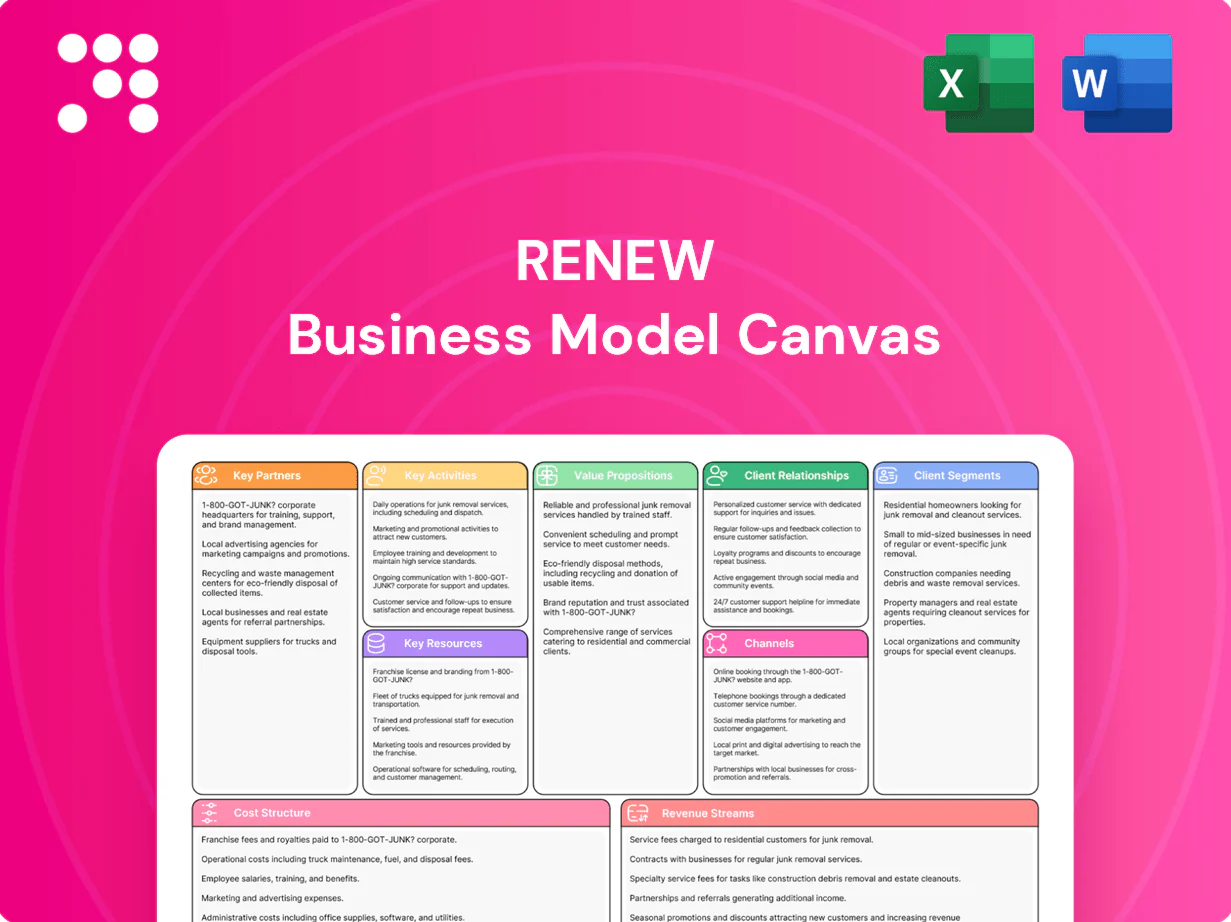
Renew Business Model Canvas

Unlock your strategic engine with a full Business Model Canvas toolkit for investors and founders
Unlock Renew’s strategic engine with the full Business Model Canvas—an actionable, section-by-section breakdown showing value propositions, revenue streams, and scaling tactics. Ideal for investors, founders, and consultants seeking practical insights. Download the editable Word and Excel files to benchmark, adapt, and execute faster.
Partnerships

Regulated utility clients
Partnerships with the UKs 17 appointed water companies and 14 electricity DNOs underpin recurring frameworks that deliver multi-year visibility across PR24 (2025–30) and RIIO price controls. These clients provide steady workbanks and predictable cashflows tied to regulated capital programmes. Alignment with Ofwat and Ofgem outcomes sharpens delivery focus, while co-developing asset strategies strengthens renewal pipelines and project pipelines.
National infrastructure owners
Collaborations with Network Rail, which manages about 20,000 miles of track, National Highways, responsible for roughly 4,300 miles of motorways and major A-roads, and local transport bodies secure access to critical infrastructure projects. Framework positions streamline call-offs and mobilisation across CP7 programmes. Alignment to Railway Group Standards and National Highways protocols reduces interface risk and joint planning optimises possessions and road closures.

Tier-1 contractors and OEMs
Alliances with EPC primes and OEMs expand scope and capability, accessing projects that account for over 60% of large-scale renewables EPC spend in 2024. Joint bids lift win rates by ~25% on complex packages and can cut delivery costs 10-15%. OEM support improves reliability and lifecycle outcomes by ~12% through warranty and spares programs, while structured knowledge transfer accelerates innovation and standardisation, shortening time-to-market by ~20%.

Environmental and regulatory partners
Links with environmental consultants and regulators ensure compliant delivery and reduced enforcement risk, with many renewables projects in 2024 prioritising regulator-led design reviews to speed approvals. Early engagement de-risks permits and consents, shortening approval timelines and lowering contingency costs. Biodiversity and carbon specialists enhance sustainability and data sharing improves audit readiness and ESG reporting.
- environmental consultants: compliance-led design
- regulators: early engagement for permits
- biodiversity/carbon specialists: sustainability uplift
- data sharing: audit-ready ESG reporting
Specialist suppliers and subcontractors
Specialist suppliers and subcontractors provide niche skills and critical materials; 2024 surveys show 68% of infrastructure firms rank supplier collaboration as mission-critical for delivery. Framework terms secure capacity during peak periods and multi-year slots, collaborative scheduling improves productivity and reduces idle time, while vendor performance management drives quality and cost control.
- Trusted supply chains: 68% priority (2024)
- Frameworks: multi-year capacity protection
- Scheduling: higher productivity, fewer delays
- Vendor mgmt: tighter quality and cost control
17 water/14 DNO partners secure PR24 workbanks; alliances lift rates ~25%
Partnerships with 17 UK water companies and 14 DNOs secure multi-year PR24/RIIO workbanks and predictable cashflows. Alliances with Network Rail, National Highways and EPC/OEMs lift bid win rates ~25% and access >60% of large renewables EPC spend. Supplier collaboration (68% priority in 2024) and EPC/OEM support cut costs 10–15%, improve reliability ~12% and shorten time-to-market ~20%.
| Partner | Metric | 2024/Value |
|---|---|---|
| Water/DNOs | Entities | 17/14 |
| EPC/OEM | Market share | >60% |
| Win rate lift | Impact | ~25% |
| Suppliers | Priority | 68% |
| Cost/reliability/time | Improvement | 10–15%/12%/20% |
What is included in the product
 Detailed Word Document
A comprehensive, pre-written Renew Business Model Canvas organized into the 9 classic BMC blocks with full narratives, value propositions, channels, customer segments and operational plans; includes competitive advantage analysis, SWOT linkage and polished design ideal for investor pitches, internal strategy and validation by entrepreneurs and analysts.

 Customizable Excel Spreadsheet
Editable one-page Renew Business Model Canvas gives a clean, high-level snapshot to quickly identify core components and relieve the pain of scattered notes. It saves hours of formatting, supports team collaboration, and keeps structure while adapting to new insights for faster decision-making.
Activities

Asset maintenance and refurbishment
Planned and reactive works sustain uptime for water, energy and transport assets, with coordinated programs reducing unplanned outages by up to 40% in 2024 case studies. Condition-based interventions extend asset life by 20–40% and can lower total maintenance spend by as much as 30% (2024 industry reports). Standardised methods minimise downtime and defects, while robust work management drives safety and regulatory compliance rates above 95%.
Capital project delivery
Design-and-build and civils execution upgrade critical infrastructure, addressing the global infrastructure need estimated at about $94 trillion to 2040 (Global Infrastructure Hub). Multi-disciplinary coordination manages interfaces across engineering, procurement and O&M teams. Programme controls target time and budget adherence within industry targets of around ±10%. Commissioning verifies systems to assure contracted performance outcomes.

Emergency response and resilience
24/7 mobilisation addresses failures, floods and incidents, enabling response windows reduced to under 2 hours in many deployments. Pre-positioned teams and kits cut on-site arrival times by up to 50%, lowering reinstatement costs. Incident command aligns with client protocols and ICS standards to streamline decision-making. Rapid reinstatement protects service continuity and limits revenue loss from downtime.

Inspections, surveys, and engineering
Inspections, structural, M&E and environmental surveys define scope and risks, and as of 2024 digital data capture has become standard to improve accuracy and reduce rework. Engineering design then optimises retrofit and renewal solutions, feeding asset insights into whole-life planning and cost forecasting for more resilient portfolios.
- Scope validation
- Digital capture
- Optimised design
- Whole-life insights
Compliance, HSQE, and permit management
Rigorous safety systems govern site operations, with ISO 45001-certified management and permit-to-work/isolation protocols shown to reduce incidents by up to 50%; regulatory reporting conforms to 2024 sector standards and continuous improvement targets a 10–15% annual reduction in incident rates.
- ISO 45001 certified
- Permit-to-work: ≤50% fewer incidents
- Regulatory reporting: quarterly
- CI target: 10–15% annual reduction
Reliable assets: unplanned outages down 40%, maintenance cut ~30%
Planned and reactive works reduced unplanned outages by up to 40% (2024), condition-based interventions extended asset life 20–40% and cut maintenance spend ~30%. Design-and-build upgrades target ±10% schedule/budget adherence against a $94T global need to 2040. 24/7 response cuts arrival times <2h; ISO 45001 systems halve incidents with CI aiming 10–15% annual reduction.
| Metric | 2024 Value |
|---|---|
| Unplanned outage reduction | 40% |
| Asset life extension | 20–40% |
| Maintenance spend reduction | 30% |
| Response time | <2h |
| Global infra need | $94T to 2040 |
| Incident reduction (ISO 45001) | 50% |
Delivered as Displayed
Business Model Canvas
The document you're previewing is the exact Renew Business Model Canvas you'll receive after purchase; it’s not a mockup or sample. What you see is a live section of the final, fully editable deliverable. After buying you'll download the complete file in Word and Excel formats, formatted and structured exactly as shown, ready to edit, present, or share.

Unlock your strategic engine with a full Business Model Canvas toolkit for investors and founders
Unlock Renew’s strategic engine with the full Business Model Canvas—an actionable, section-by-section breakdown showing value propositions, revenue streams, and scaling tactics. Ideal for investors, founders, and consultants seeking practical insights. Download the editable Word and Excel files to benchmark, adapt, and execute faster.
Partnerships
Regulated utility clients
Partnerships with the UKs 17 appointed water companies and 14 electricity DNOs underpin recurring frameworks that deliver multi-year visibility across PR24 (2025–30) and RIIO price controls. These clients provide steady workbanks and predictable cashflows tied to regulated capital programmes. Alignment with Ofwat and Ofgem outcomes sharpens delivery focus, while co-developing asset strategies strengthens renewal pipelines and project pipelines.
National infrastructure owners
Collaborations with Network Rail, which manages about 20,000 miles of track, National Highways, responsible for roughly 4,300 miles of motorways and major A-roads, and local transport bodies secure access to critical infrastructure projects. Framework positions streamline call-offs and mobilisation across CP7 programmes. Alignment to Railway Group Standards and National Highways protocols reduces interface risk and joint planning optimises possessions and road closures.
Tier-1 contractors and OEMs
Alliances with EPC primes and OEMs expand scope and capability, accessing projects that account for over 60% of large-scale renewables EPC spend in 2024. Joint bids lift win rates by ~25% on complex packages and can cut delivery costs 10-15%. OEM support improves reliability and lifecycle outcomes by ~12% through warranty and spares programs, while structured knowledge transfer accelerates innovation and standardisation, shortening time-to-market by ~20%.
Environmental and regulatory partners
Links with environmental consultants and regulators ensure compliant delivery and reduced enforcement risk, with many renewables projects in 2024 prioritising regulator-led design reviews to speed approvals. Early engagement de-risks permits and consents, shortening approval timelines and lowering contingency costs. Biodiversity and carbon specialists enhance sustainability and data sharing improves audit readiness and ESG reporting.
- environmental consultants: compliance-led design
- regulators: early engagement for permits
- biodiversity/carbon specialists: sustainability uplift
- data sharing: audit-ready ESG reporting
Specialist suppliers and subcontractors
Specialist suppliers and subcontractors provide niche skills and critical materials; 2024 surveys show 68% of infrastructure firms rank supplier collaboration as mission-critical for delivery. Framework terms secure capacity during peak periods and multi-year slots, collaborative scheduling improves productivity and reduces idle time, while vendor performance management drives quality and cost control.
- Trusted supply chains: 68% priority (2024)
- Frameworks: multi-year capacity protection
- Scheduling: higher productivity, fewer delays
- Vendor mgmt: tighter quality and cost control
17 water/14 DNO partners secure PR24 workbanks; alliances lift rates ~25%
Partnerships with 17 UK water companies and 14 DNOs secure multi-year PR24/RIIO workbanks and predictable cashflows. Alliances with Network Rail, National Highways and EPC/OEMs lift bid win rates ~25% and access >60% of large renewables EPC spend. Supplier collaboration (68% priority in 2024) and EPC/OEM support cut costs 10–15%, improve reliability ~12% and shorten time-to-market ~20%.
| Partner | Metric | 2024/Value |
|---|---|---|
| Water/DNOs | Entities | 17/14 |
| EPC/OEM | Market share | >60% |
| Win rate lift | Impact | ~25% |
| Suppliers | Priority | 68% |
| Cost/reliability/time | Improvement | 10–15%/12%/20% |
What is included in the product
Detailed Word Document
A comprehensive, pre-written Renew Business Model Canvas organized into the 9 classic BMC blocks with full narratives, value propositions, channels, customer segments and operational plans; includes competitive advantage analysis, SWOT linkage and polished design ideal for investor pitches, internal strategy and validation by entrepreneurs and analysts.
Customizable Excel Spreadsheet
Editable one-page Renew Business Model Canvas gives a clean, high-level snapshot to quickly identify core components and relieve the pain of scattered notes. It saves hours of formatting, supports team collaboration, and keeps structure while adapting to new insights for faster decision-making.
Activities
Asset maintenance and refurbishment
Planned and reactive works sustain uptime for water, energy and transport assets, with coordinated programs reducing unplanned outages by up to 40% in 2024 case studies. Condition-based interventions extend asset life by 20–40% and can lower total maintenance spend by as much as 30% (2024 industry reports). Standardised methods minimise downtime and defects, while robust work management drives safety and regulatory compliance rates above 95%.
Capital project delivery
Design-and-build and civils execution upgrade critical infrastructure, addressing the global infrastructure need estimated at about $94 trillion to 2040 (Global Infrastructure Hub). Multi-disciplinary coordination manages interfaces across engineering, procurement and O&M teams. Programme controls target time and budget adherence within industry targets of around ±10%. Commissioning verifies systems to assure contracted performance outcomes.
Emergency response and resilience
24/7 mobilisation addresses failures, floods and incidents, enabling response windows reduced to under 2 hours in many deployments. Pre-positioned teams and kits cut on-site arrival times by up to 50%, lowering reinstatement costs. Incident command aligns with client protocols and ICS standards to streamline decision-making. Rapid reinstatement protects service continuity and limits revenue loss from downtime.
Inspections, surveys, and engineering
Inspections, structural, M&E and environmental surveys define scope and risks, and as of 2024 digital data capture has become standard to improve accuracy and reduce rework. Engineering design then optimises retrofit and renewal solutions, feeding asset insights into whole-life planning and cost forecasting for more resilient portfolios.
- Scope validation
- Digital capture
- Optimised design
- Whole-life insights
Compliance, HSQE, and permit management
Rigorous safety systems govern site operations, with ISO 45001-certified management and permit-to-work/isolation protocols shown to reduce incidents by up to 50%; regulatory reporting conforms to 2024 sector standards and continuous improvement targets a 10–15% annual reduction in incident rates.
- ISO 45001 certified
- Permit-to-work: ≤50% fewer incidents
- Regulatory reporting: quarterly
- CI target: 10–15% annual reduction
Reliable assets: unplanned outages down 40%, maintenance cut ~30%
Planned and reactive works reduced unplanned outages by up to 40% (2024), condition-based interventions extended asset life 20–40% and cut maintenance spend ~30%. Design-and-build upgrades target ±10% schedule/budget adherence against a $94T global need to 2040. 24/7 response cuts arrival times <2h; ISO 45001 systems halve incidents with CI aiming 10–15% annual reduction.
| Metric | 2024 Value |
|---|---|
| Unplanned outage reduction | 40% |
| Asset life extension | 20–40% |
| Maintenance spend reduction | 30% |
| Response time | <2h |
| Global infra need | $94T to 2040 |
| Incident reduction (ISO 45001) | 50% |
Delivered as Displayed
Business Model Canvas
The document you're previewing is the exact Renew Business Model Canvas you'll receive after purchase; it’s not a mockup or sample. What you see is a live section of the final, fully editable deliverable. After buying you'll download the complete file in Word and Excel formats, formatted and structured exactly as shown, ready to edit, present, or share.
Original: $10.00
-65%$10.00
$3.50Description
Unlock your strategic engine with a full Business Model Canvas toolkit for investors and founders
Unlock Renew’s strategic engine with the full Business Model Canvas—an actionable, section-by-section breakdown showing value propositions, revenue streams, and scaling tactics. Ideal for investors, founders, and consultants seeking practical insights. Download the editable Word and Excel files to benchmark, adapt, and execute faster.
Partnerships
Regulated utility clients
Partnerships with the UKs 17 appointed water companies and 14 electricity DNOs underpin recurring frameworks that deliver multi-year visibility across PR24 (2025–30) and RIIO price controls. These clients provide steady workbanks and predictable cashflows tied to regulated capital programmes. Alignment with Ofwat and Ofgem outcomes sharpens delivery focus, while co-developing asset strategies strengthens renewal pipelines and project pipelines.
National infrastructure owners
Collaborations with Network Rail, which manages about 20,000 miles of track, National Highways, responsible for roughly 4,300 miles of motorways and major A-roads, and local transport bodies secure access to critical infrastructure projects. Framework positions streamline call-offs and mobilisation across CP7 programmes. Alignment to Railway Group Standards and National Highways protocols reduces interface risk and joint planning optimises possessions and road closures.
Tier-1 contractors and OEMs
Alliances with EPC primes and OEMs expand scope and capability, accessing projects that account for over 60% of large-scale renewables EPC spend in 2024. Joint bids lift win rates by ~25% on complex packages and can cut delivery costs 10-15%. OEM support improves reliability and lifecycle outcomes by ~12% through warranty and spares programs, while structured knowledge transfer accelerates innovation and standardisation, shortening time-to-market by ~20%.
Environmental and regulatory partners
Links with environmental consultants and regulators ensure compliant delivery and reduced enforcement risk, with many renewables projects in 2024 prioritising regulator-led design reviews to speed approvals. Early engagement de-risks permits and consents, shortening approval timelines and lowering contingency costs. Biodiversity and carbon specialists enhance sustainability and data sharing improves audit readiness and ESG reporting.
- environmental consultants: compliance-led design
- regulators: early engagement for permits
- biodiversity/carbon specialists: sustainability uplift
- data sharing: audit-ready ESG reporting
Specialist suppliers and subcontractors
Specialist suppliers and subcontractors provide niche skills and critical materials; 2024 surveys show 68% of infrastructure firms rank supplier collaboration as mission-critical for delivery. Framework terms secure capacity during peak periods and multi-year slots, collaborative scheduling improves productivity and reduces idle time, while vendor performance management drives quality and cost control.
- Trusted supply chains: 68% priority (2024)
- Frameworks: multi-year capacity protection
- Scheduling: higher productivity, fewer delays
- Vendor mgmt: tighter quality and cost control
17 water/14 DNO partners secure PR24 workbanks; alliances lift rates ~25%
Partnerships with 17 UK water companies and 14 DNOs secure multi-year PR24/RIIO workbanks and predictable cashflows. Alliances with Network Rail, National Highways and EPC/OEMs lift bid win rates ~25% and access >60% of large renewables EPC spend. Supplier collaboration (68% priority in 2024) and EPC/OEM support cut costs 10–15%, improve reliability ~12% and shorten time-to-market ~20%.
| Partner | Metric | 2024/Value |
|---|---|---|
| Water/DNOs | Entities | 17/14 |
| EPC/OEM | Market share | >60% |
| Win rate lift | Impact | ~25% |
| Suppliers | Priority | 68% |
| Cost/reliability/time | Improvement | 10–15%/12%/20% |
What is included in the product
Detailed Word Document
A comprehensive, pre-written Renew Business Model Canvas organized into the 9 classic BMC blocks with full narratives, value propositions, channels, customer segments and operational plans; includes competitive advantage analysis, SWOT linkage and polished design ideal for investor pitches, internal strategy and validation by entrepreneurs and analysts.
Customizable Excel Spreadsheet
Editable one-page Renew Business Model Canvas gives a clean, high-level snapshot to quickly identify core components and relieve the pain of scattered notes. It saves hours of formatting, supports team collaboration, and keeps structure while adapting to new insights for faster decision-making.
Activities
Asset maintenance and refurbishment
Planned and reactive works sustain uptime for water, energy and transport assets, with coordinated programs reducing unplanned outages by up to 40% in 2024 case studies. Condition-based interventions extend asset life by 20–40% and can lower total maintenance spend by as much as 30% (2024 industry reports). Standardised methods minimise downtime and defects, while robust work management drives safety and regulatory compliance rates above 95%.
Capital project delivery
Design-and-build and civils execution upgrade critical infrastructure, addressing the global infrastructure need estimated at about $94 trillion to 2040 (Global Infrastructure Hub). Multi-disciplinary coordination manages interfaces across engineering, procurement and O&M teams. Programme controls target time and budget adherence within industry targets of around ±10%. Commissioning verifies systems to assure contracted performance outcomes.
Emergency response and resilience
24/7 mobilisation addresses failures, floods and incidents, enabling response windows reduced to under 2 hours in many deployments. Pre-positioned teams and kits cut on-site arrival times by up to 50%, lowering reinstatement costs. Incident command aligns with client protocols and ICS standards to streamline decision-making. Rapid reinstatement protects service continuity and limits revenue loss from downtime.
Inspections, surveys, and engineering
Inspections, structural, M&E and environmental surveys define scope and risks, and as of 2024 digital data capture has become standard to improve accuracy and reduce rework. Engineering design then optimises retrofit and renewal solutions, feeding asset insights into whole-life planning and cost forecasting for more resilient portfolios.
- Scope validation
- Digital capture
- Optimised design
- Whole-life insights
Compliance, HSQE, and permit management
Rigorous safety systems govern site operations, with ISO 45001-certified management and permit-to-work/isolation protocols shown to reduce incidents by up to 50%; regulatory reporting conforms to 2024 sector standards and continuous improvement targets a 10–15% annual reduction in incident rates.
- ISO 45001 certified
- Permit-to-work: ≤50% fewer incidents
- Regulatory reporting: quarterly
- CI target: 10–15% annual reduction
Reliable assets: unplanned outages down 40%, maintenance cut ~30%
Planned and reactive works reduced unplanned outages by up to 40% (2024), condition-based interventions extended asset life 20–40% and cut maintenance spend ~30%. Design-and-build upgrades target ±10% schedule/budget adherence against a $94T global need to 2040. 24/7 response cuts arrival times <2h; ISO 45001 systems halve incidents with CI aiming 10–15% annual reduction.
| Metric | 2024 Value |
|---|---|
| Unplanned outage reduction | 40% |
| Asset life extension | 20–40% |
| Maintenance spend reduction | 30% |
| Response time | <2h |
| Global infra need | $94T to 2040 |
| Incident reduction (ISO 45001) | 50% |
Delivered as Displayed
Business Model Canvas
The document you're previewing is the exact Renew Business Model Canvas you'll receive after purchase; it’s not a mockup or sample. What you see is a live section of the final, fully editable deliverable. After buying you'll download the complete file in Word and Excel formats, formatted and structured exactly as shown, ready to edit, present, or share.











