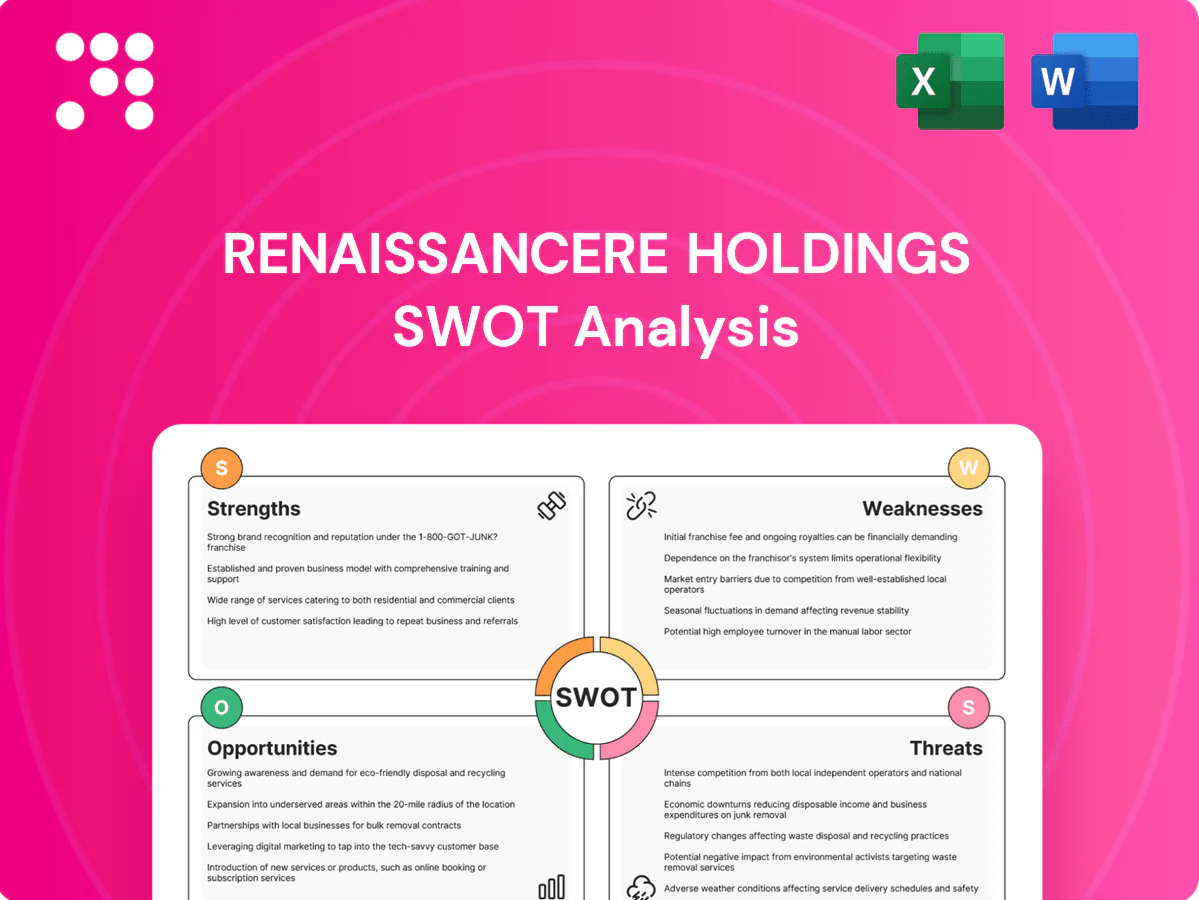
RenaissanceRe Holdings SWOT Analysis

Go Beyond the Preview—Access the Full Strategic Report
RenaissanceRe’s SWOT highlights robust underwriting expertise and capital strength, balanced by exposure to catastrophe risk and cyclical reinsurance markets. Growth drivers include diversification and specialty lines, while regulatory shifts and climate volatility pose key threats. Purchase the full SWOT analysis for a detailed, editable Word and Excel report to inform strategy and investment decisions.
Strengths

Leading catastrophe franchise
RenaissanceRe is a top-tier property-cat reinsurer with deep peak-peril underwriting expertise, delivering consistent results across cycles and attracting broker and cedent preference for complex placements.
Scale and reputation helped secure attractive shares on high-quality programs, underpinning strong deal flow and pricing power, with gross premiums written of about $3.5 billion in 2024.
Capital efficiency & third‑party vehicles
RenaissanceRe matches risks with multiple capital forms, including managed third‑party vehicles and ILS, expanding capacity without over‑levering its balance sheet and generating fee income; this capital‑light revenue mix boosts return on equity and, by relying on external capital, allows rapid scaling up or down in response to market conditions.

Advanced risk modeling & analytics
Proprietary models and data-driven selection are central to RenaissanceRe’s underwriting discipline, enabling granular risk selection and pricing. Superior analytics enhance portfolio construction, tail-risk control and pricing accuracy, helping lower loss-ratio volatility on a risk-adjusted basis versus peers. These insights also support innovative treaty structures and parametric solutions tailored to client exposures.

Diversified global book
RenaissanceRe’s diversified global book spans property, casualty and specialty lines, reducing reliance on any single segment and helping to contain volatility through 2024–2025. Geographic spread across regions lowers loss correlation from regional catastrophes, while a broad mix of cedents and brokers stabilizes premium inflows. This diversification underpinned more resilient underwriting results and earnings through the recent cycle.
- Segment diversity: property, casualty, specialty
- Geographic spread: lowers correlation of regional losses
- Client mix: varied cedents and brokers stabilize premiums
- Outcome: supports resilient earnings over the cycle
Strong balance sheet & cycle management
RenaissanceRe maintains conservative reserving and capital management that support large-event solvency and its A+ S&P rating; disciplined retrocession and portfolio hedging limit tail exposure. The firm has a track record of raising or returning capital opportunistically, preserving flexibility and enhancing long-term shareholder returns.
- Conservative reserves & capital
- Opportunistic capital actions
- Prudent retrocession & hedging
Top property-cat reinsurer with peak-peril expertise, $3.5B GWP, S&P A+
RenaissanceRe is a leading property-cat reinsurer with deep peak-peril expertise and strong broker/cedent preference. Scale and reputation drove about $3.5 billion gross premiums written in 2024 and pricing power across programs. Diverse global book, conservative reserving and opportunistic capital actions support an S&P A+ rating and resilient earnings.
| Metric | 2024 |
|---|---|
| Gross premiums written | $3.5B |
| S&P rating | A+ |
What is included in the product
 Detailed Word Document
Delivers a strategic overview of RenaissanceRe Holdings’s internal and external business factors, highlighting strengths like underwriting expertise and diversified reinsurance platforms, weaknesses such as exposure to catastrophe losses, opportunities in insurtech and emerging markets, and threats from climate change and regulatory shifts.

 Customizable Excel Spreadsheet
Provides a concise RenaissanceRe Holdings SWOT matrix for fast, visual strategy alignment and risk-focused decision-making. Ideal for executives and analysts needing a quick snapshot of strengths, vulnerabilities, opportunities, and threats to streamline capital allocation and reinsurance strategy discussions.
Weaknesses

Earnings volatility from cat exposure
Concentration in peak perils leaves RenaissanceRe exposed to event-driven swings; major hurricanes or earthquakes can move quarterly results by hundreds of millions of dollars. Even with portfolio diversification, outsized catastrophes have historically produced material quarterly earnings hits that compress valuation multiples and raise cost of capital. Investor sentiment can reverse rapidly after a large loss, amplifying share-price volatility and funding costs.
Dependence on capital markets appetite
Dependence on third‑party capital and ILS leaves RenaissanceRe exposed to cyclical investor risk tolerance; outflows during market dislocations can sharply curtail fee income and reduce underwriting capacity. Replacing withdrawn capital with share issuances or parent equity can dilute per‑share returns, while intensified competition for limited ILS funds risks compressing fee margins and lowering profitability.

Model risk and parameter uncertainty
Catastrophe and casualty models carry inherent limitations and tail uncertainty that can leave RenaissanceRe (NYSE: RNR) exposed to rare, high-severity events. Shifts in climate patterns and evolving legal trends can outpace historical data, undermining model relevance. Model mis-specification can produce underpricing or accumulation hotspots, and governance, validation and monitoring impose material ongoing costs on the firm.

Regulatory and rating agency constraints
Operating across EU Solvency II, Bermuda Monetary Authority and US state regimes raises compliance complexity and expense for RenaissanceRe, while capital requirements and rating agency criteria constrain growth flexibility and may force priority on capital preservation. Recent solvency-rule shifts in EU and Bermuda have increased buffer needs, which can dampen ROE during expansion phases.
- Regulatory overlay: multi-jurisdictional compliance
- Capital constraints: limits on rapid growth
- Solvency shifts: higher capital buffers
- ROE impact: compression during expansion
Limited primary distribution
RenaissanceRe’s reliance on reinsurance and intermediated channels reduces direct control over end customers, limiting firsthand insights and slowing product iteration due to scarce direct-to-insured data. Broker dynamics can compress access and pricing on key programs, constraining cross-sell and bundling potential across specialty lines.
- Distribution dependence: intermediated reinsurance
- Data gap: limited direct insured data
- Broker influence: pricing/access risk
- Growth limits: weaker cross-sell/bundling
Catastrophe concentration drives volatile earnings, funding cyclicality and underpricing risk
Concentration in peak-peril catastrophe risks creates large quarterly earnings volatility and rapid investor sentiment shifts; reliance on third-party ILS and capital markets raises funding and fee-income cyclicality. Model and climate/legal tail uncertainty can produce material underpricing or accumulation risk, while multi-jurisdictional solvency rules and intermediated distribution constrain capital flexibility and direct customer data access.
| Metric | Value (2024/2025) |
|---|---|
| Ticker | RNR |
| Regulator | Bermuda Monetary Authority / US states / EU |
Same Document Delivered
RenaissanceRe Holdings SWOT Analysis
This is a real excerpt from the RenaissanceRe Holdings SWOT Analysis you’re viewing—the same professional-quality document you’ll receive after purchase, with the full, editable and detailed report unlocked upon checkout.

Go Beyond the Preview—Access the Full Strategic Report
RenaissanceRe’s SWOT highlights robust underwriting expertise and capital strength, balanced by exposure to catastrophe risk and cyclical reinsurance markets. Growth drivers include diversification and specialty lines, while regulatory shifts and climate volatility pose key threats. Purchase the full SWOT analysis for a detailed, editable Word and Excel report to inform strategy and investment decisions.
Strengths
Leading catastrophe franchise
RenaissanceRe is a top-tier property-cat reinsurer with deep peak-peril underwriting expertise, delivering consistent results across cycles and attracting broker and cedent preference for complex placements.
Scale and reputation helped secure attractive shares on high-quality programs, underpinning strong deal flow and pricing power, with gross premiums written of about $3.5 billion in 2024.
Capital efficiency & third‑party vehicles
RenaissanceRe matches risks with multiple capital forms, including managed third‑party vehicles and ILS, expanding capacity without over‑levering its balance sheet and generating fee income; this capital‑light revenue mix boosts return on equity and, by relying on external capital, allows rapid scaling up or down in response to market conditions.
Advanced risk modeling & analytics
Proprietary models and data-driven selection are central to RenaissanceRe’s underwriting discipline, enabling granular risk selection and pricing. Superior analytics enhance portfolio construction, tail-risk control and pricing accuracy, helping lower loss-ratio volatility on a risk-adjusted basis versus peers. These insights also support innovative treaty structures and parametric solutions tailored to client exposures.
Diversified global book
RenaissanceRe’s diversified global book spans property, casualty and specialty lines, reducing reliance on any single segment and helping to contain volatility through 2024–2025. Geographic spread across regions lowers loss correlation from regional catastrophes, while a broad mix of cedents and brokers stabilizes premium inflows. This diversification underpinned more resilient underwriting results and earnings through the recent cycle.
- Segment diversity: property, casualty, specialty
- Geographic spread: lowers correlation of regional losses
- Client mix: varied cedents and brokers stabilize premiums
- Outcome: supports resilient earnings over the cycle
Strong balance sheet & cycle management
RenaissanceRe maintains conservative reserving and capital management that support large-event solvency and its A+ S&P rating; disciplined retrocession and portfolio hedging limit tail exposure. The firm has a track record of raising or returning capital opportunistically, preserving flexibility and enhancing long-term shareholder returns.
- Conservative reserves & capital
- Opportunistic capital actions
- Prudent retrocession & hedging
Top property-cat reinsurer with peak-peril expertise, $3.5B GWP, S&P A+
RenaissanceRe is a leading property-cat reinsurer with deep peak-peril expertise and strong broker/cedent preference. Scale and reputation drove about $3.5 billion gross premiums written in 2024 and pricing power across programs. Diverse global book, conservative reserving and opportunistic capital actions support an S&P A+ rating and resilient earnings.
| Metric | 2024 |
|---|---|
| Gross premiums written | $3.5B |
| S&P rating | A+ |
What is included in the product
Detailed Word Document
Delivers a strategic overview of RenaissanceRe Holdings’s internal and external business factors, highlighting strengths like underwriting expertise and diversified reinsurance platforms, weaknesses such as exposure to catastrophe losses, opportunities in insurtech and emerging markets, and threats from climate change and regulatory shifts.
Customizable Excel Spreadsheet
Provides a concise RenaissanceRe Holdings SWOT matrix for fast, visual strategy alignment and risk-focused decision-making. Ideal for executives and analysts needing a quick snapshot of strengths, vulnerabilities, opportunities, and threats to streamline capital allocation and reinsurance strategy discussions.
Weaknesses
Earnings volatility from cat exposure
Concentration in peak perils leaves RenaissanceRe exposed to event-driven swings; major hurricanes or earthquakes can move quarterly results by hundreds of millions of dollars. Even with portfolio diversification, outsized catastrophes have historically produced material quarterly earnings hits that compress valuation multiples and raise cost of capital. Investor sentiment can reverse rapidly after a large loss, amplifying share-price volatility and funding costs.
Dependence on capital markets appetite
Dependence on third‑party capital and ILS leaves RenaissanceRe exposed to cyclical investor risk tolerance; outflows during market dislocations can sharply curtail fee income and reduce underwriting capacity. Replacing withdrawn capital with share issuances or parent equity can dilute per‑share returns, while intensified competition for limited ILS funds risks compressing fee margins and lowering profitability.
Model risk and parameter uncertainty
Catastrophe and casualty models carry inherent limitations and tail uncertainty that can leave RenaissanceRe (NYSE: RNR) exposed to rare, high-severity events. Shifts in climate patterns and evolving legal trends can outpace historical data, undermining model relevance. Model mis-specification can produce underpricing or accumulation hotspots, and governance, validation and monitoring impose material ongoing costs on the firm.
Regulatory and rating agency constraints
Operating across EU Solvency II, Bermuda Monetary Authority and US state regimes raises compliance complexity and expense for RenaissanceRe, while capital requirements and rating agency criteria constrain growth flexibility and may force priority on capital preservation. Recent solvency-rule shifts in EU and Bermuda have increased buffer needs, which can dampen ROE during expansion phases.
- Regulatory overlay: multi-jurisdictional compliance
- Capital constraints: limits on rapid growth
- Solvency shifts: higher capital buffers
- ROE impact: compression during expansion
Limited primary distribution
RenaissanceRe’s reliance on reinsurance and intermediated channels reduces direct control over end customers, limiting firsthand insights and slowing product iteration due to scarce direct-to-insured data. Broker dynamics can compress access and pricing on key programs, constraining cross-sell and bundling potential across specialty lines.
- Distribution dependence: intermediated reinsurance
- Data gap: limited direct insured data
- Broker influence: pricing/access risk
- Growth limits: weaker cross-sell/bundling
Catastrophe concentration drives volatile earnings, funding cyclicality and underpricing risk
Concentration in peak-peril catastrophe risks creates large quarterly earnings volatility and rapid investor sentiment shifts; reliance on third-party ILS and capital markets raises funding and fee-income cyclicality. Model and climate/legal tail uncertainty can produce material underpricing or accumulation risk, while multi-jurisdictional solvency rules and intermediated distribution constrain capital flexibility and direct customer data access.
| Metric | Value (2024/2025) |
|---|---|
| Ticker | RNR |
| Regulator | Bermuda Monetary Authority / US states / EU |
Same Document Delivered
RenaissanceRe Holdings SWOT Analysis
This is a real excerpt from the RenaissanceRe Holdings SWOT Analysis you’re viewing—the same professional-quality document you’ll receive after purchase, with the full, editable and detailed report unlocked upon checkout.
Original: $10.00
-65%$10.00
$3.50Description
Go Beyond the Preview—Access the Full Strategic Report
RenaissanceRe’s SWOT highlights robust underwriting expertise and capital strength, balanced by exposure to catastrophe risk and cyclical reinsurance markets. Growth drivers include diversification and specialty lines, while regulatory shifts and climate volatility pose key threats. Purchase the full SWOT analysis for a detailed, editable Word and Excel report to inform strategy and investment decisions.
Strengths
Leading catastrophe franchise
RenaissanceRe is a top-tier property-cat reinsurer with deep peak-peril underwriting expertise, delivering consistent results across cycles and attracting broker and cedent preference for complex placements.
Scale and reputation helped secure attractive shares on high-quality programs, underpinning strong deal flow and pricing power, with gross premiums written of about $3.5 billion in 2024.
Capital efficiency & third‑party vehicles
RenaissanceRe matches risks with multiple capital forms, including managed third‑party vehicles and ILS, expanding capacity without over‑levering its balance sheet and generating fee income; this capital‑light revenue mix boosts return on equity and, by relying on external capital, allows rapid scaling up or down in response to market conditions.
Advanced risk modeling & analytics
Proprietary models and data-driven selection are central to RenaissanceRe’s underwriting discipline, enabling granular risk selection and pricing. Superior analytics enhance portfolio construction, tail-risk control and pricing accuracy, helping lower loss-ratio volatility on a risk-adjusted basis versus peers. These insights also support innovative treaty structures and parametric solutions tailored to client exposures.
Diversified global book
RenaissanceRe’s diversified global book spans property, casualty and specialty lines, reducing reliance on any single segment and helping to contain volatility through 2024–2025. Geographic spread across regions lowers loss correlation from regional catastrophes, while a broad mix of cedents and brokers stabilizes premium inflows. This diversification underpinned more resilient underwriting results and earnings through the recent cycle.
- Segment diversity: property, casualty, specialty
- Geographic spread: lowers correlation of regional losses
- Client mix: varied cedents and brokers stabilize premiums
- Outcome: supports resilient earnings over the cycle
Strong balance sheet & cycle management
RenaissanceRe maintains conservative reserving and capital management that support large-event solvency and its A+ S&P rating; disciplined retrocession and portfolio hedging limit tail exposure. The firm has a track record of raising or returning capital opportunistically, preserving flexibility and enhancing long-term shareholder returns.
- Conservative reserves & capital
- Opportunistic capital actions
- Prudent retrocession & hedging
Top property-cat reinsurer with peak-peril expertise, $3.5B GWP, S&P A+
RenaissanceRe is a leading property-cat reinsurer with deep peak-peril expertise and strong broker/cedent preference. Scale and reputation drove about $3.5 billion gross premiums written in 2024 and pricing power across programs. Diverse global book, conservative reserving and opportunistic capital actions support an S&P A+ rating and resilient earnings.
| Metric | 2024 |
|---|---|
| Gross premiums written | $3.5B |
| S&P rating | A+ |
What is included in the product
Detailed Word Document
Delivers a strategic overview of RenaissanceRe Holdings’s internal and external business factors, highlighting strengths like underwriting expertise and diversified reinsurance platforms, weaknesses such as exposure to catastrophe losses, opportunities in insurtech and emerging markets, and threats from climate change and regulatory shifts.
Customizable Excel Spreadsheet
Provides a concise RenaissanceRe Holdings SWOT matrix for fast, visual strategy alignment and risk-focused decision-making. Ideal for executives and analysts needing a quick snapshot of strengths, vulnerabilities, opportunities, and threats to streamline capital allocation and reinsurance strategy discussions.
Weaknesses
Earnings volatility from cat exposure
Concentration in peak perils leaves RenaissanceRe exposed to event-driven swings; major hurricanes or earthquakes can move quarterly results by hundreds of millions of dollars. Even with portfolio diversification, outsized catastrophes have historically produced material quarterly earnings hits that compress valuation multiples and raise cost of capital. Investor sentiment can reverse rapidly after a large loss, amplifying share-price volatility and funding costs.
Dependence on capital markets appetite
Dependence on third‑party capital and ILS leaves RenaissanceRe exposed to cyclical investor risk tolerance; outflows during market dislocations can sharply curtail fee income and reduce underwriting capacity. Replacing withdrawn capital with share issuances or parent equity can dilute per‑share returns, while intensified competition for limited ILS funds risks compressing fee margins and lowering profitability.
Model risk and parameter uncertainty
Catastrophe and casualty models carry inherent limitations and tail uncertainty that can leave RenaissanceRe (NYSE: RNR) exposed to rare, high-severity events. Shifts in climate patterns and evolving legal trends can outpace historical data, undermining model relevance. Model mis-specification can produce underpricing or accumulation hotspots, and governance, validation and monitoring impose material ongoing costs on the firm.
Regulatory and rating agency constraints
Operating across EU Solvency II, Bermuda Monetary Authority and US state regimes raises compliance complexity and expense for RenaissanceRe, while capital requirements and rating agency criteria constrain growth flexibility and may force priority on capital preservation. Recent solvency-rule shifts in EU and Bermuda have increased buffer needs, which can dampen ROE during expansion phases.
- Regulatory overlay: multi-jurisdictional compliance
- Capital constraints: limits on rapid growth
- Solvency shifts: higher capital buffers
- ROE impact: compression during expansion
Limited primary distribution
RenaissanceRe’s reliance on reinsurance and intermediated channels reduces direct control over end customers, limiting firsthand insights and slowing product iteration due to scarce direct-to-insured data. Broker dynamics can compress access and pricing on key programs, constraining cross-sell and bundling potential across specialty lines.
- Distribution dependence: intermediated reinsurance
- Data gap: limited direct insured data
- Broker influence: pricing/access risk
- Growth limits: weaker cross-sell/bundling
Catastrophe concentration drives volatile earnings, funding cyclicality and underpricing risk
Concentration in peak-peril catastrophe risks creates large quarterly earnings volatility and rapid investor sentiment shifts; reliance on third-party ILS and capital markets raises funding and fee-income cyclicality. Model and climate/legal tail uncertainty can produce material underpricing or accumulation risk, while multi-jurisdictional solvency rules and intermediated distribution constrain capital flexibility and direct customer data access.
| Metric | Value (2024/2025) |
|---|---|
| Ticker | RNR |
| Regulator | Bermuda Monetary Authority / US states / EU |
Same Document Delivered
RenaissanceRe Holdings SWOT Analysis
This is a real excerpt from the RenaissanceRe Holdings SWOT Analysis you’re viewing—the same professional-quality document you’ll receive after purchase, with the full, editable and detailed report unlocked upon checkout.











