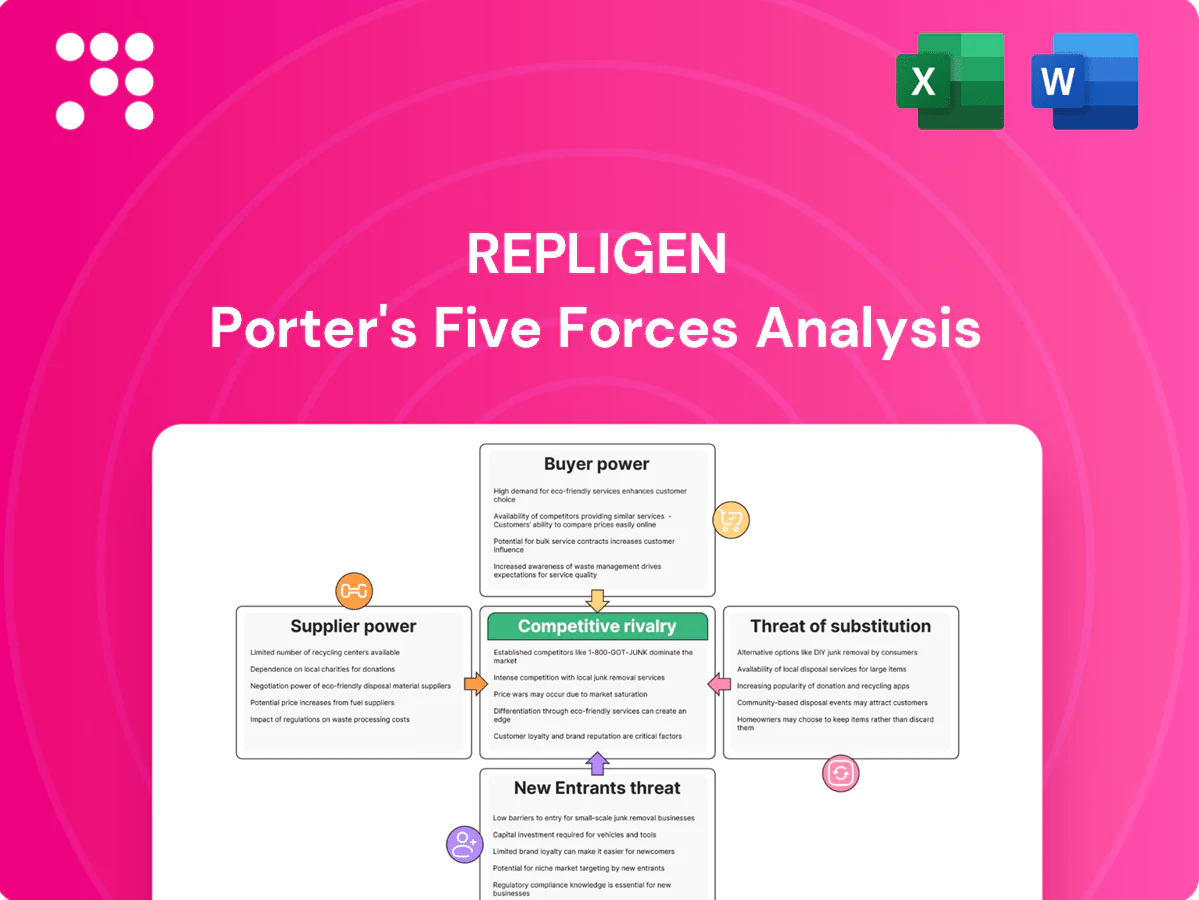
Repligen Porter's Five Forces Analysis

Don't Miss the Bigger Picture
Repligen’s Porter’s Five Forces snapshot highlights strong supplier influence in bioprocess materials, moderate buyer power across OEMs, high competitive rivalry from established life‑science suppliers, limited substitute threats, and barriers that temper new entrants’ impact. This brief overview identifies key strategic pressures and opportunities. Unlock the full Porter's Five Forces Analysis to explore Repligen’s competitive dynamics, market pressures, and strategic advantages in detail.
Suppliers Bargaining Power

Specialized raw materials
In 2024 Repligen depends on niche inputs such as ligands, resins, membranes and specialty polymers, and limited qualified sources plus strict GMP and validation raise supplier leverage. Repligen’s scale and technical expertise enable joint development and tight performance specs that temper supplier power. Multi-year contracts and maintained safety stocks further mitigate disruption risk.
Supplier concentration risk
Supplier concentration risk: critical inputs like high-purity polymers and sensor electronics are supplied by few vendors, which in 2024 Repligen highlighted in its 2024 10-K as a material supply risk; tight markets can pressure pricing and lead times. Repligen mitigates this via dual-sourcing where feasible and qualifying alternates. Geographic diversification and inventory buffering further reduce exposure.

Quality and compliance barriers
Bioprocess inputs must meet GMP and regulatory standards, limiting the qualified supplier pool and often requiring 6–12 months of qualification and hundreds of thousands in validation costs, which raises supplier leverage. Repligen’s rigorous incoming QC and supplier audits give it enforcement power to uphold specifications. Long-term partnerships align incentives on quality and supply continuity, reducing disruption risk.

Vertical integration and know-how
Repligen’s vertical integration and internal process know-how reduce dependence on upstream vendors by keeping critical capabilities in-house, shifting negotiations toward technical performance and long-term collaboration rather than pure price competition. Technical co-innovation with customers and selective manufacturing assets make inputs less substitutable, while proprietary formulations and process IP progressively erode supplier leverage.
- In-house know-how limits vendor reliance
- Co-innovation shifts focus to performance
- Proprietary IP reduces substitutability
- Supplier power declines over time
Logistics and sterilization constraints
Single-use components often require contracted sterilization capacity that can bottleneck production; Repligen reported 2024 revenue of $632 million, reflecting strong demand that amplifies sensitivity to sterilization and transport constraints. Transportation and resin lead-time volatility intermittently tighten supply, but Repligen’s planning, vendor-managed inventory and reserved sterilization slots mitigate disruption. Systemic bottlenecks — e.g., regional sterilizer shortages — can still transiently elevate supplier leverage.
- Sterilization capacity: reserved slots reduce outage risk
- Lead-time volatility: transportation and resin delays increase supplier power
- Inventory strategies: VMI smooths short-term shocks
Niche GMP inputs give supplier leverage; dual-sourcing, VMI, vertical integration — 2024 $632M
In 2024 Repligen relies on niche GMP inputs with few qualified vendors, creating supplier leverage despite co-development and scale reducing pure price pressure. Dual-sourcing, VMI, reserved sterilization slots and vertical integration mitigate disruption; 6–12 month qualifications and validation costs (> $100k) sustain supplier bargaining; 2024 revenue $632M.
| Metric | Value |
|---|---|
| 2024 revenue | $632M |
| Qualification time | 6–12 months |
| Validation cost | > $100k |
| Supplier concentration | High (few vendors) |
What is included in the product
 Detailed Word Document
Tailored Porter's Five Forces analysis for Repligen that uncovers key drivers of competition, customer influence, supplier power, and market entry risks impacting pricing and profitability. Identifies disruptive substitutes, emerging threats, and defensive dynamics that protect or challenge Repligen's market position.

 Customizable Excel Spreadsheet
A concise Repligen Porter's Five Forces one-sheet that clearly maps competitive pressure and strategic levers for quick boardroom decisions, with customizable pressure levels to reflect new data or market shifts.
Customers Bargaining Power

Customer concentration
Large biopharma and CDMOs drive the bulk of Repligen volumes, enabling strong price negotiation power; Repligen reported $1.06B revenue in 2023, reflecting concentration of demand among major customers. Preferred vendor lists and global tenders in 2024 further amplify buyer leverage across procurement. Once single-use consumables are validated, switching costs rise sharply, and strategic supplier relationships plus performance differentiation mitigate pure price pressure.
Validation-driven stickiness
Validated consumables are embedded in GMP processes with rigorous change controls, creating economic and regulatory switching costs that materially reduce buyer leverage after adoption. Buyers often demand dual-qualification yet maintain incumbent usage; surveys show over 70% of firms keep primary suppliers for commercial lines (2024). Reliability and consistency regularly trump lowest price in procurement decisions, reinforcing validation-driven stickiness.

Technical differentiation
Technical differentiation at Repligen in 2024 centers on high-performance filtration, chromatography and analytics that shrink comparable alternatives and justify sustained premium pricing when customers see clear gains in yield and throughput. Deep application support and customization embed systems into customer workflows, reducing buyer mobility and bargaining power. Demonstrable process-economics — cost-per-dose and throughput metrics provided in customer validations — sustain this edge.

Budget cycles and demand volatility
Macro budget cycles in 2024 tightened R&D spend, shifting buyer behavior: customers deferred capex projects or consolidated vendors to extract discounts, while pipeline mix and funding variability heightened procurement caution. Repligen's recurring consumables demand in 2024 provided more stable revenue versus capex-heavy systems, and multi-year framework agreements helped stabilize pricing and volumes.
- 2024: buyers defer capex, consolidate spend
- Pipeline mix/funding drive purchase timing
- Consumables = stability vs capex volatility
- Framework agreements smooth pricing/volumes
Bundling by platform vendors
Integrated suites from large platform vendors often set pricing benchmarks and shift buyer preference toward bundled procurement; large suppliers like Thermo Fisher and Danaher drive scale advantages that pressure standalone vendors. Buyers exploit cross-category bundles to negotiate discounts and service terms, forcing Repligen to emphasize niche excellence, specialized consumables and strong interoperability. Open-architecture compatibility and validated integrations help Repligen retain accounts not locked into bundles while supporting aftermarket growth.
- buyers leverage bundles to cut costs
- Repligen must compete on niche performance
- interoperability reduces account churn
CDMO consolidation boosts buyer leverage, price pressure despite $1.06B
Large biopharma and CDMOs concentrate demand, giving buyers negotiation leverage despite Repligen's $1.06B revenue in 2023; 2024 tendering and vendor consolidation raised price pressure. Validation-driven switching costs and technical differentiation limit mobility, while multi-year framework agreements and recurring consumables stabilize volumes.
| Metric | Value |
|---|---|
| Revenue | $1.06B (2023) |
| Supplier stickiness | >70% keep primary suppliers (2024 survey) |
What You See Is What You Get
Repligen Porter's Five Forces Analysis
This preview shows the exact Repligen Porter's Five Forces analysis you'll receive immediately after purchase—no placeholders or samples. The file is the final, professionally formatted assessment covering rivalry, threat of entrants, supplier and buyer power, and substitute threats, with practical implications. Once you buy, you'll get instant access to this same ready-to-use document.

Don't Miss the Bigger Picture
Repligen’s Porter’s Five Forces snapshot highlights strong supplier influence in bioprocess materials, moderate buyer power across OEMs, high competitive rivalry from established life‑science suppliers, limited substitute threats, and barriers that temper new entrants’ impact. This brief overview identifies key strategic pressures and opportunities. Unlock the full Porter's Five Forces Analysis to explore Repligen’s competitive dynamics, market pressures, and strategic advantages in detail.
Suppliers Bargaining Power
Specialized raw materials
In 2024 Repligen depends on niche inputs such as ligands, resins, membranes and specialty polymers, and limited qualified sources plus strict GMP and validation raise supplier leverage. Repligen’s scale and technical expertise enable joint development and tight performance specs that temper supplier power. Multi-year contracts and maintained safety stocks further mitigate disruption risk.
Supplier concentration risk
Supplier concentration risk: critical inputs like high-purity polymers and sensor electronics are supplied by few vendors, which in 2024 Repligen highlighted in its 2024 10-K as a material supply risk; tight markets can pressure pricing and lead times. Repligen mitigates this via dual-sourcing where feasible and qualifying alternates. Geographic diversification and inventory buffering further reduce exposure.
Quality and compliance barriers
Bioprocess inputs must meet GMP and regulatory standards, limiting the qualified supplier pool and often requiring 6–12 months of qualification and hundreds of thousands in validation costs, which raises supplier leverage. Repligen’s rigorous incoming QC and supplier audits give it enforcement power to uphold specifications. Long-term partnerships align incentives on quality and supply continuity, reducing disruption risk.
Vertical integration and know-how
Repligen’s vertical integration and internal process know-how reduce dependence on upstream vendors by keeping critical capabilities in-house, shifting negotiations toward technical performance and long-term collaboration rather than pure price competition. Technical co-innovation with customers and selective manufacturing assets make inputs less substitutable, while proprietary formulations and process IP progressively erode supplier leverage.
- In-house know-how limits vendor reliance
- Co-innovation shifts focus to performance
- Proprietary IP reduces substitutability
- Supplier power declines over time
Logistics and sterilization constraints
Single-use components often require contracted sterilization capacity that can bottleneck production; Repligen reported 2024 revenue of $632 million, reflecting strong demand that amplifies sensitivity to sterilization and transport constraints. Transportation and resin lead-time volatility intermittently tighten supply, but Repligen’s planning, vendor-managed inventory and reserved sterilization slots mitigate disruption. Systemic bottlenecks — e.g., regional sterilizer shortages — can still transiently elevate supplier leverage.
- Sterilization capacity: reserved slots reduce outage risk
- Lead-time volatility: transportation and resin delays increase supplier power
- Inventory strategies: VMI smooths short-term shocks
Niche GMP inputs give supplier leverage; dual-sourcing, VMI, vertical integration — 2024 $632M
In 2024 Repligen relies on niche GMP inputs with few qualified vendors, creating supplier leverage despite co-development and scale reducing pure price pressure. Dual-sourcing, VMI, reserved sterilization slots and vertical integration mitigate disruption; 6–12 month qualifications and validation costs (> $100k) sustain supplier bargaining; 2024 revenue $632M.
| Metric | Value |
|---|---|
| 2024 revenue | $632M |
| Qualification time | 6–12 months |
| Validation cost | > $100k |
| Supplier concentration | High (few vendors) |
What is included in the product
Detailed Word Document
Tailored Porter's Five Forces analysis for Repligen that uncovers key drivers of competition, customer influence, supplier power, and market entry risks impacting pricing and profitability. Identifies disruptive substitutes, emerging threats, and defensive dynamics that protect or challenge Repligen's market position.
Customizable Excel Spreadsheet
A concise Repligen Porter's Five Forces one-sheet that clearly maps competitive pressure and strategic levers for quick boardroom decisions, with customizable pressure levels to reflect new data or market shifts.
Customers Bargaining Power
Customer concentration
Large biopharma and CDMOs drive the bulk of Repligen volumes, enabling strong price negotiation power; Repligen reported $1.06B revenue in 2023, reflecting concentration of demand among major customers. Preferred vendor lists and global tenders in 2024 further amplify buyer leverage across procurement. Once single-use consumables are validated, switching costs rise sharply, and strategic supplier relationships plus performance differentiation mitigate pure price pressure.
Validation-driven stickiness
Validated consumables are embedded in GMP processes with rigorous change controls, creating economic and regulatory switching costs that materially reduce buyer leverage after adoption. Buyers often demand dual-qualification yet maintain incumbent usage; surveys show over 70% of firms keep primary suppliers for commercial lines (2024). Reliability and consistency regularly trump lowest price in procurement decisions, reinforcing validation-driven stickiness.
Technical differentiation
Technical differentiation at Repligen in 2024 centers on high-performance filtration, chromatography and analytics that shrink comparable alternatives and justify sustained premium pricing when customers see clear gains in yield and throughput. Deep application support and customization embed systems into customer workflows, reducing buyer mobility and bargaining power. Demonstrable process-economics — cost-per-dose and throughput metrics provided in customer validations — sustain this edge.
Budget cycles and demand volatility
Macro budget cycles in 2024 tightened R&D spend, shifting buyer behavior: customers deferred capex projects or consolidated vendors to extract discounts, while pipeline mix and funding variability heightened procurement caution. Repligen's recurring consumables demand in 2024 provided more stable revenue versus capex-heavy systems, and multi-year framework agreements helped stabilize pricing and volumes.
- 2024: buyers defer capex, consolidate spend
- Pipeline mix/funding drive purchase timing
- Consumables = stability vs capex volatility
- Framework agreements smooth pricing/volumes
Bundling by platform vendors
Integrated suites from large platform vendors often set pricing benchmarks and shift buyer preference toward bundled procurement; large suppliers like Thermo Fisher and Danaher drive scale advantages that pressure standalone vendors. Buyers exploit cross-category bundles to negotiate discounts and service terms, forcing Repligen to emphasize niche excellence, specialized consumables and strong interoperability. Open-architecture compatibility and validated integrations help Repligen retain accounts not locked into bundles while supporting aftermarket growth.
- buyers leverage bundles to cut costs
- Repligen must compete on niche performance
- interoperability reduces account churn
CDMO consolidation boosts buyer leverage, price pressure despite $1.06B
Large biopharma and CDMOs concentrate demand, giving buyers negotiation leverage despite Repligen's $1.06B revenue in 2023; 2024 tendering and vendor consolidation raised price pressure. Validation-driven switching costs and technical differentiation limit mobility, while multi-year framework agreements and recurring consumables stabilize volumes.
| Metric | Value |
|---|---|
| Revenue | $1.06B (2023) |
| Supplier stickiness | >70% keep primary suppliers (2024 survey) |
What You See Is What You Get
Repligen Porter's Five Forces Analysis
This preview shows the exact Repligen Porter's Five Forces analysis you'll receive immediately after purchase—no placeholders or samples. The file is the final, professionally formatted assessment covering rivalry, threat of entrants, supplier and buyer power, and substitute threats, with practical implications. Once you buy, you'll get instant access to this same ready-to-use document.
Description
Don't Miss the Bigger Picture
Repligen’s Porter’s Five Forces snapshot highlights strong supplier influence in bioprocess materials, moderate buyer power across OEMs, high competitive rivalry from established life‑science suppliers, limited substitute threats, and barriers that temper new entrants’ impact. This brief overview identifies key strategic pressures and opportunities. Unlock the full Porter's Five Forces Analysis to explore Repligen’s competitive dynamics, market pressures, and strategic advantages in detail.
Suppliers Bargaining Power
Specialized raw materials
In 2024 Repligen depends on niche inputs such as ligands, resins, membranes and specialty polymers, and limited qualified sources plus strict GMP and validation raise supplier leverage. Repligen’s scale and technical expertise enable joint development and tight performance specs that temper supplier power. Multi-year contracts and maintained safety stocks further mitigate disruption risk.
Supplier concentration risk
Supplier concentration risk: critical inputs like high-purity polymers and sensor electronics are supplied by few vendors, which in 2024 Repligen highlighted in its 2024 10-K as a material supply risk; tight markets can pressure pricing and lead times. Repligen mitigates this via dual-sourcing where feasible and qualifying alternates. Geographic diversification and inventory buffering further reduce exposure.
Quality and compliance barriers
Bioprocess inputs must meet GMP and regulatory standards, limiting the qualified supplier pool and often requiring 6–12 months of qualification and hundreds of thousands in validation costs, which raises supplier leverage. Repligen’s rigorous incoming QC and supplier audits give it enforcement power to uphold specifications. Long-term partnerships align incentives on quality and supply continuity, reducing disruption risk.
Vertical integration and know-how
Repligen’s vertical integration and internal process know-how reduce dependence on upstream vendors by keeping critical capabilities in-house, shifting negotiations toward technical performance and long-term collaboration rather than pure price competition. Technical co-innovation with customers and selective manufacturing assets make inputs less substitutable, while proprietary formulations and process IP progressively erode supplier leverage.
- In-house know-how limits vendor reliance
- Co-innovation shifts focus to performance
- Proprietary IP reduces substitutability
- Supplier power declines over time
Logistics and sterilization constraints
Single-use components often require contracted sterilization capacity that can bottleneck production; Repligen reported 2024 revenue of $632 million, reflecting strong demand that amplifies sensitivity to sterilization and transport constraints. Transportation and resin lead-time volatility intermittently tighten supply, but Repligen’s planning, vendor-managed inventory and reserved sterilization slots mitigate disruption. Systemic bottlenecks — e.g., regional sterilizer shortages — can still transiently elevate supplier leverage.
- Sterilization capacity: reserved slots reduce outage risk
- Lead-time volatility: transportation and resin delays increase supplier power
- Inventory strategies: VMI smooths short-term shocks
Niche GMP inputs give supplier leverage; dual-sourcing, VMI, vertical integration — 2024 $632M
In 2024 Repligen relies on niche GMP inputs with few qualified vendors, creating supplier leverage despite co-development and scale reducing pure price pressure. Dual-sourcing, VMI, reserved sterilization slots and vertical integration mitigate disruption; 6–12 month qualifications and validation costs (> $100k) sustain supplier bargaining; 2024 revenue $632M.
| Metric | Value |
|---|---|
| 2024 revenue | $632M |
| Qualification time | 6–12 months |
| Validation cost | > $100k |
| Supplier concentration | High (few vendors) |
What is included in the product
Detailed Word Document
Tailored Porter's Five Forces analysis for Repligen that uncovers key drivers of competition, customer influence, supplier power, and market entry risks impacting pricing and profitability. Identifies disruptive substitutes, emerging threats, and defensive dynamics that protect or challenge Repligen's market position.
Customizable Excel Spreadsheet
A concise Repligen Porter's Five Forces one-sheet that clearly maps competitive pressure and strategic levers for quick boardroom decisions, with customizable pressure levels to reflect new data or market shifts.
Customers Bargaining Power
Customer concentration
Large biopharma and CDMOs drive the bulk of Repligen volumes, enabling strong price negotiation power; Repligen reported $1.06B revenue in 2023, reflecting concentration of demand among major customers. Preferred vendor lists and global tenders in 2024 further amplify buyer leverage across procurement. Once single-use consumables are validated, switching costs rise sharply, and strategic supplier relationships plus performance differentiation mitigate pure price pressure.
Validation-driven stickiness
Validated consumables are embedded in GMP processes with rigorous change controls, creating economic and regulatory switching costs that materially reduce buyer leverage after adoption. Buyers often demand dual-qualification yet maintain incumbent usage; surveys show over 70% of firms keep primary suppliers for commercial lines (2024). Reliability and consistency regularly trump lowest price in procurement decisions, reinforcing validation-driven stickiness.
Technical differentiation
Technical differentiation at Repligen in 2024 centers on high-performance filtration, chromatography and analytics that shrink comparable alternatives and justify sustained premium pricing when customers see clear gains in yield and throughput. Deep application support and customization embed systems into customer workflows, reducing buyer mobility and bargaining power. Demonstrable process-economics — cost-per-dose and throughput metrics provided in customer validations — sustain this edge.
Budget cycles and demand volatility
Macro budget cycles in 2024 tightened R&D spend, shifting buyer behavior: customers deferred capex projects or consolidated vendors to extract discounts, while pipeline mix and funding variability heightened procurement caution. Repligen's recurring consumables demand in 2024 provided more stable revenue versus capex-heavy systems, and multi-year framework agreements helped stabilize pricing and volumes.
- 2024: buyers defer capex, consolidate spend
- Pipeline mix/funding drive purchase timing
- Consumables = stability vs capex volatility
- Framework agreements smooth pricing/volumes
Bundling by platform vendors
Integrated suites from large platform vendors often set pricing benchmarks and shift buyer preference toward bundled procurement; large suppliers like Thermo Fisher and Danaher drive scale advantages that pressure standalone vendors. Buyers exploit cross-category bundles to negotiate discounts and service terms, forcing Repligen to emphasize niche excellence, specialized consumables and strong interoperability. Open-architecture compatibility and validated integrations help Repligen retain accounts not locked into bundles while supporting aftermarket growth.
- buyers leverage bundles to cut costs
- Repligen must compete on niche performance
- interoperability reduces account churn
CDMO consolidation boosts buyer leverage, price pressure despite $1.06B
Large biopharma and CDMOs concentrate demand, giving buyers negotiation leverage despite Repligen's $1.06B revenue in 2023; 2024 tendering and vendor consolidation raised price pressure. Validation-driven switching costs and technical differentiation limit mobility, while multi-year framework agreements and recurring consumables stabilize volumes.
| Metric | Value |
|---|---|
| Revenue | $1.06B (2023) |
| Supplier stickiness | >70% keep primary suppliers (2024 survey) |
What You See Is What You Get
Repligen Porter's Five Forces Analysis
This preview shows the exact Repligen Porter's Five Forces analysis you'll receive immediately after purchase—no placeholders or samples. The file is the final, professionally formatted assessment covering rivalry, threat of entrants, supplier and buyer power, and substitute threats, with practical implications. Once you buy, you'll get instant access to this same ready-to-use document.











