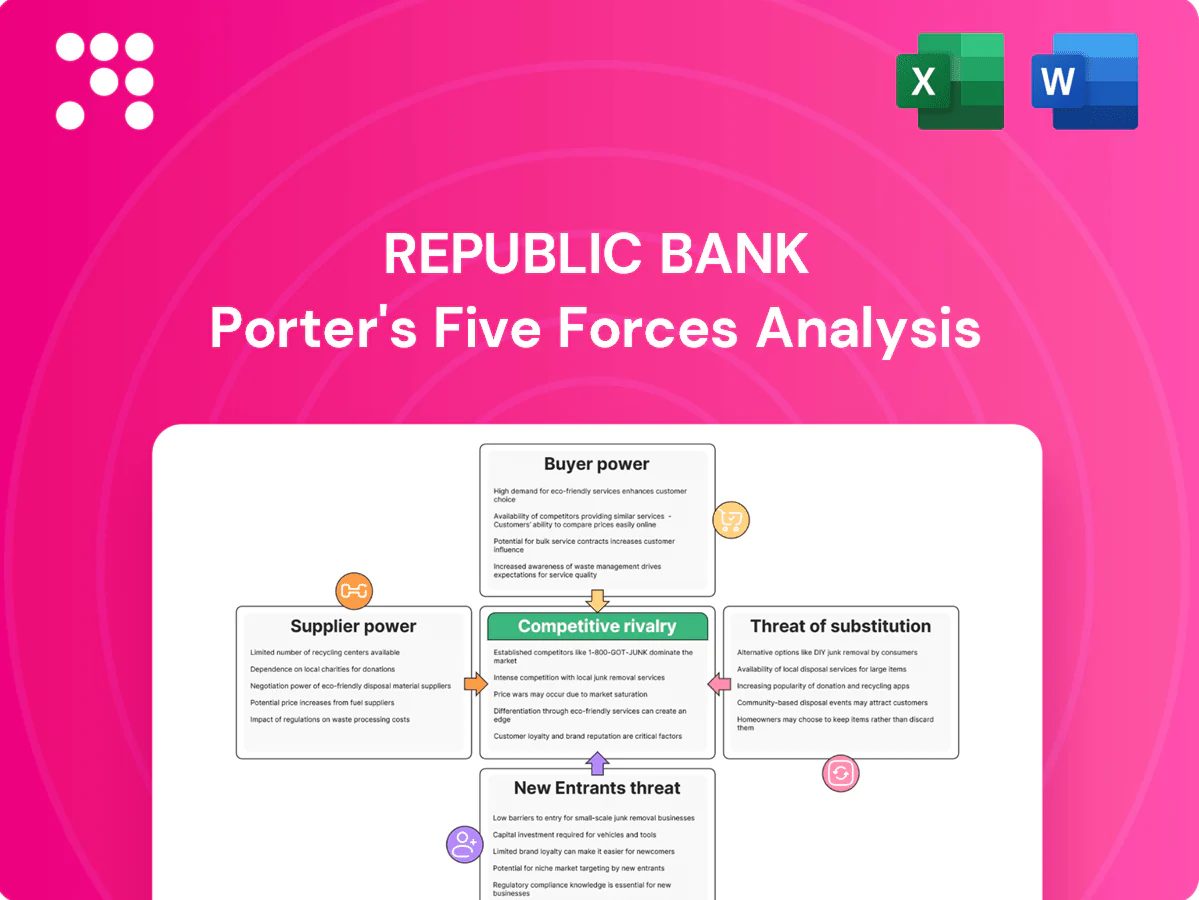
Republic Bank Porter's Five Forces Analysis

A Must-Have Tool for Decision-Makers
Republic Bank faces intense competitive rivalry, regulatory pressure, and rising digital disruptors that reshape margins and customer acquisition; supplier and buyer power are moderate but evolving. This snapshot highlights key risks and opportunities—unlock the full Porter’s Five Forces Analysis for force-by-force ratings, visuals, and actionable strategy to guide investment or strategic decisions.
Suppliers Bargaining Power

Concentrated funding sources
Deposits and wholesale funding are Republic Bank’s primary inputs, so depositors and market lenders act as key suppliers. Concentrated local deposit bases can force the bank to raise offered rates quickly, and shifts into higher-yield savings or brokered CDs raise funding costs materially. Competition for liquidity and the Fed funds target of 5.25–5.50% in 2024 increase sensitivity of funding cost to policy moves.
Technology vendor reliance
Republic Bank relies on a few core vendors—FIS, Fiserv, Temenos (which serves 3,000+ banks) and Finastra—for core banking, payments, cloud and security platforms, concentrating supplier power. Major cloud providers (AWS 32%, Microsoft 22%, Google 11% of IaaS in 2024) further centralize dependency. Core replacements commonly span 12–36 months, raising switching costs and vendor leverage. Vendor outages or breaches materially elevate operational risk and slow product rollout.

Talent and compliance expertise
Skilled lenders, risk managers and compliance officers are scarce in regional markets, with banks reporting 2024 hiring difficulty scores near historic highs as demand outstrips supply. Wage inflation and retention bonuses pushed total compensation for these roles up roughly 10–15% in 2024, raising operating costs. Growing regulatory complexity post-2020 increased demand for specialized staff, while competing banks and fintechs intensified bidding for top performers.

Capital market conditions
Capital market conditions drive supplier bargaining: access to secondary funding, securitization and subordinated debt is cyclical—tight spreads reduce funding costs while widening spreads raise them, and market stress can curtail volumes or force adverse terms. With the US federal funds target at 5.25–5.50% in late 2024, higher base rates amplified spread sensitivity and made ratings and investor sentiment direct levers on Republic Bank’s pricing power.
Payment networks and processors
Card networks and processors such as Visa and Mastercard, which together control roughly 80% of U.S. card volume in 2024, set fees and operating rules with limited negotiation room for Republic Bank. Interchange structures (commonly ~1.5–2.5% on consumer credit) and strict chargeback policies materially affect merchant economics and margin. Mandatory upgrades and compliance (PCI DSS, EMV updates) impose fixed-timeline costs and integration expenses.
- Market share: Visa+Mastercard ~80% (U.S., 2024)
- Interchange: ~1.5–2.5% typical consumer credit
- Chargebacks: tight policies increase cost volatility
- Compliance: recurring PCI/EMV upgrade costs on fixed timelines
Fed at 5.25–5.50%, deposit pressure and vendor concentration push funding risk
Depositors and wholesale lenders drive funding costs; Fed funds at 5.25–5.50% (late 2024) raised sensitivity. Core vendors (FIS/Fiserv/Temenos) and AWS/MSFT concentration increases switching costs and operational risk. Talent shortages and card networks (Visa+MC ~80% U.S. share, 2024) further amplify supplier leverage.
| Metric | 2024 |
|---|---|
| Fed target | 5.25–5.50% |
| Visa+MC U.S. share | ~80% |
| Core vendor reach | Temenos 3,000+ banks |
What is included in the product
 Detailed Word Document
Comprehensive Porter’s Five Forces analysis tailored to Republic Bank, uncovering competitive drivers, buyer and supplier power, threat of new entrants and substitutes, and disruptive forces that affect pricing, profitability and market share, delivered in fully editable format for investor reports and strategy decks.

 Customizable Excel Spreadsheet
A clear, one-sheet Porter's Five Forces for Republic Bank—customizable pressure levels and instant spider-chart visualization to simplify strategic decisions and plug directly into pitch decks or executive reports.
Customers Bargaining Power

Rate-sensitive depositors
Rate-sensitive depositors can shift rapidly via digital channels to higher-yield accounts, and with short-term Treasury yields climbing to around 5% in 2023–24, churn and promotional pricing intensified across banks. Rising deposit betas forced higher funding costs, while flows into money market funds and T-bills surged as spreads widened. Republic Bank’s loyalty programs and relationship pricing mitigate some elasticity but do not fully prevent outflows.
Commercial client negotiation
Larger commercial clients demand bespoke credit terms and fee concessions, often multi-banking to increase leverage; treasury management bundling lets Republic Bank trade margin for greater share-of-wallet. Credit concentration risk—when a small set of corporates account for a disproportionate portion of the commercial loan book—raises the cost of losing key clients and intensifies negotiation pressure in 2024.

Low switching costs digitally
Account opening and payments portability significantly lower friction—by 2024, 60% of consumers reported holding multiple bank accounts, enabling easy fund migration. Aggregators and comparison sites increased price transparency, with search volumes for bank fee comparisons up 28% year-over-year in 2024. Multiple-account behavior dilutes customer stickiness, so service gaps now convert to attrition more rapidly.

Regulatory and service expectations
Buyers demand strong consumer protection, fast fraud resolution and slick digital UX; 2024 surveys show about 62% of customers consider digital experience a top bank selection factor. Compliance-driven disclosures have made pricing more comparable, increasing price sensitivity. Repeated outages or poor CX prompt swift social-media backlash and migration; community reputation still matters but binds customers less than before.
- Digital UX priority: ~62% (2024)
- Compliance increases price transparency
- Outages -> rapid churn and social backlash
- Community reputation reduced binding power
Fee and product transparency
Market-wide visibility into overdraft, NSF and account fees—with average overdraft/NSF charges around $34 in 2024—puts pressure on Republic Bank pricing; simplified low-fee challengers have reset customer expectations and force clearer value articulation. Bundled benefits must be explicit to justify premiums, and cross-sell practices must avoid perceived junk fees to maintain trust.
- 2024 avg OD/NSF fee: ~$34
- Clear bundle value sustains premiums
- Avoid junk fees in cross-sell
Treasury ~5% fuels churn; UX 62% cuts stickiness
Customers are highly rate-sensitive as Treasury yields ~5% in 2023–24, driving deposit churn and higher funding costs. Digital UX (62% prioritization) and multi-account behavior (60% holding multiple accounts) lower stickiness. Larger corporates demand bespoke terms; fee transparency (avg OD/NSF ~$34) increases price pressure.
| Metric | 2024 |
|---|---|
| Treasury yield | ~5% |
| Digital UX priority | 62% |
| Multiple accounts | 60% |
| Search vol fee comps | +28% YoY |
| Avg OD/NSF | $34 |
Preview the Actual Deliverable
Republic Bank Porter's Five Forces Analysis
This preview shows the exact Republic Bank Porter's Five Forces Analysis you'll receive immediately after purchase—no placeholders or edits. The document is fully formatted and ready for download and use the moment you buy. You're viewing the actual file you'll get.

A Must-Have Tool for Decision-Makers
Republic Bank faces intense competitive rivalry, regulatory pressure, and rising digital disruptors that reshape margins and customer acquisition; supplier and buyer power are moderate but evolving. This snapshot highlights key risks and opportunities—unlock the full Porter’s Five Forces Analysis for force-by-force ratings, visuals, and actionable strategy to guide investment or strategic decisions.
Suppliers Bargaining Power
Concentrated funding sources
Deposits and wholesale funding are Republic Bank’s primary inputs, so depositors and market lenders act as key suppliers. Concentrated local deposit bases can force the bank to raise offered rates quickly, and shifts into higher-yield savings or brokered CDs raise funding costs materially. Competition for liquidity and the Fed funds target of 5.25–5.50% in 2024 increase sensitivity of funding cost to policy moves.
Technology vendor reliance
Republic Bank relies on a few core vendors—FIS, Fiserv, Temenos (which serves 3,000+ banks) and Finastra—for core banking, payments, cloud and security platforms, concentrating supplier power. Major cloud providers (AWS 32%, Microsoft 22%, Google 11% of IaaS in 2024) further centralize dependency. Core replacements commonly span 12–36 months, raising switching costs and vendor leverage. Vendor outages or breaches materially elevate operational risk and slow product rollout.
Talent and compliance expertise
Skilled lenders, risk managers and compliance officers are scarce in regional markets, with banks reporting 2024 hiring difficulty scores near historic highs as demand outstrips supply. Wage inflation and retention bonuses pushed total compensation for these roles up roughly 10–15% in 2024, raising operating costs. Growing regulatory complexity post-2020 increased demand for specialized staff, while competing banks and fintechs intensified bidding for top performers.
Capital market conditions
Capital market conditions drive supplier bargaining: access to secondary funding, securitization and subordinated debt is cyclical—tight spreads reduce funding costs while widening spreads raise them, and market stress can curtail volumes or force adverse terms. With the US federal funds target at 5.25–5.50% in late 2024, higher base rates amplified spread sensitivity and made ratings and investor sentiment direct levers on Republic Bank’s pricing power.
Payment networks and processors
Card networks and processors such as Visa and Mastercard, which together control roughly 80% of U.S. card volume in 2024, set fees and operating rules with limited negotiation room for Republic Bank. Interchange structures (commonly ~1.5–2.5% on consumer credit) and strict chargeback policies materially affect merchant economics and margin. Mandatory upgrades and compliance (PCI DSS, EMV updates) impose fixed-timeline costs and integration expenses.
- Market share: Visa+Mastercard ~80% (U.S., 2024)
- Interchange: ~1.5–2.5% typical consumer credit
- Chargebacks: tight policies increase cost volatility
- Compliance: recurring PCI/EMV upgrade costs on fixed timelines
Fed at 5.25–5.50%, deposit pressure and vendor concentration push funding risk
Depositors and wholesale lenders drive funding costs; Fed funds at 5.25–5.50% (late 2024) raised sensitivity. Core vendors (FIS/Fiserv/Temenos) and AWS/MSFT concentration increases switching costs and operational risk. Talent shortages and card networks (Visa+MC ~80% U.S. share, 2024) further amplify supplier leverage.
| Metric | 2024 |
|---|---|
| Fed target | 5.25–5.50% |
| Visa+MC U.S. share | ~80% |
| Core vendor reach | Temenos 3,000+ banks |
What is included in the product
Detailed Word Document
Comprehensive Porter’s Five Forces analysis tailored to Republic Bank, uncovering competitive drivers, buyer and supplier power, threat of new entrants and substitutes, and disruptive forces that affect pricing, profitability and market share, delivered in fully editable format for investor reports and strategy decks.
Customizable Excel Spreadsheet
A clear, one-sheet Porter's Five Forces for Republic Bank—customizable pressure levels and instant spider-chart visualization to simplify strategic decisions and plug directly into pitch decks or executive reports.
Customers Bargaining Power
Rate-sensitive depositors
Rate-sensitive depositors can shift rapidly via digital channels to higher-yield accounts, and with short-term Treasury yields climbing to around 5% in 2023–24, churn and promotional pricing intensified across banks. Rising deposit betas forced higher funding costs, while flows into money market funds and T-bills surged as spreads widened. Republic Bank’s loyalty programs and relationship pricing mitigate some elasticity but do not fully prevent outflows.
Commercial client negotiation
Larger commercial clients demand bespoke credit terms and fee concessions, often multi-banking to increase leverage; treasury management bundling lets Republic Bank trade margin for greater share-of-wallet. Credit concentration risk—when a small set of corporates account for a disproportionate portion of the commercial loan book—raises the cost of losing key clients and intensifies negotiation pressure in 2024.
Low switching costs digitally
Account opening and payments portability significantly lower friction—by 2024, 60% of consumers reported holding multiple bank accounts, enabling easy fund migration. Aggregators and comparison sites increased price transparency, with search volumes for bank fee comparisons up 28% year-over-year in 2024. Multiple-account behavior dilutes customer stickiness, so service gaps now convert to attrition more rapidly.
Regulatory and service expectations
Buyers demand strong consumer protection, fast fraud resolution and slick digital UX; 2024 surveys show about 62% of customers consider digital experience a top bank selection factor. Compliance-driven disclosures have made pricing more comparable, increasing price sensitivity. Repeated outages or poor CX prompt swift social-media backlash and migration; community reputation still matters but binds customers less than before.
- Digital UX priority: ~62% (2024)
- Compliance increases price transparency
- Outages -> rapid churn and social backlash
- Community reputation reduced binding power
Fee and product transparency
Market-wide visibility into overdraft, NSF and account fees—with average overdraft/NSF charges around $34 in 2024—puts pressure on Republic Bank pricing; simplified low-fee challengers have reset customer expectations and force clearer value articulation. Bundled benefits must be explicit to justify premiums, and cross-sell practices must avoid perceived junk fees to maintain trust.
- 2024 avg OD/NSF fee: ~$34
- Clear bundle value sustains premiums
- Avoid junk fees in cross-sell
Treasury ~5% fuels churn; UX 62% cuts stickiness
Customers are highly rate-sensitive as Treasury yields ~5% in 2023–24, driving deposit churn and higher funding costs. Digital UX (62% prioritization) and multi-account behavior (60% holding multiple accounts) lower stickiness. Larger corporates demand bespoke terms; fee transparency (avg OD/NSF ~$34) increases price pressure.
| Metric | 2024 |
|---|---|
| Treasury yield | ~5% |
| Digital UX priority | 62% |
| Multiple accounts | 60% |
| Search vol fee comps | +28% YoY |
| Avg OD/NSF | $34 |
Preview the Actual Deliverable
Republic Bank Porter's Five Forces Analysis
This preview shows the exact Republic Bank Porter's Five Forces Analysis you'll receive immediately after purchase—no placeholders or edits. The document is fully formatted and ready for download and use the moment you buy. You're viewing the actual file you'll get.
Description
A Must-Have Tool for Decision-Makers
Republic Bank faces intense competitive rivalry, regulatory pressure, and rising digital disruptors that reshape margins and customer acquisition; supplier and buyer power are moderate but evolving. This snapshot highlights key risks and opportunities—unlock the full Porter’s Five Forces Analysis for force-by-force ratings, visuals, and actionable strategy to guide investment or strategic decisions.
Suppliers Bargaining Power
Concentrated funding sources
Deposits and wholesale funding are Republic Bank’s primary inputs, so depositors and market lenders act as key suppliers. Concentrated local deposit bases can force the bank to raise offered rates quickly, and shifts into higher-yield savings or brokered CDs raise funding costs materially. Competition for liquidity and the Fed funds target of 5.25–5.50% in 2024 increase sensitivity of funding cost to policy moves.
Technology vendor reliance
Republic Bank relies on a few core vendors—FIS, Fiserv, Temenos (which serves 3,000+ banks) and Finastra—for core banking, payments, cloud and security platforms, concentrating supplier power. Major cloud providers (AWS 32%, Microsoft 22%, Google 11% of IaaS in 2024) further centralize dependency. Core replacements commonly span 12–36 months, raising switching costs and vendor leverage. Vendor outages or breaches materially elevate operational risk and slow product rollout.
Talent and compliance expertise
Skilled lenders, risk managers and compliance officers are scarce in regional markets, with banks reporting 2024 hiring difficulty scores near historic highs as demand outstrips supply. Wage inflation and retention bonuses pushed total compensation for these roles up roughly 10–15% in 2024, raising operating costs. Growing regulatory complexity post-2020 increased demand for specialized staff, while competing banks and fintechs intensified bidding for top performers.
Capital market conditions
Capital market conditions drive supplier bargaining: access to secondary funding, securitization and subordinated debt is cyclical—tight spreads reduce funding costs while widening spreads raise them, and market stress can curtail volumes or force adverse terms. With the US federal funds target at 5.25–5.50% in late 2024, higher base rates amplified spread sensitivity and made ratings and investor sentiment direct levers on Republic Bank’s pricing power.
Payment networks and processors
Card networks and processors such as Visa and Mastercard, which together control roughly 80% of U.S. card volume in 2024, set fees and operating rules with limited negotiation room for Republic Bank. Interchange structures (commonly ~1.5–2.5% on consumer credit) and strict chargeback policies materially affect merchant economics and margin. Mandatory upgrades and compliance (PCI DSS, EMV updates) impose fixed-timeline costs and integration expenses.
- Market share: Visa+Mastercard ~80% (U.S., 2024)
- Interchange: ~1.5–2.5% typical consumer credit
- Chargebacks: tight policies increase cost volatility
- Compliance: recurring PCI/EMV upgrade costs on fixed timelines
Fed at 5.25–5.50%, deposit pressure and vendor concentration push funding risk
Depositors and wholesale lenders drive funding costs; Fed funds at 5.25–5.50% (late 2024) raised sensitivity. Core vendors (FIS/Fiserv/Temenos) and AWS/MSFT concentration increases switching costs and operational risk. Talent shortages and card networks (Visa+MC ~80% U.S. share, 2024) further amplify supplier leverage.
| Metric | 2024 |
|---|---|
| Fed target | 5.25–5.50% |
| Visa+MC U.S. share | ~80% |
| Core vendor reach | Temenos 3,000+ banks |
What is included in the product
Detailed Word Document
Comprehensive Porter’s Five Forces analysis tailored to Republic Bank, uncovering competitive drivers, buyer and supplier power, threat of new entrants and substitutes, and disruptive forces that affect pricing, profitability and market share, delivered in fully editable format for investor reports and strategy decks.
Customizable Excel Spreadsheet
A clear, one-sheet Porter's Five Forces for Republic Bank—customizable pressure levels and instant spider-chart visualization to simplify strategic decisions and plug directly into pitch decks or executive reports.
Customers Bargaining Power
Rate-sensitive depositors
Rate-sensitive depositors can shift rapidly via digital channels to higher-yield accounts, and with short-term Treasury yields climbing to around 5% in 2023–24, churn and promotional pricing intensified across banks. Rising deposit betas forced higher funding costs, while flows into money market funds and T-bills surged as spreads widened. Republic Bank’s loyalty programs and relationship pricing mitigate some elasticity but do not fully prevent outflows.
Commercial client negotiation
Larger commercial clients demand bespoke credit terms and fee concessions, often multi-banking to increase leverage; treasury management bundling lets Republic Bank trade margin for greater share-of-wallet. Credit concentration risk—when a small set of corporates account for a disproportionate portion of the commercial loan book—raises the cost of losing key clients and intensifies negotiation pressure in 2024.
Low switching costs digitally
Account opening and payments portability significantly lower friction—by 2024, 60% of consumers reported holding multiple bank accounts, enabling easy fund migration. Aggregators and comparison sites increased price transparency, with search volumes for bank fee comparisons up 28% year-over-year in 2024. Multiple-account behavior dilutes customer stickiness, so service gaps now convert to attrition more rapidly.
Regulatory and service expectations
Buyers demand strong consumer protection, fast fraud resolution and slick digital UX; 2024 surveys show about 62% of customers consider digital experience a top bank selection factor. Compliance-driven disclosures have made pricing more comparable, increasing price sensitivity. Repeated outages or poor CX prompt swift social-media backlash and migration; community reputation still matters but binds customers less than before.
- Digital UX priority: ~62% (2024)
- Compliance increases price transparency
- Outages -> rapid churn and social backlash
- Community reputation reduced binding power
Fee and product transparency
Market-wide visibility into overdraft, NSF and account fees—with average overdraft/NSF charges around $34 in 2024—puts pressure on Republic Bank pricing; simplified low-fee challengers have reset customer expectations and force clearer value articulation. Bundled benefits must be explicit to justify premiums, and cross-sell practices must avoid perceived junk fees to maintain trust.
- 2024 avg OD/NSF fee: ~$34
- Clear bundle value sustains premiums
- Avoid junk fees in cross-sell
Treasury ~5% fuels churn; UX 62% cuts stickiness
Customers are highly rate-sensitive as Treasury yields ~5% in 2023–24, driving deposit churn and higher funding costs. Digital UX (62% prioritization) and multi-account behavior (60% holding multiple accounts) lower stickiness. Larger corporates demand bespoke terms; fee transparency (avg OD/NSF ~$34) increases price pressure.
| Metric | 2024 |
|---|---|
| Treasury yield | ~5% |
| Digital UX priority | 62% |
| Multiple accounts | 60% |
| Search vol fee comps | +28% YoY |
| Avg OD/NSF | $34 |
Preview the Actual Deliverable
Republic Bank Porter's Five Forces Analysis
This preview shows the exact Republic Bank Porter's Five Forces Analysis you'll receive immediately after purchase—no placeholders or edits. The document is fully formatted and ready for download and use the moment you buy. You're viewing the actual file you'll get.











