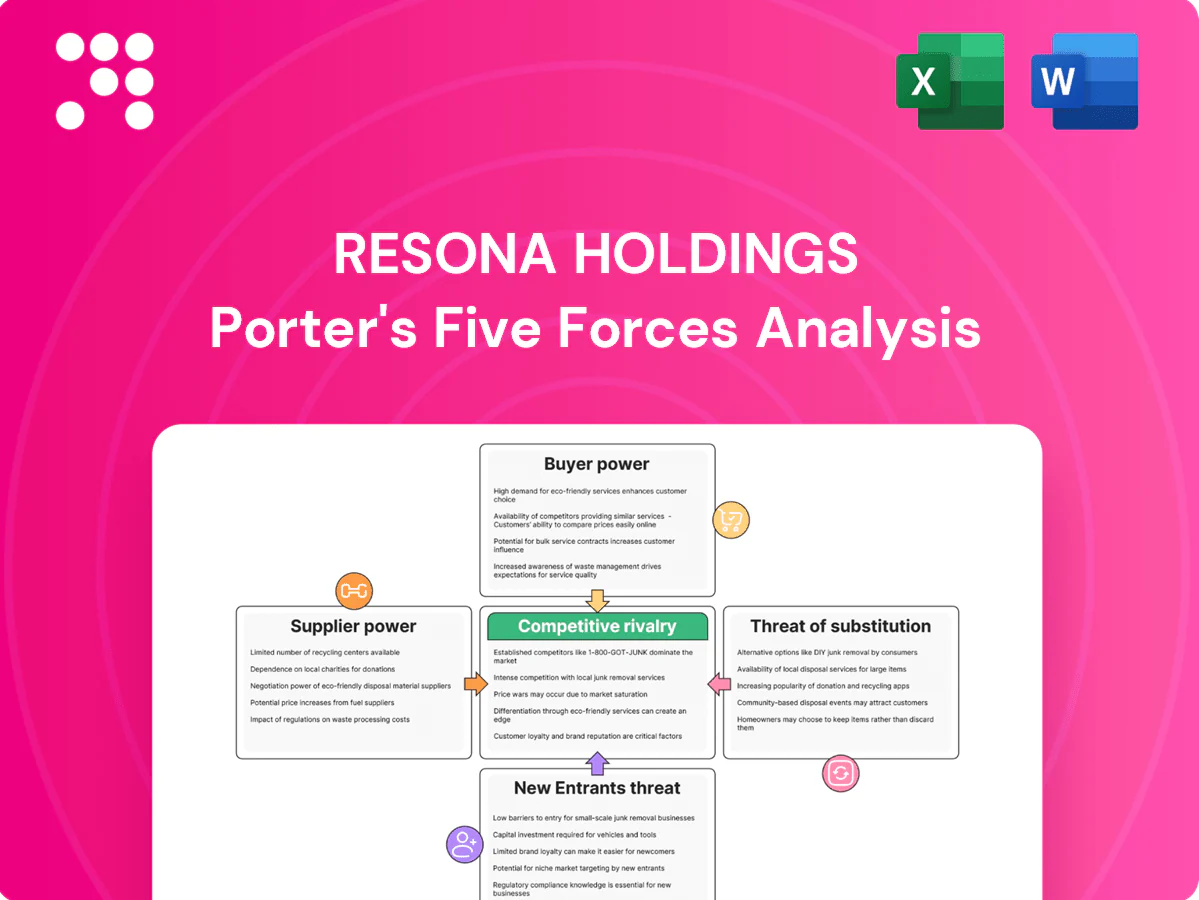
Resona Holdings Porter's Five Forces Analysis

A Must-Have Tool for Decision-Makers
Resona Holdings faces moderate buyer power, regulatory-driven entry barriers, and intense rivalry within Japan's banking sector, with fintech and low-cost competitors nudging margins; supplier power and substitute threats are evolving but containable. This snapshot highlights key tensions and strategic levers. Unlock the full Porter's Five Forces Analysis to explore Resona’s competitive dynamics, market pressures, and strategic advantages in detail.
Suppliers Bargaining Power

Diverse funding sources
Resona funds itself via retail deposits (~¥35.5 trillion), interbank lines and bond markets, reducing single-source risk; wholesale investors (≈18% of liabilities) can demand price concessions in volatile markets. Japan’s large household deposit stock (~¥1,000 trillion in 2024) keeps core funding relatively sticky, while BoJ facilities provide a liquidity backstop in stress.
Technology vendor dependence
Core banking, cloud, cybersecurity and payment rails are concentrated among a few suppliers, with cloud leaders AWS 32%, Azure 22% and GCP 10% (2023) and Visa/Mastercard accounting for roughly 80% of global card transactions (2023), giving vendors pricing and roadmap leverage. High switching costs and integration risks, plus multi-year contracts, reinforce supplier power. Resona mitigates via multi-vendor sourcing and expanding in-house capabilities.

Talent and specialist skills
Risk, digital, AI, and compliance talent are scarce and mobile, boosting supplier power as banks compete for skills; wage and retention package pressure raises labor costs. Japan’s aging population—about 29% aged 65+ in 2024—and strong unions tighten the talent pipeline. Targeted training and automation can partially offset shortages and containment of wage inflation.

Regulatory infrastructure reliance
Access to BOJ settlement, BOJ-NET and Zengin payment rails is essential for Resona; rule changes by regulators function like supplier power by imposing compliance costs and operational constraints, reducing margins and strategic flexibility. Standardization of messaging and clearing practices limits product differentiation and adds rigidity, while proactive regulatory dialogue helps Resona anticipate rule shifts and lower surprise compliance expenses.
- Dependence: BOJ-NET and Zengin critical for liquidity settlement
- Regulatory cost: rule changes act as supplier-like leverage
- Standardization: limits differentiation, increases rigidity
- Mitigation: proactive engagement reduces surprises
Data and rating agencies
Data vendors, credit bureaus and rating agencies strongly influence Resona Holdings’ funding costs and risk models; market-data gaps limit alternatives and elevate supplier bargaining power. In 2024 rating outlook shifts for Japanese banks moved bond spreads by tens of basis points almost instantly, tightening funding. Resona’s investment in proprietary analytics and internal credit scoring is reducing dependency but substitution remains gradual.
Moderate supplier power: Retail deposits anchor funding; tech and wholesale raise cost risk
Supplier power for Resona is moderate: retail deposits (~¥35.5T) and Japan’s ¥1,000T household deposits (2024) anchor funding, while wholesale (~18% liabilities) and rating-driven spread moves (tens of bps in 2024) raise cost vulnerability. Tech vendors (AWS 32%, Azure 22%, GCP 10% 2023) and card networks (~80% transactions) exert pricing power; BOJ rails and talent shortages (29% aged 65+ 2024) amplify supplier leverage.
| Driver | Metric (year) |
|---|---|
| Retail deposits | ¥35.5T (Resona) |
| Household deposits | ¥1,000T (2024) |
| Cloud share | AWS 32%/Azure 22%/GCP 10% (2023) |
What is included in the product
 Detailed Word Document
Tailored Porter's Five Forces analysis of Resona Holdings, assessing competitive rivalry, customer and supplier power, barriers to entry, and threat of substitutes to pinpoint strategic vulnerabilities and opportunities within Japan's banking sector.

 Customizable Excel Spreadsheet
Clear, one-sheet Porter's Five Forces for Resona Holdings—instantly visualize competitive pressures with an editable spider chart and customize intensity levels to reflect regulatory shifts or market events, ready to drop into pitch decks or executive reports.
Customers Bargaining Power

Rate-sensitive depositors
Long years of ultra-low rates left Resona's deposit pricing sticky, but competitive pressure since 2023 has lifted deposit betas as savers shift to higher-yield online and fintech-linked options. Retail customers actively compare yields across banks and apps, making price sensitivity high. Loyalty programs, branch convenience and integrated services still support retention. Resona must trade off margin compression against keeping core deposits.
SME bargaining via multi-banking
SMEs account for 99.7% of firms in Japan (METI 2024), and many engage in multi-banking for loans, cash management and FX, frequently soliciting competing term sheets that pressure margins and fees. Bundled cash/treasury and digital platforms can curb switching by raising lock-in. Relationship managers remain pivotal in regional hubs to retain SME business.

Large corporates run RFPs
Treasury teams in 2024 standardize RFPs across loans, DCM and transaction services, driving clear comparators and greater pricing transparency that intensifies buyer power; ancillary wallet share increasingly acts as the tie-breaker when spreads converge. Credit limits and syndication dynamics (single-bank caps typically 10–20% of a deal) constrain how deep banks can concede.

Digital comparison and switching
Apps make fees, FX and mortgage rates instantly comparable, and with 82% smartphone penetration in Japan in 2024 switching tools are widely accessible; faster digital onboarding has cut friction, enabling quicker moves between banks. Yet brand trust and effective service recovery still anchor many retail users, while superior UX and ecosystem integrations remain decisive.
- Comparability: fees, FX, mortgage rates visible in-app
- Onboarding: faster digital account opening reduces switching cost
- Retention: trust and service recovery limit churn
- Advantage: UX and ecosystem integrations drive preference
Fee transparency pressure
Regulatory nudges and consumer advocacy are forcing Resona to disclose total banking costs, as customers increasingly reject opaque ATM and payment charges, compressing non-interest income and pushing margins on fees downward. Selective, value-added advisory services remain a defensible revenue stream that can justify differentiated fees if clearly communicated and measured against customer outcomes. Ongoing transparency demands raise bargaining power of customers and constrain cross-subsidy of branch networks.
- Fee transparency: raises customer leverage
- ATM/payment opacity: reduced tolerance
- Non-interest income: pressure on margins
- Advisory fees: viable if demonstrable value
Price power: retail 82%, SMEs 99.7% multi-bank switching
Customers hold strong price leverage: retail savers (82% smartphone penetration in 2024) and SMEs (99.7% of firms, METI 2024) shop rates and fees, raising fee transparency and compressing NII. Digital comparability and standardized RFPs (single-bank caps ~10–20% of deals) intensify bidding; advisory fees survive if demonstrable value. Retention rests on UX, branch convenience and RM relationships.
| Metric | 2024 value | Impact |
|---|---|---|
| SME share | 99.7% (METI 2024) | High multi-banking |
| Smartphone penetration | 82% (2024) | Easy switching |
| Single-bank caps | 10–20% | Limits concessions |
What You See Is What You Get
Resona Holdings Porter's Five Forces Analysis
This preview shows the exact Porter’s Five Forces analysis for Resona Holdings you’ll receive. Fully formatted, professionally written and ready to use immediately after purchase. No mockups or placeholders—this file is identical to the deliverable available for instant download.

A Must-Have Tool for Decision-Makers
Resona Holdings faces moderate buyer power, regulatory-driven entry barriers, and intense rivalry within Japan's banking sector, with fintech and low-cost competitors nudging margins; supplier power and substitute threats are evolving but containable. This snapshot highlights key tensions and strategic levers. Unlock the full Porter's Five Forces Analysis to explore Resona’s competitive dynamics, market pressures, and strategic advantages in detail.
Suppliers Bargaining Power
Diverse funding sources
Resona funds itself via retail deposits (~¥35.5 trillion), interbank lines and bond markets, reducing single-source risk; wholesale investors (≈18% of liabilities) can demand price concessions in volatile markets. Japan’s large household deposit stock (~¥1,000 trillion in 2024) keeps core funding relatively sticky, while BoJ facilities provide a liquidity backstop in stress.
Technology vendor dependence
Core banking, cloud, cybersecurity and payment rails are concentrated among a few suppliers, with cloud leaders AWS 32%, Azure 22% and GCP 10% (2023) and Visa/Mastercard accounting for roughly 80% of global card transactions (2023), giving vendors pricing and roadmap leverage. High switching costs and integration risks, plus multi-year contracts, reinforce supplier power. Resona mitigates via multi-vendor sourcing and expanding in-house capabilities.
Talent and specialist skills
Risk, digital, AI, and compliance talent are scarce and mobile, boosting supplier power as banks compete for skills; wage and retention package pressure raises labor costs. Japan’s aging population—about 29% aged 65+ in 2024—and strong unions tighten the talent pipeline. Targeted training and automation can partially offset shortages and containment of wage inflation.
Regulatory infrastructure reliance
Access to BOJ settlement, BOJ-NET and Zengin payment rails is essential for Resona; rule changes by regulators function like supplier power by imposing compliance costs and operational constraints, reducing margins and strategic flexibility. Standardization of messaging and clearing practices limits product differentiation and adds rigidity, while proactive regulatory dialogue helps Resona anticipate rule shifts and lower surprise compliance expenses.
- Dependence: BOJ-NET and Zengin critical for liquidity settlement
- Regulatory cost: rule changes act as supplier-like leverage
- Standardization: limits differentiation, increases rigidity
- Mitigation: proactive engagement reduces surprises
Data and rating agencies
Data vendors, credit bureaus and rating agencies strongly influence Resona Holdings’ funding costs and risk models; market-data gaps limit alternatives and elevate supplier bargaining power. In 2024 rating outlook shifts for Japanese banks moved bond spreads by tens of basis points almost instantly, tightening funding. Resona’s investment in proprietary analytics and internal credit scoring is reducing dependency but substitution remains gradual.
Moderate supplier power: Retail deposits anchor funding; tech and wholesale raise cost risk
Supplier power for Resona is moderate: retail deposits (~¥35.5T) and Japan’s ¥1,000T household deposits (2024) anchor funding, while wholesale (~18% liabilities) and rating-driven spread moves (tens of bps in 2024) raise cost vulnerability. Tech vendors (AWS 32%, Azure 22%, GCP 10% 2023) and card networks (~80% transactions) exert pricing power; BOJ rails and talent shortages (29% aged 65+ 2024) amplify supplier leverage.
| Driver | Metric (year) |
|---|---|
| Retail deposits | ¥35.5T (Resona) |
| Household deposits | ¥1,000T (2024) |
| Cloud share | AWS 32%/Azure 22%/GCP 10% (2023) |
What is included in the product
Detailed Word Document
Tailored Porter's Five Forces analysis of Resona Holdings, assessing competitive rivalry, customer and supplier power, barriers to entry, and threat of substitutes to pinpoint strategic vulnerabilities and opportunities within Japan's banking sector.
Customizable Excel Spreadsheet
Clear, one-sheet Porter's Five Forces for Resona Holdings—instantly visualize competitive pressures with an editable spider chart and customize intensity levels to reflect regulatory shifts or market events, ready to drop into pitch decks or executive reports.
Customers Bargaining Power
Rate-sensitive depositors
Long years of ultra-low rates left Resona's deposit pricing sticky, but competitive pressure since 2023 has lifted deposit betas as savers shift to higher-yield online and fintech-linked options. Retail customers actively compare yields across banks and apps, making price sensitivity high. Loyalty programs, branch convenience and integrated services still support retention. Resona must trade off margin compression against keeping core deposits.
SME bargaining via multi-banking
SMEs account for 99.7% of firms in Japan (METI 2024), and many engage in multi-banking for loans, cash management and FX, frequently soliciting competing term sheets that pressure margins and fees. Bundled cash/treasury and digital platforms can curb switching by raising lock-in. Relationship managers remain pivotal in regional hubs to retain SME business.
Large corporates run RFPs
Treasury teams in 2024 standardize RFPs across loans, DCM and transaction services, driving clear comparators and greater pricing transparency that intensifies buyer power; ancillary wallet share increasingly acts as the tie-breaker when spreads converge. Credit limits and syndication dynamics (single-bank caps typically 10–20% of a deal) constrain how deep banks can concede.
Digital comparison and switching
Apps make fees, FX and mortgage rates instantly comparable, and with 82% smartphone penetration in Japan in 2024 switching tools are widely accessible; faster digital onboarding has cut friction, enabling quicker moves between banks. Yet brand trust and effective service recovery still anchor many retail users, while superior UX and ecosystem integrations remain decisive.
- Comparability: fees, FX, mortgage rates visible in-app
- Onboarding: faster digital account opening reduces switching cost
- Retention: trust and service recovery limit churn
- Advantage: UX and ecosystem integrations drive preference
Fee transparency pressure
Regulatory nudges and consumer advocacy are forcing Resona to disclose total banking costs, as customers increasingly reject opaque ATM and payment charges, compressing non-interest income and pushing margins on fees downward. Selective, value-added advisory services remain a defensible revenue stream that can justify differentiated fees if clearly communicated and measured against customer outcomes. Ongoing transparency demands raise bargaining power of customers and constrain cross-subsidy of branch networks.
- Fee transparency: raises customer leverage
- ATM/payment opacity: reduced tolerance
- Non-interest income: pressure on margins
- Advisory fees: viable if demonstrable value
Price power: retail 82%, SMEs 99.7% multi-bank switching
Customers hold strong price leverage: retail savers (82% smartphone penetration in 2024) and SMEs (99.7% of firms, METI 2024) shop rates and fees, raising fee transparency and compressing NII. Digital comparability and standardized RFPs (single-bank caps ~10–20% of deals) intensify bidding; advisory fees survive if demonstrable value. Retention rests on UX, branch convenience and RM relationships.
| Metric | 2024 value | Impact |
|---|---|---|
| SME share | 99.7% (METI 2024) | High multi-banking |
| Smartphone penetration | 82% (2024) | Easy switching |
| Single-bank caps | 10–20% | Limits concessions |
What You See Is What You Get
Resona Holdings Porter's Five Forces Analysis
This preview shows the exact Porter’s Five Forces analysis for Resona Holdings you’ll receive. Fully formatted, professionally written and ready to use immediately after purchase. No mockups or placeholders—this file is identical to the deliverable available for instant download.
Original: $10.00
-65%$10.00
$3.50Description
A Must-Have Tool for Decision-Makers
Resona Holdings faces moderate buyer power, regulatory-driven entry barriers, and intense rivalry within Japan's banking sector, with fintech and low-cost competitors nudging margins; supplier power and substitute threats are evolving but containable. This snapshot highlights key tensions and strategic levers. Unlock the full Porter's Five Forces Analysis to explore Resona’s competitive dynamics, market pressures, and strategic advantages in detail.
Suppliers Bargaining Power
Diverse funding sources
Resona funds itself via retail deposits (~¥35.5 trillion), interbank lines and bond markets, reducing single-source risk; wholesale investors (≈18% of liabilities) can demand price concessions in volatile markets. Japan’s large household deposit stock (~¥1,000 trillion in 2024) keeps core funding relatively sticky, while BoJ facilities provide a liquidity backstop in stress.
Technology vendor dependence
Core banking, cloud, cybersecurity and payment rails are concentrated among a few suppliers, with cloud leaders AWS 32%, Azure 22% and GCP 10% (2023) and Visa/Mastercard accounting for roughly 80% of global card transactions (2023), giving vendors pricing and roadmap leverage. High switching costs and integration risks, plus multi-year contracts, reinforce supplier power. Resona mitigates via multi-vendor sourcing and expanding in-house capabilities.
Talent and specialist skills
Risk, digital, AI, and compliance talent are scarce and mobile, boosting supplier power as banks compete for skills; wage and retention package pressure raises labor costs. Japan’s aging population—about 29% aged 65+ in 2024—and strong unions tighten the talent pipeline. Targeted training and automation can partially offset shortages and containment of wage inflation.
Regulatory infrastructure reliance
Access to BOJ settlement, BOJ-NET and Zengin payment rails is essential for Resona; rule changes by regulators function like supplier power by imposing compliance costs and operational constraints, reducing margins and strategic flexibility. Standardization of messaging and clearing practices limits product differentiation and adds rigidity, while proactive regulatory dialogue helps Resona anticipate rule shifts and lower surprise compliance expenses.
- Dependence: BOJ-NET and Zengin critical for liquidity settlement
- Regulatory cost: rule changes act as supplier-like leverage
- Standardization: limits differentiation, increases rigidity
- Mitigation: proactive engagement reduces surprises
Data and rating agencies
Data vendors, credit bureaus and rating agencies strongly influence Resona Holdings’ funding costs and risk models; market-data gaps limit alternatives and elevate supplier bargaining power. In 2024 rating outlook shifts for Japanese banks moved bond spreads by tens of basis points almost instantly, tightening funding. Resona’s investment in proprietary analytics and internal credit scoring is reducing dependency but substitution remains gradual.
Moderate supplier power: Retail deposits anchor funding; tech and wholesale raise cost risk
Supplier power for Resona is moderate: retail deposits (~¥35.5T) and Japan’s ¥1,000T household deposits (2024) anchor funding, while wholesale (~18% liabilities) and rating-driven spread moves (tens of bps in 2024) raise cost vulnerability. Tech vendors (AWS 32%, Azure 22%, GCP 10% 2023) and card networks (~80% transactions) exert pricing power; BOJ rails and talent shortages (29% aged 65+ 2024) amplify supplier leverage.
| Driver | Metric (year) |
|---|---|
| Retail deposits | ¥35.5T (Resona) |
| Household deposits | ¥1,000T (2024) |
| Cloud share | AWS 32%/Azure 22%/GCP 10% (2023) |
What is included in the product
Detailed Word Document
Tailored Porter's Five Forces analysis of Resona Holdings, assessing competitive rivalry, customer and supplier power, barriers to entry, and threat of substitutes to pinpoint strategic vulnerabilities and opportunities within Japan's banking sector.
Customizable Excel Spreadsheet
Clear, one-sheet Porter's Five Forces for Resona Holdings—instantly visualize competitive pressures with an editable spider chart and customize intensity levels to reflect regulatory shifts or market events, ready to drop into pitch decks or executive reports.
Customers Bargaining Power
Rate-sensitive depositors
Long years of ultra-low rates left Resona's deposit pricing sticky, but competitive pressure since 2023 has lifted deposit betas as savers shift to higher-yield online and fintech-linked options. Retail customers actively compare yields across banks and apps, making price sensitivity high. Loyalty programs, branch convenience and integrated services still support retention. Resona must trade off margin compression against keeping core deposits.
SME bargaining via multi-banking
SMEs account for 99.7% of firms in Japan (METI 2024), and many engage in multi-banking for loans, cash management and FX, frequently soliciting competing term sheets that pressure margins and fees. Bundled cash/treasury and digital platforms can curb switching by raising lock-in. Relationship managers remain pivotal in regional hubs to retain SME business.
Large corporates run RFPs
Treasury teams in 2024 standardize RFPs across loans, DCM and transaction services, driving clear comparators and greater pricing transparency that intensifies buyer power; ancillary wallet share increasingly acts as the tie-breaker when spreads converge. Credit limits and syndication dynamics (single-bank caps typically 10–20% of a deal) constrain how deep banks can concede.
Digital comparison and switching
Apps make fees, FX and mortgage rates instantly comparable, and with 82% smartphone penetration in Japan in 2024 switching tools are widely accessible; faster digital onboarding has cut friction, enabling quicker moves between banks. Yet brand trust and effective service recovery still anchor many retail users, while superior UX and ecosystem integrations remain decisive.
- Comparability: fees, FX, mortgage rates visible in-app
- Onboarding: faster digital account opening reduces switching cost
- Retention: trust and service recovery limit churn
- Advantage: UX and ecosystem integrations drive preference
Fee transparency pressure
Regulatory nudges and consumer advocacy are forcing Resona to disclose total banking costs, as customers increasingly reject opaque ATM and payment charges, compressing non-interest income and pushing margins on fees downward. Selective, value-added advisory services remain a defensible revenue stream that can justify differentiated fees if clearly communicated and measured against customer outcomes. Ongoing transparency demands raise bargaining power of customers and constrain cross-subsidy of branch networks.
- Fee transparency: raises customer leverage
- ATM/payment opacity: reduced tolerance
- Non-interest income: pressure on margins
- Advisory fees: viable if demonstrable value
Price power: retail 82%, SMEs 99.7% multi-bank switching
Customers hold strong price leverage: retail savers (82% smartphone penetration in 2024) and SMEs (99.7% of firms, METI 2024) shop rates and fees, raising fee transparency and compressing NII. Digital comparability and standardized RFPs (single-bank caps ~10–20% of deals) intensify bidding; advisory fees survive if demonstrable value. Retention rests on UX, branch convenience and RM relationships.
| Metric | 2024 value | Impact |
|---|---|---|
| SME share | 99.7% (METI 2024) | High multi-banking |
| Smartphone penetration | 82% (2024) | Easy switching |
| Single-bank caps | 10–20% | Limits concessions |
What You See Is What You Get
Resona Holdings Porter's Five Forces Analysis
This preview shows the exact Porter’s Five Forces analysis for Resona Holdings you’ll receive. Fully formatted, professionally written and ready to use immediately after purchase. No mockups or placeholders—this file is identical to the deliverable available for instant download.











