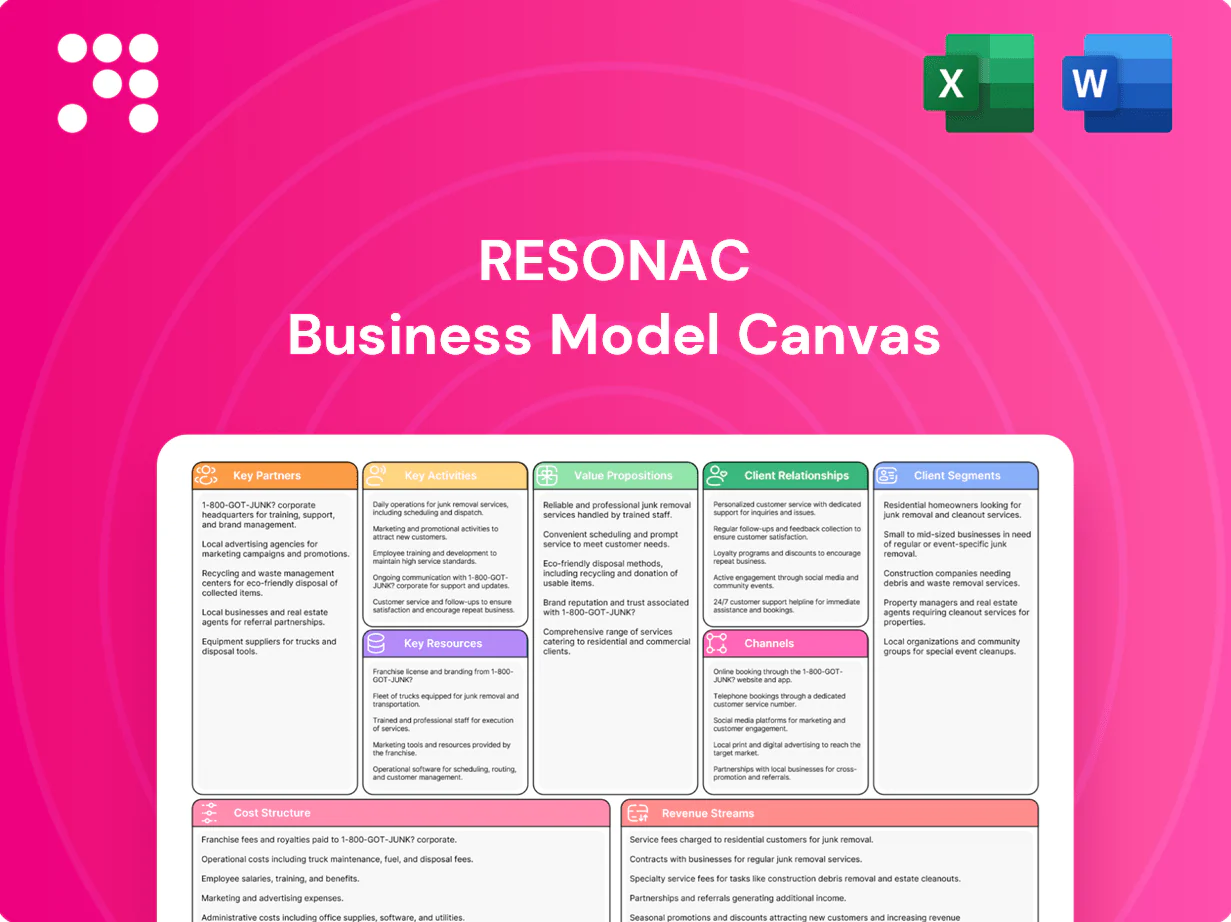
Resonac Business Model Canvas

Business Model Canvas for industrial chemicals: strategic insights for investors
Unlock the strategic blueprint behind Resonac with our Business Model Canvas. This concise, sector-specific analysis reveals value propositions, customer segments, revenue streams and cost drivers. Ideal for investors, consultants and founders seeking actionable insights—download the full, editable canvas to benchmark and plan.
Partnerships

Automotive OEM alliances
Collaborating with global automakers, Resonac co-develops lightweight composites, battery materials and thermal solutions to align material specs with vehicle platforms and 2023 EV demand of about 14 million units; joint roadmaps match regulatory timelines, early design-in secures multi-year volume agreements, and shared testing cuts qualification time and risk.
Semiconductor ecosystem partners
Resonac partners with chipmakers, OSATs and equipment vendors to co-develop advanced packaging materials and photoresists, aligning materials with leading-edge nodes such as 3nm and 5nm; advanced packaging market size reached about $47 billion in 2024. Process co-optimization and joint labs validate compatibility and reliability under real manufacturing conditions, reducing integration risk and shortening time-to-qualification. Strategic MOUs secure preferred supplier status and prioritized roadmap access.

Upstream feedstock suppliers
Partner with petrochemical and specialty precursor providers to stabilize input quality and pricing, leveraging industry-scale suppliers that serve the $600B global petrochemical market. Long-term contracts (3–7 years) and hedging programs cover a majority of exposure to manage volatility and ensure continuity. Supplier development programs target measurable sustainability gains, e.g., 25% lifecycle CO2 reduction by 2030. Dual-sourcing mitigates disruptions by splitting critical volumes across two qualified suppliers.

Academic and R&D institutes
Engage universities and consortia on next-gen polymers, carbon materials, and green chemistries to tap into the ≈$2.7T global R&D ecosystem in 2024; sponsored research accelerates discovery and IP creation while lowering time-to-market. Shared facilities cut early-stage capital intensity and risk, and embedded talent pipelines strengthen Resonac’s technical bench and hiring funnel.
- Sponsored research: accelerates IP output
- Shared facilities: lower capex for startups
- Talent pipelines: steady STEM recruits
- 2024 context: ≈$2.7T global R&D spend
Logistics and recycling partners
Coordinate with global 3PLs for hazardous-material handling and time-definite deliveries; the 3PL market exceeded $1 trillion in 2024, supporting specialized hazmat lanes and insured lead times. Collaborate with certified recyclers to reclaim solvents, plastics and metals from end-of-life products; closed-loop programs have cut scope 3 emissions for pilot clients by 10–25% and reduced material costs 8–20%. Traceability platforms (blockchain/IoT) improve compliance, auditability and customer trust.
- 3PL market >$1T (2024)
- Scope 3 cut 10–25%
- Material cost reduction 8–20%
- Reclaim solvents, plastics, metals
- Traceability via blockchain/IoT
Automaker and chipmaker design-ins tie EV composites, battery materials and advanced packaging
Resonac secures design-ins with global automakers to supply EV composites and battery materials, aligning multi-year volumes with ~14M EVs (2023).
Collaborations with chipmakers/OSATs accelerate 3nm/5nm packaging materials qualification; advanced packaging market ≈$47B (2024).
Long-term petrochemical contracts, dual-sourcing and recycler/3PL ties stabilize inputs and cut scope 3 by 10–25%.
| Partner | Role | 2024 metric |
|---|---|---|
| Automakers | Design-in, volume | 14M EVs (2023) |
| Chipmakers/OSATs | Material co-dev | $47B packaging |
| Petro suppliers | Stable inputs | 3–7yr contracts |
| 3PL/Recyclers | Logistics, closed-loop | 3PL >$1T (2024) |
What is included in the product
 Detailed Word Document
A comprehensive Business Model Canvas for Resonac detailing customer segments, channels, value propositions, revenue streams, key activities, resources, partners, cost structure and customer relationships, with SWOT-linked insights, competitive advantages and polished narrative for presentations and strategic validation.

 Customizable Excel Spreadsheet
Condenses Resonac’s strategy into a clean, one-page Business Model Canvas to quickly identify value drivers and operational pain points. Shareable and editable for team collaboration, it saves hours of structuring, ideal for fast deliverables, board reviews, or side-by-side comparisons.
Activities

Advanced materials R&D
Design and test high-performance polymers, resins, ceramics and carbon materials with iterative formulation cycles targeting conductivity, heat resistance and durability; 2024 global advanced materials market exceeds USD 500 billion and chemical R&D intensity typically ranges 5–10% of sales. Build IP portfolios—patents and trade secrets—around proprietary chemistries and processes, then scale validated formulations from lab to pilot lines for manufacturability and pilot throughput validation.
Precision manufacturing
Operate reactors, extrusion, coating and sintering lines under strict process control, using SPC and digital twins to stabilize yields and cycle times. Lines are qualified to electronics and automotive standards, including IPC family standards and IATF 16949. Continuous improvement programs target reduced scrap and lower energy intensity across high-volume production.

Customer co-development
Embed Resonac engineers at key accounts to tailor polymer and ceramic formulations directly to application needs, enabling joint trials and reliability testing under end-use conditions.
Provide rapid prototyping and on-site support to accelerate validation cycles and translate validated specs into formal long-term supply agreements tied to performance metrics.

Supply chain management
Secure critical feedstocks through regional contracts and centralized inventory hubs to smooth supply across Asia-Pacific and Europe.
Use monthly S&OP cycles to align production capacity with demand seasonality and raw-material price swings.
Qualify alternate suppliers for resilience and ensure global compliance with IMDG, IATA and ADR rules for hazardous shipments.
- regional hubs
- S&OP cadence
- dual sourcing
- IMDG/IATA/ADR compliance
Sustainability and compliance
Develop and commercialize low-VOC, recyclable and bio-based formulations while tracking Scope 1–3 emissions per the GHG Protocol and reporting product stewardship and safety under REACH/GHS frameworks; obtain ISO 14001 and customer-specific certifications; implement EPR-aligned take-back and circularity programs to close material loops.
- ISO 14001
- REACH/GHS
- GHG Protocol Scope 1–3
- Low-VOC & bio-based formulations
- Take-back / EPR circularity
Scale and IP-protect advanced polymers, ceramics; market > USD 500B
Design, scale and IP-protect advanced polymers, resins, ceramics and carbon materials; 2024 global advanced materials market > USD 500B, R&D ~5–10% of sales. Operate qualified reactors, extrusion, coating and sintering lines with SPC, digital twins and IATF/IPC standards to stabilize yields. Embed engineers at customers for joint trials, rapid prototyping and performance-linked supply. Secure feedstocks via regional hubs, dual sourcing and monthly S&OP.
| Metric | 2024 |
|---|---|
| Market | USD 500B+ |
| R&D Intensity | 5–10% |
| Key Certs | IATF16949, IPC, ISO14001 |
Preview Before You Purchase
Business Model Canvas
The document you're previewing is the actual Resonac Business Model Canvas, not a mockup—it's a direct extract from the final deliverable. After purchase you'll receive this same complete, editable file formatted for immediate use, suitable for presentation, editing, and sharing. No placeholders, no surprises—what you see is what you'll download.

Business Model Canvas for industrial chemicals: strategic insights for investors
Unlock the strategic blueprint behind Resonac with our Business Model Canvas. This concise, sector-specific analysis reveals value propositions, customer segments, revenue streams and cost drivers. Ideal for investors, consultants and founders seeking actionable insights—download the full, editable canvas to benchmark and plan.
Partnerships
Automotive OEM alliances
Collaborating with global automakers, Resonac co-develops lightweight composites, battery materials and thermal solutions to align material specs with vehicle platforms and 2023 EV demand of about 14 million units; joint roadmaps match regulatory timelines, early design-in secures multi-year volume agreements, and shared testing cuts qualification time and risk.
Semiconductor ecosystem partners
Resonac partners with chipmakers, OSATs and equipment vendors to co-develop advanced packaging materials and photoresists, aligning materials with leading-edge nodes such as 3nm and 5nm; advanced packaging market size reached about $47 billion in 2024. Process co-optimization and joint labs validate compatibility and reliability under real manufacturing conditions, reducing integration risk and shortening time-to-qualification. Strategic MOUs secure preferred supplier status and prioritized roadmap access.
Upstream feedstock suppliers
Partner with petrochemical and specialty precursor providers to stabilize input quality and pricing, leveraging industry-scale suppliers that serve the $600B global petrochemical market. Long-term contracts (3–7 years) and hedging programs cover a majority of exposure to manage volatility and ensure continuity. Supplier development programs target measurable sustainability gains, e.g., 25% lifecycle CO2 reduction by 2030. Dual-sourcing mitigates disruptions by splitting critical volumes across two qualified suppliers.
Academic and R&D institutes
Engage universities and consortia on next-gen polymers, carbon materials, and green chemistries to tap into the ≈$2.7T global R&D ecosystem in 2024; sponsored research accelerates discovery and IP creation while lowering time-to-market. Shared facilities cut early-stage capital intensity and risk, and embedded talent pipelines strengthen Resonac’s technical bench and hiring funnel.
- Sponsored research: accelerates IP output
- Shared facilities: lower capex for startups
- Talent pipelines: steady STEM recruits
- 2024 context: ≈$2.7T global R&D spend
Logistics and recycling partners
Coordinate with global 3PLs for hazardous-material handling and time-definite deliveries; the 3PL market exceeded $1 trillion in 2024, supporting specialized hazmat lanes and insured lead times. Collaborate with certified recyclers to reclaim solvents, plastics and metals from end-of-life products; closed-loop programs have cut scope 3 emissions for pilot clients by 10–25% and reduced material costs 8–20%. Traceability platforms (blockchain/IoT) improve compliance, auditability and customer trust.
- 3PL market >$1T (2024)
- Scope 3 cut 10–25%
- Material cost reduction 8–20%
- Reclaim solvents, plastics, metals
- Traceability via blockchain/IoT
Automaker and chipmaker design-ins tie EV composites, battery materials and advanced packaging
Resonac secures design-ins with global automakers to supply EV composites and battery materials, aligning multi-year volumes with ~14M EVs (2023).
Collaborations with chipmakers/OSATs accelerate 3nm/5nm packaging materials qualification; advanced packaging market ≈$47B (2024).
Long-term petrochemical contracts, dual-sourcing and recycler/3PL ties stabilize inputs and cut scope 3 by 10–25%.
| Partner | Role | 2024 metric |
|---|---|---|
| Automakers | Design-in, volume | 14M EVs (2023) |
| Chipmakers/OSATs | Material co-dev | $47B packaging |
| Petro suppliers | Stable inputs | 3–7yr contracts |
| 3PL/Recyclers | Logistics, closed-loop | 3PL >$1T (2024) |
What is included in the product
Detailed Word Document
A comprehensive Business Model Canvas for Resonac detailing customer segments, channels, value propositions, revenue streams, key activities, resources, partners, cost structure and customer relationships, with SWOT-linked insights, competitive advantages and polished narrative for presentations and strategic validation.
Customizable Excel Spreadsheet
Condenses Resonac’s strategy into a clean, one-page Business Model Canvas to quickly identify value drivers and operational pain points. Shareable and editable for team collaboration, it saves hours of structuring, ideal for fast deliverables, board reviews, or side-by-side comparisons.
Activities
Advanced materials R&D
Design and test high-performance polymers, resins, ceramics and carbon materials with iterative formulation cycles targeting conductivity, heat resistance and durability; 2024 global advanced materials market exceeds USD 500 billion and chemical R&D intensity typically ranges 5–10% of sales. Build IP portfolios—patents and trade secrets—around proprietary chemistries and processes, then scale validated formulations from lab to pilot lines for manufacturability and pilot throughput validation.
Precision manufacturing
Operate reactors, extrusion, coating and sintering lines under strict process control, using SPC and digital twins to stabilize yields and cycle times. Lines are qualified to electronics and automotive standards, including IPC family standards and IATF 16949. Continuous improvement programs target reduced scrap and lower energy intensity across high-volume production.
Customer co-development
Embed Resonac engineers at key accounts to tailor polymer and ceramic formulations directly to application needs, enabling joint trials and reliability testing under end-use conditions.
Provide rapid prototyping and on-site support to accelerate validation cycles and translate validated specs into formal long-term supply agreements tied to performance metrics.
Supply chain management
Secure critical feedstocks through regional contracts and centralized inventory hubs to smooth supply across Asia-Pacific and Europe.
Use monthly S&OP cycles to align production capacity with demand seasonality and raw-material price swings.
Qualify alternate suppliers for resilience and ensure global compliance with IMDG, IATA and ADR rules for hazardous shipments.
- regional hubs
- S&OP cadence
- dual sourcing
- IMDG/IATA/ADR compliance
Sustainability and compliance
Develop and commercialize low-VOC, recyclable and bio-based formulations while tracking Scope 1–3 emissions per the GHG Protocol and reporting product stewardship and safety under REACH/GHS frameworks; obtain ISO 14001 and customer-specific certifications; implement EPR-aligned take-back and circularity programs to close material loops.
- ISO 14001
- REACH/GHS
- GHG Protocol Scope 1–3
- Low-VOC & bio-based formulations
- Take-back / EPR circularity
Scale and IP-protect advanced polymers, ceramics; market > USD 500B
Design, scale and IP-protect advanced polymers, resins, ceramics and carbon materials; 2024 global advanced materials market > USD 500B, R&D ~5–10% of sales. Operate qualified reactors, extrusion, coating and sintering lines with SPC, digital twins and IATF/IPC standards to stabilize yields. Embed engineers at customers for joint trials, rapid prototyping and performance-linked supply. Secure feedstocks via regional hubs, dual sourcing and monthly S&OP.
| Metric | 2024 |
|---|---|
| Market | USD 500B+ |
| R&D Intensity | 5–10% |
| Key Certs | IATF16949, IPC, ISO14001 |
Preview Before You Purchase
Business Model Canvas
The document you're previewing is the actual Resonac Business Model Canvas, not a mockup—it's a direct extract from the final deliverable. After purchase you'll receive this same complete, editable file formatted for immediate use, suitable for presentation, editing, and sharing. No placeholders, no surprises—what you see is what you'll download.
Original: $10.00
-65%$10.00
$3.50Description
Business Model Canvas for industrial chemicals: strategic insights for investors
Unlock the strategic blueprint behind Resonac with our Business Model Canvas. This concise, sector-specific analysis reveals value propositions, customer segments, revenue streams and cost drivers. Ideal for investors, consultants and founders seeking actionable insights—download the full, editable canvas to benchmark and plan.
Partnerships
Automotive OEM alliances
Collaborating with global automakers, Resonac co-develops lightweight composites, battery materials and thermal solutions to align material specs with vehicle platforms and 2023 EV demand of about 14 million units; joint roadmaps match regulatory timelines, early design-in secures multi-year volume agreements, and shared testing cuts qualification time and risk.
Semiconductor ecosystem partners
Resonac partners with chipmakers, OSATs and equipment vendors to co-develop advanced packaging materials and photoresists, aligning materials with leading-edge nodes such as 3nm and 5nm; advanced packaging market size reached about $47 billion in 2024. Process co-optimization and joint labs validate compatibility and reliability under real manufacturing conditions, reducing integration risk and shortening time-to-qualification. Strategic MOUs secure preferred supplier status and prioritized roadmap access.
Upstream feedstock suppliers
Partner with petrochemical and specialty precursor providers to stabilize input quality and pricing, leveraging industry-scale suppliers that serve the $600B global petrochemical market. Long-term contracts (3–7 years) and hedging programs cover a majority of exposure to manage volatility and ensure continuity. Supplier development programs target measurable sustainability gains, e.g., 25% lifecycle CO2 reduction by 2030. Dual-sourcing mitigates disruptions by splitting critical volumes across two qualified suppliers.
Academic and R&D institutes
Engage universities and consortia on next-gen polymers, carbon materials, and green chemistries to tap into the ≈$2.7T global R&D ecosystem in 2024; sponsored research accelerates discovery and IP creation while lowering time-to-market. Shared facilities cut early-stage capital intensity and risk, and embedded talent pipelines strengthen Resonac’s technical bench and hiring funnel.
- Sponsored research: accelerates IP output
- Shared facilities: lower capex for startups
- Talent pipelines: steady STEM recruits
- 2024 context: ≈$2.7T global R&D spend
Logistics and recycling partners
Coordinate with global 3PLs for hazardous-material handling and time-definite deliveries; the 3PL market exceeded $1 trillion in 2024, supporting specialized hazmat lanes and insured lead times. Collaborate with certified recyclers to reclaim solvents, plastics and metals from end-of-life products; closed-loop programs have cut scope 3 emissions for pilot clients by 10–25% and reduced material costs 8–20%. Traceability platforms (blockchain/IoT) improve compliance, auditability and customer trust.
- 3PL market >$1T (2024)
- Scope 3 cut 10–25%
- Material cost reduction 8–20%
- Reclaim solvents, plastics, metals
- Traceability via blockchain/IoT
Automaker and chipmaker design-ins tie EV composites, battery materials and advanced packaging
Resonac secures design-ins with global automakers to supply EV composites and battery materials, aligning multi-year volumes with ~14M EVs (2023).
Collaborations with chipmakers/OSATs accelerate 3nm/5nm packaging materials qualification; advanced packaging market ≈$47B (2024).
Long-term petrochemical contracts, dual-sourcing and recycler/3PL ties stabilize inputs and cut scope 3 by 10–25%.
| Partner | Role | 2024 metric |
|---|---|---|
| Automakers | Design-in, volume | 14M EVs (2023) |
| Chipmakers/OSATs | Material co-dev | $47B packaging |
| Petro suppliers | Stable inputs | 3–7yr contracts |
| 3PL/Recyclers | Logistics, closed-loop | 3PL >$1T (2024) |
What is included in the product
Detailed Word Document
A comprehensive Business Model Canvas for Resonac detailing customer segments, channels, value propositions, revenue streams, key activities, resources, partners, cost structure and customer relationships, with SWOT-linked insights, competitive advantages and polished narrative for presentations and strategic validation.
Customizable Excel Spreadsheet
Condenses Resonac’s strategy into a clean, one-page Business Model Canvas to quickly identify value drivers and operational pain points. Shareable and editable for team collaboration, it saves hours of structuring, ideal for fast deliverables, board reviews, or side-by-side comparisons.
Activities
Advanced materials R&D
Design and test high-performance polymers, resins, ceramics and carbon materials with iterative formulation cycles targeting conductivity, heat resistance and durability; 2024 global advanced materials market exceeds USD 500 billion and chemical R&D intensity typically ranges 5–10% of sales. Build IP portfolios—patents and trade secrets—around proprietary chemistries and processes, then scale validated formulations from lab to pilot lines for manufacturability and pilot throughput validation.
Precision manufacturing
Operate reactors, extrusion, coating and sintering lines under strict process control, using SPC and digital twins to stabilize yields and cycle times. Lines are qualified to electronics and automotive standards, including IPC family standards and IATF 16949. Continuous improvement programs target reduced scrap and lower energy intensity across high-volume production.
Customer co-development
Embed Resonac engineers at key accounts to tailor polymer and ceramic formulations directly to application needs, enabling joint trials and reliability testing under end-use conditions.
Provide rapid prototyping and on-site support to accelerate validation cycles and translate validated specs into formal long-term supply agreements tied to performance metrics.
Supply chain management
Secure critical feedstocks through regional contracts and centralized inventory hubs to smooth supply across Asia-Pacific and Europe.
Use monthly S&OP cycles to align production capacity with demand seasonality and raw-material price swings.
Qualify alternate suppliers for resilience and ensure global compliance with IMDG, IATA and ADR rules for hazardous shipments.
- regional hubs
- S&OP cadence
- dual sourcing
- IMDG/IATA/ADR compliance
Sustainability and compliance
Develop and commercialize low-VOC, recyclable and bio-based formulations while tracking Scope 1–3 emissions per the GHG Protocol and reporting product stewardship and safety under REACH/GHS frameworks; obtain ISO 14001 and customer-specific certifications; implement EPR-aligned take-back and circularity programs to close material loops.
- ISO 14001
- REACH/GHS
- GHG Protocol Scope 1–3
- Low-VOC & bio-based formulations
- Take-back / EPR circularity
Scale and IP-protect advanced polymers, ceramics; market > USD 500B
Design, scale and IP-protect advanced polymers, resins, ceramics and carbon materials; 2024 global advanced materials market > USD 500B, R&D ~5–10% of sales. Operate qualified reactors, extrusion, coating and sintering lines with SPC, digital twins and IATF/IPC standards to stabilize yields. Embed engineers at customers for joint trials, rapid prototyping and performance-linked supply. Secure feedstocks via regional hubs, dual sourcing and monthly S&OP.
| Metric | 2024 |
|---|---|
| Market | USD 500B+ |
| R&D Intensity | 5–10% |
| Key Certs | IATF16949, IPC, ISO14001 |
Preview Before You Purchase
Business Model Canvas
The document you're previewing is the actual Resonac Business Model Canvas, not a mockup—it's a direct extract from the final deliverable. After purchase you'll receive this same complete, editable file formatted for immediate use, suitable for presentation, editing, and sharing. No placeholders, no surprises—what you see is what you'll download.











