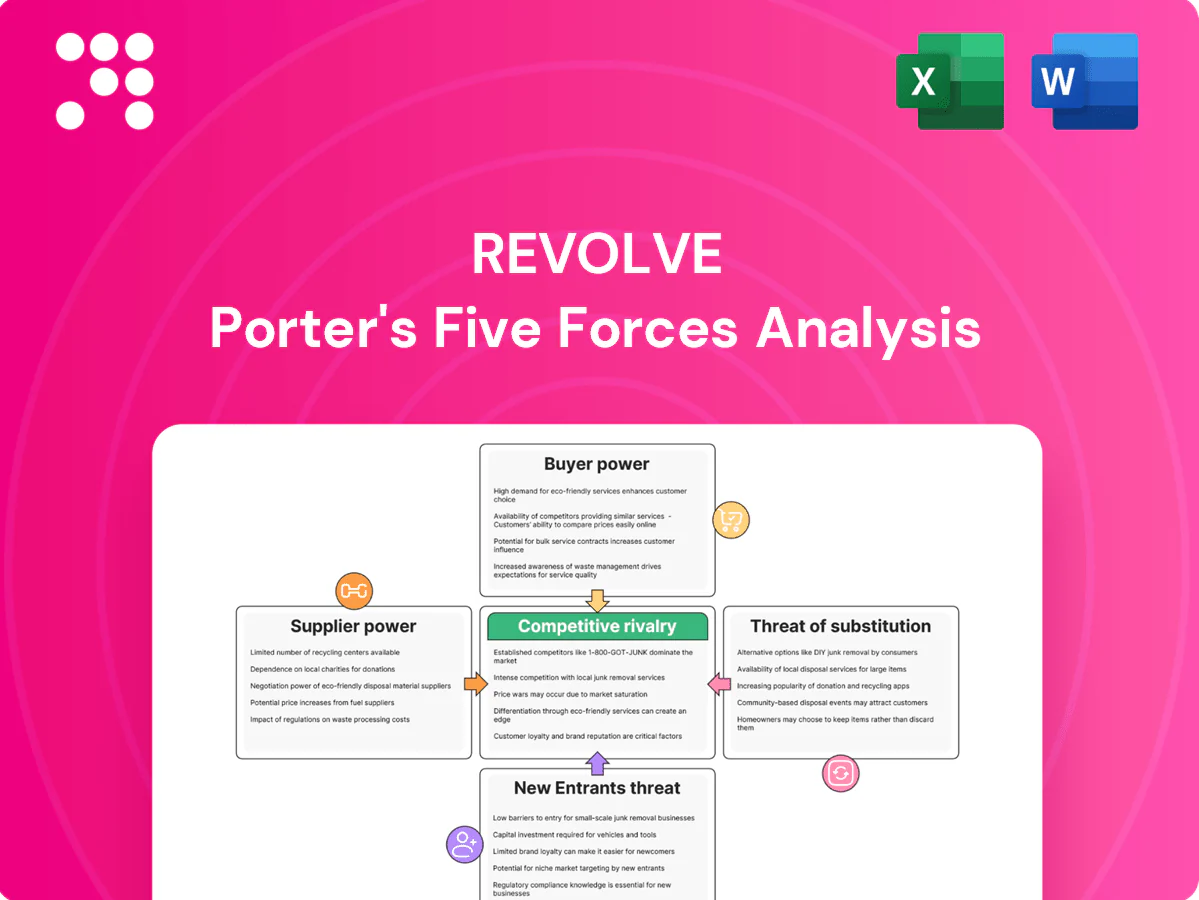
Revolve Porter's Five Forces Analysis

A Must-Have Tool for Decision-Makers
Revolve faces intense competitive rivalry and shifting consumer power as fast-fashion and luxury-adjacent players push margins and trend cycles. Supplier leverage is moderate while threat of new entrants and substitutes keeps pricing pressure high. This snapshot scratches the surface—unlock the full Porter's Five Forces Analysis for force-by-force ratings, visuals, and strategic recommendations to inform investment or strategy decisions.
Suppliers Bargaining Power

Diverse brand base dilutes leverage
Revolve sources from hundreds of established and emerging labels, which dilutes any single vendor’s ability to dictate terms and lowers supplier leverage.
The fragmented supplier base lets Revolve switch styles or brands quickly, supporting rapid assortment changes and promotional testing.
Short fashion cycles and scale of multi-sourcing in 2024—with high SKU turnover—reduce take-it-or-leave-it pressure from individual suppliers.
Private labels counterbalance vendors
In 2024 Revolve's expanded in-house brands give the company direct margin control and an alternate supply channel, reducing dependence on third-party labels. Private labels provide credible negotiating leverage: if a vendor presses price or restricts allocation, Revolve can fill assortment gaps with its own lines. This capability acts as a structural cap on supplier power and protects gross margin resilience.

Influencers as quasi-suppliers
Influencers act as quasi-suppliers for Revolve by delivering distribution and demand rather than products; the influencer marketing industry was valued at about $21.1 billion in 2023 and was projected to top $22 billion in 2024. Top creators can command premium fees and exclusivity, increasing supplier power in marketing, but a vast creator pool and performance-based contracts moderate rates. Revolve leverages first-party data to shift spend toward ROI-positive partners, improving efficiency.

Constrained premium/hero labels
- High-demand drops: limited supply, higher leverage
- Wholesale terms: tighter payment/pricing
- Traffic lift: capsules drive outsized conversion
- Margin pressure: commits/slimmer gross margins
Logistics and input volatility
Logistics and input volatility materially affect Revolve's cost-to-serve: 3PLs and carriers drive capacity-driven price swings and fabric-cost volatility; the global 3PL market was about $1.17 trillion in 2024, amplifying supplier influence. Peak-season surcharges and lead-time shifts in 2024 pressured margins, while multi-carrier strategies and nearshoring lowered exposure, though residual supplier leverage persists.
- 3PL/carrier pricing pressure
- Fabric-cost volatility
- Peak surcharges hurt margins
- Multi-carrier + nearshoring reduce risk
- Residual supplier leverage remains
Fragmented supplier base curbs vendor leverage; private labels support $1.06B
Revolve's fragmented supplier base and hundreds of labels limit individual vendor leverage, while growing private labels (supporting $1.06B fiscal 2024 revenue) provide alternate supply and margin control. Influencer partnerships (~$22B influencer market in 2024) add marketing-supplier risk but are managed via performance contracts and first-party data. Logistics and fabric cost volatility (global 3PL ~$1.17T in 2024) create residual supplier pressure mitigated by multi-carrier and nearshoring.
| Metric | 2024 | Impact |
|---|---|---|
| Revolve revenue | $1.06B | Private-label leverage |
| Influencer market | $22B | Marketing cost pressure |
| 3PL market | $1.17T | Logistics cost volatility |
What is included in the product
 Detailed Word Document
Tailored Porter's Five Forces analysis for Revolve that uncovers competitive drivers, buyer and supplier power, entry barriers, and substitutes, identifies emerging threats and disruptive forces, and offers strategic insights to guide pricing, differentiation, and defensive positioning.

 Customizable Excel Spreadsheet
Concise one-sheet Porter's Five Forces for Revolve that quantifies and visualizes competitive pressures, customizable for scenarios and export-ready for decks—eliminates analysis bottlenecks and accelerates strategic decision-making.
Customers Bargaining Power

Low switching costs, high transparency
Low switching costs and near-instant price comparison via apps raise customer bargaining power for Revolve; mobile commerce drove roughly 70% of online retail sessions in 2024, making cross-checking prices effortless. Widely offered free returns and promotions—fashion e-commerce return rates hover near 30%—encourage trial and fast churn if styles or prices disappoint. This forces Revolve into competitive pricing and rapid assortment refresh to retain customers.
Influencer-led loyalty offsets
Creator affinity and lifestyle marketing create emotional switching costs for Revolve, with influencer-led content driving repeat visits and a loyal core: the global influencer marketing market reached about $21 billion in 2024, underscoring scale. Exclusive edits and invite-only events generate perceived scarcity that elevates willingness to pay. Personalization — shown to lift conversion rates materially in 2024 studies — further increases customer stickiness. Together these effects moderate raw buyer power in Revolve’s core cohorts.

Deal sensitivity and returns
Millennial and Gen Z shoppers at Revolve are highly deal-sensitive, with surveys showing roughly 70% more likely to purchase when offered discounts or free-shipping thresholds; Revolve’s promotional cadence often targets these triggers. Elevated apparel return rates (industry ~15–20% in 2024) shift leverage to buyers expecting frictionless policies, forcing Revolve to absorb reverse logistics costs. Tightening return rules risks conversion declines, so balancing generous policies with margin protection remains critical.

Abundant alternative channels
Abundant channels — direct-to-consumer brands, marketplaces, fast fashion and a booming resale sector — let Revolve customers shop widely, intensifying price and service comparisons; social commerce (≈20% of global online sales in 2024, ≈$1.25T) adds new buying paths and discovery vectors, structurally increasing buyer power.
- Channels: DTC, marketplaces, fast fashion, resale
- Social commerce: ~20% of online sales (2024)
- Resale growth: double-digit YoY expansion (2024)
- Effect: higher price/service sensitivity
Data-driven curation creates value
Data-driven curation reduces search costs via relevant, trend-forward edits so convenience and discovery often outweigh small price gaps; fit guidance and reviews cut uncertainty, partially reclaiming pricing power for Revolve. 2024 online fashion market >$700B (Statista), where personalization lifts conversion and AOV, strengthening Revolve’s value proposition.
- relevance reduces search friction
- convenience>small price gaps
- fit guidance lowers returns
- pricing power partially recovered
70% mobile sessions and low switching costs raise buyer power; influencers restore pricing
Low switching costs and 70% mobile sessions (2024) increase buyer power; high fashion return rates (~30%) and deal sensitivity push Revolve on price and policies. Creator-led loyalty (influencer market $21B, 2024) and personalization partially restore pricing power.
| Metric | 2024 |
|---|---|
| Mobile sessions | ~70% |
| Influencer market | $21B |
| Social commerce | ~20% ($1.25T) |
Preview the Actual Deliverable
Revolve Porter's Five Forces Analysis
This preview shows the exact Revolve Porter's Five Forces Analysis you'll receive immediately after purchase—no surprises or placeholders. The document displayed here is fully formatted, professionally written, and ready for download and use the moment you buy. You're looking at the actual deliverable; after payment you'll get instant access to this identical file.

A Must-Have Tool for Decision-Makers
Revolve faces intense competitive rivalry and shifting consumer power as fast-fashion and luxury-adjacent players push margins and trend cycles. Supplier leverage is moderate while threat of new entrants and substitutes keeps pricing pressure high. This snapshot scratches the surface—unlock the full Porter's Five Forces Analysis for force-by-force ratings, visuals, and strategic recommendations to inform investment or strategy decisions.
Suppliers Bargaining Power
Diverse brand base dilutes leverage
Revolve sources from hundreds of established and emerging labels, which dilutes any single vendor’s ability to dictate terms and lowers supplier leverage.
The fragmented supplier base lets Revolve switch styles or brands quickly, supporting rapid assortment changes and promotional testing.
Short fashion cycles and scale of multi-sourcing in 2024—with high SKU turnover—reduce take-it-or-leave-it pressure from individual suppliers.
Private labels counterbalance vendors
In 2024 Revolve's expanded in-house brands give the company direct margin control and an alternate supply channel, reducing dependence on third-party labels. Private labels provide credible negotiating leverage: if a vendor presses price or restricts allocation, Revolve can fill assortment gaps with its own lines. This capability acts as a structural cap on supplier power and protects gross margin resilience.
Influencers as quasi-suppliers
Influencers act as quasi-suppliers for Revolve by delivering distribution and demand rather than products; the influencer marketing industry was valued at about $21.1 billion in 2023 and was projected to top $22 billion in 2024. Top creators can command premium fees and exclusivity, increasing supplier power in marketing, but a vast creator pool and performance-based contracts moderate rates. Revolve leverages first-party data to shift spend toward ROI-positive partners, improving efficiency.
Constrained premium/hero labels
- High-demand drops: limited supply, higher leverage
- Wholesale terms: tighter payment/pricing
- Traffic lift: capsules drive outsized conversion
- Margin pressure: commits/slimmer gross margins
Logistics and input volatility
Logistics and input volatility materially affect Revolve's cost-to-serve: 3PLs and carriers drive capacity-driven price swings and fabric-cost volatility; the global 3PL market was about $1.17 trillion in 2024, amplifying supplier influence. Peak-season surcharges and lead-time shifts in 2024 pressured margins, while multi-carrier strategies and nearshoring lowered exposure, though residual supplier leverage persists.
- 3PL/carrier pricing pressure
- Fabric-cost volatility
- Peak surcharges hurt margins
- Multi-carrier + nearshoring reduce risk
- Residual supplier leverage remains
Fragmented supplier base curbs vendor leverage; private labels support $1.06B
Revolve's fragmented supplier base and hundreds of labels limit individual vendor leverage, while growing private labels (supporting $1.06B fiscal 2024 revenue) provide alternate supply and margin control. Influencer partnerships (~$22B influencer market in 2024) add marketing-supplier risk but are managed via performance contracts and first-party data. Logistics and fabric cost volatility (global 3PL ~$1.17T in 2024) create residual supplier pressure mitigated by multi-carrier and nearshoring.
| Metric | 2024 | Impact |
|---|---|---|
| Revolve revenue | $1.06B | Private-label leverage |
| Influencer market | $22B | Marketing cost pressure |
| 3PL market | $1.17T | Logistics cost volatility |
What is included in the product
Detailed Word Document
Tailored Porter's Five Forces analysis for Revolve that uncovers competitive drivers, buyer and supplier power, entry barriers, and substitutes, identifies emerging threats and disruptive forces, and offers strategic insights to guide pricing, differentiation, and defensive positioning.
Customizable Excel Spreadsheet
Concise one-sheet Porter's Five Forces for Revolve that quantifies and visualizes competitive pressures, customizable for scenarios and export-ready for decks—eliminates analysis bottlenecks and accelerates strategic decision-making.
Customers Bargaining Power
Low switching costs, high transparency
Low switching costs and near-instant price comparison via apps raise customer bargaining power for Revolve; mobile commerce drove roughly 70% of online retail sessions in 2024, making cross-checking prices effortless. Widely offered free returns and promotions—fashion e-commerce return rates hover near 30%—encourage trial and fast churn if styles or prices disappoint. This forces Revolve into competitive pricing and rapid assortment refresh to retain customers.
Influencer-led loyalty offsets
Creator affinity and lifestyle marketing create emotional switching costs for Revolve, with influencer-led content driving repeat visits and a loyal core: the global influencer marketing market reached about $21 billion in 2024, underscoring scale. Exclusive edits and invite-only events generate perceived scarcity that elevates willingness to pay. Personalization — shown to lift conversion rates materially in 2024 studies — further increases customer stickiness. Together these effects moderate raw buyer power in Revolve’s core cohorts.
Deal sensitivity and returns
Millennial and Gen Z shoppers at Revolve are highly deal-sensitive, with surveys showing roughly 70% more likely to purchase when offered discounts or free-shipping thresholds; Revolve’s promotional cadence often targets these triggers. Elevated apparel return rates (industry ~15–20% in 2024) shift leverage to buyers expecting frictionless policies, forcing Revolve to absorb reverse logistics costs. Tightening return rules risks conversion declines, so balancing generous policies with margin protection remains critical.
Abundant alternative channels
Abundant channels — direct-to-consumer brands, marketplaces, fast fashion and a booming resale sector — let Revolve customers shop widely, intensifying price and service comparisons; social commerce (≈20% of global online sales in 2024, ≈$1.25T) adds new buying paths and discovery vectors, structurally increasing buyer power.
- Channels: DTC, marketplaces, fast fashion, resale
- Social commerce: ~20% of online sales (2024)
- Resale growth: double-digit YoY expansion (2024)
- Effect: higher price/service sensitivity
Data-driven curation creates value
Data-driven curation reduces search costs via relevant, trend-forward edits so convenience and discovery often outweigh small price gaps; fit guidance and reviews cut uncertainty, partially reclaiming pricing power for Revolve. 2024 online fashion market >$700B (Statista), where personalization lifts conversion and AOV, strengthening Revolve’s value proposition.
- relevance reduces search friction
- convenience>small price gaps
- fit guidance lowers returns
- pricing power partially recovered
70% mobile sessions and low switching costs raise buyer power; influencers restore pricing
Low switching costs and 70% mobile sessions (2024) increase buyer power; high fashion return rates (~30%) and deal sensitivity push Revolve on price and policies. Creator-led loyalty (influencer market $21B, 2024) and personalization partially restore pricing power.
| Metric | 2024 |
|---|---|
| Mobile sessions | ~70% |
| Influencer market | $21B |
| Social commerce | ~20% ($1.25T) |
Preview the Actual Deliverable
Revolve Porter's Five Forces Analysis
This preview shows the exact Revolve Porter's Five Forces Analysis you'll receive immediately after purchase—no surprises or placeholders. The document displayed here is fully formatted, professionally written, and ready for download and use the moment you buy. You're looking at the actual deliverable; after payment you'll get instant access to this identical file.
Original: $10.00
-65%$10.00
$3.50Description
A Must-Have Tool for Decision-Makers
Revolve faces intense competitive rivalry and shifting consumer power as fast-fashion and luxury-adjacent players push margins and trend cycles. Supplier leverage is moderate while threat of new entrants and substitutes keeps pricing pressure high. This snapshot scratches the surface—unlock the full Porter's Five Forces Analysis for force-by-force ratings, visuals, and strategic recommendations to inform investment or strategy decisions.
Suppliers Bargaining Power
Diverse brand base dilutes leverage
Revolve sources from hundreds of established and emerging labels, which dilutes any single vendor’s ability to dictate terms and lowers supplier leverage.
The fragmented supplier base lets Revolve switch styles or brands quickly, supporting rapid assortment changes and promotional testing.
Short fashion cycles and scale of multi-sourcing in 2024—with high SKU turnover—reduce take-it-or-leave-it pressure from individual suppliers.
Private labels counterbalance vendors
In 2024 Revolve's expanded in-house brands give the company direct margin control and an alternate supply channel, reducing dependence on third-party labels. Private labels provide credible negotiating leverage: if a vendor presses price or restricts allocation, Revolve can fill assortment gaps with its own lines. This capability acts as a structural cap on supplier power and protects gross margin resilience.
Influencers as quasi-suppliers
Influencers act as quasi-suppliers for Revolve by delivering distribution and demand rather than products; the influencer marketing industry was valued at about $21.1 billion in 2023 and was projected to top $22 billion in 2024. Top creators can command premium fees and exclusivity, increasing supplier power in marketing, but a vast creator pool and performance-based contracts moderate rates. Revolve leverages first-party data to shift spend toward ROI-positive partners, improving efficiency.
Constrained premium/hero labels
- High-demand drops: limited supply, higher leverage
- Wholesale terms: tighter payment/pricing
- Traffic lift: capsules drive outsized conversion
- Margin pressure: commits/slimmer gross margins
Logistics and input volatility
Logistics and input volatility materially affect Revolve's cost-to-serve: 3PLs and carriers drive capacity-driven price swings and fabric-cost volatility; the global 3PL market was about $1.17 trillion in 2024, amplifying supplier influence. Peak-season surcharges and lead-time shifts in 2024 pressured margins, while multi-carrier strategies and nearshoring lowered exposure, though residual supplier leverage persists.
- 3PL/carrier pricing pressure
- Fabric-cost volatility
- Peak surcharges hurt margins
- Multi-carrier + nearshoring reduce risk
- Residual supplier leverage remains
Fragmented supplier base curbs vendor leverage; private labels support $1.06B
Revolve's fragmented supplier base and hundreds of labels limit individual vendor leverage, while growing private labels (supporting $1.06B fiscal 2024 revenue) provide alternate supply and margin control. Influencer partnerships (~$22B influencer market in 2024) add marketing-supplier risk but are managed via performance contracts and first-party data. Logistics and fabric cost volatility (global 3PL ~$1.17T in 2024) create residual supplier pressure mitigated by multi-carrier and nearshoring.
| Metric | 2024 | Impact |
|---|---|---|
| Revolve revenue | $1.06B | Private-label leverage |
| Influencer market | $22B | Marketing cost pressure |
| 3PL market | $1.17T | Logistics cost volatility |
What is included in the product
Detailed Word Document
Tailored Porter's Five Forces analysis for Revolve that uncovers competitive drivers, buyer and supplier power, entry barriers, and substitutes, identifies emerging threats and disruptive forces, and offers strategic insights to guide pricing, differentiation, and defensive positioning.
Customizable Excel Spreadsheet
Concise one-sheet Porter's Five Forces for Revolve that quantifies and visualizes competitive pressures, customizable for scenarios and export-ready for decks—eliminates analysis bottlenecks and accelerates strategic decision-making.
Customers Bargaining Power
Low switching costs, high transparency
Low switching costs and near-instant price comparison via apps raise customer bargaining power for Revolve; mobile commerce drove roughly 70% of online retail sessions in 2024, making cross-checking prices effortless. Widely offered free returns and promotions—fashion e-commerce return rates hover near 30%—encourage trial and fast churn if styles or prices disappoint. This forces Revolve into competitive pricing and rapid assortment refresh to retain customers.
Influencer-led loyalty offsets
Creator affinity and lifestyle marketing create emotional switching costs for Revolve, with influencer-led content driving repeat visits and a loyal core: the global influencer marketing market reached about $21 billion in 2024, underscoring scale. Exclusive edits and invite-only events generate perceived scarcity that elevates willingness to pay. Personalization — shown to lift conversion rates materially in 2024 studies — further increases customer stickiness. Together these effects moderate raw buyer power in Revolve’s core cohorts.
Deal sensitivity and returns
Millennial and Gen Z shoppers at Revolve are highly deal-sensitive, with surveys showing roughly 70% more likely to purchase when offered discounts or free-shipping thresholds; Revolve’s promotional cadence often targets these triggers. Elevated apparel return rates (industry ~15–20% in 2024) shift leverage to buyers expecting frictionless policies, forcing Revolve to absorb reverse logistics costs. Tightening return rules risks conversion declines, so balancing generous policies with margin protection remains critical.
Abundant alternative channels
Abundant channels — direct-to-consumer brands, marketplaces, fast fashion and a booming resale sector — let Revolve customers shop widely, intensifying price and service comparisons; social commerce (≈20% of global online sales in 2024, ≈$1.25T) adds new buying paths and discovery vectors, structurally increasing buyer power.
- Channels: DTC, marketplaces, fast fashion, resale
- Social commerce: ~20% of online sales (2024)
- Resale growth: double-digit YoY expansion (2024)
- Effect: higher price/service sensitivity
Data-driven curation creates value
Data-driven curation reduces search costs via relevant, trend-forward edits so convenience and discovery often outweigh small price gaps; fit guidance and reviews cut uncertainty, partially reclaiming pricing power for Revolve. 2024 online fashion market >$700B (Statista), where personalization lifts conversion and AOV, strengthening Revolve’s value proposition.
- relevance reduces search friction
- convenience>small price gaps
- fit guidance lowers returns
- pricing power partially recovered
70% mobile sessions and low switching costs raise buyer power; influencers restore pricing
Low switching costs and 70% mobile sessions (2024) increase buyer power; high fashion return rates (~30%) and deal sensitivity push Revolve on price and policies. Creator-led loyalty (influencer market $21B, 2024) and personalization partially restore pricing power.
| Metric | 2024 |
|---|---|
| Mobile sessions | ~70% |
| Influencer market | $21B |
| Social commerce | ~20% ($1.25T) |
Preview the Actual Deliverable
Revolve Porter's Five Forces Analysis
This preview shows the exact Revolve Porter's Five Forces Analysis you'll receive immediately after purchase—no surprises or placeholders. The document displayed here is fully formatted, professionally written, and ready for download and use the moment you buy. You're looking at the actual deliverable; after payment you'll get instant access to this identical file.











