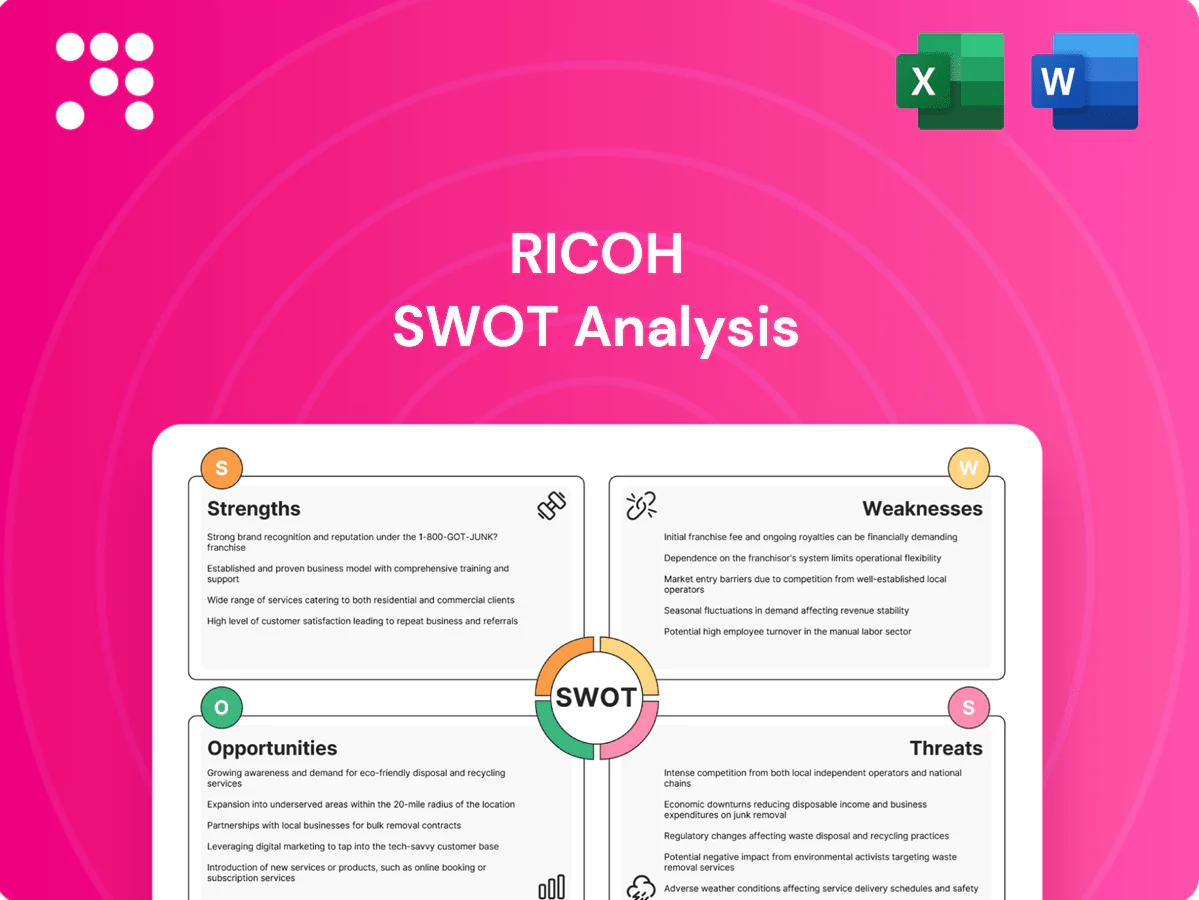
Ricoh SWOT Analysis

Your Strategic Toolkit Starts Here
Ricoh’s SWOT snapshot highlights resilient strengths in printing services, strong global distribution, and growing digital solutions, alongside pressures from declining hardware margins and intensifying competition. Our full SWOT unpacks strategic risks, market opportunities, and financial context with actionable recommendations. Purchase the complete, editable report to plan, pitch, or invest with confidence.
Strengths

Global brand and installed base
Ricoh’s long-standing global presence with millions of installed devices worldwide generates steady recurring revenue from supplies, service and periodic upgrades, underpinning high lifetime customer value. Deep channel partnerships and large enterprise contracts across more than 200 countries bolster retention and drive repeat sales. Strong brand trust reduces procurement friction in B2B deals, aiding cross-sell and renewal rates.
Diversified portfolio across hardware and services
Ricoh’s mix of office printers, production print and IT/document services stabilizes revenue—services accounted for about 40% of group sales in FY2024 and recurring contracts grew ~6% YoY—raising lifetime value per client. Cross-selling workflow, security and cloud solutions increases penetration, while diversification limits exposure to any single product cycle and sharp hardware downturns.

Expertise in document management and DX
Ricoh is widely recognized for managed print and document process optimization, leveraging its 2019 acquisition of DocuWare to strengthen cloud document management. Proven deployments across healthcare, finance and government provide compliance references and case studies. Deep process know-how and workflow consulting differentiate Ricoh beyond hardware specifications.

Robust service network and SLAs
Ricoh leverages a global field support and consumables logistics footprint across 200+ countries and regions to underpin uptime-critical environments; strong SLAs (covering rapid response and uptime guarantees) protect enterprise productivity and customer retention. Predictive maintenance and remote monitoring reduce downtime and service costs, turning service excellence into a competitive moat in large accounts, backed by Ricoh’s 80+ years of operations since 1936.
- Global footprint: 200+ countries and regions
- Heritage: 80+ years since 1936
- SLAs: rapid-response/up-time guarantees
- Tech: predictive maintenance & remote monitoring
R&D and workflow software capabilities
Ricoh’s investments in workflow, analytics and automation upgrade devices into recurring SaaS-led solutions, driving reported double-digit growth in software revenue during FY2024 and improving device attach rates.
Deep integration with cloud and security stacks increases customer stickiness and supports value-led pricing, enabling higher margins versus standalone hardware.
Continuous software enhancements and a solutions-first go-to-market lift service margins and recurring revenue share, aligning with Ricoh’s FY2024 shift toward subscription models.
- software-led growth: double-digit FY2024 expansion
- recurring revenue: higher attach rates, improved margins
- cloud/security integration: increased customer stickiness
200+ country enterprise services platform: ~40% services, recurring +6%, double-digit software
Ricoh’s 200+ country global footprint and 80+ year heritage support stable enterprise contracts and high lifetime customer value. Services made ~40% of group sales in FY2024, with recurring contracts +6% YoY and software achieving double-digit growth, boosting attach rates and margins. Predictive maintenance, SLAs and cloud/security integration increase stickiness and reduce churn.
| Metric | FY2024 / Fact |
|---|---|
| Global footprint | 200+ countries |
| Heritage | 80+ years (since 1936) |
| Services share | ~40% of group sales |
| Recurring growth | +6% YoY |
| Software growth | Double-digit |
What is included in the product
 Detailed Word Document
Provides a concise strategic overview of Ricoh’s internal capabilities, market strengths, operational weaknesses, and external opportunities and threats shaping its competitive position.

 Customizable Excel Spreadsheet
Provides a concise Ricoh SWOT matrix for fast, visual alignment across services and markets, highlighting strengths like digital transformation and weaknesses like legacy hardware reliance; ideal for executives needing a snapshot to streamline strategic decisions and integrate into reports.
Weaknesses

Exposure to declining office print volumes
Structural digitization has driven paper use down as over 80% of firms accelerated digital initiatives since 2020 (McKinsey), lowering print volumes per employee and shrinking Ricoh’s core hardware market. Even with managed print services cushioning variability, base demand pressure persists and device replacement cycles lengthen. Growth must shift toward services and adjacencies to offset declining legacy print revenue, which continues to weigh on overall margins and cash flow.
Margin pressure from hardware commoditization
Printers and MFPs face intense price competition as hardcopy peripheral shipments fell about 6% year-on-year in 2023 (IDC), compressing ASPs and gross margins. Feature convergence across vendors makes product differentiation harder, pushing Ricoh into tender-driven discounting that erodes unit profitability. As a result, Ricoh’s profit mix increasingly depends on supplies and service attach rates to sustain margins.

Complex transformation and integration risks
Shifting from product-led to solutions-led models is challenging for Ricoh; sales incentives, skills and delivery models must evolve, and integrating acquired IT capabilities has strained execution. Transition costs have pressured near-term profitability despite Ricoh generating over 1 trillion yen in annual revenue, increasing complexity and execution risk.

Dependence on enterprise capex cycles
Dependence on enterprise capex cycles makes Ricoh vulnerable: large-account upgrades are highly sensitive to macro uncertainty, procurement delays can push out revenue and budget freezes typically hit hardware line items first, weakening forecast visibility in downturns; Gartner projects global IT spending around $4.6 trillion in 2024, highlighting cyclical risk to hardware-driven segments.
- Large-account upgrades sensitive to macro uncertainty
- Procurement delays can defer revenue
- Budget freezes prioritize cutting hardware
- Downturns reduce forecast visibility
Intense competition from global incumbents
Intense competition from global incumbents such as Canon, HP, Xerox and Konica Minolta, plus IT service providers, pressures Ricoh as rivals increasingly bundle devices with cloud and security services, eroding hardware margins and forcing rapid platform investments. Price wars and feature parity compress differentiation, while overlapping channel footprints and partner incentives create conflicts in key markets. These dynamics strain Ricoh’s transition from hardware to recurring-service revenue.
- Rivals: Canon, HP, Xerox, Konica Minolta, IT service firms
- Bundled services: cloud + security offerings
- Outcome: price compression and reduced hardware margin
- Risk: channel conflicts in overlapping territories
Legacy printer leader forced into services as print demand falls and margins tighten
Ricoh faces shrinking core hardware demand as print shipments fell about 6% in 2023 and over 80% of firms accelerated digital initiatives since 2020, forcing a shift to services that compress near-term margins. Intense price competition from Canon, HP and others plus prolonged enterprise capex cycles heighten revenue volatility and execution risk.
| Weakness | Metric | Source/Year |
|---|---|---|
| Declining print demand | -6% shipments | IDC 2023 |
| Digital shift | >80% firms | McKinsey 2020–22 |
| Revenue scale | >1 trillion yen | Ricoh FY |
| Macro sensitivity | $4.6T IT spend | Gartner 2024 |
Preview the Actual Deliverable
Ricoh SWOT Analysis
This Ricoh SWOT Analysis preview is taken directly from the complete document you’ll receive upon purchase—no placeholders or summaries. It reflects the same professional, structured content and insights included in the downloadable file. Buy now to unlock the full, editable report with in-depth strengths, weaknesses, opportunities, and threats.

Your Strategic Toolkit Starts Here
Ricoh’s SWOT snapshot highlights resilient strengths in printing services, strong global distribution, and growing digital solutions, alongside pressures from declining hardware margins and intensifying competition. Our full SWOT unpacks strategic risks, market opportunities, and financial context with actionable recommendations. Purchase the complete, editable report to plan, pitch, or invest with confidence.
Strengths
Global brand and installed base
Ricoh’s long-standing global presence with millions of installed devices worldwide generates steady recurring revenue from supplies, service and periodic upgrades, underpinning high lifetime customer value. Deep channel partnerships and large enterprise contracts across more than 200 countries bolster retention and drive repeat sales. Strong brand trust reduces procurement friction in B2B deals, aiding cross-sell and renewal rates.
Diversified portfolio across hardware and services
Ricoh’s mix of office printers, production print and IT/document services stabilizes revenue—services accounted for about 40% of group sales in FY2024 and recurring contracts grew ~6% YoY—raising lifetime value per client. Cross-selling workflow, security and cloud solutions increases penetration, while diversification limits exposure to any single product cycle and sharp hardware downturns.
Expertise in document management and DX
Ricoh is widely recognized for managed print and document process optimization, leveraging its 2019 acquisition of DocuWare to strengthen cloud document management. Proven deployments across healthcare, finance and government provide compliance references and case studies. Deep process know-how and workflow consulting differentiate Ricoh beyond hardware specifications.
Robust service network and SLAs
Ricoh leverages a global field support and consumables logistics footprint across 200+ countries and regions to underpin uptime-critical environments; strong SLAs (covering rapid response and uptime guarantees) protect enterprise productivity and customer retention. Predictive maintenance and remote monitoring reduce downtime and service costs, turning service excellence into a competitive moat in large accounts, backed by Ricoh’s 80+ years of operations since 1936.
- Global footprint: 200+ countries and regions
- Heritage: 80+ years since 1936
- SLAs: rapid-response/up-time guarantees
- Tech: predictive maintenance & remote monitoring
R&D and workflow software capabilities
Ricoh’s investments in workflow, analytics and automation upgrade devices into recurring SaaS-led solutions, driving reported double-digit growth in software revenue during FY2024 and improving device attach rates.
Deep integration with cloud and security stacks increases customer stickiness and supports value-led pricing, enabling higher margins versus standalone hardware.
Continuous software enhancements and a solutions-first go-to-market lift service margins and recurring revenue share, aligning with Ricoh’s FY2024 shift toward subscription models.
- software-led growth: double-digit FY2024 expansion
- recurring revenue: higher attach rates, improved margins
- cloud/security integration: increased customer stickiness
200+ country enterprise services platform: ~40% services, recurring +6%, double-digit software
Ricoh’s 200+ country global footprint and 80+ year heritage support stable enterprise contracts and high lifetime customer value. Services made ~40% of group sales in FY2024, with recurring contracts +6% YoY and software achieving double-digit growth, boosting attach rates and margins. Predictive maintenance, SLAs and cloud/security integration increase stickiness and reduce churn.
| Metric | FY2024 / Fact |
|---|---|
| Global footprint | 200+ countries |
| Heritage | 80+ years (since 1936) |
| Services share | ~40% of group sales |
| Recurring growth | +6% YoY |
| Software growth | Double-digit |
What is included in the product
Detailed Word Document
Provides a concise strategic overview of Ricoh’s internal capabilities, market strengths, operational weaknesses, and external opportunities and threats shaping its competitive position.
Customizable Excel Spreadsheet
Provides a concise Ricoh SWOT matrix for fast, visual alignment across services and markets, highlighting strengths like digital transformation and weaknesses like legacy hardware reliance; ideal for executives needing a snapshot to streamline strategic decisions and integrate into reports.
Weaknesses
Exposure to declining office print volumes
Structural digitization has driven paper use down as over 80% of firms accelerated digital initiatives since 2020 (McKinsey), lowering print volumes per employee and shrinking Ricoh’s core hardware market. Even with managed print services cushioning variability, base demand pressure persists and device replacement cycles lengthen. Growth must shift toward services and adjacencies to offset declining legacy print revenue, which continues to weigh on overall margins and cash flow.
Margin pressure from hardware commoditization
Printers and MFPs face intense price competition as hardcopy peripheral shipments fell about 6% year-on-year in 2023 (IDC), compressing ASPs and gross margins. Feature convergence across vendors makes product differentiation harder, pushing Ricoh into tender-driven discounting that erodes unit profitability. As a result, Ricoh’s profit mix increasingly depends on supplies and service attach rates to sustain margins.
Complex transformation and integration risks
Shifting from product-led to solutions-led models is challenging for Ricoh; sales incentives, skills and delivery models must evolve, and integrating acquired IT capabilities has strained execution. Transition costs have pressured near-term profitability despite Ricoh generating over 1 trillion yen in annual revenue, increasing complexity and execution risk.
Dependence on enterprise capex cycles
Dependence on enterprise capex cycles makes Ricoh vulnerable: large-account upgrades are highly sensitive to macro uncertainty, procurement delays can push out revenue and budget freezes typically hit hardware line items first, weakening forecast visibility in downturns; Gartner projects global IT spending around $4.6 trillion in 2024, highlighting cyclical risk to hardware-driven segments.
- Large-account upgrades sensitive to macro uncertainty
- Procurement delays can defer revenue
- Budget freezes prioritize cutting hardware
- Downturns reduce forecast visibility
Intense competition from global incumbents
Intense competition from global incumbents such as Canon, HP, Xerox and Konica Minolta, plus IT service providers, pressures Ricoh as rivals increasingly bundle devices with cloud and security services, eroding hardware margins and forcing rapid platform investments. Price wars and feature parity compress differentiation, while overlapping channel footprints and partner incentives create conflicts in key markets. These dynamics strain Ricoh’s transition from hardware to recurring-service revenue.
- Rivals: Canon, HP, Xerox, Konica Minolta, IT service firms
- Bundled services: cloud + security offerings
- Outcome: price compression and reduced hardware margin
- Risk: channel conflicts in overlapping territories
Legacy printer leader forced into services as print demand falls and margins tighten
Ricoh faces shrinking core hardware demand as print shipments fell about 6% in 2023 and over 80% of firms accelerated digital initiatives since 2020, forcing a shift to services that compress near-term margins. Intense price competition from Canon, HP and others plus prolonged enterprise capex cycles heighten revenue volatility and execution risk.
| Weakness | Metric | Source/Year |
|---|---|---|
| Declining print demand | -6% shipments | IDC 2023 |
| Digital shift | >80% firms | McKinsey 2020–22 |
| Revenue scale | >1 trillion yen | Ricoh FY |
| Macro sensitivity | $4.6T IT spend | Gartner 2024 |
Preview the Actual Deliverable
Ricoh SWOT Analysis
This Ricoh SWOT Analysis preview is taken directly from the complete document you’ll receive upon purchase—no placeholders or summaries. It reflects the same professional, structured content and insights included in the downloadable file. Buy now to unlock the full, editable report with in-depth strengths, weaknesses, opportunities, and threats.
Original: $10.00
-65%$10.00
$3.50Description
Your Strategic Toolkit Starts Here
Ricoh’s SWOT snapshot highlights resilient strengths in printing services, strong global distribution, and growing digital solutions, alongside pressures from declining hardware margins and intensifying competition. Our full SWOT unpacks strategic risks, market opportunities, and financial context with actionable recommendations. Purchase the complete, editable report to plan, pitch, or invest with confidence.
Strengths
Global brand and installed base
Ricoh’s long-standing global presence with millions of installed devices worldwide generates steady recurring revenue from supplies, service and periodic upgrades, underpinning high lifetime customer value. Deep channel partnerships and large enterprise contracts across more than 200 countries bolster retention and drive repeat sales. Strong brand trust reduces procurement friction in B2B deals, aiding cross-sell and renewal rates.
Diversified portfolio across hardware and services
Ricoh’s mix of office printers, production print and IT/document services stabilizes revenue—services accounted for about 40% of group sales in FY2024 and recurring contracts grew ~6% YoY—raising lifetime value per client. Cross-selling workflow, security and cloud solutions increases penetration, while diversification limits exposure to any single product cycle and sharp hardware downturns.
Expertise in document management and DX
Ricoh is widely recognized for managed print and document process optimization, leveraging its 2019 acquisition of DocuWare to strengthen cloud document management. Proven deployments across healthcare, finance and government provide compliance references and case studies. Deep process know-how and workflow consulting differentiate Ricoh beyond hardware specifications.
Robust service network and SLAs
Ricoh leverages a global field support and consumables logistics footprint across 200+ countries and regions to underpin uptime-critical environments; strong SLAs (covering rapid response and uptime guarantees) protect enterprise productivity and customer retention. Predictive maintenance and remote monitoring reduce downtime and service costs, turning service excellence into a competitive moat in large accounts, backed by Ricoh’s 80+ years of operations since 1936.
- Global footprint: 200+ countries and regions
- Heritage: 80+ years since 1936
- SLAs: rapid-response/up-time guarantees
- Tech: predictive maintenance & remote monitoring
R&D and workflow software capabilities
Ricoh’s investments in workflow, analytics and automation upgrade devices into recurring SaaS-led solutions, driving reported double-digit growth in software revenue during FY2024 and improving device attach rates.
Deep integration with cloud and security stacks increases customer stickiness and supports value-led pricing, enabling higher margins versus standalone hardware.
Continuous software enhancements and a solutions-first go-to-market lift service margins and recurring revenue share, aligning with Ricoh’s FY2024 shift toward subscription models.
- software-led growth: double-digit FY2024 expansion
- recurring revenue: higher attach rates, improved margins
- cloud/security integration: increased customer stickiness
200+ country enterprise services platform: ~40% services, recurring +6%, double-digit software
Ricoh’s 200+ country global footprint and 80+ year heritage support stable enterprise contracts and high lifetime customer value. Services made ~40% of group sales in FY2024, with recurring contracts +6% YoY and software achieving double-digit growth, boosting attach rates and margins. Predictive maintenance, SLAs and cloud/security integration increase stickiness and reduce churn.
| Metric | FY2024 / Fact |
|---|---|
| Global footprint | 200+ countries |
| Heritage | 80+ years (since 1936) |
| Services share | ~40% of group sales |
| Recurring growth | +6% YoY |
| Software growth | Double-digit |
What is included in the product
Detailed Word Document
Provides a concise strategic overview of Ricoh’s internal capabilities, market strengths, operational weaknesses, and external opportunities and threats shaping its competitive position.
Customizable Excel Spreadsheet
Provides a concise Ricoh SWOT matrix for fast, visual alignment across services and markets, highlighting strengths like digital transformation and weaknesses like legacy hardware reliance; ideal for executives needing a snapshot to streamline strategic decisions and integrate into reports.
Weaknesses
Exposure to declining office print volumes
Structural digitization has driven paper use down as over 80% of firms accelerated digital initiatives since 2020 (McKinsey), lowering print volumes per employee and shrinking Ricoh’s core hardware market. Even with managed print services cushioning variability, base demand pressure persists and device replacement cycles lengthen. Growth must shift toward services and adjacencies to offset declining legacy print revenue, which continues to weigh on overall margins and cash flow.
Margin pressure from hardware commoditization
Printers and MFPs face intense price competition as hardcopy peripheral shipments fell about 6% year-on-year in 2023 (IDC), compressing ASPs and gross margins. Feature convergence across vendors makes product differentiation harder, pushing Ricoh into tender-driven discounting that erodes unit profitability. As a result, Ricoh’s profit mix increasingly depends on supplies and service attach rates to sustain margins.
Complex transformation and integration risks
Shifting from product-led to solutions-led models is challenging for Ricoh; sales incentives, skills and delivery models must evolve, and integrating acquired IT capabilities has strained execution. Transition costs have pressured near-term profitability despite Ricoh generating over 1 trillion yen in annual revenue, increasing complexity and execution risk.
Dependence on enterprise capex cycles
Dependence on enterprise capex cycles makes Ricoh vulnerable: large-account upgrades are highly sensitive to macro uncertainty, procurement delays can push out revenue and budget freezes typically hit hardware line items first, weakening forecast visibility in downturns; Gartner projects global IT spending around $4.6 trillion in 2024, highlighting cyclical risk to hardware-driven segments.
- Large-account upgrades sensitive to macro uncertainty
- Procurement delays can defer revenue
- Budget freezes prioritize cutting hardware
- Downturns reduce forecast visibility
Intense competition from global incumbents
Intense competition from global incumbents such as Canon, HP, Xerox and Konica Minolta, plus IT service providers, pressures Ricoh as rivals increasingly bundle devices with cloud and security services, eroding hardware margins and forcing rapid platform investments. Price wars and feature parity compress differentiation, while overlapping channel footprints and partner incentives create conflicts in key markets. These dynamics strain Ricoh’s transition from hardware to recurring-service revenue.
- Rivals: Canon, HP, Xerox, Konica Minolta, IT service firms
- Bundled services: cloud + security offerings
- Outcome: price compression and reduced hardware margin
- Risk: channel conflicts in overlapping territories
Legacy printer leader forced into services as print demand falls and margins tighten
Ricoh faces shrinking core hardware demand as print shipments fell about 6% in 2023 and over 80% of firms accelerated digital initiatives since 2020, forcing a shift to services that compress near-term margins. Intense price competition from Canon, HP and others plus prolonged enterprise capex cycles heighten revenue volatility and execution risk.
| Weakness | Metric | Source/Year |
|---|---|---|
| Declining print demand | -6% shipments | IDC 2023 |
| Digital shift | >80% firms | McKinsey 2020–22 |
| Revenue scale | >1 trillion yen | Ricoh FY |
| Macro sensitivity | $4.6T IT spend | Gartner 2024 |
Preview the Actual Deliverable
Ricoh SWOT Analysis
This Ricoh SWOT Analysis preview is taken directly from the complete document you’ll receive upon purchase—no placeholders or summaries. It reflects the same professional, structured content and insights included in the downloadable file. Buy now to unlock the full, editable report with in-depth strengths, weaknesses, opportunities, and threats.











