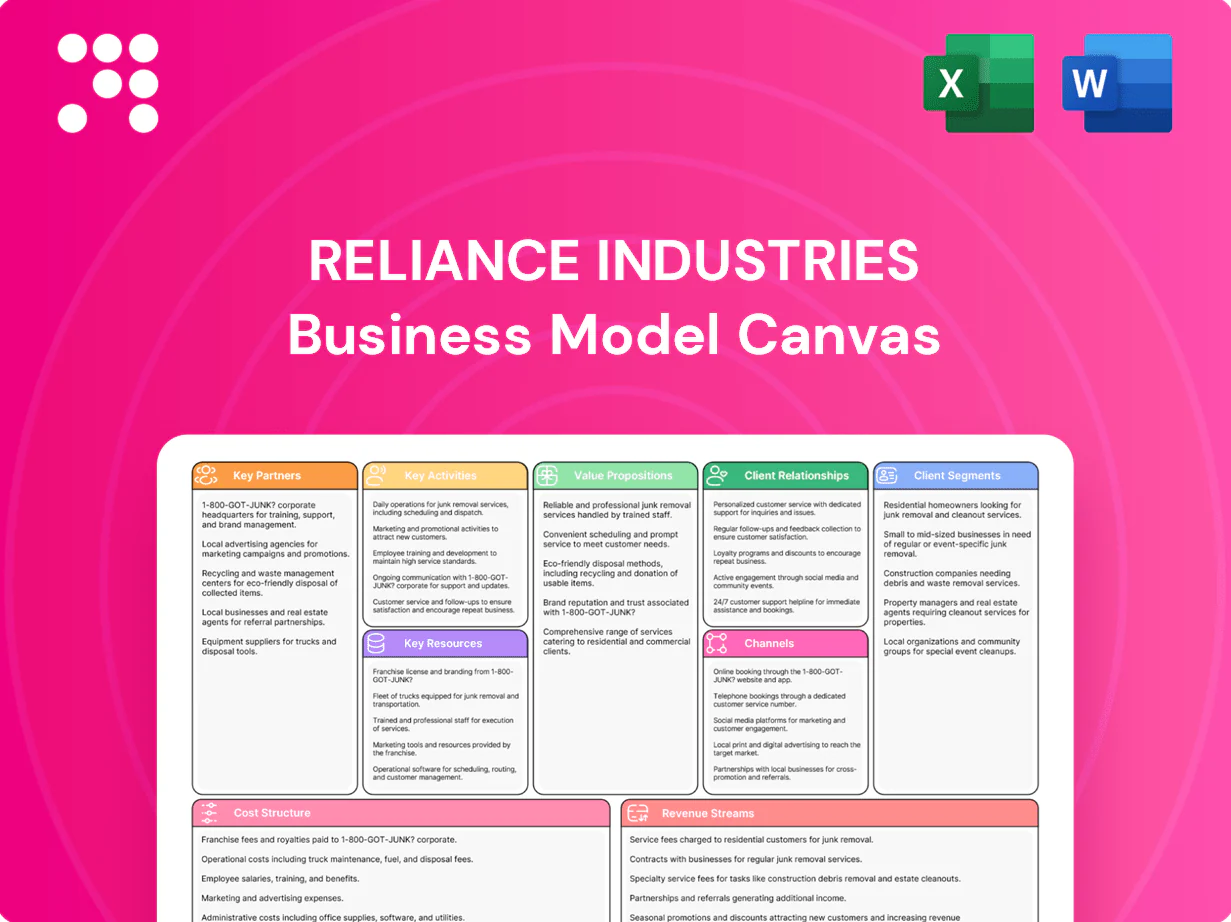
Reliance Industries Business Model Canvas

Unlock a leading conglomerate's strategic blueprint with our Business Model Canvas
Unlock Reliance Industries' strategic blueprint with our Business Model Canvas. This concise canvas maps customer segments, value propositions, key partners, revenue streams and cost drivers to show how Reliance scales and sustains market leadership. Ideal for investors, consultants, and entrepreneurs—download the full Word & Excel canvas for detailed, actionable insights.
Partnerships

Global energy JV alliances
Reliance leverages global energy JV alliances with majors such as BP (strategic ties since 2011) to access exploration, refining and petrochemical technologies while de-risking large capital outlays. Reliance’s Jamnagar refinery complex (about 1.24 million barrels per day capacity) and integrated petrochemical assets gain faster time-to-market through partner processes and local execution. The synergy broadens feedstock flexibility and expands the product slate, improving margin resilience.
Crude and feedstock supply agreements
Long-term crude and NGL supply agreements with national oil companies and global traders secure feedstock for Reliance, underpinning steady operations at Jamnagar. Supply diversity across basins and sellers stabilizes refining margins and mitigates geopolitical concentration risk. Structured procurement and blending optimize landed cost and product quality. Jamnagar complex capacity stands at ~1.24 million bpd (≈62 MMTPA) as of 2024.

Telecom, device, and content partners
Reliance Jio partners with handset OEMs such as Samsung and Xiaomi and earlier with Google on JioPhone Next, tower companies and OTT content providers including Disney+ Hotstar and Amazon Prime in bundled offers. Bundled devices and content helped Jio reach about 448.5 million wireless subscribers and a wireless ARPU of Rs 176 in Q4 FY2024. Network sharing and fiber partnerships lower capex per GB and accelerate rollouts. Ecosystem tie-ups across retail, payments and apps boost customer stickiness.

Retail brand and supplier networks
Reliance partners with FMCG brands, farmers and MSMEs to widen assortment and ensure freshness across 18,000+ stores (2024), using backward linkages and private-labels to lift gross margins. Supplier financing programs and integrated tech platforms increase fulfillment reliability and reduce stock-outs, while scale-based procurement terms drive competitive pricing both in-store and online.
- Alliances: FMCG, farmers, MSMEs
- Scale: 18,000+ stores (2024)
- Margin levers: backward linkages, private labels
- Reliability: supplier finance + tech platforms
Technology and sustainability partners
Partnerships with process licensors, renewable firms and research institutes accelerate Reliance Industries' decarbonization by deploying scalable low-carbon processes and shared R&D, while hydrogen, CCUS and recycling partners underpin transition roadmaps and feedstock circularity. Digital twins and AI collaborators boost asset reliability and efficiency, reducing emissions intensity and aligning operations with regulatory and investor ESG expectations.
- Process licensors: scalable low-carbon tech
- Renewables: project development & off-take
- Hydrogen/CCUS: transition backbone
- Recycling: feedstock circularity
- Digital twins/AI: asset performance
- Regulatory & investor alignment: ESG disclosure
Integrated energy-to-digital group secures feedstock, 448.5M subs, 18,000+ stores
Reliance leverages JVs with majors (BP since 2011) and long-term crude/NGL deals to secure feedstock for Jamnagar (1.24M bpd, 62 MMTPA). Jio ecosystem partners (Samsung, Xiaomi, Disney+ Hotstar) support 448.5M wireless subs and Rs176 ARPU (Q4 FY2024). Retail and agri tie-ups scale 18,000+ stores, lowering input cost via supplier finance and private labels.
| Partnership | Role | 2024 metric |
|---|---|---|
| Energy JVs | Tech & capex sharing | Jamnagar 1.24M bpd |
| Jio OEM/OTT | Distribution & content | 448.5M subs; ARPU Rs176 |
| Retail/agri | Supply & margins | 18,000+ stores |
What is included in the product
 Detailed Word Document
A comprehensive Business Model Canvas for Reliance Industries detailing customer segments, channels, value propositions and revenue streams across energy, petrochemicals, retail and digital (Jio), organized into the 9 BMC blocks with competitive advantages, risks and strategic insights—ideal for presentations and investor discussions.

 Customizable Excel Spreadsheet
High-level, editable Business Model Canvas for Reliance Industries that condenses its diversified strategy into a one-page snapshot to quickly identify core value drivers and pain points. Great for boardrooms and teams—shareable, saves hours of structuring insights, and perfect for side-by-side comparisons or rapid decision-making.
Activities

Refining and petrochemicals operations
Operate world-scale refineries and integrated petchem units with high complexity, exemplified by the Jamnagar complex capacity of about 1.24 million barrels per day. Optimize crude slate, product yields, and energy efficiency daily to meet market grades and margins. Maintain on-stream factors above 95% through predictive maintenance. Continuously debottleneck to lift throughput and margins.
Hydrocarbon exploration and production
Develop offshore gas fields and upstream assets such as KG-D6 to secure feedstock for petrochemicals and fuels. Apply advanced seismic imaging, directional drilling and reservoir management to raise recovery and lower cycle times. Balance upstream capex with commodity-price cycles and government incentives. Integrate production with Jamnagar refinery complex (about 1.24 million bbl/day) to capture full value chain.

Retail merchandising and supply chain
Source, assort and price products across grocery, fashion, electronics and pharma while running nationwide logistics, cold chains and last-mile delivery; Reliance Retail operates 18,000+ stores and presence in 7,000+ towns. Manage private labels and omnichannel inventory through integrated supply-chain platforms and fulfilment centers, driving store productivity and customer experience with digital tools and POS analytics.

Telecom network deployment and services
Build and operate nationwide 4G/5G networks, fiber and edge infrastructure, managing spectrum, backhaul and data centers to ensure carrier-grade reliability; serve over 400 million subscribers in 2024 with voice, data, enterprise solutions and content while using analytics for traffic shaping and churn reduction.
- Network: 4G/5G, fiber, edge
- Operations: spectrum, backhaul, data centers
- Services: voice, data, enterprise, content
- Analytics: traffic shaping, churn reduction
New energy development
Reliance is building new energy capacity focused on solar modules, batteries, green hydrogen and circular materials, targeting 100 GW and a $10 billion clean-energy investment by 2030 (as stated in 2024); it is localizing manufacturing to cut import dependence, running pilot projects to validate unit economics at scale, and aligning projects with Indian policy incentives and national carbon goals.
- 100 GW by 2030
- $10 billion target (2024)
- solar, batteries, green H2, circular materials
- localize manufacturing
- pilot projects to prove unit economics
- policy and carbon-alignment
Run 1.24M b/d refinery · 400M subs · 18,000+ stores · 100GW
Operate Jamnagar refinery (≈1.24 million bbl/day) and petchems with >95% on‑stream, optimize yields and debottleneck for margin capture. Develop upstream (KG‑D6) to secure feedstock and balance capex vs prices. Run Reliance Retail (18,000+ stores, 7,000+ towns) with omnichannel logistics. Scale Jio network and digital services to ~400M subs (2024) and build 100 GW clean energy capacity by 2030 ($10B target, 2024).
| Activity | Key metric | 2024 figure |
|---|---|---|
| Refining & petchem | Capacity | 1.24M bbl/day |
| Retail | Stores/towns | 18,000+/7,000+ |
| Telecom | Subscribers | ~400M |
| New energy | Target | 100 GW / $10B |
What You See Is What You Get
Business Model Canvas
The Reliance Industries Business Model Canvas you’re previewing is the real deliverable, not a mockup. When you purchase, you’ll receive this exact document—complete and formatted—as downloadable Word and Excel files. It’s ready to edit, present, and share with no hidden sections or surprises.

Unlock a leading conglomerate's strategic blueprint with our Business Model Canvas
Unlock Reliance Industries' strategic blueprint with our Business Model Canvas. This concise canvas maps customer segments, value propositions, key partners, revenue streams and cost drivers to show how Reliance scales and sustains market leadership. Ideal for investors, consultants, and entrepreneurs—download the full Word & Excel canvas for detailed, actionable insights.
Partnerships
Global energy JV alliances
Reliance leverages global energy JV alliances with majors such as BP (strategic ties since 2011) to access exploration, refining and petrochemical technologies while de-risking large capital outlays. Reliance’s Jamnagar refinery complex (about 1.24 million barrels per day capacity) and integrated petrochemical assets gain faster time-to-market through partner processes and local execution. The synergy broadens feedstock flexibility and expands the product slate, improving margin resilience.
Crude and feedstock supply agreements
Long-term crude and NGL supply agreements with national oil companies and global traders secure feedstock for Reliance, underpinning steady operations at Jamnagar. Supply diversity across basins and sellers stabilizes refining margins and mitigates geopolitical concentration risk. Structured procurement and blending optimize landed cost and product quality. Jamnagar complex capacity stands at ~1.24 million bpd (≈62 MMTPA) as of 2024.
Telecom, device, and content partners
Reliance Jio partners with handset OEMs such as Samsung and Xiaomi and earlier with Google on JioPhone Next, tower companies and OTT content providers including Disney+ Hotstar and Amazon Prime in bundled offers. Bundled devices and content helped Jio reach about 448.5 million wireless subscribers and a wireless ARPU of Rs 176 in Q4 FY2024. Network sharing and fiber partnerships lower capex per GB and accelerate rollouts. Ecosystem tie-ups across retail, payments and apps boost customer stickiness.
Retail brand and supplier networks
Reliance partners with FMCG brands, farmers and MSMEs to widen assortment and ensure freshness across 18,000+ stores (2024), using backward linkages and private-labels to lift gross margins. Supplier financing programs and integrated tech platforms increase fulfillment reliability and reduce stock-outs, while scale-based procurement terms drive competitive pricing both in-store and online.
- Alliances: FMCG, farmers, MSMEs
- Scale: 18,000+ stores (2024)
- Margin levers: backward linkages, private labels
- Reliability: supplier finance + tech platforms
Technology and sustainability partners
Partnerships with process licensors, renewable firms and research institutes accelerate Reliance Industries' decarbonization by deploying scalable low-carbon processes and shared R&D, while hydrogen, CCUS and recycling partners underpin transition roadmaps and feedstock circularity. Digital twins and AI collaborators boost asset reliability and efficiency, reducing emissions intensity and aligning operations with regulatory and investor ESG expectations.
- Process licensors: scalable low-carbon tech
- Renewables: project development & off-take
- Hydrogen/CCUS: transition backbone
- Recycling: feedstock circularity
- Digital twins/AI: asset performance
- Regulatory & investor alignment: ESG disclosure
Integrated energy-to-digital group secures feedstock, 448.5M subs, 18,000+ stores
Reliance leverages JVs with majors (BP since 2011) and long-term crude/NGL deals to secure feedstock for Jamnagar (1.24M bpd, 62 MMTPA). Jio ecosystem partners (Samsung, Xiaomi, Disney+ Hotstar) support 448.5M wireless subs and Rs176 ARPU (Q4 FY2024). Retail and agri tie-ups scale 18,000+ stores, lowering input cost via supplier finance and private labels.
| Partnership | Role | 2024 metric |
|---|---|---|
| Energy JVs | Tech & capex sharing | Jamnagar 1.24M bpd |
| Jio OEM/OTT | Distribution & content | 448.5M subs; ARPU Rs176 |
| Retail/agri | Supply & margins | 18,000+ stores |
What is included in the product
Detailed Word Document
A comprehensive Business Model Canvas for Reliance Industries detailing customer segments, channels, value propositions and revenue streams across energy, petrochemicals, retail and digital (Jio), organized into the 9 BMC blocks with competitive advantages, risks and strategic insights—ideal for presentations and investor discussions.
Customizable Excel Spreadsheet
High-level, editable Business Model Canvas for Reliance Industries that condenses its diversified strategy into a one-page snapshot to quickly identify core value drivers and pain points. Great for boardrooms and teams—shareable, saves hours of structuring insights, and perfect for side-by-side comparisons or rapid decision-making.
Activities
Refining and petrochemicals operations
Operate world-scale refineries and integrated petchem units with high complexity, exemplified by the Jamnagar complex capacity of about 1.24 million barrels per day. Optimize crude slate, product yields, and energy efficiency daily to meet market grades and margins. Maintain on-stream factors above 95% through predictive maintenance. Continuously debottleneck to lift throughput and margins.
Hydrocarbon exploration and production
Develop offshore gas fields and upstream assets such as KG-D6 to secure feedstock for petrochemicals and fuels. Apply advanced seismic imaging, directional drilling and reservoir management to raise recovery and lower cycle times. Balance upstream capex with commodity-price cycles and government incentives. Integrate production with Jamnagar refinery complex (about 1.24 million bbl/day) to capture full value chain.
Retail merchandising and supply chain
Source, assort and price products across grocery, fashion, electronics and pharma while running nationwide logistics, cold chains and last-mile delivery; Reliance Retail operates 18,000+ stores and presence in 7,000+ towns. Manage private labels and omnichannel inventory through integrated supply-chain platforms and fulfilment centers, driving store productivity and customer experience with digital tools and POS analytics.
Telecom network deployment and services
Build and operate nationwide 4G/5G networks, fiber and edge infrastructure, managing spectrum, backhaul and data centers to ensure carrier-grade reliability; serve over 400 million subscribers in 2024 with voice, data, enterprise solutions and content while using analytics for traffic shaping and churn reduction.
- Network: 4G/5G, fiber, edge
- Operations: spectrum, backhaul, data centers
- Services: voice, data, enterprise, content
- Analytics: traffic shaping, churn reduction
New energy development
Reliance is building new energy capacity focused on solar modules, batteries, green hydrogen and circular materials, targeting 100 GW and a $10 billion clean-energy investment by 2030 (as stated in 2024); it is localizing manufacturing to cut import dependence, running pilot projects to validate unit economics at scale, and aligning projects with Indian policy incentives and national carbon goals.
- 100 GW by 2030
- $10 billion target (2024)
- solar, batteries, green H2, circular materials
- localize manufacturing
- pilot projects to prove unit economics
- policy and carbon-alignment
Run 1.24M b/d refinery · 400M subs · 18,000+ stores · 100GW
Operate Jamnagar refinery (≈1.24 million bbl/day) and petchems with >95% on‑stream, optimize yields and debottleneck for margin capture. Develop upstream (KG‑D6) to secure feedstock and balance capex vs prices. Run Reliance Retail (18,000+ stores, 7,000+ towns) with omnichannel logistics. Scale Jio network and digital services to ~400M subs (2024) and build 100 GW clean energy capacity by 2030 ($10B target, 2024).
| Activity | Key metric | 2024 figure |
|---|---|---|
| Refining & petchem | Capacity | 1.24M bbl/day |
| Retail | Stores/towns | 18,000+/7,000+ |
| Telecom | Subscribers | ~400M |
| New energy | Target | 100 GW / $10B |
What You See Is What You Get
Business Model Canvas
The Reliance Industries Business Model Canvas you’re previewing is the real deliverable, not a mockup. When you purchase, you’ll receive this exact document—complete and formatted—as downloadable Word and Excel files. It’s ready to edit, present, and share with no hidden sections or surprises.
Original: $10.00
-65%$10.00
$3.50Description
Unlock a leading conglomerate's strategic blueprint with our Business Model Canvas
Unlock Reliance Industries' strategic blueprint with our Business Model Canvas. This concise canvas maps customer segments, value propositions, key partners, revenue streams and cost drivers to show how Reliance scales and sustains market leadership. Ideal for investors, consultants, and entrepreneurs—download the full Word & Excel canvas for detailed, actionable insights.
Partnerships
Global energy JV alliances
Reliance leverages global energy JV alliances with majors such as BP (strategic ties since 2011) to access exploration, refining and petrochemical technologies while de-risking large capital outlays. Reliance’s Jamnagar refinery complex (about 1.24 million barrels per day capacity) and integrated petrochemical assets gain faster time-to-market through partner processes and local execution. The synergy broadens feedstock flexibility and expands the product slate, improving margin resilience.
Crude and feedstock supply agreements
Long-term crude and NGL supply agreements with national oil companies and global traders secure feedstock for Reliance, underpinning steady operations at Jamnagar. Supply diversity across basins and sellers stabilizes refining margins and mitigates geopolitical concentration risk. Structured procurement and blending optimize landed cost and product quality. Jamnagar complex capacity stands at ~1.24 million bpd (≈62 MMTPA) as of 2024.
Telecom, device, and content partners
Reliance Jio partners with handset OEMs such as Samsung and Xiaomi and earlier with Google on JioPhone Next, tower companies and OTT content providers including Disney+ Hotstar and Amazon Prime in bundled offers. Bundled devices and content helped Jio reach about 448.5 million wireless subscribers and a wireless ARPU of Rs 176 in Q4 FY2024. Network sharing and fiber partnerships lower capex per GB and accelerate rollouts. Ecosystem tie-ups across retail, payments and apps boost customer stickiness.
Retail brand and supplier networks
Reliance partners with FMCG brands, farmers and MSMEs to widen assortment and ensure freshness across 18,000+ stores (2024), using backward linkages and private-labels to lift gross margins. Supplier financing programs and integrated tech platforms increase fulfillment reliability and reduce stock-outs, while scale-based procurement terms drive competitive pricing both in-store and online.
- Alliances: FMCG, farmers, MSMEs
- Scale: 18,000+ stores (2024)
- Margin levers: backward linkages, private labels
- Reliability: supplier finance + tech platforms
Technology and sustainability partners
Partnerships with process licensors, renewable firms and research institutes accelerate Reliance Industries' decarbonization by deploying scalable low-carbon processes and shared R&D, while hydrogen, CCUS and recycling partners underpin transition roadmaps and feedstock circularity. Digital twins and AI collaborators boost asset reliability and efficiency, reducing emissions intensity and aligning operations with regulatory and investor ESG expectations.
- Process licensors: scalable low-carbon tech
- Renewables: project development & off-take
- Hydrogen/CCUS: transition backbone
- Recycling: feedstock circularity
- Digital twins/AI: asset performance
- Regulatory & investor alignment: ESG disclosure
Integrated energy-to-digital group secures feedstock, 448.5M subs, 18,000+ stores
Reliance leverages JVs with majors (BP since 2011) and long-term crude/NGL deals to secure feedstock for Jamnagar (1.24M bpd, 62 MMTPA). Jio ecosystem partners (Samsung, Xiaomi, Disney+ Hotstar) support 448.5M wireless subs and Rs176 ARPU (Q4 FY2024). Retail and agri tie-ups scale 18,000+ stores, lowering input cost via supplier finance and private labels.
| Partnership | Role | 2024 metric |
|---|---|---|
| Energy JVs | Tech & capex sharing | Jamnagar 1.24M bpd |
| Jio OEM/OTT | Distribution & content | 448.5M subs; ARPU Rs176 |
| Retail/agri | Supply & margins | 18,000+ stores |
What is included in the product
Detailed Word Document
A comprehensive Business Model Canvas for Reliance Industries detailing customer segments, channels, value propositions and revenue streams across energy, petrochemicals, retail and digital (Jio), organized into the 9 BMC blocks with competitive advantages, risks and strategic insights—ideal for presentations and investor discussions.
Customizable Excel Spreadsheet
High-level, editable Business Model Canvas for Reliance Industries that condenses its diversified strategy into a one-page snapshot to quickly identify core value drivers and pain points. Great for boardrooms and teams—shareable, saves hours of structuring insights, and perfect for side-by-side comparisons or rapid decision-making.
Activities
Refining and petrochemicals operations
Operate world-scale refineries and integrated petchem units with high complexity, exemplified by the Jamnagar complex capacity of about 1.24 million barrels per day. Optimize crude slate, product yields, and energy efficiency daily to meet market grades and margins. Maintain on-stream factors above 95% through predictive maintenance. Continuously debottleneck to lift throughput and margins.
Hydrocarbon exploration and production
Develop offshore gas fields and upstream assets such as KG-D6 to secure feedstock for petrochemicals and fuels. Apply advanced seismic imaging, directional drilling and reservoir management to raise recovery and lower cycle times. Balance upstream capex with commodity-price cycles and government incentives. Integrate production with Jamnagar refinery complex (about 1.24 million bbl/day) to capture full value chain.
Retail merchandising and supply chain
Source, assort and price products across grocery, fashion, electronics and pharma while running nationwide logistics, cold chains and last-mile delivery; Reliance Retail operates 18,000+ stores and presence in 7,000+ towns. Manage private labels and omnichannel inventory through integrated supply-chain platforms and fulfilment centers, driving store productivity and customer experience with digital tools and POS analytics.
Telecom network deployment and services
Build and operate nationwide 4G/5G networks, fiber and edge infrastructure, managing spectrum, backhaul and data centers to ensure carrier-grade reliability; serve over 400 million subscribers in 2024 with voice, data, enterprise solutions and content while using analytics for traffic shaping and churn reduction.
- Network: 4G/5G, fiber, edge
- Operations: spectrum, backhaul, data centers
- Services: voice, data, enterprise, content
- Analytics: traffic shaping, churn reduction
New energy development
Reliance is building new energy capacity focused on solar modules, batteries, green hydrogen and circular materials, targeting 100 GW and a $10 billion clean-energy investment by 2030 (as stated in 2024); it is localizing manufacturing to cut import dependence, running pilot projects to validate unit economics at scale, and aligning projects with Indian policy incentives and national carbon goals.
- 100 GW by 2030
- $10 billion target (2024)
- solar, batteries, green H2, circular materials
- localize manufacturing
- pilot projects to prove unit economics
- policy and carbon-alignment
Run 1.24M b/d refinery · 400M subs · 18,000+ stores · 100GW
Operate Jamnagar refinery (≈1.24 million bbl/day) and petchems with >95% on‑stream, optimize yields and debottleneck for margin capture. Develop upstream (KG‑D6) to secure feedstock and balance capex vs prices. Run Reliance Retail (18,000+ stores, 7,000+ towns) with omnichannel logistics. Scale Jio network and digital services to ~400M subs (2024) and build 100 GW clean energy capacity by 2030 ($10B target, 2024).
| Activity | Key metric | 2024 figure |
|---|---|---|
| Refining & petchem | Capacity | 1.24M bbl/day |
| Retail | Stores/towns | 18,000+/7,000+ |
| Telecom | Subscribers | ~400M |
| New energy | Target | 100 GW / $10B |
What You See Is What You Get
Business Model Canvas
The Reliance Industries Business Model Canvas you’re previewing is the real deliverable, not a mockup. When you purchase, you’ll receive this exact document—complete and formatted—as downloadable Word and Excel files. It’s ready to edit, present, and share with no hidden sections or surprises.











