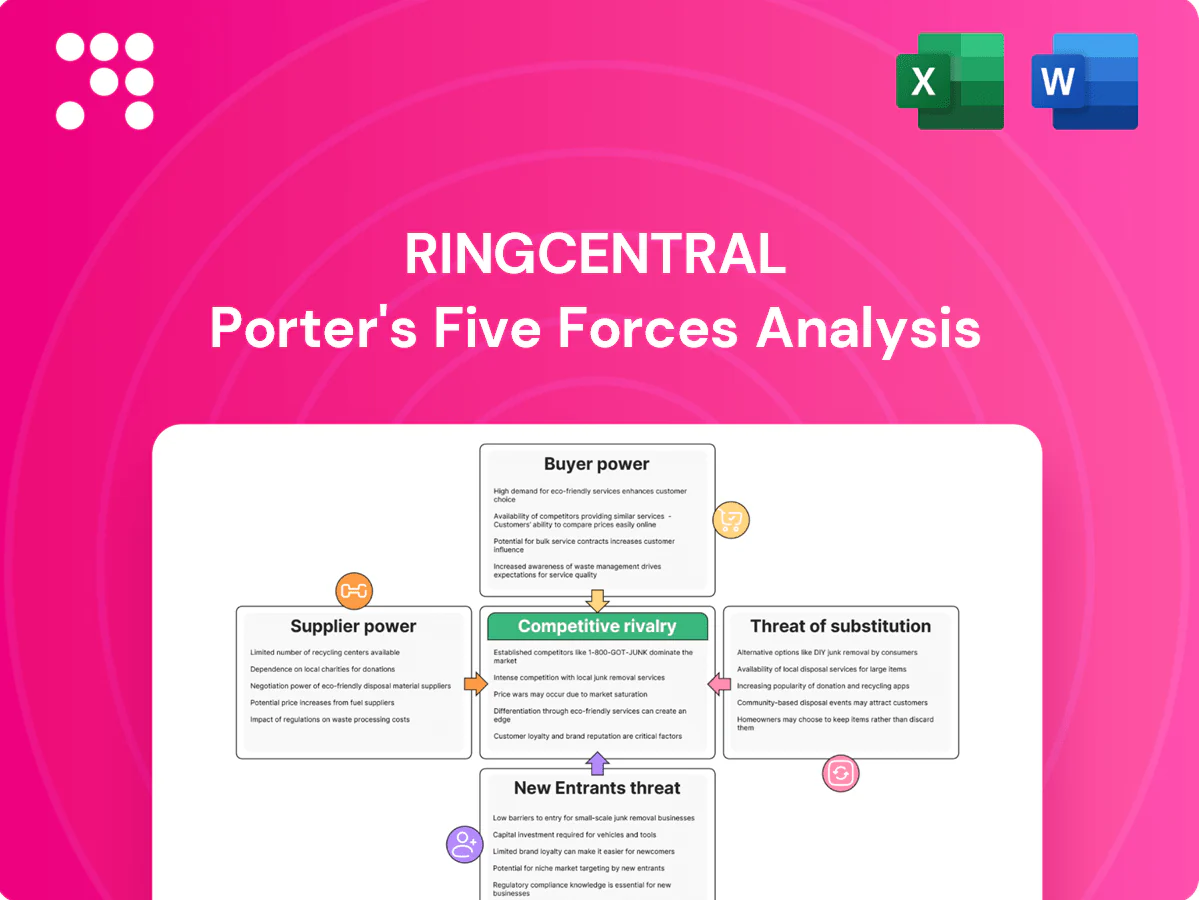
RingCentral Porter's Five Forces Analysis

From Overview to Strategy Blueprint
RingCentral faces intense rivalry and shifting buyer power as cloud UCaaS scales, while vendor integrations and substitutes raise strategic urgency; regulatory and scale barriers moderate new entrants. This brief snapshot only scratches the surface. Unlock the full Porter's Five Forces Analysis to explore RingCentral’s competitive dynamics in detail.
Suppliers Bargaining Power

Reliance on hyperscale cloud
RingCentral relies on hyperscale providers for compute, storage and bandwidth, exposing it to AWS/Azure/GCP pricing and terms; together these three held about 66% of the global cloud IaaS/PaaS market in 2024 (AWS ~31%, Azure ~24%, GCP ~11%). Multi-cloud reduces single-vendor risk but cannot fully remove dependency, and outages or price hikes can compress margins and breach SLAs, directly impacting costs and revenue recognition.
Telecom carriers and PSTN access
Global calling depends on interconnects with national carriers and aggregators, and number portability, E911 obligations and regulated termination rates give carriers outsized leverage; incumbents often hold >40% local market share. Volume commitments lower unit costs, but local monopoly conditions persist and quality/compliance needs (E911, CALEA) constrain rapid switching.

Specialized software and APIs
Dependencies on codec licensors, CPaaS APIs and security tooling create high switching costs for RingCentral, with vendor ecosystems underpinning parts of its $1.63B 2024 revenue base and CPaaS peers like Twilio reporting ~$2.96B in 2024, highlighting platform-level lock-in. Proprietary codecs and SDKs often carry per-seat or per-minute fees that can scale with adoption. Open-source alternatives lower licensing risk but require significant engineering investment. Vendor lock-in trade-offs must weigh performance SLAs against cost and flexibility.

Hardware OEMs and device ecosystems
Certified IP phones, headsets and room systems for RingCentral largely come from a small set of OEMs (Cisco, Poly, Yealink, Logitech, Jabra), and certification plus firmware support creates mutual dependence; past chip/supply disruptions produced multi-month device lead times and price spikes, while vendor bundling and managed-device deals partially blunt OEM pricing power.
- Concentrated OEM base: Cisco/Poly/Yealink/Logitech/Jabra
- Mutual dependence: certification + firmware support
- Supply risk: multi-month lead times during chip shortages
- Mitigation: bundled device deals reduce OEM leverage
Skilled talent and network POP providers
Skilled real-time communications engineers and global PoP colocation partners remained scarce in 2024, driving upward pressure on hiring and site costs as providers prioritized limited rack space and low-latency footprints.
Wage inflation and constrained site availability increased supplier leverage, while compliance and security expertise further narrowed the hireable talent pool in 2024.
Retention programs, targeted upskilling and automation (SIP/SDN orchestration) reduced exposure by lowering churn and labor intensity.
- 2024: persistent tech talent shortages
- Wage inflation amplified supplier bargaining
- Compliance/security skills are scarce
- Retention + automation mitigate risk
Suppliers dominate 2024: hyperscalers ~66%, carriers >40%
Suppliers exert meaningful leverage in 2024: hyperscalers (AWS/Azure/GCP ~66% IaaS/PaaS; AWS ~31%, Azure ~24%, GCP ~11%) limit pricing flexibility, national carriers often >40% local share raise termination/compliance costs, and a concentrated OEM/talent base (Cisco/Poly/Yealink/Logitech/Jabra; persistent tech wage inflation) keeps switching costs and lead times elevated.
| Metric | 2024 |
|---|---|
| Hyperscaler share (IaaS/PaaS) | ~66% |
| AWS / Azure / GCP | 31% / 24% / 11% |
| RingCentral revenue | $1.63B |
| Carrier local share | >40% |
What is included in the product
 Detailed Word Document
Comprehensive Porter's Five Forces analysis tailored to RingCentral, uncovering competitive intensity, buyer/supplier power, substitute threats, and entry barriers, with strategic insights on disruptive risks and market positioning.

 Customizable Excel Spreadsheet
A clear one-sheet Porter's Five Forces for RingCentral—instantly highlights competitive pressures and strategic levers for quick decision-making and pitch-ready slides.
Customers Bargaining Power

Enterprise RFPs and volume discounts
Large enterprises run competitive RFPs across multiple vendors, and RingCentral, which serves over 400,000 business customers, faces concentrated negotiations. Seat scale and multi-year deals routinely secure aggressive pricing and concessions. Buyers demand custom SLAs, integrations and data residency, concentrating pricing power with big accounts.
Moderate switching costs
Number porting, user training and workflow rewiring create switching friction for RingCentral customers but are typically completed in days to weeks, keeping costs manageable. Standards-based SIP devices and RESTful APIs shorten migration; 2024 UCaaS integrations and API usage rose about 12% year-over-year, easing vendor moves. Vendor buyout incentives and porting credits further lower barriers, giving buyers leverage in price negotiations.

Feature parity and transparency
Core UCaaS/CCaaS features are increasingly commoditized, pushing buyers—among RingCentral’s ~400,000 business customers in 2024—to focus on price and promotions that amplify price sensitivity. Public pricing and frequent vendor promotions make switching leverage higher, so differentiation shifts to integrations, analytics, and reliability. Customers routinely run pilots to validate parity before negotiating long-term contracts.

SMB churn dynamics
SMBs are highly price sensitive and tend to churn faster, amplifying buyer power; 2024 industry surveys indicate SMB churn commonly exceeds 25% annually, pressuring RingCentral on pricing and retention. Month-to-month contracts and simple setups lower switching costs and ease exits. Bundled offerings can boost stickiness if kept affordable, while support experience is a key driver of renewals.
- SMB churn >25% (2024)
- Month-to-month contracts = easier exit
- Affordable bundles improve retention
- Support quality strongly affects renewals
Integration dependence
- Integration dependence: high
- RingCentral 2024: 300+ integrations
- Open APIs: reduce vendor-risk
Enterprise pricing leverage; API +12%; SMB churn > 25%
Large enterprise buyers (RingCentral ~400,000 customers) wield strong price/contract leverage; seat scale and custom SLAs drive concessions. Migration friction exists but is limited—2024 API/integration use rose ~12% YOY and RingCentral lists 300+ integrations—so switching remains feasible. SMB churn >25% (2024) increases buyer price sensitivity and renewal pressure.
| Metric | 2024 |
|---|---|
| Customers | ~400,000 |
| Integrations | 300+ |
| API/integration usage YoY | +12% |
| SMB churn | >25% |
Same Document Delivered
RingCentral Porter's Five Forces Analysis
This preview shows the exact RingCentral Porter's Five Forces analysis you’ll receive—no placeholders or mockups. The full, professionally formatted document covers competitive rivalry, buyer and supplier power, threat of substitutes, and barriers to entry. Purchase grants instant download of this identical file, ready for use.

From Overview to Strategy Blueprint
RingCentral faces intense rivalry and shifting buyer power as cloud UCaaS scales, while vendor integrations and substitutes raise strategic urgency; regulatory and scale barriers moderate new entrants. This brief snapshot only scratches the surface. Unlock the full Porter's Five Forces Analysis to explore RingCentral’s competitive dynamics in detail.
Suppliers Bargaining Power
Reliance on hyperscale cloud
RingCentral relies on hyperscale providers for compute, storage and bandwidth, exposing it to AWS/Azure/GCP pricing and terms; together these three held about 66% of the global cloud IaaS/PaaS market in 2024 (AWS ~31%, Azure ~24%, GCP ~11%). Multi-cloud reduces single-vendor risk but cannot fully remove dependency, and outages or price hikes can compress margins and breach SLAs, directly impacting costs and revenue recognition.
Telecom carriers and PSTN access
Global calling depends on interconnects with national carriers and aggregators, and number portability, E911 obligations and regulated termination rates give carriers outsized leverage; incumbents often hold >40% local market share. Volume commitments lower unit costs, but local monopoly conditions persist and quality/compliance needs (E911, CALEA) constrain rapid switching.
Specialized software and APIs
Dependencies on codec licensors, CPaaS APIs and security tooling create high switching costs for RingCentral, with vendor ecosystems underpinning parts of its $1.63B 2024 revenue base and CPaaS peers like Twilio reporting ~$2.96B in 2024, highlighting platform-level lock-in. Proprietary codecs and SDKs often carry per-seat or per-minute fees that can scale with adoption. Open-source alternatives lower licensing risk but require significant engineering investment. Vendor lock-in trade-offs must weigh performance SLAs against cost and flexibility.
Hardware OEMs and device ecosystems
Certified IP phones, headsets and room systems for RingCentral largely come from a small set of OEMs (Cisco, Poly, Yealink, Logitech, Jabra), and certification plus firmware support creates mutual dependence; past chip/supply disruptions produced multi-month device lead times and price spikes, while vendor bundling and managed-device deals partially blunt OEM pricing power.
- Concentrated OEM base: Cisco/Poly/Yealink/Logitech/Jabra
- Mutual dependence: certification + firmware support
- Supply risk: multi-month lead times during chip shortages
- Mitigation: bundled device deals reduce OEM leverage
Skilled talent and network POP providers
Skilled real-time communications engineers and global PoP colocation partners remained scarce in 2024, driving upward pressure on hiring and site costs as providers prioritized limited rack space and low-latency footprints.
Wage inflation and constrained site availability increased supplier leverage, while compliance and security expertise further narrowed the hireable talent pool in 2024.
Retention programs, targeted upskilling and automation (SIP/SDN orchestration) reduced exposure by lowering churn and labor intensity.
- 2024: persistent tech talent shortages
- Wage inflation amplified supplier bargaining
- Compliance/security skills are scarce
- Retention + automation mitigate risk
Suppliers dominate 2024: hyperscalers ~66%, carriers >40%
Suppliers exert meaningful leverage in 2024: hyperscalers (AWS/Azure/GCP ~66% IaaS/PaaS; AWS ~31%, Azure ~24%, GCP ~11%) limit pricing flexibility, national carriers often >40% local share raise termination/compliance costs, and a concentrated OEM/talent base (Cisco/Poly/Yealink/Logitech/Jabra; persistent tech wage inflation) keeps switching costs and lead times elevated.
| Metric | 2024 |
|---|---|
| Hyperscaler share (IaaS/PaaS) | ~66% |
| AWS / Azure / GCP | 31% / 24% / 11% |
| RingCentral revenue | $1.63B |
| Carrier local share | >40% |
What is included in the product
Detailed Word Document
Comprehensive Porter's Five Forces analysis tailored to RingCentral, uncovering competitive intensity, buyer/supplier power, substitute threats, and entry barriers, with strategic insights on disruptive risks and market positioning.
Customizable Excel Spreadsheet
A clear one-sheet Porter's Five Forces for RingCentral—instantly highlights competitive pressures and strategic levers for quick decision-making and pitch-ready slides.
Customers Bargaining Power
Enterprise RFPs and volume discounts
Large enterprises run competitive RFPs across multiple vendors, and RingCentral, which serves over 400,000 business customers, faces concentrated negotiations. Seat scale and multi-year deals routinely secure aggressive pricing and concessions. Buyers demand custom SLAs, integrations and data residency, concentrating pricing power with big accounts.
Moderate switching costs
Number porting, user training and workflow rewiring create switching friction for RingCentral customers but are typically completed in days to weeks, keeping costs manageable. Standards-based SIP devices and RESTful APIs shorten migration; 2024 UCaaS integrations and API usage rose about 12% year-over-year, easing vendor moves. Vendor buyout incentives and porting credits further lower barriers, giving buyers leverage in price negotiations.
Feature parity and transparency
Core UCaaS/CCaaS features are increasingly commoditized, pushing buyers—among RingCentral’s ~400,000 business customers in 2024—to focus on price and promotions that amplify price sensitivity. Public pricing and frequent vendor promotions make switching leverage higher, so differentiation shifts to integrations, analytics, and reliability. Customers routinely run pilots to validate parity before negotiating long-term contracts.
SMB churn dynamics
SMBs are highly price sensitive and tend to churn faster, amplifying buyer power; 2024 industry surveys indicate SMB churn commonly exceeds 25% annually, pressuring RingCentral on pricing and retention. Month-to-month contracts and simple setups lower switching costs and ease exits. Bundled offerings can boost stickiness if kept affordable, while support experience is a key driver of renewals.
- SMB churn >25% (2024)
- Month-to-month contracts = easier exit
- Affordable bundles improve retention
- Support quality strongly affects renewals
Integration dependence
- Integration dependence: high
- RingCentral 2024: 300+ integrations
- Open APIs: reduce vendor-risk
Enterprise pricing leverage; API +12%; SMB churn > 25%
Large enterprise buyers (RingCentral ~400,000 customers) wield strong price/contract leverage; seat scale and custom SLAs drive concessions. Migration friction exists but is limited—2024 API/integration use rose ~12% YOY and RingCentral lists 300+ integrations—so switching remains feasible. SMB churn >25% (2024) increases buyer price sensitivity and renewal pressure.
| Metric | 2024 |
|---|---|
| Customers | ~400,000 |
| Integrations | 300+ |
| API/integration usage YoY | +12% |
| SMB churn | >25% |
Same Document Delivered
RingCentral Porter's Five Forces Analysis
This preview shows the exact RingCentral Porter's Five Forces analysis you’ll receive—no placeholders or mockups. The full, professionally formatted document covers competitive rivalry, buyer and supplier power, threat of substitutes, and barriers to entry. Purchase grants instant download of this identical file, ready for use.
Original: $10.00
-65%$10.00
$3.50Description
From Overview to Strategy Blueprint
RingCentral faces intense rivalry and shifting buyer power as cloud UCaaS scales, while vendor integrations and substitutes raise strategic urgency; regulatory and scale barriers moderate new entrants. This brief snapshot only scratches the surface. Unlock the full Porter's Five Forces Analysis to explore RingCentral’s competitive dynamics in detail.
Suppliers Bargaining Power
Reliance on hyperscale cloud
RingCentral relies on hyperscale providers for compute, storage and bandwidth, exposing it to AWS/Azure/GCP pricing and terms; together these three held about 66% of the global cloud IaaS/PaaS market in 2024 (AWS ~31%, Azure ~24%, GCP ~11%). Multi-cloud reduces single-vendor risk but cannot fully remove dependency, and outages or price hikes can compress margins and breach SLAs, directly impacting costs and revenue recognition.
Telecom carriers and PSTN access
Global calling depends on interconnects with national carriers and aggregators, and number portability, E911 obligations and regulated termination rates give carriers outsized leverage; incumbents often hold >40% local market share. Volume commitments lower unit costs, but local monopoly conditions persist and quality/compliance needs (E911, CALEA) constrain rapid switching.
Specialized software and APIs
Dependencies on codec licensors, CPaaS APIs and security tooling create high switching costs for RingCentral, with vendor ecosystems underpinning parts of its $1.63B 2024 revenue base and CPaaS peers like Twilio reporting ~$2.96B in 2024, highlighting platform-level lock-in. Proprietary codecs and SDKs often carry per-seat or per-minute fees that can scale with adoption. Open-source alternatives lower licensing risk but require significant engineering investment. Vendor lock-in trade-offs must weigh performance SLAs against cost and flexibility.
Hardware OEMs and device ecosystems
Certified IP phones, headsets and room systems for RingCentral largely come from a small set of OEMs (Cisco, Poly, Yealink, Logitech, Jabra), and certification plus firmware support creates mutual dependence; past chip/supply disruptions produced multi-month device lead times and price spikes, while vendor bundling and managed-device deals partially blunt OEM pricing power.
- Concentrated OEM base: Cisco/Poly/Yealink/Logitech/Jabra
- Mutual dependence: certification + firmware support
- Supply risk: multi-month lead times during chip shortages
- Mitigation: bundled device deals reduce OEM leverage
Skilled talent and network POP providers
Skilled real-time communications engineers and global PoP colocation partners remained scarce in 2024, driving upward pressure on hiring and site costs as providers prioritized limited rack space and low-latency footprints.
Wage inflation and constrained site availability increased supplier leverage, while compliance and security expertise further narrowed the hireable talent pool in 2024.
Retention programs, targeted upskilling and automation (SIP/SDN orchestration) reduced exposure by lowering churn and labor intensity.
- 2024: persistent tech talent shortages
- Wage inflation amplified supplier bargaining
- Compliance/security skills are scarce
- Retention + automation mitigate risk
Suppliers dominate 2024: hyperscalers ~66%, carriers >40%
Suppliers exert meaningful leverage in 2024: hyperscalers (AWS/Azure/GCP ~66% IaaS/PaaS; AWS ~31%, Azure ~24%, GCP ~11%) limit pricing flexibility, national carriers often >40% local share raise termination/compliance costs, and a concentrated OEM/talent base (Cisco/Poly/Yealink/Logitech/Jabra; persistent tech wage inflation) keeps switching costs and lead times elevated.
| Metric | 2024 |
|---|---|
| Hyperscaler share (IaaS/PaaS) | ~66% |
| AWS / Azure / GCP | 31% / 24% / 11% |
| RingCentral revenue | $1.63B |
| Carrier local share | >40% |
What is included in the product
Detailed Word Document
Comprehensive Porter's Five Forces analysis tailored to RingCentral, uncovering competitive intensity, buyer/supplier power, substitute threats, and entry barriers, with strategic insights on disruptive risks and market positioning.
Customizable Excel Spreadsheet
A clear one-sheet Porter's Five Forces for RingCentral—instantly highlights competitive pressures and strategic levers for quick decision-making and pitch-ready slides.
Customers Bargaining Power
Enterprise RFPs and volume discounts
Large enterprises run competitive RFPs across multiple vendors, and RingCentral, which serves over 400,000 business customers, faces concentrated negotiations. Seat scale and multi-year deals routinely secure aggressive pricing and concessions. Buyers demand custom SLAs, integrations and data residency, concentrating pricing power with big accounts.
Moderate switching costs
Number porting, user training and workflow rewiring create switching friction for RingCentral customers but are typically completed in days to weeks, keeping costs manageable. Standards-based SIP devices and RESTful APIs shorten migration; 2024 UCaaS integrations and API usage rose about 12% year-over-year, easing vendor moves. Vendor buyout incentives and porting credits further lower barriers, giving buyers leverage in price negotiations.
Feature parity and transparency
Core UCaaS/CCaaS features are increasingly commoditized, pushing buyers—among RingCentral’s ~400,000 business customers in 2024—to focus on price and promotions that amplify price sensitivity. Public pricing and frequent vendor promotions make switching leverage higher, so differentiation shifts to integrations, analytics, and reliability. Customers routinely run pilots to validate parity before negotiating long-term contracts.
SMB churn dynamics
SMBs are highly price sensitive and tend to churn faster, amplifying buyer power; 2024 industry surveys indicate SMB churn commonly exceeds 25% annually, pressuring RingCentral on pricing and retention. Month-to-month contracts and simple setups lower switching costs and ease exits. Bundled offerings can boost stickiness if kept affordable, while support experience is a key driver of renewals.
- SMB churn >25% (2024)
- Month-to-month contracts = easier exit
- Affordable bundles improve retention
- Support quality strongly affects renewals
Integration dependence
- Integration dependence: high
- RingCentral 2024: 300+ integrations
- Open APIs: reduce vendor-risk
Enterprise pricing leverage; API +12%; SMB churn > 25%
Large enterprise buyers (RingCentral ~400,000 customers) wield strong price/contract leverage; seat scale and custom SLAs drive concessions. Migration friction exists but is limited—2024 API/integration use rose ~12% YOY and RingCentral lists 300+ integrations—so switching remains feasible. SMB churn >25% (2024) increases buyer price sensitivity and renewal pressure.
| Metric | 2024 |
|---|---|
| Customers | ~400,000 |
| Integrations | 300+ |
| API/integration usage YoY | +12% |
| SMB churn | >25% |
Same Document Delivered
RingCentral Porter's Five Forces Analysis
This preview shows the exact RingCentral Porter's Five Forces analysis you’ll receive—no placeholders or mockups. The full, professionally formatted document covers competitive rivalry, buyer and supplier power, threat of substitutes, and barriers to entry. Purchase grants instant download of this identical file, ready for use.











