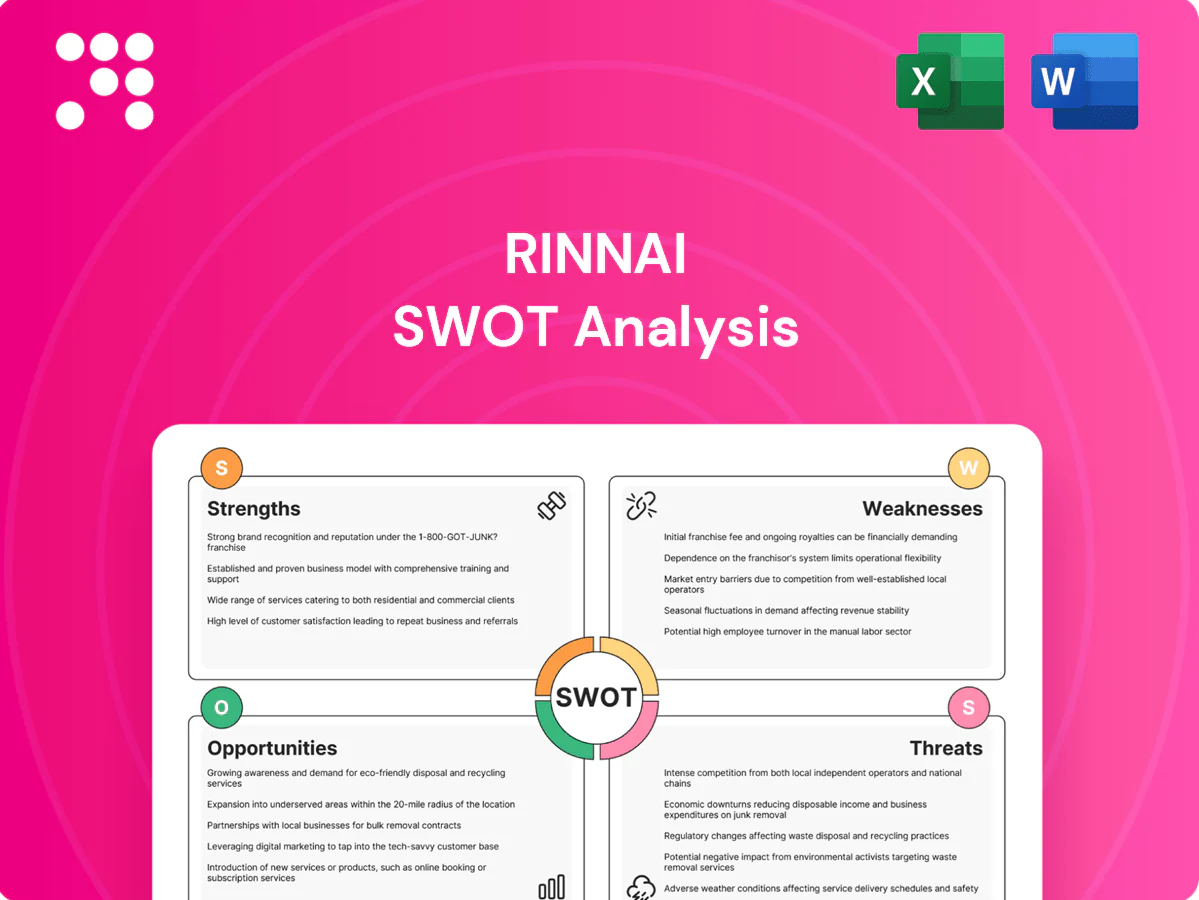
Rinnai SWOT Analysis

Your Strategic Toolkit Starts Here
Rinnai’s SWOT highlights robust brand strength in heating and appliance tech, plus expanding IoT-enabled product lines, balanced by supply-chain and regulatory risks. It outlines market opportunities in energy-efficient solutions and challenges from intensifying competition. Want the full strategic picture? Purchase the complete, editable SWOT (Word + Excel) for investor-ready insights and action plans.
Strengths

Category leadership in tankless
Rinnai is the market-leading tankless water heater brand across Japan, the U.S. and APAC, where scale drives procurement and production cost efficiencies and creates strong channel pull. Its recognized brand equity supports sustained pricing power and higher margins versus smaller competitors. Extensive installed-base visibility and contractor preference reinforce repeat sales and aftermarket demand.
Broad, energy‑efficient portfolio
Rinnai's portfolio spans tankless heaters, boilers, furnaces, ranges and commercial systems, enabling product-led penetration across end-markets. Its emphasis on high-efficiency models aligns with utility rebate programs and building codes such as IECC and ASHRAE, improving install economics. Cross-selling across residential, commercial and industrial channels diversifies revenue streams. Broad product breadth reduces dependence on any single category.

Global manufacturing and distribution
Established manufacturing sites across Japan, Malaysia, Vietnam, China, Australia and the US and long-standing supplier relationships underpin consistent product quality and availability. Extensive distributor and installer networks accelerate market access, supporting presence in over 60 countries and regions. Localized models comply with regional standards and certifications, while geographic diversification across Asia, Oceania, the Americas and Europe cushions country-specific demand swings.

R&D in low‑emissions tech
Rinnai's R&D in low-emissions technology drives continuous efficiency, reliability, and improved user experience through iterative product updates and system-level engineering. Ongoing development of hydrogen-ready burners and low-NOx designs positions the company to adapt to future fuel transitions and tightening emissions standards. Integrated connected diagnostics and advanced controls enhance field performance and reduce service costs, while deep IP and engineering capabilities create meaningful barriers to entry.
- Innovation: continuous product efficiency/reliability gains
- Future fuels: hydrogen-ready and low-NOx readiness
- Connectivity: diagnostics and controls improve uptime
- IP moat: patents/engineering depth deter rivals
After‑sales and service ecosystem
In 2024 Rinnai's certified installer programs and wide service-parts availability reduce downtime and boost uptime, while strong warranty and support raise customer trust and adoption.
Connected-unit data enables proactive maintenance and remote diagnostics, cutting emergency callouts; recurring service revenue smooths appliance cyclicality and lifts customer lifetime value.
- Certified installers increase uptime
- Warranty/support drive trust
- Connected data enables predictive service
- Service revenue smooths cycles, raises LTV
Global high-efficiency water heating leader — scale, 60+ countries, 5 product categories
Rinnai is a global leader in tankless water heaters with strong brand equity, scale-driven margins, and deep installer/distributor channels across 60+ countries. Its diversified portfolio (tankless, boilers, furnaces, ranges, commercial) and high-efficiency focus align with codes/rebates, supporting cross-sell and stable aftermarket revenue. R&D in low-NOx and hydrogen-ready tech plus connected diagnostics and certified installer programs create durable competitive advantages.
| Metric | Value |
|---|---|
| Countries | 60+ |
| Core product categories | 5 |
What is included in the product
 Detailed Word Document
Provides a clear SWOT framework identifying Rinnai’s internal strengths and weaknesses and external opportunities and threats, mapping its competitive position, growth drivers, operational gaps, and market risks to inform strategic decisions.

 Customizable Excel Spreadsheet
Provides a focused Rinnai SWOT matrix to quickly pinpoint strengths, weaknesses, opportunities and threats, easing strategic decision bottlenecks. Editable format supports rapid updates and stakeholder-ready summaries for fast alignment across teams.
Weaknesses

Gas-dependence exposure
Rinnai (TSE:5947) remains heavily tied to gas-fueled appliances, anchoring near-term growth to existing fossil-gas infrastructure. Jurisdictional moves toward building electrification and net-zero targets (many governments now target 2050) raise measurable demand risk for gas products. Shifting portfolios toward electric or low-carbon alternatives will require substantial time and capital. Brand perception risks increase as low-carbon narratives favor non-gas solutions.
Premium pricing vs rivals
Rinnai’s premium pricing leaves it exposed in commoditized segments where buyers are price-sensitive and entry models dominate; competitors in emerging markets often undercut prices by 20–30%, pressuring margins. Recent rebate and incentive shifts in key markets have reduced the relative value proposition for mid-tier buyers. Price gaps risk slowing share gains in entry tiers despite strong brand recognition.

Installer complexity and scarcity
Tankless units and advanced boilers require skilled installers and correct venting, and a 2024 industry survey found 68% of HVAC contractors reporting technician shortages, slowing conversions. Labor gaps lengthen lead times and reduce installation throughput, while errors drive callbacks—industry callback rates are commonly cited in the 3–7% range—harming brand reputation. Channel partners incur significant onboarding costs, often thousands of dollars per technician annually for Rinnai-specific training and certification.

FX and input cost volatility
Global operations expose earnings to currency swings; USD/JPY moves of 10–15% in recent years have materially shifted reported profits. Steel, copper and electronics cost spikes — LME copper near $9,500/t in 2024 — compress margins, and hedging programs only partially offset that volatility. Passing costs to customers risks volume declines in weak markets.
- FX exposure: significant overseas sales; USD/JPY volatility 10–15%
- Input costs: LME copper ≈ $9,500/t (2024)
- Hedging: partial offset only
- Price pass-through: volume risk in soft demand
Capex-heavy manufacturing footprint
Rinnai's capex-heavy manufacturing footprint demands ongoing investment in plants and testing—Rinnai reported capital expenditure of JPY 12.8 billion in FY2024, keeping PPE elevated and fixed costs high. Capacity misalignment in downturns pressures returns as underutilised plants erode margins; cyclical softness can cut operating margins by several percentage points. Re-tooling for new fuels or low-GWP refrigerants is capital-intensive, and high asset intensity reduces flexibility versus fabless competitors that have markedly lower capex needs.
- Capex FY2024: JPY 12.8bn
- PPE-heavy: elevated fixed costs
- Downturn risk: margin compression from underutilisation
- Re-tooling cost: high for new fuels/refrigerants
- Flexibility: weaker vs fabless rivals
Gas-focused portfolio exposed by electrification, competitor price cuts and cost pressures
Rinnai’s gas-centric portfolio and premium pricing leave it exposed as electrification policies (many 2050 net-zero targets) and low-carbon preferences grow, while competitors cut prices 20–30% in emerging markets. Skilled-installer shortages (68% of contractors, 2024) and 3–7% callback rates raise service costs. FX swings (USD/JPY ±10–15%), input spikes (LME copper ≈ $9,500/t 2024) and JPY 12.8bn capex (FY2024) compress margins.
| Metric | Value |
|---|---|
| Capex FY2024 | JPY 12.8bn |
| Contractor shortage (2024) | 68% |
| Callback rates | 3–7% |
| Competitor price gap | 20–30% |
| Copper (2024) | $9,500/t |
| USD/JPY volatility | ±10–15% |
Same Document Delivered
Rinnai SWOT Analysis
This is the actual SWOT analysis document you’ll receive upon purchase—no surprises, just professional quality. The preview below is taken directly from the full SWOT report you'll get. Once purchased, the complete, editable version is unlocked for immediate download.

Your Strategic Toolkit Starts Here
Rinnai’s SWOT highlights robust brand strength in heating and appliance tech, plus expanding IoT-enabled product lines, balanced by supply-chain and regulatory risks. It outlines market opportunities in energy-efficient solutions and challenges from intensifying competition. Want the full strategic picture? Purchase the complete, editable SWOT (Word + Excel) for investor-ready insights and action plans.
Strengths
Category leadership in tankless
Rinnai is the market-leading tankless water heater brand across Japan, the U.S. and APAC, where scale drives procurement and production cost efficiencies and creates strong channel pull. Its recognized brand equity supports sustained pricing power and higher margins versus smaller competitors. Extensive installed-base visibility and contractor preference reinforce repeat sales and aftermarket demand.
Broad, energy‑efficient portfolio
Rinnai's portfolio spans tankless heaters, boilers, furnaces, ranges and commercial systems, enabling product-led penetration across end-markets. Its emphasis on high-efficiency models aligns with utility rebate programs and building codes such as IECC and ASHRAE, improving install economics. Cross-selling across residential, commercial and industrial channels diversifies revenue streams. Broad product breadth reduces dependence on any single category.
Global manufacturing and distribution
Established manufacturing sites across Japan, Malaysia, Vietnam, China, Australia and the US and long-standing supplier relationships underpin consistent product quality and availability. Extensive distributor and installer networks accelerate market access, supporting presence in over 60 countries and regions. Localized models comply with regional standards and certifications, while geographic diversification across Asia, Oceania, the Americas and Europe cushions country-specific demand swings.
R&D in low‑emissions tech
Rinnai's R&D in low-emissions technology drives continuous efficiency, reliability, and improved user experience through iterative product updates and system-level engineering. Ongoing development of hydrogen-ready burners and low-NOx designs positions the company to adapt to future fuel transitions and tightening emissions standards. Integrated connected diagnostics and advanced controls enhance field performance and reduce service costs, while deep IP and engineering capabilities create meaningful barriers to entry.
- Innovation: continuous product efficiency/reliability gains
- Future fuels: hydrogen-ready and low-NOx readiness
- Connectivity: diagnostics and controls improve uptime
- IP moat: patents/engineering depth deter rivals
After‑sales and service ecosystem
In 2024 Rinnai's certified installer programs and wide service-parts availability reduce downtime and boost uptime, while strong warranty and support raise customer trust and adoption.
Connected-unit data enables proactive maintenance and remote diagnostics, cutting emergency callouts; recurring service revenue smooths appliance cyclicality and lifts customer lifetime value.
- Certified installers increase uptime
- Warranty/support drive trust
- Connected data enables predictive service
- Service revenue smooths cycles, raises LTV
Global high-efficiency water heating leader — scale, 60+ countries, 5 product categories
Rinnai is a global leader in tankless water heaters with strong brand equity, scale-driven margins, and deep installer/distributor channels across 60+ countries. Its diversified portfolio (tankless, boilers, furnaces, ranges, commercial) and high-efficiency focus align with codes/rebates, supporting cross-sell and stable aftermarket revenue. R&D in low-NOx and hydrogen-ready tech plus connected diagnostics and certified installer programs create durable competitive advantages.
| Metric | Value |
|---|---|
| Countries | 60+ |
| Core product categories | 5 |
What is included in the product
Detailed Word Document
Provides a clear SWOT framework identifying Rinnai’s internal strengths and weaknesses and external opportunities and threats, mapping its competitive position, growth drivers, operational gaps, and market risks to inform strategic decisions.
Customizable Excel Spreadsheet
Provides a focused Rinnai SWOT matrix to quickly pinpoint strengths, weaknesses, opportunities and threats, easing strategic decision bottlenecks. Editable format supports rapid updates and stakeholder-ready summaries for fast alignment across teams.
Weaknesses
Gas-dependence exposure
Rinnai (TSE:5947) remains heavily tied to gas-fueled appliances, anchoring near-term growth to existing fossil-gas infrastructure. Jurisdictional moves toward building electrification and net-zero targets (many governments now target 2050) raise measurable demand risk for gas products. Shifting portfolios toward electric or low-carbon alternatives will require substantial time and capital. Brand perception risks increase as low-carbon narratives favor non-gas solutions.
Premium pricing vs rivals
Rinnai’s premium pricing leaves it exposed in commoditized segments where buyers are price-sensitive and entry models dominate; competitors in emerging markets often undercut prices by 20–30%, pressuring margins. Recent rebate and incentive shifts in key markets have reduced the relative value proposition for mid-tier buyers. Price gaps risk slowing share gains in entry tiers despite strong brand recognition.
Installer complexity and scarcity
Tankless units and advanced boilers require skilled installers and correct venting, and a 2024 industry survey found 68% of HVAC contractors reporting technician shortages, slowing conversions. Labor gaps lengthen lead times and reduce installation throughput, while errors drive callbacks—industry callback rates are commonly cited in the 3–7% range—harming brand reputation. Channel partners incur significant onboarding costs, often thousands of dollars per technician annually for Rinnai-specific training and certification.
FX and input cost volatility
Global operations expose earnings to currency swings; USD/JPY moves of 10–15% in recent years have materially shifted reported profits. Steel, copper and electronics cost spikes — LME copper near $9,500/t in 2024 — compress margins, and hedging programs only partially offset that volatility. Passing costs to customers risks volume declines in weak markets.
- FX exposure: significant overseas sales; USD/JPY volatility 10–15%
- Input costs: LME copper ≈ $9,500/t (2024)
- Hedging: partial offset only
- Price pass-through: volume risk in soft demand
Capex-heavy manufacturing footprint
Rinnai's capex-heavy manufacturing footprint demands ongoing investment in plants and testing—Rinnai reported capital expenditure of JPY 12.8 billion in FY2024, keeping PPE elevated and fixed costs high. Capacity misalignment in downturns pressures returns as underutilised plants erode margins; cyclical softness can cut operating margins by several percentage points. Re-tooling for new fuels or low-GWP refrigerants is capital-intensive, and high asset intensity reduces flexibility versus fabless competitors that have markedly lower capex needs.
- Capex FY2024: JPY 12.8bn
- PPE-heavy: elevated fixed costs
- Downturn risk: margin compression from underutilisation
- Re-tooling cost: high for new fuels/refrigerants
- Flexibility: weaker vs fabless rivals
Gas-focused portfolio exposed by electrification, competitor price cuts and cost pressures
Rinnai’s gas-centric portfolio and premium pricing leave it exposed as electrification policies (many 2050 net-zero targets) and low-carbon preferences grow, while competitors cut prices 20–30% in emerging markets. Skilled-installer shortages (68% of contractors, 2024) and 3–7% callback rates raise service costs. FX swings (USD/JPY ±10–15%), input spikes (LME copper ≈ $9,500/t 2024) and JPY 12.8bn capex (FY2024) compress margins.
| Metric | Value |
|---|---|
| Capex FY2024 | JPY 12.8bn |
| Contractor shortage (2024) | 68% |
| Callback rates | 3–7% |
| Competitor price gap | 20–30% |
| Copper (2024) | $9,500/t |
| USD/JPY volatility | ±10–15% |
Same Document Delivered
Rinnai SWOT Analysis
This is the actual SWOT analysis document you’ll receive upon purchase—no surprises, just professional quality. The preview below is taken directly from the full SWOT report you'll get. Once purchased, the complete, editable version is unlocked for immediate download.
Original: $10.00
-65%$10.00
$3.50Description
Your Strategic Toolkit Starts Here
Rinnai’s SWOT highlights robust brand strength in heating and appliance tech, plus expanding IoT-enabled product lines, balanced by supply-chain and regulatory risks. It outlines market opportunities in energy-efficient solutions and challenges from intensifying competition. Want the full strategic picture? Purchase the complete, editable SWOT (Word + Excel) for investor-ready insights and action plans.
Strengths
Category leadership in tankless
Rinnai is the market-leading tankless water heater brand across Japan, the U.S. and APAC, where scale drives procurement and production cost efficiencies and creates strong channel pull. Its recognized brand equity supports sustained pricing power and higher margins versus smaller competitors. Extensive installed-base visibility and contractor preference reinforce repeat sales and aftermarket demand.
Broad, energy‑efficient portfolio
Rinnai's portfolio spans tankless heaters, boilers, furnaces, ranges and commercial systems, enabling product-led penetration across end-markets. Its emphasis on high-efficiency models aligns with utility rebate programs and building codes such as IECC and ASHRAE, improving install economics. Cross-selling across residential, commercial and industrial channels diversifies revenue streams. Broad product breadth reduces dependence on any single category.
Global manufacturing and distribution
Established manufacturing sites across Japan, Malaysia, Vietnam, China, Australia and the US and long-standing supplier relationships underpin consistent product quality and availability. Extensive distributor and installer networks accelerate market access, supporting presence in over 60 countries and regions. Localized models comply with regional standards and certifications, while geographic diversification across Asia, Oceania, the Americas and Europe cushions country-specific demand swings.
R&D in low‑emissions tech
Rinnai's R&D in low-emissions technology drives continuous efficiency, reliability, and improved user experience through iterative product updates and system-level engineering. Ongoing development of hydrogen-ready burners and low-NOx designs positions the company to adapt to future fuel transitions and tightening emissions standards. Integrated connected diagnostics and advanced controls enhance field performance and reduce service costs, while deep IP and engineering capabilities create meaningful barriers to entry.
- Innovation: continuous product efficiency/reliability gains
- Future fuels: hydrogen-ready and low-NOx readiness
- Connectivity: diagnostics and controls improve uptime
- IP moat: patents/engineering depth deter rivals
After‑sales and service ecosystem
In 2024 Rinnai's certified installer programs and wide service-parts availability reduce downtime and boost uptime, while strong warranty and support raise customer trust and adoption.
Connected-unit data enables proactive maintenance and remote diagnostics, cutting emergency callouts; recurring service revenue smooths appliance cyclicality and lifts customer lifetime value.
- Certified installers increase uptime
- Warranty/support drive trust
- Connected data enables predictive service
- Service revenue smooths cycles, raises LTV
Global high-efficiency water heating leader — scale, 60+ countries, 5 product categories
Rinnai is a global leader in tankless water heaters with strong brand equity, scale-driven margins, and deep installer/distributor channels across 60+ countries. Its diversified portfolio (tankless, boilers, furnaces, ranges, commercial) and high-efficiency focus align with codes/rebates, supporting cross-sell and stable aftermarket revenue. R&D in low-NOx and hydrogen-ready tech plus connected diagnostics and certified installer programs create durable competitive advantages.
| Metric | Value |
|---|---|
| Countries | 60+ |
| Core product categories | 5 |
What is included in the product
Detailed Word Document
Provides a clear SWOT framework identifying Rinnai’s internal strengths and weaknesses and external opportunities and threats, mapping its competitive position, growth drivers, operational gaps, and market risks to inform strategic decisions.
Customizable Excel Spreadsheet
Provides a focused Rinnai SWOT matrix to quickly pinpoint strengths, weaknesses, opportunities and threats, easing strategic decision bottlenecks. Editable format supports rapid updates and stakeholder-ready summaries for fast alignment across teams.
Weaknesses
Gas-dependence exposure
Rinnai (TSE:5947) remains heavily tied to gas-fueled appliances, anchoring near-term growth to existing fossil-gas infrastructure. Jurisdictional moves toward building electrification and net-zero targets (many governments now target 2050) raise measurable demand risk for gas products. Shifting portfolios toward electric or low-carbon alternatives will require substantial time and capital. Brand perception risks increase as low-carbon narratives favor non-gas solutions.
Premium pricing vs rivals
Rinnai’s premium pricing leaves it exposed in commoditized segments where buyers are price-sensitive and entry models dominate; competitors in emerging markets often undercut prices by 20–30%, pressuring margins. Recent rebate and incentive shifts in key markets have reduced the relative value proposition for mid-tier buyers. Price gaps risk slowing share gains in entry tiers despite strong brand recognition.
Installer complexity and scarcity
Tankless units and advanced boilers require skilled installers and correct venting, and a 2024 industry survey found 68% of HVAC contractors reporting technician shortages, slowing conversions. Labor gaps lengthen lead times and reduce installation throughput, while errors drive callbacks—industry callback rates are commonly cited in the 3–7% range—harming brand reputation. Channel partners incur significant onboarding costs, often thousands of dollars per technician annually for Rinnai-specific training and certification.
FX and input cost volatility
Global operations expose earnings to currency swings; USD/JPY moves of 10–15% in recent years have materially shifted reported profits. Steel, copper and electronics cost spikes — LME copper near $9,500/t in 2024 — compress margins, and hedging programs only partially offset that volatility. Passing costs to customers risks volume declines in weak markets.
- FX exposure: significant overseas sales; USD/JPY volatility 10–15%
- Input costs: LME copper ≈ $9,500/t (2024)
- Hedging: partial offset only
- Price pass-through: volume risk in soft demand
Capex-heavy manufacturing footprint
Rinnai's capex-heavy manufacturing footprint demands ongoing investment in plants and testing—Rinnai reported capital expenditure of JPY 12.8 billion in FY2024, keeping PPE elevated and fixed costs high. Capacity misalignment in downturns pressures returns as underutilised plants erode margins; cyclical softness can cut operating margins by several percentage points. Re-tooling for new fuels or low-GWP refrigerants is capital-intensive, and high asset intensity reduces flexibility versus fabless competitors that have markedly lower capex needs.
- Capex FY2024: JPY 12.8bn
- PPE-heavy: elevated fixed costs
- Downturn risk: margin compression from underutilisation
- Re-tooling cost: high for new fuels/refrigerants
- Flexibility: weaker vs fabless rivals
Gas-focused portfolio exposed by electrification, competitor price cuts and cost pressures
Rinnai’s gas-centric portfolio and premium pricing leave it exposed as electrification policies (many 2050 net-zero targets) and low-carbon preferences grow, while competitors cut prices 20–30% in emerging markets. Skilled-installer shortages (68% of contractors, 2024) and 3–7% callback rates raise service costs. FX swings (USD/JPY ±10–15%), input spikes (LME copper ≈ $9,500/t 2024) and JPY 12.8bn capex (FY2024) compress margins.
| Metric | Value |
|---|---|
| Capex FY2024 | JPY 12.8bn |
| Contractor shortage (2024) | 68% |
| Callback rates | 3–7% |
| Competitor price gap | 20–30% |
| Copper (2024) | $9,500/t |
| USD/JPY volatility | ±10–15% |
Same Document Delivered
Rinnai SWOT Analysis
This is the actual SWOT analysis document you’ll receive upon purchase—no surprises, just professional quality. The preview below is taken directly from the full SWOT report you'll get. Once purchased, the complete, editable version is unlocked for immediate download.











