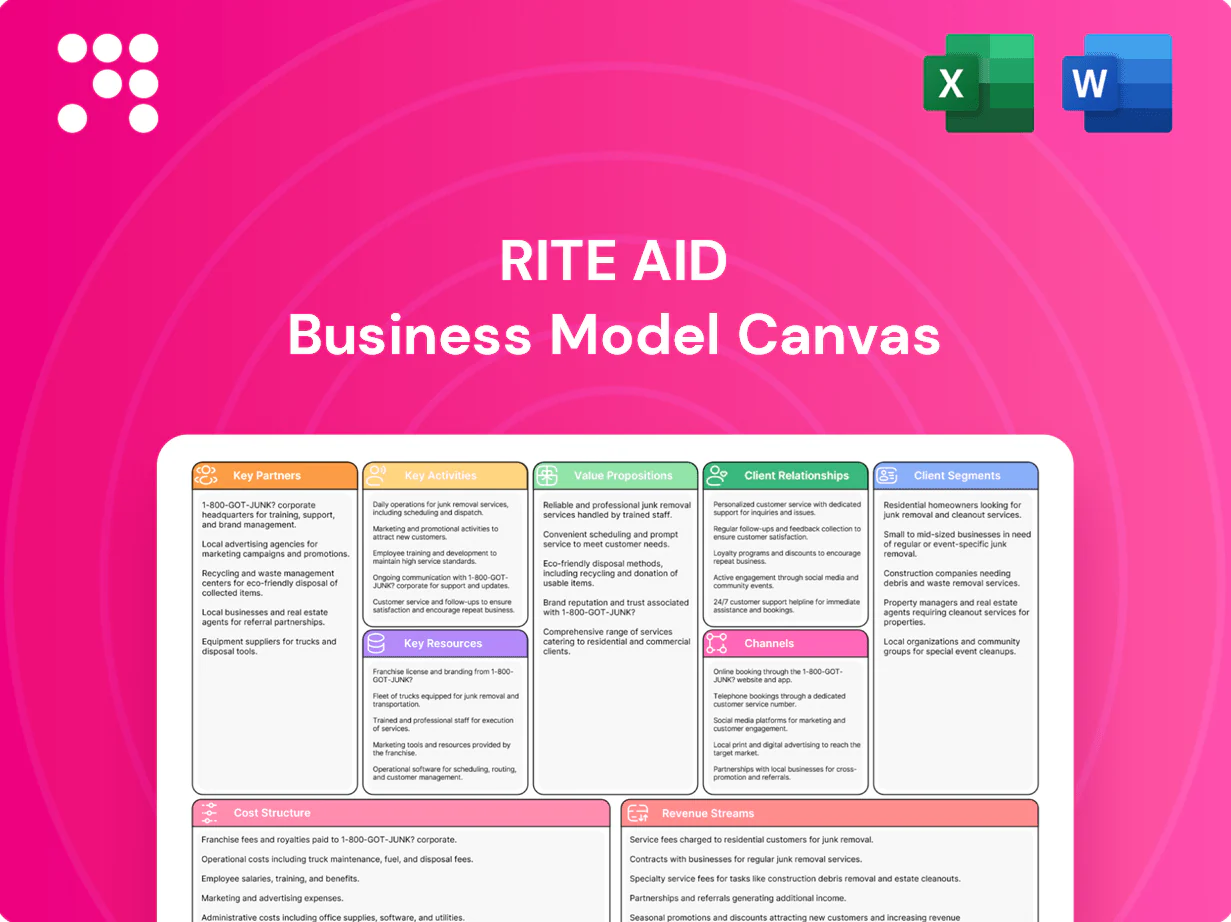
Rite Aid Business Model Canvas

Unlock the strategic blueprint of a leading retail pharmacy with a concise Business Model Canvas
Unlock the strategic blueprint of Rite Aid with a concise Business Model Canvas showing customer segments, value propositions, key partners and revenue streams. This snapshot reveals how Rite Aid captures market share and manages costs in retail pharmacy. Purchase the full, editable Canvas for a detailed, section-by-section analysis ready for presentations and strategy work.
Partnerships

Pharmaceutical manufacturers
Rite Aid depends on pharmaceutical manufacturers for a steady flow of brand and generic medicines, co-op marketing, and patient support programs, supporting its ~2,174 stores and roughly 69 million prescriptions filled annually (FY2024). Strategic agreements secure preferred pricing and rebates that can materially improve margins; manufacturer rebates often represent double-digit percentages of net drug cost. Collaboration on adherence programs and vaccination initiatives (over 3 million immunizations in recent years) extends product value, while joint forecasting with suppliers reduces stockouts and waste.
Drug wholesalers and distributors
Rite Aid relies on wholesale partners such as McKesson, Cardinal Health and AmerisourceBergen to enable nationwide, just-in-time replenishment across thousands of SKUs. The three majors collectively handle over 85% of US drug distribution, delivering scale economics, secondary sourcing and specialty cold-chain logistics. Integrated ordering and demand planning improve inventory turns, while service-level reliability directly drives fill rates and customer satisfaction.

Health plans, PBMs, and employer sponsors
Rite Aid and its PBM Elixir partner with health plans and employer sponsors to design formularies, networks, and cost-containment programs that steer utilization and preferred-script volume. These contracts, across Rite Aid’s network of over 2,000 retail locations, drive pharmacy script volume via preferred status and network placement. Data-sharing enables utilization management and outcomes reporting for millions of members, aligning incentives to lower total cost of care and improve member experience.

Healthcare providers and clinical partners
Physicians, clinics, and telehealth partners coordinate with Rite Aid pharmacists for medication therapy management, supporting care transitions across the retailer's network of over 2,000 pharmacies in 2024.
Referral pathways from clinicians boost immunizations, point-of-care testing, and specialty-scripts fulfillment, increasing clinical throughput and revenue per patient.
Collaborative practice agreements enable expanded services—vaccinations, chronic disease management, and standing orders—under pharmacist-led protocols.
Shared-care models between clinicians and pharmacists improve adherence and measurable clinical outcomes through follow-up and data sharing.
- network_size: over 2,000 pharmacies (2024)
- services: MTM, immunizations, POC testing, chronic care
- agreements: collaborative practice/standing orders
- impact: improved adherence and outcomes via shared-care
Technology, data, and delivery vendors
IT platforms, eRx networks and analytics vendors power Rite Aid’s claims adjudication, e‑commerce and personalization across roughly 2,100 stores (2024); same‑day delivery via partners such as Instacart extends convenience beyond the store. Cybersecurity and HIPAA‑compliant tools protect PHI and payment data, while EHR interoperability streamlines workflows and reduces medication errors.
- eRx networks: real‑time prescribing
- Analytics: personalization & fraud detection
- Last‑mile: Instacart/same‑day delivery
- Security: HIPAA/compliance
- Interoperability: EHR integration
Integrated pharmacy network: ~2,174 stores, ~69M scripts, double-digit rebates, 3M+ immunizations
Rite Aid leverages manufacturers, wholesalers, PBM Elixir, clinicians and tech partners to support ~2,174 stores and ~69M prescriptions (FY2024), with manufacturer rebates often in double-digit % of net drug cost and >3M immunizations delivered recently. Major wholesalers cover ~85% of US drug distribution, enabling just‑in‑time replenishment and specialty logistics. Integrated IT and last‑mile partners (e.g., Instacart) power e‑commerce, claims and same‑day delivery.
| Partnership | Partner(s) | 2024 metric |
|---|---|---|
| Manufacturers | Brand/Generic | Rebates double‑digit % |
| Wholesalers | McKesson/Cardinal/Ameri | ~85% distribution |
| PBM/Plans | Elixir/health plans | Drives script volume |
| Tech/Delivery | eRx/Instacart | ~2,100 stores online |
What is included in the product
 Detailed Word Document
A comprehensive Business Model Canvas for Rite Aid outlining customer segments, value propositions, channels, revenue streams, key partners, activities, resources, cost structure and customer relationships, with linked competitive advantages and SWOT insights; tailored for presentations, investor discussions and strategic decision-making.

 Customizable Excel Spreadsheet
Condenses Rite Aid's pharmacy retail and healthcare-services model into a clean, editable one-page canvas that highlights pain points—inventory inefficiencies, store footprint optimization, and patient adherence gaps—so teams can quickly prioritize solutions and align operational or strategic fixes.
Activities

Retail dispensing and patient counseling
Pharmacists at Rite Aid fill prescriptions with clinical drug utilization reviews and counseling, supporting the chain’s network of over 2,000 stores and roughly 100 million prescriptions filled annually (2024). Immunizations, point-of-care testing and targeted OTC recommendations expand clinical engagement and revenue per visit. Continuous workflow optimization sustains high fill rates and short wait times. Quality metrics track medication safety and regulatory compliance.
PBM services and formulary management
Rite Aid-owned PBM Elixir manages claims adjudication, network contracting and rebate administration to centralize pharmacy spend control.
Elixir designs formularies and utilization-management protocols to steer prescribing toward cost-effective therapies and lower unit prices.
Advanced analytics identify savings and adherence opportunities and client reporting in 2024 documents outcomes and value delivered to plan sponsors.

Merchandising and inventory optimization
Category planning, planograms, and targeted promotions drive front-end sales by aligning shelf space with high-margin SKUs and impulse buys; demand forecasting and cycle counting cut shrink and expirations through tighter replenishment and SKU rationalization. Vendor-managed inventory and automated reordering raise turns and reduce stockouts, while seasonal and local assortments tailor assortments to community needs and peak demand.

Omnichannel fulfillment and digital engagement
Omnichannel fulfillment at Rite Aid combines online refills, mobile app and mail delivery to ensure continuity of care; buy-online-pickup-in-store and curbside tie digital orders to ~2,100 stores in 2024, while CRM-driven Wellness+ personalization and proactive refill reminders plus chat support boost adherence and customer satisfaction.
Regulatory, quality, and risk management
Operations follow federal and state pharmacy laws, payer rules, and accreditation standards; Rite Aid in 2024 operated about 2,000 stores across 17 states and reported roughly $21B in revenue, driving strict compliance oversight.
Continuous training, audits, data-privacy and cybersecurity programs protect customer information, while safety protocols ensure proper handling of controlled substances and vaccines.
- compliance: federal/state laws, payer rules
- scale: ~2,000 stores (2024)
- controls: audits, training
- security: data privacy, cybersecurity
- safety: controlled substances, vaccines
Pharmacies fill ~100M scripts across 2,000 stores - PBM savings and omnichannel growth
Pharmacists fill ~100M prescriptions annually (2024) with counseling, immunizations and point-of-care testing across ~2,000 stores. Elixir PBM centralizes claims, formularies and rebates to reduce drug spend and steer utilization. Omnichannel fulfillment (app, BOPIS, mail) plus category planning and analytics boost front-end margins and adherence.
| Metric | 2024 |
|---|---|
| Stores | ~2,000 |
| Prescriptions | ~100M |
| Revenue | $21B |
Preview Before You Purchase
Business Model Canvas
This preview is an authentic excerpt from the Rite Aid Business Model Canvas—not a mockup—and it reflects the exact structure, content, and formatting you’ll receive after purchase. When you complete your order you’ll get the full, editable document instantly in Word and Excel formats. No placeholders, no missing pages—what you see here is what you’ll own and can use for presentations, planning, or customization.

Unlock the strategic blueprint of a leading retail pharmacy with a concise Business Model Canvas
Unlock the strategic blueprint of Rite Aid with a concise Business Model Canvas showing customer segments, value propositions, key partners and revenue streams. This snapshot reveals how Rite Aid captures market share and manages costs in retail pharmacy. Purchase the full, editable Canvas for a detailed, section-by-section analysis ready for presentations and strategy work.
Partnerships
Pharmaceutical manufacturers
Rite Aid depends on pharmaceutical manufacturers for a steady flow of brand and generic medicines, co-op marketing, and patient support programs, supporting its ~2,174 stores and roughly 69 million prescriptions filled annually (FY2024). Strategic agreements secure preferred pricing and rebates that can materially improve margins; manufacturer rebates often represent double-digit percentages of net drug cost. Collaboration on adherence programs and vaccination initiatives (over 3 million immunizations in recent years) extends product value, while joint forecasting with suppliers reduces stockouts and waste.
Drug wholesalers and distributors
Rite Aid relies on wholesale partners such as McKesson, Cardinal Health and AmerisourceBergen to enable nationwide, just-in-time replenishment across thousands of SKUs. The three majors collectively handle over 85% of US drug distribution, delivering scale economics, secondary sourcing and specialty cold-chain logistics. Integrated ordering and demand planning improve inventory turns, while service-level reliability directly drives fill rates and customer satisfaction.
Health plans, PBMs, and employer sponsors
Rite Aid and its PBM Elixir partner with health plans and employer sponsors to design formularies, networks, and cost-containment programs that steer utilization and preferred-script volume. These contracts, across Rite Aid’s network of over 2,000 retail locations, drive pharmacy script volume via preferred status and network placement. Data-sharing enables utilization management and outcomes reporting for millions of members, aligning incentives to lower total cost of care and improve member experience.
Healthcare providers and clinical partners
Physicians, clinics, and telehealth partners coordinate with Rite Aid pharmacists for medication therapy management, supporting care transitions across the retailer's network of over 2,000 pharmacies in 2024.
Referral pathways from clinicians boost immunizations, point-of-care testing, and specialty-scripts fulfillment, increasing clinical throughput and revenue per patient.
Collaborative practice agreements enable expanded services—vaccinations, chronic disease management, and standing orders—under pharmacist-led protocols.
Shared-care models between clinicians and pharmacists improve adherence and measurable clinical outcomes through follow-up and data sharing.
- network_size: over 2,000 pharmacies (2024)
- services: MTM, immunizations, POC testing, chronic care
- agreements: collaborative practice/standing orders
- impact: improved adherence and outcomes via shared-care
Technology, data, and delivery vendors
IT platforms, eRx networks and analytics vendors power Rite Aid’s claims adjudication, e‑commerce and personalization across roughly 2,100 stores (2024); same‑day delivery via partners such as Instacart extends convenience beyond the store. Cybersecurity and HIPAA‑compliant tools protect PHI and payment data, while EHR interoperability streamlines workflows and reduces medication errors.
- eRx networks: real‑time prescribing
- Analytics: personalization & fraud detection
- Last‑mile: Instacart/same‑day delivery
- Security: HIPAA/compliance
- Interoperability: EHR integration
Integrated pharmacy network: ~2,174 stores, ~69M scripts, double-digit rebates, 3M+ immunizations
Rite Aid leverages manufacturers, wholesalers, PBM Elixir, clinicians and tech partners to support ~2,174 stores and ~69M prescriptions (FY2024), with manufacturer rebates often in double-digit % of net drug cost and >3M immunizations delivered recently. Major wholesalers cover ~85% of US drug distribution, enabling just‑in‑time replenishment and specialty logistics. Integrated IT and last‑mile partners (e.g., Instacart) power e‑commerce, claims and same‑day delivery.
| Partnership | Partner(s) | 2024 metric |
|---|---|---|
| Manufacturers | Brand/Generic | Rebates double‑digit % |
| Wholesalers | McKesson/Cardinal/Ameri | ~85% distribution |
| PBM/Plans | Elixir/health plans | Drives script volume |
| Tech/Delivery | eRx/Instacart | ~2,100 stores online |
What is included in the product
Detailed Word Document
A comprehensive Business Model Canvas for Rite Aid outlining customer segments, value propositions, channels, revenue streams, key partners, activities, resources, cost structure and customer relationships, with linked competitive advantages and SWOT insights; tailored for presentations, investor discussions and strategic decision-making.
Customizable Excel Spreadsheet
Condenses Rite Aid's pharmacy retail and healthcare-services model into a clean, editable one-page canvas that highlights pain points—inventory inefficiencies, store footprint optimization, and patient adherence gaps—so teams can quickly prioritize solutions and align operational or strategic fixes.
Activities
Retail dispensing and patient counseling
Pharmacists at Rite Aid fill prescriptions with clinical drug utilization reviews and counseling, supporting the chain’s network of over 2,000 stores and roughly 100 million prescriptions filled annually (2024). Immunizations, point-of-care testing and targeted OTC recommendations expand clinical engagement and revenue per visit. Continuous workflow optimization sustains high fill rates and short wait times. Quality metrics track medication safety and regulatory compliance.
PBM services and formulary management
Rite Aid-owned PBM Elixir manages claims adjudication, network contracting and rebate administration to centralize pharmacy spend control.
Elixir designs formularies and utilization-management protocols to steer prescribing toward cost-effective therapies and lower unit prices.
Advanced analytics identify savings and adherence opportunities and client reporting in 2024 documents outcomes and value delivered to plan sponsors.
Merchandising and inventory optimization
Category planning, planograms, and targeted promotions drive front-end sales by aligning shelf space with high-margin SKUs and impulse buys; demand forecasting and cycle counting cut shrink and expirations through tighter replenishment and SKU rationalization. Vendor-managed inventory and automated reordering raise turns and reduce stockouts, while seasonal and local assortments tailor assortments to community needs and peak demand.
Omnichannel fulfillment and digital engagement
Omnichannel fulfillment at Rite Aid combines online refills, mobile app and mail delivery to ensure continuity of care; buy-online-pickup-in-store and curbside tie digital orders to ~2,100 stores in 2024, while CRM-driven Wellness+ personalization and proactive refill reminders plus chat support boost adherence and customer satisfaction.
Regulatory, quality, and risk management
Operations follow federal and state pharmacy laws, payer rules, and accreditation standards; Rite Aid in 2024 operated about 2,000 stores across 17 states and reported roughly $21B in revenue, driving strict compliance oversight.
Continuous training, audits, data-privacy and cybersecurity programs protect customer information, while safety protocols ensure proper handling of controlled substances and vaccines.
- compliance: federal/state laws, payer rules
- scale: ~2,000 stores (2024)
- controls: audits, training
- security: data privacy, cybersecurity
- safety: controlled substances, vaccines
Pharmacies fill ~100M scripts across 2,000 stores - PBM savings and omnichannel growth
Pharmacists fill ~100M prescriptions annually (2024) with counseling, immunizations and point-of-care testing across ~2,000 stores. Elixir PBM centralizes claims, formularies and rebates to reduce drug spend and steer utilization. Omnichannel fulfillment (app, BOPIS, mail) plus category planning and analytics boost front-end margins and adherence.
| Metric | 2024 |
|---|---|
| Stores | ~2,000 |
| Prescriptions | ~100M |
| Revenue | $21B |
Preview Before You Purchase
Business Model Canvas
This preview is an authentic excerpt from the Rite Aid Business Model Canvas—not a mockup—and it reflects the exact structure, content, and formatting you’ll receive after purchase. When you complete your order you’ll get the full, editable document instantly in Word and Excel formats. No placeholders, no missing pages—what you see here is what you’ll own and can use for presentations, planning, or customization.
Original: $10.00
-65%$10.00
$3.50Description
Unlock the strategic blueprint of a leading retail pharmacy with a concise Business Model Canvas
Unlock the strategic blueprint of Rite Aid with a concise Business Model Canvas showing customer segments, value propositions, key partners and revenue streams. This snapshot reveals how Rite Aid captures market share and manages costs in retail pharmacy. Purchase the full, editable Canvas for a detailed, section-by-section analysis ready for presentations and strategy work.
Partnerships
Pharmaceutical manufacturers
Rite Aid depends on pharmaceutical manufacturers for a steady flow of brand and generic medicines, co-op marketing, and patient support programs, supporting its ~2,174 stores and roughly 69 million prescriptions filled annually (FY2024). Strategic agreements secure preferred pricing and rebates that can materially improve margins; manufacturer rebates often represent double-digit percentages of net drug cost. Collaboration on adherence programs and vaccination initiatives (over 3 million immunizations in recent years) extends product value, while joint forecasting with suppliers reduces stockouts and waste.
Drug wholesalers and distributors
Rite Aid relies on wholesale partners such as McKesson, Cardinal Health and AmerisourceBergen to enable nationwide, just-in-time replenishment across thousands of SKUs. The three majors collectively handle over 85% of US drug distribution, delivering scale economics, secondary sourcing and specialty cold-chain logistics. Integrated ordering and demand planning improve inventory turns, while service-level reliability directly drives fill rates and customer satisfaction.
Health plans, PBMs, and employer sponsors
Rite Aid and its PBM Elixir partner with health plans and employer sponsors to design formularies, networks, and cost-containment programs that steer utilization and preferred-script volume. These contracts, across Rite Aid’s network of over 2,000 retail locations, drive pharmacy script volume via preferred status and network placement. Data-sharing enables utilization management and outcomes reporting for millions of members, aligning incentives to lower total cost of care and improve member experience.
Healthcare providers and clinical partners
Physicians, clinics, and telehealth partners coordinate with Rite Aid pharmacists for medication therapy management, supporting care transitions across the retailer's network of over 2,000 pharmacies in 2024.
Referral pathways from clinicians boost immunizations, point-of-care testing, and specialty-scripts fulfillment, increasing clinical throughput and revenue per patient.
Collaborative practice agreements enable expanded services—vaccinations, chronic disease management, and standing orders—under pharmacist-led protocols.
Shared-care models between clinicians and pharmacists improve adherence and measurable clinical outcomes through follow-up and data sharing.
- network_size: over 2,000 pharmacies (2024)
- services: MTM, immunizations, POC testing, chronic care
- agreements: collaborative practice/standing orders
- impact: improved adherence and outcomes via shared-care
Technology, data, and delivery vendors
IT platforms, eRx networks and analytics vendors power Rite Aid’s claims adjudication, e‑commerce and personalization across roughly 2,100 stores (2024); same‑day delivery via partners such as Instacart extends convenience beyond the store. Cybersecurity and HIPAA‑compliant tools protect PHI and payment data, while EHR interoperability streamlines workflows and reduces medication errors.
- eRx networks: real‑time prescribing
- Analytics: personalization & fraud detection
- Last‑mile: Instacart/same‑day delivery
- Security: HIPAA/compliance
- Interoperability: EHR integration
Integrated pharmacy network: ~2,174 stores, ~69M scripts, double-digit rebates, 3M+ immunizations
Rite Aid leverages manufacturers, wholesalers, PBM Elixir, clinicians and tech partners to support ~2,174 stores and ~69M prescriptions (FY2024), with manufacturer rebates often in double-digit % of net drug cost and >3M immunizations delivered recently. Major wholesalers cover ~85% of US drug distribution, enabling just‑in‑time replenishment and specialty logistics. Integrated IT and last‑mile partners (e.g., Instacart) power e‑commerce, claims and same‑day delivery.
| Partnership | Partner(s) | 2024 metric |
|---|---|---|
| Manufacturers | Brand/Generic | Rebates double‑digit % |
| Wholesalers | McKesson/Cardinal/Ameri | ~85% distribution |
| PBM/Plans | Elixir/health plans | Drives script volume |
| Tech/Delivery | eRx/Instacart | ~2,100 stores online |
What is included in the product
Detailed Word Document
A comprehensive Business Model Canvas for Rite Aid outlining customer segments, value propositions, channels, revenue streams, key partners, activities, resources, cost structure and customer relationships, with linked competitive advantages and SWOT insights; tailored for presentations, investor discussions and strategic decision-making.
Customizable Excel Spreadsheet
Condenses Rite Aid's pharmacy retail and healthcare-services model into a clean, editable one-page canvas that highlights pain points—inventory inefficiencies, store footprint optimization, and patient adherence gaps—so teams can quickly prioritize solutions and align operational or strategic fixes.
Activities
Retail dispensing and patient counseling
Pharmacists at Rite Aid fill prescriptions with clinical drug utilization reviews and counseling, supporting the chain’s network of over 2,000 stores and roughly 100 million prescriptions filled annually (2024). Immunizations, point-of-care testing and targeted OTC recommendations expand clinical engagement and revenue per visit. Continuous workflow optimization sustains high fill rates and short wait times. Quality metrics track medication safety and regulatory compliance.
PBM services and formulary management
Rite Aid-owned PBM Elixir manages claims adjudication, network contracting and rebate administration to centralize pharmacy spend control.
Elixir designs formularies and utilization-management protocols to steer prescribing toward cost-effective therapies and lower unit prices.
Advanced analytics identify savings and adherence opportunities and client reporting in 2024 documents outcomes and value delivered to plan sponsors.
Merchandising and inventory optimization
Category planning, planograms, and targeted promotions drive front-end sales by aligning shelf space with high-margin SKUs and impulse buys; demand forecasting and cycle counting cut shrink and expirations through tighter replenishment and SKU rationalization. Vendor-managed inventory and automated reordering raise turns and reduce stockouts, while seasonal and local assortments tailor assortments to community needs and peak demand.
Omnichannel fulfillment and digital engagement
Omnichannel fulfillment at Rite Aid combines online refills, mobile app and mail delivery to ensure continuity of care; buy-online-pickup-in-store and curbside tie digital orders to ~2,100 stores in 2024, while CRM-driven Wellness+ personalization and proactive refill reminders plus chat support boost adherence and customer satisfaction.
Regulatory, quality, and risk management
Operations follow federal and state pharmacy laws, payer rules, and accreditation standards; Rite Aid in 2024 operated about 2,000 stores across 17 states and reported roughly $21B in revenue, driving strict compliance oversight.
Continuous training, audits, data-privacy and cybersecurity programs protect customer information, while safety protocols ensure proper handling of controlled substances and vaccines.
- compliance: federal/state laws, payer rules
- scale: ~2,000 stores (2024)
- controls: audits, training
- security: data privacy, cybersecurity
- safety: controlled substances, vaccines
Pharmacies fill ~100M scripts across 2,000 stores - PBM savings and omnichannel growth
Pharmacists fill ~100M prescriptions annually (2024) with counseling, immunizations and point-of-care testing across ~2,000 stores. Elixir PBM centralizes claims, formularies and rebates to reduce drug spend and steer utilization. Omnichannel fulfillment (app, BOPIS, mail) plus category planning and analytics boost front-end margins and adherence.
| Metric | 2024 |
|---|---|
| Stores | ~2,000 |
| Prescriptions | ~100M |
| Revenue | $21B |
Preview Before You Purchase
Business Model Canvas
This preview is an authentic excerpt from the Rite Aid Business Model Canvas—not a mockup—and it reflects the exact structure, content, and formatting you’ll receive after purchase. When you complete your order you’ll get the full, editable document instantly in Word and Excel formats. No placeholders, no missing pages—what you see here is what you’ll own and can use for presentations, planning, or customization.











