Rite Aid Marketing Mix

Get Inspired by a Complete Brand Strategy
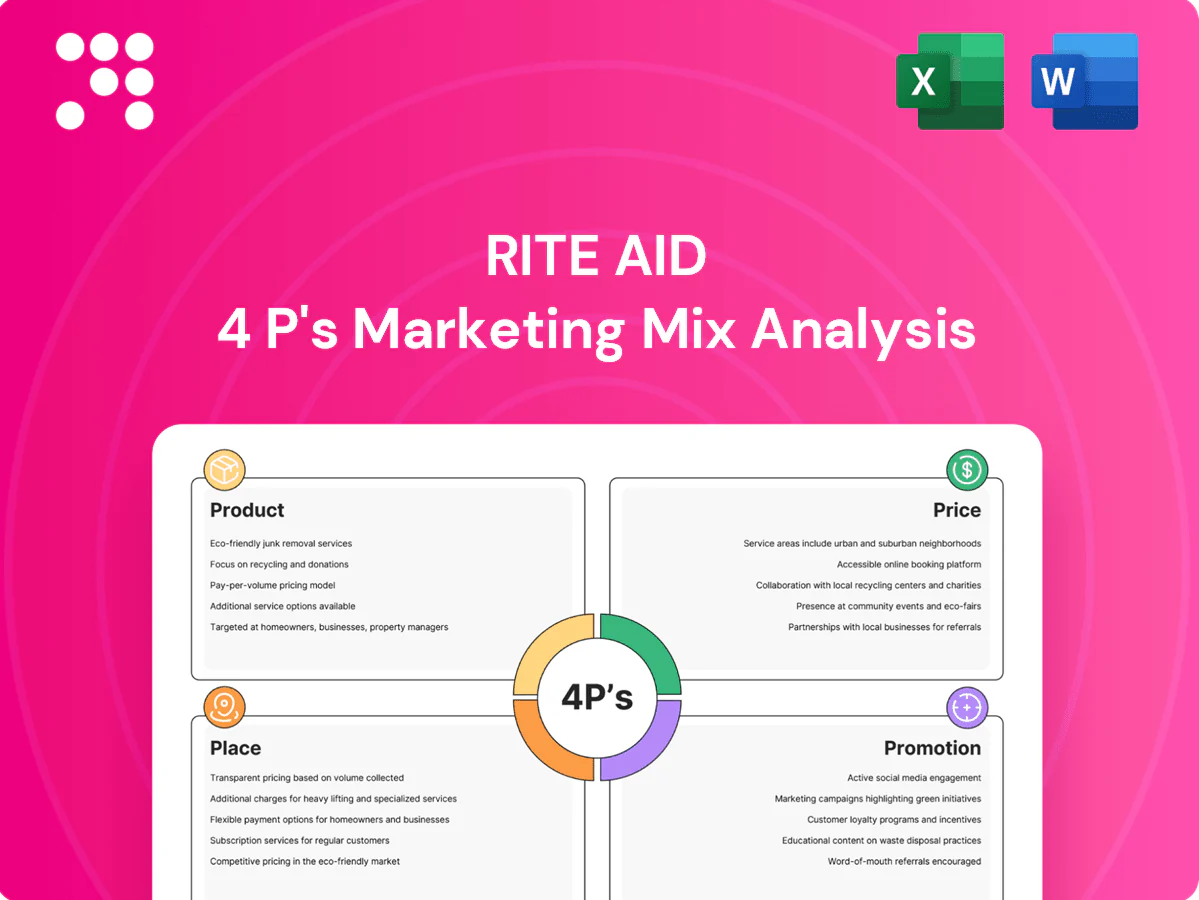
Rite Aid’s 4P snapshot reveals product assortment, value-based pricing, omnichannel placement, and targeted promotions shaping its market position. This preview highlights strategic moves and gaps worth exploiting. Get the full, editable 4Ps Marketing Mix Analysis for data-driven insights and ready-to-use slides. Save time and apply proven tactics to your strategy now.
Product

Rx & OTC portfolio
Rite Aid's Rx & OTC portfolio covers prescription meds, vaccines and OTC remedies for pain, cold/flu, allergy and wellness, serving everyday and chronic needs across its network of over 2,000 stores. Curation prioritizes FDA-approved therapies with pharmacist guidance at point of care, supporting a U.S. market that fills about 4.5 billion prescriptions annually. Seasonal and acute-care SKUs are flexed regionally to maintain availability and relevance.
Health & wellness services
Rite Aid pharmacists across more than 2,000 stores provide immunizations, medication therapy management and consultations to improve adherence and outcomes for targeted patient segments. Auto-refill, 90‑day supplies and synchronization enhance convenience; pharmacy services drove a significant share of Rite Aid’s ~22 billion USD 2024 revenue and support payer/provider value‑based partnerships covering millions of members.

PBM/Elixir solutions
Elixir delivers pharmacy benefit management for plan sponsors, integrating formulary management, claims adjudication and clinical programs. The PBM complements Rite Aid retail by steering members to cost-effective options and leveraging retail/mail channels. Specialty and mail solutions support complex therapies and continuity of care as specialty drugs account for roughly 50% of U.S. drug spend. Data-driven utilization controls balance cost, access and adherence while PBMs process about 80% of U.S. prescriptions.

Private label brands
Private label brands at Rite Aid deliver value alternatives with retailer-controlled quality, building on the Well at Rite Aid line launched in 2018 and sold across about 2,300 stores in 2024.
Higher margins and dedicated shelf presence boost category profitability, while packaging and formulations are developed to match national-brand benchmarks.
Assortment adapts dynamically to price-sensitive shoppers and growing wellness demand through targeted SKUs and promotions.
- Well at Rite Aid launched 2018; ~2,300 stores (2024)
- Private label supports margin and shelf share
- Formulations aligned to national-brand standards
- Assortment targets price-sensitive and wellness consumers
Convenience merchandise
Convenience merchandise at Rite Aid — beauty, personal care, snacks, seasonal and household basics — complements prescriptions to increase basket size and extend trip missions; front-end assortments are localized to neighborhood demographics and traffic patterns across a multi-thousand-store footprint, while impulse items and promotional endcaps drive incremental sales and higher front-end share of transactions.
- Front-end categories: beauty, personal care, snacks, seasonal, household
- Localized assortments reflect neighborhood demand
- Impulse/promotional endcaps boost incremental sales
- Supports larger basket size beyond prescriptions
Pharmacy chain drives ~22B USD via Rx/OTC, immunizations, PBM
Rite Aid’s product mix combines Rx/OTC, immunizations and pharmacy services across ~2,000+ stores, private‑label Well at Rite Aid (~2,300 store distribution 2024) and front‑end convenience assortments that boost basket size; pharmacy services materially supported ~22B USD 2024 revenue and PBM integration (Elixir) drives adherence and cost control.
| Metric | Value |
|---|---|
| Stores (retail) | ~2,000+ |
| 2024 Revenue | ~22 billion USD |
| Well at Rite Aid reach (2024) | ~2,300 stores |
| PBM Rx processing (US share) | ~80% |
| Specialty drug share of US spend | ~50% |
What is included in the product
 Detailed Word Document
Delivers a concise, company-specific deep dive into Rite Aid’s Product, Price, Place, and Promotion strategies, using real brand practices and competitive context to ground recommendations. Ideal for managers and consultants needing a ready-to-use, evidence-based marketing brief.

 Customizable Excel Spreadsheet
Condenses Rite Aid’s 4P marketing mix into a concise, at-a-glance summary that highlights product, price, place, and promotion levers to quickly identify and relieve customer experience and operational pain points. Designed for leadership decks or cross-functional teams, it’s a plug‑and‑play one‑pager to align strategy, prioritize fixes, and accelerate decision-making.
Place

Nationwide pharmacies
Rite Aid operates about 2,200 stores nationwide (2024), sited in community corridors to capture routine healthcare trips and drive foot traffic. Proximity to residential areas maximizes convenience and repeat visits, supporting loyalty and OTC sales. Store formats emphasize pharmacy-first layouts for quick service and higher prescription throughput. Hours and staffing flex to local demand and prescription volume to optimize wait times and adherence.
Omnichannel e-commerce
Rite Aid's omnichannel e-commerce platform supports prescription management, refills and OTC ordering through its app and website, linking digital prescriptions with its ~2,400-store footprint (2024) to broaden access. Click-and-collect and home delivery options reduce reliance on store visits, while integrated app/web loyalty, coupons and health records ensure continuity of care. Real-time inventory visibility smooths fulfillment and lowers out-of-stock friction.

In-store clinics & drive-thru
In-store clinics and drive-thru at Rite Aid, available in roughly 2,100 stores, enable vaccinations, testing events and drive-thru prescription pickup, addressing time-sensitive needs while maintaining throughput. These touchpoints boost pharmacy utilization and drive higher retention, with pharmacy services contributing materially to core retail traffic. Convenient onsite access differentiates Rite Aid versus pure e-commerce rivals in urgent-care convenience.

Mail & specialty pharmacy
Mail options serve chronic therapies with predictable refills and adherence support. Specialty channels manage high-touch, high-cost medications with dedicated counseling. Cold-chain logistics and coordination with prescribers ensure continuity of care. Centralized fulfillment lowers cost-to-serve for qualified prescriptions; specialty drugs comprised 53% of U.S. medicine spend in 2024 (IQVIA).
- Mail: chronic adherence, predictable refills
- Specialty: counseling, high-touch
- Cold-chain: temperature-controlled continuity
- Centralized fulfillment: lower cost-to-serve
B2B PBM distribution
Elixir, Rite Aid’s PBM, contracts directly with employers, health plans and government sponsors to manage pharmacy benefits and negotiate formularies.
Its network design leverages Rite Aid’s retail footprint plus third-party partners to balance access and cost-efficiency, while claims processing and clinical edits steer members to the most appropriate channels.
Robust reporting and plan-design tools give sponsors granular control over utilization and spend, enabling targeted interventions and rebate optimization.
- Elixir contracts with employers, health plans, government sponsors
- Network: retail footprint plus third-party partners
- Claims routing and clinical edits optimize channel use
- Reporting and plan-design tools support sponsor control over spend
Neighborhood pharmacy chain: ~2,400 stores, omnichannel scripts and 53% specialty
Rite Aid operates ~2,400 stores (2024), placed in residential/community corridors to drive repeat pharmacy and OTC sales; pharmacy-first layouts and flexible staffing optimize throughput. Omnichannel (app, web, click-and-collect, home delivery) links digital scripts to stores; mail, specialty fulfillment and Elixir PBM expand access and lower cost-to-serve.
| Metric | 2024 |
|---|---|
| Stores | ~2,400 |
| Drive-thru/clinics | ~2,100 |
| Specialty med share | 53% (IQVIA) |
What You Preview Is What You Download
Rite Aid 4P's Marketing Mix Analysis
This Rite Aid 4P's Marketing Mix Analysis covers Product, Price, Place and Promotion with actionable insights, editable charts and strategic recommendations. It's tailored for investors and managers seeking clear, practical guidance. The preview shown here is the actual document you'll receive instantly after purchase—fully complete and ready to use.

Get Inspired by a Complete Brand Strategy
Rite Aid’s 4P snapshot reveals product assortment, value-based pricing, omnichannel placement, and targeted promotions shaping its market position. This preview highlights strategic moves and gaps worth exploiting. Get the full, editable 4Ps Marketing Mix Analysis for data-driven insights and ready-to-use slides. Save time and apply proven tactics to your strategy now.
Product
Rx & OTC portfolio
Rite Aid's Rx & OTC portfolio covers prescription meds, vaccines and OTC remedies for pain, cold/flu, allergy and wellness, serving everyday and chronic needs across its network of over 2,000 stores. Curation prioritizes FDA-approved therapies with pharmacist guidance at point of care, supporting a U.S. market that fills about 4.5 billion prescriptions annually. Seasonal and acute-care SKUs are flexed regionally to maintain availability and relevance.
Health & wellness services
Rite Aid pharmacists across more than 2,000 stores provide immunizations, medication therapy management and consultations to improve adherence and outcomes for targeted patient segments. Auto-refill, 90‑day supplies and synchronization enhance convenience; pharmacy services drove a significant share of Rite Aid’s ~22 billion USD 2024 revenue and support payer/provider value‑based partnerships covering millions of members.
PBM/Elixir solutions
Elixir delivers pharmacy benefit management for plan sponsors, integrating formulary management, claims adjudication and clinical programs. The PBM complements Rite Aid retail by steering members to cost-effective options and leveraging retail/mail channels. Specialty and mail solutions support complex therapies and continuity of care as specialty drugs account for roughly 50% of U.S. drug spend. Data-driven utilization controls balance cost, access and adherence while PBMs process about 80% of U.S. prescriptions.
Private label brands
Private label brands at Rite Aid deliver value alternatives with retailer-controlled quality, building on the Well at Rite Aid line launched in 2018 and sold across about 2,300 stores in 2024.
Higher margins and dedicated shelf presence boost category profitability, while packaging and formulations are developed to match national-brand benchmarks.
Assortment adapts dynamically to price-sensitive shoppers and growing wellness demand through targeted SKUs and promotions.
- Well at Rite Aid launched 2018; ~2,300 stores (2024)
- Private label supports margin and shelf share
- Formulations aligned to national-brand standards
- Assortment targets price-sensitive and wellness consumers
Convenience merchandise
Convenience merchandise at Rite Aid — beauty, personal care, snacks, seasonal and household basics — complements prescriptions to increase basket size and extend trip missions; front-end assortments are localized to neighborhood demographics and traffic patterns across a multi-thousand-store footprint, while impulse items and promotional endcaps drive incremental sales and higher front-end share of transactions.
- Front-end categories: beauty, personal care, snacks, seasonal, household
- Localized assortments reflect neighborhood demand
- Impulse/promotional endcaps boost incremental sales
- Supports larger basket size beyond prescriptions
Pharmacy chain drives ~22B USD via Rx/OTC, immunizations, PBM
Rite Aid’s product mix combines Rx/OTC, immunizations and pharmacy services across ~2,000+ stores, private‑label Well at Rite Aid (~2,300 store distribution 2024) and front‑end convenience assortments that boost basket size; pharmacy services materially supported ~22B USD 2024 revenue and PBM integration (Elixir) drives adherence and cost control.
| Metric | Value |
|---|---|
| Stores (retail) | ~2,000+ |
| 2024 Revenue | ~22 billion USD |
| Well at Rite Aid reach (2024) | ~2,300 stores |
| PBM Rx processing (US share) | ~80% |
| Specialty drug share of US spend | ~50% |
What is included in the product
Detailed Word Document
Delivers a concise, company-specific deep dive into Rite Aid’s Product, Price, Place, and Promotion strategies, using real brand practices and competitive context to ground recommendations. Ideal for managers and consultants needing a ready-to-use, evidence-based marketing brief.
Customizable Excel Spreadsheet
Condenses Rite Aid’s 4P marketing mix into a concise, at-a-glance summary that highlights product, price, place, and promotion levers to quickly identify and relieve customer experience and operational pain points. Designed for leadership decks or cross-functional teams, it’s a plug‑and‑play one‑pager to align strategy, prioritize fixes, and accelerate decision-making.
Place
Nationwide pharmacies
Rite Aid operates about 2,200 stores nationwide (2024), sited in community corridors to capture routine healthcare trips and drive foot traffic. Proximity to residential areas maximizes convenience and repeat visits, supporting loyalty and OTC sales. Store formats emphasize pharmacy-first layouts for quick service and higher prescription throughput. Hours and staffing flex to local demand and prescription volume to optimize wait times and adherence.
Omnichannel e-commerce
Rite Aid's omnichannel e-commerce platform supports prescription management, refills and OTC ordering through its app and website, linking digital prescriptions with its ~2,400-store footprint (2024) to broaden access. Click-and-collect and home delivery options reduce reliance on store visits, while integrated app/web loyalty, coupons and health records ensure continuity of care. Real-time inventory visibility smooths fulfillment and lowers out-of-stock friction.
In-store clinics & drive-thru
In-store clinics and drive-thru at Rite Aid, available in roughly 2,100 stores, enable vaccinations, testing events and drive-thru prescription pickup, addressing time-sensitive needs while maintaining throughput. These touchpoints boost pharmacy utilization and drive higher retention, with pharmacy services contributing materially to core retail traffic. Convenient onsite access differentiates Rite Aid versus pure e-commerce rivals in urgent-care convenience.
Mail & specialty pharmacy
Mail options serve chronic therapies with predictable refills and adherence support. Specialty channels manage high-touch, high-cost medications with dedicated counseling. Cold-chain logistics and coordination with prescribers ensure continuity of care. Centralized fulfillment lowers cost-to-serve for qualified prescriptions; specialty drugs comprised 53% of U.S. medicine spend in 2024 (IQVIA).
- Mail: chronic adherence, predictable refills
- Specialty: counseling, high-touch
- Cold-chain: temperature-controlled continuity
- Centralized fulfillment: lower cost-to-serve
B2B PBM distribution
Elixir, Rite Aid’s PBM, contracts directly with employers, health plans and government sponsors to manage pharmacy benefits and negotiate formularies.
Its network design leverages Rite Aid’s retail footprint plus third-party partners to balance access and cost-efficiency, while claims processing and clinical edits steer members to the most appropriate channels.
Robust reporting and plan-design tools give sponsors granular control over utilization and spend, enabling targeted interventions and rebate optimization.
- Elixir contracts with employers, health plans, government sponsors
- Network: retail footprint plus third-party partners
- Claims routing and clinical edits optimize channel use
- Reporting and plan-design tools support sponsor control over spend
Neighborhood pharmacy chain: ~2,400 stores, omnichannel scripts and 53% specialty
Rite Aid operates ~2,400 stores (2024), placed in residential/community corridors to drive repeat pharmacy and OTC sales; pharmacy-first layouts and flexible staffing optimize throughput. Omnichannel (app, web, click-and-collect, home delivery) links digital scripts to stores; mail, specialty fulfillment and Elixir PBM expand access and lower cost-to-serve.
| Metric | 2024 |
|---|---|
| Stores | ~2,400 |
| Drive-thru/clinics | ~2,100 |
| Specialty med share | 53% (IQVIA) |
What You Preview Is What You Download
Rite Aid 4P's Marketing Mix Analysis
This Rite Aid 4P's Marketing Mix Analysis covers Product, Price, Place and Promotion with actionable insights, editable charts and strategic recommendations. It's tailored for investors and managers seeking clear, practical guidance. The preview shown here is the actual document you'll receive instantly after purchase—fully complete and ready to use.
Original: $10.00
-65%$10.00
$3.50Description
Get Inspired by a Complete Brand Strategy
Rite Aid’s 4P snapshot reveals product assortment, value-based pricing, omnichannel placement, and targeted promotions shaping its market position. This preview highlights strategic moves and gaps worth exploiting. Get the full, editable 4Ps Marketing Mix Analysis for data-driven insights and ready-to-use slides. Save time and apply proven tactics to your strategy now.
Product
Rx & OTC portfolio
Rite Aid's Rx & OTC portfolio covers prescription meds, vaccines and OTC remedies for pain, cold/flu, allergy and wellness, serving everyday and chronic needs across its network of over 2,000 stores. Curation prioritizes FDA-approved therapies with pharmacist guidance at point of care, supporting a U.S. market that fills about 4.5 billion prescriptions annually. Seasonal and acute-care SKUs are flexed regionally to maintain availability and relevance.
Health & wellness services
Rite Aid pharmacists across more than 2,000 stores provide immunizations, medication therapy management and consultations to improve adherence and outcomes for targeted patient segments. Auto-refill, 90‑day supplies and synchronization enhance convenience; pharmacy services drove a significant share of Rite Aid’s ~22 billion USD 2024 revenue and support payer/provider value‑based partnerships covering millions of members.
PBM/Elixir solutions
Elixir delivers pharmacy benefit management for plan sponsors, integrating formulary management, claims adjudication and clinical programs. The PBM complements Rite Aid retail by steering members to cost-effective options and leveraging retail/mail channels. Specialty and mail solutions support complex therapies and continuity of care as specialty drugs account for roughly 50% of U.S. drug spend. Data-driven utilization controls balance cost, access and adherence while PBMs process about 80% of U.S. prescriptions.
Private label brands
Private label brands at Rite Aid deliver value alternatives with retailer-controlled quality, building on the Well at Rite Aid line launched in 2018 and sold across about 2,300 stores in 2024.
Higher margins and dedicated shelf presence boost category profitability, while packaging and formulations are developed to match national-brand benchmarks.
Assortment adapts dynamically to price-sensitive shoppers and growing wellness demand through targeted SKUs and promotions.
- Well at Rite Aid launched 2018; ~2,300 stores (2024)
- Private label supports margin and shelf share
- Formulations aligned to national-brand standards
- Assortment targets price-sensitive and wellness consumers
Convenience merchandise
Convenience merchandise at Rite Aid — beauty, personal care, snacks, seasonal and household basics — complements prescriptions to increase basket size and extend trip missions; front-end assortments are localized to neighborhood demographics and traffic patterns across a multi-thousand-store footprint, while impulse items and promotional endcaps drive incremental sales and higher front-end share of transactions.
- Front-end categories: beauty, personal care, snacks, seasonal, household
- Localized assortments reflect neighborhood demand
- Impulse/promotional endcaps boost incremental sales
- Supports larger basket size beyond prescriptions
Pharmacy chain drives ~22B USD via Rx/OTC, immunizations, PBM
Rite Aid’s product mix combines Rx/OTC, immunizations and pharmacy services across ~2,000+ stores, private‑label Well at Rite Aid (~2,300 store distribution 2024) and front‑end convenience assortments that boost basket size; pharmacy services materially supported ~22B USD 2024 revenue and PBM integration (Elixir) drives adherence and cost control.
| Metric | Value |
|---|---|
| Stores (retail) | ~2,000+ |
| 2024 Revenue | ~22 billion USD |
| Well at Rite Aid reach (2024) | ~2,300 stores |
| PBM Rx processing (US share) | ~80% |
| Specialty drug share of US spend | ~50% |
What is included in the product
Detailed Word Document
Delivers a concise, company-specific deep dive into Rite Aid’s Product, Price, Place, and Promotion strategies, using real brand practices and competitive context to ground recommendations. Ideal for managers and consultants needing a ready-to-use, evidence-based marketing brief.
Customizable Excel Spreadsheet
Condenses Rite Aid’s 4P marketing mix into a concise, at-a-glance summary that highlights product, price, place, and promotion levers to quickly identify and relieve customer experience and operational pain points. Designed for leadership decks or cross-functional teams, it’s a plug‑and‑play one‑pager to align strategy, prioritize fixes, and accelerate decision-making.
Place
Nationwide pharmacies
Rite Aid operates about 2,200 stores nationwide (2024), sited in community corridors to capture routine healthcare trips and drive foot traffic. Proximity to residential areas maximizes convenience and repeat visits, supporting loyalty and OTC sales. Store formats emphasize pharmacy-first layouts for quick service and higher prescription throughput. Hours and staffing flex to local demand and prescription volume to optimize wait times and adherence.
Omnichannel e-commerce
Rite Aid's omnichannel e-commerce platform supports prescription management, refills and OTC ordering through its app and website, linking digital prescriptions with its ~2,400-store footprint (2024) to broaden access. Click-and-collect and home delivery options reduce reliance on store visits, while integrated app/web loyalty, coupons and health records ensure continuity of care. Real-time inventory visibility smooths fulfillment and lowers out-of-stock friction.
In-store clinics & drive-thru
In-store clinics and drive-thru at Rite Aid, available in roughly 2,100 stores, enable vaccinations, testing events and drive-thru prescription pickup, addressing time-sensitive needs while maintaining throughput. These touchpoints boost pharmacy utilization and drive higher retention, with pharmacy services contributing materially to core retail traffic. Convenient onsite access differentiates Rite Aid versus pure e-commerce rivals in urgent-care convenience.
Mail & specialty pharmacy
Mail options serve chronic therapies with predictable refills and adherence support. Specialty channels manage high-touch, high-cost medications with dedicated counseling. Cold-chain logistics and coordination with prescribers ensure continuity of care. Centralized fulfillment lowers cost-to-serve for qualified prescriptions; specialty drugs comprised 53% of U.S. medicine spend in 2024 (IQVIA).
- Mail: chronic adherence, predictable refills
- Specialty: counseling, high-touch
- Cold-chain: temperature-controlled continuity
- Centralized fulfillment: lower cost-to-serve
B2B PBM distribution
Elixir, Rite Aid’s PBM, contracts directly with employers, health plans and government sponsors to manage pharmacy benefits and negotiate formularies.
Its network design leverages Rite Aid’s retail footprint plus third-party partners to balance access and cost-efficiency, while claims processing and clinical edits steer members to the most appropriate channels.
Robust reporting and plan-design tools give sponsors granular control over utilization and spend, enabling targeted interventions and rebate optimization.
- Elixir contracts with employers, health plans, government sponsors
- Network: retail footprint plus third-party partners
- Claims routing and clinical edits optimize channel use
- Reporting and plan-design tools support sponsor control over spend
Neighborhood pharmacy chain: ~2,400 stores, omnichannel scripts and 53% specialty
Rite Aid operates ~2,400 stores (2024), placed in residential/community corridors to drive repeat pharmacy and OTC sales; pharmacy-first layouts and flexible staffing optimize throughput. Omnichannel (app, web, click-and-collect, home delivery) links digital scripts to stores; mail, specialty fulfillment and Elixir PBM expand access and lower cost-to-serve.
| Metric | 2024 |
|---|---|
| Stores | ~2,400 |
| Drive-thru/clinics | ~2,100 |
| Specialty med share | 53% (IQVIA) |
What You Preview Is What You Download
Rite Aid 4P's Marketing Mix Analysis
This Rite Aid 4P's Marketing Mix Analysis covers Product, Price, Place and Promotion with actionable insights, editable charts and strategic recommendations. It's tailored for investors and managers seeking clear, practical guidance. The preview shown here is the actual document you'll receive instantly after purchase—fully complete and ready to use.











