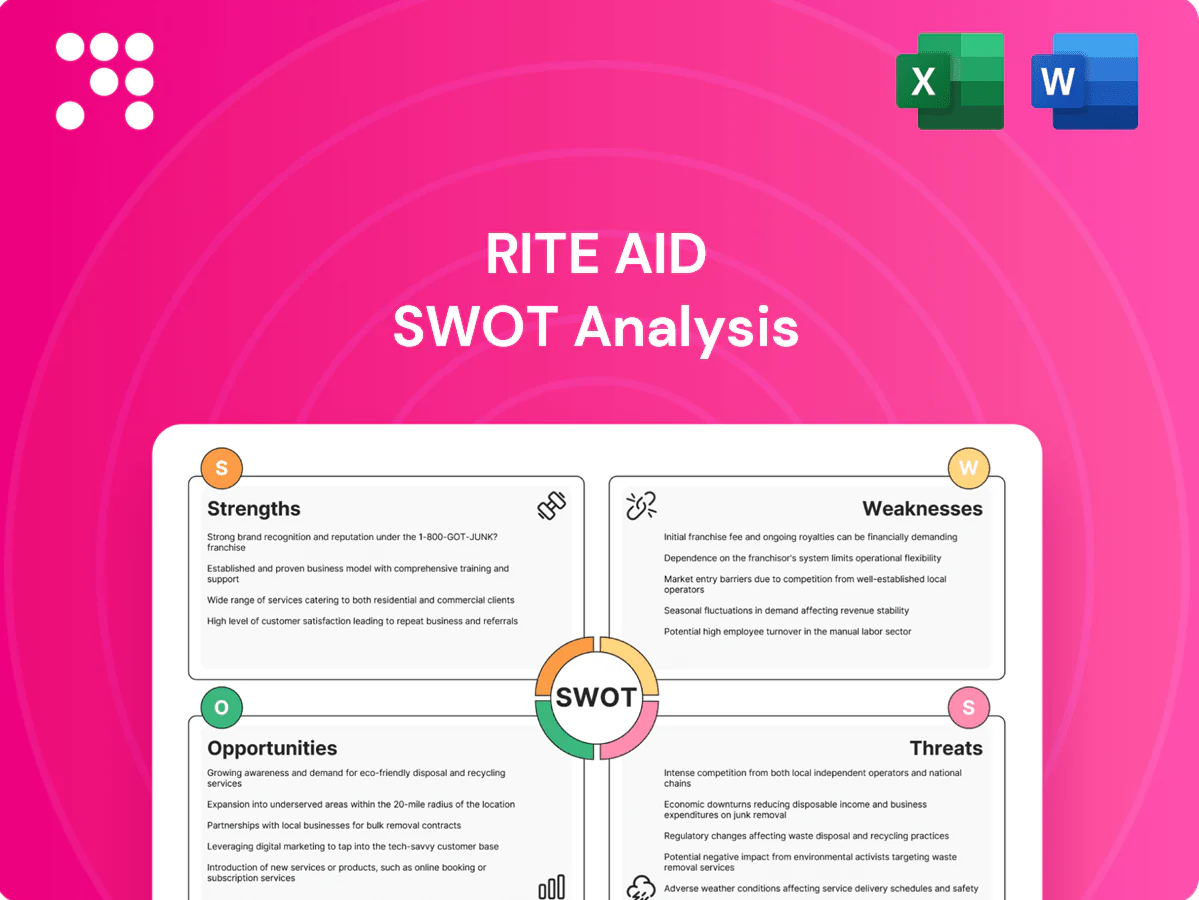
Rite Aid SWOT Analysis

Elevate Your Analysis with the Complete SWOT Report
Rite Aid faces margin pressure from industry consolidation and legacy debt, yet maintains a broad retail footprint and customer loyalty assets that could support turnaround initiatives. Competitive threats, regulatory shifts, and supply-chain risks temper near-term upside, while partnerships and store optimization present clear growth levers. Purchase the full SWOT analysis for a research-backed, editable report and Excel matrix to guide strategy, investment, or M&A decisions.
Strengths

Nationwide retail footprint
Rite Aid’s nationwide retail footprint—about 2,000 neighborhood locations as of 2024—provides convenient access to prescriptions, vaccines and health essentials, supporting higher prescription adherence through proximity-driven repeat traffic. Local stores enable community-based health initiatives and vaccination clinics. Dense clusters improve last-mile logistics and same-day fulfillment capabilities, lowering delivery times and costs.
Integrated PBM via Elixir
Rite Aid's ownership of PBM Elixir gives vertical control of formulary and claims flow, tying pharmacy access across roughly 2,100 stores to PBM operations and millions of covered lives. Integrated claims data supports targeted adherence programs and outreach, while cross-selling at retail can raise capture rates and script volumes. Scale from combined retail/PBM improves leverage in rebate and network negotiations.

Pharmacy expertise and trusted brand
Rite Aid leverages pharmacist relationships to deliver immunizations, MTM and chronic-care counseling, positioning clinical services as core revenue drivers. Trust in medication guidance differentiates it from general merchandisers and supports higher patient retention. Health-and-wellness positioning aligns with an aging US population—about 17% are 65+ (2024 US Census est.)—while longstanding brand recognition lowers customer acquisition costs.

Diversified revenue mix
Rite Aid leverages a mix of prescriptions, OTC, front-end sales and PBM spreads to diversify revenue and reduce category risk, operating about 2,000 stores nationwide. Seasonal and wellness SKUs boost basket size around prescription visits, while immunizations and point-of-care clinical services generate fee-based revenue. Expanding private-label lines supports higher margins and loyalty.
- Prescription + OTC + front-end + PBM
- Seasonal/wellness lift basket
- Immunizations/clinical fees
- Private-label margin/loyalty
Omnichannel and convenience capabilities
Rite Aid’s omnichannel mix — refill app, drive-thru, delivery and BOPIS — aligns with rising consumer expectations and leverages its network of over 2,000 stores to boost convenience and retention; digital engagement can increase medication adherence and customer lifetime value, while inventory visibility drives conversion and larger baskets, partially offsetting price competition pressure.
- refill app
- drive-thru
- delivery
- BOPIS
2,000-store pharmacy chain uses owned PBM, pharmacist services and omnichannel reach for aging US
Rite Aid’s ~2,000-store footprint (2024) drives convenient access and repeat prescription traffic. Ownership of PBM Elixir integrates claims and formulary control, supporting targeted adherence and cross-sell. Pharmacist-led clinical services, omnichannel fulfillment and private-label lines boost margins and retention amid an aging population (65+ = 17% in 2024).
| Metric | Value (2024) |
|---|---|
| Stores | ~2,000 |
| PBM | Elixir (owned) |
| Covered lives | Millions |
| 65+ share (US) | 17% |
What is included in the product
 Detailed Word Document
Provides a concise strategic overview of Rite Aid’s internal strengths and weaknesses and external opportunities and threats, mapping competitive position, operational gaps, growth drivers, and market risks to inform strategic decisions.

 Customizable Excel Spreadsheet
Provides a concise, high-level Rite Aid SWOT matrix for quick strategy alignment and stakeholder presentations, enabling fast edits to reflect evolving retail pharmacy priorities and streamline decision-making.
Weaknesses

Scale disadvantage vs. larger peers
Rite Aid's roughly 2,200-store footprint (2024) limits purchasing scale versus CVS Health (~9,900 stores) and Walgreens (~8,800 stores), reducing negotiating leverage on drugs and supplies. Lower marketing spend and a narrower national presence constrain brand reach and network effects. Smaller volume and a tighter footprint contribute to higher costs per script and pressure on margins.
Thin margins and high fixed costs
Rite Aid's thin margins are pressured by PBM reimbursement headwinds and generic deflation, compressing gross profit while labor, rent and compliance remain largely fixed costs. Front-end traffic volatility amplifies operating leverage across its roughly 2,200 US stores, turning small sales drops into outsized profit declines. After filing Chapter 11 in October 2023, limited cash flow has constrained reinvestment and modernization efforts.

Operational complexity across formats
Managing pharmacy operations, front-end retail and a PBM arm requires tight coordination across roughly 2,100 stores, increasing execution risk and labor complexity. Persistent inventory and shrink control issues have pressured margins, aligning with retail pharmacy industry shrink averages near 1–2%. Legacy IT stacks limit real-time analytics and automation, slowing cost-savings initiatives. Wide variation in store performance complicates rollout of standardized operating procedures.

Brand perception and store condition gaps
Inconsistent in-store experience at Rite Aid can erode loyalty, with the chain operating roughly 2,000 stores and reporting weaker local Net Promoter Scores than national peers in recent market studies. Dated layouts and limited assortments compress basket size while competitors like CVS and Walgreens continue heavy remodel and health-service investment.
- Stores: ~2,000 national locations
- Competitor scale: CVS/Walgreens major remodel spending
- Impact: lower NPS and reduced basket size
Financial flexibility constraints
Persistent debt service—approximately $3.4 billion of long-term obligations as of FY2024—plus restructuring expenses constrain strategic moves, while vendor terms have tightened amid perceived risk; capital-intensive store and IT upgrades face tough prioritization and cash-flow volatility (quarterly free cash flow swings exceeding 25%) heightens covenant pressure.
- debt ~$3.4B (FY2024)
- leverage ~4.5x EBITDA
- FCF volatility >25% q/q
- vendor tightening raises working capital cost
Small chain (~2,200 stores), heavy $3.4B debt and 4.5x leverage constrain recovery
Rite Aid's ~2,200-store footprint (2024) limits purchasing scale vs CVS/Walgreens and reduces bargaining power. Thin margins face PBM reimbursement headwinds, generic deflation and fixed labor/rent costs. Heavy debt (~$3.4B, leverage ~4.5x EBITDA) and Chapter 11 (Oct 2023) constrain reinvestment and modernization.
| Metric | Value |
|---|---|
| Stores (2024) | ~2,200 |
| Debt (FY2024) | $3.4B |
| Leverage | ~4.5x EBITDA |
| FCF volatility | >25% q/q |
| Chapter | Filed Oct 2023 |
Full Version Awaits
Rite Aid SWOT Analysis
This is the actual SWOT analysis document you’ll receive upon purchase—no surprises, just professional quality. The preview below is taken directly from the full SWOT report you'll get, with the same structure and findings. Buy now to unlock the complete, editable version immediately after checkout.

Elevate Your Analysis with the Complete SWOT Report
Rite Aid faces margin pressure from industry consolidation and legacy debt, yet maintains a broad retail footprint and customer loyalty assets that could support turnaround initiatives. Competitive threats, regulatory shifts, and supply-chain risks temper near-term upside, while partnerships and store optimization present clear growth levers. Purchase the full SWOT analysis for a research-backed, editable report and Excel matrix to guide strategy, investment, or M&A decisions.
Strengths
Nationwide retail footprint
Rite Aid’s nationwide retail footprint—about 2,000 neighborhood locations as of 2024—provides convenient access to prescriptions, vaccines and health essentials, supporting higher prescription adherence through proximity-driven repeat traffic. Local stores enable community-based health initiatives and vaccination clinics. Dense clusters improve last-mile logistics and same-day fulfillment capabilities, lowering delivery times and costs.
Integrated PBM via Elixir
Rite Aid's ownership of PBM Elixir gives vertical control of formulary and claims flow, tying pharmacy access across roughly 2,100 stores to PBM operations and millions of covered lives. Integrated claims data supports targeted adherence programs and outreach, while cross-selling at retail can raise capture rates and script volumes. Scale from combined retail/PBM improves leverage in rebate and network negotiations.
Pharmacy expertise and trusted brand
Rite Aid leverages pharmacist relationships to deliver immunizations, MTM and chronic-care counseling, positioning clinical services as core revenue drivers. Trust in medication guidance differentiates it from general merchandisers and supports higher patient retention. Health-and-wellness positioning aligns with an aging US population—about 17% are 65+ (2024 US Census est.)—while longstanding brand recognition lowers customer acquisition costs.
Diversified revenue mix
Rite Aid leverages a mix of prescriptions, OTC, front-end sales and PBM spreads to diversify revenue and reduce category risk, operating about 2,000 stores nationwide. Seasonal and wellness SKUs boost basket size around prescription visits, while immunizations and point-of-care clinical services generate fee-based revenue. Expanding private-label lines supports higher margins and loyalty.
- Prescription + OTC + front-end + PBM
- Seasonal/wellness lift basket
- Immunizations/clinical fees
- Private-label margin/loyalty
Omnichannel and convenience capabilities
Rite Aid’s omnichannel mix — refill app, drive-thru, delivery and BOPIS — aligns with rising consumer expectations and leverages its network of over 2,000 stores to boost convenience and retention; digital engagement can increase medication adherence and customer lifetime value, while inventory visibility drives conversion and larger baskets, partially offsetting price competition pressure.
- refill app
- drive-thru
- delivery
- BOPIS
2,000-store pharmacy chain uses owned PBM, pharmacist services and omnichannel reach for aging US
Rite Aid’s ~2,000-store footprint (2024) drives convenient access and repeat prescription traffic. Ownership of PBM Elixir integrates claims and formulary control, supporting targeted adherence and cross-sell. Pharmacist-led clinical services, omnichannel fulfillment and private-label lines boost margins and retention amid an aging population (65+ = 17% in 2024).
| Metric | Value (2024) |
|---|---|
| Stores | ~2,000 |
| PBM | Elixir (owned) |
| Covered lives | Millions |
| 65+ share (US) | 17% |
What is included in the product
Detailed Word Document
Provides a concise strategic overview of Rite Aid’s internal strengths and weaknesses and external opportunities and threats, mapping competitive position, operational gaps, growth drivers, and market risks to inform strategic decisions.
Customizable Excel Spreadsheet
Provides a concise, high-level Rite Aid SWOT matrix for quick strategy alignment and stakeholder presentations, enabling fast edits to reflect evolving retail pharmacy priorities and streamline decision-making.
Weaknesses
Scale disadvantage vs. larger peers
Rite Aid's roughly 2,200-store footprint (2024) limits purchasing scale versus CVS Health (~9,900 stores) and Walgreens (~8,800 stores), reducing negotiating leverage on drugs and supplies. Lower marketing spend and a narrower national presence constrain brand reach and network effects. Smaller volume and a tighter footprint contribute to higher costs per script and pressure on margins.
Thin margins and high fixed costs
Rite Aid's thin margins are pressured by PBM reimbursement headwinds and generic deflation, compressing gross profit while labor, rent and compliance remain largely fixed costs. Front-end traffic volatility amplifies operating leverage across its roughly 2,200 US stores, turning small sales drops into outsized profit declines. After filing Chapter 11 in October 2023, limited cash flow has constrained reinvestment and modernization efforts.
Operational complexity across formats
Managing pharmacy operations, front-end retail and a PBM arm requires tight coordination across roughly 2,100 stores, increasing execution risk and labor complexity. Persistent inventory and shrink control issues have pressured margins, aligning with retail pharmacy industry shrink averages near 1–2%. Legacy IT stacks limit real-time analytics and automation, slowing cost-savings initiatives. Wide variation in store performance complicates rollout of standardized operating procedures.
Brand perception and store condition gaps
Inconsistent in-store experience at Rite Aid can erode loyalty, with the chain operating roughly 2,000 stores and reporting weaker local Net Promoter Scores than national peers in recent market studies. Dated layouts and limited assortments compress basket size while competitors like CVS and Walgreens continue heavy remodel and health-service investment.
- Stores: ~2,000 national locations
- Competitor scale: CVS/Walgreens major remodel spending
- Impact: lower NPS and reduced basket size
Financial flexibility constraints
Persistent debt service—approximately $3.4 billion of long-term obligations as of FY2024—plus restructuring expenses constrain strategic moves, while vendor terms have tightened amid perceived risk; capital-intensive store and IT upgrades face tough prioritization and cash-flow volatility (quarterly free cash flow swings exceeding 25%) heightens covenant pressure.
- debt ~$3.4B (FY2024)
- leverage ~4.5x EBITDA
- FCF volatility >25% q/q
- vendor tightening raises working capital cost
Small chain (~2,200 stores), heavy $3.4B debt and 4.5x leverage constrain recovery
Rite Aid's ~2,200-store footprint (2024) limits purchasing scale vs CVS/Walgreens and reduces bargaining power. Thin margins face PBM reimbursement headwinds, generic deflation and fixed labor/rent costs. Heavy debt (~$3.4B, leverage ~4.5x EBITDA) and Chapter 11 (Oct 2023) constrain reinvestment and modernization.
| Metric | Value |
|---|---|
| Stores (2024) | ~2,200 |
| Debt (FY2024) | $3.4B |
| Leverage | ~4.5x EBITDA |
| FCF volatility | >25% q/q |
| Chapter | Filed Oct 2023 |
Full Version Awaits
Rite Aid SWOT Analysis
This is the actual SWOT analysis document you’ll receive upon purchase—no surprises, just professional quality. The preview below is taken directly from the full SWOT report you'll get, with the same structure and findings. Buy now to unlock the complete, editable version immediately after checkout.
Original: $10.00
-65%$10.00
$3.50Description
Elevate Your Analysis with the Complete SWOT Report
Rite Aid faces margin pressure from industry consolidation and legacy debt, yet maintains a broad retail footprint and customer loyalty assets that could support turnaround initiatives. Competitive threats, regulatory shifts, and supply-chain risks temper near-term upside, while partnerships and store optimization present clear growth levers. Purchase the full SWOT analysis for a research-backed, editable report and Excel matrix to guide strategy, investment, or M&A decisions.
Strengths
Nationwide retail footprint
Rite Aid’s nationwide retail footprint—about 2,000 neighborhood locations as of 2024—provides convenient access to prescriptions, vaccines and health essentials, supporting higher prescription adherence through proximity-driven repeat traffic. Local stores enable community-based health initiatives and vaccination clinics. Dense clusters improve last-mile logistics and same-day fulfillment capabilities, lowering delivery times and costs.
Integrated PBM via Elixir
Rite Aid's ownership of PBM Elixir gives vertical control of formulary and claims flow, tying pharmacy access across roughly 2,100 stores to PBM operations and millions of covered lives. Integrated claims data supports targeted adherence programs and outreach, while cross-selling at retail can raise capture rates and script volumes. Scale from combined retail/PBM improves leverage in rebate and network negotiations.
Pharmacy expertise and trusted brand
Rite Aid leverages pharmacist relationships to deliver immunizations, MTM and chronic-care counseling, positioning clinical services as core revenue drivers. Trust in medication guidance differentiates it from general merchandisers and supports higher patient retention. Health-and-wellness positioning aligns with an aging US population—about 17% are 65+ (2024 US Census est.)—while longstanding brand recognition lowers customer acquisition costs.
Diversified revenue mix
Rite Aid leverages a mix of prescriptions, OTC, front-end sales and PBM spreads to diversify revenue and reduce category risk, operating about 2,000 stores nationwide. Seasonal and wellness SKUs boost basket size around prescription visits, while immunizations and point-of-care clinical services generate fee-based revenue. Expanding private-label lines supports higher margins and loyalty.
- Prescription + OTC + front-end + PBM
- Seasonal/wellness lift basket
- Immunizations/clinical fees
- Private-label margin/loyalty
Omnichannel and convenience capabilities
Rite Aid’s omnichannel mix — refill app, drive-thru, delivery and BOPIS — aligns with rising consumer expectations and leverages its network of over 2,000 stores to boost convenience and retention; digital engagement can increase medication adherence and customer lifetime value, while inventory visibility drives conversion and larger baskets, partially offsetting price competition pressure.
- refill app
- drive-thru
- delivery
- BOPIS
2,000-store pharmacy chain uses owned PBM, pharmacist services and omnichannel reach for aging US
Rite Aid’s ~2,000-store footprint (2024) drives convenient access and repeat prescription traffic. Ownership of PBM Elixir integrates claims and formulary control, supporting targeted adherence and cross-sell. Pharmacist-led clinical services, omnichannel fulfillment and private-label lines boost margins and retention amid an aging population (65+ = 17% in 2024).
| Metric | Value (2024) |
|---|---|
| Stores | ~2,000 |
| PBM | Elixir (owned) |
| Covered lives | Millions |
| 65+ share (US) | 17% |
What is included in the product
Detailed Word Document
Provides a concise strategic overview of Rite Aid’s internal strengths and weaknesses and external opportunities and threats, mapping competitive position, operational gaps, growth drivers, and market risks to inform strategic decisions.
Customizable Excel Spreadsheet
Provides a concise, high-level Rite Aid SWOT matrix for quick strategy alignment and stakeholder presentations, enabling fast edits to reflect evolving retail pharmacy priorities and streamline decision-making.
Weaknesses
Scale disadvantage vs. larger peers
Rite Aid's roughly 2,200-store footprint (2024) limits purchasing scale versus CVS Health (~9,900 stores) and Walgreens (~8,800 stores), reducing negotiating leverage on drugs and supplies. Lower marketing spend and a narrower national presence constrain brand reach and network effects. Smaller volume and a tighter footprint contribute to higher costs per script and pressure on margins.
Thin margins and high fixed costs
Rite Aid's thin margins are pressured by PBM reimbursement headwinds and generic deflation, compressing gross profit while labor, rent and compliance remain largely fixed costs. Front-end traffic volatility amplifies operating leverage across its roughly 2,200 US stores, turning small sales drops into outsized profit declines. After filing Chapter 11 in October 2023, limited cash flow has constrained reinvestment and modernization efforts.
Operational complexity across formats
Managing pharmacy operations, front-end retail and a PBM arm requires tight coordination across roughly 2,100 stores, increasing execution risk and labor complexity. Persistent inventory and shrink control issues have pressured margins, aligning with retail pharmacy industry shrink averages near 1–2%. Legacy IT stacks limit real-time analytics and automation, slowing cost-savings initiatives. Wide variation in store performance complicates rollout of standardized operating procedures.
Brand perception and store condition gaps
Inconsistent in-store experience at Rite Aid can erode loyalty, with the chain operating roughly 2,000 stores and reporting weaker local Net Promoter Scores than national peers in recent market studies. Dated layouts and limited assortments compress basket size while competitors like CVS and Walgreens continue heavy remodel and health-service investment.
- Stores: ~2,000 national locations
- Competitor scale: CVS/Walgreens major remodel spending
- Impact: lower NPS and reduced basket size
Financial flexibility constraints
Persistent debt service—approximately $3.4 billion of long-term obligations as of FY2024—plus restructuring expenses constrain strategic moves, while vendor terms have tightened amid perceived risk; capital-intensive store and IT upgrades face tough prioritization and cash-flow volatility (quarterly free cash flow swings exceeding 25%) heightens covenant pressure.
- debt ~$3.4B (FY2024)
- leverage ~4.5x EBITDA
- FCF volatility >25% q/q
- vendor tightening raises working capital cost
Small chain (~2,200 stores), heavy $3.4B debt and 4.5x leverage constrain recovery
Rite Aid's ~2,200-store footprint (2024) limits purchasing scale vs CVS/Walgreens and reduces bargaining power. Thin margins face PBM reimbursement headwinds, generic deflation and fixed labor/rent costs. Heavy debt (~$3.4B, leverage ~4.5x EBITDA) and Chapter 11 (Oct 2023) constrain reinvestment and modernization.
| Metric | Value |
|---|---|
| Stores (2024) | ~2,200 |
| Debt (FY2024) | $3.4B |
| Leverage | ~4.5x EBITDA |
| FCF volatility | >25% q/q |
| Chapter | Filed Oct 2023 |
Full Version Awaits
Rite Aid SWOT Analysis
This is the actual SWOT analysis document you’ll receive upon purchase—no surprises, just professional quality. The preview below is taken directly from the full SWOT report you'll get, with the same structure and findings. Buy now to unlock the complete, editable version immediately after checkout.











